Revista de la Facultad de Ciencias
Agrarias. Universidad Nacional de Cuyo. Tomo 55(2). ISSN (en línea) 1853-8665.
Año 2023.
Original article
Effect
of cutting height, a bacterial inoculant and a fibrolytic enzyme on corn (Zea
mays L.) silage quality
Altura
de corte y adición de un inoculante bacteriano y una enzima fibrolítica sobre
la calidad del ensilado de maíz (Zea mays L.)
José A. Rueda 2
Carlos Iván
Medel Contreras 2
Jorge Hernández
Bautista 3
Agustín Corral
Luna 1
Monserrath Félix
Portillo 1
1
Universidad Autónoma de Chihuahua. Facultad de Zootecnia y Ecología. Periférico
Francisco R. Almada km 1. Chihuahua. Chihuahua. 33820. México.
2
Universidad del Papaloapan. Instituto de Agroingeniería. Av. Ferrocarril SN.
Loma Bonita. Oaxaca. 68400. México.
3
Universidad Autónoma Benito Juárez de Oaxaca. Facultad de Medicina Veterinaria
y Zootecnia. Oaxaca. 68110. México.
*mvzsramirez@gmail.com
Abstract
This study aimed
to evaluate cutting height (CH) effects on ensiled corn without additives (C),
with a lactic acid bacteria inoculant (L), a fibrolytic enzyme (F), or a
mixture of both (FL), considering chemical composition and both in vitro digestibility
dry matter (IVDMD) and in vitro neutral detergent fiber (IVNDFD). Corn
was harvested at three different cutting heights (12, 25 or 42 cm above the
soil) and ensiled with or without additives (AD). Data
was analyzed according to a factorial design, with a 3 x 4 arrangement of
treatments and three repeats. Dry matter content was highest in C12 and lowest
in F12 (P<0.05) silages. As cutting height was higher, cell wall
content was lower (P<0.05). Even considering it increased after the
use of additives (P<0.05), the highest values occurred with FL
silages. Crude protein was equal (P˃0.05) between CH and increased (P<0.05)
with AD. The highest IVDMD was observed for 42 cm CH, while IVDMD and IVNDFD
were higher in C and F, but lower with FL. None of the inoculation treatments,
alone or combined improved corn silage quality. In fact, FL combination
decreased such quality.
Keywords: additives,
starch, biomass, soluble carbohydrates, NDFD, digestibility, fiber
Resumen
El objetivo de
este estudio fue evaluar el efecto de la altura de corte (AC) sobre la
composición química y la digestibilidad in vitro tanto de la materia
seca (DIVMS) como de la fibra detergente neutro (DIVFDN) de plantas de maíz
ensiladas sin (C), con inoculante de bacterias ácidos lácticas (L), una enzima
fibrolítica (F), o una mezcla de ambos (FL). El maíz fue cosechado a tres
alturas de corte (12, 25 y 42 cm por encima de suelo) y ensilado con o sin
aditivos (AD). Los datos se analizaron de acuerdo con un diseño con arreglo
factorial 3 x 4 con tres repeticiones. El contenido de materia seca en los
ensilados fue más alto en C12 y más bajo en F12 (P<0,05). A mayor
altura de corte, la fracción de la pared celular fue menor (P<0,05),
aunque con el uso de aditivos, esta aumentó (P<0,05); los valores más
altos ocurrieron con FL. La proteína cruda fue igual (P˃0,05) entre AC y
se incrementó (P<0,05) con AD. La DIVMS más alta se observó en la
altura de 42 cm AC, mientras que la DIVMS y DIVFDN fueron más altas con C y F y
más bajas con FL. Ningún aditivo, solo o en combinación, mejoró la calidad del
ensilado de maíz; de hecho, la combinación FL disminuyó dicha calidad.
Palabras clave: aditivos,
almidón, biomasa, carbohidratos solubles, DFDN, digestibilidad, fibra
Originales: Recepción: 25/11/2021 - Aceptación: 31/07/2023
Introduction
Feeding corn
silage to dairy cows is a growing practice in the Mexican tropics. Maximizing
nutrient bioavailability of corn silage would represent important economic and
productive advantages. Specifically, enhancing cell wall degradability might
improve profits while reducing both solid excretion and methane production, and
potentially reducing grain level in feed up to 3% (40).
Plant cell walls
are a major source of energy for ruminants. However, only less than 50% are readily
digested and utilized by the ruminant host (3).
In fact, the low degradability of cell wall fractions (cellulose,
hemicellulose, pectin and lignin) is a key factor limiting its use by rumen
microorganisms. In addition to corn variety, crop maturity, kernel processing
and particle cut length (12), another
alternative to improve fiber degradability of corn silage is to increase
cutting height at harvest (9) improving
both forage quality and milk production (9, 12, 21).
Lactic acid
bacteria (LAB) inoculants and exogenous fibrolytic enzymes (EFE) have become
popular as silage additives intended to improve silage nutritional value (5, 17, 26). LAB improve fermentation
characteristics by promoting faster pH decline, avoiding both proteolysis and
excessive fermentation of water-soluble carbohydrates (WSC) (25). In addition, LAB also improve the lactic
acid-acetic acid ratio and promote low ammonia nitrogen content (38). Furthermore, dry matter loss is reduced by
35%, while intake, digestibility, weight gain, and milk production are also
improved (38). Exogenous fibrolytic
enzymes promote cellulose and hemicellulose hydrolysis, therefore improving
cell wall degradation while releasing WSC, which undergoes subsequent
fermentation by LAB (15, 33).
Additionally, the enzymatic additives improve fermentation by stimulating the
production of acids and lowering pH and ammonia nitrogen in the silage (38). When EFE are added to forage, parameters
like digestibility, dry matter intake and milk production, usually increase (38). However, data on how EFE affects
digestibility of DM and NDF have been mostly inconsistent (17, 38).
Among other
factors, LAB efficacy depends on WSC content of the forage to be ensiled, while
EFE extent of action is related to both NDF content and chemical composition.
It is hypothesized that changing the grain-to-stover ratio through cutting
height might promote the synergistic effect between LAB and EFE on silage
digestibility. This study aimed to assess the single and combined effects of
LAB and/or EFE on chemical composition and in vitro digestibility of the
DM and NDF in corn silage when corn is harvested at different cutting heights.
Materials
and methods
Corn was planted
in Jose Azueta, Veracruz, Mexico; at 18°05’50” N and 95°39’35’’ W, and 16 m
above sea level. Local climate is warm and subhumid with summer rains (Aw1).
Maximum, mean and minimum temperatures are 31.8, 26.3 and 20.8°C, with an
annual rainfall of 1601 mm (16). The most
common soil types are gleysol (39%) and phaeozem (39%).
Hybrid corn
DK-357 (DEKALB®) was established on November 29 of 2017, and grown under
rainfed conditions. Sowing density was 75,000 seeds ha-1, at 80 cm
between rows. Fertilization consisted of 175 kg ha-1 of diammonium phosphate
(DAP, 18-46-00) during sowing.
Treatments
and silages
Corn was
harvested when dry matter content approached 35%, around day 103 after
planting. On the plot, ten out of 108 rows were randomly selected and three 10
m long sections were sampled at 20, 150 and 280 m from the end row. On every
sampling, plant number and height, stem diameter and node number were recorded.
Then, six random plants were cut at 12, 25 or 42 cm cutting heights (CH). A
total of 60 plants were harvested for every CH. Plants were then transported to
the Laboratory of the Universidad del Papaloapan, in Loma Bonita, Oaxaca.
Fifty-five out
of the 60 plants, were assigned to four treatments: without additive (C,
control) and with additives (AD) Fibrozyme® (F), Sil-All® (L), and with
Fibrozyme plus Sil-All (FL). According to manufacturers, Fibrozyme® (Alltech
Inc., Nicholasville, KY, USA) is a fermentation extract of Aspergillus niger
and Trichoderma viride with 31.0 and 43.4 IU of xylanase and
cellulase activity, respectively (11). Sil-All® (Lallemand Specialties, Inc.
Milwaukee, WI, USA) contains Lactobacillus plantarum, Pediococcus
acidilactici, Enterococcus faecium, Lactobacillus salivarius at a minimum
ratio of 2.1 x 10¹⁰ CFU g-1.
Plants were cut
with a stationary gas chopper (Raiken® RKP-3000B) before filling three
laboratory silos with their corresponding treatment (C12, C25, C42, F12, F25,
F42, L12, L25, L42 or FL12, FL25, FL42). Laboratory silos with a capacity of
3.0 kg of fresh forage, were made from PVC tubes (15.7” high x 4” wide).
Sil-All dosage was provided according to manufacturer’s specifications (10 mg
kg-1 of fresh forage). Fibrozyme dosage was 60 mg kg-1 of
the DM to be ensiled. Twenty-two milliliters of distilled water dissolved each
additive, and then the solution was spread over the chopped forage. Treatment C
consisted of 22 mL of distilled water spread over the forage. Then, laboratory
silos were filled up and compacted manually, covered with a grow bag and sealed
with brown tape. The 36 laboratory silos were weighted and kept at room
temperature in the Laboratory of the Universidad del Papaloapan for 50 days.
Chemical
analysis
After 50 d of
ensiling, all laboratory silos were weighted and then opened. Considering each
silo, pH was assessed in a 25 g sample mixed in 250 mL of distilled water and
blended for 30 s at maximum speed. The solution was filtered through two
cheesecloth layers before taking the pH readings with a HANNA® potentiometer
(model pH 209, Instruments Inc. USA).
Partial dry
matter content was determined with 500 g samples from each silo, oven dried at
60°C for 48 h and ground through a Wiley® mill to pass a 1 mm screen (10). Ground samples were used to estimate total
dry matter (method # 930.15), ash (method # 942.05) and crude protein content
(CP, method # 990.03), according to AOAC (2006).
Furthermore, cell wall fractions of neutral detergent fiber (NDF), acid
detergent fiber (ADF), and acid detergent lignin (ADL) were determined. The NDF
analysis was carried out using Na2SO3 and α-amylase. ADL
analysis was run in a beaker by immersion in 72% H2SO4.
Cell-wall fractions content was determined sequentially in the ANKOM200® fiber
analyzer, using Ankom F57® filter bags, following the procedures proposed by
the company. Additionally, non-fibrous carbohydrates (NFC) content was
calculated using the equation: NFC (%) = 100 – [NDF% + CP% + ether extract % +
ash], where NDF was not corrected for CP or ash, and ether extract was
considered 3.2% for all silages (28).
In
vitro digestibility
of DM and NDF
In vitro DM digestibility
(IVDMD) and NDF (IVNDFD) were determined by incubating silage samples in Ankom
F57® filter bags for 48 h in a DAYSI-II® incubator, as recommended by the
manufacturer. Ruminal inoculum was collected from three slaughtered cows in the
Loma Bonita slaughterhouse. Donors grazed tropical pastures.
Total digestible
nutrients per hectare (TDN ha-1) was calculated through the equation: %TDN =
87.84 - (0.70 x ADF) (36) and multiplying
those values in silages by dry matter yield (DMY) obtained at each cutting
height.
Statistical
analyses
Data were
analyzed for effects of AD, CH and CH x AD using a general linear model (31) as a completely randomized design in a 4 x 3
factorial arrangement with three repeats per treatment: one control (C), three
treatments including additive and/or enzyme (F, L and FL) and three CH (12, 25
and 42 cm). Mean comparison was run by least significant difference (LSD), at P≤0.05.
Additionally, cell wall fractions and forage yield in response to CH were
analyzed by regression analysis.
Results
and discussion
Dry
matter content
Significant
differences in DM content of corn silage were found for the interaction CH x AD
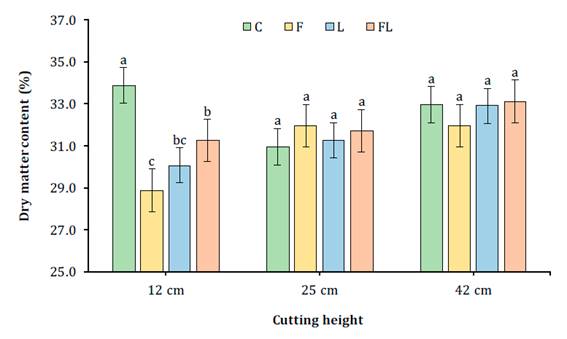
(P=0.01). At 12 cm cutting height, C12 (control treatment) showed the
highest (P<0.05) and F12 showed the lowest (P<0.05) DM
content, with 33.9, 31.2, 30.1 and 28.9% for C12, FL12, L12 and F12,
respectively, while for 25 and 42 cm cutting heights, no differences were found
(figure 1).
For each cutting height bars with different letter
are statistically different (P<0.05). C - control (distilled water
only); F - Fibrozyme® (fibrolytic enzymes with xylanase activity); L - Sil-All®
(bacterial inoculant for silage based on lactic acid bacteria); FL - mixture of
Fibrozyme + Sil-All.
Para cada altura de corte barras con diferente letra
son estadísticamente diferentes (P<0,05). C- control (solo agua
destilada); F - Fibrozyme® (enzimas fibrolíticas con actividad xilanasa); L -
Sil-All® (inoculante bacteriano para ensilaje a base de bacterias
ácido-lácticas); FL - mezcla de Fibrozyme + Sil-All.
Figure 1. Dry
matter (%) of corn silage in response to additive (C, F, L, FL) and cutting
height (12, 25, 42 cm).
Figura 1. Materia
seca (%) de ensilados de maíz en respuesta al aditivo (C, F, L, FL) y a la
altura de corte (12, 25, 42 cm).
Harvesting at
higher CH implied an improvement of digestible nutrients per kilogram of DM,
then reflected in milk yield, both per area and weight unit. These improvements
justify leaving the most fibrous and lignified part of the stem on the field.
On the other hand, an increase of 1.7 units (5.2%) in DM content is expected
with the increase in CH from 12 to 42 cm, due to higher DM content in cobs
compared to leaves or stems (23). In this
regard, higher CH results in increased DM content in corn crops for ensiling,
explained by a higher stover-to-grain ratio in the ensiled mass (18). Regarding AD, Colombatto
et al. (2004) found no effect of added EFE on corn silage DM, with
33.3 and 33.8% average fresh and ensiled corn, respectively.
Dry
matter yield (DMY) due to cutting height effect
Average DMY was
10.7 t ha-1. At conventional CH (12 cm) DMY was low (12.5 t ha-1),
given three factors: final plant density (52,430 plants ha-1), plant height
(198.3 cm) and rainfall, considering water availability is a determining factor
in forage yield (30). As expected, DMY
was highest (P<0.0001) for the 12 cm as compared to 25 cm and 42 cm
CH (figure 2).
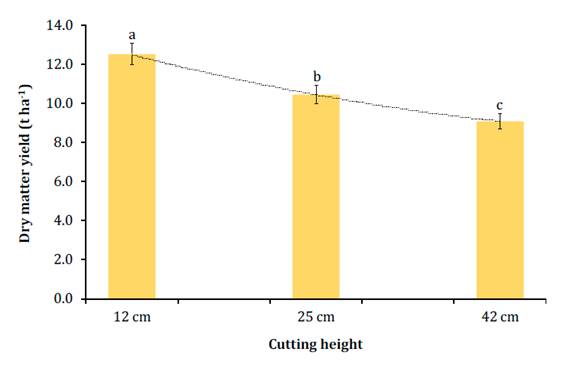
Figure 2. Dry
matter yield (t ha-1) of the whole corn plant harvested at three cutting
heights (CH).
Figura 2. Rendimiento
de materia seca (t ha-1) de la planta entera de maíz cosechada a tres alturas
de corte.
DMY decreases as
CH increases, because of the lower proportion of stem in plants harvested at a
greater height. On the other hand, DMY is also affected by DM content of the
harvested forage, which might vary among different CH (figure 1,
page 132). Both forage DM and forage moisture content, are also related to the
amount of stem left on the field at each CH. That is, the higher the CH at
harvest (such as 25 cm and 42 cm) the lower the amount of moisture carried
within the plant, which in the end is reflected in a higher DM content, since
the stem contributes the most to plant moisture (21,
40).
DMY is inversely
proportional to cutting height. In this study, the greater reduction in DMY
occurred between 12 and 25 cm (20.1%) CH; followed by 25 to 42 cm (15.1%);
while for CH 12 to 42 cm, DMY was considerably higher (37.3%). The regression
analysis showed that for every 1 cm increase in CH above 12 cm, DMY decreases
112 kg ha-1 (R2=0.51; P<0.05). The 37.3% decrease in DMY from 12
to 42 cm is significantly high compared to results published by other research
groups. For instance, Wu and Roth (2005) reported a
7.4% reduction in DMY when the CH changed from 17 to 48 cm; Kung et al. (2008) found a DMY drop of 20.1% from
10-15 to 46-51 cm, and Neylon and Kung (2003)
reported decreases of 5 to 10% DMY when CH went from 12.7 to 45.7 cm. These
reported DMY dissimilarities might be explained by the differences in plant
heights among them. For example, Kung et al. (2008)
reported an average plant height of 3.04 m, while in the present study, average
was 1.98 m. Plant height must be considered before deciding on harvest cutting
height.
Chemical
composition
pH ranged from
3.86 to 4.43, with an average pH of 4.0, suggesting all silages were well preserved.
Silage pH was not affected by the added fibrolytic enzyme, bacterial inoculant or
cutting height. The purpose of adding an inoculant or enzyme was to improve
forage fermentation by stimulating organic acids production and thus lowering
pH (36). However, the addition of L, F or
their combination did not stimulate fermentation of WSC due to EFE effect,
since final pH remained unaffected, as in previous studies (6, 8).
The activity of
most EFE improves when pH is above 4.5 (2, 38).
It has been suggested that EFE work better at a ruminal pH close to neutrality
(8). Neylon and Kung (2003), did not find
pH changes between corn cutting heights at 12.7 or 45.7 cm, at 34% of DM.
Usually, when adding an inoculant, studies focus both on pH and acid concentration
(9, 24); given the speed at which pH
falls and stops enzymatic and bacterial activity plays a key role in avoiding
unnecessary nutrient loss. However, in this work pH was not measured at
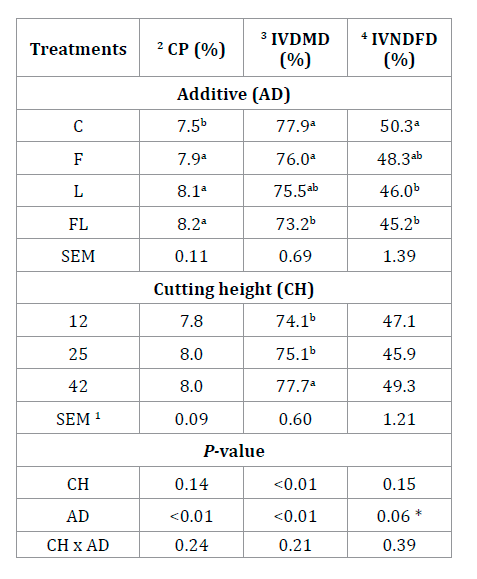
different times. Crude protein (CP) in silages was higher (P<0.01)
with L, F or the combination LF, as compared to the control (table
1), registering an increase of 0.4 to 0.8 %.
Table
1. Crude protein (CP, % of DM) and in
vitro digestibility of corn silages harvested at three cutting heights (in
cm) and inoculated with lactic acid bacteria and exogenous fibrolytic enzymes.
Tabla 1.
Proteína cruda (PC, % de la MS) y digestibilidad in vitro de ensilados
de maíz cosechados a tres alturas de corte (en cm) e inoculados con bacterias
ácido lácticas y enzimas fibrolíticas exógenas.
ab
For each factor, different letters indicate statistical differences (P≤0.05).
1 SEM - Standard error mean; 2 CP - crude protein; 3
IVDMD - in vitro dry matter digestibility, after 48 h of incubation in
the DaisyII equipment; 4 IVNDFD - in vitro neutral detergent
fiber digestibility, after 48 h of incubation in the DaisyII equipment; C -
control (distilled water); F - Fibrozyme® (fibrolytic enzymes with xylanase
activity); L - Sil-All® (bacterial inoculant for silage based on lactic acid
bacteria); FL - mixture of Fibrozyme + Sil-All. * - a trend.
ab
Para cada factor, diferentes letras indican diferencia estadística (P≤0.05);
1 SEM - Error estándar de la media; 2 CP - proteína
cruda; 3 IVDMD - digestibilidad in vitro de la materia seca,
después de 48 h de incubación en el equipo DaisyII; 4 IVNDFD -
digestibilidad in vitro de la fibra detergente neutro, después de 48 h
de incubación en el equipo DaisyII; C - control (solo agua destilada); F -
Fibrozyme® (enzimas fibrolíticas con actividad xilanasa); L - Sil-All®
(inoculante bacteriano para ensilado a base de bacterias ácido lácticas); FL -
mezcla de Fibrozyme + Sil-All. * - una tendencia.
Thus, as
previously documented, we assume less proteolysis when these additives are used
(14, 35). Bacterial inoculants promote
faster pH decline in silage with the consequent prevention of more WSC
consumption, as well as further proteolysis.
The lower CP
content recorded in the control (C) may be related to higher (P<0.05)
DM content (32.6, 30.9, 31.4 and 32%) and less DM loss (P<0.05)
during fermentation in these silages (0.97, 2.97, 1.85 and 1.87% for C, F, L,
and FL, respectively), causing CP dilution. This is also supported by the fact
that the treated silage showed lower quality, evidenced by a higher fiber
content and a lower digestibility than C silages. Besides, it has been widely
stated that protein content in corn silages is not affected by CH at harvest (19, 22, 38). Finally, average CP content was
7.9%, within the expected range according to NRC (2001).
Cell-wall
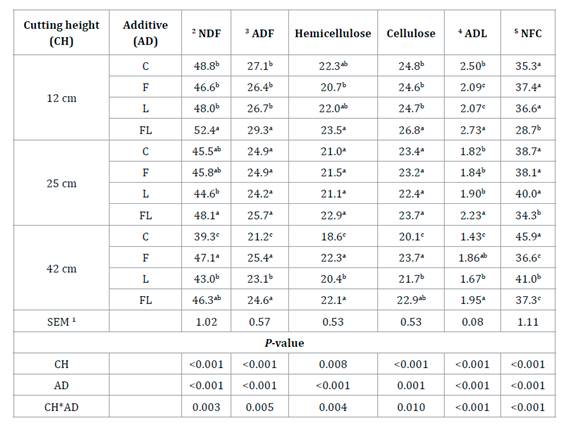
fractions. The
NDF, ADF, hemicellulose, cellulose and ADL, as well as non-fiber carbohydrates
(NFC), showed interaction effects (P<0.01). The lower cell wall and
higher NFC content occurred in C42 silage (table 2).
Table
2. Cell wall fractions (% of DM) in corn
silages harvested at three cutting heights and inoculated with lactic acid
bacteria and exogenous fibrolytic enzymes.
Tabla 2.
Fracciones de la pared celular (% de la MS) de ensilados de maíz cosechados a
tres alturas de corte e inoculados con bacterias ácido lácticas y enzimas
fibrolíticas.
For each cutting height means with different letters
are statistically different (P≤0.05). SEM 1- Standard error
mean; 2 NDF - neutral detergent fiber; 3 ADF - acid
detergent fiber; 4 ADL - acid detergent lignin; 5 NFC - non-fiber
carbohydrates [100 - (NDF + CP + ether extract + ash)]; C - control (distilled
water); F - Fibrozyme® (fibrolytic enzymes with xylanase activity); L -
Sil-All® (bacterial inoculant for silage based on lactic acid bacteria); FL -
mixture of Fibrozyme + Sil-All.
Para cada altura de corte, medias con diferente
letra son estadísticamente diferentes (P≤0,05). 1 SEM - Error
estándar de la media; 2 NDF - fibra detergente neutro; 3
ADF - fibra detergente ácido; 4 ADL- lignina detergente ácido; 5 NFC
- carbohidratos no fibrosos [100- (PC + cenizas + grasa cruda + FDN)]; C -
control (solo agua destilada); F - Fibrozyme® (enzimas fibrolíticas con
actividad xilanasa); L - Sil-All® (inoculante bacteriano para ensilado a base
de bacterias ácido lácticas); FL - mezcla de Fibrozyme + Sil-All.
Conversely, the
highest cell wall and the lowest NFC contents converged in FL12 silage. In
fact, all FL silages showed higher cell walls and lower NFC contents as compared
to the remaining treatments (P<0.05). Higher fiber values in FL
silages could be consequence of a dilution effect due to a greater loss of WSC
occurring in this treatment (15, 17). At
the CH of 12 cm, hemicellulose and ADL content were lower for the F silages, as
compared to C silages, whereas, ADL values of the L silages (P<0.05)
were lower than those of the C silages. Cell wall content was affected by
cutting height (P<0.05) i.e., the higher cutting height had
the lower cell wall content. The latter remained true for the treatments
without additives (P=0.05) (table 2).
In this
research, both additives combined resulted in a setback regarding the expected
reduction in cell wall fractions. Noteworthy is that EFE activity depends on
several factors (type of enzyme, type of forage, pH, temperature, dosage, and
others), and if most of these conditions are met, greater enzymatic efficacy
may be achieved upon the potentially digestible fraction of the forages.
The NDF, ADF and
ADL contents were within the range stated by the NRC
(2001) for corn silages with 32 to 38% DM. However, our values were
slightly higher than those reported in previous studies (6, 22, 24, 40). Such discrepancies might be
explained by environmental differences as is widely known that grasses
accumulate more cell walls when grown in warmer climates, such as those from
intertropical regions (4), as might be
the case for the corn genotype herein considered.
In this study,
the use of fibrolytic enzyme negatively impacted silage fiber content and
digestibility, probably a consequence of the high xylanase activity presented
in the used EFE. It has been observed that enzymes with xylanase activity do
not improve DM or NDF biodegradability (11).
In contrast, an improvement in NDF degradation occured when EFE had higher
endoglucanase activity (11, 33). In this
regard, Wallace et al. (2001) reported that
several products with endoglucanase activity were more effective at stimulating
fermentation in corn silage than those with high xylanase activity and low
endoglucanase activity.
Finally, Vallejo et al. (2016) concluded that cellulases
were more effective than xylanases when added to corn straws. Unlike ferulic
acid esterase, xylanase and cellulase cannot hydrolyze the ester bonds between
sugars and hydroxycinnamic acids within the cell wall (2). On the other hand, according to the
manufacturer the Fibrozyme is recommended for TMR and not for ensiled forage.
In this regard, Singh et al. (2018) found
that xylanases and cellulases are more effective in TMR than applied on
concentrate or forage. Furthermore, LAB are more effective in grasses with
lower WSC and low buffering capacity than in forages like corn, sorghum or
sugar cane (29). Lastly, LAB do not have
a direct influence on forage DM digestibility, but they can promote better
silage fermentation.
In
vitro DM
and NDF digestibility
The IVDMD was
affected by both additives and cutting height, while IVNDFD showed a trend (P=0.06)
by additive effect (table 1, page 134). Both IVDMD and
IVNDFD, were higher in C and F and lower in FL silages (P<0.05). In
this study, IVDMD and IVNDFD followed a similar pattern as compared to cell
wall content (table 2, page 135). The highest digestibility
occurred for C silages, where fiber was lower, whereas the opposite occurred
for FL silages. Regarding cutting height, IVDMD was higher (P<0.05)
for 42 cm (77.7%). IVNDFD was unaltered by cutting height (P=0.15);
however, the 42 cm treatment exceeded that of 12 cm by 2.2% (table
1, page 134).
The highest and
lowest IVDMD observed in C and FL respectively, might be related to the lowest
(0.97%) and highest (2.97%) DM losses during fermentation. Consequently, less
degradable fibrous components increased, either by dilution or by the greater
degradation of WSC when additives are used. However, this last hypothesis is
weakly supported since pH was not lower. On the other hand, it is also possible
that LAB did not use WSC effectively. Sheperd and Kung
(1996) observed that after 56 d of fermentation, pH was equal (3.55) for
silage treated with EFE compared to untreated, where glucose content
represented 0.10 and 0.37% of DM (P<0.05), respectively; suggesting
that cell walls were partially hydrolyzed by added enzymes. On the other hand,
after 196 d of fermentation with and without EFE, pH was 3.63 and 3.56 (P<0.05)
and glucose percentages were 0.09 and 0.10%, respectively. Increases in IVDMD
by varying cutting height from 12 to 42 cm, accorded with many studies showing
that varying cutting height at harvest implies improvements (12, 27) in corn silage digestibility of about 2.5
and 4.7% for IVDMD and IVNDFD, respectively (40).
Corn silage
nutritional value could not be improved by EFE, LAB or their combination, since
IVDMD and IVNDFD at 48 h of incubation were lower than in the control
treatment. Previous studies reported similar effects of EFE on silage (19, 24, 32); while other studies documented that
EFE increased degradation rate after 12 and 24 h of in vitro incubation,
but not after 48 or 96 h (6). This is
supported by other studies (7), reporting
that EFE promote a fast degradation of some fraction of fiber, but have no
activity upon the less degradable fraction. Accordingly, digestion rate
increases within the first hours of incubation, then decreases until an
asymptote (20), given by lack of
substrate (6) or inability of enzymes
(whether exogenous or ruminal) to degrade that part of the fiber.
Adding EFE and
LAB to the forage before ensiling, reduced digestibility of corn silage,
particularly when used together. Stokes (1992) also
reported this antagonistic effect between EFE and LAB when they are combined.
Also, Lynch et al. (2015) reported that
adding EFE alone or in combination with ferulic acid inoculant, did not improve
corn silage fermentation or nutritional value, and even resulted in negative
effects on these parameters.
In this study,
neither EFE nor LAB alone, or their combination, showed a positive effect on
corn silage quality. These results coincide with other studies on EFE alone (13, 19), or combined with LAB (5, 24, 26). However, more research should confirm
these results. Gandra et al. (2017) concluded
that the combination of EFE and LAB had a minimal synergistic effect on guinea
grass silage quality when added to increase NDF digestibility and decrease
silage proteolysis.
In line with previous
reports (21), cutting height did not
affect IVNDFD (P=0.15) in this study. Nevertheless, most studies do
report differences in NDF digestibility. Wu and Roth
(2005) observed a 6.7% increase in IVNDFD from 17 to 49 cm cutting heights,
while Neylon and Kung Jr (2003) found that
digestibility went from 48.7 to 51.5% from 12.7 to 45.7 cm cutting heights. The
latter result was attributed to a lower NDF content in silage from corn cut at
taller heights. According to Lewis et al. (2004),
66.1, 67.3 or 69.1% of IVNDFD occurred from 15, 30 or 46 cm height,
respectively, in three corn hybrids harvested at 35% DM.
Total
digestible nutrients (TDN)
An interaction
CH x AD (P=0.008) occurred for TDN per hectare (TDN ha-1) (figure 3).
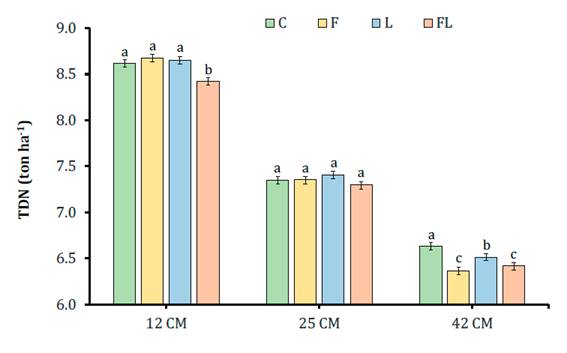
For each cutting height bars with different letters
are statistically different (P<0.05). C - control (distilled water
only); F - Fibrozyme® (fibrolytic enzymes with xylanase activity); L - Sil-All®
(bacterial inoculant for silage based on lactic acid bacteria); FL - mixture of
Fibrozyme + Sil-All.
Para cada altura de corte barras con diferente letra
son estadísticamente diferentes (P<0,05). C- control (solo agua
destilada); F - Fibrozyme® (enzimas fibrolíticas con actividad xilanasa); L -
Sil-All® (inoculante bacteriano para ensilaje a base de bacterias
ácido-lácticas); FL - mezcla de Fibrozyme + Sil-All.
Figure 3.
Total digestible nutrients (TDN) of corn silages treated with different
additives (C, F, L, FL) at three cutting heights (CH).
Figura 3.
Nutrientes digestibles totales (TND) de ensilados de maíz tratados con
diferentes aditivos (C, F, L, FL) a tres alturas de corte.
The treatment
FL12 showed the lowest TDN yield. At 25 cm, no differences were found between
treatments, while at 42 cm, TDN was higher in C and L, but lower in F and FL.
These data show that F negatively affected TDN ha-1. Moreover, cutting height
affected nutrients yield by area reducing 24.5% when cutting height changed
from 12 to 42 cm. This decrease is especially important in corn plants with
reduced height, as in this study.
Conclusions
Corn silage
quality was not affected by adding a bacterial inoculant or a fibrolytic
enzyme. The combination of both, inoculant and enzyme, decreased corn silage
quality by promoting greater content of cell wall fractions and decreasing dry
matter digestibility. Silage quality was greater for the 42 cm cutting height,
but this cutting height produced 37.3% less dry matter and 24.5% less nutrients
yield. The authors recommend focusing on good practices when ensiling.
1. AOAC
(Association of Official Agricultural Chemist). 2006. Official methods of
analysis. 18th ed. AOAC International, Arlington. VA.
2. Arriola, K.
G.; Kim, S. C.; Staples, C. R.; Adesogan, A. T. 2011. Effect of fibrolytic
enzyme application to low- and high-concentrate diets on the performance of lactating
dairy cattle. In Journal of Dairy Science. 94(2): 832-841. DOI:
10.3168/jds.2010-3424
3. Badhan, A.;
Jin, L.; Wang, Y.; Han, S.; Kowalczys, K.; Brown, D.; Juarez A. C.;
Latoszek-Green, M.; Miki, B.; Tsang, A.; McAllister, T. 2014. Expression of a
fungal ferulic acid esterase in alfalfa modifies cell wall digestibility. In
Biotechnology for Biofuels. 7(1): 39. DOI: 10.1186/1754-6834-7-39
4. Berone, G.;
Bertrám, N.; Di Nucci, E. 2021. Forage production and leaf proportion of lucerne
(Medicago sativa L.) in subtropical environments: fall dormancy, cutting
frequency and canopy effects. Revista de la Facultad de Ciencias Agrarias.
Universidad Nacional de Cuyo. Mendoza. Argentina. 53(1): 79-88. DOI:
https://doi.org/10.48162/rev.39.008
5. Bureenok, S.;
Langsoumechai, S.; Pitiwittayakul, N.; Yuangklang, C.; Vasupen, K.;
Saenmahayak, B.; Schonewille, J. T. 2019. Effects of fibrolytic enzymes and
lactic acid bacteria on fermentation quality and in vitro digestibility
of Napier grass silage. In Italian Journal of Animal Science. 18(1): 1438-1444.
DOI: 10.1080/1828051X.2019.1681910
6. Colombatto,
D.; Mould, F. L.; Bhat, M. K.; Phipps, R. H.; Owen, E. 2004. In vitro evaluation
of fibrolytic enzymes as additives for maize (Zea mays L.) silage II.
Effects on rate of acidification, fibre degradation during ensiling and rumen
fermentation. In Animal Feed Science and Technology. 111(1-4): 129-143. DOI:
10.1016/j.anifeedsci.2003.08.011
7. Colombatto,
D.; Mould, F. L.; Bhat, M. K.; Owen, E. 2007. Influence of exogenous fibrolytic
enzyme level and incubation pH on the in vitro ruminal fermentation of
alfalfa stems. InAnimal Feed Science and Technology . 137(1-2):
150-162. DOI: 10.1016/j.anifeedsci.2006.10.001
8. Dehghani, M.
R.; Weisbjerg, M. R.; Hvelplund, T.; Kristensen, N. B. 2012. Effect of enzyme
addition to forage at ensiling on silage chemical composition and NDF
degradation characteristics. In Livestock Science. 150 (1-3): 51-58. DOI:
10.1016/j.livsci.2012.07.031
9. Diepersloot,
E. C.; Heizen, C. Jr.; Saylor, B. A.; Ferraretto, L. F. 2022. Effect of cutting
height, microbial inoculation, and storage length on fermentation profile and
nutrient composition of wholeplant corn silage. In Translational Animal
Science. 6(2): 1-10. DOI: 10.1093/tas/ txac037
10. dos Santos, A.
P. M.; Santos, E. M.; Silva de Oliveira, J.; Pinto de Carvalho, G. G.; Garcia
Leal de Araújo, G.; Moura Zanine, A.; Martins Araújo Pinho, R.; Ferreira, D. de
J.; da Silva Macedo, A. J.; Pereira Alves, J. 2021. Effect of urea on gas and
effluent losses, microbial populations, aerobic stability and chemical
composition of corn (Zea mays L.) silage. Revista de la Facultad de
Ciencias Agrarias . Universidad Nacional de Cuyo. Mendoza. Argentina. 53(1):
309-319. DOI: https://doi.org/10.48162/rev.39.030
11. Eun, J. S.;
Beauchemin; K. A.; Schulze, H. 2007. Use of exogenous fibrolytic enzymes to
enhance in vitro fermentation of alfalfa hay and corn silage. In Journal
of Dairy Science. 90(3): 1440-1451. DOI: 10.3168/jds.S0022-0302(07)71629-6
12. Ferraretto, L.
F.; Shaver, R. D.; Luck, B. D. 2018. Silage review: recent advances and future technologies
for whole-plant and fractionated corn silage harvesting. In Journal of Dairy Science.
101(5): 3937-3951. DOI: 10.3168/jds.2017-13728
13. Gallardo,
I.; Bárcena, R.; Pinos-Rodríguez, J. M.; Cobos, M.; Carreón, L.; Ortega, M. E.
2010. Influence of exogenous fibrolytic enzymes on in vitro and in
sacco degradation of forages for ruminants. InItalian Journal of Animal Science .
9(e8): 34-38. DOI: 10.4081/ijas.2010.e8
14. Gandra, J.
R.; De Oliveira, E. R.; De Goes, R. H. T. B.; De Oliveira, K. M. P.; Takiya, C.
S.; Del Valle, T. A.; Araki, H. M. C; Silveira, K.; Silva, D.; Da Silva Pause,
A. G. 2017. Microbial inoculant and an extract of Trichoderma
longibrachiatum with xylanase activity effect on chemical composition,
fermentative profile and aerobic stability of guinea grass (Pancium máximum Jacq.)
silage. In Journal of Animal and Feed Sciences. 26: 339-347. DOI:
10.22358/jafs/80776/2017
15. Getabalew,
M.; Mindaye, A.; Alemneh, T. 2022. Silage and enzyme additives as animal feed
and animals response. In Archives of Animal Husbandry & Dairy Science.
2(4): 1-6. DOI: 10.33552/AAHDS.2022.02.000543
16. INEGI
(Instituto Nacional de Estadística y Geografía). 2017. Anuario estadístico y
geográfico de Veracruz de Ignacio de la Llave 2017. INEGI, México. 1222 p.
http://ceieg.
veracruz.gob.mx/wp-content/uploads/sites/21/2018/04/AEGEV-2017.pdf (fecha de
consulta: 21/08/2020).
17. Irawan, A.;
Sofyan, A.; Ridwan, R.; Hassim, H. A.; Respati, A. N.; Wardani, W. W.;
Sadarman, Astuti, W. D.; Jayanegara, A. 2021. Effects of different lactic acid
bacteria groups and fibrolytic enzymes as additives on silage quality: A
meta-analysis. In Bioresource Technology Reports. 14: 100654. DOI: 10.1016/j.biteb.2021.100654
18. Kolar, S.;
Vranic, M.; Bozic, L.; Bosnjak, K. 2022. The effect of maize crop cutting
height and the maturity at harvest on maize silage chemical composition and
fermentation quality in silo. In Journal of Central European Agriculture.
23(2): 290-298. DOI: 10.5513/JCEA01/23.2.3504
19. Kung, L.
Jr.; Treacher, R. J.; Nauman, G. A.; Smagala, A. M.; Endres, K. M.; Cohen, M.
A. 2000. The effect of treating forages with fibrolytic enzymes on its
nutritive value and lactation performance of dairy cows. In Journal of Dairy
Science. 83(1): 115-122. DOI: 10.3168/jds.S0022-0302(00)74862-4
20. Kung, L.
Jr.; Cohen, M. A.; Rode, L. M.; Treacher, R. J. 2002. The effect of fibrolytic
enzymes sprayed onto forages and fed in a total mixed ratio to lactating dairy
cows. In Journal of Dairy Science. 85(9): 2396-2402. DOI:
10.3168/jds.S0022-0302(02)74321-X
21. Kung, L.
Jr.; Moulder, B. M.; Mulrooney, C. M.; Teller, R. S.; Schmidt, R. J. 2008. The
effect of silage cutting height on the nutritive value of a normal corn silage
hybrid compared with Brown midrib corn silage fed to lactating cows. In Journal
of Dairy Science. 91(4): 1451-1457. DOI: 10.3168/jds.2007-0236
22. Lewis, A.
L.; Cox, W. J.; Cherney, J. H. 2004. Hybrid, maturity, and cutting height Interactions
on corn forage yield and quality. In Agronomy Journal. 96: 267-274. DOI:
10.2134/agronj2004.2670
23. Lynch, J.
P.; OʼKiely, P.; Waters, S. M.; Doyle, E. M. 2012. Conservation characteristics
of corn ears and stover ensiled with the addition of Lactobacillus plantarum
MTD-1, Lactobacillus plantarum 30114, or Lactobacillus buchneri 11A44.
In Journal of Dairy Science. 95(4): 2070-2080. DOI: 10.3168/jds.2011-5013
24. Lynch, J.
P.; Baah, J.; Beauchemin, K. A. 2015. Conservation, fiber digestibility, and
nutritive value of corn harvested at 2 cutting heights and ensiled with
fibrolytic enzymes, either alone or with a ferulic acid esterase-producing
inoculant. In Journal of Dairy Science. 98(2): 1214-1224. DOI:
10.3168/jds.2014-8768
25. Muck, R. E.;
Nadeau, E. M. G.; McAllister, T. A.; Contreras-Govea, F. E.; Santos, M. C.;
Kung, L. Jr. 2017. Silage review: recent advances and future uses of silage
additives. In Journal of Dairy Science. 101(5): 3980-400. DOI:
10.3168/jds.2017-13839
26. Nair, J.;
Yang, H. E.; Redman, A. A.; Chevaux, E.; Drouin, P.; McAllister, T. A.; Wang,
Y. 2022. Effects of a mixture of Lentilactobacillus hilgardii,
Lentilactobacillus buchneri, Pediococcus pentosaceus and fibrolytic enzymes
on silage fermentation, aerobic stability, and performance of growing beef
cattle. Translational Animal Science. 6(4): 1-12. DOI: 10.1093/tas/txac144
27. Neylon, J.
M.; Kung, L. Jr. 2003. Effects of cut height and maturity on the nutritive
value of corn silage for lactating cows. In Journal of Dairy Science. 86(6):
2163-2169. DOI: 10.3168/jds.S0022-0302(03)73806-5
28. NRC
(National Research Council). 2001. Nutrient Requirements of Dairy Cattle. 7th
rev. ed. Natl. Acad. Sci., Washington. DC.
29. Oliveira, A.
S.; Weinberg, Z. G.; Ogunade, I. M.; Cervantes, A. A. P.; Arriola, K. G.;
Jiang, Y.; Kim, D.; Li, X.; Gonçalves, M. C. M.; Vyas, D.; Adesogan, A. T.
2017. Meta-analysis of effects of inoculation with homofermentative and
facultative heterofermentative lactic acid bacteria on silage fermentation, aerobic
stability, and the performance of dairy cows. In Journal of Dairy Science.
100(6): 4587-4603. DOI: 10.3168/jds.2016-11815
30. Rebora, C.;
Ibarguren, L.; Barros, A.; Bertona, A.; Antonini, C.; Arenas, F.; Calderón, M.;
Guerrero, D. 2018. Corn silage production in the northern oasis of Mendoza,
Argentina. Revista
de la Facultad de Ciencias Agrarias . Universidad Nacional de Cuyo.
Mendoza. Argentina. 50(2): 369-375. https://bdigital.uncu.edu.ar/12073.
31. SAS/STAT®.
2004. Versión 9.1 del sistema SAS para Windows, copyright 2004 SAS Institute
Inc., Cary, NC, USA.
32. Sheperd, A.
C.; Kung, L. Jr. 1996. An enzyme additive for corn silage: Effects on silage
composition and animal performance. In Journal of Dairy Science. 79(10):
1760-1766. DOI: 10.3168/jds.S0022-0302(96)76543-8
33. Silveira
Pimentel, P. R.; dos Santos Brant, L. M.; Vasconcelos de Oliveira Lima, A. G.; Costa
Cotrim, D.; Nascimento, T.; Lopes Oliveira, R. 2022. How can nutritional
additives modify ruminant nutrition? InRevista de la Facultad de Ciencias Agrarias .
Universidad Nacional de Cuyo. Mendoza. Argentina. 54(1): 175-189. DOI:
10.48162/rev.39.076
34. Singh, D.;
Kumar-yadav, S.; Sharma, B.; Malik, T. A.; Kumari, V.; Hassan-Mir, S. 2018. Use
of exogenous fibrolytic enzymes as feed additive in ruminants: A review. In
International Journal of Chemical Studies. 6(6): 2912-2917.
35. Stokes, M.
R. 1992. Effects of an enzyme mixture, an inoculant, and their Interaction on
silage fermentation and dairy production. In Journal of Dairy Science. 75(3):
764-773. DOI: 10.3168/jds.S0022-0302(92)77814-X
36. Undersander,
D.; Mertens, D.; Thiex, N. 1993. Forage analyses procedures. National Forage
Testing Association. Omaha, NE 68137, USA. p. 139.
https://fyi.extension.wisc.edu/ forage/files/2014/01/NFTA-Forage-Analysis-Procedures.pdf
(Accessed November 2021).
37. Vallejo, L.
H.; Salem, A. Z. M.; Kholif, A. E.; Elghangour, M. M. Y.; Fajardo, R. C.;
Rivero, N.; Bastida, A. Z.; Mariezcurrena, M. D. 2016. Influence of cellulase
or xylanase on the in vitro rumen gas production and fermentation of
corn stover. In Indian Journal of Animal Sciences. 86(1): 70-74.
38. Yitbarek, M.
B.; Tamir, B. 2014. Silage Additives: Review. In Open Journal of Applied
Sciences. 4(5): 258-274. DOI: 10.4236/ojapps.2014.45026
39. Wallace, R.
J.; Wallace, S. J.; Mckain, N.; Nsereko, V. L.; Hartnell, G. F. 2001 Influence
of supplementary fibrolytic enzymes on the fermentation of corn and grass
silages by mixed ruminal microorganisms in vitro. In Journal of Animal
Science. 79(7): 1905-1916. DOI: 10.2527/2001.7971905x
40. Wu, Z.;
Roth, G. 2005. Considerations in managing cutting height of corn silage. Penn
State Cooperative Extension Bulletin DAS 03-72. Department of Dairy and Animal
Science, Pennsylvania State University, University Park. 7 p.
https://extension.psu.edu/considerations-in-managing-cutting-height-of-corn-silage
(Accessed August 2020).