Revista de la Facultad de Ciencias
Agrarias. Universidad Nacional de Cuyo. Tomo 54(2). ISSN (en línea) 1853-8665.
Año 2022.
Original article
Line x
tester analysis to estimate combining ability in grain sorghum (Sorghum
bicolor L.)
Análisis línea x probador para estimar la aptitud combinatoria en sorgo de
grano (Sorghum bicolor L.)
Héctor Williams-Alanís 1
Gerardo Árcos Cavazos 1
Francisco Zavala Garcia 3
Marisol Galicia Júarez 4
María del Carmen Rodríguez
Vázquez 3
Jorge Elizondo Barrón 1
1 Ex-Investigador del Instituto Nacional de
Investigaciones Forestales, Agrícolas y Pecuarias (INIFAP). Campo Experimental
Rio Bravo. Programa de Sorgo.
2 Instituto Nacional de Investigaciones Forestales,
Agrícolas y Pecuarias, (INIFAP). Campo Experimental Rio Bravo. Programa de
Sorgo.
3 Universidad Autónoma de Nuevo León (UANL). Facultad de
Agronomía.
4
Universidad Autónoma de Baja California. Instituto de Ciencias Agrícolas.
Carretera a Delta/ Oaxaca s/n. Ejido Nuevo León. Valle de Mexicali. Baja California. CP 2175.
* aranda.ulises@inifap.gob.mx
Abstract
Sorghum in
Mexico ranks third in grain production. This study aimed to estimate general
combining ability (GCA) and specific combining ability (SCA) for commercial and
experimental sorghum grain parents and hybrids. The combining ability was
estimated using the line x tester method described by Kempthorne. The
experiment was established during the spring-summer 2018 cycle at INIFAP, Las
Huastecas, México. It consisted of five lines, eight
testers and 40 hybrids; in a randomized block design with three replications.
The ANOVA showed highly significant differences for lines, testers, and line x
testers, suggesting the existence of a broad base of genetic variability. GCA
and SCA differences were statistically significant for grain yield, specific
grain weight and plant height, indicating additive gene relevance, dominance
and epistasis. For grain yield, the experimental lines: RB214A, RB225A and
RB248A, and the testers RB133 and RB221, resulted significantly higher in GCA
and superior to commercial RB225A line and RTx430 and RTx437 testers. Seventeen
experimental hybrids were found to have significantly higher in SCA and were
superior to INIFAP commercial hybrids.
Keywords: Sorghum bicolor
L.; Plant breeding; Hybrids; Parental lines; Grain
production.
Resumen
El sorgo en México ocupa el tercer lugar en producción de grano. El
objetivo del estudio fue estimar la aptitud combinatoria general (ACG) y
especifica (ACE) en progenitores e híbridos comerciales y experimentales de
sorgo para grano. La aptitud combinatoria se estimó mediante el método de línea
x probador descrito por Kempthorne. El experimento se estableció durante el
ciclo primavera-verano 2018 en INIFAP, Huastecas, México. Consistió de cinco
líneas, ocho probadores y 40 híbridos; en un diseño de bloques al azar con tres
repeticiones. El ANOVA detectó diferencias altamente significativas para
líneas, probadoras y línea x probador; sugiriendo la existencia de una amplia
base de variabilidad genética. Para rendimiento de grano, peso específico de
grano y altura de planta, la ACG y ACE, fueron significativas lo cual indica la
relevancia de genes aditivos de dominancia y epistasis. Para rendimiento de
grano las líneas experimentales: RB214A, RB225A y RB248A y, los probadores
RB133 y RB221, fueron altamente significativos en ACG y fueron superiores a la
línea RBSBA25 y los probadores RTx430 y RBTx437 comerciales. Se encontró
diecisiete híbridos experimentales con diferencias significativas en ACE y
fueron superiores que los híbridos comerciales del INIFAP.
Palabras
clave: Sorghum bicolor L.; Mejoramiento genético;
Híbridos; Progenitores; Producción de grano.
Originales: Recepción: 10/03/2022
Aceptación: 23/11/2022
Introduction
In México, sorghum Sorghum bicolor (L.) Moench is the
third largest grain crop produced after corn, Zea mays (L.) and common
bean, Phaseolus vulgaris (L.) (21). Tamaulipas is the main sorghum-producing
state, contributing in 2017 with 2,205,000 tons of grain, equivalent to 45.45%
of national production (1). However, this supply is not enough for the
national demand, making it necessary to increase productivity (18).
The discovery
of cytoplasmic male sterility by Stephens and Holland
(1954), was of vital importance for the commercial
production of hybrid seed, allowing significant production improvement (19). In the United States of America, 35% to 40%
of total profit obtained in grain production, is attributed to this technology (4). In this sense, a successful hybridization
program largely depends, on selecting the proper parental lines and knowing the
different types of gene action (9). General combining ability (GCA) and
specific combining ability (SCA) are key tools in plant genetic improvement (3, 15). The line x tester mating method for GCA and
SCA determination suggested by Kempthorne (1957) is appropriate for parent and
higher hybrid identification (7). In this context, using productive hybrid
seed with enhanced environmental adaptation has been fundamental for obtaining
higher yields. Available Mexican seed varieties provide job positions in
production activities while reducing capital flight (26). In this sense, The Instituto Nacional de
Investigaciones Forestales Agrícolas y Pecuarias (INIFAP), Río Bravo
Experimental Station, Tamaulipas, México, began working on genetic sorghum
breeding in 1973, generating varieties and hybrids for northern México (28): RB-2000, RB-2020, RB-3030, RB-3006,
RB-4000, RB-Patrón, RB-4040, RB-Huasteco, RB-Norteño; and RB-Paloma,
RB-Gaviota, RB-Williams and Arcos varieties.
The objective
of this study was to estimate general combining ability (GCA) effects for
females and males, and specific combining ability (SCA) effects for grain
sorghum hybrids, identifying high-yield hybrids with earliness and adequate
harvest height.
Materials
and methods
The Genetic
material considered in this study comprised the commercial lines: A/B:
SBA12/SBB12, parents of RB-3030; SBA25/SBB25 parents of RB-4000, RB-Patron and
RB-Huasteco hybrids. R Lines (testers): RTx430 (11) and RTx437 (17), originated at Texas A&M University.
INIFAP experimental lines A/B: RB214A/RB214B, RB225A/ RB225B, RB248A/RB248B,
and testers: RB128, RB133, RB135, RB221, RB256 and RB373. These genotypes were
generated by hybridization in 2003. Maintainer lines were generated from
SBB-25, parent of RB-Patrón hybrid (27), LRB-118B, parent of RB-4040 hybrid (25) and VAR-B, generated by the International
Crops Research Institute for the Semi-Arid Tropics (ICRISAT), Hyderabad, India.
Experimental testers were generated from crosses between RTx437, LRB-210 and
SBR-24. RTx437, originated in Texas A&M University
(16); LRB-210,
parent of RB-4040, INIFAP hybrid (24); SBR-24, parent of RB-4000 INIFAP hybrid. In
F2 generations, row by panicle selection or pedigree was performed along five
generations for large panicle length, higher grain volume, plant height,
non-senescent plant, charcoal rot tolerance [Macrophomina phaseolina (Tassi)
Goid], Head smut [Sporisorium reilianu (Kühn)] Langdon and Fullerton,
and foliar diseases. In Marin Experimental Station, Marin, Nuevo León, México,
Universidad Autónoma de Nuevo León (UANL), from 2010 to 2017, the described
selection process continued while sterilization of best maintainer lines (B)
was carried out, by 7 generations backcrosses.
The genetic
material was increased at the mentioned Experimental Station, during
spring-summer 2017 and fall-winter 2017-2018. A and B
lines and R were increased, and F1 hybrids were developed under line × tester
(5 × 8) crossing scheme. The experiment was established under rain-fed
conditions during the spring-summer 2018 in INIFAP, Las Huastecas Experimental
Station, located at Altamira municipality, Tamaulipas, Mexico; 22°33’ LN/
98°09’ LW, and 20 m above sea level. It has a warm sub-humid climate (Aw0) with
summer and winter rain (5); average annual temperature of 24.5°C and
842 mm annual rainfall (6). This experiment consisted of 40 possible
hybrid combinations, including INIFAP´s commercial hybrids; RB-3030, RB-Patrón
and RB-Huasteco, five fertility maintaining lines, eight testers and the
commercial hybrids Pioneer P83P27 and P85P20. The B lines or fertility-maintaining
lines were used to determine maternal per se performance.
The
experimental design was a randomized block with 55 treatments and three
replications, distributed in a one-row plot of 5 m long and 0.80 m apart.
Sowing was on August 15, 2018. Fertilization was 90-40-00 with triple
superphosphate and ammonium nitrate. Thinning was done 20 days after emergence
leaving a population of 250 thousand plants ha-1.
Weed control was carried out at 10, 20 and 25 days after plant emergence. The
yellow aphid [Melanaphis sacchari (Zehntner)] was controlled with Toreto
(Sulfoxaflor) 21.8% at a dose of 0.06 l ha-1.
Days to
flowering (DF) were observed at 50% flowering. One week before physiological
maturity, the following traits were measured: plant height (PH, in cm, from the
ground to the panicle apex), panicle length (PL, in cm, from the base to the
apex), and exertion length (EL, in cm, from the ligule of the flag leaf to base
panicle). The entire plot was harvested and threshed. Then, grain moisture was
determined, estimating grain yield (GY). Results were reported in t ha-1
(GY, at 12% moisture) and specific grain weight (SGW, in kg per
hectoliter). Line × Tester analysis was done according to Kempthorne (8) estimating general combining ability (GCA)
effects for females and males and specific combining ability (SCA) effects for
hybrids. Statistics were carried out with R platform (16).
Results
and discussion
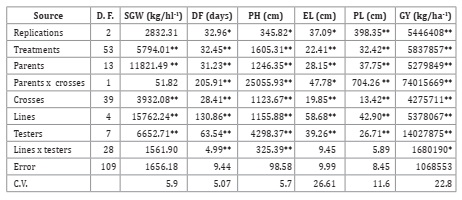
The ANOVA
(Table 1), revealed highly significant
differences (p≤0.01) between parents and hybrids for all traits.
Table
1: Line x tester ANOVA for
agronomic traits. INIFAP,
Las Huastecas Experimental Station, Altamira, Municipality, Tamaulipas, México.
2018, Spring-Summer cycle.
Tabla 1: Análisis de varianza por el método de línea x
probador de las variables agronómicas. INIFAP, Campo Experimental las
Huastecas, Municipio de Altamira Tamaulipas, México, ciclo primavera-verano
2018.
SGW: specific grain weight (kghl-1);
DF: days to flowering; PH: plant height (cm); EL: exertion length (cm); PL:
panicle length (cm); and GY: grain yield (kgha-1).
C.V.; coefficient of variation (%). *, **: Significant at 0.05 and 0.01% probability levels, respectively.
SGW: peso específico del grano (kg hl-1);
DF: días a floración; PH: altura de planta (cm); EL: longitud de excersión
(cm); PL: longitud de panícula (cm); y GY: rendimiento de grano (kg ha-1). C.V.: coeficiente de
variación (%). *, **: Significativo al nivel de 0,05 y 0,01% de probabilidad,
respectivamente.
In this regard, Mohammed
(2009) found similar results in forage sorghum for days to flowering and plant
height. In parents x hybrids, highly significant differences were observed in
DF, PH, PL and GY variables, while significant differences resulted for EL. In lines x tester, highly significant differences were observed in
DF and PH, while significant differences were found in GY. Likewise,
highly significant differences in EL and PL were found for treatments, parents,
crosses and lines. Results indicate a broad base of genetic variability among
the used germplasm, favoring an appropriate selection of parents and hybrids.
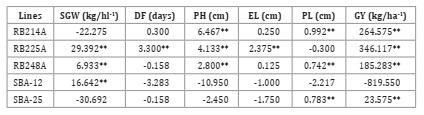
General
combining ability (GCA) in lines (Table 2), showed four out of five lines with significant values
(p≤0.01) for GY, of which three corresponded to experimental lines.
Table
2: Estimates of general
combining ability (GCA) in lines for agronomic traits in INIFAP, Las Huastecas
Experimental Station, Altamira, Municipality, Tamaulipas, México.
2018, Spring-Summer cycle.
Tabla 2: Valores estimados de los efectos de aptitud
combinatoria general (ACG) en líneas, para las variables agronómicas. INIFAP,
Campo Experimental las Huastecas, Municipio de Altamira Tamaulipas, México,
ciclo primavera-verano 2018.
SGW: specific grain weight (kg hl-1);
DF: days to flowering; PH: plant height (cm); EL: excertion length (cm); PL:
panicle length (cm); and GY: grain yield (kg ha-1).
*, **: Significant at 0.05 and 0.01%
probability levels, respectively.
SGW: peso específico del grano (kg hl-1);
DF: días a floración; PH: altura de planta (cm); EL: longitud de excersión
(cm); PL: longitud de panícula (cm); y GY: rendimiento de grano (kg ha-1). *, **: Significativo al nivel de 0,05 y
0,01% de probabilidad, respectivamente.
For SGW,
PH and PL, three out of five lines showed high GCA values. For GY, genotypes
RB214A, RB225A, RB248A and SBA-25 showed highly significant values (p≤0.01). In
addition, the experimental line RB225A presented highly significant values for
SGW, DF, PH and EL. For PH, negative GCA values are desirable (9),
given that low-PH sorghums are preferred. The reason for the commercial line
SBA-25 showing a positive GCA value for GY, in contrast to SBA-12, (which
showed a negative value), was due to possible differences in obtention periods,
around the ‘90s (13) and ‘50s (28),
respectively. Thus, in the first line, more recently created, greater
recombination and genetic advance were achieved. The agronomic traits showing
predominant general combining ability, respond to present additive genes. Zewdie et al. (2001), working with hot pepper,
and Khan et al. (2009) with sunflower,
suggested that for this type of predominating genes, recurrent reciprocal selection
allows good genetic improvement.
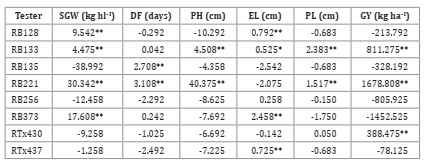
The GCA
for GY (Table 3), in the genotypes RB133,
RB221 and RTx430, was highly significant and higher than commercial RTx437,
which presented a negative response. For GSW, four out of eight testers
presented positive and highly significant values of GCA.
Table
3: Estimates of general
combining ability (GCA) in testers for agronomic traits. INIFAP, Las Huastecas Experimental
Station, Altamira, Municipality, Tamaulipas, México. 2018, Spring-Summer cycle.
Tabla 3: Efectos de aptitud combinatoria general (ACG)
estimada para las variables agronómicas en los probadores. INIFAP, Campo
Experimental las Huastecas, Municipio de Altamira Tamaulipas, México, ciclo
primavera-verano 2018.
SGW: specific grain weight (kg hl-1);
DF: days to flowering; PH: plant height (cm); EL: excertion length (cm); PL:
panicle length (cm); and GY: grain yield (kg ha-1).
*, **: Significant at 0.05 and 0.01%
probability levels, respectively.
SGW: peso específico del grano (kg hl-1);
DF: días a floración; PH: altura de planta (cm); EL: longitud de excersión
(cm); PL: longitud de panícula (cm); y GY: rendimiento de grano (kg ha-1). *, **: Significativo al nivel de 0,05 y
0,01% de probabilidad, respectivamente.
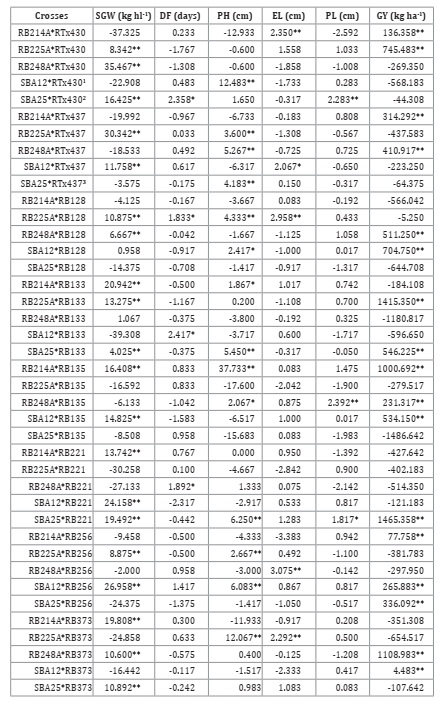
Specific
combining ability (SCA) for GY in Table 4,
shows 17 experimental highly significant hybrids (p≤0.01%), while INIFAP´s
commercial hybrids, RB-3030, RB-4000 and RB-Huasteco, presented a negative
response.
Table 4: Estimation effects of specific combining ability (SCA) in
agronomic traits. INIFAP, Las Huastecas Experimental
Station, Altamira, Municipality, Tamaulipas, Mexico. 2018, Spring-Summer cycle.
Tabla 4: Estimación de los efectos de aptitud combinatoria
específica (ACE) en las variables agronómicas. INIFAP, Campo Experimental las
Huastecas, Municipio de Altamira Tamaulipas, México, ciclo primavera-verano
2018.
SGW: specific grain weight (kg hl-1);
DF: days to flowering; PH: plant height (cm); EL: excertion length (cm); PL:
panicle length (cm); and GY: grain yield (kg ha-1).
*, **: Significant at 0.05 and 0.01 % probability levels, respectively. 1RB-3030.
2RB-Patrón.
3RB-Huasteco.
SGW: peso específico del grano (kg hl-1);
DF: días a floración; PH: altura de planta (cm); EL: longitud de excersión
(cm); PL: longitud de panícula (cm); y GY: rendimiento de grano (kg ha-1). *, **: Significativo al nivel de 0,05 y
0,01% de probabilidad, respectivamente.
Positive
effects of SCA, indicate dominant and epitasis genes. On the other hand,
genotypes presenting negative values show parental unfavorable combinations.
The SCA importance for sorghum GY has already been reported (3, 23,
24). For SGW, half
the hybrids showed highly significant differences, indicating non-additive gene
importance. Regarding PH, 11 hybrids resulted highly significant and 11
significant.
This turns
favorable for hybrid selection considering suitable plant height. DF, PL and EL, showed few significant differences.
Table 5 shows proportional line contribution and lines x tester
for six agronomic traits.
Table
5: Contribution of Lines,
testers, and lines x testers to the total variance in agronomic traits. INIFAP, Las Huastecas Experimental
Station, Altamira, Municipality, Tamaulipas, México. 2018, Spring-Summer cycle.
Tabla 5: Contribución de las líneas, probadores y líneas x
probadores en la varianza para las variables agronómicas estudiadas. INIFAP,
Campo Experimental las Huastecas, Municipio de Altamira Tamaulipas, México,
ciclo primavera-verano 2018.
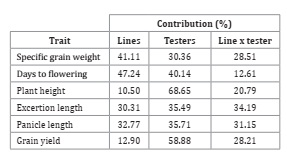
Lines played an
evident role in SGW (41.11%) and DF (47.24%), indicating maternal predominance.
Testers showed more influence in DF (40.14), PH (68.65%), EL (35.49%), PL
(35.71%) and GY (58.88%). Previously, Mohammed (2009),
found the same results in forage sorghum for lines in green fodder and dry
fodder production, while Pataki et al. (2007)
found greater line influence on plant height.
A
positive and significant correlation was found for grain yield (p≤0.001) and
panicle length (Figure 1), in
coincidence with Makanda et al. (2010) and Bunphan et al. (2015).
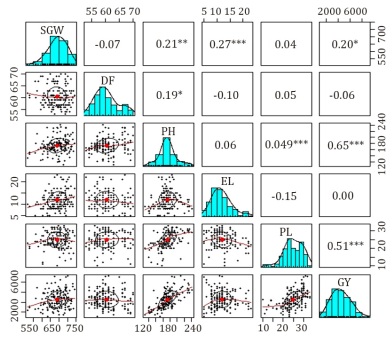
SGW: specific grain weight (kg hl-1);
DF: days to flowering; PH: plant height (cm); EL: excertion length (cm); PL:
panicle length (cm); and GY: grain yield (kg ha-1).
*, **, ***: Significant at 0.05, 0.01 and 0.001 % probability levels,
respectively.
SGW: peso específico del grano (kg hl-1); DF:
días a floración; PH: altura de planta (cm); EL: longitud de excersión (cm);
PL: longitud de panícula (cm); and GY: rendimiento de grano (kg ha-1);
*,**,***: Significativo al nivel de 0,05 y 0,01% de
probabilidad, respectivamente.
Figure 1: Correlation
coefficients between agronomic variables for hybrids and sorghum parents. INIFAP, Las Huastecas Experimental Station, Altamira Municipality, Tamaulipas,
México. 2018, Spring-Summer cycle.
Figura 1: Coeficientes de correlación entre las
variables agronómicas para híbridos y progenitores de sorgo. INIFAP, Campo
Experimental las Huastecas, Municipio de Altamira Tamaulipas, México, ciclo
primavera-verano 2018.
Williams et al. (2015) mentioned that the
highest-yielding hybrids had higher panicle lengths. In addition, a significant
correlation (p≤0.001) was also found for grain yield in kg ha-1 and plant height (Sarvari and Behesthi, 2012). This significant
correlation between PH and PL is given by the fact that taller plants and
greater panicle length are correlated with higher grain yield. A positive
correlation was also found between SGW, PH, PL and GY.
Table 6 shows the mean values of the best experimental and
commercial hybrids for grain yield, ranging from 3941 to 8108 kg ha-1, where SBA25xRB221
experimental hybrid showed more than 8,000 kg ha-1.
Table 6: Sorghum hybrids and tested agronomic traits. INIFAP,
Las Huastecas Experimental Station, Altamira Municipality, Tamaulipas, México. 2018, Spring-summer cycle.
Tabla 6: Híbridos de sorgo y variables agronómicas evaluadas.
INIFAP, Campo Experimental las Huastecas, Municipio de Altamira Tamaulipas,
México, ciclo primavera-verano 2018.
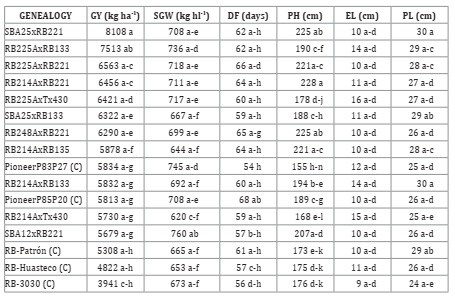
GY: grain yield (kg ha-1),
SGW: specific grain weight (kg hl-1);
DF: days to flowering; PH: plant height (cm); EL: excertion length (cm); PL:
panicle length (cm); (C) Controls. Different letters (a, b, c) in each trait
and within the same group denote statistical significance (Tukey; p=0.05).
GY: rendimiento de grano (kg ha-1);
SGW: peso específico del grano (kg hl-1);
DF: días a floración; PH: altura de planta (cm); EL: longitud de excersión
(cm); PL: longitud de panícula (cm); (C): Controles. Literales diferentes (a,b,c) en cada variable y dentro del mismo grupo denotan
significancia estadística (Tukey; p=0,05).
In this regard,
Williams et al. (2015), conducted evaluations
of experimental and commercial hybrids during three years in INIFAP, obtaining
maximum grain yields of 6400 kg ha-1,
under favorable soil moisture and management conditions. Table 6 shows that 11 experimental hybrids resulted statistically
equal (p<0.05) in grain yield to the commercial controls: Pioneer® P83P27
and P85P20, RB-Patrón and RB-Huasteco. Within this group, two experimental
hybrids, SBA25xRB221 and RB225AxRB133, were superior to RB-3030 and seven other
experimental hybrids. In both cases, parental lines showed highly significant
values for GCA (Table 2 and Table 3) while the hybrids
showed high SCA (Table 4). Williams et al. 2015 indicated that tall plant
hybrids usually present lodging problems, and difficult mechanical harvesting.
Therefore, we considered the experimental hybrid SBA25xRB221, 225 cm high, not
suitable for commercial planting. Hybrid height depends on parental GCA and
hybrid SCA height (Table 2, Table 3, and Table
4). We concluded that the experimental hybrid
RB225AxRB133 showed the best grain yield and plant height combination.
For grain
yield, some experimental lines, testers and hybrids turned out superior to
commercial ones. For grain yield, specific grain weight and plant height,
additive genes as well as dominance and epistasis genes resulted important. The
general combining ability in lines was proportionally higher in genotype number
for specific grain weight, plant height and grain yield than testers. Results
indicated that experimental lines and testers are promising for hybrid
development and breeding.
Conclusions
The results
showed that general combining ability (GCA) and specific combining ability
(SCA) were important for grain yield, grain-specific weight and plant height.
For grain yield, the experimental lines RB214A, RB225A and RB248A, and the
testers RB133 and RB221, resulted superior in GCA than commercial ones.
Seventeen experimental hybrids were found to have better SCA than INIFAP
commercial hybrids.
References
1. Alejandro, A. F.; García, M. R.; García, S. R. C.; Mora, F. J.
S.; Sangerman-Jarquín, D. M. 2020. Competitividad de la
producción de sorgo en el norte de Tamaulipas, México. Revista Mexicana de
Ciencias Agrícolas. 11(1): 139-150. doi:
https://doi.org/10.29312/remexca.v11i1.1914
2. Bunphan, D.; Jaisil, P.; Sanitchon, J.; Knoll, J. E.; Anderson,
W. F. 2015. Heterosis and combining ability of F1 hybrid
sweet sorghum in Thailand. Crop Science. 55(1):
178-187. doi: https://doi.
org/10.2135/cropsci2014.05.0363
3. Chaudhari, D. R.; Solanki, B. G.; Narwade, A. V.; Patel, A.;
Faldu, G. O. 2016. Combining ability studies in grain sorghum [Sorghum bicolor (L.) Moench] using
line x tester analysis. An International e-Journal.
5(2): 137-145.
4. Duvick, D. N. 1999. Heterosis: feeding people and protecting
natural resources. En: J. G. Coors, y S.Pandey . (Ed.). The genetics and
exploitation of heterosis in crops. American Society of Agronomy, Inc.,
Crop Science of America, Inc., Soil Science Society of America, Inc., Madison,
Wi, USA. p. 19-29.
5. García, E. 2004. Modificaciones al sistema de clasificación
climática de Koppen. Universidad Nacional Autónoma de México. Instituto de
Geografía. Libro Nº 6. México. D. F. MEX.
6. INIFAP. 2015. Campo Experimental Huastecas. https://www.inifapcirne.gob.mx/LocalizacionHuastecas.htm/. (Date of consultation: 08/08/2021).
7. International of Journal Current Microbiology &
AppliedScience. 6(10): 3434-3442. doi:
https://doi.org/10.20546/ijcmas.2017.610.405.
8. Kempthorne, O. 1957. An introduction to
genetic statistics. John Wiley & Sons, Inc., N.Y.
p. 545.
9. Khan, S. A.; Ahmad, H.; Khan, A.; Saeed, M.; Khan, S. M; Ahmad,
B. 2009. Using line x tester analysis for earliness and plant
height traits in sunflower (Helianthus annuus L.). Recent Research in Science and Technology. 1(5): 202-206.
10. Makanda, I.; Tongoona, P.; Derera, J.; Sibiya, J.; Fato, P.
2010. Combining ability and cultivar superiority of sorghum
germplasm for grain yield across tropical low-and mid-altitude environments.
Field Crops Research. 116(1-2): 75-85. doi: https://doi.org/10.1016/j.fcr.2009.11.015
11. Miller, F. R. 1984. Registration of RTx430
sorghum parental line. Crop Science. 24:1224.
doi: 10.2135/cropsci1986.0011183X002600010083x
12. Mohammed, M. I. 2009. Line x tester analysis
across locations and years in Sudanese x exotic lines of forage sorghum.
Journal of Plant Breeding and Crop Science. 1(9):
311-319. doi: https:// doi.org/10.5897/JPBCS.9000089
13. Montes G, N.; Williams, A. H.; Arcos, C. G.; Pecina, Q. V.;
Garza, C. M. D. L.; Moreno, G. T.; Vargas, V. E. 2014. RB-Huasteco,
sorgo de grano para áreas de riego y temporal. Revista Mexicana de Ciencias
Agrícolas. 5(SPE7): 1331-1335.
14. Pataki, I.; Marinković, R.; Vasiljević, S.; Mikić, A.; Milić,
D. 2007. Kombinacione sposobnosti za visinu biljke kod krmnog
sirka i sudanske trave analizom linija x tester. Zbornik
Radova-A. Periodical of Scientific Research on Field
& Vegetable Crops. 44(1): 185-192.
15. Pereira Ribeiro, L.; Dessaune Tardin, F.; Beserra de Menezes,
C.; Botega Baldoni, A.; Teodoro, P.; Lopes Bhering, L. 2021. Combining
yield, earliness and plant height in a single genotype: a proposal for breeding
in grain sorghum (Sorghum bicolor L.) Revista
de la Facultad de Ciencias Agrarias. Universidad Nacional de Cuyo. Mendoza.
Argentina. 53(1): 11-21.
16. R Development Core Team. 2012. R: A language and environment
for statistical computing. 2.14.2. R Found. Stat. Comput., Vienna.
17. Rooney, W. L.; Miller, F. R.; Rooney, L. W. 2003. Registration of RTx437 sorghum parental line. Crop Science. 43: 445-446.
18. SAGARPA. Secretaria de Agricultura, Ganadería,
Desarrollo Rural, Pesca y Alimentación. 2017. Sorgo grano mexicano. Planeación
Agrícola Nacional 2017-2030. https://www.gob.mx › B_sico-
Sorgo_Grano. (Date of consultation: 08/10/2021).
19. Sarvari, S. M.; Behesthi, S. A. 2012. Relationship
between grain yield and plant characteristics in grain sorghum genotypes under
drought stress conditions. Iranian Journal Crop Science . 14: 183-201.
20. Smith, S.; Primomo, V.; Monk, R.; Nelson, B.; Jones, E.;
Porter, K. 2010. Genetic diversity of widely used U.S.
sorghum hybrids 1980-2008. Crop Science .
50(5): 164-1673. doi:
https://doi.org/10.2135/cropsci2009.10.0619
21. Soltero-Díaz, L.; Ron-Parra, J.; Ramírez-Díaz, J. L.;
González-Eguiarte, D. R. 2005. Respuesta a la selección de la población de
sorgo TP-17 para resistencia a Exserohilum turcicum (Leo y Sug.) y para
porte bajo de planta. Revista Fitotecnia Mexicana. 28(2): 99-104.
22. Stephens, J. C.; Holland, R. F. 1954. Cytoplasmic
male sterility for hybrids sorghum seed production. Agronomy
Journal. 46:20-23. doi:
https://doi.org/10.2134/agronj1954.00021962004600010006x
23. Tafere, M.; Sentayehu, A.; Taye, T.; Dagne, W. 2020. Combining ability of lowland adapted Ethiopian sorghum hybrids for
yield. Ethiop. J. Agric. Sci. 30(2): 89-98.
24. Thakare, D. P.; Ghorade, R. B.; Bagade, A. B. 2014. Combining ability studies in grain sorghum using line x tester
analysis. International Journal of Current
Microbiology & Applied Science. 3(10): 594-603.
25. Williams, A. H. 1996. RB-4040, nuevo híbrido
de sorgo para el noreste de México y tolerante a Sporisorium reilianum y
Macrophomina phaseolina. Revista Fitotecnia Mexicana. 19: 193- 194.
26. Williams, A. H.; Pecina, Q. V.; Zavala, G. F.; Montes, G. N.
2004. RB-Patrón, nuevo híbrido de sorgo para grano en el
noreste de México. Revista Fitotecnia Mexicana. 27(3): 291-293.
27. Williams, A. H.; Arcos, C. G. 2015. Comportamiento
agronómico de híbridos y progenitores de sorgo para grano en las Huastecas. Agronomía
Mesoamericana. 26(1): 88-97. doi:
10.15517/am.v26i1.16926
28. Williams, A. H.; Aranda, L. U.; Arcos, C. G.; Zavala, G. F.;
Rodríguez, V. M. del C.; Olivares, S. E. 2021. Potencial
productivo de variedades experimentales de sorgo blanco para el sur de
Tamaulipas. Nova Scientia. 13(26): 1-19. doi:
https://doi.org/10.21640/ns.v13i26.2688.
29. Zewdie, Y.; Bosland, P. W.; Steiner, R. 2001. Combining ability and heterosis for capsaicinoids in Capsicum
pubescens. HortScience. 36(7):
1315-1317.doi: https://doi.org/10.21273/HORTSCI.36.7.1315