Revista de la Facultad de Ciencias
Agrarias. Universidad Nacional de Cuyo. Tomo 55(2). ISSN (en línea) 1853-8665.
Año 2023.
Original article
Health
risk due to pesticide exposure in tomato (Solanum lycopersicum) crop in
Oaxaca, Mexico
Riesgo
a la salud por exposición a plaguicidas en el cultivo de tomate (Solanum
lycopersicum) en Oaxaca, México
Héctor Ulises
Bernardino Hernández1*
Honorio Torres
Aguilar1
1Universidad
Autónoma Benito Juárez de Oaxaca. Facultad de Ciencias Químicas. México. Av.
Universidad S/N. Cinco Señores. C. P. 68120. Oaxaca de Juárez. Oaxaca. México.
*hbernardino@yahoo.com
Abstract
Pesticides
increase agricultural productivity worldwide. Unfortunately, these pesticides
put public health and the environment at risk. This study aimed to document the
presence of pests and diseases in tomato crops, the range of pesticides used,
and acute pesticide poisoning symptoms (APP) among producers from various
municipalities in the State of Oaxaca, Mexico. Surveys were applied from 2019
to 2021. The information was examined through a descriptive analysis. The
Mann-Whitney U test and Spearman’s Rho correlation established differences
between groups and associations. The main pests were the white fly, various
worms, blight, mildew, and weeds. Fifty-five active ingredients (AI) were
identified, predominantly Toxicological Category (TC) IV, such as insecticides
and fungicides, as well as TC III herbicides. Factors associated with a greater
diversity of AI were <10 years in agricultural activity, high presence of
pests and diseases, and surfaces >1 ha. Up to six APP symptoms occurred in
60.6% of the producers, and 58.2% of the AI identified are considered hazardous
pesticides.
Keywords: tomato, pest,
pesticides exposure, health, acute pesticide poisoning
Resumen
El uso de
plaguicidas ha sido una estrategia para incrementar la productividad agrícola a
nivel mundial. Lamentablemente, dichos insumos ponen en riesgo la salud pública
y el ambiente. El objetivo del presente estudio, fue documentar la presencia de
plagas y enfermedades en el cultivo de tomate, la diversidad de plaguicidas
utilizados y los síntomas de intoxicación aguda por plaguicidas (IAP) entre
productores de diversos municipios del estado de Oaxaca, México. Se aplicaron
encuestas durante 2019 a 2021. La información se examinó mediante un análisis
descriptivo; para establecer diferencias entre grupos y asociaciones, se empleó
la prueba de U de Mann-Whitney y correlación de Rho de Spearman. Las
principales plagas fueron la mosquita blanca, diversos gusanos, tizón,
cenicilla y malas hierbas. Se identificaron 55 ingredientes activos (IA),
predominando los insecticidas y fungicidas de Categoría Toxicológica (CT) IV y
herbicidas CT III. Los factores que se asociaron al uso de una mayor diversidad
de IA, fueron la incursión <10 años en la actividad agrícola, el incremento
de plagas y enfermedades y las superficies >1 ha. El 60,6% de los productores
manifestaron hasta seis síntomas de IAP. El 58,2% de los IA identificados, son
considerados como plaguicidas altamente peligrosos.
Palabras clave: tomate, plagas,
exposición a plaguicidas, salud, intoxicación aguda por plaguicidas
Originales: Recepción: 27/12/2022 - Aceptación: 12/10/2023
Introduction
Worldwide
agricultural productivity has increased in recent years in parallel with
population growth. The horticultural subsector has grown the most, especially
in medium- and high-income countries (28).
Pesticides have been one of the external agricultural supplies that have
guaranteed increased food production by preventing and controlling various
pests that affect crops (32). In recent
years, the trend in the use and development of pesticides has undergone
modifications. Chemical substances such as organochlorine, organophosphorus,
carbamates, and synthetic pyrethroid are being replaced by products with novel
action mechanisms and unique chemical structures to avoid emerging pesticide
resistance (33) and with apparent lower
danger to public health and the environment. Pesticides are associated with
this process, mainly in crops of high economic value, protecting investment.
Among these crops, tomato is considered one of the most important internationally.
Until 2017, China, India, Turkey, the United States, and Egypt centralized
production; while Mexico ranked ninth worldwide (9).
Until 2020, 54.4% of tomato production in the Mexican Republic was concentrated
in the states of Sinaloa (22.9%), Michoacán (11.7%), Zacatecas (6.8%), San Luis
Potosí (6.6%) and Baja California Sur (6.4%). In that same year, the State of
Oaxaca was in seventeenth place (1.7%), where the Valles Centrales region led
the production (49.9%), followed by Huajuapan de León (15.1%), Istmo (14.5%),
Cañada (14.4%) and Sierra Juárez (6.2%). Greenhouse production reached 62.9%,
compared to open field (37.1%) (29).
Tomato crops are
susceptible to various arthropod insects and a wide variety of diseases caused
by multiple pathogens (fungi, viruses, and bacteria) in the various
phenological phases of growth (pre-harvest and post-harvest), as well as in
different parts of the plant (root, stems, foliage and fruits) (16). These insects and pathogens cause
considerable decrease in yield and consequent high economic losses. Chemical
control using pesticides turns normal.
In recent years,
tomato cultivation has increased in various municipalities of the State of
Oaxaca, particularly in the Valles Centrales region. Currently, for this
region, there is limited information on pathogen diversity or pesticide usage.
Specifically, for San Baltazar Chichicapam, mites, blight, and powdery mildew
have been reported and controlled with abamectin, bifenthrin and mancozeb (26). National reports for various vegetables
evidence indiscriminate use of pesticides of different types (herbicides,
insecticides, and fungicides) belonging to different toxicological categories
and chemical groups (organophosphates, carbamates, dithiocarbamates,
pyrethroids, bipyridyls, and even organochlorines) (10,
24). Therefore, it can be assumed that tomato production systems
located in said region, not yet documented, represent a scenario where farmers
might be highly exposed to pesticides of different toxicity. Considering the
information cited, the present study documents the presence of pests and
diseases on tomato crops, the diversity of pesticides used, and the symptoms
related to acute intoxication due to pesticide exposure, in different regions
of the State of Oaxaca.
Materials
and methods
A descriptive
study was carried out in municipalities from different regions of the State of
Oaxaca from September 2019 to September 2021 (figure 1).
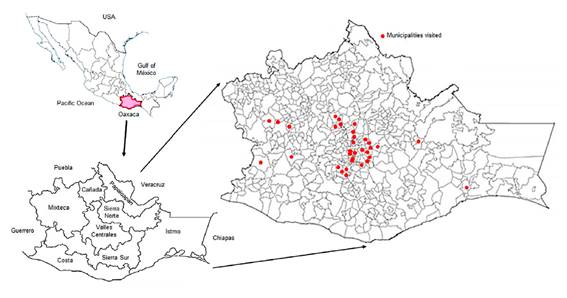
Figure 1. Study
locations in the State of Oaxaca.
Figura 1. Ubicación
del área de estudio en el estado de Oaxaca.
The study
population included tomato producers residing in the visited sites. Several
field visits identified producers who, by prior authorization and manifesting
pesticide use, completed a survey documenting age and information related to
tomato cultivation (historical time of the crop; pest and disease problems; and
pesticide use), as well as APP symptoms during or after fumigation (2, 11, 12). All individuals were informed of the
study’s objective under the Helsinki Declaration with the approval of the
Institution’s Ethics Committee.
Information
based on producers knowledge, allowed characterization of the insects and
diseases, i.e., no biological collections were taken. Revision of
technical safety sheets based on trade names determined active ingredients,
chemical classification, and type of action (herbicide, insecticide, or
fungicide). The toxicological category (TC) was based on the Federal Commission
for the Protection against Sanitary Risks (COFEPRIS, by its acronym in Spanish)
(5), substantiated by the LD50 expressed
in mg/kg recommended by the World Health Organization (WHO), and under the
Official Mexican Standard: NOM-232-SSA1-2009 (19).
Statistics
included frequencies for the qualitative variables and measures of central
tendency and dispersion for quantitative variables. The Student’s t or
Mann-Whitney U test and Pearson’s or Spearman’s Rho correlations were used,
respectively, following normality of data according to Shapiro-Wilk test for
comparison among groups (19 to 50 / >50 years, <1.0 / >1 ha
cultivated, <10 / >10 years of seniority in the activity) and the number
of AI used, and to relate the number of AI used with the number of APP symptoms
and number of pests and diseases. The statistical package used was SPPS v.15.0.
Results
The sample size
was 114 producers: 61.4% were from 26 municipalities in the Valles Centrales
region, 15.8% from four Mixteca municipalities, 10.5% from the Sierra Sur,
10.5% from the Istmo, and 1.8% in two towns in the Sierra Norte. The average
age was 43.8±14.1 years (range =19 to 73 years). The predominance age group was
19 to 50-year-old group (68.9%) followed by the >50-year-old group (31.1%).
The average area cultivated with tomatoes was 1.2±1.4 ha, with areas <1.0 ha
(73.5%) outweighing areas between 1.0 and 5.0 ha (26.5%). The average tomato
cultivation period was 8.8±7.4 years, predominantly producers with <10 years
growing tomatoes without performing crop rotation (78.1%) over producers
between 11 and 34 years old in the same activity (21.9%). According to the
farmers’ perspective, the most common problem is pest and disease attack
(92.1%), followed by economic difficulties (31.6%), lack of training and
technical advice (28.9%), droughts (26.3%), poor quality of irrigation water
(13.2%), low soil fertility (9.6%), floods (3.5%), and excessive winds (0.9%).
The average attack by insects was 2.5±2.6 of 10 different problems, mainly
white flies and various worms, while for disease development, the media was
2.2±2.3 of 8 identified diseases, mainly blight and mildew. A proportion of
38.6% of the producers stated that weeds must be controlled to guarantee crop
production (figure 2).
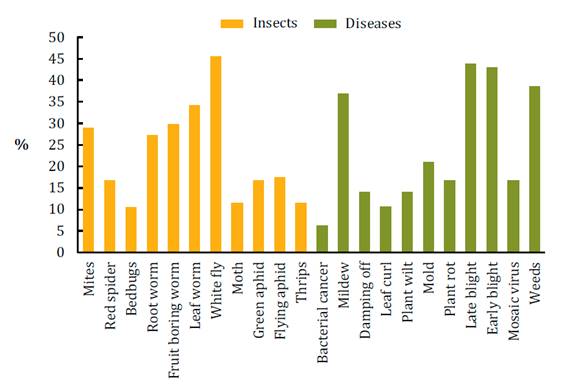
Figure 2. Pests
and diseases affecting tomato crops.
Figura 2. Plagas
y enfermedades que afectan al cultivo de tomate.
The average was
5.1±3.2 different types of pests and diseases out of 19 identified; 64% stated
up to five, 28.1% from six to ten, and 6.1% from 11 to 18.
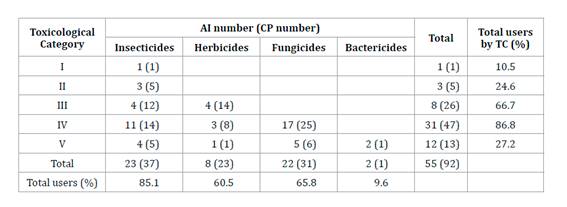
A total of 55
active ingredients (AI) from 92 commercial pesticides were identified,
corresponding to 35 chemical groups. TC IV products predominate, followed by TC
V, III, II, and I. According to their action, insecticides predominate,
followed by fungicides, herbicides, and bactericides. In general, the use of TC
IV insecticides and fungicides and TC III herbicides prevails (table
1).
Table
1. Toxicological category of identified
pesticides via active ingredients (AI) and commercial presentation (CP).
Tabla 1. Categoría
toxicológica de los plaguicidas identificados en el presente estudio, a través
de sus ingredientes activos (IA) y presentación comercial (PC).
When detection
and identification of more pests and diseases occurred, more varieties of AI
were used (Spearman’s Rho=0.202, p=0.031). In addition, there was a significant
increase in AI use on surfaces over 1 ha, compared to smaller áreas
(Mann-Whitney U = 437.5, p = 0.014). Producers with <10 years in tomato
production, used a significantly greater diversity of AI compared to producers
with greater seniority (Mann-Whitney U= 710.5, p=0.005). No significant
differences were identified between age groups and number of AI used. The most
frequently used insecticides were the combination of lamba-cyhalothrin with
imidacloprid by the commercial brand Corax (pyrethroid and neonicotinoid TC
III), imidacloprid by Confidor and Patron, methomyl by Lannate and generic
methomyl (carbamate TC II). A small group of users utilized methyl parathion as
Foley (organophosphate TC I). The most used fungicides were Captan by the same trade
name (carboxamide, TC IV), followed by mancozeb by Manzate brand
(dithiocarbamate, TC IV), metalaxyl by Ridomil mainly (anilide, TC IV), and the
combination of metalaxyl with mancozeb by Ridomil Gold. For herbicides,
glyphosate (phosphonate TC IV) and paraquat (bipyridyl TC III) stand out under
various commercial brands. The bactericides identified were streptomycin in
combination with oxytetracycline under the trade name Agri-mycin 100, used by a
small group (table 2).
Table
2. Classification of identified pesticides
in tomato crops.
Tabla 2. Clasificación
de los plaguicidas identificados en el cultivo de tomate.
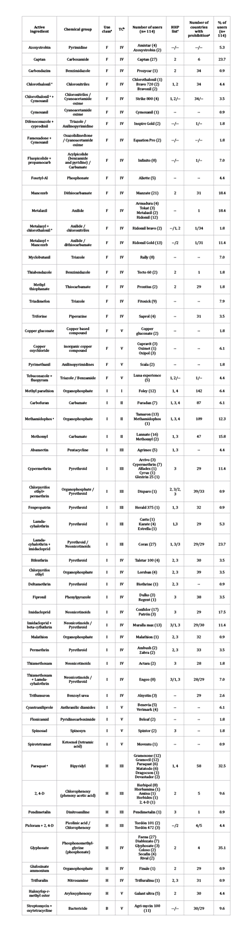
H / I / F / B:
Herbicide/Insecticide/Fungicide/Bactericide. b TC:
Toxicological Category: I (extremely dangerous), II (highly dangerous), III (moderately
dangerous), IV (slightly dangerous), and V (normally not dangerous) (5, 19). c Criteria for inclusion in the PAN International Highly
Hazardous Pesticides list: [1] High Acute Toxicity; [2] Chronic effects on
human health; [3] Environmental toxicity; and [4] Restricted or prohibited by
environmental conventions (21). d PAN
International list of prohibited pesticides in other countries (22).
e Use restricted by COFEPRIS
(2022).
a H / I / F / B: Herbicida/Insecticida/Fungicida/Bactericida. b CT: Categoría Toxicológica: I (extremadamente peligroso),
II (altamente peligroso), III (moderadamente peligroso), IV (ligeramente
peligroso), V (normalmente no peligroso) (5,
19). c Criterios de inclusión en la lista
de Plaguicidas Altamente Peligrosos de PAN Internacional: [1] Toxicidad Aguda
alta; [2] Efectos crónicos en la salud humana; [3] Toxicidad ambiental y; [4]
Restringidos o prohibidos por convenios ambientales (21). d Lista
de plaguicidas prohibidos en otros países de PAN Internacional (22).
e Uso restringido por COFEPRIS
(2022).
An average of
3.9±2.3 AI per producer is used, 48.2% use up to three AI, 32.5% from four to
six AI, and 19.3% from seven to nine AI.
Plot average
fumigation time was 2.8±1.8 hours daily. Producers (31.6%) stated having at
least one hour a day exposure, 36.8% up to three hours, and 31.6% up to six
hours. A high diversity of fungicides and insecticides control different
diseases and insects. Triazoles are chosen as fungicides, and pyrethroids,
organophosphates, neonicotinoids, and carbamates, as insecticides. Several
producers (7.9%) used duplicated applications of the same active ingredient via
different commercial products, especially three herbicides (Paraquat: Gramoxone
and generic Paraquat [0.9], Gramoxone and Matatodo [0.9%]; 2, 4-D: Amina and Herbidex [0.9%]; Glyphosate:
Diablozate with Rival [0.9%], Faena and Colossus [0.9%]; Faena with Secafin [2.6%]) and an insecticide (Ciantraniliprol: Benevia and
Verimarck [1.8%]).
In addition, a group of producers applied some pesticide mixed with foliar
fertilizers (17.5%) or other pesticides (7.9%). Three users combined
insecticides (Arrivo with Karate: cypermethrin with lamda-cyhalothrin; Foley
with Engeo: parathion with thiamethoxan+lambda-cyhalothrin; Patron with Lannate:
chlorpyrifos ethyl with methomyl), three users mixed herbicides (Herbipol with
Coloso: 2,4-D with glyphosate; Tordon 101 with Tordon 472: both contain
picloram+2,4-D; Diablozate with Tordon 101: glyphosate with picloram+2,4-D),
one user mixed fungicides (Cymoxanil with Manzate: cymoxanil with mancozeb),
and two users used insecticides with fungicides (Foley -paration- with
fungicides without mentioning their names; Karate with Cymoxanil and Manzate:
lamda-cyhalotrina, cymoxanil, and mancozeb).
The average number
of APP symptoms in producers was 3.0±2.6 out of 17 identified. While 36.0%
manifested up to three symptoms, 24.6% had four to six symptoms, and 12.3% from
seven to ten symptoms. The symptoms most frequently perceived were headache,
burning skin, dizziness, itching, muscle and stomach pain, and watery eyes, in
that order of occurrence (figure 3).
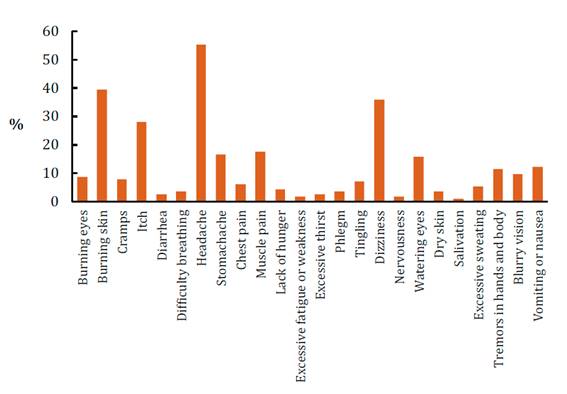
Figure 3. Symptoms
of acute pesticide poisoning perceived by users.
Figura 3. Síntomas
de intoxicación aguda por plaguicidas percibidas por los usuarios.
The average time
for the symptoms to appear was 5.0±4.5 years, during and after fumigation. No
producer mentioned using personal protection when fumigating. No significant
association was identified between the number of AI and APP symptoms
(Spearman’s Rho=0.066, p=0.488). It should be noted that 27.2% of the users
stated no symptoms.
However, 60% of
the users accepted that some pesticides used, cause said symptoms, insecticides
predominating and particularly, imidacloprid in combination with betacyfluthrin,
followed by the herbicides paraquat, picloram+2, 4-D, methamidophos, methomyl,
and glyphosate mainly (figure 4a).
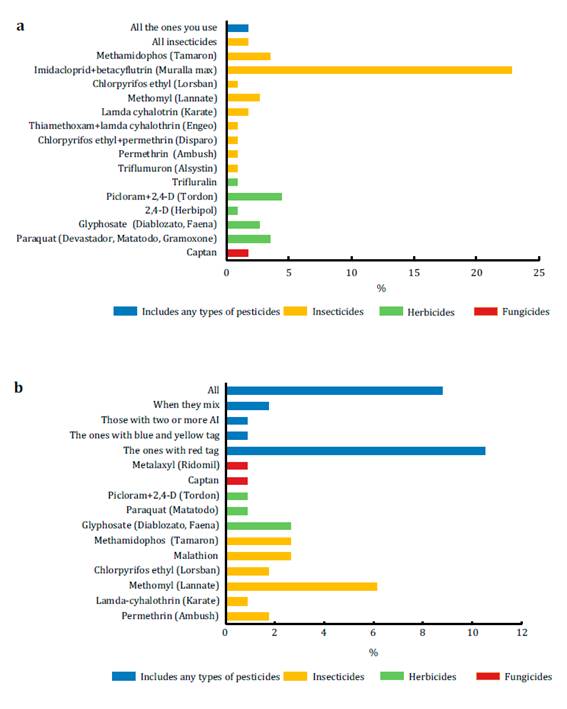
Figure 4. a-
Active ingredients perceived as responsible for APP symptoms, and b- Active
ingredients identified as the most dangerous.
Figura 4. a-
Ingredientes activos percibidos como los responsables de los síntomas de IAP y,
b- Ingredientes activos identificados como los más peligrosos por los usuarios.
A small group of
users stated all insecticides and/or pesticides used, cause their perceived
symptoms. In addition, 44.7% of the producers affirmed that red-labeled
products and insecticide and herbicide types are the most dangerous and toxic,
with methomyl and glyphosate predominating in the latter groups, respectively (figure 4b). Nine users (7.9%) agreed that the same AI
responsible for APP are the most dangerous and toxic. The products were
permethrin (Ambush), glyphosate (Diablozato and Faena), lamda-cyhalothrin
(Karate), methomyl (Lannate), chlorpyrifos ethyl (Lorsban), and methamidophos
(Tamaron), mainly belonging to neonicotinoids, pyrethroids, bipyridyl,
organophosphates, and carbamates.
Discussion
Tomatoes are one
highly demanded vegetable in the Mexican national market, and the State of
Oaxaca is no exception. This high demand for tomatoes is explained by the need
to be met in the Valles Centrales region, which is home to 33% of the state
population in 121 municipalities, and in particular, in the metropolitan area,
where 17.7% of the total population resides, and distributed in 23
municipalities. The identification of a significant number of young producers
in the Valles Centrales region coincides with this increased demand for tomato
production (29). The increased economic
opportunity is attractive for new producers. However, farmers face various
problems, some of which coincide with what has been reported in other studies,
where climate change, pests, and diseases negatively affect vegetable
productivity, including tomatoes, worldwide (15).
In particular, early blight and powdery mildew cause the most damage in the
South of Tamaulipas (27) and Sinaloa,
Mexico (8). Insects, such as white flies
and various worms cause severe damage in multiple provinces of Ecuador (4) and in the Ivory Coast, Africa (31). This reaffirms that tomatoes are susceptible
to a variety of insects and diseases (25),
that if not prevented and/or controlled, cause substantial yield losses and
severe economic impacts.
The present
study identified a significant association between using high diversity AI
against a greater number of pests and diseases, in areas >1 ha, and
producers with <10 years of experience. These findings are similar to those
reported for Los Altos de Chiapas, Mexico (1),
where increased pesticide use was found in the largest agricultural áreas with
the highest diversity of pests and diseases. Recently incorporated producers
use a greater variety of AI to obtain the highest possible agricultural yields
and guarantee investment returns, coinciding with what was reported for Loja,
Ecuador (3). These facts indicate
similarities in the circulation and use of various AI in Mexico and South
America. In addition, there is evident abuse in the application of various
pesticides individually and in mixtures, as occurs in other similar production
systems in India (13) and Ghana (6). Concerning mixtures, underreporting of
pesticide application is likely due to fear of sharing which mixtures they
consider more successful in preventing or controlling pests and diseases. It is
essential to mention that several non-COFEPRIS (2022),
recorded insecticides were identified (Glextrin 25, Casta, Estrella, and
Alsystin), probably because they are not yet registered or being sold
clandestinely in the state.
It is alarming
that 58.2% of the AI identified are considered Highly Hazardous Pesticides,
fungicides, and herbicides due to their chronic effects on human health, while
most commonly used insecticides in this group are included in the list mainly
because of their environmental toxicity. In addition, 67.3% of AI are
prohibited in other countries due to their high acute and environmental
toxicity including possible chronic health effects (21,
22). However, the fungicide chlorothalonil, the insecticide
methamidophos, and the herbicide paraquat are considered restricted pesticides
in Mexico by COFEPRIS (2022) and a recent campaign
promotes the gradual elimination of glyphosate by a presidential decree
published on December 31, 2020 (7).
Unfortunately, in the agricultural fields of the Mexican southeast, this
chemical is still being used.
Regarding APP
symptoms, 27.2% of producers stated not having any. However, it is likely they
hide their symptoms, since it is common among the rural male population to
project they are strong and perceive themselves as immune to the dangers that
APP represents (14). Several identified
APP symptoms are reported when users are exposed to acetylcholinesterase
inhibitors (muscarinic and nicotinic), such as carbamates and organophosphates
(34). Health damage from exposure via inhalation
during fumigation is exhibited mainly through symptoms related to the central
nervous system. Dermal exposure damage is seen by skin irritation given absent
personal protection while fumigating. The presence of weakness, headache,
dizziness, fever, and skin irritation have been reported with the use of
pyrethroids and carbamates mainly in small tomato producers in Cameroon (30), as well as in Arusha, Northern Tanzania (17), similar to the findings obtained in this
study.
A considerable
proportion of producers have shown three or more APP symptoms. Although no
clinical tests were used to detect residues or metabolites of the identified
pesticides, one or several pesticides used are possibly responsible for their
symptoms. The high variety of commercial products applied individually or mixed
complicates AI accurate identification concerning APP symptoms. Even though
most of the AI used belong to fungicides and insecticides of TC IV and V,
considered by Mexican regulations as only dangerous and not harmful, they still
harm human health and the environment causing potential latent health risk
among producers chronically exposed to these pesticides, as well as health
risks to consumers, since residual pesticide contamination in food has been
documented. Such is the case for the presence of pyrethroid insecticides
lambda-cyhalothrin, cypermethrin, and deltamethrin, as well as the
organophosphate chlorpyrifos on tomato surfaces (20).
In this regard, acute poisoning due to intake of contaminated food is not frequent.
However, daily consumption may lead to diseases manifesting in the long term,
such as various types of cancers (18),
implying a public health problem.
Despite the
limitation of the sample size, this study provides information for governmental
and non-governmental agencies in the agricultural sector to propose actions
addressing this problem. For example, proper training in the use and management
of pesticides is highly recommended. In addition, personal protection during
pesticide application is strongly recommended. It is also advisable to carry
out periodic phytosanitary diagnoses, establishing better control techniques,
along with gradual replacement of pesticides with more environmentally friendly
products. Taking this a step further, promoting agroecological practices (like
crop rotation, use of plant extracts and allelopathic plants, among others) (23), guarantees healthier plants, and promotes a
safer work environment and more nutritious food for the consumer.
Pesticide-residue monitoring in the harvested product, water, and soil, as well
as in users and consumers, helps identify possible risks to public health and
the environment.
Conclusions
Younger
producers are introducing themselves to tomato cultivation under a conventional
system with the intensive use of various pesticides, predominantly TC IV
insecticides and fungicides, as well as TC III herbicides. Primary damages to
tomato crops are due to white flies, multiple worms, blight, mildew, and weeds.
In the short period of conventional agriculture, increasing pests and diseases
in areas >1 ha is associated with using a greater variety of pesticides.
Most producers had up to six APP symptoms, related to organophosphates and
carbamates, and predominantly to the central nervous system and skin. However,
the possibility that several symptoms are related to other chemical groups has
not been ruled out. Pesticide use will likely continue in the area studied,
thus, in the medium to long term, health damages associated with acute and
chronic exposure to the pesticides identified will continue. We recommend
promoting the adoption of agroecological practices, providing training in the
proper use and management of pesticides, and gradual substitution with less
aggressive products.
1. Bernardino,
H. H. U.; Mariaca, M. R.; Nazar, B. A.; Álvarez, S. J. D.; Torres, D. A.;
Herrera, P. C. 2016. Factores socioeconómicos y tecnológicos en el uso de
agroquímicos en tres sistemas agrícolas en Los Altos de Chiapas, México.
Revista Interciencia. 41(6): 382-392.
http://www.redalyc.org/articulo.oa?id=33945816003
2. Bernardino,
H. H. U.; Mariaca, M. R.; Nazar, B. A.; Álvarez, S. J. D.; Torres, D. A.;
Herrera, P.C. 2019. Conocimientos, conductas y síntomas de intoxicación aguda
por plaguicidas entre productores de tres sistemas de producción agrícolas en
los Altos de Chiapas, México. Rev. Int. Contam. Ambie. 35(1): 7-23.
doi:10.20937/RICA.2019.35.01.01
3.
Castillo-Pérez, B.; Castillo-Bermeo, V. 2021. Uso de plaguicidas químicos en
tomate riñón (Solanum lycopersicum L.) en condiciones de invernadero y
campo en Loja, Ecuador. CEDAMAZ Revista del Centro de Estudio y Desarrollo de
la Amazonia. 11(1): 22-41. https://revistas.
unl.edu.ec/index.php/cedamaz/article/view/1034
4. Chirinos, D.
T.; Castro, R.; Cun, J.; Castro, J.; Peñarrieta, B. S.; Solis, L.;
Geraud-Pouey, F. 2020. Los insecticidas y el control de plagas agrícolas: la
magnitud de su uso en cultivos de algunas provincias de Ecuador. Ciencia y
Tecnología Agropecuaria. 21(1): e1276. doi: https://doi.org/10.21930/rcta.vol21_num1_art:1276
5. Comisión
Federal para la Protección contra Riesgos Sanitarios (COFEPRIS). 2022. Consulta
de registros sanitarios de plaguicidas, nutrientes vegetales y LMR. México:
COFEPRIS, Secretaria de Salud. http://siipris03.cofepris.gob.mx/Resoluciones/
Consultas/ConWebRegPlaguicida.asp, (consultation date: 12/06/2022).
6. Dari, L.;
Addo, A.; Dzisi, K. A. 2016. Pesticide use in the production of tomato (Solanum
lycopersicum L.) in some areas of Northern Ghana. African Journal of
Agricultural Research. 11(5): 352-355. doi:10.5897/AJAR2015.10325
7. Diario
Oficial de la Federación. 2020. Secretaria de Gobernación. México.
https://www.dof.gob.mx/nota_detalle.
php?codigo=5609365&fecha=31/12/2020#gsc.tab=0, (consultation date a:16/09/2022).
8.
Félix-Gastélum, R.; Maldonado-Mendoza, I. E.; Beltrán-Peña, H.;
Apodaca-Sánchez, M. A.; Espinoza-Matías, S.; Martínez-Valenzuela, M. C.;
Longoria-Espinoza, R. M.; Olivas-Peraza, N. G. 2017. Powdery mildews in
agricultural crops of Sinaloa: Current status on their identification and
future research lines. Revista Mexicana de Fitopatología. 35: 106-129.
https://doi.org/10.18781/r.mex.fit.1607-4
9. Fideicomisos
Instituidos en Relación a la Agricultura (FIRA). 2019. Panorama agroalimentario.
Tomate rojo 2019. Dirección de Investigación y Evaluación Económica y
Sectorial. México.
https://www.inforural.com.mx/wp-content/uploads/2019/06/Panorama-Agroalimentario-Tomate-rojo-2019.pdf
10. García, G.
C.; Rodríguez, M. G. D. 2012. Problemática y riesgo ambiental por el uso de
plaguicidas en Sinaloa. Ra Ximhai. 8(3): 1-10. http://www.redalyc.org/articulo.oa?id=46125177005
11. Jensen, H.
K.; Konradsen, F.; Jørs, E.; Petersen, J. H.; Dalsgaard, A. 2011. Pesticide use
and self-reported symptoms of acute pesticide poisoning among aquatic farmers
in Phnom Penh, Cambodia. Journal of Toxicology. 8. doi:10.1155/2011/639814
12.
Kangkhetkron, T.; Juntarawijit, C. 2012. Factors influencing practice of
pesticide use and acute health symptoms among farmers in Nakhon Sawan,
Thailand. Int J Environ Res Public Health. 18(16): 8803. doi:10.3390/ijerph18168803
13.
Keshavareddy, G.; Nagaraj, K. H.; Kamala, B. S.; Kulkarni, L. R. 2018.
Pesticides usage and handling by the tomato growers in Ramanagara District of
Karnataka, India-An Analysis. International Journal of Current Microbiology and
Applied Sciences. 7(4): 3312-3321. https://doi.org/10.20546/ijcmas.2018.704.375
14. Kunin, J.;
Aldana, L. P. 2020. Percepción social del riesgo y dinámicas de género en la
producción agrícola basada en plaguicidas en la Pampa Húmeda Argentina.
Sexualidad, Salud y Sociedad. Revista Latinoamericana. 35: 58-81.
http://doi.org/10.1590/1984-6487. sess.2020.35.04.a
15. Litskas, V.
D.; Migeon, A.; Navajas, M.; Tixier, M. S.; Stavrinides, M. C. 2019. Impacts of
climate change on tomato, a notorious pest and its natural enemy: small scale
agriculture at higher risk. Environmental Research Letters. 14(8): 1-9.
https://doi.org/10.1088/1748-9326/ab3313
16. Liu, J.;
Wang, X. 2020. Tomato diseases and pests detection based on improved Yolo V3
convolutional neural network. Front Plant Sci. 11: 898.
https://doi.org/10.3389/fpls.2020.00898
17. Manyilizu,
W. B.; Mdegela, R. H.; Helleve, A.; Skjerve, E.; Kazwala, R.; Nonga, H.;
Muller, M. H. B.; Lie, E.; Lyche, J. 2017. Self-reported symptoms and pesticide
use among arm workers in Arusha, Northern Tanzania: A cross sectional study.
Toxics. 5(4): 24. doi: 10.3390/ toxics5040024
18. Morera, R.
I. 2015. Identificación de principios activos de plaguicidas en frutas,
hortalizas y granos básicos en Costa Rica: Una propuesta para la implementación
de nuevas metodologías de análisis. Revista Pensamiento Actual. 15(25):
155-171. https://revistas.ucr.
ac.cr/index.php/pensamiento-actual/article/view/22602/24026
19. Norma
Oficial Mexicana NOM-232-SSA1-2009. Diario Oficial de la Federación. Publicado
el 13 de abril de 2010. https://www.gob.mx/cofepris/documentos/nom-232-ssa1-2009-plaguicidas,
(consultation date: 3/06/2022).
20. Páez, M. M.
I.; Varona, U. M.; Díaz, S. M.; Castro, R. A.; Barbosa, E.; Carvajal, N.;
Londoño, A. 2011. Evaluación de riesgo en humanos por plaguicidas en tomate
cultivado con sistemas tradicional y BPA (Buenas Prácticas Agrícolas). Revista
de Ciencias Sociales. 15: 153-166. https://doi.org/10.25100/rc.v15i0.523
21. Pan
International. 2021. List of Highly Hazardous Pesticides. March 2021. Pesticide
Action Network International c/o PAN International, Hamburg, Germany. https://
pan-international.org/wp-content/uploads/PAN_HHP_List-es.pdf, (consultation date:
12/04/2022).
22. Pan
International. 2022. PAN International Consolidated List of Baned Pesticide.
2022. Pesticide Action Network International c/o PAN International c/o PAN Asia
Pacific, Penang, Malaysia. 6th edition. https://pan-international.org/pan-international-consolidated-list-of-bannedpesticides/,
(consultation date: 12/04/2022).
23. Peredo, P.
S.; Barrera, S. C. 2019. Evaluación participativa de la sustentabilidad entre
un sistema campesino bajo manejo convencional y uno agroecológico de una comunidad
Mapuche de la Región de la Araucanía (Chile). Revista de la Facultad de
Ciencias Agrarias. Universidad Nacional de Cuyo. Mendoza. Argentina. 51(1):
323-336.
https://revistas.uncu.edu.ar/ojs3/index.php/RFCA/article/view/2454/1777
24. Pérez, M.
A.; Navarro, H.; Miranda, E. 2013. Residuos de plaguicidas en hortalizas:
problemática y riesgo en México. Rev. Int. Contam. Ambie . 29 (Número
especial sobre plaguicidas): 45-64. https://www.revistascca.unam.mx/rica/index.php/rica/article/view/41423
25. Reinoso, J.
2015. Diagnóstico del uso de plaguicidas en el cultivo de tomate riñón en el
Cantón Paute. Maskana. 6(2):147-154. https://doi.org/10.18537/mskn.06.02.11
26. Rodríguez,
B. M. K.; Zavaleta, D.; Reyes, V. L.; Torres, A. H.; Bernardino, H. H. U. 2020.
Uso de plaguicidas e intoxicaciones agudas en la población rural de San
Baltazar Chichicápam, Oaxaca, México. Revista AIDIS-UNAM. 13(2): 616-629.
http://dx.doi.org/10.22201/iingen.0718378xe.2020.13.2.68117
27. Salas, G. A.
L.; Osorio, H. E.; Espinoza, A. C. A.; Rodríguez, H. R.; Segura, M. M. T. J.;
Neri, R. E.; Estrada, D. B. 2022. Principales enfermedades del cultivo de
tomate (Solanum lycopersicum L.) en condiciones de campo. Ciencia Latina
Revista Científica Multidisciplinar. 6(1): 1-21. https://doi.org/10.37811/cl_rcm.v6i1.1793
28.
Schreinemachers, P.; Simmons, E. B.; Wopereis, M. C. S. 2018. Tapping the
economic and nutritional power of vegetables. Global Food Security. 16: 36-45.
https://doi.org/10.1016/j.gfs.2017.09.005
29. Sistema de Información
Agroalimentaria y Pesquera. 2021. Producción anual agrícola. Sistema de Información
Agroalimentaria y Pesquera (SIAP). Gobierno de México.
https://www.gob.mx/siap/documentos/siacon-ng-161430 y https://nube.siap.gob.mx/
avance_agricol/, (consultation date: 14/07/2022).
30. Tandi, T.;
Wook, C.; Shendeh, T.; Eko, E.; Afoh, C. 2014. Small-scale tomato cultivators’
perception on pesticides usage and practices in Buea Cameroon. Health. 6:
2945-2958. doi: 10.4236/health.2014.621333
31. Tonessia, D.
C.; Soumahin, E. F.; Boye, M. A. D.; Niangoran, Y. A. T.; Djabla, J. M.; Zoh,
O. D.; Kouadio, Y. J. 2018. Diseases and pests associated to tomato cultivation
in the locality of Daloa (Côte d’Ivoire). Journal of Advances in Agriculture.
9: 1546-1557. doi:10.24297/jaa.v9i0.7935
32. Tudi, M.;
Ruan, D. H.; Wang, L.; Lyu, J.; Sadler, R.; Connell, D.; Chu, C.; Phung, D.T.
2021. Agriculture development, pesticide application and its impact on the
environment. Int. J. Environ. Res. Public Health. 18: 1112. https://doi.org/10.3390/ijerph18031112
33. Umetsu, N.;
Shirai, Y. 2020. Development of novel pesticides in the 21st century. Journal
of Pesticide Science. 45(2): 54-74. doi:
10.1584/jpestics.D20-201
34. Virú, L. M.
A. 2015. Manejo actual de las intoxicaciones agudas por inhibidores de la
colinesterasa: conceptos erróneos y necesidad de guías peruanas actualizadas.
Anales de la Facultad de Medicina. 76(4): 431-437.
http://dx.doi.org/10.15381/anales.v76i4.11414