Revista de la Facultad de Ciencias
Agrarias. Universidad Nacional de Cuyo. Tomo 56(1). ISSN (en línea) 1853-8665.
Año 2024.
Original article
Traditional
cow-calf systems of the northern region of Santa Fe, Argentina: current
situation and improvement opportunities
Sistemas
de cría tradicionales de la región norte de Santa Fe, Argentina: situación
actual y oportunidades de mejora
Javier Baudracco2,
Carlos Dimundo1,
Belén Lazzarini1,
Julieta Scarel3,
Agustín Alesso2,
Claudio Machado4
1Universidad
Nacional del Litoral. Facultad de Ciencias Agrarias. R.P. Kreder 2805 2° Piso.
C. P. 3080. Esperanza. Argentina.
2Universidad
Nacional del Litoral. FCA. CONICET. IciAgro Litoral. R. P. Kreder 2805. C. P.
3080. Esperanza. Argentina.
3Instituto
Nacional de Tecnología Agropecuaria. Agencia de Extensión Rural INTA Calchaquí.
Bv. Belgrano 939. C. P. 3050. Calchaquí. Argentina.
4Facultad
de Ciencias Veterinarias. Centro de Investigación Veterinaria de
Tandil-CIVETAN. CICPBA-CONICET, PROANVET UNCPBA. B7000GHG. Tandil. Argentina.
*guillerminagregoretti.gg@gmail.com
Abstract
Cow-calf systems
are at the core of Argentina´s significant national beef industry. The objectives
were: i) to characterize the productive state of traditional cow-calf systems, named
BASE, from the northern region of Santa Fe province, ii) to identify
technologies for the productive improvement of the BASE system, and iii) to
quantify the productive and economic impact of the adoption of the identified
technologies. To characterize the BASE system, the available published data
were systematized and validated in a workshop with leading regional experts in
the field. To identify the technologies for improvement, a survey was conducted
among regional farm advisors. Finally, to quantify the impact of adopting
improvements in the BASE system, a modelling study was conducted. The results showed
that traditional cow-calf systems have low productive and reproductive
efficiency (45 kg LW ha-1 year-1 and 48% weaning rate)
and little adoption of herd management and forage production technologies. The
technologies identified were grazing management, training of farmers and farm
staff, and seasonal mating. The modelling study showed that improvements in the
production and use of forage and herd management practices would increase beef
production and the gross margin of the BASE system by 70% and 96%,
respectively.
Keywords: beef production,
survey, technologies, simulation, opportunities
Resumen
Los sistemas de
cría son el núcleo de la importante industria nacional de carne bovina de
Argentina. Los objetivos fueron: i) caracterizar la situación productiva de
sistemas de cría tradicionales, nombrado BASE, del norte de la provincia de
Santa Fe ii) identificar tecnologías para su mejora productiva iii) cuantificar
el impacto productivo y económico de la adopción de las tecnologías
identificadas. Para caracterizar el sistema BASE se sistematizó la información
disponible que fue validada en un taller con expertos referentes de la zona.
Para identificar tecnologías de mejora, se implementó una encuesta a asesores
referentes de la región. Finalmente, para cuantificar el impacto de la adopción
de mejoras en el sistema BASE se realizó un estudio de simulación. Los
resultados demostraron que los sistemas de cría tradicionales tienen baja
eficiencia productiva y reproductiva (45 kg de PV ha-1 año-1
y 48% de destete, respectivamente) y baja adopción de tecnologías de manejo del
rodeo y producción forrajera. Las tecnologías identificadas fueron manejo del
pastoreo, capacitación del productor y el personal de campo y estacionamiento
del servicio. La simulación demostró que mejoras en producción y uso de
forrajes y manejo de rodeo podrían incrementar la producción de carne y el
margen bruto del sistema BASE en un 70% y 96%, respectivamente.
Palabras claves:
producción
de carne, encuesta, tecnologías, simulación, oportunidades
Originales: Recepción: 12/04/2023 - Aceptación: 29/02/2024
Introduction
The livestock
sector faces the challenge of producing food in the context of increasing global
demand for meat, which is estimated to increase by 1.6% per year (30). Intensification has been a way to improve
productivity and efficiency in the beef production sector and has contributed
to an increase in food production since the mid-twentieth century (18, 38). Intensification of livestock systems is
defined as an increase in meat and milk production per animal and per area of
land (31). In beef production systems,
there are mainly two ways of intensification: through the increase in pasture
production and supplementation of animals in grazing systems, or through the
confinement of animals in feedlots with high feed offers (20).
Argentina
produces 3.1 thousand tonnes of beef and ranks fourth among the world’s beef-producing
and exporting countries (43). Beef
production is a relevant activity for the country’s economy because it
contributes 28.7% of gross domestic income and 11% of private employment within
the agricultural industry (14). However,
the national average weaning rate (total of weaned calves/ total of cows × 100)
is lower (63%) (26) than that in other
beef-producing countries such as Australia (70%) (41)
and New Zealand (80%) (42). In Argentina,
more than 95% of the area used for cow-calf systems is based on natural grasslands
(non-cultivated environments), with poor synchronization between forage supply
and livestock nutrient demand, reduced control of animal diseases (15), mainly concerning venereal and reproductive
diseases (2), and low stocking rates
(less than 0.50 cow ha-1) (26),
resulting in low productivity, in terms of beef production per hectare (less
than 90 kg ha-1) (26).
Buenos Aires
province is the main beef-producing region of Argentina, and different studies
have evaluated the impact of technological improvements (3, 16), technical assistance on the productivity
of systems (33), and pasture production (22), among others. However, for the second most
important region in calves´ provision, the northern region of Santa Fe
province, which provides 10% of total Argentine calves (26), there is minimal information regarding the
characterization of technified systems (21),
but none for traditional systems. Therefore, the objectives of the present
study were: i) to characterize the productive situation of the traditional
cow-calf systems (hereafter BASE system) in the northern region of Santa Fe
province, Argentina; ii) to identify technologies for improving productivity
based on critical technologies; and iii) to quantify the productive and
economic impacts of applying technologies.
Materials
and methods
Description
of the region
The cow-calf
systems analysed in this study are located in the north-central region of
Argentina, between 28° to 30° South and 59° to 60° West in the departments of
General Obligado and Vera in the province of Santa Fe. This region has
approximately 900,000 ha of agricultural use (10).
The climate is subtropical with average, minimum, and maximum annual air
temperature of 20.1°C, 10.1°C (July) and 28.2°C (January), respectively (23). The average annual rainfall (±SD) (over the
last 50 years) is 1,294 ± 310 mm, concentrated in the warmest season (82%
between October and April) (24).
Predominant soils belong to the Natracualf and Alfacualf groups, with drainage
deficiency and saline-sodium conditions (19).
Productive
characterization of the traditional systems
Different
sources of information (scientific literature, technical reports, national and
regional statistics and a workshop with local experts) were used to
characterize the traditional (BASE) system in terms of land use, herd
management, forage production, and productive efficiency indicators such as
stocking rate (cows ha-1), weaning rate (%), and beef production (kg
of calves beef ha-1 year-1 and kg of LW ha-1
year-1).
Survey
design: Identification and ranking of technologies to improve productivity
A digital survey
(Google Forms) was designed to identify and rank technologies that could
promote the improvement of traditional systems. The project’s interdisciplinary
team identified most region-based farm advisors and extensionists with
recognized expertise in the field (n = 22) and invited them to complete the
survey. The survey was structured into 10 questions. Questions 1 to 6 refer to
the degree of agreement that advisors had regarding the priority of
improvements in forage resources, herd management, productive and economic
records, and farm infrastructure. Questions 7 to 10 refer to the technologies
that advisors prioritize to improve forage resources, herd management, and farm
infrastructure. To analyze the results, radar charts were created with the
average priority for each option. The prioritization patterns for each question
were analyzed using principal components analysis. In addition, the
relationship between the prioritizations assigned according to expertise
background (agriculture or veterinary science) and work environment (private or
public) of the respondents was evaluated using ANOVA. Infostat software version
2018 (12) was used for statistical
analyses.
Simulation of
productive and economic impact of applying technologies
1- Simulation
model: The productive and economic impact of the adoption of the identified
technologies in the survey described above was quantified through a
participatory modelling approach (17)
using Baqueano Cría software (40). This
deterministic simulation model represents stabilized cow-calf systems and
allows for monthly estimations of herd dynamics, forage and energy balance
between feed supply and animal requirements, and productive and economic
results. The main inputs of this model include herd composition, prices and
live weight of cattle categories, monthly availability of forage, and prices of
the main inputs (food, health, and labour). The main outputs included beef
production (kg LW ha-1 year-1) and gross margin (U$S ha-1).
2- Simulation of
BASE and improved systems: The traditional cow-calf systems, characterized in
the present study (objective i) and named as BASE system, were first simulated.
It was used as the baseline to simulate three further scenarios, using
technologies to improve productivity and economic results (improved systems) (table 1).
Table
1. Characteristics of the BASE system and
improved systems include: increased stocking rate (+SR), increased reproductive
efficiency (+EFFICIENCY) and the combination of both alternatives (+SR+E).
Tabla 1. Características
del sistema BASE y sistemas mejorados incluyendo: aumento de carga animal
(+SR), aumento de la eficiencia reproductiva (+EFFICIENCY) y la combinación de
ambas alternativas (+SR+E).
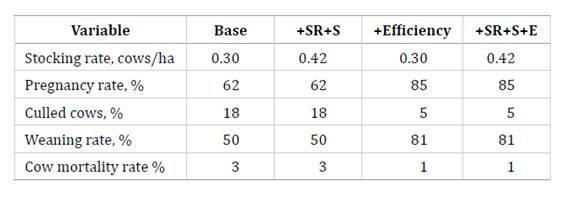
Based on the
technologies identified as critical by the experts (objective ii of this
study), three improved systems were designed (table 1):
+SR+S, which includes increased stocking rate and supplementation with hay
(+39% SR and +173% of hay than the BASE), +EFFICIENCY, which includes higher
pregnancy rates and lower mortality rates in cows and calves; and finally
+SR+S+E system was simulated, which combined the alternatives +SR+S and
+EFFICIENCY. It was assumed that the greater pregnancy efficiency was the
result of strategic supplementation (2.5 kg of DM of cottonseed and 1 kg of DM
sorghum seed cow -1 d -1 between May and September) due
to its incidence on the body condition of cows (35),
and mortality rates were reduced due to better health management, with greater
expenses on cow health (+77% compared to BASE).
3- Productive
and economic assumptions: Forage production and utilization for the BASE system
were obtained from the database reviewed for objective (i) of this study (table 2), and the same figures were assumed for the improved
systems. The mating season was assumed to occur from November to February for
all systems.
Table
2. Average forage production (Tn DM ha-1
year -1) of the traditional cow-calf system of the northern region
of Santa Fe province.
Tabla 2. Valores
de producción (Tn MS ha-1 año-1) de los recursos
forrajeros de los sistemas de cría tradicionales del norte de la provincia de
Santa Fe.

Economic values
are expressed in U.S. dollars (U$S dollars). A cost of US$ 16 cow -1
was assumed for animal health. Full-time employees were considered for all farm
tasks (180 cows), with a monthly salary of US$744. Herd live weights and farm
prices are listed in table 3.
Table
3. Herd live weight (kg head-1)
and farm price (U$S kg-1) of different animal categories in a
cow-calf system in the northern region of Santa Fe province.
Tabla 3. Peso
(kg cabeza-1) y precio (U$S kg-1) de las diferentes
categorías en un sistema de cría bovina de la región norte de la provincia de
Santa Fe.
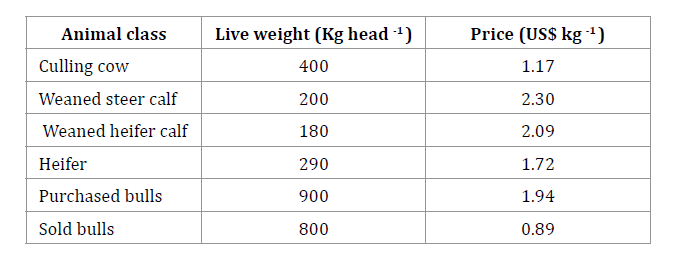
The purchase and
sale expenses of the different animal categories were 5% and 2% of the price,
respectively. The annual gross margin, defined as the difference between net
income and direct costs (1), was also simulated, considering the
prices of the main products for the region (feed, health, and labour).
Results
and discussion
Productive
characterization of the traditional cow-calf system in northern región of Santa
Fe
Use of area
and forage resources
Three
contrasting vegetation environments were differentiated in the region:
grasslands, forests, and low-stratum vegetation (27).
Such environments are usually found in each farm in proportions of 50%, 35%,
and 15% of the total area, respectively (11).
The aforementioned diversity of environments poses a challenge for livestock
management as they have different herbage mass rates, which implies different
grazing management in each environment.
1- Grasslands:
It is defined as plant communities dominated by various species where it
predominates Sorghastrum setosum (Grise.) Hitchc (5, 34). The forage contribution to livestock in
these environments varies from 3,000 to 6,000 kg DM ha-1. Other
species with high forage value, such as legumes (i.e., genus Desmodium,
Desmanthus, and Vicia) and grasses of the genus Paspalum (5), can be found in this environment.
2- Forest: The
predominant species in this environment was Schinopsis balansae Engl.
Plant communities in the forest are dominated by species of the genera Stipa
and Piptochaetium (28). These
environments provide forage for cattle in variable quantities and quality
(1,000-5,000 kg MS ha-1) according to the state of forest
conservation.
3- Low stratum
vegetation: These environments are dominated by hygrophilous herbaceous
communities dominated by grasses such as Echinochloa helodes (Hackel) Parodi,
Leersia hexandra Sw., and Luziola peruviana Juss. Ex J.F. Gmel.,
with a dry matter production of 6,000 to 8,000 kg ha-1 (34).
Improvement of
forage production through fertilization or introduction of cultivated species
such as perennial pastures or annual forage crops is almost null among the
traditional farms in the northern region of Santa Fe province. Cultivated
forage species are usually no more than 2% of total area in cow-calf systems
some cultivated species are Avena sativa L., Melilotus albus Medik,
Medicago sativa L., Sorghum bicolor L. Monech and Chloris
gayana Kunth (6).
Productive
and reproductive efficiency and herd management
Mating is
continuous throughout the year, with little adoption of herd management and
health technologies, such as venereal disease control (13). The age at the first mating is usually
greater than 24 months. Supplementation of heifers is carried out occasionally with
pasture hay (less than 1 kg DM animal-1) in winter and, to a lesser
extent, energy concentrates, such as corn and sorghum grains (6). Calve weaning is performed at 8 months of
age, the weaning rate is 48%, and beef production is approximately 45 kg LW ha-1
year-1 (6).
Survey
results: opportunities for technological improvement
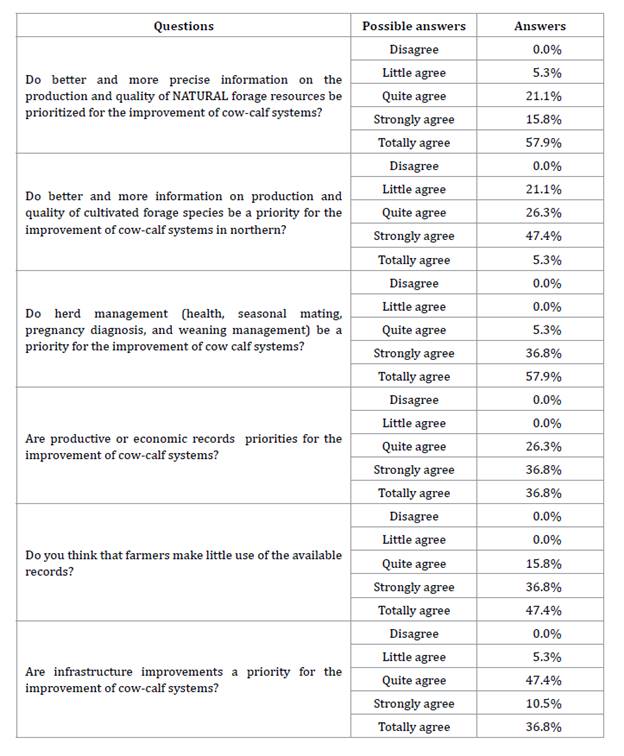
There was a high
level of answers (86% of the invited regional consultants). Respondents were
highly experienced experts in veterinary sciences (42%) and agriculture science
(58%). The results are presented in table 4 and figure
1.
Table
4. Questions 1 to 6 used in the survey to
regional farm advisors and answers.
Tabla 4. Preguntas
utilizadas en la encuesta a asesores referentes y respuestas.
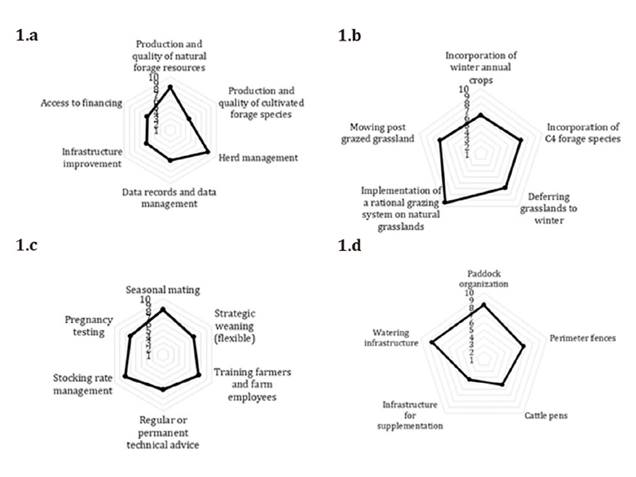
Priority in: (1.b.) forage supply, (1.c.) herd
management, (1.d) infrastructure.
Prioridad en: (1.b.) oferta forrajera, (1.c.) manejo
del rodeo, (1.d.) infraestructura.
Figure 1. Technologies
prioritized by advisors, (10 maximum, 1 minimum). (1.a.) Priority of potential
technological improvements.
Figura 1. Tecnologías
priorizadas por los asesores, (10 máximo, 1 mínimo). (1.a.) Prioridad de
mejoras tecnológicas potenciales.
Priority given
to improve herd management was higher for professionals working in the private sector
(p < 0.05), and in general, answers for each aspect (forage supply, herd
management practices, and farm infrastructure) were independent of the career
and the field of work of the respondents (p > 0.05).
Productive
and economic impact of technological improvements
The results of
the modelling studies are shown in figure 2.
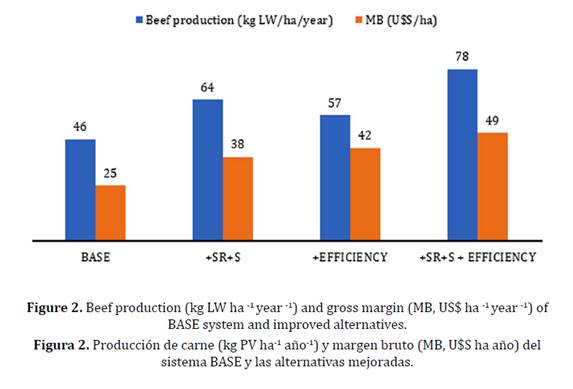
Figure 2. Beef
production (kg LW ha-1 year-1) and gross margin (MB, US$
ha-1 year-1) of BASE system and improved alternatives.
Figura 2. Producción
de carne (kg PV ha-1 año-1) y margen bruto (MB, U$S ha-1
año-1) del sistema BASE y las alternativas mejoradas.
All three
improved systems resulted in higher beef production and a higher gross margin
than those of the BASE system. The +SR+S+E alternative showed an increase of
70% and 96% in beef production and gross margin, respectively, compared with
the BASE system, despite showing higher direct costs (figure 2).
These results agree with previous simulation studies (16, 17) conducted in other regions of Argentina,
which showed that the combination of increased SR increased supplementation,
and better reproductive management (similar to +SR+S+E in this study) would
increase productive and economic results to a greater extent than if they are
implemented as sole alternatives.
A change in
stocking rate directly influences income as it correlates with the growth of livestock
capital. However, it’s essential to note that the economic efficiency of
agricultural systems can be significantly influenced by factors beyond the
scope of this study, such as the land tenure regime (39).
Table
5 shows previous studies and compares the contrasting productive parameters
between the traditional system and existing top technological systems (high use
of technologies) in the same region (21).
Table
5. Productive differences between the
traditional and top cow-calf systems of the northern region of Santa Fe
province.
Tabla 5. Diferencias
productivas entre sistemas tradicionales y tecnificados de la región norte de
la provincia de Santa Fe.
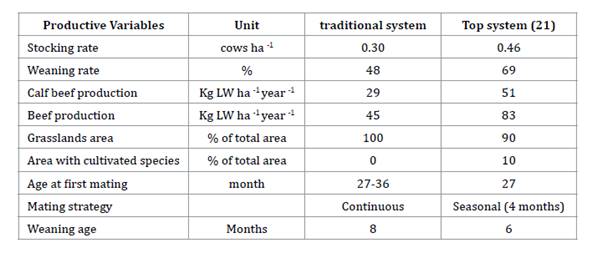
The productive
potential of current top cow-calf systems (those having greater technological
adoption and management skills compared to traditional farmers in the region)
in this region has been recently estimated (21)
and the technological gap with the BASE system is 86% in beef productivity
(kg/ha/year) and 44% in weaning rate (table 5). This
difference is based on the application of technologies that increase forage
supply (greater area of cultivated pastures and annual forage crops) and improve
herd management techniques, such as greater supplementation of cows, higher stocking
rate, seasonal mating, and shorter age for first mating and weaning applied in
the top systems compared to the traditional systems.
Fernandez-Rosso et al. (2020) reported 63% more
beef production and 340% higher gross margin in systems that combined herd
management technologies such as early weaning (2 to 4 months) and implantation
of cultivated forage species, in the southwest of Buenos Aires province,
compared with traditional systems of that region.
Data available
from net aerial primary productivity (NAPP) and the quality of forage available
in the region under study are mainly reported for cultivated pastures (32, 36). The productive and economic simulations
carried out in this study were based on NAPP data of natural forage resources
using a combination of unpublished data of forage cuts validated by experts (table 2). However, alternative methodologies that allow for the
estimation of NAPP have been applied with promising results in other regions of
Argentina, such as the green index (22),
simulation models (4), and regression equations for forage cuts (17), and could be used in future studies.
In the northern
region of Santa Fe Province, there have been several public policies aimed at
assisting farmers in improving the productive efficiency of cow-calf systems
through subsidized loans and farm advisory support by applying and monitoring
health, nutritional, and reproductive management technologies (7, 29). However, the low adoption of technologies
and the current low productive and reproductive efficiency (table
5), which have remained stable for years (8, 9),
reflect the low effectiveness of those policies. This situation encourages a
deeper understanding of the causes of farmers’ scarce technological adoption.
In other important beef cattle breeding regions of the country, barriers to the
adoption of technologies in farming systems are mentioned. In cow-calf system
studies located in Buenos Aires province, it has stood out (17, 35) as adoption barriers of technology in the
cattle breeding systems of that region due to a lack of training in process
technologies, the absence of suitable public policies for the region, and the
producers’ partial dedication to the activity. Additionally, barriers related
to the lack of agricultural vocation among heirs and the absence of technical
assistance in low-tech systems have also been described (17).
The applied
participatory modelling methodology (17)
provided preliminary information and a “what if” analysis (25) of this important productive area. However,
the productive characterization of cow-calf traditional systems carried out in
this study will require additional research to refine farm information and to
define barriers to technological adoption in breeding systems in northern Santa
Fe. This understanding might aid in the better design of public policies, which
should include the social and cultural conditions of farmers (37). This methodology was also key to the
conservation and sustainable development of livestock systems in other
countries (44).
Conclusions
We combined the
available scarce data on traditional cow-calf systems in the northern region of
Santa Fe Province with the qualified knowledge provided by highly experienced
farm advisors, in order to establish a benchmark and to identify challenges for
future studies. Experts prioritized the improvement of forage supply and herd
management to increase the productivity of cow-calf systems. Implementation of
a rational grazing system for grasslands, training the farmer and farm staff on
herd management, and seasonal mating were the factors selected to be adopted in
the first place. The modelling study showed that increased SR, higher
supplementation and higher reproductive efficiency increased production and
economic results by 70 and 96%, respectively. The participatory modelling
methodology applied also allowed us to identify areas in which greater research
efforts are needed, such as more precise research information on farm
characterisation, forage production and quality, and farmers’ constraints for
technological adoption, which will be relevant inputs for designing and
promoting effective policies for the livestock sector.
Acknowledgements
The authors
express their gratitude to the Consorcio Regional de Experimentación
Agropecuaria Región Norte de Santa Fe (CREA) and its advisors for generously
providing the data and collaborating in discussions, offering valuable
suggestions for describing the traditional systems in the region. This research
is a part of the first author’s doctoral studies in Agriculture Science at the
Universidad Nacional del Litoral. This research was funded by a doctoral
scholarship from CONICET and a research project from Ministerio de Ciencia y
Tecnologia (PICT-2017-2271).
1. AACREA. 1990.
Normas para medir los resultados económicos en las empresas agropecuarias. Convenio
AACREA BANCO RIO. Buenos Aires. Argentina.
2. Abdala, A.
A.; Maciel, M. G.; Salado, E.; Aleman, R.; Scandolo, D. 2013. Pérdidas de
preñez en un rodeo de cría del norte de la provincia de Santa Fe. Rev. Arg.
Prod. Anim. 33(2):109- 115.
3. Andreu, M.;
Giancola, S. I.; Carranza, A.; Roberi, A.; Serena, J.; Carranza, F.; Nemoz, J.
P.; Meyer Paz, R. 2014. Resultados físicos y económicos de la implementación de
tecnologías críticas en sistemas ganaderos bovinos de ciclo completo en Cuenca
del Salado, provincia de Buenos Aires. Instituto Nacional de Tecnología
Agropecuaria, Centro de Investigación en Economía y Prospectiva (CIEP). Azul.
Argentina.
4. Berger, H.;
Machado, C. F.; Agnusdei, M.; Cullen, B. R. 2014. Use of a biophysical
simulation model (DairyMod) to represent tall fescue pasture growth in
Argentina. Grass and Forage Science. 69(3): 441-453. doi
10.1111/gfs.12064
5. Capozzolo, M.
C.; Crudeli, S. M.; Rollo, L. 2017a. Análisis de la base forrajera de un
sistema de cría bovina. Revista Voces y Ecos N° 37. Instituto Nacional de
Tecnología Agropecuaria, Estación Experimental Reconquista. Reconquista.
Argentina.
6. Capozzolo,
C.; Scarel, J.; Ocampo, M. E.; Ybran, R.; Hug, O.; Mitre, P. 2017b. Sistemas
ganaderos bovinos - Caracterización del distrito Toba. Instituto Nacional de
Tecnología Agropecuaria, EEA Reconquista. Reconquista. Argentina.
7. Cersan. 2006.
Proyecto Regional: Producción sustentable de carne bovina en la provincia de
Santa Fe. SANFE05. INTA - CERSAN.
8. Chimicz, J.
2006. Tipificación de la Cría bovina en Santa Fe. Una propuesta para la
elaboración de estrategias diferenciales de extensión. Instituto Nacional de
Tecnología Agropecuaria, Estación Experimental Rafaela, Rafaela. Argentina.
9. Chiossone, G.
2006. Sistemas de producción ganaderos del noreste argentino; Situación actual
y propuestas tecnológicas para mejorar su productividad. p. 120-137. En X
Seminario de manejo y utilización de pastos y forrajes en sistemas de
producción animal. 20-22 de abril. Maracaibo, Venezuela.
10. CNA. 2008.
Censo Nacional Agropecuario 2008.
https://www.indec.gob.ar/indec/web/Nivel4-Tema-3-8-87. (Date of consultation:
29/03/2023).
11. Dimundo, C.
D. 2021. Ciclo completo en ambientes marginales. En El NEA hacia la
intensificación ganadera. IPCVA. 24 de febrero. Reconquista, Argentina.
12. Di Rienzo,
J. A.; Casanoves, F.; Balzarini, M. G.; Gonzalez, L.; Tablada, M.; Robledo, C.
W. 2011. InfoStat versión 2011. Grupo InfoStat. FCA. Universidad Nacional de
Córdoba. Argentina. http:// www.infostat.com.ar. (Date of consultation
29/03/2023).
13. Dolzani, M.;
Rosatti, G.; Yaya, A.; Gatti, E.; Bertoli, J.; Zoratti, O.; Ruiz, M.;
Podversich, F.; Bressan, E.; Tauber, C. 2019. Causas que limitan la adopción de
tecnologías en sistemas de producción de carne del norte de Santa Fe.
Argentina. VII Jornada de Difusión de la Investigación y Extensión. Esperanza.
Argentina.
14. FADA. 2021.
Aporte de las cadenas agroindustriales al PBI. Año 2020.
file:///C:/Users/Win10/Downloads/Producto%20Bruto%20Interno%202020.pdf (Date of
consultation 29/03/2023).
15. FAO-NZAGRC.
2017. Low-emissions development of the beef cattle sector in Argentina:
reducing enteric methane for food security and livelihoods. FAO. Rome.
16. Faverin, C.;
Bilotto, F.; Fernández Rosso, C.; Machado, C. F. 2019. Modelación productiva,
económica y de gases de efecto invernadero de sistemas típicos de cría bovina
de la Pampa Deprimida. Chilean Journal of Agricultural and Animal Sciences.
35(1): 14-25. doi: 10.4067/S0719-38902019005000102.
17. Fernández
Rosso, C.; Bilotto, F.; Lauric, A.; De Leo, G. A.; Torres Carbonell, C.;
Arroqui, M. A.; Sorensen, C. G.; Machado, C. F. 2020. An innovation path in
Argentinean cow–calf operations: Insights from participatory farm system
modelling. Systems Research and Behavioral Science. 1-15. doi:10.1002/sres.2679
18. Fuglie, K.
O. 2012. Productivity growth and technology capital in the global agricultural
economy. In: Fuglie, K. O., Wang, S. L., Ball, V. E. (Eds.). Productivity
Growth in Agriculture: An International Perspective. CAB International,
Cambridge. p. 335-368.
19. Giorgi, R.;
Tosolini, R.; Sapino, V.; Villar, J.; León, C.; Chiavassa, A. 2007.
Zonificación agroeconómica de la Provincia de Santa Fe. Delimitación y
descripción de las zonas y subzonas agroeconómicas. Publicación Miscelánea N°
110. Instituto Nacional de Tecnología Agropecuaria. Estación Experimental
Rafaela. Argentina.
20. Greenwood,
P. 2021. Review: An overview of beef production from pasture and feedlot
globally, as demand for beef and the need for sustainable practices increase.
Animal: an international journal of animal bioscience. 15(2): 100295. doi 10.1016/j.animal.2021.100295
21. Gregoretti,
G.; Baudracco, J.; Dimundo, C.; Alesso, A.; Lazzarini, B. y Machado, C. 2020.
Caracterización productiva de sistemas de cría tecnificados de la región centro
norte de Argentina. Chilean Journal of Agricultural and Animal Sciences. 36(3):
233-243. doi 10.29393/chjaas36-22cpgg60022.
22. Grigera, G.;
Oesterheld, M.; Pacín, F. 2007. Monitoring forage production for farmers’
decision making. Agricultural Systems. 94: 637-648. doi
10.1016/j.agsy.2007.01.001
23. INTA. 2018.
Estación Meteorológica Reconquista. Instituto Nacional de Tecnología
Agropecuaria. https://inta.gob.ar/documentos/estacion-meteorologicareconquista
(Date of consultation 29/03/2023).
24. INTA. 2020.
Estación Meteorológica Reconquista. Instituto Nacional de Tecnología
Agropecuaria. https://inta.gob.ar/documentos/estacion-meteorologica-reconquista
(Date of consultation 29/03/2023).
25. Machado, C.
F.; Berger, H. 2012. Uso de modelos de simulación para asistir decisiones. en sistemas de producción de carne. Revista Argentina de
Producción Animal. 32: 87-105.
26. MAGyP. 2023.
Informes Técnicos y Estimaciones. Ministerio de Agricultura Ganadería y Pesca
de Argentina. https://www.argentina.gob.ar/agricultura (Date of consultation
29/03/2029).
27. Marino, G.;
Pensiero, J. F. 2003. Heterogeneidad florística y estructural de los bosques de
Schinopsis balansae (Anacardiaceae) en el sur del Chaco Húmedo.
Darwiniana 41:17-28. Doi 10.14522/darwiniana.2014.411-4.203
28. Martín, S.;
Pensiero, J. F.; D´Angelo, C. D. 2006. Bosques para siempre. Las prácticas para
un manejo sustentable de los bosques santafesinos. Mesa Agroforestal
Santafesina. Argentina.
29. MPSF. 2019.
Ministerio de la Producción de Santa Fe. 2019. Programa Más Terneros. Santa Fe.
https://www. santafe.gob.ar/index.php/tramites/modul1/index?m=descripcion&imprimir=1&id=245848.
(Date of consultation 29/03/2023).
30. OECD-FAO.
2023. Perspectivas agrícolas 2020-2029. https://www.oecd-ilibrary.org/
sites/498ef94ees/index.html?itemId=/content/component/498ef94e-es#sectiond1e21140.
(Date of consultation 29/03/2003).
31. Oenema, O.;
De Klein, C. A. M.; Alfaro, A. 2014. Intensification of grassland and forage
use: Driving forces and constrains. Crop and Pasture Science. 65(6): 524. doi 10.1071/CP14001
32. Oprandi, G.;
Coloombo, F.; Parodi, M.I. 2014. Grama rhodes, una alternativa productiva para
los sistemas ganaderos del norte de Santa Fe. Revista Voces y Ecos. 31: 26-27.
33. Pacín, F.;
Oesterheld, M. 2015. Closing the technological gap of animal and crop
production through technical assistance. Agricultural Systems. 137: 101-107. doi: 10.1016/j.agsy.2015.04.007
34. Pensiero, J.
F. 2017. Guía de reconocimiento de herbáceas del Chaco Húmedo. Características
para su manejo. Buenas Prácticas para una ganadería sustentable. Fundación Vida
Silvestre y Aves Argentinas.
35. Recavarren,
P.; Bruno, S.; Torres Carbonell C.; Balda, S.; Kaspar, G. 2021. Resultados del
taller “Sistemas de cría vacuna: tecnologías, innovación y extensión en el
CeRBAS”. Ediciones INTA; Estación Experimental Agropecuaria Balcarce. 16 p.
36. Saucedo M.
E.; Castro, C. G.; Obregón, H. J.; Dolzani, E. 2016. Introducción de nuevas
pasturas en el norte de Santa Fe. Revista Voces y Ecos. 35: 47-49.
37. Serra, R.;
Kiker, G. A.; Minten, B.; Valerio, V. C.; Varijakshapanicker, P.; Wane, A.
2020. Filling knowledge gaps to strengthen livestock policies in low-income
countries. Global Food Security. 26: 100428. Doi: 10.1016/j.gfs.2020.100428.
38. Tilman, D.;
Cassman, K.; Matson, P.; Naylor, R.; Polasky, S. 2002. Agricultural
sustainability and intensive production practices. Nature. 418: 671-677.
39. Troncoso
Sepúlveda, R. A.; Cabas Monje, J. H.; Guesmi, B. 2023. Land tenure and cost
inefficiency: the case of rice (Oryza sativa L.) cultivation in Chile.
Revista de la Facultad de Ciencias Agrarias. Universidad Nacional de Cuyo.
Mendoza. Argentina. 55(2): 61-75. DOI: https://doi.org/10.48162/rev.39.109
40. Uniagro.
2019. Software Baqueano cría vacuna. www.uniagro.com.ar
41. USDA. 2019a.
Livestock and Product Semi-annual.
https://apps.fas.usda.gov/newgainapi/api/report/downloadreportbyfilename?filename=Livestock%20and%20Products%20Semiannual_Canberra_Australia_3-1-2019.pdf
(Date of consultation 29/03/2023).
42. USDA. 2019b.
Cattle and Beef Semi-Annual Report 2019.
https://apps.fas.usda.gov/newgainapi/api/report/downloadreportbyfilename?filename=Cattle%20and%20Beef%20Semi-Annual%20Report%202019%20for%20New%20Zealand_Wellington_New%20Zealand_3-12-2019.pdf
(Date of consultation 29/03/2023).
43. USDA. 2023.
Livestock and Poultry: World Markets and Trade.
https://apps.fas.usda.gov/psdonline/circulars/livestock_poultry.pdf (Date of
consultation 29/03/2023)
44.
Vargas-López, S.; Bustamante-González, A.; Ramírez-Bribiesca, J. E.;
Torres-Hernández, G.; Larbi, A.; Maldonado-Jáquez, López-Tecpoyotl, Z. G. 2022.
Rescue and participatory conservation of Creole goats in the agro-silvopastoral
systems of the Mountains of Guerrero, Mexico. Revista de la Facultad de
Ciencias Agrarias. Universidad Nacional de Cuyo. Mendoza. Argentina. 54(1):
153-162. DOI: https://doi.org/10.48162/rev.39.074