Revista de la Facultad de Ciencias
Agrarias. Universidad Nacional de Cuyo. Tomo 55(2). ISSN (en línea) 1853-8665.
Año 2023.
Original article
Effect of yeast
and mycorrhizae inoculation on tomato (Solanum lycopersicum) production
under normal and water stress conditions
Efecto
de la inoculación con levaduras y micorrizas sobre la producción de tomate (Solanum
lycopersicum) en condiciones normales y de estrés hídrico
Fontenla Sonia 1
Solans Mariana 3
1 Laboratorio de Microbiología Aplicada y Biotecnología. Centro
Regional Universitario Bariloche (CRUB). UNCO.
2 IPATEC. Universidad Nacional del Comahue. CONICET.
3 INIBIOMA. Universidad Nacional del Comahue. CONICET. Quintral
1250. Bariloche (8400) Rio Negro, Argentina.
* micaelaboenel@comahue-conicet.gob.ar
Abstract
The integration of
beneficial microorganisms into agricultural systems can improve crop resistance
to stress and increase yields. We studied tomato (Solanum lycopersicum) production
in a greenhouse experimental trial over a complete growing season. The experimental
design involved three factors: irrigation condition (normal/low), addition of
the arbuscular mycorrhizal fungi Funneliformis mosseae (with/without),
and inoculation with four native soil yeasts (Candida aff. ralunensis; Candida
sake; Lachancea nothofagi and Candida oleophila). Co-inoculation
of F. mosseae and yeasts did not affect the tomato plants. Addition of F.
mosseae increased mycorrhizal colonization and production variables
regardless of irrigation level; however, its effects on growth were variable.
None of the inoculated yeasts increased mycorrhizal colonization. C. aff. ralunensis and C. oleophila inoculation
increased stem diameter under all conditions studied. C. aff. ralunensis inoculation enhanced fruit set and the
fruit/flower ratio under normal irrigation conditions, while C. sake inoculation
increased the fruit/flower ratio under low irrigation conditions. Arbuscular
mycorrhizae inoculation is presented as a beneficial production strategy to
increase plant tolerance and improve water use. We propose that C. aff. ralunensis and C. oleophila inoculation improves
plant vigor.
Keywords: Candida aff. ralunensis, Candida sake, Candida oleophila, Lachancea
nothofagi, Funneliformis mosseae, Water efficiency, Plant growth promotion
Resumen
La integración de microorganismos
beneficiosos en los sistemas agrícolas puede mejorar la resistencia de los
cultivos al estrés y aumentar el rendimiento. Se estudió la producción de
tomate (Solanum lycopersicum) en un ensayo experimental en invernadero,
durante una temporada completa de producción. El diseño experimental incluyó
tres factores: condición de riego (normal/bajo), adición del hongo micorrícico
arbuscular Funneliformis mosseae (con/sin), e inoculación con cuatro
levaduras nativas del suelo (Candida aff. ralunensis; Candida sake;
Lachancea nothofagi y Candida oleophila). No hubo efecto de la
co-inoculación de F. mosseae y las levaduras en las plantas de tomate.
La adición de F. mosseae aumentó la colonización micorrícica y las
variables de producción independientemente del nivel de riego; sin embargo, los
efectos sobre el crecimiento fueron variables. Ninguna de las levaduras
inoculadas aumentó la colonización micorrícica. La inoculación de C. aff. ralunensis y C. oleophila aumentó el diámetro del
tallo en todas las condiciones estudiadas. La inoculación de C. aff. ralunensis aumentó la relación fruto/flor en condiciones
normales de riego. La inoculación con C. sake aumentó la relación
fruto/flor en condiciones de riego bajo. La inoculación de micorrizas
arbusculares se presenta como una estrategia de producción beneficiosa para
aumentar la tolerancia de las plantas y mejorar el uso del agua. Proponemos
que la inoculación de C. aff. ralunensis y C.
oleophila mejora el vigor de la planta.
Palabras clave: Candida aff. ralunensis, Candida sake, Candida oleophila, Lachancea
nothofagi, Funneliformis mosseae, eficiencia del uso del agua, promoción del crecimiento vegetal
Originales: Recepción: 15/05/2023 - Aceptación: 22/11/2023
Introduction
Drought represents a
massive threat to agricultural productivity (24, 35),
affecting more than 64% of the world’s land. Almost 70% of Argentina is
occupied by drylands, including the extensive Patagonian region that suffers
strong desertification processes (48, 55).
During drought, osmotic stress suppresses overall plant growth (39, 43); accelerates the senescence of older
leaves (16); reduces the number, size and
viability of seeds; and delays germination (9),
flowering and fruiting (49, 56). Climate
change is likely to intensify these factors, further impairing normal growth
and reducing plant water use efficiency (12).
Crop water use efficiency is therefore a topic worthy of attention (45).
Rhizospheric
microorganisms that promote plant growth help plants become established in
their environment (32) by enhancing water
and nutrient acquisition (34, 51),
improving homeostasis and tolerance processes (3)
and alleviating abiotic stress (21),
among other possible mechanisms. One of the most studied fungi types in this
regard are mycorrhizal fungi and, more recently, yeasts have also been
considered. Mycorrhizal fungi are essential for the development of most plants
(52): this symbiosis improves plant establishment,
enhances plant nutrient uptake (5) and
protects host plants from the detrimental effects of osmotic stress caused by
water deficit (40). Inoculation with
arbuscular mycorrhizae (AM) is a common practice in agriculture and forestry (17). Furthermore, it is known that AM fungi
influence and are influenced by the activities of other soil microorganisms (2, 5). Microorganisms that facilitate the
development and function of mycorrhizal symbiosis are considered mycorrhizal
helper microorganisms (1, 5). Yeasts have
been shown to have growth-promoting properties in plants, including pathogen
control (11), phytohormone production (33, 47), phosphate solubilization (20), siderophore production (10) and increased AM root colonization (42).
The
use of AM fungi and other growth-promoting microorganisms can improve plant
establishment and help them cope with stress from factors such as drought and
nutrient limitations (6). Native
microorganisms have the advantage of being adapted and resistant to local
environmental stressors, so could be the most effective when inoculated in
plants cultivated in their own environments (37).
Inoculation with these microorganisms increases their number in the soil, thus
helping maximize their beneficial properties by promoting crop yield (11) and crop tolerance to environmental stress (26).
Microbial communities
present complex interactions between species, making it difficult to predict
their responses to changes in land use, especially in a context of global
change. Major research efforts are underway to generate strategies to combat
abiotic stress in plants, and although some are promising, such as farm
management practices using breeding and genetic engineering (54), they are time-consuming and expensive. The
use of microorganisms for multiple purposes may be an eco-friendly, sustainable
and cost-effective approach. Studying the interaction between microorganisms
and their relationship with plants in an environment with low water
availability could help us find low-cost, environmentally friendly
biotechnological tools. In Andean Patagonia, several studies have described
native rhizospheric yeast communities (27, 28)
and their physiological characteristics that promote in-vitro (29, 31) and in-vivo (32) plant growth. Tomato was selected as the
object of study here because of its agronomic significance and its role as a
model plant in scientific research (14).
The objective of the present work was to study how inoculation with arbuscular
mycorrhizae and plant growth-promoting yeasts adapted to local conditions can
influence tomato production in water-deficit conditions.
Materials
and methods
Experimental
design
We designed a
tri-factorial pot trial with two irrigation regimes (normal and low), two
mycorrhiza levels (with or without addition) and five yeast levels (with one of
4 yeast species or without yeast). The trial comprised 20 treatments with six
replicates each (120 plants).
Microbial
inocula
The arbuscular
mycorrhizal fungus used in our experimental trial was Funneliformis mosseae (F.M.;
ex Glommus mosseae). Soil inoculum containing 110 sporocarps per 10 g of
soil was produced under greenhouse conditions from trap plants at Estación
Experimental del Zaidín, CSIC (Spain).
The yeast strains
used belong to the Yeast Collection of the Centro Regional Universitario
Bariloche, Universidad Nacional del Comahue, Argentina. They were isolated from
rhizosphere soils of native forests in the Northwest region of Patagonia,
Argentina, and identified by Mestre et al. (2011, 2014). Yeast strains were selected based on their plant
growth-promoting traits (29, 31) and
osmotic tolerance. The four yeasts, Candida aff. ralunensis
(C.R.), Candida sake (C.S.), Lachancea nothofagi (L.N.) and Candida
oleophila (C.O.), produced auxin-like compounds and tolerated up to 10%
NaCl. In addition, C.R. L.S. and L.N. solubilized phosphates, and L.N. and
C.O. produced siderophores. The yeast strains were cultivated at 20 °C for 72
h on solid medium (MYP, g 100mL -1:
Malt extract 0.70, Yeast extract 0.05, Soybean peptone 0.23, Agar 1.50). Each
yeast strain was suspended in peptone water (1% Soybean peptone) to a turbidity
of 0.3 at 600 nm, equivalent to a suspension of 106
cells mL -1.
These cell suspensions were used to inoculate the seedlings. The timing and
final concentration of the inoculations are detailed in the section “Production
Conditions”.
Production
conditions
Commercial tomato
seeds (Solanum lycopersicum var. platense) were used. The seeds were
pre-treated by immersion in 20% sodium hypochlorite for 2 min, followed by
triple washing with sterile water, to reduce their microbial load. Three
hundred seeds were placed in a culture chamber under controlled conditions (16
hours of light at 25°C, 8 hours of darkness at 22°C) for 4 days, and 140
germinated seeds were then planted in alveolar trays with sterile commercial
seedling substrate (with an organic amendment). The Funneliformis mosseae (FM)
mycorrhizal inoculum was added to the substrate of half the trays in a 2 % P/V
ratio: plants in these trays were thus considered to be inoculated with
arbuscular mycorrhiza (F.M.+). The seedlings were incubated in a chamber under
controlled conditions (10 hours darkness at 20°C, 14 hours light at 28°C) and
periodically watered with sterile water. When the first true leaves appeared
(10 to 15 days after germination), 6 ml of yeast inoculum was applied to the
stem base of the seedlings as follows: 18 seedlings of each mycorrhizal
treatment were inoculated with a single yeast strain (C.R., C.S., L.N. or
C.O.), and 18 were inoculated with peptone water without yeast
(control, Y-). After 45 days in the germination chamber, all seedlings were
transferred to a greenhouse. The greenhouse belongs to the Forestry Department
of the Province of Rio Negro and is located in the city of Bariloche, Río
Negro, Argentina. Twelve seedlings per treatment were transplanted into pots
according to the following criteria: minimum height of 10 cm, at least 3 true
leaves, complete root system and well-adhered substrate when detached from the
tray insert. Each seedling was placed manually into a 7L pot containing a
mixture of perlite, peat and soil in a ratio of 1:1:2. The soil used in the
study, sourced from the vicinity of the greenhouse, is commonly employed for
cultivating horticultural and forestry seedlings in the area. Typical
production conditions were therefore replicated, using soil with its native
microbial community. Once in the greenhouse, 60 plants were kept under normal
irrigation conditions (W+) for the entire trial. For the remaining 60 plants
(W-) irrigation was discontinued 30 days after transplanting, and a pulse of
water (lasting 7 days) was applied only when visible symptoms of plant wilting
appeared (loss of stem and leaf turgidity). Normal and low irrigation regimes
were set up using a drip irrigation system, and the pots were distributed
randomly within each irrigation regime. The low irrigation treatment provided
only 15% of the amount of water provided in the normal irrigation treatment.
All the plants were
fertilized with commercial Nitrofull (Emerger) three times during the trial, at
different phenological stages of the plants: the first was 0.36 g per plant
when the plants had no fruit; the second and third doses were 0.8 g per plant,
one at the beginning of the fruit production period and the last one close to
the end of production. Weed control was carried out every 15 days and axillary
buds were eliminated to simulate productive conditions. The trial was designed
such that the production cycle would be completed during the Patagonian growing
season, from September (late winter) to April (early autumn), a total of 205
days.
Mycorrhizal
colonization: At the end of the production cycle, the root systems of 3 plants
from each of the 20 treatments were collected at random. They were first
carefully rinsed with tap water and then a portion (2 g per plant) was
conserved in alcohol 70% V/V and stained using the modified method of Phillips
and Hayman (38). The mycorrhizal status
of each plant was determined in fine roots (<2 mm diameter) using an optical
microscope (Olympus BX40). The presence of arbuscules was used as a diagnostic
feature of AM presence. For quantification, ten stained root fragments of 1cm
length were placed on a slide and observed with 200x magnification, in
triplicate, resulting in the observation of at least 300 fields per plant
(about 100 fields per preparation). Percentage of AM colonization (AM%) was estimated
using the method described by Giovannetti and Mosse (1980).
Growth variables: At
the end of the trial all plants were harvested. Plant and root length were
recorded with a tape measure (0.1 cm) and stem diameter with a digital caliper
(0.01 mm). Aerial and root material was harvested separately, dried at 90 °C to
constant weight and then weighed to determine dry biomass to the nearest 0.001
g.
Production variables:
Ripe tomatoes were harvested periodically throughout the trial. At the end of
the trial all fruits were harvested. The number of flowers and fruits per plant
was recorded. The fruit-to-flower ratio (FFR) was calculated as the ratio of
the number of fruits to the final number of flowers. Yield was determined by
calculating average fresh weight of fruit per treatment.
Statistical
analysis
To
determine whether the treatments affected the development of the tomato plants,
we carried out a three-way ANOVA test, taking into account the following
variables: percentage of arbuscular mycorrhiza colonization, root length, stem
diameter, dry shoot biomass, dry root biomass, number of flowers, number of
fruits, fruit to flower ratio and yield. Data were transformed when necessary
to achieve normality: AM% data were transformed with the square root of
arcsine, and FFR value and fruit number with the square root. A gamma distribution
was assumed for dry root biomass results. The figures present non-transformed
data. Tukey’s post-hoc tests were used to form homogeneous groups when
necessary (α = 0.05).
Results
None of the variables
analyzed in this trial showed significant interaction between the three factors
(3-way interaction), and no interaction was found between yeast inoculation and
the addition of AM (co-inoculation) for the variables analyzed.
Mycorrhizal
colonization
Neither the yeast
treatments nor the interactions had a significant effect on AM%, whereas F.M.
addition and irrigation conditions showed significant main effects. The AM% in
plants subjected to normal irrigation conditions was significantly higher than
in plants under low irrigation conditions (W+ > W-; p = 0.001; figure
1A); AM% was significantly higher in plants with F.M. than in those without
it (F.M.- < F.M+; p = 0.012; figure 1B).
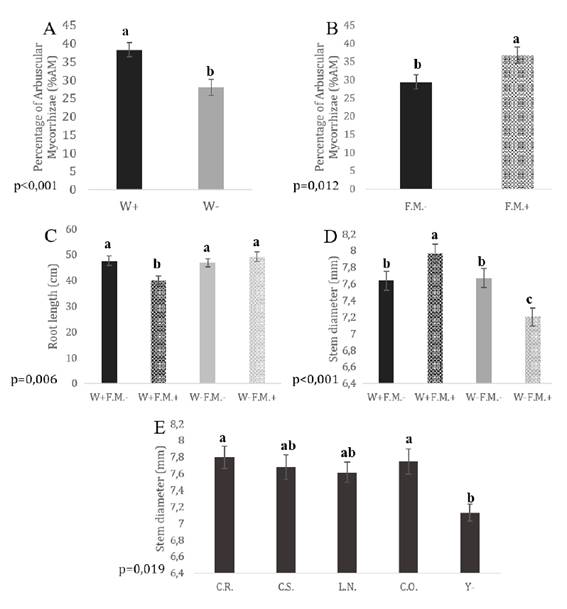
W+: normal irrigation; W-: low irrigation; F.M.-: without Funneliformis
mosseae.; F.M.+: with F. mosseae. C.R.: Candida aff. ralunensis; C.S.: C. sake; L.N.: Lachancea
nothofagi; C.O.: C. oleophila; Y-: non yeast inoculation. Mean
values and standard errors are given for each treatment (bars). Statistically
significant differences are indicated by different letters (Tukey’s post-hoc
test. p ≤ 0.05).
W+: riego normal; W-: bajo riego; F.M.- :
sin Funneliformis mosseae.; F.M.+: con F. mosseae. C.R.: Candida
aff. ralunensis; C.S.: C. sake; L.N.: Lachancea
nothofagi; C.O.: C. oleophila; Y-: sin inoculación de levadura. Se
indican los valores medios y los errores estándar para cada tratamiento
(barras). Las diferencias estadísticamente significativas se indican con letras
distintas (prueba post hoc de Tukey. p ≤ 0,05)
Figure 1. Effect of irrigation
(A) and mycorrhizal inoculation (B) on the percentage of mycorrhizal
colonization. Interacting effects of irrigation and mycorrhizal inoculation on
root length (C) and stem diameter (D). Effect of yeast inoculation on the stem
diameter (E) of tomato plants.
Figura 1. Efecto
del riego (A) y la inoculación micorrícica (B) sobre el porcentaje de
colonización micorrícica. Efectos interactivos del riego y la inoculación micorrícica
sobre la longitud radical (C) y el diámetro del tallo (D). Efecto de la
inoculación con levaduras sobre el crecimiento del diámetro del tallo (E) de
plantas de tomate.
Growth
variables
Root
length was not affected by the individual main factors but was significantly
affected by the interaction between irrigation condition and F.M. addition (p =
0.006). Roots were shorter in tomato plants subjected to normal irrigation
conditions with F.M. than in any other treatment (W+F.M.+ < W+F.M.-, W-F.M.+,
W-F.M.-; figure 1C).
Stem diameter was
affected by yeast inoculation as a main effect (p = 0.019): tomato plants
inoculated with C.R. or C.O. showed larger stem diameters than plants without
yeast inoculation (C.R. = C.O. > Y-; figure 1E, page 145).
Stem diameter was also affected significantly by the interaction between
irrigation condition and F.M. addition (p ≤ 0.001): the highest value was
obtained with F.M. and normal irrigation, intermediate values were observed for
both irrigation treatments without F.M., and the lowest values were obtained
with F.M. and low irrigation (figure 1D, page 145).
In the case of dry
shoot biomass, F.M. addition was the only factor that generated significant
differences (p = 0.015): plants without F.M. showed higher values than those
with FM (F.M- > F.M.+). The only factor that generated significant
differences for dry root biomass was the irrigation condition (p ≤ 0.001):
plants under low irrigation conditions had higher root dry biomass than those
receiving normal irrigation (W- > W+).
Production
variables
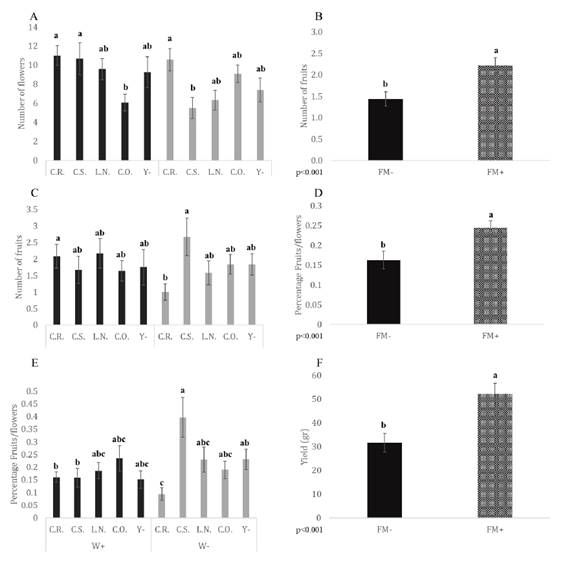
Flower numbers showed
a significant interaction between irrigation and yeast inoculation (p =
0.012). The number of flowers was higher in plants exposed to normal irrigation
conditions and inoculated with C.S. than in plants under low irrigation
conditions inoculated with the same yeast strain (W+C.S. > W-C.S.; figure 2A, page 147). On the other hand, of the normally
irrigated plants those inoculated with C.R. and C.S. showed higher numbers of
flowers than those inoculated with C.O. Of the plants with reduced irrigation,
those inoculated with C.R. had higher numbers of flowers than those inoculated
with C.S. The main effect of F.M. addition showed significant differences in
the number of fruits (p < 0.001): plants with F.M. produced 55% more fruit
than those without it (F.M.- < F.M.+; figure 2B, page
147). The number of fruits also showed a significant interaction between the
irrigation and yeast factors (p = 0.025). Plants inoculated with C.R. had
a higher number of fruits under normal irrigation than under low irrigation
(W+C.R. > W-C.R.; figure 2C, page 147), and plants
inoculated with C.S. had a higher number of fruits than plants inoculated with
C.R. under low irrigation conditions (W-C.S. > W-C.R.; figure
2C, page 147).
W+: normal irrigation; W-: low irrigation; F.M.-: without Funneliformis
mosseae.; F.M.+: with F. mosseae. C.R.: Candida aff. ralunensis; C.S.: C. sake; L.N.: Lachancea
nothofagi; C.O.: C. oleophila; Y-: without yeast inoculation. Mean
values and standard errors are given for each treatment (bars). Statistically
significant differences are indicated by different letters (Tukey’s post-hoc
test. p ≤ 0.05).
W+: riego normal; W-:
bajo riego; F.M.- : sin Funneliformis mosseae.;
F.M.+: con F. mosseae. C.R.: Candida aff. ralunensis;
C.S.: C. sake; L.N.: Lachancea nothofagi; C.O.: C. oleophila;
Y-: sin inoculación con levaduras. Se indican los valores medios y los errores
estándar para cada tratamiento (barras). Las diferencias estadísticamente significativas
se indican con letras distintas (prueba post hoc de Tukey. p ≤ 0,05)
Figure 2. Interactive effects
of irrigation and yeast inoculation on A) Number of flowers C) Number of fruits
and E) Fruits/flowers ratio. Effect of mycorrhizal inoculation on B) Number of
fruits D) Ratio fruits/flowers F) Yield.
Figura 2. Efectos
interactivos del riego y la inoculación de levadura sobre A) Número de flores
C) Número de frutos y E) Proporción frutos/flores. Efecto de la inoculación
micorrícica sobre B) Número de frutos D) Proporción frutos/flores F)
Rendimiento.
Funneliformis mosseae
addition
showed significant differences as a main effect for the fruit-to-flower ratio
(p < 0.001), which was higher in plants with F.M. than in those without it
(F.M.- < F.M.+; figure 2D, page 147).
The FFR also showed
significant interaction between irrigation and yeast inoculation (p = 0.005).
For plants inoculated with C.R., the FFR was significantly higher under
normal than low irrigation conditions (W+C.R. > W-C.R.; figure
2E, page 147). In contrast, for plants inoculated with C.S. the FFR was
lower in plants under normal irrigation conditions than low (W-C.S. >
W+C.S.). Plants under low irrigation conditions and inoculated with C.S. rendered
the highest FFR.
Yield showed significant
differences for F.M. addition as a main effect (p < 0.001): plants with F.M.
showed a 65% higher yield than plants without F.M. (F.M.- < F.M.+; figure 2F, page 147).
Discussion
Our results indicate
no three-way interaction between factors for any of the variables measured.
Statistical significance was observed for single main effects of the factors or
pairwise interactions, one of the interacting factors being the irrigation
condition. The irrigation regime therefore seems to be the main source of
variation for most of the variables analysed. Plants subjected to a low
irrigation regime received 85% less water and showed symptoms of osmotic
stress, such as a decrease in stem diameter and number of flowers. This may be
related to growth inhibition due to osmotic stress. Hydric stress decreases
stem and leaf growth and accelerates senescence and abscission in older leaves
(16). Under water deficit conditions,
plants generate strategies to modulate their soil water uptake capacity, such
as lateral root development or main root elongation (9,
22, 44); this explains the increase in root length and root dry
biomass observed under low irrigation conditions.
The effect of drought on mycorrhizal symbiosis was poorly
established since we found negative, positive and even neutral effects (4, 15, 25, 57). Drought effects on the establishment
and colonization of mycorrhizal fungi depend on several conditions, such as
plant and fungal species, environmental conditions and stress levels (4). In our work, limiting irrigation negatively
affected mycorrhizal colonization.
Other studies have
reported that co-inoculation of arbuscular mycorrhizal fungi and yeasts can
have positive effects on plant growth and development (57). These effects may be related to beneficial
interactions between the AM fungi and yeasts, such as nutrient solubilization
and improved plant resistance to stress. In our study, however, co-inoculation
had no significant effect on tomato plants. This could be due to the particular
yeast and AM species used, soil conditions or production conditions.
Mycorrhizal colonization was observed in all the plants studied,
demonstrating that mycorrhizal communities in Patagonian soils are capable of
colonizing agriculturally important plants such as the tomato. Addition of F.
mosseae increased mycorrhizal colonization, which may be attributed to
higher inoculum pressure, the highest infectivity of F. mosseae, or a
beneficial synergistic effect of both AM communities on these annual plants.
The addition of F. mosseae increased productive parameters such as fruit
number, FFR and yield in tomato plants. Arbuscular mycorrhiza hyphae can
penetrate soil pores and extend beyond the root zone, increasing the soil
volume to be explored and the possibility of better nutrient uptake (41, 46). Additionally, AM fungi are known to
influence the nutrient balance of plants, including carbohydrate balance (7) and hormone production (50), two factors that affect flowering and fruit
set (8). This indicates that increased AM
colonization, in this case, the addition of F. mosseae, can positively
influence productive parameters, both under normal irrigation conditions and in
situations of water shortage.
The relationship
between Patagonian yeasts and native mycorrhizal colonization has been reported
in studies such as Mestre et al. (2017),
where a tendency of increased colonization of native mycorrhizae was observed
in poplars inoculated with the native yeast Tausonia pullulans. Fracchia et al. (2003)
recorded an increase in mycorrhizal colonization in soybean (Glycine max)
and red clover roots after double inoculation of F. mosseae and Rhodotorula
mucilaginosa, when the yeast was inoculated before F. mosseae. Our
results show that yeast inoculation did not significantly affect the percentage
of AM colonization; however, there was a tendency of increased mycorrhizal
colonization in plants inoculated with C. sake, without F. mosseae, under
both irrigation conditions. This suggests a possible mycorrhizal helper effect
of C. sake on native mycorrhizal fungi present in Patagonian soils.
Further study should be carried out on this relationship, considering factors
such as the concentration of each microorganism, the location, timing and
frequency of inoculations, the order of inoculation of the microorganisms, and
a combination of these factors, to enhance understanding and enable
improvements to be made in agricultural production strategies.
Enhancing the ability of native mycorrhizal fungi to colonize
economically important crops could be an alternative to using external
mycorrhizal inoculum, which has to be purchased by producers and adds to
production costs. From an environmental point of view, using native yeasts to
improve native mycorrhizal colonization may be advantageous in that the
introduction of foreign microorganisms can be avoided. Inoculation with C.
aff ralunensis and C. oleophila led to significantly larger stem
diameters than in plants without yeast, under both irrigation conditions and F.
mosseae addition. Plants with larger stem diameters are less susceptible to
environmental stress after transplanting (53).
Stem diameter is a general measure of plant resistance to drought (19), and is often correlated with transplant
vigor (23). The greater the vigor of the
plants, the more resilient they will be in adverse conditions and the more
capable of producing a large quantity of fruit. Therefore, inoculation of
either of these two yeasts can enhance overall plant resistance by increasing
plant vigor. Inoculation with C. aff ralunensis and C. oleophila are
proposed as a complement to inoculation with F. mosseae, as a way of
improving plant performance under water deficit conditions, in which the
results of F. mosseae addition were not as good as under normal
irrigation. We believe that one possible mechanism by which C. aff. ralunensis and C. sake promoted plant
productivity is linked to their ability to solubilize inorganic phosphate.
Argentine Patagonia has Andisol soils characterized by high phosphorus
retention (36); the presence of
solubilizing microorganisms is, therefore, crucial as they make this nutrient
available for plant uptake, improving plant nutrition. The direct
characteristics of C. sake as a plant growth promoter have been reported
in the work of Gollner et al. (2006),
where inoculation with C. sake increases the biomass of maize (Zea
mays) plants. Although in our research C. sake does not present
statistically significant differences compared to control plants, we observed
that under water deficit conditions it reached the highest values in productive
parameters such as fruit number and FFR. This suggests a promising trend,
although not statistically significant, indicating possible potential as a
growth promoter under water stress. Continuing research to explore this trend
is required to confirm its viability as a beneficial solution under water
scarcity conditions.
Conclusions
Our findings reveal that adding F. mosseae significantly
increases arbuscular mycorrhizal colonization and improves several productive
parameters in tomato plants, both under normal and limited irrigation
conditions. The use of indigenous rhizospheric yeasts such as C. aff. ralunensis and C. oleophila, is proposed for the
cultivation of more robust plants, not only in conventional irrigation systems
but also in situations of water scarcity. These findings indicate that
employing indigenous microorganisms could be a promising alternative to
external inoculants, potentially reducing production costs and obviating the
need to introduce foreign microorganisms into the environment. Arbuscular
mycorrhizae and yeast inoculation could be effective in improving crop yields
and increasing plant resistance to water stress. Nevertheless, additional
research is necessary to further understand these processes and optimize their
practical application in agriculture.
Acknowledgments
We are grateful to Dr. A. Carron, Lic. D. Moguilevsky, Lic. V.
Bella, Prof. J. Puga, Tec. S. Olarte and Tec. N. Robredo for their helpful
assistance with technical and greenhouse work, and Audrey Urquhart BSc (Hon)
for language revision. We thank the authorities of Administración de Parques Nacionales
(Argentina) and Delegación de Bosques de Rio Negro for their courtesy and
cooperation. Lic. Boenel M was supported by a doctoral fellowship from the
Consejo Nacional de Investigaciones Científicas y Técnicas (CONICET).
1.
Alonso, L. M.; Kleiner, D.; Ortega, E. 2008. Spores of the mycorrhizal fungus Glomus
mosseae host yeasts that solubilize phosphate and accumulate
polyphosphates. Mycorrhiza. 18(4):197- 204. DOI: 10.1007/s00572-008-0172-7
2.
Andrade, G.; Mihara, K. L.; Linderman, R. G.; Bethlenfalvay, G. J. 1997.
Bacteria from rhizosphere and hyphosphere soils of different
arbuscular-mycorrhizal fungi. Plant and Soil. 192: 71-79. DOI: 10.1023/A:1004249629643
3.
Armada, R. E.; Barea, J. M; Castillo P.; Roldán, A. 2015. Characterization and
management of autochthonous bacterial strains from semiarid soils of Spain and
their interactions with fermented agrowastes to improve drought tolerance in
native shrub species. Applied Soil Ecology. 96: 306-318. DOI: 10. 1016/j.
apsoil. 2015. 08. 008
4.
Augé, R. M.; Toler, H. D.; Saxton, A. M. 2015. Arbuscular mycorrhizal symbiosis
alters stomatal conductance of host plants more under drought than under amply
watered conditions: a meta-analysis. Mycorrhiza. 25: 13-24. DOI:
10.1007/s00572-014-0585-4
5.
Barea, J. M.; Azcón, R.; Azcón-Aguilar C. 2002. Mycorrhizosphere interactions
to improve plant fitness and soil quality. Antonie van Leeuwenhoek. 81:
343-351. DOI: 10.1023/A:1020588701325
6.
Bashan, Y.; de-Bashan, L. E.; Prabhu, S. R.; Hernandez, J. P. 2014. Advances in
plant growth-promoting bacterial inoculant technology: formulations and
practical perspectives (1998-2013). Plant and Soil .
378(1): 1-33. DOI: 10.1007/s11104-013-1956-x
7.
Boldt, K.; Pörs, Y.; Haupt, B.; Bitterlich, M.; Kühn, C.; Grimm, B.; Franken,
P. 2011. Photochemical processes, carbon assimilation and RNA accumulation of
sucrose transporter genes in tomato arbuscular mycorrhiza. Journal of Plant
Physiology. 168(11): 1256-1263. DOI: 10.1016/j.jplph.2011.01.026
8.
Bona, E.; Todeschini, V.; Cantamessa, S.; Cesaro, P.; Copetta, A.; Lingua, G.;
Gamalero, E.; Berta, G.; Massa, N. 2018. Combined bacterial and mycorrhizal
inocula improve tomato quality at reduced fertilization. Scientia Horticulturae
234: 160-165. DOI: 10.1016/j.scienta.2018.02.026
9.
Brunner, I.; Herzog, C.; Dawes, M. A.; Arend, M.; Sperisen, C. 2015. How tree
roots respond to drought. Frontiers in Plant Science. 6:547. DOI:
10.3389/fpls.2015.00547
10.
Calvente, V.; Benuzzi, D.; Tosetti, M. I. S. 1999. Antagonistic action of
siderophores from Rhodotorul aglutinis upon the postharvest pathogen Penicillium
expansum. International Biodeterioration and Biodegradation. 43: 167-172.
DOI: 10.1016/S0964-8305(99)00046-3
11.
El-Tarabily, K. A.; Sivasithamparam K. 2006. Potential of yeasts as biocontrol
agents of soil-borne fungal plant pathogens and as plant growth promoters.
Mycoscience. 47: 25-35. DOI: 10.1007/s10267-005-0268-2
12.
Farooq, M.; Hussain, M.; Wahid, A.; Siddique, K. H. M. 2012. Drought stress in
plants: an overview. In: Aroca R, editor. Plant responses to drought stress.
Berlin: Springer. 1-33. DOI: 10.1007/978-3-642-32653-0
13.
Fracchia, S.; Godeas, A.; Scervino, J. M.; Sampedro, I. J.; Ocampo, A.; Garcıa-Romera,
I. 2003. Interaction between the soil yeast Rhodotorula mucilaginosa and
the arbuscular mycorrhizal fungi Glomus mosseae and Gigaspora rosea.
Soil Biology and Biochemistry. 35(5): 701-707. DOI:
10.1016/S0038-0717(03)00086-5
14.
Funes-Pinter, I.; Salomón, M. V.; Martín, J. N.; Uliarte, N.; Hidalgo, A. 2022.
Effect of bioslurries on tomato Solanum lycopersicum L and lettuce Lactuca
sativa development. Revista de la Facultad de Ciencias Agrarias.
Universidad Nacional de Cuyo. Mendoza. Argentina. 54(2): 48-60. DOI:
https://doi.org/10.48162/rev.39.082
15.
García, I. V. 2021. Lotus tenuis and Schedonorus arundinaceus co-culture
exposed to defoliation and water stress. Revista de la
Facultad de Ciencias Agrarias . Universidad Nacional de Cuyo. Mendoza. Argentina.
53(2): 100-108. DOI: https://doi.org/10.48162/rev.39.044
16.
Gepstein, S.; Glick, B. R. 2013. Strategies to ameliorate abiotic stressinduced
plant senescence. Plant Molecular Biology. 82: 623-633. DOI: https://doi.org/10.1007/s11103-013-0038-z
17.
Gianinazzi, S.; Gollotte, A.; Binet, M. N.; van Tuinen, D.; Redecker, D.; Wipf,
D. 2010. Agroecology: the key role of arbuscular mycorrhizas in ecosystem
services. Mycorrhiza . 20(8): 519-530. DOI: 10.1007/s00572-010-0333-3
18.
Giovannetti, M.; Mosse, B. 1980. An evaluation of techniques for measuring
vesicular arbuscular mycorrhizal infection in roots. New phytologist. 489-500.
Retrieved August 17, 2021, from http://www.jstor.org/stable/2432123
19.
Gollner, M. J.; Püschel, D.; Rydlová, J.; Vosátka, M. 2006. Effect of
inoculation with soil yeasts on mycorrhizal symbiosis of maize. Pedobiologia.
50 (4): 341-345. DOI: 10.1016/j. pedobi.2006.06.002
20.
Hesham, A. L.; Mohamed, H. 2011. Molecular genetic identification of yeast
strains isolated from Egyptian soils for solubilization of inorganic phosphates
and growth promotion of corn plants. Journal of Microbiology and Biotechnology.
21(1): 55-61. DOI: 10.4014/ jmb.1006.06045
21. Khan, N.; Bano, A.; Ali, S.; Babar,
M. 2020. Crosstalk amongst phytohormones from planta and PGPR under biotic and
abiotic stresses. Plant Growth Regulation. 90 (2): 189-203. DOI:
10.1007/s10725-020-00571-
22.
Koevoets, I. T.; Venema, J. H.; Elzenga, J. T. M.; Testerink, C. 2016. Roots
withstanding their environment: exploiting root system architecture responses
to abiotic stress to improve crop tolerance. Frontiers in plant science. 7:
1335. DOI: 10.3389/fpls.2016.01335
23.
Kokalis-Burelle, N.; Vavrina, C. S.; Rosskopf, E. N.; Shelby, R. A. 2002. Field
evaluation of plant growth-promoting rhizobacteria amended transplant mixes and
soil solarization for tomato and pepper production in Florida. Plant
and Soil . 238: 257-266. DOI: 10.1023/A:10144
64716 261
24.
Lobell, D. B.; Roberts, M. J.; Schlenker, W.; Braun, N.; Little, B. B.;
Rejesus, R. M.; Hammer, G. L. 2014. Greater Sensitivity to Drought Accompanies
Maize Yield Increase in the U.S. Midwest. Science 344 (6183): 516-519. DOI:
10.1126/science.1251423
25.
López-Ráez, J. A. 2016. How drought and salinity affect arbuscular mycorrhizal
symbiosis and strigolactone biosynthesis? Planta. 243(6): 1375-1385. DOI:10.1007/s00425-015-2435-9
26.
Marulanda, A.; Porcel, R.; Barea, J. M.; Azcón, R. 2007. Drought tolerance and
antioxidant activities in lavender plants colonized by native drought-tolerant
or drought-sensitive Glomus species. Microbial Ecology. 54: 543. DOI:
10.1007/s00248-007-9237-y
27.
Mestre, M. C.; Rosa, C. A.; Safar, S. V.; Libkind, D.; Fontenla, S. B. 2011.
Yeast communities associated with the bulk-soil, rhizosphere and
ectomycorrhizosphere of a Nothofagus pumilio forest in northwestern
Patagonia, Argentina. FEMS Microbiology Ecology. 78(3): 531-541. DOI:
10.1111/j.1574-6941.2011.01183.x
28.
Mestre, M. C.; Fontenla, S.; Rosa, C. A. 2014. Ecology of cultivable yeasts in
pristine forests in northern Patagonia (Argentina) influenced by different
environmental factors. Canadian Journal of Microbiology. 60(6): 371-382. DOI:
10.1139/cjm-2013-0897
29.
Mestre, M. C.; Fontenla, S.; Bruzone, M. C.; Fernández, N. V.; Dames, J. 2016.
Detection of plant growth enhancing features in psychrotolerant yeasts from
Patagonia (Argentina). Journal of Basic Microbiology. 56(10): 1098-1106. DOI:
10.1002/jobm.201500728
30.
Mestre, M. C.; Pastorino, M. J.; Aparicio, A. G.; Fontenla, S. B. 2017. Natives
helping foreigners?: The effect of inoculation of poplar with patagonian
beneficial microorganisms. Journal of Soil Science and Plant Nutrition. 17(4):
1028-1039. DOI: 10.4067/S0718-95162017000400014
31.
Mestre, M. C.; Severino, M. E.; Fontenla, S. 2020. Evaluation and selection of
culture media for the detection of auxin-like compounds and phosphate solubilization
on soil yeasts. Revista Argentina de Microbiología. 53(1): 78-83. DOI:
10.1002/jobm.201500728
32.
Morrissey, J. P.; Dow, J. M.; Mark, G. L.; O’Gara, F. 2004. Are microbes at the
root of a solution to world food production? Rational exploitation of
interactions between microbes and plants can help to transform agriculture.
EMBO Reports. 5: 922-926. DOI: 10.1038/sj.embor.7400263
33.
Nassar, A. H.; El-Tarabily, K. A.; Sivasithamparam, K. 2005. Promotion of plant
growth by an auxin-producing isolate of the yeast Williopsis saturnus endophytic
in maize (Zea mays L.) roots. Biology and Fertility of Soils. 42:
97-108. DOI: 10.1007/s00374-005-0008-y
34.
Ngumbi, E.; Kloepper. J. 2016. Bacterial-mediated drought tolerance: current
and future prospects. Applied Soil Ecology . 105:
109-125. DOI: 10.1016/j.apsoil.2016.04.009
35.
Panda, D.; Mishra, S. S.; Behera, P. K. 2021. Drought tolerance in rice: focus
on recent mechanisms and approaches. Rice Science. 28(2): 119-132. DOI:
10.1016/j.rsci.2021.01.002
36.
Pereyra, F. X.; Bouza, P. 2019. Soils from the Patagonian region. In: Rubio G,
Lavado R, Pereyra F. (eds) The Soils of Argentina. World Soils Book Series.
Springer, Cham. 101-121. DOI: 10.1007/978-3-319-76853-3_7
37.
Pérez-Rodriguez, M. M.; Piccoli, P.; Anzuay, M. S.; Baraldi, R.; Neri, L.;
Taurian, T.; Lobato Ureche, M. A.; Segura, D. M. & Cohen, A. C. 2020.
Native bacteria isolated from roots and rhizosphere of Solanum lycopersicum L.
increase tomato seedling growth under a reduced fertilization regime.
Scientific Reports. 10(1): 1-14. DOI: 10.1038/s41598-020-72507-4
38.
Phillips, J. M.; Hayman, D. S. 1970. Improved procedures for clearing roots and
staining parasitic and vesicular-arbuscular mycorrhizal fungi for rapid
assessment of infection. Transactions of the British Mycological Society. 55:
158-161.
39.
Roelfsema, M. R.; Hedrich, R. 2005. In the light of stomatal opening: new
insights into ‘the Watergate’. New Phytologist. 167: 665-91. DOI:
10.1111/j.1469-8137.2005.01460.x
40.
Ruiz-Lozano, J. M.; Aroca, R. 2010. Host response to osmotic stresses: Stomatal
behaviour and water use efficiency of arbuscular mycorrhizal plants. In: Koltai
H, Kapulnik Y (eds) Arbuscular Mycorrhizas: Physiology and Function. Springer,
Dordrecht. DOI: 10.1007/978- 90-481- 9489-6_11
41.
Sampaio de Almeida, D.; Mendonça Freitas, M. S.; Cordeiro de Carvalho, A. J.;
Beltrame, R. A.; Ola Moreira, S.; Vieira, M. E. 2021. Mycorrhizal fungi and
phosphate fertilization in the production of Euterpe edulis seedlings. Revista
de la Facultad de Ciencias Agrarias . Universidad Nacional de Cuyo.
Mendoza. Argentina. 53(2): 109-118. DOI: https://doi. org/10.48162/rev.39.045
42.
Sampedro, I.; Aranda, E.; Scervino, J. M.; Fracchia, S.; García-Romera, I.;
Ocampo, J. A.; Godeas, A. 2004. Improvement by soil yeasts of arbuscular
mycorrhizal symbiosis of soybean (Glycine max) colonized by Glomus
mosseae. Mycorrhiza . 14(4): 229-234. DOI: 10.1007/
s00572-003-0285-y
43.
Schroeder, J. I.; Kwak, J. M.; Allen, G. J. 2001. Guard cell abscisic acid
signalling and engineering drought hardiness in plants. Nature. 410:
327-30. DOI: 10.1038/35066500
44. Sharp, R. E. 2002. Interaction with
ethylene: changing views on the role of abscisic acid in root and shoot growth
responses to water stress. Plant, Cell & Environment. 25: 211-222.
DOI:10.1046/j.1365-3040.2002.00798.x
45.
Sivamani, E.; Bahieldin, A.; Wraith, J. M.; Al-Niemi, T.; Dyer, W. E.; Ho, T.
H. D.; Qu, R. 2000. Improved biomass productivity and water use efficiency
under water deficit conditions in transgenic wheat constitutively expressing
the barley HVA1 gene. Plant Sciences. 155(1): 1-9. DOI:
10.1016/S0168-9452(99)00247-2
46.
Smith, S. E.; Read, D. 2008. Mycorrhizal Symbiosis. Academic Press. Great
Britain.
47.
Streletskii, R. A.; Kachalkin, A. V.; Glushakova, A. M.; Yurkov, A. M.; Demin,
V. V. 2019. Yeasts producing zeatin. Peer. J. 7: 6474. DOI: 10.7717/peerj.6474
48.
Tadey, M. 2006. Grazing without grasses: Effects of introduced livestock on
plant community composition in an arid environment in northern Patagonia.
Applied Vegetation Science. 9: 109-116. DOI:10.1111/j.1654-109X.2006.tb00660.x
49.
Tadey, M. 2020. Reshaping phenology: Livestock has stronger effects than
climate on flowering and fruiting phenology in desert plants. Perspectives in
Plant Ecology, Evolution and Systematics. 42: 125501. DOI:
10.1016/j.ppees.2019.125501
50.
Torelli, A.; Trotta, A.; Acerbi, L.; Arcidiacono, G.; Berta, G.; Branca, C.
2000. IAA and ZR content in leek (Allium porrum L.), as influenced by P
nutrition and arbuscular mycorrhizae, in relation to plant development. Plant
and Soil . 226: 29-35. DOI: 10.1023/A:1026430019738
51.
Turner, T. R.; James, E. K.; Poole, P. S. 2013. The plant microbiome. Genome
Biology. 14: 209. DOI: 10.1186/gb-2013-14-6-209
52.
Van Der Heijden, M. G.; Horton, T. R. 2009. Socialism in soil? The importance
of mycorrhizal fungal networks for facilitation in natural ecosystems. Journal
of Ecology. 97(6): 1139-1150. DOI: 10.1111/j.1365-2745.2009.01570.x
53.
Vavrina, C. S. 1996. An introduction to the production of containerized
vegetable transplants. Univ. FL., Cooperative Extension Service, Bulletin Nª.
302.
54.
Venkateswarlu, B.; Shanker, A. K. 2009. Climate change and agriculture:
Adaptation and mitigation strategies. Indian Journal of Agronomy. 54(2):
226-230.
55.
Voigt-Beier, E.; Fernandes, F.; Poleto, C. 2016. Desertification increased in
Argentinian Patagonia: anthropogenic interferences. Acta Scientiarum: Human
& Social Sciences, 38(1). DOI: 10.4025/actascihumansoc.v38i1.30177
56.
Xu, Z.; Jiang, Y.; Jia, B.; Zhou, G. 2016. Elevated-CO2 response
of stomata and its dependence on environmental factors. Frontiers in Plant
Science. 7: 657. DOI: 10.3389/fpls.2016.00657
57. Zhu, X. C.; Song,
F. B.; Liu, S. Q.; Liu, T. D.; Zhou, X. 2012. Arbuscular mycorrhizae improves
photosynthesis and water status of Zea mays L. under drought stress. Plant and Soil Environ. 58: 186-191.
Funding
This work was
supported by the “Universidad Nacional del Comahue-Centro Regional
Universitario Bariloche” under Grant 04-B200; “Fondo para la Investigación
Científica y Tecnológica (FONCYT)” under Grant PICT 2018-3441 and “Consejo Nacional
de Ciencia y Técnica” under Grant PIP 0235.
The authors report
there are no competing interests to declare.
Availability of data
and material
All data generated or
analyzed during this study have been included in this published article.
Data availability: Accession numbers for nucleotide sequences of Candida
aff ralunensis CRUB 1774, Candida sake CRUB 1997, Lachancea
nothofagi CRUB 2011 and Candida oleophila CRUB 2104 are KU693289,
KF826535, KF826536 and MZ191065, respectively.