Revista de la Facultad de Ciencias
Agrarias. Universidad Nacional de Cuyo. Tomo 55(2). ISSN (en línea) 1853-8665.
Año 2023.
Original article
Efficacy
of zinc lactate and Lactobacillus bulgaricus on nutrition and health of
broiler chickens
Eficacia
del lactato de zinc y Lactobacillus bulgaricus en la nutrición y salud
de pollos de engorde
Dayana Parra
Ferrín 1,
Guido Cusme
Lucas 1,
Viviana Talledo
Solórzano 1,
Braulio Loor
Gorozabel 1,
Anderson Pazmiño
Castro 1,
1 Universidad
Técnica de Manabí. Facultad de Agrociencias. Extensión Chone. Manabí. 130703.
Ecuador.
*gerardo.cuenca@utm.edu.ec
ABSTRACT
This
investigation examined the effects of zinc lactate and Lactobacillus
bulgaricus supplementation on the gastrointestinal microbiota of broiler
chickens, analysing zootechnical, allometric, microbiological parameters and
small intestine morphology. A total of 300 broiler chickens with an average
initial weight of 47 g were distributed in four treatments in a completely
randomised design. Treatments consisted of different zinc lactate and probiotic
amounts added to the base diet. Chickens receiving the basal diet with organic
zinc and L. bulgaricus showed a healthy response, remaining free of
infectious agents for the 42-day study period. Treatment T1, with 30 mg of zinc
lactate and 10 mg of probiotics per kg, showed improvements in weight gain,
feed conversion, allometry, and intestinal health, as well as a healthy
presence of gastrointestinal microbiota. Thus, the incorporation of zinc
lactate (organic Zn) and probiotics based on L. bulgaricus into the
basal diet of broiler chickens is an effective strategy to improve sanitary
conditions and organic production of these species.
Keywords: allometry, basal
diet, metabolism, gastrointestinal microbiota, animal health
RESUMEN
Esta
investigación examinó los efectos del lactato de zinc y la suplementación de Lactobacillus
bulgaricus en la microbiota gastrointestinal de pollos de engorde,
analizando parámetros zootécnicos, alométricos, microbiológicos y de la
morfología del intestino delgado. Se utilizaron un total de 300 pollos de
engorde con un peso inicial promedio de 47 gramos, distribuidos en cuatro
tratamientos distribuidos en un diseño completamente aleatorizado. Los
tratamientos variaron en la cantidad de lactato de zinc y probiótico añadidos a
la dieta basal. Los pollos que recibieron la dieta basal con zinc orgánico y L.
bulgaricus mostraron una respuesta saludable, permaneciendo libres de
agentes infecciosos durante el período de estudio de 42 días. El tratamiento
T1, que incluía 30 mg de lactato de zinc y 10 mg de probióticos por kilogramo,
fue el más efectivo, mostrando mejoras en la ganancia de peso, la conversión
alimenticia, la alometría y la salud intestinal, así como una desarrollo
saludable de la microbiota gastrointestinal. Por lo tanto, la incorporación de
lactato de zinc (Zn orgánico) y probióticos a base de L. bulgaricus en
la dieta basal de los pollos de engorde puede ser una estrategia efectiva para
mejorar las condiciones sanitarias y la producción orgánica de estas especies.
Palabras claves:
alometría,
dieta basal, metabolismo, microbiota gastrointestinal, sanidad animal
Originales: Recepción: 18/05/2023 - Aceptación: 14/11/2023
Introduction
Accelerated
demographic growth generates increasing consumption of animal protein,
enhancing poultry farming development over the last years, from agricultural
systems where chickens were fed seeds and natural food products like worms or
earthworms; to technified farming systems (16).
In the present decade, poultry meat production leads meat production growth by 50%
and is projected to occupy first place worldwide in 2030 (15).
In Ecuador,
poultry production registers 1819 poultry farms generating 32000 job positions,
220000 indirect sources and around 2000 million dollars a year, that is, 16% of
the agricultural GDP and 2% of the total GDP. The country’s chicken meat
production is mainly distributed among the provinces of Guayas with 22%,
Pichincha with 16% and Santo Domingo de los Tsáchilas with 14%. Performing an
economic analysis between 2018 and 2019, Ecuadorian poultry has gradually grown
27% (5).
Besides being a
low-fat and low-calorie meat, chicken meat contributes a high biological value
protein, essential and non-essential amino acids for human nutrition, B-complex
vitamins and minerals such as iron, selenium, and copper (22). However, the choice for more productive
animals and the increasing use of antibiotics favour stress conditions,
increasing deficiencies in intestinal microbiota and producing a consequent
lower natural resistance to pathogenic microorganisms (8).
The current
excessive expenditure for feed in poultry diets has negatively affected
productivity (22). However,
new organic sources of minerals such as zinc, together with the addition of
lactic acid bacteria such as L. bulgaricus, have been safely used in the
feeding of other animal species, with several benefits. Therefore, the main
objective of this research was to evaluate the effect of zinc lactate and Lactobacillus
bulgaricus supplementation on broilers gastrointestinal microbiota (13).
Materials
and methods
The study was
conducted on the property of Mr Cusme Manzaba, located in the Camareta site of
the Santa Rita parish of the Chone canton in the province of Manabi. The area
is located 45 m.a.s.l., with an average temperature of 28°C, annual rainfall of
1025 mm and relative humidity of 83%.
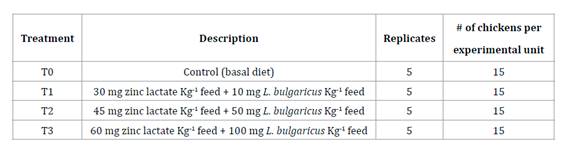
A total of 300
healthy one-day-old broilers, with an average initial weight of 47 g were
arranged in a completely randomized design with four treatments, five
replicates and fifteen broilers per experimental unit. Three levels of zinc
lactate plus the probiotic (w/w ratio) were evaluated weekly in a proportional
manner (table 1), according to Shah et
al. (2018) defining zootechnical, productive and sensory behaviour of
broilers.
Table
1. Experimental design.
Tabla 1. Descripción
del diseño experimental usado en la investigación.
The chickens’
diet (table 2) was corn-based, and following the guidelines
of the National Research Council (1994), the basal
diet adopted three phases of feeding, initial (1-14 days), growth (15-28 days)
and final (29-42 days). Food and water were provided ad libitum. Crude
protein (Nx6.25), dry matter, fat and crude fibre were determined using the
standard methods described in the AOAC (1).
Table
2. Proximal chemical analysis and
Apparent Metabolizable Energy calculation of starter, grower and finisher diets
for broilers.
Tabla 2.
Análisis químico proximal y cálculo de energía metabolizable aparente de dietas
de iniciación, crecimiento y finalización para pollos de engorde.
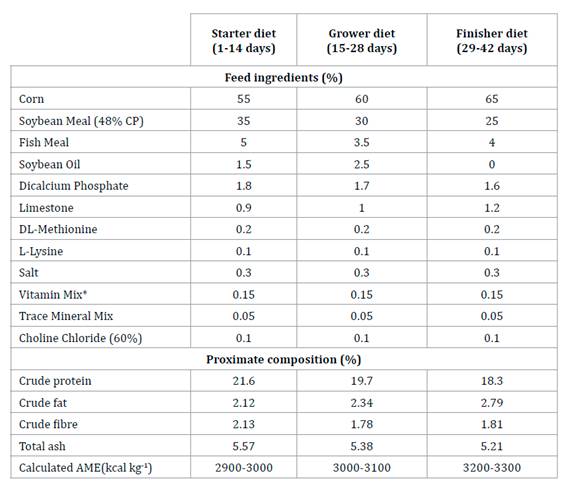
*Vitamin mineral mix (each kg contained): Ca: 195g;
K: 70g; Na: 18g; Mg: 6g; Zn:29mg; Fe: 2000mg; Cu: 400mg; Mn: 1200mg; Se: 8mg;
Co: 20mg; I: 40mg; vitamim A: 200000IU; vitamin D3: 80000IU; vitamin E: 1072IU;
vitamin K3: 34mg; ascorbic acid: 1300mg; thiamine: 35mg; riboflavin: 135mg;
niacin:1340mg; vitamin B6: 100mg; folic acid: 34mg; vitamin B12: 670ug and biotin:
3350ug. AME: Apparent Metabolizable Energy.
*Mezcla de vitaminas y minerales (cada kg contenía):
Ca: 195g; K: 70g; Na: 18g; Mg: 6g; Zn: 29mg; Fe: 2000mg; Cu: 400mg; Mn: 1200mg;
Se: 8mg; Co: 20mg; I: 40mg; vitamina A: 200000UI; vitamina D3: 80000UI; vitamina
E: 1072UI; vitamina K3: 34mg; ácido ascórbico: 1300mg; tiamina: 35mg;
riboflavina: 135mg; niacina:1340mg; vitamina B6: 100mg; ácido fólico: 34mg;
vitamina B12: 670ug y biotina: 3350ug. AME: Energía Metabolizable Aparente.
Zootechnical
parameters
The following
productivity parameters were evaluated on days 7, 14, 21, 28, 35 and 42. Weekly
weight gain Live weight of the chickens was weekly assessed and weight gain
calculated according to Madrid Garcés et al. (2022).

Feed
conversion ratio
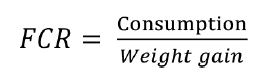
This parameter
determines consumed feed weight over animal weight gain. The lower the feed
conversion ratio, the more efficient animal raising (7).
Mortality
Percentage of
dead chicks in a given period.

European Efficiency
Index (EEI)
This index
compares different flocks within an integration. The minimum value expected is
200. Any result below 200 defines low performance (6).

Allometric
parameters
During the
staggered euthanasia (according to Comité de Bioética de la Universidad Técnica
de Manabí), 40 birds were sacrificed as follows: on days 21 and 42, one chicken
was sacrificed for each replicate. Animals were stunned by applying a carbon
dioxide atmosphere for 3 minutes. All birds were sacrificed 3 hours after the
last meal.
Organ weights
Organ weights
were calculated as a percentage of live weight (%OW) as follows.

Allometric
growth
To determine
organ ontogenesis and its relationship with body weight, the allometric growth
constant (AC), proposed by Campos et al. (2022)
was used.
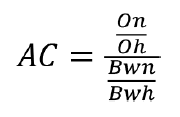
where:
O = organ weight
n = days after
birth
h = birth weight
BW = body weight
When the organ
grows in the same proportion to body weight, CA equals 1. If organ growth is
below body weight, CA is smaller than 1. For CA over 1, relative growth to
total body weight gain is accelerated (11).
Small
intestine morphometry
After 48 hours
of collection, samples from different sections of the intestine were preserved
in 10% formalin, then embedded in kerosene, cut at 4μm thickness and stained
with hematoxylin-eosin to be washed and stored in ethanol: water (75:25, v:v) according to Chávez et al. (2016).
Intestinal
villi
Height: once
villus base was established, a line from midpoint to apex defined height.
Width: distance between apical edges of epithelial cells from opposite sides,
located approximately in the middle of the villus.
Crypts of
Lieberkühn
According to Quevedo et al. (2020), depth and width of
Lieberkühn crypts (mm) were determined using an optical microscope with a
micrometre eyepiece.
Microbiological
parameters
For the
microbiological analysis of mesophilic aerobes, enterobacteria and
lactobacillus, samples of the small intestine and muscle were taken from 3
chickens per treatment (one per replicate) and taken to perform microbial culture
(2).
Statistical
analysis
The experimental
results obtained from zootechnical, allometric, histomorphological (small
intestine) and microbiological assessments were analyzed by ANOVA. followed by Duncan’s test (p < 0.05) multiple comparisons
of means, using R version 3.5.2 (2018-12-20).
Results
and discussion
Analysis
of zootechnical and productive parameters
All chickens
considered in the 3 treatments with zinc lactate and L. bulgaricus in
the basal diet presented optimal state of health, during the study phase. No
statistical interactions were found between the treatments for any of the
variables considered. Independent effects were analyzed.
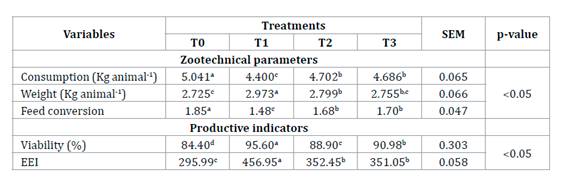
Regarding feed
consumption (Kg animal-1), significant differences between
treatments were observed, where the chicks in T1 had the lowest feed
consumption compared to the other treatments (p<0.05; table 3).
It is worth mentioning that the chickens subjected to T0 presented higher feed
consumption, while the rest of the chickens subjected to T2 and T3 had moderate
feed consumption. Regarding weight (Kg animal-1), significant
differences were also found.
Table
3. Zootechnical and productive analysis of
broilers subjected to zinc lactate and L. bulgaricus supplementation in
the basal diet for 42 days.
Tabla 3. Análisis
productivo y zootécnico de pollos de engorde sujetos a suplementación de
lactato de zinc y L. bulgaricus en la dieta basal por 42 días.
EEI = European Efficiency Index. SEM = Standard
Error of the Mean. Groups according to p-value 0.05. Different letters show
significant differences among means.
EEI = European. Efficiency Index. SEM = Error
Estándar de la Media. Los grupos se clasifican según la probabilidad de que
exista una diferencia significativa entre sus medias, tomando en cuenta un
nivel alfa de 0,05.
The best broiler
feed conversion was achieved with T1 (1.48). Percentage of viability and the
European Efficiency Index were also achieved in T1, values closely related to
those obtained by Shah et al. (2018) when
determining the effect of zinc and probiotics on the performance and morphology
of immune organs in heat-stressed broilers. The authors stated that zinc and
probiotics vary in effectiveness according to intestinal absorption degrees and
subsequent blood bioavailability. On the other hand, according to González-Vásquez et al. (2020), the
concentration of zinc lactate recommended for poultry diets should be
approximately 40mg Kg-1 and 75mg Kg-1 of feed. In the
present study, we obtained better benefits with 40 mg of zinc lactate and 15 mg
of probiotic per Kg of feed.
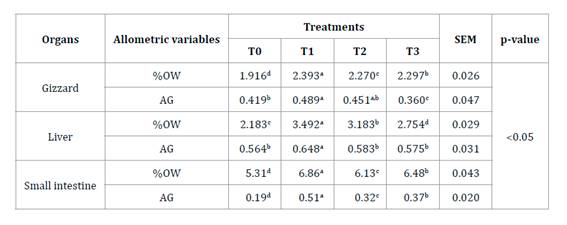
Significant
differences (p<0.05) were evidenced for organ weight (%PV) during this
research, where the gizzard reached average weight (2.269%), liver (2.928%) and
small intestine (6.312%). It should be noted that both the liver and small
intestine obtained the highest weights at T1, while the gizzar reached the
highest weight at T3 (2.443%).
Organ allometric
analysis showed statistically significant differences (p<0.05). Chicken
gizzard presented an average growth (CA=0.49), liver (CA=0.62) and small
intestine (CA=0.47), all “slow growth values” (CA<1) in relation to body
weight (table 4).
Table
4. Organ weight (%OW) and allometric analysis
of broilers under supplementation with zinc lactate and probiotic (L.
bulgaricus) for 42 days.
Tabla 4. Peso
del órgano (%PO) y análisis alométrico de pollos de engorde que se sometieron a
suplementación de la dieta basal con lactato de zinc y probióticos (L.
bulgaricus) durante 42 días.
%OW = organ weight. AG = allometric growth. SEM =
Standard Error of the Mean. Groups according to p-value 0.05. Means with the
same letter are not significantly different.
%PO = peso del órgano. CA = crecimiento alométrico.
EEM = Error estándar de la media. Los grupos se clasifican según la
probabilidad de que exista una diferencia significativa entre sus medias,
tomando en cuenta un nivel alfa de 0,05.
Consumption of
zinc lactate and probiotics enhances productive parameters and influences
weight and organ development, particularly intestine (23).
Higher organ
weights were found in chickens subjected to T1 (basal diet plus 30 mg of zinc
lactate and 10 mg of probiotic Kg-1). the
amount of zinc lactate and probiotics to be added, should not surpass the
indicated amounts since they can cause an opposite effect such as poor nutrient
retention, low weight gain and low organ development (2).
Providing
broilers with diets including zinc lactate and probiotics, improve digestive
performance. This research verified the positive effect of adding zinc lactate
and probiotics to conventional feed. In accordance with previous studies (18, 21), animal metabolic processes as well as
nutrient absorption were more efficient.
Morphometry
of the small intestine
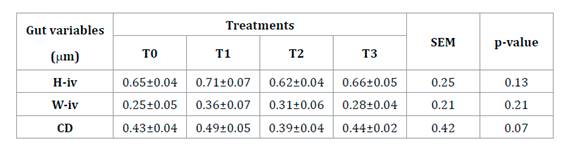
Table
5 (page 126), presents histomorphological variables corresponding to
significant interactions between Zn and probiotic mixture.
Table
5. Effect of dietary zinc lactate and L.
bulgaricus on histomorphology parameters of the small intestine of broiler
chickens at 42 days of age.
Tabla 5. Efecto
de la inclusión de lactato de zinc y L. bulgaricus en la dieta sobre
parámetros histomorfológicos del intestino delgado de pollos de engorde a los
42 días de edad.
H-iv = height of intestinal villi. W-iv = width of
intestinal villi. CD = crypt depth. SEM = Standard Error of the Mean. Groups
according to p-value 0.05.
H-iv = Altura de las vellosidades intestinales. W-iv
= Ancho de las vellosidades intestinales. CD = Profundidad de la cripta. SEM =
Error estándar de la media. Los grupos se clasifican según la probabilidad de
que exista una diferencia significativa entre sus medias, tomando en cuenta un nivel
alfa de 0,05.
According to Iñiguez
Heredia et al. (2021) probiotics and organic
acids are important fattening stimulants. These authors state that Lieberkühn
crypts in intestines have a key role in determining enzymatic effects. In this
context, we observed variations, however non-significant, in height and width
of intestinal villi between T1 and T0, T2, T3. Crypts resulted deeper in T1,
than in T0, T2 and T3.
Microbiological
analysis
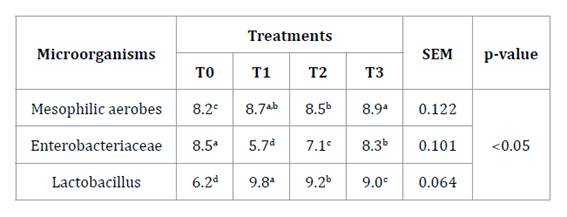
Table
6 shows statistical differences between treatments for populations of
enterobacteria, mesophiles and lactobacillus. Mesophilic bacteria showed 8.2
log CFU g-1 for T0 and 8.9 log CFU g-1 for T3,
respectively, remaining stable between all treatments, in accordance with González-Vásquez et al. (2020), who found no
statistical differences in the population of mesophilic aerobes in chicken
ileum.
Table
6. Counting of bacterial populations in
chicken small intestine.
Tabla 6. Conteo
de poblaciones bacterianas en el intestino delgado del pollo.
Groups by probability of mean difference
and alpha level (0.05) SEM = Standard Error of the Mean Groups according to
p-value 0.05.
Los grupos se clasifican según la
probabilidad de que exista una diferencia significativa entre sus medias,
tomando en cuenta un nivel alfa de 0,05. SEM = Error
Estándar de la Media.
Enterobacteria
yielded significant differences in all treatments. The presence of
enterobacteria (gram-negative bacteria) was lower for T1, as stated by Rebollada-Merino et al. (2020) when adding
antibiotics and prebiotics to chicken basal diet.
Regarding lactic
acid bacteria, T1 presented the highest count. Lactobacillus bacteria had the
lowest presence for treatment T0, (6.3 log CFU g-1) and the highest
presence in T1 with 9.9 log CFU g-1 This, according to Blajman et al. (2015), helps improve
gastrointestinal flora, inhibiting pathogenic microorganisms and enhancing
immunology, thus improving general growth.
Conclusion
Zinc lactate and
L. bulgaricus in the basal diet of broilers allowed obtaining better
sanitary conditions in organic production since performance of broiler
management is evaluated in terms of zootechnical, allometric, histomorphology
and microbiological parameters of small intestine resulting in greater villi
growth and decreased enterobacteria and mesophilic aerobes populations.
1. Association
of Analytical Communities International. 2019. Official Methods of Analysis of
AOAC. AOAC International.
2. Blajman, J.
E.; Zbrun, M. V.; Astesana, D. M.; Berisvil, A. P.; Romero Scharpen, A.;
Fusari, M. L.; Soto, L. P.; Signorini, M. L.; Rosmini, M. R.; Frizzo; L. S.
2015. Probióticos en pollos parrilleros: una estrategia para los modelos
productivos intensivos? Rev Argent Microbiol. 47(4):
360-7.
3. Campos, J.
T.; Escalona, M. A.; Nichorzon, M. R.; Ramírez, L. C.; Acuña, R. S. 2022.
Alometría digestiva en pollos suplementados con harina de orégano como promotor
de crecimiento. Revista Espamciencia. 13(1): 16-25.
4. Chávez, L.
A.; López, A.; Parra, J. E. 2016. Crecimiento y desarrollo intestinal de aves
de engorde alimentadas con cepas probióticas. Archivos de zootecnia. 65(249):
51-8.
5. Corporación
Nacional de Avicultores del Ecuador (CONAVE). 2021. Estadísticas del sector
avícola. Vol. 4281. cited 2022 Sep 1. p. 1-6. https://conave.org/informacion-sector-avicolapublico/
6. Cowieson, A.
J.; Smith, A.; Sorbara, J. O. B.; Pappenberger, G.; Olukosi, O. A. 2019.
Efficacy of a monocomponent exogenous protease in the presence of a high
concentration of exogenous phytase on growth performance of broiler chickens.
Journal of Applied Poultry Research. 28(3): 638-46.
7. da Silva, I.
M.; Broch, J.; Wachholz, L.; de Souza, C.; Dalólio, F. S.; Teixeira, L. V.;
Eyng, C.; Nunes, R. V. 2019. Dry residue of cassava associated with
carbohydrases in diets for broiler chickens. Journal of Applied Poultry Research .
28(4): 1189-201.
8. Espinoza, L.
F. V.; Gómez, J. J. A.; Morán, D. L. T.; Baldeón, J. J. G. 2022. Avaliação da
produção de frangos de corte com diferentes doses de vinagre em água potável no
cantão Babahoyo: Evaluation of broiler production with different doses of
vinegars in drinking water in the Babahoyo canton. Brazilian Journal of Animal
and Environmental Research. 5(3): 3182-98.
9.
González-Vázquez, A.; Ponce-Figueroa, L.; Alcivar-Cobeña, J.; Valverde-Lucio,
Y.; Gabriel-Ortega, J. 2020. Suplementación alimenticia con promotores de
crecimiento en pollos de engorde Cobb 500. Vol. 7, Journal of the Selva Andina
Animal Science. Scielobo. p. 3-16.
10. Iñiguez
Heredia, F. A.; Espinoza Bustamante, X. E.; Galarza Molina, E. L. 2021. Uso de
probióticos y ácidos orgánicos como estimulantes del desarrollo de aves de
engorde: artículo de revisión. Alfa Revista de Investigación en Ciencias
Agronómicas y Veterinaria. 5(14): 166-72.
11. Loor
Gorozabel, B. E.; Talledo Solórzano, M. V.; Cuenca Nevarez, G. J.; Intriago
Flor, F. G. 2020. Actividad probiótica de (Lactobacillus spp.), y su
incidencia en el desarrollo de los parámetros zootécnicos, alométricos y de la
microbiota gastrointestinal en pollos broilers. Revista Ecuatoriana de Ciencia
Animal. 4(2): 96-108.
12. Madrid
Garcés, T. A.; González Herrera, L. G.; López Herrera, A.; Parra Suescun, J.
2022. Improvement of productive and metabolic indicators of broiler by the
application of Lippia origanoides essential oil in an in vivo intestinal
inflammation model. Rev Fac Nac Agron Medellin. 75(2).
13.
Medeiros-Ventura, W. R. L.; Rabello, C. B. V.; Barros, M. R.; Silva Junior, R.
V.; Oliveira, H. B.; Faria, A. G.; Silva, A. F.; Soares, P. C.; Pereira, C. G.;
Santos, M. J. B.; Fireman, A. K. † 2020. Zinc, manganese, and copper amino acid
complexes improve performance and bone characteristics of layertype chicks
under thermoneutral and cold stress conditions. Poult Sci. 99(11): 5718-27.
14. National
Research Council. 1994. Nutrient Requirements of Poultry. Washington, DC: The
National Academies Press.
15. OCDE, FAO.
2020. Perspectivas Agrícolas 2020‑2029. OECD Publishing. Paris: OECD
Publishing. 278 p.
https://www.oecd-ilibrary.org/agriculture-andfood/ocde-fao-perspectivasagricolas-2020-2029_a0848ac0-es
16.
Pomboza-Tamaquiza, P.; Guerrero-López, R.; Guevara-Freire, D.; Rivera, V. 2018.
Granjas avícolas y autosuficiencia de maíz y soya: caso Tungurahua-Ecuador.
Estudios sociales (Hermosillo, Son). 28(51): 0.
17. Quevedo, D.
M.; Ochoa, J. E.; Corredor, J. R.; Pulecio, S. L. 2020. Efectos de la adición
de probiótico Saccharomyces cerevisiae sobre histomorfología intestinal
en pollos de engorde. Vol. 67, Revista de la Facultad de Medicina Veterinaria y
de Zootecnia. Scieloco. p. 239-52.
18. Ramiah, S.
K.; Awad, E. A.; Mookiah, S.; Idrus, Z. 2019. Effects of zinc oxide
nanoparticles on growth performance and concentrations of malondialdehyde, zinc
in tissues, and corticosterone in broiler chickens under heat stress
conditions. Poult Sci. 98(9): 3828-38.
19.
Rebollada-Merino, A.; Ugarte-Ruiz, M.; Hernández, M.; Miguela-Villoldo, P.;
Abad, D.; Rodríguez- Lázaro, D.; de Juan, L.; Domínguez, L.; Rodríguez-Bertos,
A. 2020. Reduction of Salmonella Typhimurium cecal colonisation
and improvement of intestinal health in broilers supplemented with fermented
defatted ‘alperujo’, an olive oil by-product. Animals. 10(10): 1931.
20. Shah, M.;
Zaneb, H.; Masood, S.; Khan, I.; Sikandar, A.; Ashraf, S.; Rehman, H. F.;
Usman, M. M.; Khan, F. A.; Amanullah, H.; Rehman, H. 2018. Effect of zinc and
probiotics supplementation on performance and immune organs morphology in heat
stressed broilers. S Afr J Anim Sci. 48(6).
21. Swain, P.
S.; Rao, S. B. N.; Rajendran, D.; Dominic, G.; Selvaraju, S. 2016. Nano zinc,
an alternative to conventional zinc as animal feed supplement: A review. Animal
Nutrition. 2(3): 134-41.
22. Wu, X. P.;
Zhu, Y. F.; Zhang, K. Y.; Ding, X. M.; Bai, S. P.; Wang, J. P.; Peng, H. W.;
Zeng, Q. F. 2019. Growth performance, zinc tissue content, and intestinal
health in meat ducks fed different specific surface area of micronized zinc
oxide. Poult Sci. 98(9): 3894-901.
23. Zaghari, M.;
Mehrvarz, H.; Hajati, H.; Moravej, H. 2022. Evaluation of an innovative Zn
source on feed efficiency, Growth Performance, Skin and Bone Quality of
Broilers Suffering Heat Stress. Animals. 12(23): 3272.