Revista de la Facultad de Ciencias
Agrarias. Universidad Nacional de Cuyo. Tomo 55(2). ISSN (en línea) 1853-8665.
Año 2023.
Original article
Hazard
indicators in urban trees. Case studies on Platanus x hispanica Mill. ex Münchh and Morus alba L. in Mendoza city-Argentina
Indicadores
de riesgo en el arbolado urbano. Casos de estudio en Platanus hispanica y
Morus alba en la ciudad de Mendoza-Argentina
Ana Paula
Coelho-Duarte 2
1
Centro Científico Tecnológico CCT CONICET Mendoza. Instituto de Ambiente, Hábitat
y Energía. Av. Ruiz Leal s/n Parque Gral. San Martín. CP 5500. Mendoza. Argentina.
2
Universidad de la República. Facultad de Agronomía. Departamento Forestal. Av. Garzón
780. Sayago. CP 12900. Montevideo. Uruguay
*
cmartinez@mendoza-conicet.gob.ar
Abstract
Urban forests
significantly benefit cities and people´s wellbeing. However, under suboptimal
growth conditions, they can pose risks. The tree risk and tree hazard
assessments in public spaces bring together several protocols for preventing
damage to people and property. This article aims to strengthen the database on
forest resources at the urban scale and to identify key characteristics of
relevant species of street trees in Mendoza-Argentina. In terms of methodology,
trees of Platanus hispanica (London Plane tree) and Morus alba (Mulberry
tree) were evaluated in situ by indicators related to the probability of
failure such as defects, injuries and stress signals. The results show
deterioration of part of the urban forest, as well as the greater resilience of
P. hispanica when compared to M. alba. We conclude that
systematically implementing these assessments will
provide guidelines for the sustainable management of urban trees, improving
forest infrastructure under sustainable development guidelines.
Keywords: Platanus hispánica,
Morus alba, risk
assessment, urban forest, urban tree management
Resumen
Los bosques
urbanos aportan numerosos beneficios a las ciudades y a la calidad de vida de
sus habitantes. No obstante, pueden ofrecer riesgos cuando su crecimiento no es
óptimo. La evaluación de riesgo o peligrosidad de árboles en el espacio público
reúne una serie de protocolos para prevenir daños a personas y bienes
materiales. Este articulo busca fortalecer la base de
información del recurso forestal a escala urbana e identificar características particulares
de especies relevantes del arbolado público de Mendoza-Argentina. En términos
metodológicos, se evalúan in situ una muestra representativa de ejemplares de Platanus
hispanica y Morus alba con defectos, lesiones y signos de estrés.
Los resultados muestran el grado de deterioro de parte del universo forestal
urbano, como también la resiliencia de P. hispanica sobre M. alba.
Se concluye que la aplicación de estas evaluaciones en forma sistemática y
planificada, aportará directrices para el manejo sustentable del arbolado
urbano; que mejore la infraestructura del bosque bajo lineamientos de
desarrollo sustentable.
Palabras clave: Platanus hispánica, Morus alba,
evaluación de riesgo, bosque urbano, manejo del arbolado urbano
Originales: Recepción: 31/05/2023 - Aceptación: 04/12/2023
Introduction
Trees growing in
cities are conditioned by certain variables compromising their performance.
In this case,
Mendoza-Argentina, with approximately 700,000 street trees only in the
metropolitan area, has gained national and international recognition as an
“oasis city.” However, Mendoza has an arid climate and restrictive growth
resources-mainly drought and thermal stress- (14).
These circumstances require efficient management and monitoring in order to
ensure this natural resource and the numerous ecosystem services provided.
The most
frequently used species in urban alignments, particularly in the city of
Mendoza, are Platanus hispanica (9%), Morus alba (39%), y Fraxinus
excelsior L and Fraxinus americana. (20%), accounting for 68% of total street
trees (15, 17). Platanus hispanica (London
Plane trees) and Morus alba (Mulberry trees) are species widely used in
the city of Mendoza, both for their size, of 1st and 2nd
magnitude respectively, and for their shade and ecosystem services of
regulation and comfort. In this context, urban trees provide numerous benefits,
improving the urban climate, mitigating “heat island” intensity effects in
climates with high heliophany; hydrating the atmosphere and reducing summer
heat loads with consequent energy savings (22);
allowing the retention of suspended particles and noise mitigation by foliage;
increasing comfort conditions in public spaces and significantly contributing
to urban aesthetics (15). According to
dendrochronological analyses carried out in situ (13), the studied specimens show an approximate
age of between 90 years (Mulberry trees) and 119 years (London Plane trees),
while also showing symptoms of water and thermal stress and some obvious hazard
indicators, such as cracks, hollows, and exudates.
Risk assessment
of trees growing in urban public spaces (2, 4)
supports subsequent improvement of tree growing conditions, enhancing benefits
and preventing damage to people, material losses or service outages. Among
several methods for risk assessment of urban trees, those using visual
assessment and best known in urban arboriculture are the “Tree Hazard
Evaluation Method” (16), “A Guide to
Identifying, Assessing, and Managing Hazard Trees in Developed Recreational
Sites of the Northern Rocky Mountains and the Intermountain West” (8), and “Best Management Practice - Tree Risk
Assessment” (6). In this work, we applied
the rapid visual evaluation protocol (1, 3).
Our objectives
are to strengthen the database and the analysis of urban forest in terms of
risk assessment identifying key characteristics of important species in the
city while providing guidelines for sustainable management of urban trees.
The hypothesis
stated that “Growth patterns of urban trees reflect changes occurring in the
city, such as frequent and severe pruning, impermeabilization of irrigation
ditches, construction of infrastructure and land development. These stress
factors, together with water scarcity and rising temperatures, impact growing
conditions and increase tree failure likelihood. Platanus hispanica is
comparatively more resilient to these impacts than Morus alba”.
Materials
and Methods
Study
area
The province of
Mendoza, situated at the foot of the Andes Mountains, is in central-western
Argentina and included in the South American arid diagonal, between 32° and
37°35’ south latitude - 66°30’ and 70°35’ west longitude (figure
1).
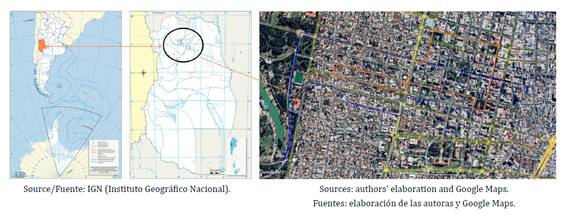
Figure 1. Location
of the study area and map of the assessment route. Yellow and blue lines
indicate walking tours.
Figura 1. Ubicación
del área de estudio y mapa de la ruta de evaluación. Líneas naranja y azul
indican los recorridos realizados.
Mendoza city is
characterized by sustained aridity, a temperate-dry climate (BWk-Koppen),
restricted water resources (average rainfall 250mm/year) and high constant
solar radiation throughout the year (1840 MJ/m2). The annual potential
evapotranspiration (ET) is 782mm, indicating a water deficit of 532mm. The
Mendoza Metropolitan Area (MMA) is an urban conglomerate with more than two
million inhabitants characterized by massive presence of trees in an urban
structure -tree/inhabitant ratio = 0.50 in 2021; (19);
i.e., one tree every two inhabitants.
The urbanized
area has a high percentage of green spaces and tree alignments parallel to
urban blocks and road layouts. An artificial irrigation network made up of
irrigation canals carry water from the mountain snowmelt (14) supporting this forestation. However, the
sustained scarcity of water resources during the decade 2010-2020 and the
progressive loss of irrigation efficiency compromised growth, structural
stability and forest health.
Tree
Assessment
The two most
frequent species were surveyed following a circuit that passed through the
areas of low building density (< 2m2/m3) to the
densely built-up area (>2 to 4 m2/m3). In the surveyed
area, around 840 tree individuals were observed in street alignments, at
regular planting intervals. Data collection was carried out between 22nd
and 24th March 2023, in the area located between Colón Street (to
the south), Emilio Civit/Sarmiento Street (to the north), San Martín Street (to
the east) and Boulogne Sur Mer Street (to the west) (figure 1).
For risk
assessment, walking tours were conducted along sidewalks and streets, according
to a level 1 assessment (6), based on the
rapid assessment method according to Coelho Duarte (2021b).
This method aims to identify obvious tree defects and hazardous situations,
without determining a final risk level.
The assessments
resulted in a profile of probable failures per species and biomechanical
adaptations. For this, the risk management of urban trees guide by Pokorny (2003) was used. Chapter 3, How to detect
and assess hazardous defects in trees, describes tree defects divided into
seven categories.
Results
and Discussion
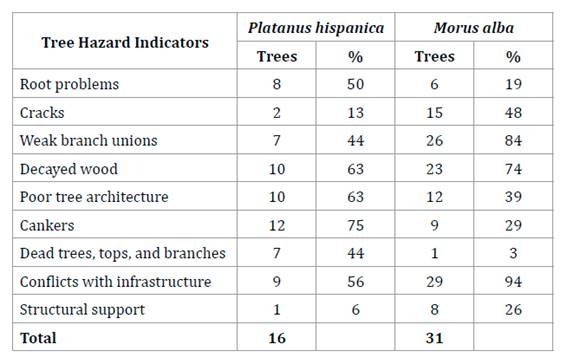
A total of 47
trees with hazardous defects were detected, 16 London Plane and 31 Mulberry
trees, representing 6.5% of assessed trees. This low percentage of trees with
higher likelihood of failure is expected and consistent with Coelho-Duarte (2021a), who recommends three different
levels of assessment to optimize risk management.
Tree
Hazard Indicators
Table 1, shows
tree hazard indicators identifying defective trees by species.
Table 1. Number
of trees for each hazard indicator and occurrence (%) by species.
Tabla 1. Número
de árboles para cada indicador de riesgo y ocurrencia por especie (%).
Decayed
Wood
Decayed wood
results from the interaction among the tree, biodeterioration agents (such as
bacteria, fungi or xylophagous insects) and environmental conditions (such as
humidity and temperature) (7). In living
trees, as decay progresses, cavities and hollows may appear, reducing
structural strength and stability of the individuals (2). Rotten wood, the presence of fungal fruiting
bodies, cavities, hollows, cracks, wood bulging and bark oozing are indicators
of advanced wood decay (16, 20, 28).
In 63% of London
Plane trees and 74% of Mulberry trees, some type of decay was observed during
the assessment circuit, most of it due to severe or inadequate pruning, in
which the trees are not able to complete wound compartmentalization (figure 2, page 156).
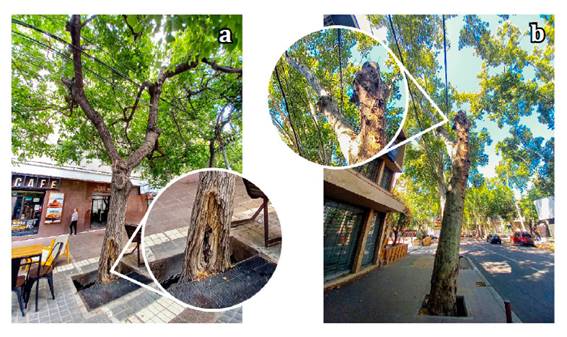
Figure 2. Decay
defect observed on a- Morus alba on Peatonal Sarmiento and b- Platanus
hispanica with dry branches on Montevideo Street.
Figure 2. Defecto
de pudrición observados en a- Morus alba de la Peatonal
Sarmieneto y b- Platanus hispanica con ramas secas, en calle
Montevideo.
Cavities with
rotten wood were observed in trunks, while branch advanced decay with large
pruning cuts showed, in some cases, wound wood and in others, loss of wood and
cavities. No fungal fruiting bodies were observed during data collection,
probably caused by the study taking part during late summer-autumn, with high
temperatures.
In some trees,
decay was associated with longitudinal cracks, especially in trees with
codominant stems and included bark and cankers. Defects simultaneously
occurring, and potentiated can increase failure likelihood, like cracks
separating codominant stems with deterioration in the union area (8, 20). This combination of problems was mainly
observed in Mulberry trees, associated with crown shape and consecutive
pruning.
Among tree
defence strategies against biodeterioration agents, the process of heartwood
formation consists of wood gaining natural durability thanks to biochemical changes
(7, 11). Another important defence
mechanism of trees is compartmentalization, first described by Shigo (1977) who stated four tree barriers formed in
the Compartmentalization of Decay in Trees (CODIT) model, with changes
at the chemical and anatomical level, preventing microorganisms from advancing
into the wood. More recently, the letter D for Decay is also used as Damage,
as compartmentalization can occur after a wound, with prior tissue infection (12).
In London Plane
trees, wound wood formation was observed, even when pruning cuts or wounds
caused by vehicular traffic, were large (figure 2).
Cracks
A crack is a
separation in the wood tissue (16), and
one major defect in more severe cases as they indicate the tree is already
failing (20). Cracks can be formed when a
trunk or branch does not support a certain load, either due to poorly closed
wounds, split of weak unions or branches with overloaded limbs (2). They can also be caused by frost damage or sunscald
(28). Vertical cracks following the
direction of longitudinal fibers, were present in 48% of Mulberry trees,
combined with the presence of codominant V-shaped stems and decay (figure
3a, page 157).
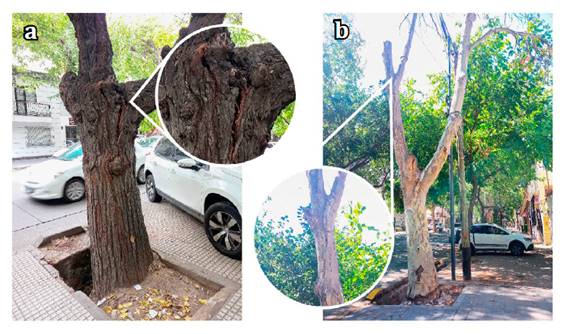
Figure 3. Crack
defect in a- Morus alba and b- Platanus hispanica.
Figura 3. Defecto
de grietas en a- Morus alba y b- Platanus hispanica.
In London Plane
trees, they were rarely observed (13%), mostly associated with dead wood (figure 3b, page 157). These defects have a high to imminent likelihood
of failure, and treatment should be recommended.
Root
problems
Site factors
such as reduced space for root development, shallow, compacted, or poor soil,
cause tree decline in urban areas (27).
Limited space for root growth of these first magnitude species, such as London
Plane trees, and second magnitude like Mulberry trees, is compounded by
impermeabilized irrigation ditches of Mendoza. Although this does not normally
result in direct tree damage, decreasing soil moisture and oxygen availability,
reduces tree ability to recover from injury, insect attack and/or disease (5). Also, root weakness results in loss of
anchorage and support (28), increasing
the possibility of whole-tree overturning. Thus, significant changes in the
critical root radius (CRR) can lead to a high failure potential especially when
more than 40% of the roots within this zone are damaged (9, 20). In Mulberry trees, impacts of ditch
impermeabilization were observed in 19% of the trees (figure 4a,
page 157).
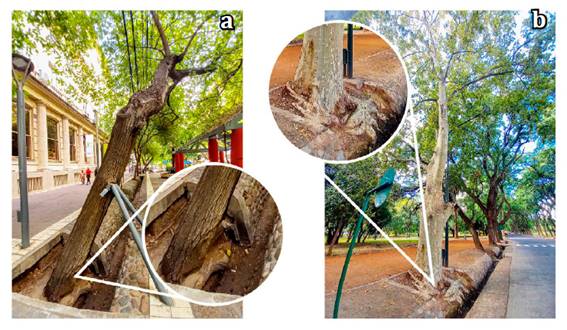
Figure 4. Root
problems related to pot dimensions or planting site, and impermeabilization; a-
Morus alba; b- Platanus hispanica.
Figura 4. Problemas
del sistema radical relacionado con las dimensiones de la cazuela o sitio de
plantación, e impermeabilización; a- Morus alba; b- Platanus
hispánica.
In 50% of London
Plane trees some root problems were observed, such as girdling and exposed
roots in search of oxygen (figure 4b, page 157).
Girdling roots
compress root collar, hindering water, nutrients, and sap transport from and to
the roots (9, 10). These roots can
originate in the nursery itself, in seedlings grown in small pots, or when the
tree is grown in a small rigid space, where structural roots are unable to grow
laterally (16).
Weak
branch unions
Wood at the stem
union has anatomical changes that generate greater cohesion (25) to fulfil the function of absorbing and
transmitting wind loads until they dissipate into the soil (28). Epicormic shoots emerge from dormant
adventitious buds activated by stress conditions, such as topping (12). These buds may be present in the outer
growth layers, resulting in superficial attachment. The larger the epicormic
shoot, the greater the load on this weak union. On the other hand, included
bark may be generated during the development of bifurcated stems or branch
insertions which, instead of generating the more cohesive axillary wood, grow
with bark between the stems, resulting in no connection between them. This may
occur due to an intrinsic species trait, as in those with opposite buds, or
after inappropriate management, altering bud development (24). Included bark can be detected by the
V-shaped insertion, as opposed to a strong union, which would be U-shaped. Both
included bark -especially between codominant stems resulting in opposing loads
of similar magnitude- and epicormic shoots are types of weak unions present in
trees (20). Eighty-four percent of
Mulberry trees showed codominant, V-shaped structural branches with a very
small angle of insertion and branches overextended towards the roadside. In
some cases, this defect was combined with cracks, cankers, or rots (figure 5a).
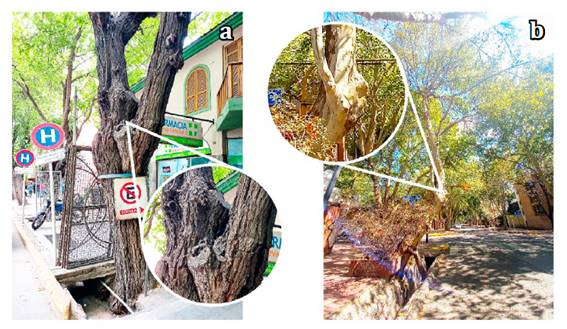
Figure 5. Defects
concerning weak branch unions or codominant stems; a- Morus alba;
b- Platanus hispanica.
Figura 5. Defectos
referidos a uniones débiles de ramas o troncos codominantes; a-Morus
alba; b- Platanus hispanica.
This makes stem
splits the main likelihood of failure. In London Plane trees, 44% had weak
unions, mainly in the most intensively managed trees, where the crown is
largely made up of epicormic shoots and, in some cases, these weak unions were
combined with decayed wood (figure 5b).
Cankers
Cankers are
areas with damaged cambium (16) on
trunks, branches, and roots (2). They can
be caused by fungi, insects, lightning or mechanical damage, such as wounds
caused by vehicles, lawn mowers, among others. According to Pokorny (2003), regardless of the origin of the damage,
more than 40% affectation of the circumference of a tree may cause failure and,
in turn, if the canker is associated with decay, it can quickly weaken the
tree. In the streets of Mendoza city, cankers were mainly associated with
pruning wounds and decay, being recorded in 29% of the Mulberry trees and 75%
of the London Plane trees. Figure 6a (page 159), shows a
Mulberry tree with abnormal basal growth, appearing as a “wood belt” (16), which may have been caused by damage during
changes in the sidewalk.
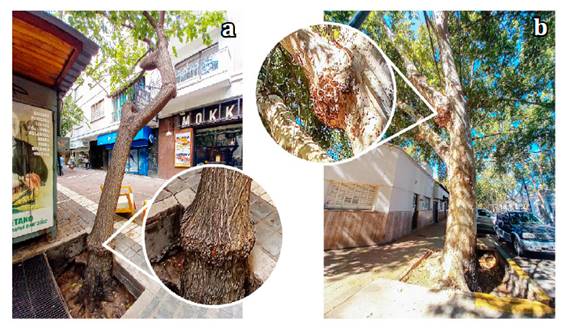
Figure 6. Canker
present in a- Morus and b- Platanus.
Figura 6. Defectos
compatibles con cancros en a- Morus y, b- Platanus.
In one specimen
of London Plane an abnormal discoloration, combined with branch dieback, may
have been associated with disease. In another case, a gall-like growth was
observed, with a significant change in bark texture (figure 6b,
page 159). According to Mattheck et al. (2015),
this form is not associated with a severe structural problem. The problem is
aggravated when the canker is associated with decayed wood.
Poor
tree architecture
Poor
architecture suggests imbalance and weakness of branches, trunk, or whole tree.
According to Pokorny (2003), indicators could be unbalanced
crown leaning, overextended, twisted, bent or harp-shaped branches, multiple
stems or epicormic shoots originating from the same area and stump sprouts.
Among the trees
assessed, 63% of the London Plane trees and 39% of the Mulberry trees showed
some problem related to architecture, especially observed in those subsequently
intervened by pruning, resulting in an unbalanced, curved shape (figure
7a) and with overextended branches towards the roadside.
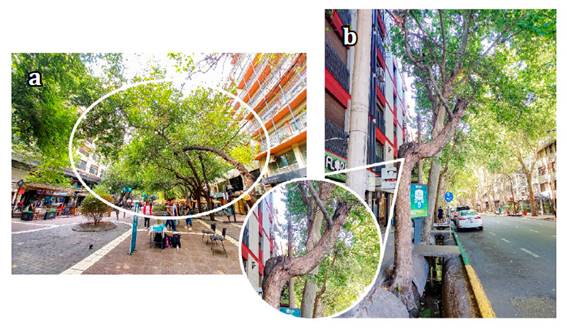
Figure 7. a- Imbalance
in the morphology of a Mulberry tree in Peatonal Sarmiento. b- London
Plane tree with poor architecture accompanied by decayed wood.
Figura 7. a- Desequilibrio
en la morfología de Morus, en Peatonal Sarmiento. b- Platanus con
arquitectura pobre acompañada de madera seca.
Although these
indicators, according to Pokorny (2003), correspond
to a moderate likelihood of failure, these defects are in some cases combined
with the presence of decayed wood (figure 7b).
Dead
trees, tops, and branches
Dead branches
can remain attached to the tree for a long time, and suddenly break off as they
no longer have the tension that keeps them attached (20).
This was observed in 3% Mulberry trees, and 44% London Plane trees, especially
where impermeabilisation hindered water availability (figure 8).
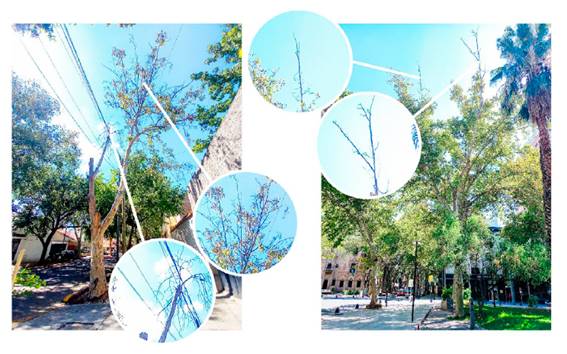
Figure 8. London
Plane individuals showing signs of dieback.
Figura 8. Ejemplares
de plátanos con signos de “muerte regresiva”.
The dieback
observed in London Plane specimens may be associated with site factors leading
to root decay, such as soil compaction or impermeabilisation that impede root
gas exchange reducing root mass and, consequently, water and nutrient
absorption (16). As a result, the tree
starts to die out from the branch tips inwards (20).
Slenderness
(H:D)
Slender trees
may be more prone to mechanical failure, causing permanent bending or stem
breakage (8). The slenderness index,
characterizing likelihood of failure, is calculated by dividing tree total
height by the diameter at breast height (both in meters). Many authors classify
the likelihood of failure as possible for slenderness between 60 and 80,
probable between 81 and 100, and imminent over 100. When “lion tailing” pruning
is done, leaving branches accumulated at the ends of main stems, slenderness is
increased. Another factor increasing this index is tree planting near tall
buildings, reducing light availability, and promoting growth in height without
an increase in trunk diameter (15)
something the tree will correct only under healthy, vigorous conditions (28). Figure 9 (page 161), shows
this behavior in a London Plane specimen showing signs of crown lifting
pruning. In addition, the epicormic origins of these branches, with a weaker
union, as well as the presence of non-compartmentalized pruning wounds with
decay, can increase likelihood of failure.
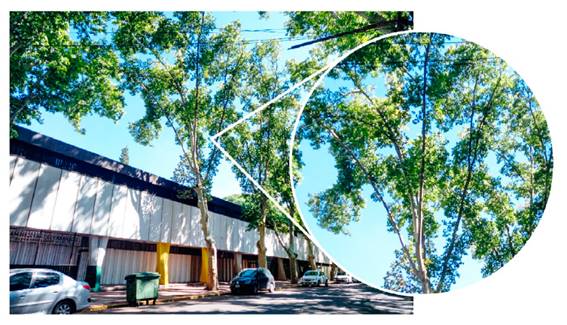
Figure 9. Defect
in London Plane trees compatible with slender individuals.
Figura 9. Defecto
en Platanus compatible con ejemplares esbeltos.
Conflicts
with infrastructure
In addition to
the risk of structural failure, interference with pedestrian walkways,
underground utilities or utility poles and wires should be considered in the
risk assessment (6). The presence of
aerial utility wiring in the city of Mendoza with either Mulberry or London
Plane trees (figure 10, page 161), increases the need for
frequent interventions on the tree crown to reduce the occurrence of friction
between branches and wires.
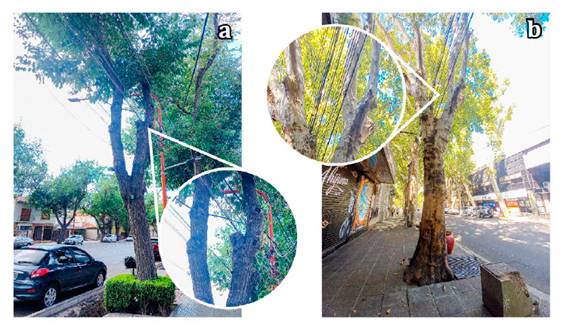
Figure 10. Conflicts
with utility wiring and lighting poles; a- Morus alba; b- Platanus
hispanica.
Figura 10. Interferencias
con cableado y postes de iluminación pública; a- Morus alba; b-
Platanus hispanica.
These conflicts
were observed in 94% of the Mulberry trees and 56% of the London Plane trees. Greater
deterioration is observed in the Mulberry trees in general, compared to the
London Plane trees.
Biomechanical
adaptation
Biomechanics
study how trees adapt to different growth sites, climatic conditions, and
stresses (2). Ditches create special
conditions for root performance, and in many cases, impermeabilization adds
resistance making root growth limited. In some individuals of both species,
structural roots and root collar growth, was observed above ground level and
towards the roadside curb (figure 11, page 162).
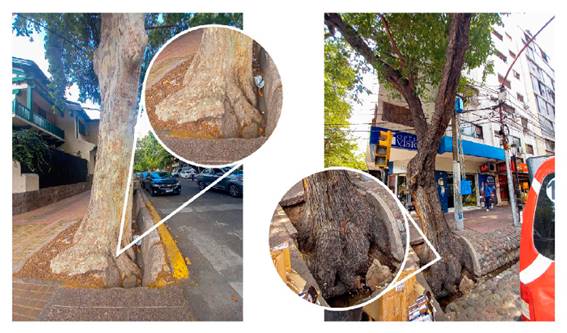
Figure 11. Structural
roots and root collar growth above ground level.
Figura 11. Crecimiento
de las raíces estructurales y del cuello por arriba del nivel del suelo.
Although this
tissue contains dormant adventitious buds, that become active under
stress-generating epicormic shoots, it does not provide the expected structural
anchorage (16). In addition, the wood in
this area is exposed to mechanical damage and deterioration agents such as
fungi and xylophagous insects.
Structural
support
Supports are
necessary when the tree has a probable or imminent likelihood of failure due to
high pedestrian/vehicle occupancy rate or presence of targets that cannot be
moved (12). This generally occurs when
tree adaptation is slow compared to the response needed to reduce the hazard.
In the study area, supports were observed on Mulberry trees tying co-dominant
stems, where a crack separating them was already visible (figure
5a, page 158). Supports were also observed on steeply inclined trees in
both species (figure 12).
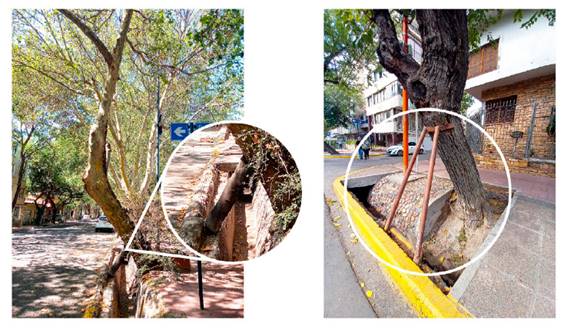
Figure 12. Individuals
of Platanus and Morus with structural supports, orthopedics or
“crutches”.
Figura 12. Ejemplares
de Platanus y Morus con soportes estructurales, ortopedias o
“muletas”.
When using
supports, tree reactions such as wound generation or positive adaptive response
must be monitored, and the option of relocating, reinforcing, or removing the
support, should be evaluated. However, in some cases, supports generated wounds
or cracks, indicating it should have been removed after the tree corrected the
lean.
General
discussion
The failure
profile indicated that the main problems identified in London Planes were cankers
with decay, combined with poor branch architecture, caused by successive and intensive
pruning to release aerial wiring. These problems indicating a “probable”
likelihood of failure, were more evident in streets with ditch
impermeabilization and/or inefficient irrigation. In most streets, London Plane
trees were in good phytosanitary condition and the wounds were
compartmentalized.
On the other
hand, Mulberry trees showed more dangerous defects, with an “imminent” likelihood
of failure. Indicators were the presence of cracks in the codominant stems union
with bark included, or along overextended structural branches, in both cases
combined with decay. Mulberry trees were also intervened year after year, with
large cuts releasing utility wiring. In many cases, this resulted in an
imbalanced architecture of the crown, with branches overextending towards the
roadside. Additionally, pruning cuts were not effectively compartmentalised,
with evident decay, cankers, and exudations. In addition to interventions due
to competition with the aerial utilities, changes around the root system also
affected some individuals, such as changes in soil level and impermeabilization
of ditches, also observed in London Planes.
In addition to
the obvious conflict with the city’s grey infrastructure, these trees are ageing
without adequate maintenance. The literature indicates that large, mature trees
generate more ecosystemic services than small trees (18,
21, 26). The problem is established when these large individuals
deteriorate and with indicators of “probable to imminent” likelihood of
failure. This, combined with high occupancy rate of the area and the large size
of parts that can fail, results in high to extreme risk. In this scenario,
increasing decay and consequent reduction in vigor, in addition to the already
detected conditions of water and heat stress, seriously impact ecosystem
services and tree safety. This reinforces the need for the development of
short-term strategic management including the replacement of trees posing the
highest risks.
Conclusions
This rapid
visual assessment allowed for an efficient survey of street trees, identifying
main problems in two major species in Mendoza city -Platanus hispanica and
Morus alba and in areas with the highest occupancy rate, where the fall
of a whole or part of a tree could cause significant damage. Potential failure
or defect profiles increase efficiency in surveying monitoring zones, making
assessments more effective, especially in areas with higher vehicular and
pedestrian traffic flow.
In cases with a
probable to imminent likelihood of failure, we recommended following the risk
management protocol and making more in-depth assessments at a level 2 or basic
visual level, indicating risk mitigation treatments.
In comparative
terms, London plane showed the presence of cankers with decay, combined with poor
branch architecture, while mulberry trees showed more dangerous defects, and
“imminent” likelihood of failure, cracks in the union area of codominant
structural branches with bark included and signs of decay. In this sense,
London plane is recommended for new urban forests in highly consolidated areas
and under intense anthropic pressure, compared to Mulberry tree.
Although this
case study does not provide an in-depth assessment of species adaptation, the
defect profiles can be considered as a preliminary conclusion on London Plane
trees being more resilient to pruning interventions compared to Mulberry trees.
However, changes near the root zone, and in the frequency and amount of
irrigation, lead to a considerable decrease in vigor.
The planning and
integration of knowledge, scientific advances and practical experience have a
positive impact on the management and preservation of urban forests as a public
resource in cities. This is even more relevant in the case of Mendoza, given
climatic and geographical conditions in terms of water restriction,
environmental vulnerability, and advances in urbanization patterns.
Acknowledgements
The authors
would like to thank the Comisión Sectorial de Investigación Científica de la
Universidad de la República (CSIC/UDELAR), the Consejo Nacional de
Investigaciones Científicas y Técnicas (CONICET) and the Agencia Nacional de
Promoción de la Ciencia y Tecnología (ANPCyT) for the funding received through
the project PICT 2018-03590 in support of the development of this research. And
express gratitude to Agustina Sergio for her friendly cooperation.
1. Ameneiros,
C.; Fratti, P.; Sergio, A.; Coelho-Duarte, A. P.; Ponce-Donoso, M.;
Vallejos-Barra, Ó. 2022. Comparison of visual risk assessment methods applied
in street trees of Montevideo city, Uruguay. Revista de la Facultad de Ciencias
Agrarias. Universidad Nacional de Cuyo. Mendoza. Argentina. 54(2): 38-47. DOI:
https://doi.org/10.48162/rev.39.081
2. Calaza, P.;
Iglesias, I. 2016. El riesgo del arbolad o urbano. Contexto, concepto y
evolución. Mundi- Prensa. 526 p.
3. Coelho-Duarte
A. P. 2021a. Evaluación del riesgo de los árboles urbanos: propuesta de un
protocolo para Montevideo, Uruguay. Tesis de maestría. Universidad de la
República (Uruguay). Facultad de Agronomía. Unidad de Posgrados y Educación
Permanente
4. Coelho-Duarte
A. P.; Daniluk-Mosquera G.; Gravina V.; Vallejos Barra O.; Ponce-Donoso, M.
2021b. Tree risk assessment: Component analysis of six visual methods applied
in an urban park, Montevideo, Uruguay. Urban Forestry & Urban Greening. 59:
127005. https://doi.org/10.1016/j.ufug.2021.127005
5. Czaja, M.;
Kołton, A.; Muras, P. 2020. The complex issue of urban trees-stress factor
accumulation and Ecological Service Possibilities. Forests. 11(9): 932.
https://doi.org/10.3390/f11090932
6. Dunster, J.
A.; Smiley, E. T.; Matheny, N.; Lilly, S. 2017. Tree risk assessment manual.
International Society of Arboriculture. 194 p.
7. Forest
Products Laboratory. 2010. Wood Handbook. Wood as an Engineering Material. USDA
Forest Service. General Technical Report FPL- GTR-190. 509 p.
https://doi.org/10.2737/FPLGTR-190
8. Guyon, J.;
Cleaver, C.; Jackson, M.; Saavedra, A.; Zambino, P. 2017. A guide to
identifying, assessing, and managing hazard trees in developed recreational
sites of the northern Rocky Mountains and the intermountain West. USDA Forest
Service. Northern and Intermountain Regions. Report number R1-17-31. 82 p.
https://www.fs.usda.gov/Internet/FSE_DOCUMENTS/fseprd571021.pdf
9. Hauer, R. J.;
Johnson, G. R. 2021. Relationship of structural root depth on the formation of
stem encircling roots and stem girdling roots: Implications on tree condition.
Urban Forestry & Urban Greening, 60: 127031.
https://doi.org/10.1016/j.ufug.2021.127031.
10. Johnson, G.;
Fallon, D. 2021. Stem girdling roots the underground epidemic killing our
trees. University of Minnesota Digital Conservancy. Urban Forestry. (11). 13 p.
https://conservancy.umn.edu/bitstream/handle/11299/226077/Stem%20Girdling%20Roots-The%20Underground%20Epidemic%20Killing%20Our%20Trees.pdf?sequence=1&isAllowed=y
11. Kim, Y. S.;
Funada, R.; Singh, A. P. (Eds.). 2016. Secondary xylem biology: Origins,
functions, and applications. Elsevier/Academic Press.
12. Lilly, S.;
Bassett, C.; Komen, J.; Purcell, L. 2022. Arborists’ Certification Study Guide
(4th ed.). International Society of Arboriculture. 468 p.
13. Martinez, C.
F. 2014. Crecimiento bajo déficit hídrico de especies forestales urbanas de la
ciudad oasis de Mendoza, Argentina y su área metropolitana. Ecosistemas:
Revista Científica de Ecología y Medio Ambiente. Revista Ecosistemas 23(2):
147-152. Doi.: 10.7818/ECOS.2014.23-2.20
14. Martinez, C.
F.; Cavagnaro, J. B.; Roig, F. A.; Cantón, M. A. 2013. Respuesta al déficit
hídrico en el crecimiento de forestales del bosque urbano de Mendoza. Análisis
comparativo en árboles jóvenes. Revista de la Facultad de Ciencias Agrarias.
Universidad Nacional de Cuyo. Mendoza. Argentina. 45(2): 47-64.
15. Martinez, C.
F.; Cantón, M. A.; Roig Juñent, F. A. 2014. Incidencia del déficit hídrico en
el crecimiento de forestales de uso urbano en ciudades de zonas áridas. Caso de
Mendoza, Argentina. INTERCIENCIA Revista de Ciencia y Tecnología de América.
Venezuela. Vol. 39 (12): 890-897.
16. Mattheck,
C.; Bethge, K.; Weber, K. 2015. The body language of trees: Encyclopedia of
visual tree assessment. KS Druck GmbH. 548 p.
17.
Municipalidad de Capital. 2012. 1° Censo Georreferenciado del Arbolado Público
de la Ciudad de Mendoza. Municipalidad de la Ciudad de Mendoza. Inédito.
18. Nowak, D.;
Crane, D.; Stevens, J.; Hoehn, R.; Walton, J.; Bond, J. 2008. A Ground-Based
Method of Assessing Urban Forest Structure and Ecosystem Services.
Arboriculture & Urban Forestry. 34(6): 347-358. https://doi.org/10.48044/jauf.2008.048
19. INDEC 2022.
https://www.indec.gob.ar/indec/web/Nivel4-Tema-2-41-165. Fecha de consulta
22/05/2023.
20. Pokorny, J.
D. 2003. Urban tree risk management: A community guide to program design and
implementation. USDA Forest Service. Northeastern Area, State and Private
Forestry.
https://www.fs.usda.gov/naspf/publications/urban-tree-risk-managementcommunityguide-program-design-and-implementation.
NA-TP-03-03. 204 p. https://www.fs.usda.gov/nrs/pubs/na/NA-TP-03-03.pdf
21. Rötzer, T.;
Moser-Reischl, A.; Rahman, M. A.; Grote, R.; Pauleit, S.; Pretzsch, H. 2020.
Modelling urban tree growth and ecosystem services: Review and Perspectives. En
F. M. Cánovas, U. Lüttge, M. C. Risueño, & H. Pretzsch (Eds.). Springer
International Publishing. 82(405-464). https://doi.org/10.1007/124_2020_46
22. Ruiz, M. A.;
Colli, M. F.; Martinez, C. F.; Correa, E. 2022. Park cool island and
built environment. Ten years evaluation in Parque Central, Mendoza-Argentina.
Sustainable Cities and Society. Volume 79: 103681.
https://doi.org/10.1016/j.scs.2022.103681
23. Shigo, A.
1977. Compartmentalization of decay in trees. USDA Forest Service. Agriculture
Information. 73. https://permanent.fdlp.gov/gpo65586/ne_aib405.pdf
24. Slater, D.
2018. Natural bracing in trees: Management recommendations. Arboricultural
Journal. 40(2): 106-133. https://doi.org/10.1080/03071375.2017.1415560
25. Slater, D.;
Harbinson, C. 2010. Towards a new model of branch attachment. Arboricultural
Journal. 33(2): 95-105. https://doi.org/10.1080/03071375.2010.9747599
26. Wang, Y.;
Bakker, F.; De Groot, R.; Wörtche, H. 2014. Effect of ecosystem services
provided by urban green infrastructure on indoor environment: A literature
review. Building and Environment. 77: 88-100.
https://doi.org/10.1016/j.buildenv.2014.03.021
27. Watson, G.
W.; Hewitt, A. M.; Custic, M.; Lo, M. 2014. The management of tree root systems
in urban and suburban settings II: A review of strategies to mitigate human
impacts. Arboriculture and Urban Forestry. 40: 249-271.
https://doi.org/10.48044/jauf.2014.025
28. Wessolly,
L.; Erb, M. 2016. Manual of Tree Statics and Tree Inspection. Patzer Verlag.
288 p.