Revista de la Facultad de Ciencias
Agrarias. Universidad Nacional de Cuyo. Tomo 56(1). ISSN (en línea) 1853-8665.
Año 2024.
Original article
Morphostructural
composition and meat quality in local goat kids from the northeastern region of
Mexico
Composición
morfoestructural y calidad de la carne en cabritos locales de la región noreste
de México
Yuridia Bautista-Martínez1,
Lorenzo Danilo Granados-Rivera2,
Rafael Jimenez-Ocampo3,
1Universidad
Autónoma de Tamaulipas. Facultad de Medicina Veterinaria y Zootecnia. 87000.
Ciudad Victoria, Tamaulipas. México.
2Instituto
Nacional de Investigaciones Forestales, Agricolas y Pecuarias. Campo
Experimental General Terán. 67400. General Terán, Nuevo León. México.
3Instituto
Nacional de Investigaciones Forestales, Agrícolas y Pecuarias. Campo
Experimental Valle del Guadiana. 34170. Durango, Durango. México.
4Instituto
Nacional de Investigaciones Forestales, Agrícolas y Pecuarias. Campo
Experimental La Laguna. 27440. Matamoros. Coahuila. México.
*maldonadoj.jorge@hotmail.com
Abstract
Goat farming is
an important activity in northern Mexico. In this sense, “cabrito” or kid goat
is a typical regional dish with high economic and cultural value. However,
information on the morphostructural composition and meat quality of these local
specimens is scarce. Given this, the objective was to evaluate morphostructural
characteristics, carcass and meat quality in local kids according to sex in the
northeastern region of Mexico. For this purpose, 14 kids (7 males and 7
females) 57 days old were slaughtered. Morphostructural composition was
evaluated with 22 zoomometric and phenotypic variables. Carcass characteristics
were evaluated by considering different body structures, carcass yield and
degree of fatness. Meat quality was determined by physicochemical
characteristics, nutritional value and fatty acid profile. The sex effect was
evaluated by t-test of independent means and Chi-square. Meat physicochemical
characteristics, nutritional value and morphostructure of local kids were heterogeneous
and showed no differences (P≥0.05) concerning sex. Carcass, kidneys, head, neck,
rib and loin weights were higher in males than in females (P≤0.05). Fatty acids
(FA) found in greater proportion were palmitic (C16:0), oleic (C18:1, n-9),
stearic (C18:0), and myristic (C14:0). These FA comprised 80.85 % of the lipid
profile of male meat and 76.83% of females. These results are the basis for
future programs aimed to improve production systems. Differences found could
shed light on future efforts on how to differentiate goat meat from this region
of Mexico and enter new markets directly benefiting small producers.
Keywords: meat, carcass,
nutritional quality, fatty acid profile
Resumen
La
caprinocultura es una actividad muy importante en el norte de México por la
producción de leche y carne. En este sentido, el cabrito es un platillo típico
de esta región con valor económico y cultural elevado, no obstante, la
información que describe la composición morfoestructural y calidad de carne de
estos ejemplares locales, ha sido poco documentada. Debido a lo anterior, el
objetivo fue evaluar las características morfoestructurales, calidad de canal y
carne en cabritos locales de acuerdo con el sexo (machos y hembras) en la
región noreste de México, para esto se sacrificaron 14 cabritos (7 machos y 7
hembras) de 57 días de edad. Para evaluar la composición morfoestructural, se
consideraron 22 variables zoométricas y fenotípicas. Las características de la
canal se evaluaron considerando las distintas estructuras corporales,
rendimiento en canal y grado de engrasamiento. Se determinó calidad de carne
midiendo las características fisicoquímicas, valor nutricional y perfil de
ácidos grasos. Se evaluó el efecto del sexo mediante una prueba de t de medias
independientes y Chi cuadrada. La estructura morfoestructural de los cabritos
locales es heterogénea, y no mostraron diferencias (P≥0,05) respecto del sexo.
El peso de la canal, riñones, cabeza, cuello, costillar y lomo fueron mayores
en machos que en hembras (P≤0,05). Las características fisicoquímicas y valor
nutricional de la carne no mostraron diferencias entre sexos. Los ácidos grasos
(AG) que se encontraron en mayor proporción fueron; palmítico (C16:0), oleico
(C18:1, n-9), esteárico (C18:0), y mirístico (C14:0). Estos AG comprendieron el
80,85 % del perfil lipídico de la carne de los machos, mientras que en hembras
representaron el 76,83 %. Estos resultados son la base para futuros programas
de mejora del sistema productivo y donde las diferencias encontradas podrían
arrojar luz sobre esfuerzos futuros, sobre cómo diferenciar la carne de cabrito
en esta región de México e ingresar a nuevos mercados que beneficiarían
directamente a los pequeños productores.
Palabras clave: carne, canal,
calidad nutricional, perfil de ácidos grasos
Originales: Recepción: 26/06/2023 - Aceptación: 22/03/2024
Introduction
In Mexico, goat
production is focused on meat and milk. During 2022, carcass meat production
achieved 77,000 tons, and 160 million liters of milk (32). The
predominant production system is extensive, with animals known as “local”, with
an undefined phenotype derived from mating different breeds such as Alpina,
Saanen, Nubia, and Toggenburg (31). Besides
feeding suckling kids, the produced milk is used for cheese, cajeta (a milk candy-type),
and typical regional candies. Kids are slaughtered and consumed at
approximately 30 days old. Their meat is soft and tender, low-fat, pearly white
and juicy. As a traditional Mexican dish, particularly in the north of Mexico,
it is consumed on special events and can be cooked in various presentations
like “al pastor” (shawarma), fried, or roasted. It is also considered a gourmet
dish reaching high prices in restaurants (32).
Similar dishes
are prepared in other countries such as Spain, where this meat should meet
certain characteristics (9), India, China,
Pakistan, Nigeria, Bangladesh, and Iran, where goat production is important (13). However, in
Mexico, particularly in the northeast, information on body structure, carcass
quality, and nutritional properties of kid meat is scarce. Nevertheless, breeds
such as Payoya, Gokcead, Maltese, Majorera, Blanca celtiberica, Negra serrana
and Moncaica, have been extensively documented (6).
In this context,
generating local information on kid meat produced in this region of Mexico is
important given that it supplies almost all the consumed kid meat in the
northern states of Mexico. Regional goat raising relies on the environmentally
best-adapted breeds. In this sense, particular production strategies can set
particular qualities, where denominations of origin can trigger added value (26). The
aforementioned is particularly important for smallscale, and highly social and
economically marginalized producers (31, 35). Therefore,
our objective was to evaluate morphostructural traits, carcass and meat
quality, and fatty acid profile considering sex in local kids from the
northeastern region of Mexico.
Material
and methods
Animal
management and study protocol was approved by the Bioethics Committee of the
Facultad de Medicina Veterinaria y Zootecnia – Universidad Autónoma de Tamaulipas
in the pronouncement CBBA_01_2023.
Place
of study
This experiment
was conducted in a commercial production unit, located in ejido Ignacio
Zaragoza, Viesca, Coahuila, Mexico, within the region known as Comarca
Lagunera. The climate is desert, semi-warm with cool winters (BWhw), mean
annual rainfall of 240 mm, with average temperature of 25°C, ranging from -1°C
in winter to 44°C in summer.
Animals
and feeding
Before the
experiment, during the summer, a herd of 150 local empty goats mated naturally
during grazing and in housing pens.
Fourteen
57-day-old kids (7 males and 7 females) weighing 7.7 kg (live weight; LW) were
housed with their mothers from birth in individual 2 x 3 m pens provided with
shade, drinkers and ad libitum mineral salts.
Goat feeding was
based on grazing from 8:00 a.m. to 1:00 p.m., and from 4:00 p.m. to 8:00 p.m.,
keeping the goats penned during the hottest hours of the day, and taking
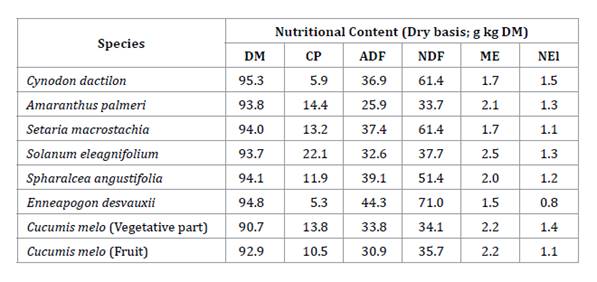
advantage of this space of time for kid suckling. Table 1 shows plant
nutritional value during grazing.
Table
1. Average chemical composition of the
main plant species consumed by local goats in northeastern Mexico.
Tabla 1. Composición
química promedio de las principales especies de plantas consumidas por caprinos
locales en el noreste de México.
DM= dry matter; CP= crude protein; ADF= acid
detergent fiber; NDF= neutral detergent fiber; ME= metabolizable energy; NEl=
net energy for lactation.
DM= materia seca; CP= proteína cruda; ADF= fibra
detergente ácido; NDF= fibra detergente neutro; ME= energía metabolizable; NEl=
energía neta para la lactancia.
Transportation
and slaughtering of goat kids
Kids were
slaughtered at weaning (57 days of age). Twelve hours before slaughter, they
were separated from their mothers and transported to the Municipal
slaughterhouse in Matamoros, Coahuila, where they were slaughtered following
the Official Mexican Standard NOM-033-SAG/ZOO-2014.
Zoometric
and morphostructural measurements
Before
slaughter, zoometric traits were measured: live weight (LW), face width (FW),
skull length (SL), ear length (EL), ear width (EW), neck width (NW), neck
length (NL), height at withers (HW), chest circumference (CC), barrel
circumference (BC), flank depth (FD), lumbosacral height (ASL), leg length
(LL), cane perimeter (CP). Morphostructural traits recorded included skin
pigmentation (SP), hoof pigmentation (HP), mucous membrane pigmentation (MP),
presence of wattles, beard, and horns (1=present, 2=absent) (8,
12, 14).
Carcass
yield
Before
slaughter, the PV was recorded. Subsequently, carcass productive components
were sectioned and removed (head without skin, skin, legs, lungs and trachea,
liver, heart, rumen, intestine and testicles -in males-). Yield was calculated
by dividing cold carcass weight (24 hours postmortem at 4°C) by the initial
live weight, expressed as a percentage (4).
Nutritional
value
From each kid,
200 g of Longissimus dorsi muscle meat were grounded to homogenize and
determine protein, fat, collagen, and moisture content with a FoodScan™ Meat
Analyzer.
Physicochemical
characteristics of meat
To measure meat
physicochemical characteristics, the Longissimus Dorsi muscle was
removed with a transverse cut between the 12th and 14th
rib, 24 hours postmortem (4).
pH
The pH was
measured 24 h post mortem from a cut of the Longissimus dorsi muscle
at the 12th rib, inserting the electrode of a portable potentiometer
(HANNA® instruments, HI99163, Singapore), previously calibrated with pH 4.00
and 7.00 buffer solutions.
Color
Color was
measured at three different points on the surface of the Longissimus dorsi muscle
24 h post mortem, using the Hunter method. A colorimeter (Minolta, Mod
CR-400/410, Tokyo, Japan) determined L* (lightness), a* (red-green) and b*
(yellow-blue) (11).
Drip
loss
Drip loss was
determined after Wang et al. (2016) with
modifications. Approximately 30 g of the Longissimus dorsi muscle meat
sample were weighed and placed in Styrofoam cups hanging from a thread without
touching the walls of the cup. Subsequently, they were stored at 4°C and
weighed 24 h later. Drip loss was expressed as the percentage of weight loss to
initial weight (8).
Water
retention capacity (WRC)
The WRC was
analyzed following Guerrero et al. (2002), with
modifications. Five g of finely minced meat of the Longissimus dorsi muscle,
24 h postmortem, were weighed and homogenized with 8 ml of sodium
chloride for 1 minute using a glass rod. Subsequently, it was left to rest for
30 minutes in an ice bath. The extract was centrifuged for 25 minutes at 35,000
r.p.m. The supernatant was drained and the volume was measured in a graduated
cylinder. The amount of ml of solution retained in 100 g of meat was reported.
Cooking
yield
Cooking yield
was determined after Liu et al. (2012) with
modifications. From each meat sample, 50 g of the Longissimus dorsi muscle,
24 h postmortem were weighed using an analytical scale and placed in
Ziploc-type bags. They were then placed in a water bath at 90°C for 15 minutes.
Meat internal temperature was measured with a stem thermometer. Subsequently,
they were left to rest at room temperature for 30 minutes. After this time,
they were re-weighed. Cooking yield was obtained by considering initial vs. final weight differences, expressed as percentages.
Fatty
acid (FA) profile
Fat purification
was carried out through FA methylation. We proceeded to oven-dehydrate 30 g of
the Longissimus dorsi muscle at 60°C. Subsequently, meat samples were
purified (15) and methylated
according to Jenkins (2010) modified by Granados-Rivera
et al. (2017).
Once the FA methyl esters were obtained, they were determined in a Hewlett
Packard 6890 chromatograph with an automatic injector equipped with a silica
capillary column (100 m x 0.25 mm x 0.20 μm thickness, Sp-2560, Supelco). FA
identification was done by comparing retention times of each peak obtained from
the chromatogram against a standard of 37 FA methyl ester components, and a
specific standard for cis-9, trans-11 and trans-10, cis-12 isomers (Nu-Check).
Statistical
analysis
Significant
differences among quantitative zoometric traits, nutritional value, carcass and
meat quality, and fatty acid profile between male and female goat kids were
determined by a t-student test for independent means with the SAS version 9.3
program. Given morphostructural variables are frequencies, a Chi-square (χ²)
test was used to assess independence concerning sex.
Results
Zoometric,
morphostructural, and carcass measurements
Morphostructure
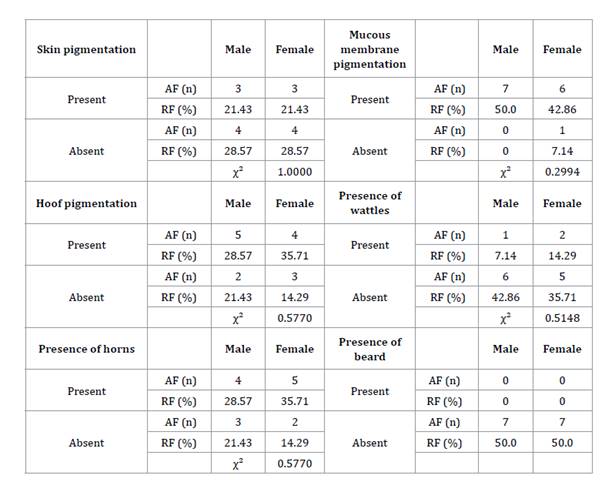
of local kids was heterogeneous, and no differences (P≥0.05) were found between
sexes (table
2).
Table
2. Absolute (AF) and relative (RF)
frequencies for morphostructural traits in local goat kids.
Tabla 2. Frecuencias
absolutas (FA) y relativas (FR) para las características morfoestructurales en
cabritos locales.
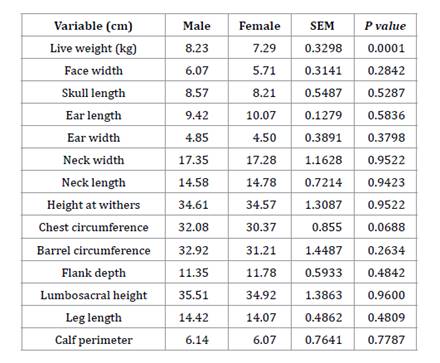
Concerning live
weight, males were significantly heavier compared to females at 57 days old,
with an average difference of 0.940 kg. Regarding other body traits, no
differences (P≥0.05) were found between sexes (table 3).
Table
3. Live weight and zoometric measurements
of local goat kids.
Tabla 3. Peso
vivo y medidas zoométricas de cabritos locales.
SEM: Mean standard error.
SEM: error estándar de la media.
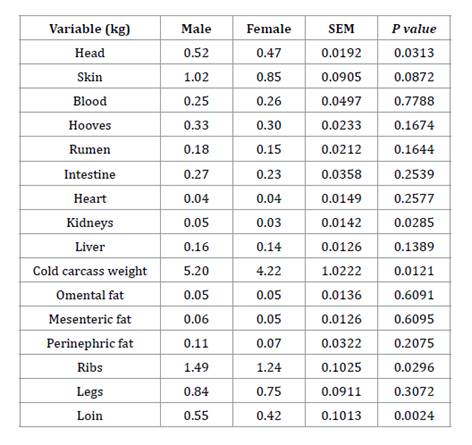
Regarding yield
components and carcass traits, weights of cold carcass, kidneys, head, neck,
ribs, and loin were higher in males than females (P≤0.05), showing significant
differences between sexes. Other carcass components did not show differences
between sexes (table 4).
Table
4. Yield components of the carcass in
local goat kids.
Tabla 4. Componentes
de rendimiento de la canal en cabritos locales.
SEM: Mean standard error.
SEM: error estándar de la media.
Nutritional
value and meat physicochemical characteristics
Meat nutritional
value of male and female kids showed no differences (P≥0.05) (table
5).
Table
5. Nutritional value and meat quality of
local goat kids.
Tabla 5. Valor
nutricional y calidad de la carne de cabritos locales.
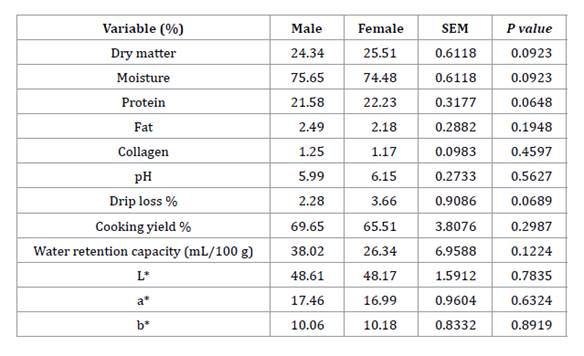
L*: lightness index; a* red to green index; b*:
yellow to blue index; SEM: Mean standard error.
L*: índice de luminosidad; a*índice de rojo a verde;
b*: índice de amarillo a azul; SEM: error estándar de la media.
Fatty
acid profile
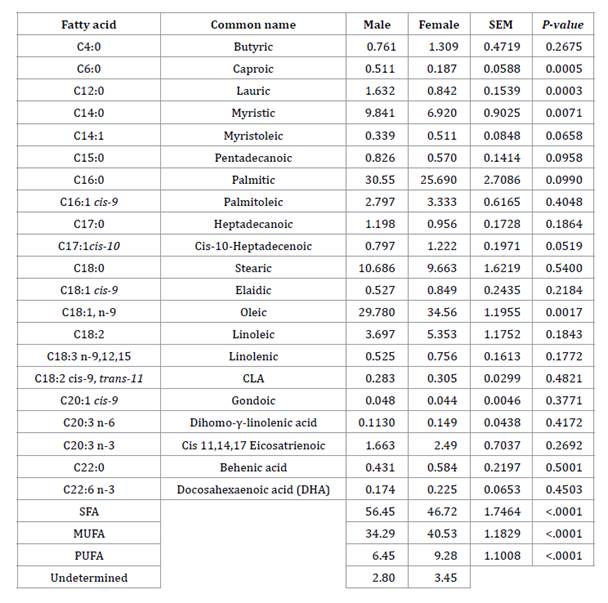
The FAs found in
greater quantity in meat were palmitic (C16:0), oleic (C18:1, n-9), stearic
(C18:0), and myristic (C14:0). These, in total, represented an average of
80.85% of the FA that make up male meat and 76.83% of female meat (table
6).
Table
6. Fatty acid profile (g/100 g-1
of fat) in local goat kids’ meat.
Tabla 6.
Perfil de ácidos grasos (g/100 g-1 de grasa) en carne de cabritos
locales.
ab
Different letters in the same row show statistical differences (P ≤ 0.05); SEM:
Mean standard error; SFA= saturated fatty acids, MUFA= monounsaturated fatty
acids; PUFA= polyunsaturated fatty acids.
ab
Letras diferentes en la misma fila presentan diferencias estadísticas (P ≤
0,05); SEM: error estándar de la media; SFA= ácidos grasos saturados, MUFA=
ácidos grasos monoinsaturados; PUFA= ácidos grasos poliinsaturados.
Meat
concentration of caproic, lauric, myristic, and oleic acids showed differences
(P≥0.05) regarding sex, being higher in male meat.
The
concentration of saturated FA was significantly higher in males compared to
females with values of 56.45% and 46.72%, respectively, while the amount of
monounsaturated (40.53 %) and polyunsaturated (9.28 %) FA was higher females
compared to males (P<0.05).
Discussion
Zoometric,
morphostructural and carcass measurements
Morphostructural
characteristics were heterogeneous, without defined traits in terms of sex. In
this regard, Maldonado-Jáquez et al. (2023) report that,
in local kids from northern Mexico, the dominant phenotype corresponds to
animals without wattles or beards. This coincides with our study since no
animal presented wattles (total frequency of 78.57%), or beard. Furthermore,
these same authors mention that local kids present pigmented mucous membranes
and horns. In this study, 85.71% of the animals presented pigmented mucous
membranes and 94.28% presented horns, reaffirming this information. These
results can be attributed to local animals of this region being a cross between
different breeds, with varying phenotypic traits.
On the other
hand, sex had a significant effect on animal weight, where males were heavier
than females. This same result is reported by Maldonado-Jáquez
et al. (2023)
for 30-day-old kids, where males weighed an average of 800 g more than females.
This effect is explained by goat growth curves (2), showing
shorter growth phases in males (ending up to 4 months before) than females.
Moreover, the growth hormone has a marked effect on the early development of males,
when the highest growth rates are observed between 20 and 60 days old (27,
29).
Regarding body
measurements, our results differ from the reported by Maldonado-Jáquez
et al. (2023),
who indicated differences in neck length and width, body length, chest
circumference, and leg length, probably given by age differences. While Maldonado-Jáquez
et al. (2023)
considered 1 to 30 days, our research measured at 57 days old. Age
significantly influences live weight and body conformation (3).
Cold carcass was
heavier in males than in females, as found by Todaro et al.
(2004)
who reported differences in carcass weight with respect to sex with values of
5.7 kg and 5.3 in males and females of the Nebrodi breed, respectively, at 47
days old. However, Bonvillani et al. (2010) indicated no
differences concerning sex, with average weights of 5.34 and 5.48 kg for
females and males respectively in local kids from Córdoba, Argentina, at 60 to
90 days old. This could be due to age heterogeneity rather than sex. However,
the breed effect could also influence carcass weight of males and females.
Differences in
rib and loin weights between males and females can be attributed to males
having a higher live weight at 56 days old, and consequently, a higher carcass
weight reflected in a higher weight in these structures. This sex difference
may assist decisions considering males being directed to the sale of cuts (30), for wholesale
sale and/or in restaurants, reaching high prices. This relies on the fact that
a single piece is equivalent to 50% of the price paid to the producer for a
whole live goat (5). Females not
meeting breeding characteristics can be commercialized as meat.
Nutritional
value of meat
Sex does not
influence meat nutritional value. Other authors concluded that in Nebrodi breed
kids, sex did not change the protein, fat, and ash contents of meat (34).
Protein content of local kid meat from northeastern Mexico is higher than the
20.79% and 19.72% reported by Horcada et
al. (2012),
as well as the 2.37% fat reported by Kawęcka et
al. (2022).
Fat percentage in kid meat is low compared to other species, probably because
of age, since fat formed in early stages is mesenteric, while intramuscular fat
is formed during adulthood (20).
Physicochemical
characteristics of meat
Sex does not
influence meat pH at 24 hours post mortem. Values found are close to those
reported in Payoya kids at 30 days old (19). However,
others report higher pH (23). Regardless,
our values are over the recommendations for normal meat considering species for
meat production (1). This effect could be
due to kids being only fed with milk and muscle glycogen before slaughter is
not abundant given goat restless behavior (20)
rather than chronic stress before slaughter, a condition that has been
documented to cause high pH values in meat (1).
Drip loss, water
retention capacity, cooking yield, and color were not modified by sex, as
already observed (33, 34). This may be
explained by absent differences in pH since low or high final pH will determine
the amount of water lost during handling, as well as pale or dark colors. The
lightness index and yellow index values obtained in this study are within the
reported ranks (10, 19, 34). Conversely,
the values obtained for the a* parameter are higher than other reports (33, 34), probably given by factors like breed and
age at the time of slaughter.
Fatty
acid profile
Fatty acids
found in greater quantity are within the reported ranges. Regardless of breed
or feeding systems, FAs are palmitic acid (C16:0) with minimum values from
17.32 g/100 g (34) to 25.0 g/100 g (20);
stearic acid (C18:0) with values from 7.87 g/100 g (21)
to 19.71 g/100 g (7); and oleic acid
(C18:1, n-9) with values from 25.38 g/100 g (34)
to 51.08 g/100 g (21). The fact that
these fatty acids predominate in meat of young and adult animals can be
explained by ruminant animals with endogenous synthesis in the adipocyte from
acetate, obtained during ruminal fermentation. This determines palmitic acid as
the main final product, later elongated into stearic acid or desaturated to
oleic acid. Long-chain fatty acids are easily synthesized in adipose tissue (17, 28).
While other
studies found no differences regarding fatty acid content concerning sex in
Nebrodi and Criollo Cordobes breeds (10, 34),
our study found the opposite effect with a greater amount of saturated fatty
acids; caproic, lauric, and myristic in male meat. While females have a higher
amount of oleic unsaturated fatty acid due to the above, males showed a higher
amount of saturated fatty acids and a lower amount of monounsaturated and
polyunsaturated fatty acids. These differences could be due to breed or diet,
since, even though kids are milk-fed, the lipid profile of the mother’s milk
will be largely determined by her diet (25).
Conclusions
Based on the
results, we conclude that kid morphometric characteristics are heterogeneous in
females and males in northeastern Mexico. Sex did not affect carcass
characteristics, nutritional value, and physicochemical traits of meat.
However, sex tended to modify FA profile, favoring a higher concentration of
caproic (C6:0), lauric (C12:0), myristic (C14:0), and oleic (C18:1, n-9) acids
in males.
This constitutes
a pioneer study on morphostructure, carcass, and meat quality characterization
of local goat kids from northeastern Mexico and will lay the foundations for
future programs to improve the production system. The differences found could
shed light on future efforts to differentiate kid meat from this region of
Mexico oriented to new markets that would directly benefit small producers.
Acknowledgements
We thank the
Colegio de Postgraduados- Livestock program for allowing us to carry out the
fatty acid profile of the meat sample in the gas chromatograph of its Animal
Nutrition laboratory.
1. Adzitey, F.;
Nurul H. 2011. Pale soft exudative (PSE) and dark firm dry (DFD) meats causes
and measures to reduce these incidences-a mini review. International Food
Research Journal. 18: 11-20.
2. Aguirre, L.;
Albito, O.; Abad-Guamán, R.; Maza, T. 2022. Determinación de la curva de
crecimiento en la cabra “Chusca Lojana” del bosque seco del Sur del Ecuador.
CEDAMAZ. 12(2): 125-129. https://doi.org/10.54753/cedamaz.v12i2.1216
3. Aktas, A. H.;
Gök, B.; Ates, S.; Tekin, M. E.; Halici, I.; Bas, H.; Erduran, H.; Kassam, S.
2015. Fattening performance and carcass characteristics of Turkish indigenous
Hair and Honamli goat male kids. Turkish Journal of Veterinary & Animal
Sciences. 39: 643-653. doi:10.3906/vet-1505-84
4. Alcalde, M.
J.; Suárez, M. D.; Rodero, E.; Álvarez, R.; Sáez, M. I.; Martínez, T. F. 2017.
Effects of farm management practices and transport duration on stress response
and meat quality traits of suckling goat kids. Animal. 11(9): 626-1635.
https://doi.org/10.1017/S1751731116002858
5. Araújo, M.; Marcílio,
F.; Das- Graças, G. M.; Wandrick. H.; José, M. F.; Aldo, T. S.; Rayanna, C. F.
2017. Commercial cuts and carcass characteristics of sheep and goats
supplemented with multinutritional blocks. Revista MVZ Córdoba. 22(3):
6180-6190. https://doi.org/10.21897/rmvz.1123
6. Argüello, A.;
Castro, N.; Capote, J.; Solomon, M. 2005. Effects of diet and live weight at
slaughter on kid meat quality. Meat Science. 70(1): 173-179.
https://doi.org/10.1016/j.meatsci.2004.12.009
7. Atti, N.;
Mahouachi, M.; Rouissi, H. 2006. The effect of spineless cactus (Opuntia
ficus-indica f. inermis) supplementation on growth, carcass, meat quality
and fatty acid composition of male goat kids. Meat Science. 73(2): 229-235.
https://doi.org/10.1016/j.meatsci.2005.11.018
8. Bedotti, D.;
Gómez-Castro, A. G.; Sánchez-Rodríguez, M., Martos-Peinado, J. 2004.
Caracterización morfológica y faneróptica de la cabra colorada pampeana.
Archivos de Zootecnia. 53: 261-271.
https://www.redalyc.org/pdf/495/49520303.pdf
9. BOE (Boletín
Oficial del Estado). 2011. Resolución de 19 de diciembre de 2011 de la
Dirección General de Recursos Agrícolas y Ganaderos, por la que se aprueba la
guía del etiquetado facultativo de carne de cordero y cabrito. Núm. 314:
146362-146367. https://www.boe.es/diario_boe/txt.php?id=BOE-A-2016-12450
10. Bonvillani,
A.; Peña, F.; Domenech, V.; Polvillo, O.; García, P. T.; Casal, J. J. 2010.
Meat quality of Criollo Cordobes goat kids produced under extensive feeding
conditions. Effects of sex and age/weight at slaughter. Spanish Journal of
Agricultural Research. 8(1): 116-125. https://doi.org/10.5424/sjar/2010081-1150
11. CIE
(Commission Internationale de L’Eclairage). 1986. Colorimetry (2nd ed.).
Vienna.
12.
Dorantes-Coronado, E. J.; Torres-Hernández, G.; Hernández-Mendo, O.; Rojo-Rubio,
R. 2015. Zoometric measures and their utilization in prediction of live weight
of local goats in Southern Mexico. SpringerPlus. 4: 695. https://doi.org/10.
1186/s40064-015-1424-6
13. Ekiz, B.;
Ozcan, M.; Yilmaz, A.; Tölü, C.; Savaş, T. 2010. Carcass measurements and meat
quality characteristics of dairy suckling kids compared to an indigenous
genotype. Meat Science. 85(2): 245-249.
https://doi.org/10.1016/j.meatsci.2010.01.006
14. El Moutchou,
N.; González, A. M.; Chentouf, M.; Lairini, K.; Rodero, E. 2017. Morphological differentiation
of Northern Morocco goat. Journal of Livestock Science and Technologies. 5(1):
33-41. https://doi.org/10.22103/JLST.2017.1662
15. Feng, S. A.;
Lock, L. A.; Garnsworthy, P. C. 2004. A rapid lipid separation method for
determining fatty acid composition of milk. Journal of Dairy Science. 11(87):
3785-3788. https://doi.org/10.3168/jds.S0022-0302(04)73517-1
16.
Granados-Rivera, L. D.; Hernández-Mendo, O.; González-Muñoz, S. S.;
Burgueño-Ferreira, J. A.; Mendoza-Martínez, G. D.; Arriaga-Jordán, C. M. 2017.
Effect of palmitic acid on the mitigation of milk fat depression syndrome
caused by trans-10, cis-12-conjugated linoleic acid in grazing dairy cows.
Archives of animal nutrition. 71(6): 428-440. https://doi.org/10.1080/1745039X.2017.1379165
17.
Granados-Rivera, L. D.; Hernández-Mendo, O. 2018. Síndrome de depresión de
grasa láctea provocado por el isómero trans-10, cis-12 del ácido linoleico
conjugado en vacas lactantes. Revisión. Revista mexicana de ciencias pecuarias.
9(3): 536-554. https://doi.org/10.22319/rmcp.v9i3.4337
18. Guerrero, L.
I.; Ponce, A. E.; Pérez, M. L. 2002. Curso práctico de tecnología de carnes y
pescado. Universidad Metropolitana Unidad Iztapalapa. D. F. México. 1: 171.
19. Guzmán, J.
L.; De La Vega, F.; Zarazaga, L. Á.; Argüello, H. A.; Delgado-Pertíñez, M.
2019. Carcass characteristics and meat quality of conventionally and
organically reared suckling dairy goat kids of the Payoya breed. Annals of
Animal Science. 19(4): 1143-1159. https://doi.org/10.2478/aoas-2019-0047
20. Horcada, A.;
Ripoll, G.; Alcalde, M. J.; Sañudo, C.; Teixeira, A.; Panea, B. 2012. Fatty
acid profile of three adipose depots in seven Spanish breeds of suckling kids.
Meat Science. 92(2): 89-96. https://doi.org/10.1016/j.meatsci.2012.04.018
21. Hulya, Y.;
Ekiz, B.; Ozcan, M. 2018. Comparison of meat quality characteristics and fatty
acid composition of finished goat kids from indigenous and dairy breeds.
Tropical Animal Health Production. 50: 1261-1269. https://doi.org/10.1007/s11250-018-1553-3
22. Jenkins, T.
C. 2010. Technical note: Common analytical errors yielding inaccurate results
during analysis of fatty acids in feed and digesta samples. Journal of Dairy
Science. 93(3):1170-1174. https://doi.org/10.3168/jds.2009-2509
23. Kawęcka, A.;
Sikora, J.; Gąsior, R., Puchała, M.; Wojtycza, K. 2022. Comparison of carcass
and meat quality traits of the native Polish Heath lambs and the Carpathian
kids. Journal of Applied Animal Research. 50(1): 109-117.
https://doi.org/10.1080/09712119.2022.2040514
24. Liu, F.;
Meng, L.; Gao, X.; Li, X.; Luo, H.; Dai, R. 2012. Effect of end point
temperature on cooking losses, shear force, color, protein solubility and
microstructure of goat meat. Journal of Food Processing and Preservation.
37(3): 275-283. doi:10.1111/j.1745-4549.2011.00646.x
25. Madruga, M.
S.; Resosemito, F. S.; Narain, N.; Souza, W. H.; Cunha, M. G. G.; Ramos, J. L.
F. 2006. Effect of raising conditions of goats on physico-chemical and chemical
quality of its meat. CYTAJournal of Food. 5(2): 100-104.
https://doi.org/10.1080/11358120609487678
26.
Maldonado-Jáquez, J. A.; Arenas-Báez, P.; Garay-Martínez, J. R.;
Granados-Rivera, L. D. 2023. Body composition as a function of coat color, sex
and age in local kids from northern Mexico. Agrociencia.
https://doi.org/10.47163/agrociencia.v57i4.2916
27.
Marquínez-Bastita, L. M.; Saldaña-Ríos, C. I.; Moreno, E. E.; Rivera, R.;
Escudero, V.; Sandoya, I.; Espinosa, J.; Martínez, M. 2022. Caracterización de
la producción, agroindustrialización y comercialización de ovinos y caprinos en
Panamá. Ciencia Agropecuaria. 35: 30-52.
http://www.revistacienciaagropecuaria.ac.pa/index.php/ciencia-agropecuaria/article/view/594
28. Martinez, A.
L. M.; Alba, L. P.; Castro, G. G.; Hernández, M. P. 2010. Digestión de los
lípidos en los rumiantes: una revisión. Interciencia. 35(4): 240-246.
https://www.redalyc.org/pdf/339/33913156002.pdf
29. Patel, J.
V.; Srivastava, A. K.; Chauhan, H. D.; Gupta, J. P.; Gami, Y. M.; Patel, V. K.;
Madhavatar, M. P.; Thakkar, N. K. 2019. Factor affecting birth weight of
Mehsana goat kid at organized farm. International Journal of Current
Microbiology and Applied Sciences. 8(3): 1963-1967.
https://doi.org/10.20546/ijcmas.2019.803.000
30. Prado, D.
M.; Pozo, J. M. 2011. Acciones para potenciar el incremento de la producción y
comercialización de carne ovina por el municipio de Yaguajay. Economía y
Desarrollo. 146(1-2): 174-188.
https://www.redalyc.org/articulo.oa?id=425541315011
31.
Salinas-González, H.; Maldonado, J. A.; Torres-Hernández, G.; Triana-Gutiérrez,
M.; Isidro-Requejo, L. M.; Meda-Alducin, P. 2015. Calidad composicional de la
leche de cabras locales en la Comarca Lagunera de México. Revista Chapingo
Serie Zonas Áridas. 14(2): 175-184. https://doi.org/10.5154/r.rchsza.2015.08.008
32. SIAP 2022.
¿Qué alimentos obtenemos de los caprinos o chivos? Consultado el 20 de agosto
del 2022. https://www.gob.mx/siap/articulos/caprinos-o-chivos
33. Teixeira,
A.; Jimenez-Badillo. M. R.; Rodrigues, S. 2011. Effect of sex and carcass
weight on carcass traits and meat quality in goat kids of Cabrito Transmontano.
Spanish Journal of Agricultural Research. (3): 753-760.
https://doi.org/10.5424/sjar/20110903-248-10
34. Todaro, M.;
Corrao, A.; Alicata, M. L.; Schinelli, R.; Giaccone, P.; Priolo A. 2004.
Effects of litter size and sex on meat quality traits of kid meat. Small
Ruminant Research. 54(3): 191-196. https://doi.org/10.1016/j.smallrumres.2003.11.011
35.
Vargas-López, S.; Bustamante-González, A.; Ramírez-Bribiesca, J. E.;
Torres-Hernández, G.; Larbi, A.; Maldonado-Jáquez, J. A.; López-Tecpoyotl, Z.
G. 2022. Rescue and participatory conservation of Creole goats in the
agro-silvopastoral systems of the Mountains of Guerrero, Mexico. Revista de la
Facultad de Ciencias Agrarias. Universidad Nacional de Cuyo. Mendoza.
Argentina. 54(1): 153-162. DOI: https://doi.org/10.48162/rev.39.074
36. Wang, Z.;
He, F.; Rao, W.; Ni, N.; Shen, Q.; Zhang, D. 2016. Proteomic analysis of goat
Longissimus dorsi muscles with different drip loss values related to meat quality
traits. Food Science and Biotechnology. 25: 425-431. https://doi.org
/10.1007/s10068-016-0058