Rev. FCA UNCuyo | 2026 | 58(1) | ISSN 1853-8665
Economy and agricultural politics
https://doi.org/10.48162/rev.39.194
Farmers’ Fertilizer Use Behaviour: Evidence from Western Part of Türkiye
Análisis de los factores que afectan al comportamiento de los agricultores frente al uso de fertilizantes: datos de la parte occidental de Turquía
Kenan Ciftci2,
Sule Isin1
1Ege University. Faculty of Agriculture. Department of Agricultural Economics. 35100. Bornova/İzmir. Türkiye.
2Van Yüzüncü Yıl University. Faculty of Agriculture. Department of Agricultural Economics. 65080. Tuşba/Van. Türkiye.
*cagla.kart@ege.edu.tr
Abstract
Fertilizer use has been important for decades. Recent records show significant increases in their usage. Excessive and unconscious applications threaten human and environmental health and cause economic losses. This study aims to identify farmers’ fertilizer use behaviour in Izmir province. In 2016, survey data were collected using a structured questionnaire concerning farmers’ views and attitudes regarding fertilizer use. Seven factors were identified, explaining 80.34% of total variability, determining farmers’ behaviour in the study area by cluster analysis. Farmers in the region were classified into four groups. The largest group, “environment and health-oriented”, comprised 38.8% of the farmers. We concluded that farmers consider environmental sensitivity regarding fertilizer applications; however, environmental awareness should be further developed.
Keywords: cluster, farmer decisions, factor analysis, fertilizer, input choices
Resumen
El uso de fertilizantes ha sido importante por décadas. Los registros recientes muestran grandes incrementos en el uso de fertilizantes. El uso excesivo e inconsciente de fertilizantes amenaza la salud humana y ambiental y causa pérdidas económicas. Este estudio tiene como objetivo identificar el comportamiento de uso de fertilizantes de los agricultores en la provincia de Izmir. En 2016, se recopiló datos de encuestas utilizando un cuestionario estructurado sobre las opiniones y actitudes de los agricultores en relación con el uso de fertilizantes. Siete factores explican el 80,34% de la variabilidad total, determinando el comportamiento de los agricultores en el área de estudio mediante análisis de conglomerados. Los agricultores de la región se clasificaron en cuatro grupos. El grupo más grande, “orientado al medio ambiente y la salud”, comprendía el 38,8% de los agricultores. Concluimos que los agricultores consideran la sensibilidad ambiental respecto de las aplicaciones de fertilizantes; sin embargo, la conciencia ambiental aguarda por mayor desarrollo.
Palabras clave: conglomerados, decisiones de los agricultores, análisis factorial, fertilizantes, elección de insumos
Originales: Recepción: 09/02/2024 - Aceptación: 23/07/2025
Introduction
Agriculture has taken its present form after various stages in human history. The development of agriculture-based industries, soilless agriculture, irrigation techniques and major scientific developments has led to revolutionary changes in agriculture aimed at increasing yields. For production enhancement, soil protection, agrochemical use, and improved agricultural technology constitute distinct factors (17). Undoubtedly, fertilization is one major practice aimed at increasing production and food, with shares in crop production of approximately 58% (4, 19). Today, producing desired quantities and qualities is not possible without using fertilizers (20).
Recent records show significant increases in fertilizer usage. Excessive and unconscious use of fertilizers threatens human and environmental health and causes economic losses. Overuse of chemical fertilizer and soil quality are common issues in both developed and developing countries. In Türkiye, several studies have examined fertilizer use behaviour. Farmers often rely on personal experience to determine fertilizer type and quantity (1, 6, 8, 9, 10, 13, 15, 20).
Western Türkiye, characterized by diverse soil types including alluvial, clay, and sandy soils, is highly fertile and supports a wide range of agricultural activities. The region experiences a Mediterranean climate with hot, dry summers and mild wet winters, growing crops such as olives, grapes, figs, and citrus fruits. Agricultural practices in this region follow both traditional methods and modern techniques, including irrigation systems, greenhouses, and organic farming practices. The combination of favourable soil characteristics, climate, and advanced agricultural practices makes Western Türkiye a key area for agricultural production (14, 16). This study aimed to identify farmers’ fertilizer use behaviour. Our objectives are to:
- explore farmers’ attitudes towards fertilizers effects on production and the environment, and to,
- classify farmers according to their fertilizer purchasing and usage behaviour.
Materials and Methods
Considering crop pattern and level of production intensity, in 2016 we selected Menemen (38°36’ N 27°04’ E), Torbali (38°9’ N 27°21’ E), and Tire (38°5’ N 27°44’ E), districts of Izmir province (figure 1).
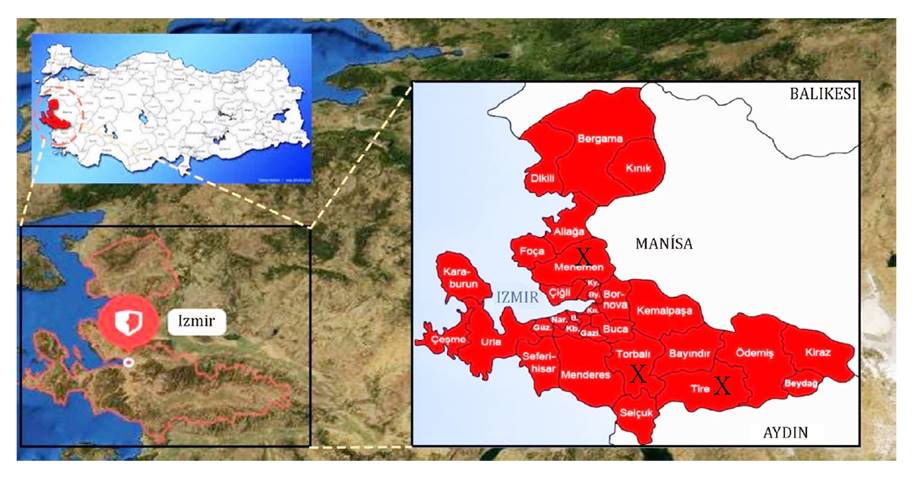
Figure 1. Study area.
Figura 1. Area de studio.
Data were collected using a structured questionnaire concerning farmers’ views and attitudes regarding fertilizer use.
Using equation 1 (11), the sample size was 165, at 99% confidence interval and with a 10% margin of error.
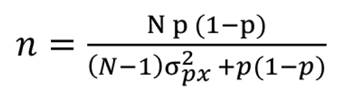
We conducted interviews with 32 farmers (19.4%) in Menemen, 46 farmers (27.9%) in Torbalı, and 87 farmers (52.7%) in Tire. Our analysis involved descriptive statistics, absolute and relative distributions, cross tables, simple averages, and statistical comparisons. Additionally, we asked the farmers to indicate agreement or disagreement regarding several statements related to fertilizer issues. Options included “strongly agree”, “agree”, “neutral”, “disagree”, and “strongly disagree” (Likert-type scale).
Factor analysis is one of the multivariate analysis techniques frequently used in various fields, especially in the social sciences. We use factor analysis to reduce the number of attitudinal and behavioural variables in fertilizer use, easing interpretation. The question set with 38 statements on fertilizer use was then reduced to 31 statements and seven factor dimensions. Finally, using scores obtained from factor analysis, we clustered the farmers.
Cluster analysis is used for sociological data and homogeneous research groups based on behaviour, attitude, and opinion. The analysis groups and distinguishes comparable units, separating them from different units, creating variables with ‘great’ similarity within each cluster (2, 3, 5, 7). Hierarchical clustering (HC) segments objects based on similarity (12, 18).
Results and Discussion
Socio-Economic Characteristics of the Farmers
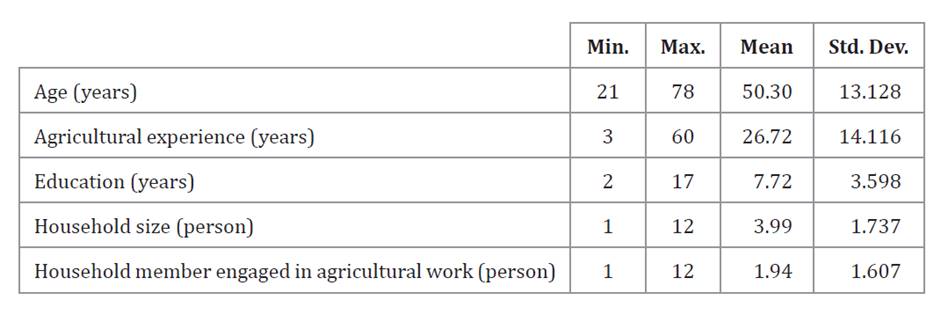
Table 1 shows general characteristics of farmers. Average age was 50 years old, with the youngest farmer being 21 and the oldest farmer being 78 years old. On average, farmers had approximately eight years of education and 27 years of experience. Additionally, average household size was four people, with two individuals from each family engaged in agricultural work.
Table 1. General information about farmers.
Tabla 1. Información general sobre los agricultores.
Note: derived from research.
Nota: derivado de la investigación.
Land Structure and Crop Pattern
Average farm size was 13.65 ha, irrigated land size was 13.40 ha, non-irrigated land size was 0.25 ha, and 6.88 average number of plots. Almost 40.22% of field area, 11.04 hectares, is dedicated to cotton cultivation, while 38.23% is used for grain maize, 11.96% for wheat, 10.33% for silage maize (second crop), 7.43% for silage maize, 1.18% for barley, 1.00% for alfalfa, and 3.35% for other cereals (second crop). Regarding orchards, 59.02% of 0.61 hectare is dedicated to peach production, 29.51% to olives, and the rest are vineyard (table 2).
Table 2. Land structure and crop patterns.
Tabla 2. Estructura de la tierra y modelos de producción.
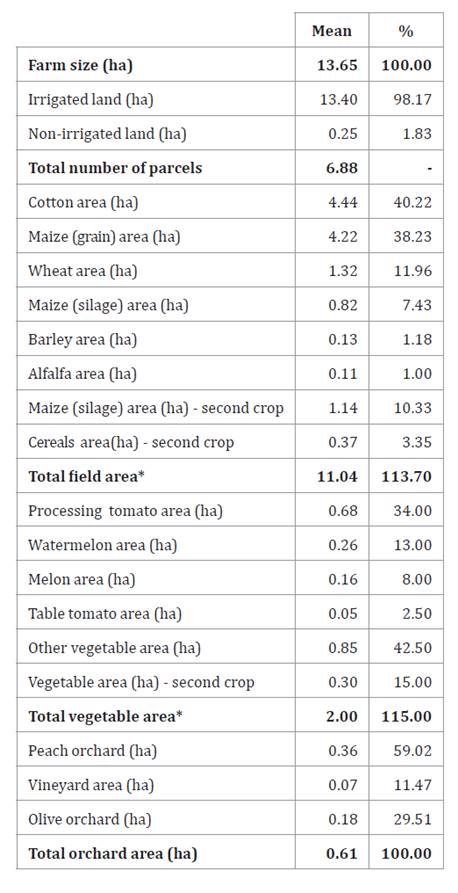
Note: derived from research. * Due to the second crops, the sum of percentages is more than 100.
Nota: derivado de la investigación.
* La superficie total del campo es superior a 100 debido a cultivos secundarios.
Factor Dimensions Related to Fertilizer Use
Factors related to fertilizer use practices were assessed using a five-point Likert scale (table 3). We defined ranges as 1.00-1.49 strongly disagree, 1.50-2.49 disagree, 2.50-3.49 neutral, 3.50-4.49 agree, and 4.50-5.00 strongly agree.
Table 3. Factor dimensions determining farmers’ attitudes towards fertilizer use.
Tabla 3. Dimensiones de los factores que determinan las actitudes de las explotaciones en cuanto al uso de fertilizantes.
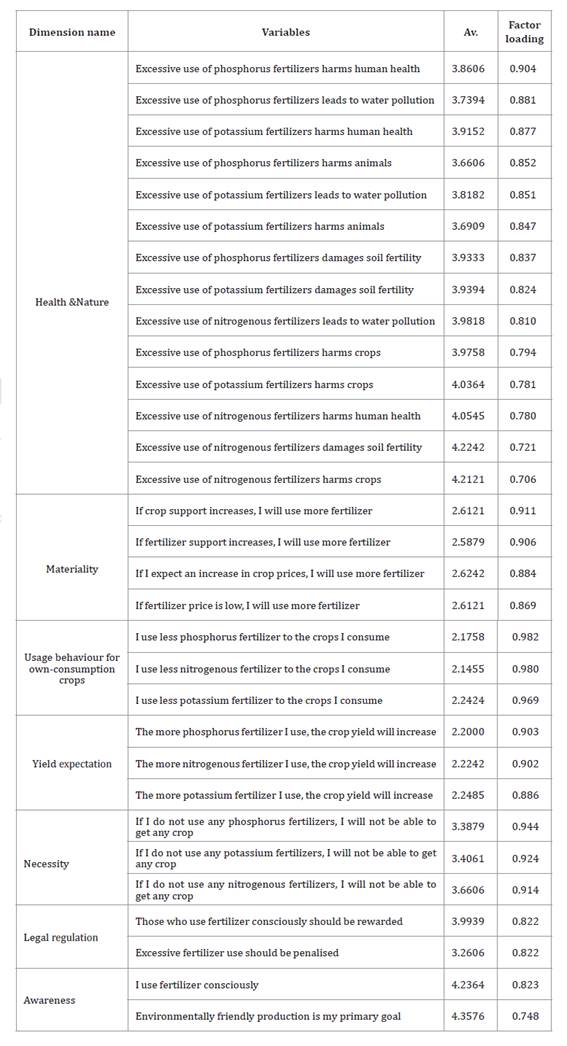
Note: derived from research. KMO: 0.782 Bartlett’s Test of Sphericity: 6204.316682 Sig: 0.000 Variance Explained: 80.343.
Nota: derivado de la investigación. KMO: 0,782 Prueba de esfericidad de Bartlett: 6204,316682 Sig: 0,000 Varianza explicada: 80,343.
Factor analysis generally requires sample sizes four or five times larger than the number of variables. This study used data from 165 farmers responding to 31 variables using the Likert scale. The hypothesis “the population correlation matrix is a unit matrix” was rejected based on Bartlett’s Test of Sphericity (6204.316682). Additionally, the Kaiser-Meyer-Olkin (KMO) statistic was 0.782 (KMO ≥ 0.5), indicating that factor analysis was appropriate.
Seven identified factors explained 80.34% of variability, determining fertilizer use behaviour in the study area (table 3). The first factor, “health and nature” exerts the greatest influence and encompasses statements such as “Excessive use of fertilizers harms human health” “Excessive use of fertilizers leads to water pollution”, “Excessive use of fertilizers harms animals” “Excessive use of fertilizers damages soil fertility”, and “Excessive use of fertilizers harms crops”.
The second factor, “materiality” includes statements as “If crop support increases, I will use more fertilizer”, “If fertilizer support increases, I will use more fertilizer”, “If I expect an increase in crop prices, I will use more fertilizer” and “If fertilizer price is low, I will use more fertilizer”.
The third factor, “usage behaviour for own-consumption crops” includes the statements “I use less phosphorus/nitrogenous/potassium fertilizer to the crops I consume”.
The fourth factor, called “yield expectation” has a weaker impact and is influenced by the statement “The more nitrogenous/phosphorus/potassium fertilizer I use, the crop yield will increase”.
The fifth factor, referred to as “necessity” includes the statements “If I do not use any phosphorus/ potassium/nitrogenous fertilizers, I will not be able to get any crop.”
The sixth factor, named “legal regulation” encompasses the statements “Those who use fertilizer consciously should be rewarded” and “Those who use excessive fertilizer should be penalised.”
The final factor, called “awareness” has the least effect and involves “I use fertilizer consciously “and “Environmentally friendly production is my primary goal.”
Farmers Classification According to Fertilizer Use Behaviour
Farmers were categorized according to factor dimensions. Cluster analysis identified four groups: “unconscious”, “support oriented”, “environment and health oriented” and “return oriented”.
Each dimension represents distinct motivational or perceptual factors influencing fertilizer use behaviour. Table 4 includes individual items or statements grouped under factor dimensions. The Kruskal-Wallis test was applied to determine statistically significant differences among group regression scores. When examining dimensions determining fertilizer usage behaviour within different groups, variations arise in materiality, yield expectation, necessity, legal regulation, and awareness.
Table 4. Farmers’ groups according to fertilizer use and behaviour dimensions.
Tabla 4. Grupos de agricultores según las dimensiones de uso de fertilizantes y comportamiento.
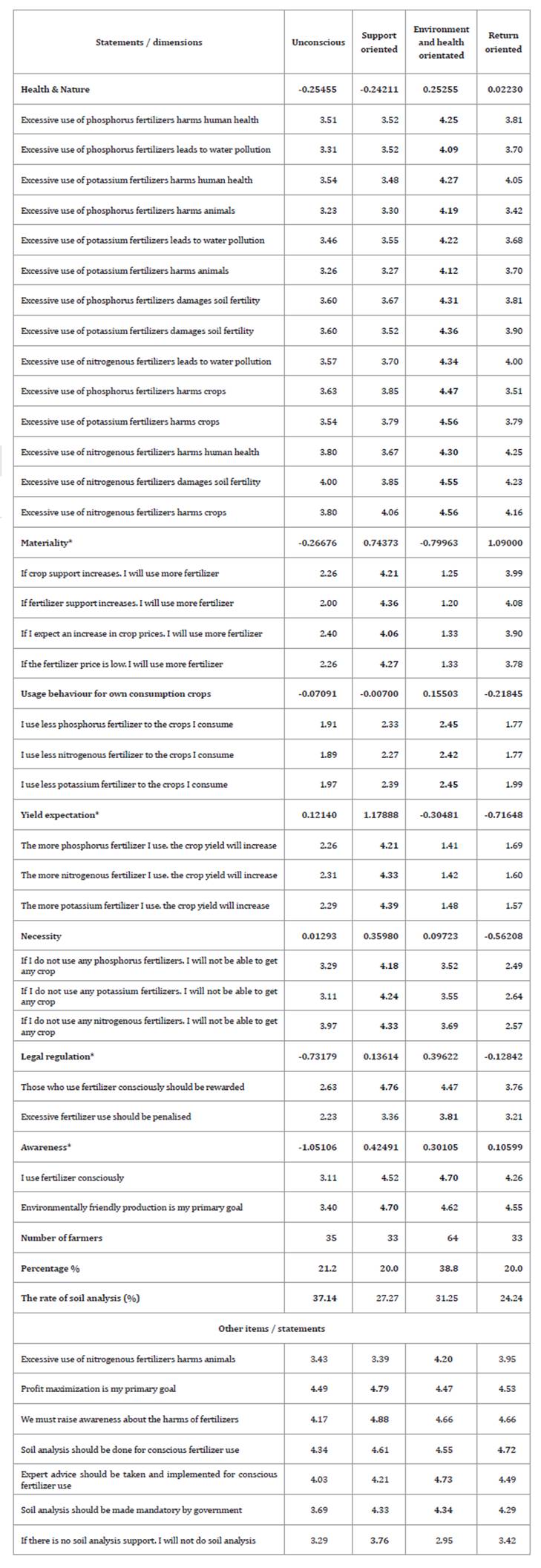
Note: derived from research. * Significant for p<0.01 according to the Kruskal-Wallis test.
Nota: derivado de la investigación. * Significativo para p<0,01 según la prueba de Kruskal-Wallis.
The “environment and health-oriented” group is the largest, comprising 38.8% of farmers. Farmers largely associate excessive use of fertilizers (phosphorus, potassium, and nitrogen) with negative consequences for soil, water, human and animal health. The environmental and health-oriented group generally reports higher agreement (scores around 4.2-4.5), suggesting stronger alignment with sustainability.
Farmers in the “unconscious” group exhibit the lowest levels of awareness and legal regulation. Additionally, this group demonstrates a negative attitude towards “health and nature” “materiality” and “usage behaviour for own consumption crops”.
Farmers in the second group, called “support oriented” exhibit positive behaviour towards “yield expectation”, “necessity”, “materiality”, “legal regulation”, and “awareness” in fertilizer use. In other words, farmers in this group have environmental concern, but use fertilizers to achieve higher yields. The “support oriented” group” highly rates statements regarding material incentives (e.g., “If crop support increases, I will use more fertilizer”) reflecting a reliance on external incentives, like subsidies. Conversely, the environment and health-oriented dimension scores are notably lower.
Farmers categorized as “environment and health-oriented” score higher than other groups in terms of “health and nature”, “usage behaviour for own consumption crops” and “legal regulation”. However, they hold negative attitudes towards “materiality” and “yield expectation” dimensions.
Farmers in the last group, “return oriented”, have a strong positive association with the “materiality” dimension. Farmers in this group use fertilizers based on fertilizer price, crop price and subsidies.
Legal statements emphasize the importance of regulatory frameworks and awareness campaigns. The environment and health-oriented dimension strongly supports these initiatives, while the unconscious group disagrees. Notably, “I use fertilizer consciously” scores highest in the health-oriented group, underscoring commitment to sustainability.
Conclusion
This study identified farmers’ fertilizer use behaviours in Izmir. We determined farmers’ tendencies regarding fertilizer use behaviours, and environmental concern. Although farmers show moderate environmental sensitivity, they should gain further awareness.
Worldwide demand for food and the consequent demand for higher yields increase day by day. Fertilizers are emerging as an essential element for increased production. But excessive fertilizer use has negative technical, environmental and economic effects. Therefore, education and extension services should aim at raising consciousness, while the agricultural policies to be implemented should not only ensure economic sustainability in agricultural production but also incorporate environmentally friendly measures.
1. Aydin, B.; Ozkan, E.; Kayali, E.; Atav, V.; Gurbuz, M. A.; Kursun, I.; Kayhan, I. E. 2022. Comparative analysis of the opinions of the producers regarding fertilization practices and subsidies in Edirne and Tekirdağ Provinces. Journal of Agriculture Engineering. 374: 43-55.
2. Bynen, E. J. 1973. Cluster Analysis: Survey and Evaluation of Techniques. Tilburg University Press. 112p.
3. Cuhadar, M.; Atis, E. 2021. The analysis underlying factors affecting farmers’ attitudes towards drought. Turkish Journal of Agriculture and Natural Sciences. 8(1): 1-7.
4. Eraslan, F.; Nal, A.; Gunes, A.; Erdal, I.; Coskan, A. 2010. Chemical fertilizer production and consumption status, problems, solution suggestions and innovations in Türkiye, Proceedings of Turkish Chamber of Agricultural Engineers; Agricultural Engineering VII. Technical Congress. Ankara. 955-972.
5. Etumnu, C.; Gray, A. W. 2020. A clustering approach to understanding farmers’ success strategies. Journal of Agricultural and Applied Economics. 52(3): 335-351.
6. Gozener, B.; Sayili, M.; Yurdabakan, M. 2016. Fertilizer use condition in important products: Tokat city Kazova district example. Journal of Agricultural Faculty of Gaziosmanpasa University. 33(2): 41-47.
7. Hyland, J. J.; Jones, D. L.; Parkhill, K. A.; Barnes, A. P.; Williams, A. P. 2016. Farmers’ perceptions of climate change: identifying types. Agriculture and Human Values. 33(2): 323-339.
8. Kadioglu, B. 2021. Investigation of possible links between soil pollution and chemical fertilizer use. Journal of Mus Alparslan University Agricultural Production and Technologies. 1(2): 26-38.
9. Kilic, O.; Eryilmaz, G. A.; Cakır, S. 2021. Environmental sensitivity of fruit producers toward chemical fertilizer and pesticide use in Zonguldak Province. Anadolu J Agr Sci. 36(1): 113-121.
10. Kiziloglu, R.; Kizilaslan, N. 2017. Fertilizer use the condition of cultivator province center in Kahramanmaras, Turkish Journal of Agriculture-Food Science and Technology. 5(1): 18-23.
11. Newbold, P. 1995. Statistics for business and economics. Prentice-Hall International, Upper Saddle River.
12. Nguyen, L. L. H.; Khuu, D. T.; Halibas, A.; Nguyen, T. Q. 2024. Factors that influence the intention of smallholder rice farmers to adopt cleaner production practices: An empirical study of precision agriculture adoption. Evaluation Review. 48(4): 692-735.
13. Ozalp, B.; Guldal, H. T. 2017. Sensitiveness of maize producers on to environmental and human health in terms of hybrid seed, chemical fertilizer and pesticide: case of Adana. Turkish Journal of Agricultural Economics. 23(1): 13-24.
14. Ozturk, M.; Altay, V.; Gonenç, T. M.; Unal, B. T.; Efe, R.; Akcicek, E.; Bukhari, A. 2021. An overview of olive cultivation in Turkey: botanical features, eco-physiology and phytochemical aspects. Agronomy. 11(2): 295.
15. Sipahi, C.; Kizilaslan, H. 2003. The study of acquire and apply chemical fertilizer on Artova area of Tokat province. Journal of Agricultural Faculty of Gaziosmanpasa University (JAFAG). 20(1): 17-25.
16. Turkes, M.; Sahin, S. 2024. Will olive groves have a future under climate change conditions in the North Aegean sub-region, a Mediterranean agricultural environment of Turkey? Turkish Journal of Agriculture-Food Science and Technology. 13(1): 43-58.
17. Wagan, S. A.; Memon, Q. U. A.; Chunyu, D.; Jingdong, L.; 2018. A comparative study on agricultural production efficiency between China and Pakistan using data envelopment analysis (DEA). Custos e Agronegocio on Line. 14: 169-190.
18. Wawire, A. W.; Csorba, Á.; Tóth, J. A.; Michéli, E.; Szalai, M.; Mutuma, E.; Kovács, E. 2021. Soil fertility management among smallholder farmers in Mount Kenya East region. Heliyon. 7(3).
19. Welte, E. 1973. Profitability and optimal use of mineral fertilizer in forms of different cropping potential. Pontificiae Academial Screntiarum Scripta Varia. 38: 403-426.
20. Yilmaz, H.; Demircan, V.; Gul, M. 2009. Determination of information sources of producers on chemical fertilizer use and evaluation in terms of agricultural extension. Journal of Suleyman Demirel University Faculty of Agriculture. 4(1): 31-44.
Funding
We are grateful to Ege University Scientific Research Projects Coordination (BAP) which was supported this study under the project number 2013-ZRF-017.
Conflict of Interest
The authors declare no competing interests.
Author contribution statement
All authors contributed equally to the design and implementation of the research, to the analysis of the results and to the writing of the manuscript.