Rev. FCA UNCuyo | 2026 | 58(1) | ISSN 1853-8665
Plant protection
https://doi.org/10.48162/rev.39.217
Seed Physiological Quality and Selectivity of Pre-Emergence Herbicides in Soybean (Glycine max L.)
Calidad fisiológica de las semillas y selectividad de herbicidas pre-emergentes en el cultivo de soja (Glycine max L.)
Alessandro Guerra da Silva 1,
João Victor dos Santos Caldas 1,
Sérgio de Oliveira Procópio 2,
Guilherme Braga Pereira Braz 1,
Itamar Rosa Teixeira 3,
Camila Jorge Bernabé Ferreira 1,
Matheus de Freitas Souza 1,
Ricardo Scheffer de Andrade Silva 1*
1 Universidade de Rio Verde. Programa de Pós-graduação em Produção Vegetal. Fazenda Fontes do Saber. Campus Universitário. Rio Verde. Goiás. Brasil. CEP: 75.901-970.
2 Embrapa Meio Ambiente. Rodovia SP-340. Km 127,5. Tanquinho Velho. Jaguariúna. São Paulo. Brasil. CEP: 13918-110.
3 Universidade Estadual de Goiás. Instituto de Ciências Agrárias. Campus CET. Anápolis. Goiás. Brasil. CEP 75132-203.
* ricardoscheffer@unirv.edu.br
Abstract
Seed physiological quality significantly affects crop performance. Besides proper crop establishment, pre-emergence herbicides constitute one major weed-control strategy. This study evaluated selectivity of pre-emergence herbicides in soybean sown with seeds of high and low physiological quality. The experiment was conducted in Rio Verde, Brazil, in a 4x2 randomized block design, with four replications. The treatments consisted of low and high-quality seeds combined with pre-emergence herbicides [imazethapyr + flumioxazin], diclosulam and [sulfentrazone + diuron], and a control. Plants from high-quality sedes showed better performance than those grown from low-quality seeds. This resulted in a greater emergence speed index, plant height, inter-row cover, NDVI, plant population, first pod height, thousand-grain weight, and grain yield. Regardless of seed quality, pre-emergence herbicides did not influence the evaluated traits.
Keywords: Glycine max, vigor, germination, weeds, grain yield
Resumen
La calidad fisiológica de las semillas puede afectar significativamente el rendimiento de las plantas de soja. Además del adecuado establecimiento del cultivo, es necesario manejar las malezas, siendo los herbicidas pre-emergentes una de las principales opciones de control. El objetivo de este estudio fue evaluar la selectividad de herbicidas aplicados en pre-emergencia en soja sembrada con semillas de alta y baja calidad fisiológica. El experimento se implementó en campo en el municipio de Río Verde, Brasil, en un diseño factorial 4x2 en bloques al azar, con cuatro repeticiones. Los tratamientos consistieron en el uso de semillas de baja y alta calidad fisiológica combinadas con la aplicación de herbicidas [imazetapir + flumioxazina], diclosulam y [sulfentrazona + diurón] en pre-emergencia, además de un tratamiento sin herbicida. Las plantas provenientes de semillas de alta calidad fisiológica mostraron un mejor desempeño fitotécnico que las provenientes de semillas de baja calidad fisiológica. Esto resultó en aumentos en el índice de velocidad de emergencia, altura de planta, cobertura entre hileras, NDVI, población de plantas, altura de la primera vaina, peso de mil granos y rendimiento de grano. Los herbicidas aplicados en pre-emergencia no influyeron en las características evaluadas, independientemente de la calidad de las semillas.
Palabras clave: Glycine max, vigor, germinación, malezas, rendimiento de grano
Originales: Recepción: 16/10/2024- Aceptación: 13/04/2026
Introduction
Soybean is the main oilseed grown in Brazil. Worldwide, Brazil is the largest soybean producer and exporter, with an estimated area of 47.6 million hectares in the 2024/2025 growing season and a production of approximately 169.7 million tons of grains (5). Over the decades, Brazilian soybean production has increased, given the expansion of cultivated areas and increased productivity. However, technological difficulties like low seed quality still hinder crop maximum productivity. The use of high-physiological quality seeds ensures plant establishment and higher leaf area indices, leading to increased grain yield (3, 8). Due to metabolic processes involved in germination (7), seeds of high physiological quality have higher content of proteins, starch and soluble sugars, and greater capacity to mobilize reserves during germination, resulting in better initial performance (16). Soybean seeds with high physiological quality also exhibit quicker emergence and seedling development, resulting in rapid inter-row closure and, consequently, greater competition with weeds (6).
Noteworthy, weed interference can affect crop development. These negative effects vary with the weed community, plant density, and the period of coexistence with the crop (14). Therefore, without effective control, weed interference in soybeans can lead to significant reductions in grain yield (26).
The use of herbicides is a fundamental strategy in weed-integrated management in soybeans. The emergence and rapid spread of weeds resistant to post-emergence herbicides like glyphosate has demanded pre-emergence products (20). However, phytotoxicity after pre-emergence applications is often observed in soybean crops, stopping farmers from adopting the technology. Possible reasons for this damage in soybean plants may be related to soil properties, such as texture (2, 15), organic matter (13), and moisture (21, 31), in addition to excessive doses (4, 9), and sprayer overlapping. However, the use of seeds of low physiological quality can also contribute to the occurrence of phytotoxicity in the soybean crop. In this context, seed vigor influences seedling emergence (19) and, consequently, herbicide absorption (23).
Studies investigating the relationship between seed quality and herbicide phytotoxicity are still limited. We evaluated herbicide selectivity in pre-emergence, considering soybean seeds of high and low physiological quality.
Material and Methods
The field experiment was conducted in Rio Verde, state of Goiás, Brazil (17°47’228” S; 51°00’383” W; 769 m altitude) from December 13, 2019, to April 3, 2020. Soil physicochemical characterization included pH in CaCl2: 5.2; O.M.: 32.1 and O.C.: 18.6 in g.dm-3; P: 5.4 mg.dm-3; K: 0.35; Ca: 1.42; Mg: 0.88; Al: 0.03; H+Al: 1.90; CEC: 4.55 and SB: 2.65 in cmolc.dm-3; sand, silt, and clay: 470, 80, and 450 in g.kg-1, respectively (clay texture).
Before installing the experiment, weed chemical desiccation was carried out with two applications. The first application was 20 days before soybean sowing using glyphosate (1,440 g a.i. ha-1) combined with clethodim (108 g a.i. ha-1). The second application was carried out 7 days before sowing, using paraquat (400 g a.i. ha-1). Both 150 L ha-1 applications were applied with a spraying bar. The experiment was a 2x4 randomized block design with four replications. The first factor was the physiological quality of soybean seeds, classified according to tetrazolium test (12), at high physiological quality (86% vigor and 94% viability) and low physiological quality (67% vigor and 86% viability). The second factor included three pre-emergence herbicides: [imazethapyr + flumioxazin] ([106 + 50 g a.i. ha-1]), diclosulam (29.4 g a.i. ha-1) and [sulfentrazone + diuron] ([210 + 420 g a.i. ha-1]), and a control treatment without herbicide. Each experimental unit consisted of four sowing rows, 8.0 m long, spaced 0.5 m apart. The studied area was formed by the two central rows, disregarding 1.0 m at each end, totaling 6.0 m2.
Soybean cultivar was NS 7007 IPRO®, with indeterminate growth and relative maturity group 7.1. Mechanical sowing was on December 13, 2019, at 2 cm depth and 17 seeds linear m-1. Fertilization responded to soil chemical analysis. At sowing, the equivalent of 300 kg ha-1 00-20-20 fertilizer, corresponding to 60 kg P2O5 and K2O, was applied. For nitrogen supply by symbiotic N2 fixation, seeds were inoculated with Bradyrhizobium elkanii (concentration of 5x10⁹ viable cells per mL) in the proportion of 0.15 L 100 kg-1 seeds. Herbicides were applied after sowing using a CO2 constant-pressure backpack sprayer (206843 Pa). The equipment consisted of a bar with four XR 110.015 VS fan spray nozzles, spaced at 0.5 m, providing a spray volume of 150 L ha-1. A thermo-hygro-anemometer monitored environmental conditions during the applications (table 1). The anemometer was placed just above the plant apex at the beginning and at the end of the applications.
Table 1. Environmental conditions during herbicide application.
Tabla 1. Condiciones ambientales durante la aplicación de los tratamientos herbicidas.
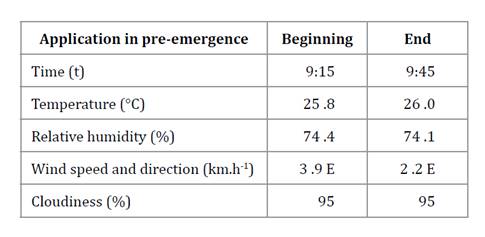
During the experiment, emerged weeds were manually eliminated, leaving soybean plants just exposed to the herbicides. Pest and disease management followed technical recommendations (28).
Treatment effects on soybean plant development were evaluated by calculating the emergence speed index (ESI; Equation 1; 18) in the first 10 days after emergence (DAE) until constant number of emerged plants; plant height at 7, 14, 21, 28 and 35 DAE (measurement from the soil surface to the insertion of the last fully developed trifoliate leaf in five plants per plot, randomly chosen); visual phytotoxicity at 7, 14, 21 and 28 DAE (30); normalized difference vegetation index (NDVI) at 7, 14, 21, 28 and 35 DAE, using the GreenSeeker® sensor; inter-row space closure at 35 and 42 DAE (evaluation of the percentage area covered by foliage, considering half inter-row coverage by leaves of each adjacent row, as 100% closure); and chlorophyll a, b and total at 14, 28, and 35 DAE (measurement of the last fully developed trifoliate leaf in five plants per plot randomly chosen) using a ClorofiLOG® sensor.

where:
ESI = emergence speed index
E = Number of plants emerged each day
N = Number of days elapsed from sowing
At harvest, first pod height (distance from the ground to the insertion of the first pod, measured in five random plants), plant population (number of plants harvested), pods per plant (in five random plants), weight of a thousand grains (counting a thousand grains 13% moisture), grain yield (harvesting the plants and threshing pods, with subsequent cleaning and weighing, 13% moisture) and relative yield (yield gain in relation to the control and to the use high-quality seeds).
Statistical Analysis
Data not meeting ANOVA assumptions were transformed into √(x+0.5): emergence speed index, NDVI at 28 and 35 DAE, inter-row cover, chlorophyll a, b, and total at 28 and 35 DAE and plant population. Data were tested by ANOVA using the F-test (p<0.05). Means were compared by Tukey’s test (p<0.05). For data analysis, Sisvar software was used (10).
Results and Discussion
Physiological quality of seeds significantly influenced emergence speed (48% higher) and plant height in all evaluations, as previously seen (3, 22, 25). However, no interaction was found with pre-emergence herbicides (table 2).
Table 2. Emergence speed index and plant height at 7, 14, 21, 28, and 35 DAE as a function of seed physiological quality and pre-emergence herbicide application.
Tabla 2. Índice de velocidad de emergencia y altura de plantas a los 7, 14, 21, 28 y 35 días después de la emergencia (DAE) en función de la calidad fisiológica de la semilla y la aplicación de herbicidas en preemergencia.
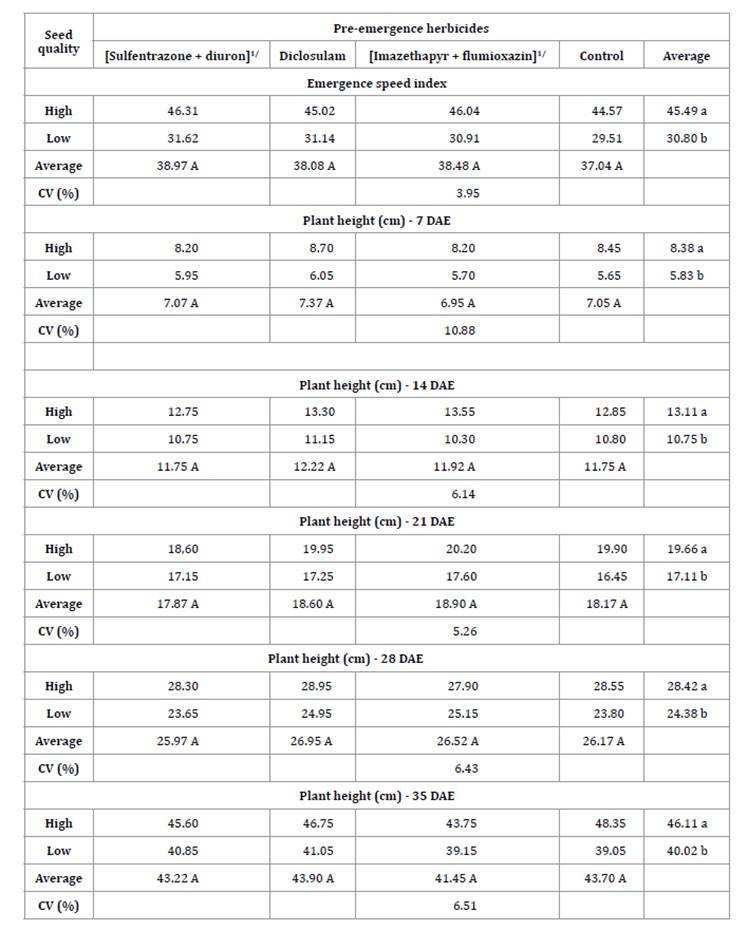
1/ formulated mixture. Means followed by distinct letters, lowercase in columns and uppercase in rows, differ significantly from each other, by Tukey’s test (p = 0.05). Data not meeting normality or homoscedasticity were transformed into √(x+0.5).
1/ mezcla formulada indicada. Las medias seguidas de letras distintas, minúsculas en la columna y mayúsculas en la fila, difieren significativamente entre sí, según la prueba de Tukey al 5% de probabilidad. Los datos que no cumplían con el supuesto de normalidad se transformaron en √(x+0,5).
Regardless of seed physiological quality, none of the pre-emergence herbicides delayed soybean emergence or reduced plant size at 7, 14, 21, 28, and 35 DAE (table 2). Thus, herbicides did not influence crop establishment, proving selectivity in pre-emergence, as previously seen (24).
At 7 and 14 DAE, and regardless of seed physiological quality, few phytotoxicity symptoms (5%) were found in soybean plants treated with herbicides [sulfentrazone + diuron], diclosulam and [imazethapyr + flumioxazin] (table 3). Later evaluations performed at 21 and 28 DAE showed no visual symptoms. Thus, a rapid recovery takes place, considering the few initial phytotoxicity symptoms. Similar results were reported by Sanchotene et al. (2017), who also observed mild phytotoxicity symptoms caused by the herbicides sulfentrazone, [imazethapyr + flumioxazin] and diclosulam in soybean.
Table 3. Phytotoxicity in soybean plants at 7, 14, 21, and 28 DAE as a function of seed physiological quality and pre-emergence herbicides.
Tabla 3. Fitotoxicidad en plantas de soja a los 7, 14, 21 y 28 días después de la emergencia (DAE) en función de la calidad fisiológica de la semilla y la aplicación de herbicidas en preemergencia en soja.
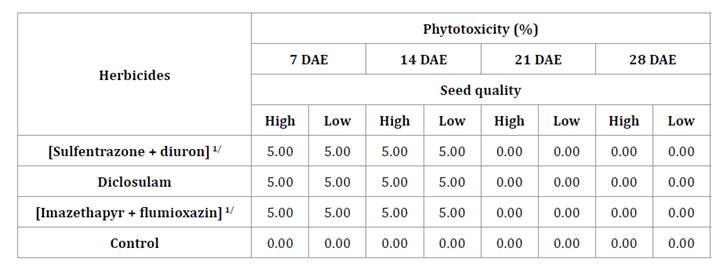
1/ formulated mixture.
1/ mezcla formulada.
The NDVI and inter-row cover significantly affected seed physiological quality in all evaluations (table 4). Pre-emergence herbicides caused significant effects only at 14 and 35 DAE for NDVI, without inter-row effects. Similarly, seed physiological quality and pre-emergence herbicides showed no interaction.
Table 4. NDVI at 7, 14, 21, 28, and 35 DAE and soybean inter-row closure at 35 and 42 DAE as a function of seed vigor and application of pre-emergence herbicides.
Tabla 4. Índice de Vegetación de Diferencia Normalizada (IVDN) a los 7, 14, 21, 28 y 35 días después de la emergencia (DAE) y cierre entre hileras de soja a los 35 y 42 DAE en función del vigor de la semilla y la aplicación de herbicidas en preemergencia.
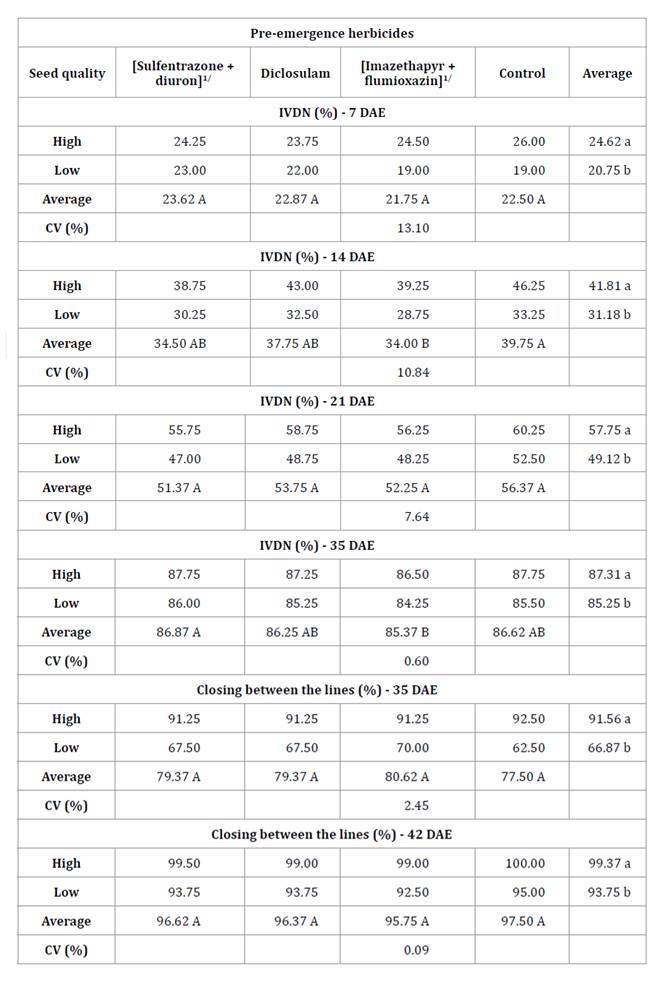
1/ formulated mixture. Means followed by distinct letters, lowercase in columns and uppercase in rows, differ significantly from each other, by Tukey’s test at p=0.05. Data not meeting normality y homocedasticidad were transformed into √(x+0.5).
1/ mezcla formulada indicada. Las medias seguidas de letras distintas, minúsculas en la columna y mayúsculas en la fila, difieren significativamente entre sí, según la prueba de Tukey al 5% de probabilidad. Los datos que no cumplían con el supuesto de normalidad se transformaron en √(x+0,5).
The use of high-quality seeds resulted in higher soybean NDVI in all evaluations (table 4). The highest values obtained from high-quality seeds relate to quicker emergence and initial plant growth (17).
At 14 DAE, the treatment [imazethapyr + flumioxazin] reduced soybean NDVI in relation to the control (table 4), probably given by mild initial phytotoxicity. At 35 DAE, this herbicide reduced NDVI values in relation to [sulfentrazone + diuron], however, none differed from the control.
Plants from high-quality seeds provided 37% higher inter-row cover at 35 DAE than plants from low-quality seeds. At 42 DAE, high-quality seed had almost completely closed inter-rows (99%). This demonstrates the importance of using high-quality seeds in faster canopy closure and consequent weed control (1).
Chlorophyll a, b and total index showed no interaction between seed physiological quality and pre-emergence herbicide application (table 5). Furthermore, regardless of the evaluation period (14, 28, and 35 DAE), no herbicide altered chlorophyll contents. Nevertheless, soybean plants from seeds of higher physiological quality had higher content of chlorophyll b at 14 DAE, as well as chlorophyll a and total chlorophyll at 28 DAE (table 5). Since more vigorous seeds induce faster and more uniform emergence of seedlings, there is a greater need for water and nutrients in early crop development. Thus, photosynthesis occurs earlier, with greater accumulation of photoassimilates in early developmental stages, and consequent greater yield (8).
Table 5. Chlorophyll a, b and total index in soybean plants at 14, 28, and 35 DAE as a function of seed vigor and pre-emergence herbicide application.
Tabla 5. Índice de clorofila a, b y total en plantas de soja a los 14, 28 y 35 días después de la emergencia (DAE) en función del vigor de la semilla y la aplicación de herbicidas en preemergencia.
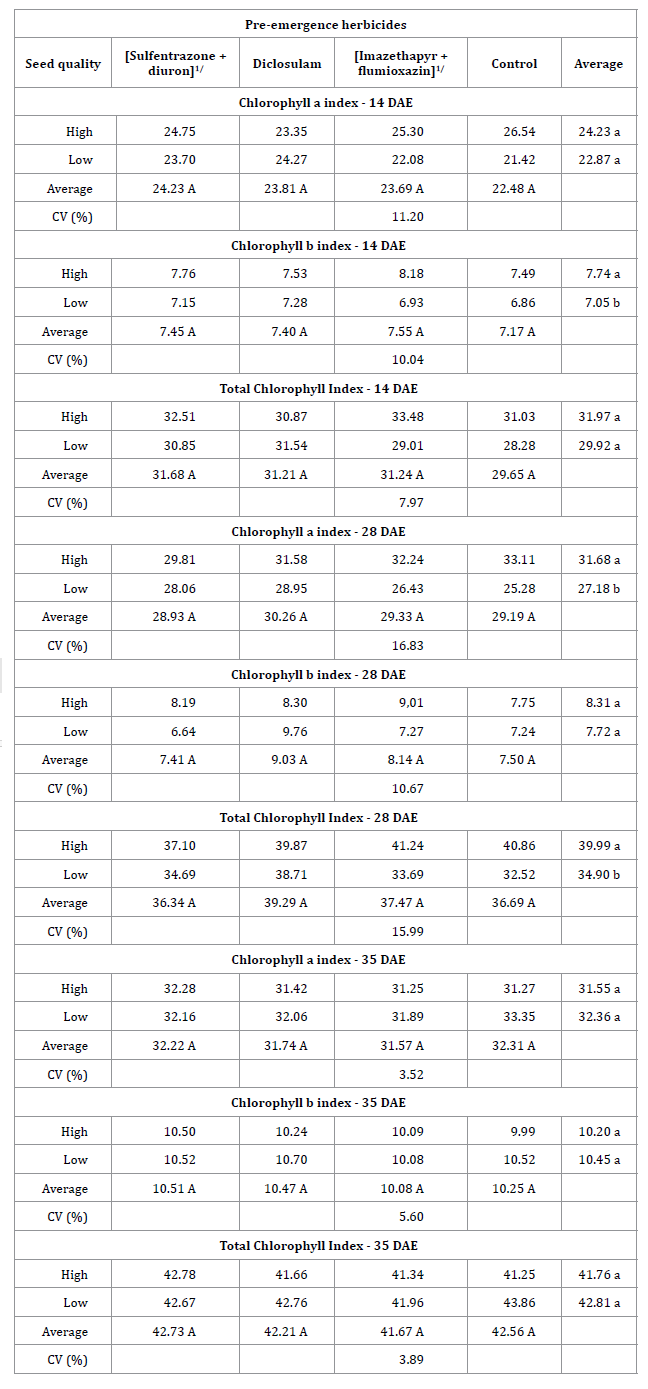
1/ formulated mixture. Means followed by distinct letters, lowercase in columns and uppercase in rows, differ significantly from each other, by Tukey’s test at p=0.05. Data not meeting normality were transformed into √(x+0.5).
1/ mezcla formulada indicada. Las medias seguidas de letras distintas, minúsculas en la columna y mayúsculas en la fila, difieren significativamente entre sí, según la prueba de Tukey al 5% de probabilidad. Los datos que no cumplían con el supuesto de normalidad se transformaron en √(x+0,5).
Considering agronomic traits, first pod height, plant population, pods per plant, thousand-grain weight, grain yield and relative yield showed no effects of pre-emergence herbicides or the interaction of this factor with seed quality of the seeds. However, except for pods per plant, in which there was no effect on seed quality, plants from high-quality seeds resulted in better agronomic traits than low-quality seeds (table 6).
Table 6. Height of first pod insertion, plant population, pods per plant, thousand grain weight, grain yield and relative soybean yield as a function of seed vigor and pre-emergence herbicide application.
Tabla 6. Altura de inserción de la primera vaina, población de plantas, número de vainas por planta, peso de mil granos, rendimiento de grano y rendimiento relativo de soja en función del vigor de la semilla y la aplicación de herbicidas en preemergencia.
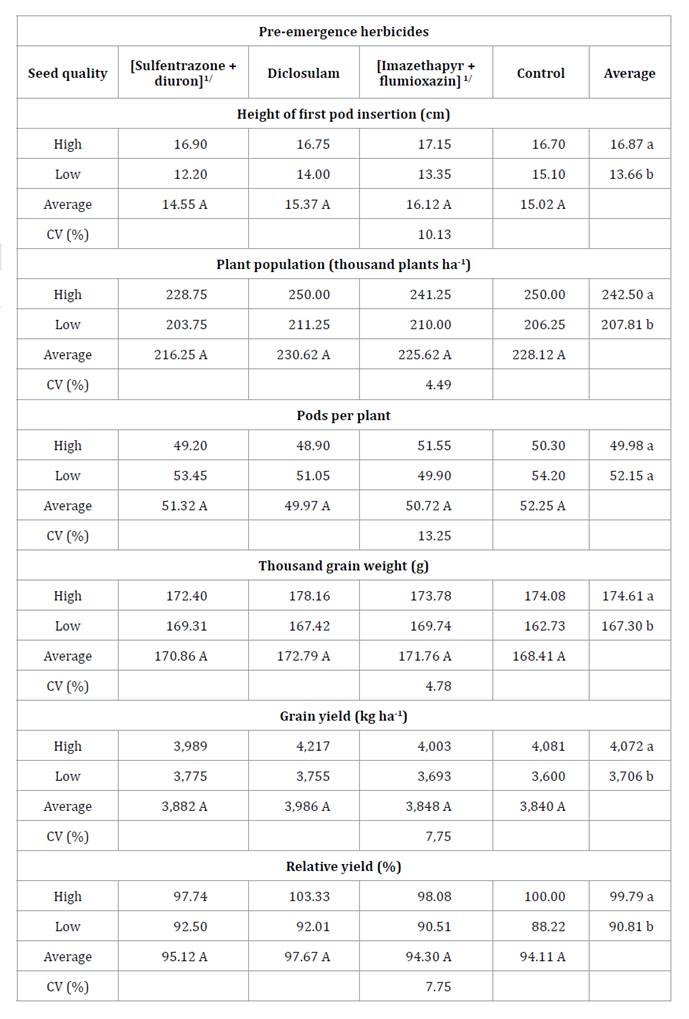
1/ formulated mixture. Means followed by distinct letters, lowercase in columns and uppercase in rows, differ significantly from each other, by Tukey’s test at p=0.05. Data not meeting normality were transformed into √(x+0.5).
1/ mezcla formulada indicada. Las medias seguidas de letras distintas, minúsculas en la columna y mayúsculas en la fila, difieren significativamente entre sí, según la prueba de Tukey al 5% de probabilidad. Los datos que no cumplían con el supuesto de normalidad se transformaron en √(x+0,5).
Higher first pod height was observed in soybean plants originating from high-quality seeds (table 6), also verified by Rossi et al. (2017). This result is highly relevant, as soybean plants with higher pod height suffer less grain loss in mechanized harvesting, which results in higher grain yield and less infestation of volunteer plants in subsequent cultivation. In addition to a taller pod, high-quality seeds provided, at harvest, 34,700 more soybean plants per hectare (17%) than low-quality seeds (table 6). Considering all treatments initiated with the same plant population, differences among treatments are only given by seed quality (3). Furthermore, higher seed quality results in more emerged seedlings and lower plant mortality, as emphasized by Rossi et al. (2017). Still, the null seed quality effects over pods per plant may be related to final population (table 6). Based on our results, low-quality seeds resulted in a smaller population, probably stimulating vegetative growth in the form of branches, inducing pod development (11).
Another benefit of using high-quality seeds is the larger thousand-grain weight (table 6) (3, 8). This leads to the belief that soybean plants with better photosynthetic apparatus, as observed by the higher chlorophyll levels in certain treatments, produce more photoassimilates for grain formation and filling.
Grain yield of soybean plants from high-quality seeds was higher than in plants from low-quality seeds, regardless of pre-emergence herbicide (table 6). Positive effects of using better seeds are also reported (3, 8, 22, 25). In general, our analysis showed an increase of approximately 9% in grain yield for treatments using high-quality seeds than low-quality ones.
Finally, pre-emergence herbicides were selective for soybean, not affecting development or yield components, regardless of seed quality. In addition, plants from high-quality seeds have faster emergence and vegetative growth, increased plant population and thousand-grain weight.
Conclusions
The herbicides [sulfentrazone + diuron], diclosulam and [imazethapyr + flumioxazin], applied in pre-emergence, do not influence growth, plant population, yield components, or soybean grain yield, regardless of seed physiological quality in sowing.
Soybean plants from high-quality seeds provide faster emergence, taller plants, greater NDVI, inter-row cover, plant population, first pod height, thousand-grain weight and grain yield, regardless of pre-emergence herbicide.
Acknowledgments
To the Research Support Foundation of the State of Goiás (FAPEG) and the Coordination for the Improvement of Higher Education Personnel (CAPES/BRASIL), for financial support to perform this project and the University of Rio Verde, for financial support to aid publication.
1. Asami, H.; Tachibana, M.; Homma, K. 2021. Chemical and cultural control of Ipomoea hederácea var. integriuscula in narrow-row soybean in southwestern Japan. Weed Biology and Management. 21(3): 135-145. DOI: 10.1111/wbm.12232
2. Asher, B. S.; Dotray, P. A.; Liebl, R. A.; Keeling, J. W.; Ritchie, G. D.; Udeigwe, T. K.; Reed, J. D.; Keller, K. E.; Bowe, S. J.; Aldridge, R. B.; Simon, A. 2021. Vertical mobility and cotton tolerance to trifludimoxazin, a new protoporphyrinogen oxidase-inhibiting herbicide, in three West Texas soils. Weed Technology. 35(1): 144-148. DOI: 10.1017/wet.2020.95
3. Caverzan, A.; Giacomin, R.; Müller, M.; Biazus, C.; Lângaro, N. C.; Chavarria, G. 2018. How does seed vigor affect soybean yield components? Agronomy Journal. 110(4): 318-1327. DOI: 10.2134/agronj2017.11.0670
4. Cieslik, L. F.; Vidal, R. A.; Trezzi, M. M. 2014. Fomesafen toxicity to bean plants as a function of the time of application and herbicide dose. Acta Scientiarum. Agronomy. 36(3): 329-334. DOI: 10.4025/actasciagron.v36i3.17630
5. Companhia Nacional de Abastecimento (CONAB). 2025. Acompanhamento de safra brasileira: grãos, décimo primeiro levantamento, safra 2024/25. CONAB. 12(11): 85-89.
6. Dias, M. A. N.; Pinto, T. L. F.; Mondo, V. H. V.; Cicero, S. M.; Pedrini, L. G. 2011. Direct effects of soybean seed vigor on weed competition. Revista Brasileira de Sementes. 33(2): 346-351. DOI: 10.1590/S0101-31222011000200017
7. Domergue, J. B.; Abadie, C.; Limani, A.; Way, D.; Tcherkez, G. 2019. Seed quality and carbon primary metabolism. Plant, Cell & Environment. 42(10): 2776-2788. DOI: 10.1111/pce.13618
8. Ebone, L. A.; Caverzan, A.; Tagliari, A.; Chiomento, J. L. T.; Silveira, D. C.; Chavarria, G. 2020. Soybean seed vigor: uniformity and growth as key factors to improve yield. Agronomy. 10(4): 545. DOI: 10.3390/agronomy10040545
9. Ethridge, S.; Post, A.; Devkota, P.; Mulvaney, M.; Leon, R. 2021. Characterisation of carinata tolerance to select herbicides using field dose-response studies. Weed Technology. 35(6): 957-966. DOI: 10.1017/wet.2021.57
10. Ferreira, D. F. 2019. Sisvar: A computer analysis system to fixed effects splitplot type designs. Brazilian Journal of Biometrics. 37(4): 529-535. DOI: 10.28951/rbb.v37i4.450
11. França, E. E.; Silva, G. C.; Araújo, M. E. V.; Teixeira, I. R.; Corrêa, P. C.; Silva, A. G. 2021. Agronomic and physiological characteristics of soybean cultivars and their seeds according to plant population. Agronomía Colombiana. 39(2): 177-186. DOI: 10.15446/agron.colomb.v39n2.93019.
12. França-Neto, J. B.; Krzyzanowski, F. C.; Costa, N. P. 1998. The tetrazolium test for soybean seeds. Embrapa Soja. 71 p.
13. Gannon, T. W.; Hixson, A. C.; Keller, K. E.; Weber, J. B.; Knezevic, S. Z.; Yelverton, F. H. 2014. Soil properties influence saflufenacil phytotoxicity. Weed Science. 62(4): 657-663. DOI: 10.1614/WS-D-13-00171.1
14. Ghersa, C. M.; Holt, J. S. 1995. Using phenology prediction in weed management: a review. Weed Research. 35(6): 461-470. DOI: 10.1111/j.1365-3180.1995.tb01643.x
15. Ghirardello, G. A.; Araújo, L. S.; Bacchin, L. C.; Dotta, M. A.; Souza, R. O.; Silva, A. F. M.; Silva, G. S.; Victoria Filho, R. 2021. Selectivity index of indaziflam to sugarcane cv. IACSP95-5000 in two soil textures. Revista Facultad Nacional de Agronomía Medellín. 74(2): 9531-9539. DOI: 10.15446/rfnam.v74n2.92423
16. Henning, A. F.; Mertz, M. L.; Jacob, E. A. J.; Dorneles, M.; Ronei, G. F.; Dejalma, P. Z. 2010. Composição química e mobilização de reservas em sementes de soja de alto e baixo vigor. Bragantia. 69(3): 727-733. DOI: 10.1590/S0006-87052010000300026
17. Lima, G. C.; Silva, M. L. N.; Curil, N.; Silva, M. A.; Oliveira, A. H.; Avanzi, J. C.; Ummus, M. E. 2013. Avaliação da cobertura vegetal pelo índice de vegetação por diferença normalizada (IVDN). Ambiente & Água. 8(2): 204-214. DOI: 10.4136/ambi-agua.959
18. Maguire, J. D. 1962. Speed of germination-aid in selection and evaluation for seedling emergence and vigor. Crop Science. 2(1): 176-177. DOI: 10.2135/cropsci1962.0011183X000200020033x
19. Meneguzzo, M. R. R.; Meneghello, G. E.; Nadal, A. P.; Xavier, F. M.; Dellagostin, S. M.; Carvalho, I. R.; Gonçalves, V. P.; Lautenchleger, F.; Lângaro, N. C. 2021. Seedling length and soybean seed vigor. Ciência Rural. 51(7): e20190495. DOI: 10.1590/0103-8478cr20190495
20. Mueller, C. T.; Boswell, B. W.; Mueller, S. S.; Steckei, L. E. 2014. Dissipation of fomesafen, saflufenacil, sulfentrazone, and flumioxazin from a Tennessee soil under field conditions. Weed Science. 62(4): 664-671. DOI: 10.1614/WS-D-13-00183.1
21. Pacanoski, Z.; Mehemeti, A. 2021. Efficacy and selectivity of pre-em herbicide on dependence of soil types and precipitation in sunflower crop. Agraarteadus: Journal of Agricultural Science. 32(1): 100-110. DOI: 10.15159/jas.21.08
22. Pino, M.; Schuch, L. O. B.; Castellanos, C. I. S.; Koch, F.; Szareski, V. J.; Pimentel, J. R.; Troyjack, C.; Carvalho, I. R.; Martins, A. B. N.; Silva, F. L.; Peter, M.; Monteiro, M. A.; Demari, G. H.; Aumonde, T. Z.; Pedó, T. 2019. Individual and population behavior of soybean plants grown in rows with different proportions of high-and low-vigor seeds. Australian Journal of Crop Science. 13(1): 151-158. DOI: 10.21475/ajcs.19.13.01.p1044
23. Procópio, S. O.; Silva, A. A.; Santos, J. B.; Araújo, E. F.; Ribeiro Jr., J. I.; Ferreira, L. R. 2002. Efeito do envelhecimento artificial de sementes sobre a tolerância do feijão ao S-metolachlor, em baixa temperatura. Revista Ceres. 49(284): 353-367. DOI: 10.7824/rbh.v2i3.362
24. Ribeiro, V. H. V.; Maia, L. G. S.; Arneson, N. J.; Oliveira, M. C.; Read, H. W.; Ané, J. M.; Santos, J. B.; Werle R. 2021. Influence of pre-emergence herbicides on soybean development, root nodulation and symbiotic nitrogen fixation. Crop Protection. 144(1): 105576. DOI: 10.1016/j.cropro.2021.105576
25. Rossi, R. F.; Cavariani, C.; França-Neto, J. B. 2017. Vigor de sementes, população de plantas e desempenho agronômico de soja. Revista de Ciências Agrárias. 60(3): 215-222. DOI: 10.4322/rca.2239
26. Rüdell, E. C.; Petrolli, I. D. S.; Santos, F. M.; Frandaloso, D.; Silva, D. R. O. 2021. Weed interference capacity on soybean yield. Revista Facultad Nacional de Agronomía Medellín. 74(2): 9541-9547. DOI: 10.15446/rfnam.v74n2.89705
27. Sanchotene, D. M.; Dornelles, S. H. B.; Bolzan, T. M.; Vos, H. M.; Escobar, O. S.; Leon, C. B.; Muller, E. N.; Shimóia, E. P. 2017. Desempenho de diferentes herbicidas pré-emergentes para controle de Euphorbia heterophylla na cultura da soja. Perspectiva. 41(155): 7-15.
28. Seixas, C. D. S.; Neumaier, N.; Balbinot Jr., A. A.; Krzyzanwski, F. C.; Leite, R. M. V. B. de C. 2020. Tecnologias de produção de soja: região Central do Brasil. Londrina. Embrapa Soja. 347 p.
29. Shapiro, S. S.; Wilk, M. B. 1965. An analysis of variance test for normality (complete sample). Biometrika. 52(3): 591-611.
30. Sociedade Brasileira da Ciência das Plantas Daninhas (SBCPD). 1995. Procedimentos para instalação, avaliação e análise de experimentos com herbicidas. SBCPD. 42 p.
31. Viger, P. R.; Eberlein, C. V.; Fuerst, E. P. 1991. Influence of available soil water content, temperature, and CGA-154281 on metolachlor injury to corn. Weed Science. 39(2): 227-231.