Rev. FCA UNCuyo | 2026 | 58(1) | ISSN 1853-8665
Plant protection
https://doi.org/10.48162/rev.39.206
Scientific Note
First Record of Spintherophyta aurichalcea (Germar, 1824) (Coleoptera: Chrysomelidae) Damaging Ilex paraguariensis (St. Hil.) Crops in Argentina
Primer registro de Spintherophyta aurichalcea (Germar, 1824) (Coleoptera: Chrysomelidae) dañando cultivos de Ilex paraguariensis (St. Hil.) en Argentina
Maria Elena Schapovaloff 1, 2*,
Abel Nicolás Scherf 1,
Marcos Rubén Costa 1,
Maria Cecilia Gramajo 3,
Diana Virginia Ohashi 4,
Daniela Sofia Ayala 4
1 Instituto Nacional de Tecnología Agropecuaria (INTA). EEA Montecarlo. Av. El Libertador 2472. N3384. Montecarlo. Misiones. Argentina.
2 Consejo Nacional de Investigaciones Científicas y Técnicas (CONICET). Godoy Cruz 2290. C1425FQB. Ciudad Autónoma de Buenos Aires Argentina.
3 Fundación Miguel Lillo. Miguel Lillo 251. T4000JFD. San Miguel de Tucumán. Tucumán. Argentina.
4 Instituto Nacional de Tecnología Agropecuaria (INTA). EEA Cerro Azul. Ruta Nacional 14. Km. 1085. N3313 Cerro Azul. Misiones. Argentina.
* schapovaloff.maria@inta.gob.ar
Abstract
Ilex paraguariensis (St. Hil.), commonly known as yerba mate, is a native plant to South America and cultivated in Argentina, Brazil and Paraguay. In Argentina, yerba mate is produced and cultivated throughout the province of Misiones and northeastern Corrientes. Yerba mate is a major crop in this region, providing raw material for beverages and active compounds for the pharmaceutical industry. Yerba mate crops are attacked by different phytophagous insects that can cause significant damage. This study reports the first confirmed record of Spintherophyta aurichalcea (Germar, 1824) as a phytophagous insect damaging commercial Ilex paraguariensis plantations in Misiones and Corrientes provinces, Argentina.
Keywords: Phytophagous insects, crop damage, leaf bettles, herbivory, yerba mate
Resumen
Ilex paraguariensis (St. Hil.), comúnmente conocida como yerba mate, es una planta originaria de Sudamérica y se cultiva en Argentina, Brasil y Paraguay. En Argentina la yerba mate se produce y cultiva en toda la provincia de Misiones y nordeste de la provincia de Corrientes. La yerba mate es un cultivo importante en esta región, proporcionando materia para bebidas y compuestos activos para la industria farmacéutica. Los cultivos de yerba mate son atacados por distintos insectos fitófagos que pueden ocasionar daños significativos. Este estudio reporta el primer registro confirmado de Spintherophyta aurichalcea (Germar, 1824) como insecto fitófago que daña plantaciones comerciales de Ilex paraguariensis en las provincias de Misiones y Corrientes, Argentina.
Palabras clave: Insectos fitófagos, daños a los cultivos, escarabajos de las hojas, herbivoría, yerba mate
Originales: Recepción: 20/12/2024 - Aceptación: 12/11/2025
Introduction
Yerba mate (Ilex paraguariensis St. Hil.) is a South American native crop, primarily cultivated in Brazil, Paraguay, and Argentina. Within Argentina, its production is concentrated across the entire province of Misiones and northeastern Corrientes, where it represents one of the region’s most significant agricultural activities (2, 6). According to data from the Instituto Nacional de la Yerba Mate (INYM), in April 2025, 25,050,144 kg of yerba mate were distributed to the domestic market, and 3,482,132 kg were exported. Notably, the amount leaving the mills is considered a reliable indicator of product performance on store shelves (13).
Yerba mate provides raw material for beverages and bioactive compounds for the pharmaceutical industry (5, 11). Infusions of leaves are widely consumed as mate or chimarrão (hot) and tererê (cold) in Argentina (11), southern Brazil, Paraguay, and Uruguay. In addition to these traditional uses, yerba mate has recently been processed into beer, moisturizing creams, sweets, and other non-traditional products, contributing to its growing global popularity (29).
The expansion of yerba mate monocultures has promoted the growth of phytophagous insect populations while reducing natural enemies. As a result, some insects have shifted from occasional visitors to economically significant pests (5, 10). Iede and Machado (1989) reported 86 insect species feeding on different parts of the yerba mate plant. However, only a few are considered pests, since most occur at low population levels and cause no economic damage. According to these authors, six species are currently recognized as pests: Hedypathes betulinus (Klug, 1825), Isomerida picticollis (Bates, 1881) (Coleoptera: Cerambycidae), Gyropsylla spegazziniana (Lizer, 1919) (Hemiptera: Aphalaridae), Thelosia camina (Schaus, 1896) (Lepidoptera: Apatelodidae), Hylesia nigricans (Berg, 1875) (Lepidoptera: Saturniidae), and Ceroplastes grandis (Hempel, 1900) (Hemiptera: Coccidae) (10, 12).
The family Chrysomelidae is among the five largest Coleoptera families and ranks second among phytophagous beetles (20). Their diversity, global distribution, and feeding habits confer significant ecological and economic importance (4).
The genus Spintherophyta Dejean, 1836 (= Chrysodina Baly, according to Monrós & Bechyné, 1956), within the subfamily Eumolpinae, is widely distributed in Central and South America (24), with some species present in North America (21). About 100 species have been described (23), but information on host plants is limited (25). Species of Chrysodina [sic] have been reported as apple tree defoliators in Brazil (22), while in Argentina Spintherophyta spp. have been recorded as floral visitors of sunflower (Helianthus annuus) (27, 28).
The objective of this study was to report the presence and identification of a Chrysomelidae species damaging commercial Ilex paraguariensis crops in Argentina.
Materials and Methods
Entomofaunal monitoring was conducted in commercial yerba mate plantations at 14 sites in Misiones Province and four sites in Corrientes Province (figure 1). A small beetle species was observed from September to May during the 2021/2022 and 2022/2023 growing seasons.
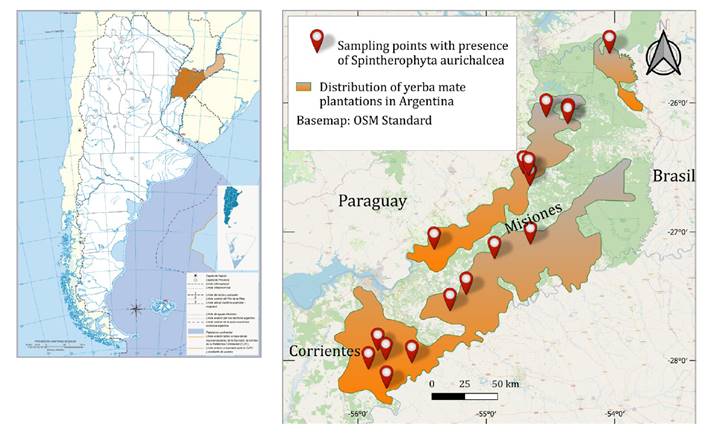
Source/Fuente: IGN
The map was generated using QGIS software (v.3.24), based on data from the geographic information system of yerba mate in the Argentine Republic (INYM) and OpenStreetMap.
El mapa fue generado por los autores utilizando el software QGIS (v.3.24), con base en datos del sistema de información geográfica de la yerba mate en la República Argentina (INYM) y OpenStreetMap.
Figure 1. Sampling sites across the yerba mate cultivation area in Argentina.
Figura 1. Ubicación de los sitios de muestreo en la zona de cultivo de yerba mate en Argentina.
Adult specimens were manually collected, placed in plastic bags, and transported to the laboratory of the Montecarlo Agricultural Experimental Station of the National Institute of Agricultural Technology (INTA - EEA Montecarlo). Specimens were sent to the Miguel Lillo Foundation (FML) for taxonomic identification. Due to limited literature on this genus, the specialist compared the material with reference collections originally identified by Monrós (1951) and with the original species description by Germar (1824). All specimens were pinned and deposited in the beetle collections of the Miguel Lillo Fundation (San Miguel de Tucumán, Tucumán, Argentina) and INTA - EEA Montecarlo (Montecarlo, Misiones, Argentina).
Results and Discussion
Small beetles were collected during the sampling seasons at the 18 monitored sites in Misiones and Corrientes Provinces (figure 1). These insects caused visible damage to both young and mature yerba mate plants. The beetles were first observed feeding on tender shoots, gnawing the epidermis of apical buds. As the leaves developed, necrotic lesions appeared, resulting in characteristic damage to shoots and leaves, including necrotic and perforated areas (figure 2).
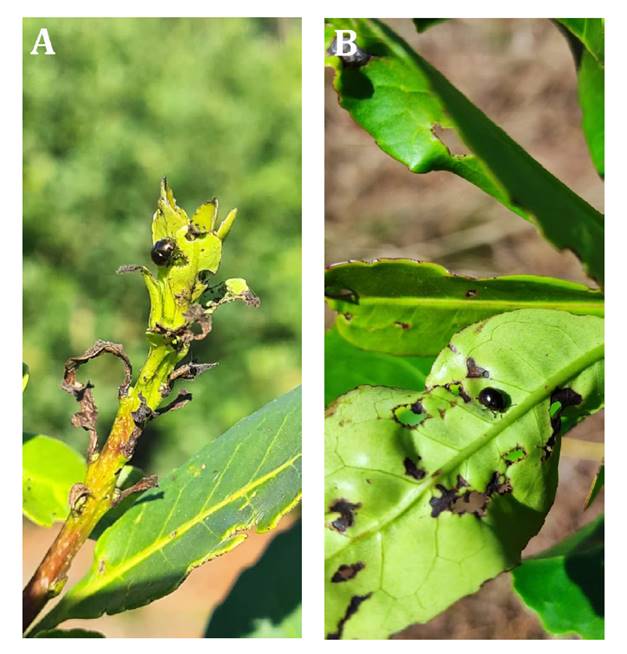
Damage to shoots (A) and damage to mature leaves (B).
Daños en brotes (A) y daños en hojas maduras (B).
Figure 2. Damage caused by Spintherophyta aurichalcea (Germar, 1824) to yerba mate plants.
Figura 2. Daños causados por Spintherophyta aurichalcea (Germar, 1824) a las plantas de yerba mate.
The subfamily Eumolpinae, within the family Chrysomelidae, known as leaf beetles, comprises 12 tribes, nearly 500 genera, and approximately 7,000 species worldwide (1, 14, 24). These beetles occur on all continents except Antarctica, with a predominance in tropical and subtropical regions (14, 26). Species identification and description within many genus of Eumolpinae remain challenging (19). The considerable diversity of this group is reflected in persistent difficulties in its taxonomic classification, which several authors have described as chaotic and disorganized (8, 9, 18).
Currently, S. aurichalcea is classified within the genus Spintherophyta Dejean, 1836. It has also been referred to as [= Chrysodina aurichalcea ab. pseudofulgurans] Bechyné, 1949: 476; Bechyné, 1953: 128. Another species of this genus, S. semiaurata (Klug, 1829), has been reported in Argentina in the provinces of Córdoba, Misiones, Entre Ríos, and Buenos Aires (3). Adults of this species have been reported feeding on hibiscus flowers (Hibiscus curtifolia L.), peach (Prunus persica L.), Citrus sp., blueberries and Prosopis sp. In Brazil, S. semiaurata has also been reported feeding on I. paraguariensis, Prosopis sp., strawberry flowers (Fragaria x ananassa), citrus (C. sinensis, C. limon, C. reticulata, C. nobilis), persimmon (Diospyros kaki), apple (Malus domestica), peach (Prunus persica), nectarine (Prunus persica var nucipersica), and pear (Pyrus communis) (12, 15, 30, 31).
Given the limited knowledge surrounding Spintherophyta bioecology, further research into its life cycle, natural enemies, and economic impact on yerba mate crops is essential to determine if pest control measures are necessary.
All specimens were identified as Spintherophyta aurichalcea (Germar, 1824) (Coleoptera: Chrysomelidae: Eumolpinae) (figure 3). This is the first report of S. aurichalcea causing direct damage to both nursery seedlings and mature commercial plantations of Ilex paraguariensis in Argentina, and, according to the available literature, the species has not previously been recorded affecting any other major crop in the country. Therefore, developing a quantitative assessment of the symptoms and damage caused by S. aurichalcea would be highly valuable for yerba mate cultivation, as demonstrated in recent work on the soybean black weevil, Rhyssomatus subtilis Fiedler (Coleoptera: Curculionidae) (17).
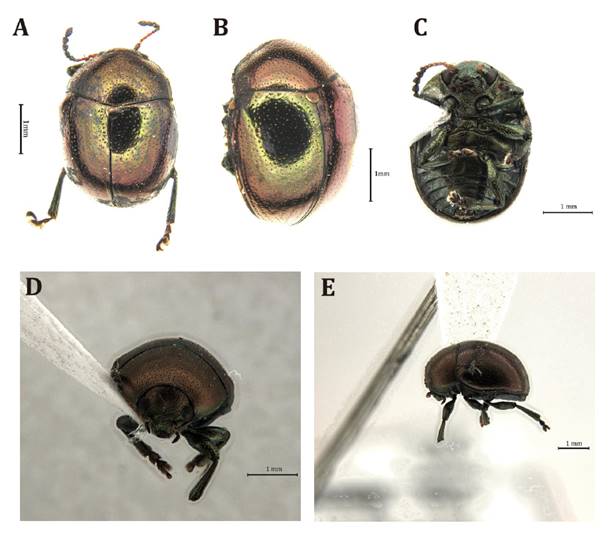
Dorsal view (A), semi-dorsal view (B), ventral view (C), front view (D) and lateral view (E).
Vista Dorsal (A), vista semidorsal (B), vista ventral (C), vista frontal (D) y vista lateral (E).
Figure 3. Habitus of a Spintherophyta aurichalcea Adult.
Figura 3. Hábito de un Spintherophyta aurichalcea adulto.
Conclusions
This study provides the first record of Spintherophyta aurichalcea (Germar, 1824) (Coleoptera: Chrysomelidae: Eumolpinae) damaging commercial Ilex paraguariensis crops in Argentina. The beetle was found feeding on both young shoots and mature leaves, causing necrotic and perforated areas that may compromise plant growth. Given the scarce knowledge of the bioecology of this genus, further studies are required to assess its life cycle, population dynamics, natural enemies, and potential economic impact on yerba mate production. These findings provide essential information, which results crucial for developing future monitoring and integrated pest management strategies.
Acknowledgments
We thank Lic. Silvia Cordoba from the Institute the Entomology, Miguel Lillo Fundation (FML) for identifying the specimens.
1. Bouchard, P.; Bousquet, Y.; Davies, A.; Alonso-Zarazaga, M.; Lawrence, J.; Lyal, C.; Newton, A.; Reid, C.; Schmitt, M.; Slipinski, A.; Smith, A. 2011. Family- group names in Coleoptera (Insecta). ZooKeys. 88: 1-972. https://doi.org/10.3897/zookeys.88.807
2. Burgos, A.; Cabrera, M.; Capellari, P.; Dalurzo, H.; Dávalos, M.; Dirchwolf, P.; Dolce, N.; Fediuk, A.; Llera, V.; Maiocchi, M.; Medina, R.; Molina, S.; Pinto Ruiz, G.; Mayol M.; Tarragó, J.; Yacovich, M. 2017. Yerba mate. Reseña Histórica y Estadística. Producción e Industrialización en el siglo XXI. Ciudad Autónoma de Buenos Aires: Consejo Federal de inversiones. 310 p.
3. Cabrera, N.; Rocca, M. 2012. First records of Chrysomelidae (Insecta, Coleoptera) on blueberries in Argentina: New associations between native chrysomelids and an exotic crop. Revista de la Sociedad Entomológica Argentina. 71(1-2): 45-55.
4. Chaboo, C. 2007. Biology and phylogeny of the Cassidinae Gyllenhal sensu lato (tortoise and leaf-mining beetles) (Coleoptera: Chrysomelidae). Bulletin of the American Museum of Natural History. New York. 305: 1-250.
5. Chiaradia, L.; Milanez, J.; Zidko, A. 2002. Estimativa das gerações anuais de Gyropsylla spegazziniana (Lizer, 1917) em função de sua exigência térmica. Ciência Rural. 32(3): 385-391.
6. Daniel, O. 2009. Erva-mate: sistema de produção e processamento industrial. Dourados. MS. Universidade Federal da Grande Dourados. 288 p.
7. Germar, E. 1824. Insectorum species: novae aut minus cognitae, descriptionibus illustratae. Volumen primum, Coleoptera. Halae, Impensis J. C. Hendelii et Filii. 25: 624 p. II plates.
8. Gómez-Zurita, J.; Jolivet, P.; Vogler, A. 2005. Molecular systematics of Eumolpinae and the relationships with Spilopyrinae (Coleoptera, Chrysomelidae). Molecular phylogenetics and evolution. 34(3): 584-600. https://doi.org/10.1016/j.ympev.2004.11.022
9. Gómez-Zurita, J. 2018. Description of Kumatoeides gen. nov. (Coleoptera: Chrysomelidae, Eumolpinae) from New Caledonia. Zootaxa. 4521(1): 89-115. https://doi.org/10.11646/zootaxa.4521.1.4
10. Grigoletti Jr. A.; Auer, C.; Iede, E.; Soares, C. 2000. Manual de identificação de pragas e doenças da erva mate (Ilex paraguariensis St. Hil.). Colombo: Embrapa Florestas. Documentos. 44. 24 p.
11. Heck, C.; Mejia, E. 2007. Yerba mate tea (Ilex paraguariensis): A comprehensive review on chemistry, health implications, and technological considerations. Journal of Food Science. 72(9): 138-151.
12. Iede, E.; Machado, D. 1989. Pragas da erva-mate (Ilex paraguariensis St. Hil.) e seu controle. Boletim de Pesquisa Florestal. 18: 51-60.
13. Instituto Nacional de la Yerba Mate (INYM). (2025, June 12). https://www.inym.org.ar/
14. Jolivet, P.; Verma, K. 2008. Eumolpinae - a widely distributed and much diversified subfamily of leaf beetles (Coleoptera, Chrysomelidae). Terrestrial arthropod reviews. 1(1): 3-37. https://doi.org/10.1163/187498308X345424
15. Milleó, J.; Tesserolli de Souza, J.; Freitas Barbola, I.; Azevedo Moura, L.; Baer Pucci, M. 2013. Diversidade e sazonalidade de crisomelídeos (Coleoptera: Chrysomelidae) em pomar, no município de Ponta Grossa. Revista Brasileira de Fruticultura. 35(2): 454-463.
16. Monrós, F.; Bechyné J. 1956. Üeber einige verkannte Chrysomeliden-Namen. Entomologische Arbeiten aus dem Museum G. Frey. 7: 1118-1137.
17. Peralta, C. R.; Rinero, M.; Igarzábal, D. A.; De Rossi, R. L. 2025. First Report of the Black Soybean Weevil Rhyssomatus subtilis Fiedler (Coleoptera: Curculionidae) in Córdoba, Argentina. Crop Damage Estimation. Revista de la Facultad de Ciencias Agrarias. Universidad Nacional de Cuyo. Mendoza. Argentina. 57(2): 138-147. DOI: https://doi.org/10.48162/rev.39.177
18. Reid, C. 1995. A cladistic analysis of subfamilial relationships in the Chrysomelidae sensu lato (Chrysomeloidea). In: Pakaluk, J., Slipinski, S.A. (Eds.), Biology, Phylogeny and Classification of Coleoptera. Papers Celebrating the 80th Birthday of Roy A. Crowson. Muzeum i Instytut Zoologii PAN. Warszawa. 559-631.
19. Riley, E. 2020. A review of the Colaspis suilla species group, with description of three new species from Florida (Coleoptera: Chrysomelidae: Eumolpinae). Insecta Mundi. 0830: 1-21.
20. Riley, E.; Clark, S.; Flowers, R.; Gilbert, A. 2002. Chrysomelidae Latreille 1802. In: Arnett, R., Thomas, M., Skelley, P., & Frank, H. (Eds.). American Beetles volume II: Polyphaga: Scarabaeoidea through Curculionoidea. CRC. Press LLC. 2: 617-691.
21. Riley, E.; Clark, S.; Seeno, T. 2003. Catalog of the leaf beetles of America north of Mexico (Coleoptera: Megalopodidae, Orsodacnidae and Chrysomelidae, excluding Bruchinae). The Coleopterists Society, Special Publication. 1: 1-290.
22. Santos, J.; Gonçalves, P. 2009. Principais insetos-pragas e inimigos naturais no sistema de produção orgânica de maçãs. Revista Brasileira de Agroecología. 4: 307-311.
23. Schultz, W. 1976. Review of the genus Spintherophyta (Coleoptera: Chrysomelidae) in North America North of Mexico. Annals of the Entomological Society of America. 69(5): 877-881.
24. Seeno, T.; Wilcox, J. 1982. Leaf beetle genera (Coleoptera: Chrysomelidae). Entomography. 1: 1-221.
25. Staines junior C. 1991. A host plant for adult Spintherophyta globosa (Olivier) (Coleoptera: Chrysomelidae). The Coleopterists Bulletin. 45(2): 200.
26. Strother, M.; Staines, C. L. 2008. A revision of the New World genus Fidia Baly 1863 (Coleoptera: Chrysomelidae: Eumolpinae: Adoxini). Zootaxa. 1798: 1-100. https://doi.org/10.11646/ xootaxa. 1798.1.1
27. Torreta, J.; Navarro, F.; Medan, D. 2009. Visitantes florales nocturnos del girasol (Helianthus annuus, Asterales: Asteraceae) en la Argentina. Revista de la Sociedad Entomológica Argentina. 68(3-4): 339-350.
28. Torreta, J.; Medan, D.; Roig Alsina, A.; Montaldo, N. 2010. Visitantes florales diurnos del girasol (Helianthus annuus, Asterales: Asteraceae) en la Argentina. Revista de la Sociedad Entomológica Argentina. 69(1-2): 17-32.
29. Vieira, M.; Rovaris, A.; Maraschin, M.; De Simas, K.; Pagliosa, C.; Podestá, R.; Amboni, R.; Barreto, P.; Amante, E. 2008. Chemical characterization of candy made of Erva-Mate (Ilex paraguariensis A. St. Hil.) residue. Journal of Agricultural and Food Chemistry. 56(12): 4637-4642. https://doi.org/10.1021/jf8011085
30. Ward, C.; O’Brien C.; O’Brien L.; Foster, D.; Huddleston, E. 1977. Annotated checklist of New World insects associated with Prosopis (Mesquite). Technical Bulletin. 1557: 115 p.
31. Zawadneak, M.; Rosado Neto, G.; Schuber, J.; Parchen, H. 2011. First Record of Spintherophyta semiaurata (Klug) (Coleoptera: Chrysomelidae) damaging strawberry flowers. Neotropical Entomology. 40(3): 407-408.
Conflicts of Interest
The authors declare that they have no conflicts of interest.