Rev. FCA UNCuyo | 2026 | 58(1) | ISSN 1853-8665
Plant protection
https://doi.org/10.48162/rev.39.207
Monitoring of the Community of Scandent Weeds in Yerba Mate (Ilex paraguariensis A. St. Hil., Aquifoliaceae) Cultivated in North-Eastern Argentina
Monitoreo de la comunidad de malezas trepadoras en cultivo de yerba mate (Ilex paraguariensis A. St. Hil., Aquifoliaceae) en el nordeste de Argentina
Rafael Augusto Lovato Echeverría 1, 2,
Laura Itatí Giménez 1,
1 Universidad Nacional del Nordeste (UNNE). Facultad de Ciencias Agrarias. Sgto. Cabral 2131. C. P. 3400. Corrientes. Argentina.
2 Universidad Nacional del Nordeste (UNNE). Facultad de Ciencias Agrarias. Centro de Malezas.
* mdavalos@agr.unne.edu.ar
Abstract
Perennial crops account for 10% of the world’s cultivated area. In Argentina, yerba mate is grown within complex plant communities where scandent weeds are major challenges. We conducted bimonthly vegetation censuses to evaluate plant communities in yerba mate fields. These data were used to compare species presence-absence across the four seasons from 2018 to 2023. We grouped the censused species into scandent and non-scandent. The relative frequencies of the species analysed showed minor seasonal variation (chi-square = 2.0802, df = 3, p-value = 0.5559). These results indicated that frequency patterns remained stable throughout the observation period. Consequently, information on species richness and frequency may inform integrated management strategies for these challenges. Although this work focused on yerba mate, the monitoring methodology can be adapted and applied to other perennial crops of agronomic interest.
Keywords: weeds, climbing plants, perennial crops, phytosociology
Resumen
Los cultivos perennes representan un 10% de la superficie cultivada a nivel mundial. En Argentina, la yerba mate se cultiva formando parte de una comunidad vegetal compleja y las malezas de hábito escandente están entre las principales adversidades. Con el objetivo de conocer y evaluar las comunidades vegetales asociadas a este cultivo, se realizaron censos de vegetación con una frecuencia bimestral, con esos datos se realizó la comparación de presencia-ausencia de especies en las cuatro estaciones del año desde 2018 hasta 2023. Las especies censadas fueron agrupadas en escandentes y no escandentes. Las frecuencias relativas de las formas de vida analizadas mostraron escasas variaciones en las estaciones del año (chi-cuadrado = 2,0802, df = 3, p-valor = 0,5559). Esto indica que la estructura de formas de vida fue independiente de la variación estacional a lo largo de los años de observación. Esta información acerca de riqueza específica y frecuencia de especies podría contribuir a una mejor estrategia de manejo integrado de estas adversidades. Si bien este trabajo se realizó en el cultivo de yerba mate, la metodología de monitoreo puede ser adaptada y aplicada a otros cultivos perennes de interés agronómico.
Palabras clave: arvenses, plantas trepadoras, cultivos perennes, fitosociología
Originales: Recepción: 07/04/2025 - Aceptación: 29/10/2025
Introduction
About 5,000 million hectares of land exist worldwide, of which 38% (1,900 million hectares) is used for agriculture. Only approximately 62.7 million hectares (1.25%) are cultivated with perennial crops, mainly in tropical and subtropical regions (14). Among these perennial crops, coffee (Coffea arabica L. and Coffea robusta L. Linden) stands out globally, with 11 million hectares cultivated in 75 countries. Half of this area is in the Americas, with Brazil as the leading producer, dedicating 1.7 million hectares to its cultivation (29). Citrus species are also important, covering 10 million hectares, with Argentina as the main producer and exporter of Citrus limon L., “lemon” (27). Additionally, there are approximately 5 million hectares of tea (Camellia sinensis (L.) Kuntze), mostly in Southeast Asia.
Yerba mate (Ilex paraguariensis A. St. Hil.) is cultivated on approximately 200,000 hectares in Argentina (7), mainly in Misiones and Corrientes (7, 15) with significant socioeconomic importance (34). According to the National Institute of Yerba Mate (INYM, 2016), 18,615 farmers produce around 750 million kilograms of green leaf. This supply supports an industry with increasing domestic and international demand (17). Farmers manually harvest 90% of the area, requiring intensive labor for much of the year (7).
Perennial crop agroecosystems generally host high biodiversity. These crops coexist year-round with various arable (spontaneous) species, mostly native, and some adventitious species (9). If this community is improperly managed, it can cause environmental and economic problems since some spontaneously growing species may become weeds for crops (2). Therefore, it is necessary to understand plant biodiversity within these perennial crop agroecosystems. This knowledge allows management strategies favoring the crop over weeds (3).
Growing land use and food demand make adopting sustainable crop practices essential. These practices should enhance production efficiency by increasing yields while conserving natural resources (30). Among these resources are plant species commonly called weeds. Although certain species exhibit weedy behavior, all play functional roles within agroecosystems (3, 31).
Knowing the floristic composition of scandent and non-scandent plants helps understand plant community functioning in perennial crops. These are commonly identified as climbing and non-climbing plants (12, 13, 28). Moreover, understanding interactions with other organisms, including arthropods, birds, and microorganisms, further improves knowledge. Consequently, this knowledge facilitates efficient and sustainable management of these environments (16). Under favorable conditions, scandent weeds can completely cover the plants within a few weeks (10, 11). Such coverage causes defoliation through competition for light and soil nutrients (figure 1). Consequent damage can be both direct and indirect. Direct impacts include hindering weeding operations and injuring cultivated plants. Indirect effects involve altered leaf quality, the industry’s main raw material, during post-harvest processes.
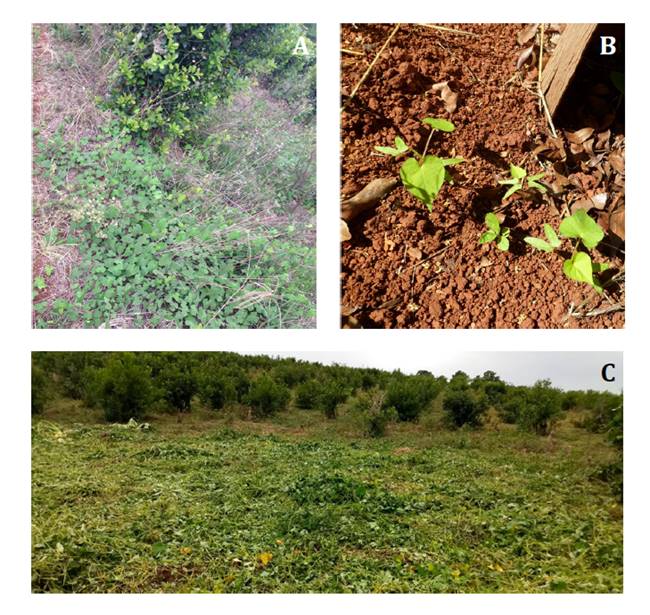
A- Ipomoea grandifolia (Dammer) O´Donell growing in crop line; B- Seedlings of I. grandifolia growing in spring; C- Cleaning the crop in summer, before harvest.
A- Ipomoea grandifolia (Dammer) O´Donell creciendo en línea del cultivo; B- Plántulas de I. grandifolia creciendo en primavera; C- Limpieza de cultivo en verano previo a la cosecha.
Figure 1. Scandent weeds in yerba mate crop.
Figura 1. Malezas escandentes en cultivo de yerba mate.
In integrated weed management, phytosociological surveys are crucial for obtaining reliable and objective data (8). Developing a weed monitoring methodology tailored to perennial crops is essential for efficiently assessing and comparing plant communities over time. This approach also helps prevent severe crop infestations and the depletion of natural resources (6). The composition of plant communities in yerba mate agroecosystems changes with the seasons (9), and plant communities can behave as weeds under certain circumstances. Nonetheless, the scandent species are present throughout the year and are the only ones considered important weeds in the crop. Certain species have medicinal uses. Examples include Ipomoea purpurea (L.) Roth, Ipomoea indica (Burm.) Merr. And Ipomoea nil (L.) Roth (20) or Smilax campestris Griseb. (22). Others, like species from the genus Ipomoea (19), are melliferous and serve as host plants for predatory arthropods. Certain Bignoniaceae species, including Pyrostegia venusta (Ker Gawl.) Miers, Dolichandra cynanchoides Cham. and Dolichandra unguis-cati (L.) L. G. Lohmann, provide materials used in crafts (3).
Understanding the importance of the scandent species in this perennial agroecosystem assists decision-making in integrated weed management. Furthermore, an adequate monitoring methodology allows efficient evaluation and comparison of plant communities over time. This approach also helps prevent severe crop infestations and loss of natural resources. Information on weed species in yerba mate cultivation is limited. Specific authors, therefore, approach the topic superficially (6) or mention a few species as competitors (12). By contrast, recent studies adopt phytosociological or integrative approaches (9, 10, 11). This study aimed to evaluate species richness and seasonal frequency of scandent and non-scandent weed communities of yerba mate crop.
Materials and Methods
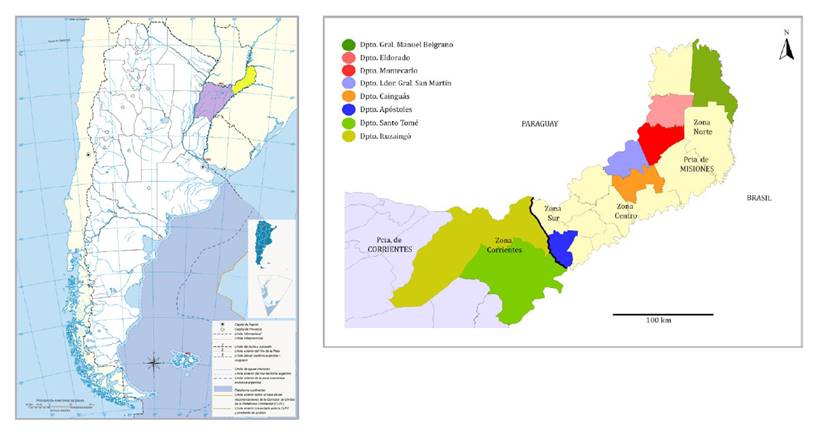
Between autumn 2018 and winter 2023, 81 censuses were conducted using the Braun-Blanquet (1950) and Mueller-Dumbois & Ellenberg (1974) phytosociological methods. Forty-four censuses were conducted during the spring-summer months of 2018, 2019, 2020, 2021, and 2023. Thirty-seven censuses were conducted during the autumn-winter months of 2018, 2021, 2022, and 2023. This schedule covered all four seasons of the year. The number of surveys per yerba mate field depended on the state of the crop at the time. Fields ranged between 2 and 6 hectares and were located across six departments in the province of Misiones and two departments in the province of Corrientes (figure 2).
Source/Fuente: IGN.
Figure 2. Geographical distribution of surveys in the north-eastern region of Argentina.
Figura 2. Distribución geográfica de los censos en la región nordeste de la República Argentina.
Fields were selected based on two criteria. First, the age of the crop, specifically those in full production with plants between 20 and 40 years old. Second, the planting framework, with the most common being traditional or modern systematized management practices for the production area (5).
Determination of the minimum sampling area: This constitutes the minimum surface area that represents the community (1, 4). In this study, a minimum area of 7 m2 (figure 3) was determined, based on three considerations.
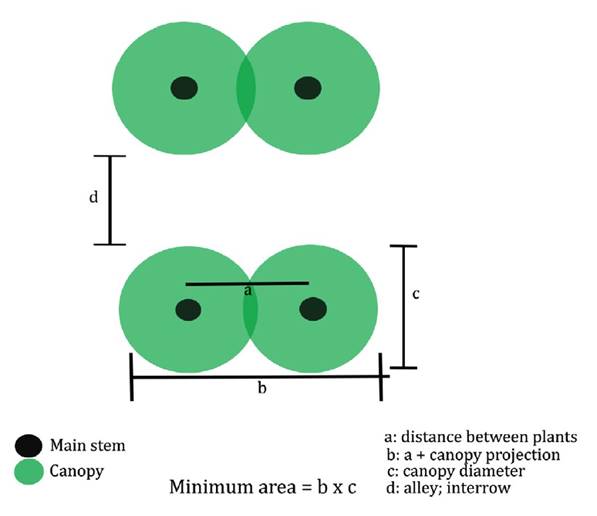
Figure 3. Determination of the minimum area for weed monitoring in perennial crops.
Figura 3. Determinación del área mínima para el monitoreo de malezas en cultivos perennes.
The first consideration was the planting framework of most yerba mate fields, with 3–3.5 m between rows and 1.2-1.5 m between plants. The second consideration was the need to observe seedlings, small plants, and even propagules, which might go unnoticed in larger areas. The third consideration was the projection of the crop canopy, since plants in this area can become weeds and, in high-density populations, hinder normal crop growth (11).
Sampling Design: The minimum area was distributed using a systematized design with transects placed parallel to the plant rows (figure 4). This design was chosen for practicality and potential application to other perennial crops.
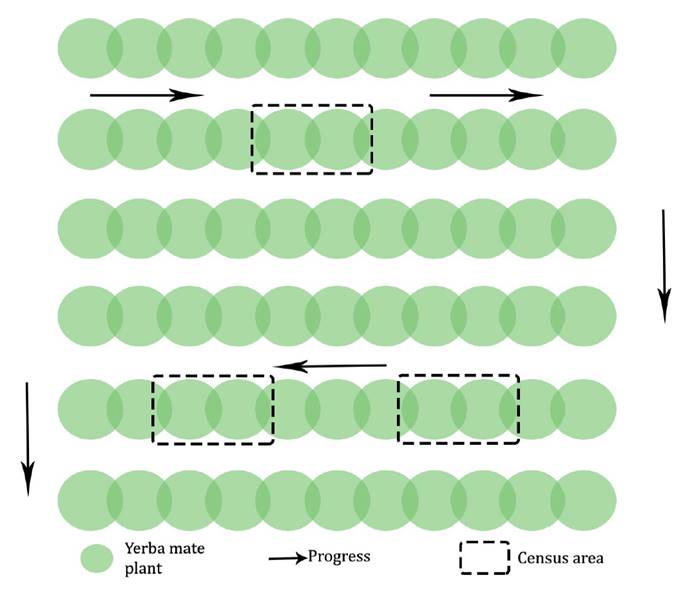
The arrows indicate the direction of progression, forming parallel transects.
Las flechas indican el sentido de avance formándose las transectas paralelas.
Figure 4. Distribution of the survey areas.
Figura 4. Distribución de las áreas censales.
Weed surveys: we collected plant material from species not identified in situ and took it to the Facultad de Ciencias Agrarias de la Universidad Nacional del Nordeste (FCA-UNNE) Specific taxonomic literature was used to accurately identify the species. A list of the surveyed species was compiled. For each species, presence/absence and abundance-coverage were recorded using the Braun-Blanquet scale (4). Finally, the presence/absence data were analysed and the frequency value of each species was determined.
Species richness and community composition: Species richness refers to the number of different species in an ecosystem, regardless of abundance (27). All recorded species were grouped into scandent and non-scandent species and organized by seasonal frequency in a contingency table. The four seasons were defined by summer and winter solstices and spring and autumn equinoxes, starting on 21/12, 21/6, 21/9 and 21/3, respectively. A chi-square test of independence (χ2) was applied to determine whether the proportions of scandent and non-scandent life forms were related to the seasons. Additionally, a Pearson chi-squared analysis was conducted on the 10 species with the highest absolute and relative frequencies. This analysis included species regardless of life form and was performed to examine their seasonal patterns (23, 25).
Results and Discussion
Species Richness and Community Composition
A total of 153 species were surveyed, with 119 species (77.3%) classified as non-scandent and 34 (22.2%) as scandent (figure 5).
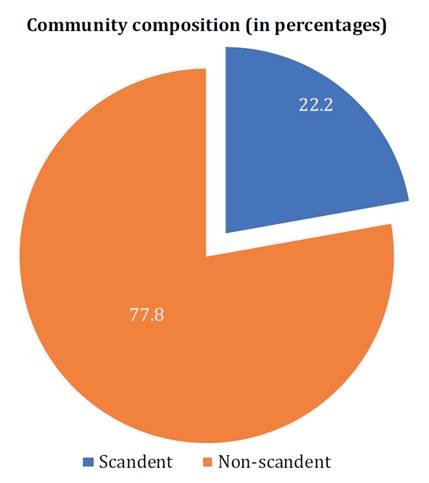
Figure 5. Community composition by scandent and non-scandent species (in percentages).
Figura 5. Composición de la comunidad por especies escandentes y no escandentes (en porcentajes).
Table 1 shows 1,705 species records obtained from 81 surveys, with 1,143 (67%) classified as non-scandent and 562 (33%) as scandent.
Table 1. Seasonal records of scandent and non-scandent species.
Tabla 1. Registros estacionales de especies escandentes y no escandentes.
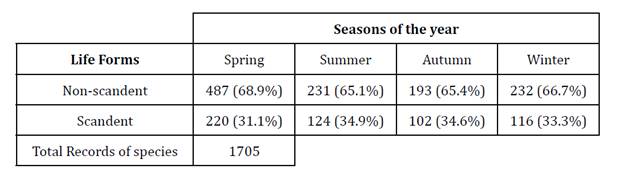
Scandent and non-scandent species were organized in a contingency table displaying the frequency of life forms for each season (table 1). A chi-square (χ2) independence test was conducted to assess whether the proportions of scandent and non-scandent species varied with the seasons.
Relative frequencies of the surveyed species (table 1) showed little variation throughout the year. This result is explained by the considered variables:
chi-square = 2.0802, df = 3, p-value = 0.5559
Notably, spring showed the highest number of individuals, while autumn had the lowest.
Absolute and Relative Frequencies of Scandent and Non-Scandent Species
In the field, certain species, such as Ipomoea cairica (L.) Sweet and Scutellaria racemosa Pers. (table 2), showed different frequencies across seasons. However, the chi-square test did not confirm this variation for scandent and non-scandent species. To verify seasonal patterns, the 10 species with the highest absolute and relative annual frequencies were selected and analyzed (table 2). Five of the six scandent species ranked at the top, highlighting their importance in the yerba mate agroecosystem throughout the year.
Table 2. Seasonal records and relative frequencies (%) of the 10 most frequent species by season of the year.
Tabla 2. Registros estacionales y frecuencias relativas (en porcentaje) de las 10 especies más frecuentes por estación del año.
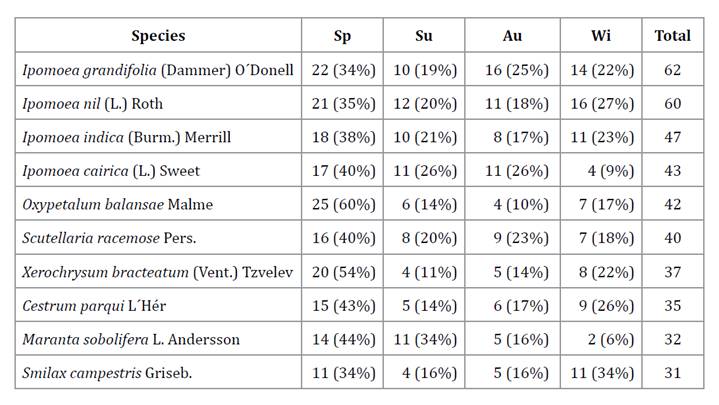
S: Spring, Su: Summer, Au: Autumn, and Wi: Winter.
Sp: primavera, Su: verano, Au: otoño y Wi: invierno.
The Pearson Chi-Square test, with a value of P=205.46, was significant with a P value < 0.0001. These results suggest that the presence or absence of these species is seasonally influenced. Such observations are explained by the subtropical climate of yerba mate regions in Argentina, without dry season (5) and winter temperatures above 20°C for several weeks. Combined with precipitation during these months, this mild winter allows seed germination, seedling emergence, and sprouting of underground and vegetative organs. Blooming, fruiting, and propagule release also occur throughout the year.
The study shows that scandent species play a more significant role in the community as a life form than as contributors to floristic richness. Understanding their ecological role can help optimize resource allocation in integrated crop management. Although often considered secondary, climbing plants should receive greater attention based on these results.
Vanni et al. (2003) reported that scandent species contributed 20.7% to floristic richness in Iguazú National Park (PNI), while Miranda and Dummel (2016) found 18% in the Guaraní Multiple-Use Reserve (RUMG). Scandent species accounted for 22.22% in this study, higher than in natural ecosystems. Further research should determine if this difference is due to crop management. Such management may favor species preadapted to thrive as weeds, which benefit from microhabitat changes and become troublesome (22).
Swamy & Ramakrishnan (1987) report that Mikania micrantha rapidly spreads through disturbances, mainly forest fires, establishing seedlings or clones in newly affected areas. Dávalos et al. (2019) and Dávalos et al. (2023) report that over 90% of the accompanying species in the yerba mate agroecosystem are native. Seed banks and propagation structures facilitate their seasonal establishment. Species that adapt to the newly imposed conditions may become weeds in the crop.
In perennial crops such as coffee and sugarcane, the frequency of scandent species can vary. For example, I. grandifolia showed the highest relative frequency in this study. Kranz et al. (2009) reported this species in coffee cultivation in Paraná (Brazil) with a frequency of 21.9%. Oliveira et al. (2008) recorded it in sugarcane in Rio de Janeiro, with frequencies of 34.4% in autumn-winter and 15.5% in spring-summer. Despite these values, I. grandifolia is considered a secondary weed in coffee and sugarcane, unlike in yerba mate.
Conclusions
Scandent species are important weeds in yerba mate, representing 22% of species richness and 31.1-34.9% of the community composition in each season. Implementing a proper weed monitoring methodology, both in perennial crops generally and in yerba mate specifically, improves understanding of plant community dynamics over time. This methodology is a key tool for preventing weed infestations and evaluating the effectiveness of management strategies.
Acknowledgments
We sincerely thank the Centro de Malezas de la Facultad de Ciencias Agrícolas de la Universidad Nacional del Noreste (FCA-UNNE) for their invaluable support and guidance. We also acknowledge the Instituto de Botánica del Noreste (IBONE) and the Secretaría General de Ciencia y Tecnología (SGCyT-UNNE) of the Universidad Nacional del Noreste for financial assistance.
Finally, we are especially grateful to the farmers and their families for their warm hospitality and for welcoming us during each visit.
1. Alcaraz Ariza, F. J. 2013. El método fitosociológico. Geobotánica, Tema 11. Universidad de Murcia. España. http://creativecommons.org/licenses/by-nc/3.0/deed.es_CL
2. Altieri, M. A. 1999. Agroecología: bases científicas para una agricultura sustentable. Nordan Comunidad. 325 p.
3. Amarilla Rodríguez, S. M.; Amarilla Borja, S. C.; Insfrán Ortiz, A.; Pérez de Molas, F. 2022. Servicios ecosistémicos de provisión y culturales en el Paisaje Protegido Cerro Kavajú, Departamento de Cordillera, Paraguay. Investigación Agraria. 24(2).
4. Braun-Blanquet, J. 1950. Fitosociología. Bases para el estudio de las comunidades vegetales. Acme Agency. 444 p.
5. Bruniard, E. 1995. Geografía de los climas y de las formaciones vegetales: aportes para un modelo fitoclimático mundial. EUDENE.
6. Burtnik, O. J. 2006. Yerba mate: manual de producción. INTA-AER Santo Tomé. 52 p.
7. Capellari, P. L. 2017. Yerba mate. Reseña histórica y estadística. Producción e Industrialización en el siglo XXI. CABA: CFI. 310 p.
8. Concenço, G.; Farias, P. M. de; Quintero, N. F. A.; Schreiber, F.; Galon, L.; Tomazi, M. & Andres, A. 2017. Phytosociological Surveys in Weed Science: Old Concept, New Approach. InTech. DOI: 10.5772/intechopen.69083
9. Dávalos, C. M.; Kalitko, M.; Knott, K.; Podkowa, F.; Pawluk, L.; Rem, M. V.; López, M. G.; Vanni, R. O. 2019. Relevamiento de malezas frecuentes en el cultivo de yerba mate (Ilex paraguariensis A. St. Hil.) en lotes productivos de la provincia de misiones, Argentina. 1º Jornada de Divulgación Científica Producción de Yerba Mate. Misiones.
10. Dávalos, C. M.; Wilson, B. D.; Vallejos, F. E.; Alsina, A. F.; Benítez, A. E., Cardozo, A. E., López, G.; Vanni, R. O. 2023. Comunidad vegetal otoñal en un yerbal de la localidad de Andresito (Misiones). XXVIII Reunión de Comunicaciones Científicas, Técnicas y de Extensión. Corrientes.
11. Dávalos, C. M., López, M. G.; Vanni, R. O. 2025. Reconocimiento de malezas importantes en estadios juveniles en cultivos del Noreste de Argentina. Investigación Agraria. 26(2): 67-74. https://doi.org/10.18004/investig.agrar.2024.diciembre.2602807
12. De David, F.; Galon, L.; Perin, G. F.; Concenço, G.; Castamann, A.; Forte, C. T.; Rochely De David, P.; Mossin, A. J.; Andres, A.; Moisinho, I. 2018. Weed Interference in the Morphophysiological and Nutritional Characteristics of Erva-Mate (Ilex paraguariensis). American Journal of Plant Sciences. 9: 435-445.
13. Ellenberg, H.; Mueller-Dombois, D. A. 1967. Key to Raunkiaer plant life- forms with revised subdivisions. Berichte des Geobot Institutes der Eidg Techn Hochschule. Stift Rübel. 37: 56-73.
14. FAO. 2011. El estado de los recursos de tierras y aguas del mundo para la alimentación y la agricultura. La gestión de los sistemas en situación de riesgo. Organización de las Naciones Unidas para la Alimentación y la Agricultura. Roma y Mundi-Prensa, Madrid. https://openknowledge.fao.org/handle/20.500.14283/cb7654es
15. Giberti, G. C. 2011. La yerba mate (Ilex paraguariensis, Aquifoliaceae) en tempranos escritos rioplatenses de Bonpland y su real distribución geográfica en Sudamérica austral. Bonplandia. 20 (2): 203-212.
16. Gliessmann, S. R. 2002. Agroecología. Procesos ecológicos en agricultura sostenible. CATIE. 359 p.
17. Instituto Nacional de la Yerba Mate. 2016. www.inym.org.ar
18. Kranz, W. M.; Fonseca Jr., N.; Passini, T.; Brito Martins, N. 2009. Ocorrência e distribuição de plantas daninhas no Paraná. Instituto Agronómico do Paraná. Londrina.
19. Lovato Echeverría, R. A; Salgado, C.; Dávalos, M.; Royo Simonella, L.; López, M. G. 2022. Weeds of melliferous importance in crops of the Northeast Argentina Region. Revista Ciencias Agronómicas. 40 (22): 69-72. https://doi.org/10.35305/agro40.e029
20. Meira, M.; Pereira da Silva, E.; David, J. M.; David, J. P. 2012. Review of the genus Ipomoea: tradicional uses, chemistry and biological activities. Revista Brasiliera de Farmacognosia. 22(3): 682-713.
21. Miranda, D. E.; Dummel, C. 2016. Clave de identificación de especies de plantas trepadoras de la reserva de uso múltiple Guaraní (RUMG) Misiones, Argentina. Revista Forestal Yvyraretá. 23: 50-72.
22. Morais, M. I.; Pinto, M. E. A.; Araújo, S. G., Castro, A. H. F.; Duarte-Almeida, J. M.; Rosa, L. H.; Rosa, C. A.; Johan, S.; Dos Santos, L. A. R. 2014. Antioxidant and antifungal activities of Smilax campestris Griseb. (Smilacaceae). Natural producto Research. 28(16): 1275-1279. https://doi.org/10.1080/14786419.2014.895728
23. Mortimer, A. 2003. Manejo de malezas para países en desarrollo. Cap. 2. Estudio FAO.
24. Mueller Dumbois, D.; Ellemberg, H. 1974. Aims and methods of vegetation ecology. John Wiley & Sons, Inc.
25. Navure Team (2023). Navure (2.7.3): A data-science-statistic oriented application for making evidence-based decisions. http://www.navure.com
26. Oliveira, A. R.; Freitas, S. P. 2008. Levantamento Fitossociológico de plantas daninhas en áreas de produção de cana-de-açúcar. Planta Daninha, Viçosa-MG. 26(1): 33-46.
27. Palacios, J. 2005. Citricultura. Tucumán. Argentina. 518 p.
28. Raunkiær, C. 1907. Planterigets livsformer, Og deres betydning for geografien. I commission hos Gyldendalske boghandel. Nordisk forlag. 132 p.
29. Sacco dos Anjos, F.; Belik, W.; Velleda Caldas, N. 2011. La caficultura en Brasil. Evolución, situación actual y nuevos retos cara al futuro. Mundo Agrario. 12(23). Recuperado de https://www.redalyc.org/articulo.oa?id=84522393005 (fecha de consulta: 7 de marzo de 2025).
30. Sánchez-Moreiras, A. M.; Vieites-Álvarez, Y; Fernández Calviño, D.; Campillo, C.; Gonzalez-de-Santos, P.; Rodríguez Silva, T.; Fedoniuk, T.; Synowiec, A.; Almeida Pinheiro de Carvalho, M. A.; Vityi, A.; Araniti, F.; Nacher, J.; Bolat, I.; Zornoza, R.; Verdeguer, M.; Shanskiy, M.; Reinhardt-Weik, H.; Johannesson, H. & Piron, L. 2024. Estrategias agroecológicas para el manejo sostenible de malas hierbas en cultivos europeos de relevancia económica (AGROSUS). Revista de Ciências Agrárias. 47(1): 107-112.
31. Sánchez-Sánchez, C.; Paz-Pellat, F.; Hernández-de la Rosa, P.; Velázquez-Rodríguez, A.; Vibrans, H.; Vargas-Hernández, J.; Valdez-Hernández, J. I.; Valdez-Lazalde, J. R. 2021. Riqueza de especies y tipos funcionales: su relación en bosques de oyamel del Monte Tláloc, Estado de México. Madera y Bosques. 27(4): e2742427. DOI: 10.21829/myb.2021.2742427
32. Swamy, P.; Ramakrishnan, P. 1987. Effect of fire on population dynamics of Mikania micrantha H. B. K. during early succession after slash and burn agricultura (jhum) in northeastern India. Weed Research. 27: 397-403.
33. Vanni, R. O.; López, M. G.; Dávalos, C. M. 2003. Inventario Florístico del Parque Nacional Iguazú. UNNE. Comunicaciones científicas y tecnológicas.
34. Yacovich, M. 2017. La actividad yerbatera en la provincia de Corrientes. Números para saber dónde estamos. En Yerba mate, reseña histórica y estadística, producción e industrialización en el siglo XXI.