Rev. FCA UNCuyo | 2026 | 58(1) | ISSN 1853-8665
Plant protection
https://doi.org/10.48162/rev.39.218
First Record of Potential Vectors (Hemiptera: Auchenorrhyncha) of Xylella fastidiosa in Olive Groves from Argentina
Primer registro de potenciales vectores (Hemiptera: Auchenorrhyncha) de Xylella fastidiosa en olivares de Argentina
Angelo Mazzaglia 3,
Susana L. Paradell 2,
Gabriela Lucero 4,
Álvaro Foieri 2,
Pablo Pizzuolo 4,
Oscar Peñaloza 5,
Eduardo G. Virla 6,
Stefano Speranza 3
1 Centro de Estudios Parasitológicos y de Vectores (CONICET-UNLP-CICPBA). Boulevard 120 s/n (1900). La Plata. Buenos Aires. Argentina.
2 Universidad Nacional de La Plata. Facultad de Ciencias Naturales y Museo. División Entomología. Av. 60 y 122 s/n (1900). La Plata. Buenos Aires. Argentina.
3 Università degli Studi della Tuscia. Dipartimento di Scienze Agrarie e Forestali. Italia.
4 Universidad Nacional de Cuyo. Facultad de Ciencias Agrarias. Almirante Brown 500 (M5528AHB). Chacras de Coria. Luján de Cuyo. Mendoza. Argentina.
5 Universidad Nacional de La Rioja. Centro de Investigación e Innovación Tecnológica. Argentina. Av. Luis M. De La Fuente S/N. Ciudad de La Rioja. La Rioja. Argentina.
6 Fundación Miguel Lillo - CONICET. Miguel Lillo 251 (T4000JFE). San Miguel de Tucumán. Tucumán. Argentina.
* bdefea@cepave.edu.ar
Abstract
This study aimed to identify potential vectors of the bacterium Xylella fastidiosa in olive orchards in La Rioja Province, Argentina. Hoppers (Hemiptera: Auchenorrhyncha) were collected during the spring of 2019 from localities with a high incidence of this pathogen in olive trees and associated spontaneous vegetation. Of the 14 species identified, eight tested positive for X. fastidiosa subsp. pauca. The ability to transmit this xylem-inhabiting bacterium is directly linked to the feeding habits of its vectors. The xylem-feeding species Bucephalogonia xanthophis (Berg), Ciminius albolineatus (Taschenberg), and Notozulia entreriana (Berg) tested positive and are confirmed carriers of X. fastidiosa. Consequently, these species may be considered potential vectors in olive orchards in La Rioja and represent suitable candidates for further epidemiological studies aimed at confirming their role as effective vectors of the bacterium.
Keywords: Cercopidae, Cicadellidae, Cicadellinae, molecular detection, olives, olive quick decline
Resumen
El objetivo de este trabajo fue identificar vectores potenciales de la bacteria Xylella fastidiosa en plantaciones olivícolas de la provincia de La Rioja, Argentina. Las “chicharritas” (Hemiptera: Auchenorrhyncha) fueron recolectadas durante la primavera de 2019 en localidades con alta incidencia de este patógeno en plantas de olivos y la vegetación espontánea. De las 14 especies identificadas, ocho resultaron positivas para X. fastidiosa subsp. pauca. La capacidad de transmisión de esta bacteria, que se aloja en los vasos xilemáticos, está directamente relacionada con el hábito alimenticio de sus vectores. Las especies alimentadoras del xilema Bucephalogonia xanthophis (Berg), Ciminius albolineatus (Taschenberg) y Notozulia entreriana (Berg) resultaron positivas y se confirman como portadoras de X. fastidiosa. Consecuentemente, podrían considerarse como potenciales vectores de olivos en La Rioja y son las candidatas apropiadas para nuevos estudios epidemiológicos que permitan confirmar su rol como vectores de la bacteria.
Palabras clave: Cercopidae, Cicadellidae, Cicadellinae, detección molecular, olivos, declinamiento rápido del olivo
Originales: Recepción: 06/08/2025 - Aceptación: 15/04/2026
Introduction
Xylella fastidiosa Wells is a gram-negative bacterium belonging to the family Xanthomonadaceae that affects a wide range of plant species, including agricultural and ornamental crops worldwide (Redak et al., 2004). It has caused significant economic losses in South America and Europe (Castro et al., 2021) and represents a global threat to woodycrops (Rapicavoli et al., 2018). In the Americas, different subspecies of X. fastidiosa are associated with diseases such as Citrus Variegated Chlorosis, Pierce’s disease of grapevine, and Olive Quick Decline (OQD), among others (Haelterman et al., 2015; Rapicavoli et al., 2018; Redak et al., 2004). In Argentina, citrus and almond crops are among the most affected (Carciofi et al., 2023; Nome et al., 1992). In 2013, the subspecies pauca was detected in olive plants, leading to significant losses in key production areas of La Rioja and Córdoba provinces (Haelterman et al., 2015). Olive orchards in Argentina cover approximately 67,000 ha, ranking second among fruit crops in cultivated area. La Rioja Province leads both planted area (26,000 ha) and production (138,000 t), followed by San Juan, Catamarca, and Mendoza provinces (FOA, 2024). In La Rioja, olive cultivation represents one of the oldest and most socioeconomically important productive sectors. Although Argentina is currently the leading producer and exporter of olive oil and table olives in the Americas, national production has declined in recent years. The incidence of X. fastidiosa in olive orchards in La Rioja (Arauco Department) has reached 100%, constituting a major phytosanitary constraint with a negative impact on local production (Ministerio de Desarrollo Productivo Argentina, 2022).
The main vectors of X. fastidiosa are two groups of xylem-sap-feeding hemipterans, commonly known as “sharpshooters” (Auchenorrhyncha: Membracoidea: Cicadellidae: Cicadellinae) and “spittlebugs” (Auchenorrhyncha: Cercopoidea: Aphrophoridae and Cercopidae) (Cornara et al., 2019; Redak et al., 2004). The ability to transmit this pathogen is directly linked to their feeding habits (Severin, 1950). Most species within Cicadellinae that have demonstrated the capacity to acquire and transmit X. fastidiosa have been confirmed as disease vectors in different crops, suggesting that all members of this subfamily may be considered potential vectors (Redak et al., 2004). Indeed, transmission may be a general trait of xylem-feeding insects, and all species with this feeding habit should be regarded as potential vectors (Lopes et al., 2014). In recent years, numerous additional vector species have been identified following outbreaks in olive production systems in Europe and South America (Cornara et al., 2019; Froza, 2022).
Information on the composition of xylem-feeding insect communities associated with olive orchards in Argentina is limited (Calahorra, 2023; Defea et al., 2019), and the vectors of Olive Quick Decline (OQD) in the region remain unknown. This knowledge gap has hindered disease surveillance and the development of effective management strategies. This study aimed to confirm the presence of X. fastidiosa in Auchenorrhyncha species inhabiting affected olive orchards in La Rioja, Argentina.
Material and Methods
To achieve this objective, field surveys were conducted in two olive orchards severely affected by OQD-like symptoms in Aimogasta (28°35’34.90” S; 66°47’24.31” W; 825 m a. s. l.) and Villa Mazán (28°39’30.19” S; 66°31’54.38” W; 652 m a. s. l.), located 35 km apart in La Rioja Province, Argentina. Both orchards were planted with olive trees cv. Arauco, the cultivar most affected by OQD in the region (Tolocka et al., 2021). Surveys were carried out in mid-November 2019. Insects were collected using two methods: (1) sweep net sampling in the olive canopy and surrounding vegetation, and (2) light trapping using a halogen lamp and a sheet. For sweep net sampling, four trees per orchard were sampled, with four sets of 10 sweeps per tree. In addition, three 50 m transects were established in each orchard to sample spontaneous vegetation, with 100 sweeps per transect (300 sweeps per orchard). In total, seven sweep net samples were obtained per orchard per sampling date, amounting to 340 sweeps per orchard. For light trapping, a light sheet equipped with a halogen lamp was operated from 18 to 20 November, and insects were collected from twilight until 03:00 h using a manual aspirator. All captured hoppers were preserved in 70% ethanol and subsequently transferred to the laboratory for taxonomic identification and screening for X. fastidiosa.
Specimens were identified to the species level using the identification keys of Jones & Deitz (2009), Leal et al. (2016), Paladini et al. (2008), Young (1968, 1977), Zahniser & Dietrich (2013) and Zanol (2007). Male genitalia were dissected and cleared in 10% KOH for stereoscopic examination and subsequently preserved in glycerin. All material was deposited in the entomological collection of the Museo de La Plata, Argentina (UNLP). For the molecular detection of X. fastidiosa, ethanol was carefully removed from the samples by evaporation, and insect heads were dissected from the body (Bextine et al., 2004) the almost exclusive foregut colonization of the bacterium (Janse & Obradovic, 2010). Heads were pooled by species, with up to five individuals per sample when available, resulting in a total of 15 samples for analysis. Total DNA was extracted using the NucleoSpin® DNA Insect kit (Macherey-Nagel, Germany) following the manufacturer’s instructions.
Standard PCR reaction (25 μL) was prepared containing 12.5 μL of 2X PCR Master Mix (PCRBIO HS Taq Mix Red, PCRBIOSYSTEMS), 1 μL (400 nM) of forward primer RST31 (GCGTTAATTTTCGAAGTGATTCGATTGC), 1 μL (400 nM) of reverse primer RST33 (CACCATTCGTATCCCGGTG), 1 μL (~10 ng) of extracted DNA, and 9.5 μL of PCR-grade water. The thermic profile consisted of an initial denaturation at 95°C for 1 min, followed by 40 cycles at 95°C for 30 s, 55°C for 30 s, and 72°C for 45 s, with a final elongation at 72°C for 5 min (Minsavage et al., 1994). Amplicons were visualized by agarose gel electrophoresis after staining with GelRed® Nucleic Acid Gel Stain (10,000X; Biotium, Inc., USA). Samples were scored as positive when a single band of the expected size (733 bp) was clearly visible under UV light and as negative if no band or bands of different sizes were observed. DNA from X. fastidiosa subsp. pauca strain CoDiRO (CFBP 8402) served as a positive control, and PCR-grade water was used as a negative control.
It should be noted that the findings of this study were duly reported to the Servicio Nacional de Sanidad y Calidad Agroalimentaria (SENASA) through the Sistema Nacional de Vigilancia y Monitoreo de Plagas (SINAVIMO).
Results and Discussion
Due to extreme dryness during the sampling period, no hoppers were collected from olive trees or spontaneous vegetation using the sweep net method; therefore, all specimens analyzed in this study were obtained using the light sheet. A total of 324 individuals of Auchenorrhyncha were collected in La Rioja, Argentina (73 from Aimogasta and 251 from Villa Mazán). Cicadellidae was the most abundant family at both localities.
Thirteen leafhopper species and one Cercopid species were identified (table 1). The most abundant species were Paratanus exitiosus (Beamer), Chlorotettix fraterculus (Berg), and Ciminius albolineatus (Taschenberg), while Curtara nebula (Beamer) was present at both sites (table 1).
Table 1. Auchenorrhyncha species collected in olive crops severely affected by Xylella fastidiosa in La Rioja, Argentina, indicating those in which at least one specimen was infected with the bacterium.
Tabla 1. Especies de Auchenorrhyncha recolectadas en cultivos de olivo severamente afectados por Xylella fastidiosa en La Rioja, Argentina, en la cual se indican aquellas especies con al menos un ejemplar infectado con la bacteria.
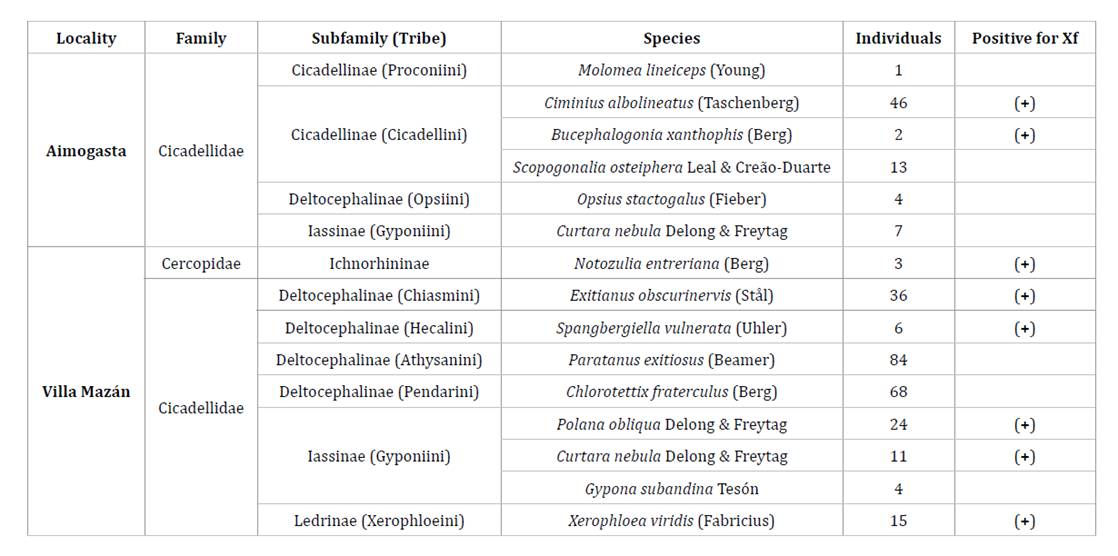
In Aimogasta, four xylem-feeding species were recorded: Bucephalogonia xanthophis (Berg), C. albolineatus, Molomea lineiceps (Young), and Scopogonalia osteiphera Leal & Creão-Duarte. In contrast, in Villa Mazán, only the cercopid Notozulia entreriana (Berg) was identified as a xylem feeder, with the remaining species classified as phloem feeders. In Aimogasta, two known vectors of X. fastidiosa, B. xanthophis and N. entreriana, were detected, and C. albolineatus was associated with infected olive plants for the first time (figure 1).
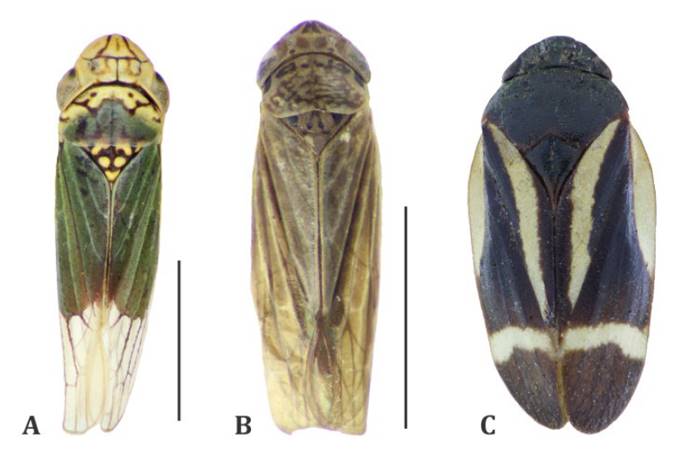
(A) Bucephalogonia xanthophis, (B) Ciminius albolineatus, (C) Notozulia entreriana.
Figure 1. Xylem-Feeding Auchenorrhyncha positive for Xylella fastidiosa in olive orchards of La Rioja, Argentina.
Figura 1. Auchenorrhyncha especialistas del xilema positivas para Xylella fastidiosa en olivares de La Rioja, Argentina.
A similar species assemblage has previously been reported in Aimogasta (Defea et al., 2019) and Chilecito (Calahorra, 2023). Except for Macugonalia cavifrons (Stål), not collected in this study, the xylem-feeding species correspond to those reported by Defea et al. (2019). In Villa Mazán, the identified species were predominantly phloem feeders (except N. entreriana), belonging to the subfamilies Deltocephalinae, Iassinae, and Ledrinae (table 1). Previous studies suggest that Cicadomorpha community composition is influenced by local vegetation structure (Biedermann et al., 2005; Carpio et al., 2020). The predominance of phloem feeders, along with the presence of N. entreriana in Villa Mazán, may be associated with differences in vegetation cover and plant diversity between sites. The main weeds associated with olive orchards in this region belong to the families Asteraceae, Poaceae, and Solanaceae (Esteva et al., 2019), and include numerous species reported as hosts of X. fastidiosa by the European Foos Safety Authority Journal, such as Bidens pilosa L., Sorghum halepense (L.) Pers., Cynodon dactylon (L.) Pers., and Hordeum vulgare L., among others.
The detection method enabled confirmation of Xylella fastidiosa subsp. pauca in multiple tested specimens (table 1). Fifty-seven percent of the identified species, including seven Cicadellidae and one Cercopidae, tested positive for the bacterium (table 1). Among the xylem-feeding species, B. xanthophis, C. albolineatus (both Cicadellini), and N. entreriana tested positive for X. fastidiosa (figure 1).
Our results are consistent with previous vector surveys and transmission studies conducted in olive groves in Italy (Cavalieri et al., 2018; Saponari et al., 2014), Brazil (Froza, 2022) and Spain (Lopes et al., 2014), which identified numerous species of sharpshooters and spittlebugs as the main vectors of this bacterium.
Among Cicadellinae, B. xanthophis is a well-known vector of X. fastidiosa to citrus in Brazil (Marucci et al., 2008) and a potential vector for coffee (Leite & Nunes, 2003). In Argentina, it has been confirmed as a carrier of the bacterium through DIVA and PCR analyses (de Coll et al., 2000; Dellapé et al., 2016) and is a predominant species in olive groves in Chilecito, La Rioja Province (Calahorra, 2023). Interestingly, in detection studies conducted on Brazilian olives, B. xanthophis tested negative for the bacterium (Froza, 2022). In contrast, C. albolineatus had not previously been associated with X. fastidiosa until the present study. Other Cicadellinae species, such as C. platensis (Berg) and C. yana (Young), have been reported on citrus in northern Argentina (Defea et al., 2022; Remes Lenicov et al., 1999). Further studies are required to determine the role of C. albolineatus in the spread of X. fastidiosa, as it was the most abundant xylem-feeding species collected that also tested positive for the bacterium.
Spittlebugs, previously considered marginal vectors, have gained increased attention following X. fastidiosa outbreaks in Europe, with Philaenus spumarius (L.) recognized as a key vector in olive crops (Cornara et al., 2017; Saponari et al., 2014). More recently, three cercopid species were confirmed as proven vectors of olives in Brazil (Froza, 2022). In the present study, N. entreriana was the only spittlebug collected and tested positive for X. fastidiosa, representing the first record of a Cercopid as a potential vector of this bacterium in Argentina.
The sharpshooter M. lineiceps was previously reported as positive for X. fastidiosa by conventional PCR in Entre Ríos Province (Dellapé et al., 2016). Along with S. osteiphera, these species have been documented as common inhabitants of olive crops in Aimogasta (Defea et al., 2019, 2022) and Chilecito (Calahorra, 2023). Scopogonalia osteiphera is abundant and frequently observed in the spontaneous vegetation of olive groves in Chilecito (Calahorra, 2023). In contrast, in the present study, both species were collected in low numbers, and all specimens tested negative for the bacterium. Nevertheless, given their reported presence in olive agroecosystems, they should be considered in future surveillance and transmission studies. The low abundance observed in our surveys may be attributed to the sparse vegetation present during the sampling period.
Numerous phloem-feeding species were collected in Villa Mazán (table 1). The leafhoppers E. obscurinervis (Stål), P. exitiosus (Beamer), and C. fraterculus (Berg) were among the most abundant. Notably, Spangbergiella vulnerata (Uhler), Xerophloea viridis (Fabricius), and E. obscurinervis are reported here for the first time in association with X. fastidiosa. Although previous studies have shown that phloem-feeding members of other Cicadellidae subfamilies may occasionally ingest xylem sap and acquire X. fastidiosa, their ability to transmit the bacterium has not yet been demonstrated (Ben Moussa et al., 2016; Chuche et al., 2017).
Conclusions
This study provides new insights into the epidemiology of X. fastidiosa in Argentine olive orchards. Further transmission assays are essential to confirm the species capable of acting as vectors and to identify those of epidemiological significance. In the absence of such information, effective vector monitoring and management strategies will remain limited, potentially compromising disease control and the health of olive production systems in Argentina.
Acknowledgements
We thank the authorities of La Rioja Province for granting permission to collect insect specimens (Nº P4-00409-19). We are also grateful to PROIMI, and particularly to Dr. Mario Baigori, for providing access to laboratory facilities for the detection of Xylella fastidiosa. This work was supported by the Italian Ministry of Foreign Affairs and International Cooperation (MAECI), Italy, and the Universidad Nacional de La Plata, Argentina [11N/868].
Ben Moussa, I. E., Mazzoni, V., Valentini, F., Yaseen, T., Lorusso, D., Speranza, S. & D’Onghia, A. M. (2016). Seasonal fluctuations of sap-feeding insect species infected by Xylella fastidiosa in Apulian olive groves of southern Italy. Journal of Economic Entomology, 109(4), 1512-1518. DOI: 10.1093/jee/tow123
Bextine, B., Tuan, S. J., Shaikh, H., Blua, M., & Miller, T. A. (2004). Evaluation of methods for extracting Xylella fastidiosa DNA from the glassy-winged sharpshooter. Journal of Economic Entomology, 97(3), 757-763. DOI: 10.1093/jee/97.3.757
Biedermann, R., Achtziger, R., Nickel, H., & Stewart, A. J. (2005). Conservation of grassland leafhoppers: a brief review. Journal of Insect Conservation, 9, 229-243. DOI: 10.1007/s10841-005-0531-z
Calahorra, M. A. (2023). Monitoreo de Chicharritas y Salivazos Asociados al Agroecosistema Olivícola, Potenciales Vectores de Xylella fastidiosa en Chilecito, La Rioja (Insecta: Hemiptera: Cicadellidae, Cercopidae). [Tesis de Maestría, Universidad Nacional de Chilecito, Argentina]. https://repositorio.inta.gob.ar/xmlui/handle/20.500.12123/216/browse?authority=27227180086&type=author
Carciofi, I., Maspi, N. & Guevara Lynch, J. P. (2023). Cítricos dulces en Argentina. Antecedentes productivos, catalizadores tecnológicos y experiencias internacionales de la industria citrícola. Documento N°39. Ministerio de Economía. Secretaría de Industria y Desarrollo Productivo.
Carpio, A. J., Solana, M., Tortosa, F. S., & Castro, J. (2020). Effect of cover crops in olive groves on Cicadomorpha communities. Spanish Journal of Agricultural Research, 18(2). DOI: 10.5424/sjar/2020182-15991
Castro, C., Di Salvo, B., & Roper, M. C. (2021). Xylella fastidiosa: A reemerging plant pathogen that threatens crops globally. PLoS Pathogens, 17(9), e1009813. DOI: 10.1371/journal. ppat.1009813
Cavalieri, V., Dongiovanni, C., Tauro, D., Altamura, G., Di Carolo, M., Fumarola, G., Saponari, M., & Bosco, D. (2018). Transmission of the CODIRO strain of Xylella fastidiosa by different insect species. In Proceedings XI European Congress of Entomology. Naples, Italy.
Chuche, J., Backus, E. A., Thiéry, D., & Sauvion, N. (2017). First finding of a dual-meaning X wave for phloem and xylem fluid ingestion: characterization of Scaphoideus titanus (Hemiptera: Cicadellidae) EPG waveforms. Journal of Insect Physiology, 102, 50-61. DOI: 10.1016/j. jinsphys.2017.01.013
Cornara, D., Cavalieri, V., Dongiovanni, C., Altamura, G., Palmisano, F., Bosco, D. & Saponari, M. (2017). Transmission of Xylella fastidiosa by naturally infected Philaenus spumarius (Hemiptera, Aphrophoridae) to different host plants. Journal of Applied Entomology, 141(1-2), 80-87. DOI: 10.1111/jen.12365
Cornara, D., Morente, M., Markheiser, A., Bodino, N., Fereres, A., Redak, R. A. & Lopes, J. R. S. (2019). An overview on the worldwide vectors of Xylella fastidiosa. Entomologia Generalis, 39(3-4), 157-181. DOI: 10.1127/entomologia/2019/0811
De Coll, O. R., Remes-Lenicov, A. M. M., Agostini, J. P., & Paradell, S. (2000). Detection of Xylella fastidiosa in Weedsand Sharpshooters in Orange Groves affected with Citrus Variegated Chlorosis in Misiones, Argentina. International Organization of Citrus Virologists Conference Proceedings (1957-2010), 14(14), 216-222. https://escholarship.org/uc/item/0x65j6dn
Defea, B., Foieri, A., & Paradell, S. (2019). Vectores de Xylella Fastidiosa. En Esteva Matías (Ed.), Manual de protocolos de manejo de Plagas y patologías del olivo. 155-172.
Defea, B., Virla, E. G., Logarzo, G. A., Cavichioli, R. R., Tapia, S., Aguirre, M. R. & Paradell, S. L. (2022). Contributions to the knowledge of the Cicadellini Sharpshooters (Hemiptera: Cicadellidae) associated with citrus orchards in Argentina. Zootaxa, 5205(1), 55-72. DOI: 10.11646/zootaxa.5205.1.4
Dellapé, G., Paradell, S., Semorile, L., & Delfederico, L. (2016). Potential vectors of Xylella fastidiosa: a study of leafhoppers and treehoppers in citrus agroecosystems affected by Citrus Variegated Chlorosis. Entomologia Experimentalis et Applicata, 161(2), 92-103. DOI: 10.1111/eea.12491
Esteva, M., Banno, N., Bataglia, M. J., Bonafede, F., Brizuela, M. G., Calahorra, M. A., Defea, B. S. (2019). Manual de protocolos de manejo de plagas y patologías del olivo. Consejo Federal de Inversiones.
FOA (Federación Olivícola Argentina). (2024). Informe Olivícola 2018-2024. https://federacionolivicolaargentina. com.ar/informes-anuales/
Froza, J. (2022). Papel de espécies de cigarrinhas (Hemiptera: Auchenorrhyncha) na disseminação de Xylella fastidiosa em oliveira na Serra da Mantiqueira. [Thesis PhD. Piracicaba, Brazil].
Gibin, D., Gutierrez Linares, A., Fasanelli, E., Pasinato, L., & Delbianco, A. (2023). Update of the Xylella spp. host plant database-systematic literature search up to 30 June 2023. EFSA Journal, 21(12), e8477. https://doi.org/10.2903/j.efsa.2023.8477
Haelterman, R. M., Tolocka, P. A., Roca, M. E., Guzmán, F. A., Fernández, F. D., & Otero, M. L. (2015). First presumptive diagnosis of Xylella fastidiosa causing olive scorch in Argentina. Journal of Plant Pathology, 97(2), 393.
Janse, J. D., & Obradovic, A. (2010). Xylella fastidiosa: its biology, diagnosis, control and risks. Journal of Plant Pathology, 92(1), 35-148.
Jones, J. R., & Deitz, L. L. (2009). Phylogeny and systematics of the leafhopper subfamily Ledrinae (Hemiptera: Cicadellidae). Zootaxa, 2186(1), 1-120. DOI: 10.11646/zootaxa.2186.1.1
Leal, A. H., Creão-Duarte, A. J., & Mejdalani, G. (2016). Taxonomic review of Scopogonalia Young, 1977 (Insecta: Hemiptera: Cicadellidae: Cicadellini) with description of six new species. Journal of Natural History, 50(23-24), 1513-1542. DOI: 10.1080/00222933.2016.1166530
Leite, R. P., & Nunes, L. M. (2003). Avanços nas pesquisas sobre Xylella fastidiosa do café no Brasil. In Produção integrada de café (p. 87-101). Universidade Federal de Viçosa, Brazil.
Lopes, J., Landa, B., Fereres, A. (2014). A survey of potential insect vectors of the plant pathogenic bacterium Xylella fastidiosa in three regions of Spain. Spanish Journal of Agricultural Research, 12(3), 795-800.
Marucci, R. C., Lopes, J. R., & Cavichioli, R. R. (2008). Transmission efficiency of Xylella fastidiosa by sharpshooters (Hemiptera: Cicadellidae) in coffee and citrus. Journal of Economic Entomology, 101(4), 1114-1121. DOI: 10.1603/0022-0493(2008)101[1114:TEOXFB]2.0.CO;2
Ministerio de Desarrollo Productivo Argentina. (2022). Olivicultura en Argentina. Aprendiendo de la experiencia internacional: políticas públicas para el desarrollo sostenible del sector. Doc. 26. https://www.argentina.gob.ar/produccion/cep/consejo-cambio-estructural/documentos
Minsavage, G. V., Thompson, C. M., Hopkins, D. L., Leite, R. M. V. B. C. & Stall, R. E. (1994). Development of a polymerase chain reaction protocol for detection of Xylella fastidiosa in plant tissue. Phytopathology, 84(5), 456-461. DOI: 10.1094/Phyto-84-456
Nome, S. F., Haelterman, R. M., Docampo, D. M., Prataviera, A. G., & Feo, L. D. V. D. (1992). Almond leaf scorch in Argentina. Brazilian Phytopathology, 17, 57-60.
Paladini, A., Carvalho, G. S., & Valério, J. R. (2008). Ultrastructure and redescription of Notozulia entreriana (Berg) (Hemiptera: Cercopidae). Neotropical Entomology, 37, 552-557. DOI: 10.1590/S1519-566X2008000500008
Rapicavoli, J., Ingel, B., Blanco‐Ulate, B., Cantu, D., & Roper, C. (2018). Xylella fastidiosa: an examination of a re‐emerging plant pathogen. Molecular plant pathology, 19(4), 786-800. DOI: 10.1111/mpp.12585
Redak, R. A., Purcell, A. H., Lopes, J. R., Blua, M. J., Mizell Iii, R. F., & Andersen, P. C. (2004). The biology of xylem fluid-feeding insect vectors of Xylella fastidiosa and their relation to disease epidemiology. Annual Reviews in Entomology, 49(1), 243-270. DOI: 10.1146/annurev.ento.49.061802.123403
Remes Lenicov, A. M., Paradell, S., De Coll, O., & Agostini, J. (1999). Cicadelinos asociados a citrus afectados por clorosis variegada (CVC) en la República Argentina (Insecta: Homoptera: Cicadellidae). Revista de la Sociedad Entomologica Argentina, 58(3-4), 211-225.
Saponari, M., Loconsole, G., Cornara, D., Yokomi, R. K., De Stradis, A., Boscia, D. & Porcelli, F. (2014). Infectivity and transmission of Xylella fastidiosa by Philaenus spumarius (Hemiptera: Aphrophoridae) in Apulia, Italy. Journal of Economic Entomology, 107(4), 1316-1319.
Severin, H. H. (1950). Spittle-insect vectors of Pierce’s disease virus. II. Life history and virus transmission. Hilgardia, 19(11), 357.
Tolocka, P. A., Giolitti, F., Guzmán, F. A., Mattio, M. F., Nome, C. F., Ortega, L. I. & Haelterman, R. M. (2021). Caracterización de Xylella fastidiosa a partir de materiales vegetales y cepas aisladas de olivo (Olea europaea L.) e implementación de un sistema de diagnóstico serológico en Argentina. Revista de investigaciones agropecuarias, 47(3), 380-389.
Young, D. A. (1968). Taxonomic Study of the Cicadellinae (Homoptera: Cicadellidae). Technichal Bulletin of Carolina Agricultural Experimental Station. North Carolina State University. (239, 281).
Young, D. A. (1977). Taxonomic study of the Cicadellinae (Homoptera: Cicadellidae). Part 2. New World Cicadellini and the genus Cicadella. Bulletin of Carolina Agricultural Experimental Station. North Carolina State University.
Zahniser, J. N., & Dietrich, C. (2013). A review of the tribes of Deltocephalinae (Hemiptera: Auchenorrhyncha: Cicadellidae). European Journal of Taxonomy, (45). DOI: 10.5852/ejt.2013.45
Zanol, K. (2007). Catalogue of the neotropical Deltocephalinae (Hemiptera: Cicadellidae). Part II-Tribe. Acta Biol. Par., 36 (1-2): 1-46.
Author contributions
BSD: conceptualization, taxonomic identification (Cicadelllinae), original draft preparation; AM and SS: molecular analysis and draft supervision; SP: taxonomic identification (Deltocephalinae, Iassinae), draft supervision; GL and PP: molecular detection, draft supervision; AF: taxonomic identification (Cercopidae), draft supervision; OP: field samplings; EV: fiel samplings, conceptualization and original draft preparation.