Rev. FCA UNCuyo | 2026 | 58(2) | ISSN 1853-8665
Ecophysiology and crop management
https://doi.org/10.48162/rev.39.230
Effects of Agronomic and Environmental Factors on Potato (Solanum tuberosum L.) Cultivars: II. Phenological Phases and Dry Matter Production
Efectos de los factores agronómicos y ambientales sobre cultivares de papa (Solanum tuberosum L.): II. Fases fenológicas y producción de materia seca
Paul Christiaan Struik 2,
Marcelo Atilio Huarte 3
1 Universidad Nacional de Mar del Plata. Cátedra de Horticultura. Buenos Aires. Argentina.
2 Wageningen University & Research. Wageningen. Centre for Crop Physiology. Wageningen The Netherlands.
3 Instituto Nacional de Tecnología Agropecuaria. Balcarce. Buenos Aires. Argentina.
* joasa2010@gmail.com
Abstract
Potato (Solanum tuberosum ssp. tuberosum L.) ecophysiology, including growth, development, and dry matter distribution, is influenced by agronomic and environmental factors. This study analyzed plant phenology and dry matter production in contrasting potato cultivars grown in southeastern Buenos Aires Province, Argentina, considering interactions among environmental factors (temperature, radiation, and photoperiod) and agronomic factors (planting date, PD, and plant density). The study evaluated three PDs in a randomized complete block design with four replications using four cultivars differing in maturity class. Later planting shortened the emergence-to-tuber initiation (E-Ti) period in two cultivars. Later planting shortened the tuber initiation-to-end of leaf growth period in “Spunta” but lengthened it in “Kennebec.” The period from end of leaf growth to maturity was affected by cultivar and PD, being generally shorter for the first PD and longer for the second. Temperature, radiation, and photoperiod influenced dry matter accumulation, depending on the phenological phase. Photoperiod influenced the E-Ti period, whereas temperature influenced later stages of crop development. A longer E-Ti period for the first and last PDs significantly shortened subsequent periods. The second PD appeared to be the most conducive to potato production in this region. Moreover, duration of the E-Ti period was inversely related to the combined duration of the other periods, explaining 56% of the variation in total dry matter. The longer duration of this phenological period contributed to higher dry matter production across the range of PDs analyzed in this region. Therefore, selecting an appropriate PD is essential for maximizing dry matter production. Maximizing yield requires moderate plant density and conditions favoring high harvest indices while avoiding excessive investment in foliage.
Keywords: dry matter production, plant development, phenological phase, planting date
Resumen
El comportamiento del cultivo de papa (Solanum tuberosum ssp. tuberosum L.), incluyendo el crecimiento y distribución de materia seca, es afectado por varios factores agronómicos y ambientales. Este estudio tuvo por objetivo analizar la producción de materia seca y la fenología del cultivo en cultivares de papa en el sudeste de la provincia de Buenos Aires sobre cómo la temperatura, la radiación y el fotoperíodo interactuaron con la fecha de plantación (FP) y densidad de plantas (DP). La investigación probó combinaciones de tres FP en un diseño en bloques completamente aleatorizado con cuatro repeticiones para cultivares de diferente tipo de maduración. Los resultados revelaron que la demora de la plantación acortó el período emergencia - inicio de la tuberización (E-It) para dos cultivares. El período inicio de la tuberización - final del crecimiento foliar varió por cultivar: este disminuyó para cv. Spunta con la plantación tardía pero incrementó para cv. Kennebec. El período final del crecimiento foliar - cosecha cambió con la FP para cada cultivar tendiendo a ser más corto para la primera FP y más largo para la segunda. La temperatura, la radiación y el fotoperíodo afectaron la acumulación de materia seca de las distintas fases fenológicas. El fotoperíodo fue especialmente importante durante el período emergencia - inicio de la tuberización, mientras que la temperatura fue el factor más relevante en los restantes períodos. El aumento del período E-It en la primera y tercera FP tendió a acortar significativamente los períodos subsiguientes. Al parecer, la segunda FP fue la más beneficiosa para la producción de papa en esta región. Además, la duración del período E-It fue inversamente proporcional a la duración combinada de los demás períodos, lo que explicó el 56% de la variación total de la materia seca. El aumento de este período fenológico contribuyó a una mayor producción de materia seca en el rango de fechas de siembra analizado en esta región. Por lo tanto, es fundamental seleccionar una fecha de siembra adecuada para maximizar la producción de materia seca. Esto requiere una densidad de plantación media y condiciones que favorezcan un alto índice de cosecha para evitar demasiada acumulación de materia seca en el follaje.
Palabras claves: producción de materia seca, desarrollo de la planta, fase fenológica, fecha de plantación
Originals: Received: 04/07/2025 - Accepted: 26/08/2026
Introduction
The southeastern region of Buenos Aires Province, Argentina, is characterized as a temperate pampeano zone, with a small portion of the region having a temperate oceanic climate. In this area, potato growers aim to optimize both tuber yield and quality. Various agronomic factors, including plant density, nitrogen application, water supply, and disease control, as well as environmental factors, such as radiation, temperature, and photoperiod, influence potato crop performance. Improved agronomic practices are therefore required to achieve these objectives. Previous studies have investigated potato crop responses to agronomic factors such as nitrogen (N) application (Giletto et al., 2003; Saluzzo, 1994a, b; Saluzzo, 2001) and water supply (Della Maggiora, 1995). However, information regarding the effects of environmental factors, such as radiation, temperature, and photoperiod, remains relatively scarce for this region (Cantos, 1988). Moreover, intrinsic crop characteristics, including physiology, phenology, the physiological age of seed tubers, and canopy architecture, affect dry matter production and its partitioning among plant organs, as well as tuber quality (Caldiz, 2009; Caldiz and Gaspari, 1997; Ewing and Sandlan, 1995; Khan et al., 2019a, b; Khan et al., 2014; Kooman, 1995; Ospina et al., 2014). Given this complexity, understanding crop yield responses to site-specific environmental factors such as radiation, temperature, and photoperiod is crucial (Al-Mamun et al., 2016; Begun et al., 2015; Hou et al., 2018, 2020; Prysiazhniuk et al., 2023; Tessema et al., 2020; Vander Zaag et al., 1990; Yasmin and Zakaria, 2019; Zheng et al., 2016). Such studies provide a framework for addressing other factors that limit potential yield.
In potato cultivation, radiation intensity affects the assimilation rate and plays a significant role in the allocation of assimilates (Ewing and Sandlan, 1995; Gawronska and Dwelle, 1989). Field experiments involving shading have demonstrated that low radiation during the early growth stages can have substantial effects: low radiation during early growth delays tuber initiation and alters tuber-size distribution (Sale, 1973a, b). Ewing and Sandlan (1995) indicated that cloudy conditions reduce assimilation rates and lower the proportion of assimilates translocated to tubers. Consequently, radiation is a critical factor in studying potential yield in this region because it is directly related to dry matter production, dry matter allocation, and yield. However, high radiation often coincides with elevated temperatures and high vapor pressure deficits, which can also reduce yields (Manrique et al., 1991b).
The effects of temperature on organ development, dry matter production and distribution, maturity, and tuber quality are well documented in potato crops (Fleisher et al., 2006; Manrique and Bartholomew, 1991a; Naawe et al., 2024; Struik, 2007; Van Dam et al., 1996; Wurr et al., 1997). Optimal yields are typically achieved when temperatures range from 15°C to 22°C. Under long-day conditions, the growing season is longer at 25°C than at 17°C, although tuber dry matter production is lower because higher temperatures result in lower harvest indices (Kooman, 1995). Moreover, cultivars differ significantly in their responses to temperature, and temperature effects also interact with those of nitrogen fertilization, physiological age of seed tubers, and incoming radiation.
Like temperature, photoperiod influences numerous processes related to the morphology and physiology of the potato plant (Ewing and Sandlan, 1995), often interacting with cultivar effects (Kooman, 1995). The effect of photoperiod is most relevant before and during the tuber initiation phase, as shorter days can advance tuber initiation, whereas longer days can postpone it. The critical photoperiod varies among cultivars (Kooman, 1995). These effects of photoperiod are particularly relevant in regions with two cropping cycles per year, where the interaction between photoperiod and temperature plays a more pronounced role than in areas with a single crop cycle (Ewing and Sandlan, 1995; Kwambai et al., 2024; Zheng et al., 2016). In a companion paper (Saluzzo et al., 2026), the responses of potato cultivars to planting date (PD) and plant density were analyzed. Yield, tuber quality, maturity class, plant morphology, and inherent crop characteristics were discussed for potato cultivars grown by growers in this region. The aim of the current study was to examine dry matter production and plant phenology of potato cultivars in relation to environmental factors (radiation, temperature, and photoperiod) as affected by PD and plant density.
Material and Methods
Conditions and Cultural Practices
Details of the experiments and data collection are provided in Saluzzo et al. (2026). Weather data (temperature, radiation, and rainfall) were obtained from a meteorological station located approximately 1000 m from the experimental site (figure 1). The cultivars used were Bonaerense La Ballenera (Year 1), Spunta (Years 1 and 3), Kennebec (Years 2 and 3), and Shepody (Year 3). Treatments included all factorial combinations of three levels of plant spacing (0.15, 0.30, and 0.45 m within the row for cvs. Bonaerense La Ballenera, Spunta, and Kennebec, and 0.125, 0.250, and 0.375 m for cv. Shepody) and three PDs: October 14, October 20, and November 8 in Year 1; October 6, October 24, and November 11 in Year 2; and October 10, October 23, and November 10 in Year 3. The medium plant density was defined based on common practice in the area.
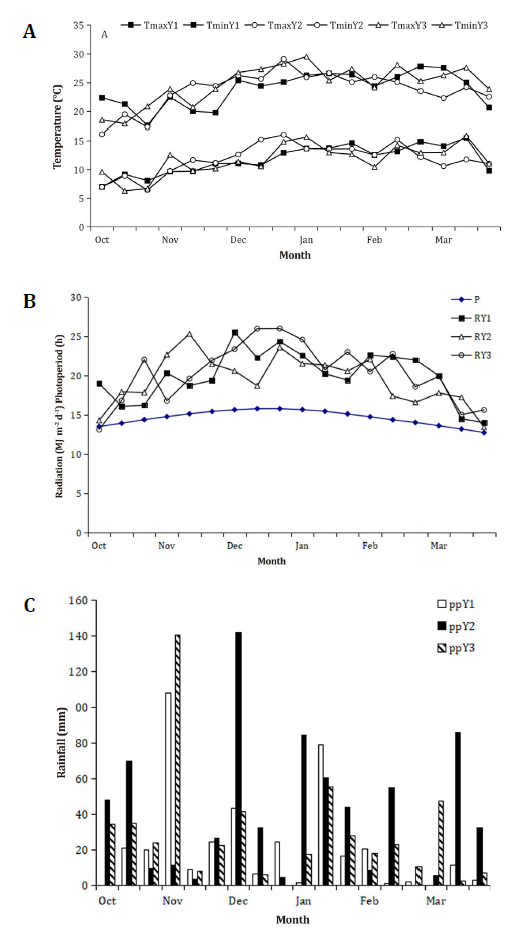
Temperature and radiation data are means over 10-day periods from October (Oct), November (Nov), December (Dec), January (Jan), February (Feb), and March (Mar) for Year 1 (Y1), Year 2 (Y2), and Year 3 (Y3) growing cycles; rainfall is the total for each 10-day period.
Los datos son medias de 10 días de octubre (oct.), noviembre (nov.), diciembre (dic.), enero (ene.), febrero (feb.) y marzo (mar.) para los ciclos de crecimiento del Año 1 (Y1), Año 2 (Y2) y Año 3 (Y3); la precipitación es la suma de un período de 10 días.
Figure 1. Meteorological data for temperature (T, °C) (A), radiation intensity (R, MJ m-2 d-1) (B), photoperiod (P, h) and rainfall (mm) (C) during the experiments.
Figura 1. Datos meteorológicos de temperatura (T, °C) (A), intensidad de radiación (R, MJ m-2 d-1) (B), duración del día (P, h) y precipitación (pp, mm) (C) durante los experimentos.
Growth and Dry Matter Production
From 40 to 50 days after planting until maturity, intermediate harvests of four or five plants, surrounded by guard plants, were conducted. Samples collected during these intermediate harvests were separated into leaves, stems, and tubers. The following parameters were recorded: leaf dry weight, stem dry weight, tuber fresh weight (TubFW), and tuber dry matter concentration. Tuber dry matter concentration was determined using subsamples of 500 -700 g of fresh tuber material, which were dried in an oven at 70°C until a constant weight was reached.
Data were collected from experiments in which three PDs were combined with three plant densities. The experiments were arranged in randomized complete block designs with four replicates for each potato cultivar. Linear regression coefficients were used to determine the rate of increase in dry matter yield (kg ha-1 oCd-1) per unit of accumulated degree-days during the growing cycle.
Phenological phases were defined as emergence to tuber initiation (Period 1), tuber initiation to the end of leaf growth (Period 2), and the end of leaf growth to maturity (Period 3). Tuber initiation was defined using nonlinear regression as the point at which tuber dry weight (TubDW) reached 1 g m-2. The end of leaf growth was defined as the point at which dry matter partitioning to the tubers reached 90% (Van Dam et al., 1996). Because harvest timing was dictated by deteriorating weather conditions at the end of the growing season, the harvest date was also used to define maturity.
Development rate (DR, days-1) was defined as the inverse of the number of days from the beginning to the end of each of the defined phenological phases (Kooman, 1995). DR was related to the mean ambient temperature (T, oC) and radiation (R, MJ m-2 d-1). DR was also correlated with the photoperiod (P, h) at the beginning of each phase.
Statistical analyses for each period were conducted considering the following factors: PD (three levels), with plant densities included as replications, and cultivar, with their respective growing cycles. Relationships between DR and T, R, and P were analyzed by selecting multiple regression models based on the highest adjusted R², with degrees of freedom and residual analyses also considered (Infostat, 2020).
Results and Discussion
Growth and Dry Matter Production
The effects of agronomic factors, including plant density and PD, were analyzed for all cultivars using the following growth variables: TubDW, TubFW, total dry weight (TotDW), and foliage dry weight (FolDW). Since temperature is the principal factor driving potato growth, the growth variables associated with dry matter production were related to degree-days accumulated during the growing cycle (DDA) (Khan et al., 2019b; Krug, 1997). Crop growth rates were analyzed for all potato cultivars included in the trials.
The TubDW and TotDW rates were consistent among cultivars and across growing seasons (table 1). For cv. Bonaerense La Ballenera, the TubDW, TubFW, and TotDW rates exhibited similar responses across the three PDs, whereas FolDW rates increased as planting was delayed. For cv. Spunta, these growth variables were influenced by PD, with distinct trends observed across the different growing cycles. In contrast, cv. Kennebec was less sensitive to changes in PD than cv. Spunta in both growing cycles. The early-maturing cv. Shepody varied in its responses to PD for variables TubDW, TubFW, TotDW, and FolDW, but its growth rates remained within the ranges observed for the other cultivars. Finally, cv. Kennebec had lower TubFW than cv. Spunta in both growing cycles. Cv. Spunta had higher TubFW than cv. Bonaerense La Ballenera in Year 1 and then cv. Kennebec in Year 3. These results for cv. Spunta may be attributed to its inherently low tuber dry matter content in the tubers (Cacace et al., 1994).
Table 1. Coefficients (s.e.) of growth variables: tuber dry weight (TubDW, kg ha-1), tuber fresh weight (TubFW, kg ha-1), total dry weight (TotDW, kg ha-1), and foliage dry weight (FolDW, kg ha-1) against degree days accumulated (°C day) as affected by cultivars and planting date.
Tabla 1. Coeficientes (s.e.) de las variables de crecimiento: peso seco del tubérculo (PSTub, kg ha-1), peso fresco del tubérculo (PFTub, kg ha-1), peso seco total (PSTtot, kg ha-1) y peso seco del follaje (PFol, kg ha-1) en función de los grados-día acumulados (°C/día) según los cultivares y la fecha de siembra.
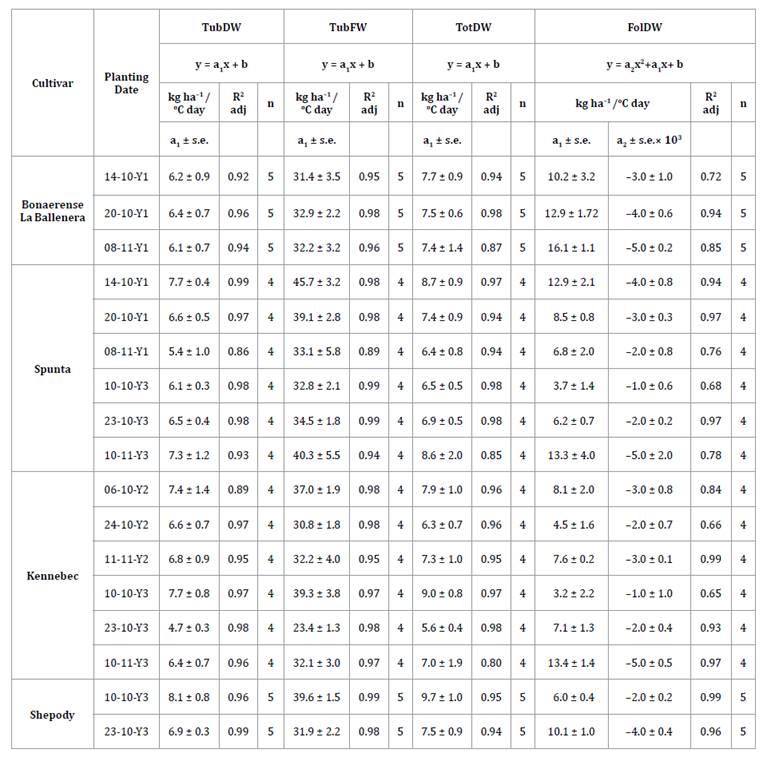
Data are means of three plant densities at each planting date, with four replicates. Plant densities: d1 = 8.4, d2 = 4.2, and d3 = 2.8 mother tubers m-2 for all cultivars except Shepody, for which densities were d1 = 10, d2 = 5, d3 = 3.2 mother tubers m-2.
Los datos son medias de tres densidades de plantas en cada fecha de siembra con cuatro repeticiones. Densidad de siembra: d1 = 8,4, d2 = 4,2 y d3 = 2,8 tubérculos madre m-2 para todos los cultivares, excepto Shepody, cuyas densidades fueron d1 = 10, d2 = 5 y d3 = 3,2 tubérculos madre m-2.
FolDW rates were consistent across growing seasons within the same cultivar, as observed for cvs. Spunta and Kennebec. Cv. Bonaerense La Ballenera displayed the highest FolDW rate. In Year 1, cv. Bonaerense La Ballenera had a higher FolDW rate than cv. Spunta, with the aerial organs of cv. Bonaerense La Ballenera exceeding 4,000 kg ha-1, whereas those of cv. Spunta remained below this level (data not shown). However, in Year 3, FolDW rates were similar among all cultivars tested in that year. These findings suggest that cultivar responses to temperature are primarily associated with maturity class and are only slightly influenced by temperature conditions during the growing cycle (cf. Lizana et al., 2017). These results are consistent with previous studies, indicating that changes in PDs slightly modify TotDW but significantly influence dry matter partitioning in response to variations in temperature and photoperiod (Manrique and Bartholomew, 1991b).
The effect of PD on dry matter distribution was associated with the environmental conditions under which the plants were grown. Longer photoperiods and higher temperatures increased stem length and branching in cvs. Spunta and Kennebec in Year 3 (Saluzzo et al., 2026), and these changes were associated with increased FolDW rates as planting was delayed. Longer photoperiods and higher temperatures were also associated with higher radiation (figure 1). Consequently, greater dry matter partitioning to the haulm did not affect tuber growth rates in these cultivars (cf. Lorenzen and Ewing, 1990). Cv. Shepody exhibited responses similar to those of the other cultivars across the PDs in Year 3. Similarly, increased dry matter partitioning to aerial organs with delayed planting did not affect tuber growth in cv. Bonaerense La Ballenera. The behavior of cv. Spunta observed in Year 1 could be attributed to delayed plant emergence, which is discussed in the following section. For cv. Kennebec in Year 1, the FolDW rate increased with delayed planting, whereas the TubDW rate remained unchanged. During this year, solar radiation levels in December were lower than those in the other years (figure 1). This environmental factor likely reduced crop growth, resulting in lower total and marketable yields for the second and third PDs (Sale, 1973a, b; Saluzzo et al., 2026).
Phenology
Period 1: Emergence to Tuber Initiation
The DR of each phenological phase was analyzed in relation to the average environmental factors of temperature (T), radiation (R), and photoperiod (P) at emergence. Photoperiod was the most significant environmental factor, increasing DR in cv. Bonaerense La Ballenera and cv. Kennebec in both years, but not in cv. Spunta or cv. Shepody (table 2). Differences in photoperiod sensitivity among cultivars were also observed, consistent with the findings of Kooman (1995) for the same phenological period in potato grown in different geographic regions. Temperature also increased from the first to the last PD; however, unlike P, it was not significantly associated with DR, likely because of greater variability in this factor among PDs.
Table 2. Linear regression statistics for the effect of photoperiod (P, h) at emergence on development rate (DR, day-1) during the emergence-to-tuber initiation period.
Tabla 2. Estadísticas de regresión lineal del efecto del fotoperiodo (P, h) en la emergencia sobre la tasa de desarrollo (día-1) durante el periodo de emergencia e iniciación de la tuberización.
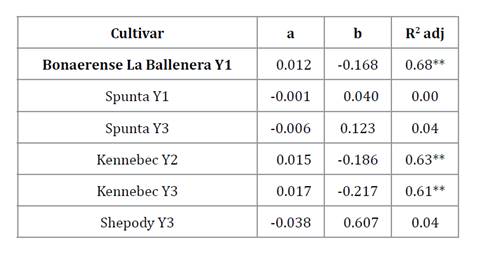
The cultivar name is followed by the year of the growing cycle (DR = aP + b). ** (p < 0.01), * (p < 0.05).
Nombre del cultivar seguido del año del ciclo de cultivo. (día–1 = tasa de desarrollo = aT + b). ** (p<0,01), * (p<0,05).
In addition to its low sensitivity to photoperiod, cv. Spunta also appeared to be less sensitive to the temperature range prevailing during Period 1 than cv. Kennebec; a similar response for cv. Spunta was reported by Kooman (1995) (table 3). Under the experimental conditions of this study, photoperiod varied by nearly 1 h between the first and last PDs. A longer photoperiod was positively associated with higher temperature, which increased from 16°C to 19°C. These temperatures were within the optimal thermal range. Temperature increases the DR of this phase from 10°C to nearly 21°C (Kooman, 1995; Van Dam et al., 1996). However, the physiological age of the seed tubers may also have contributed to the observed responses, as discussed below.
Table 3. Development rate (DR; day-1, s.d.) during the emergence-to-tuber initiation period for potato cultivars as affected by planting date (PD) in relation to ambient temperature (T, °C), radiation (R, MJ m-1 d-1), and photoperiod (P, h). PD and cultivar interacted for DR (p<0.01).
Tabla 3. Tasa de desarrollo (TD) (día-1, d.e.) de emergencia . periodo de iniciación de la tuberización de cultivares de papa, según la fecha de siembra (PD) en relación con los factores ambientales: temperatura (T, °C), radiación (R, MJ m-1 d-1) y fotoperiodo (P, h). La PD y el cultivar interactuaron para la TD (p<0,01).
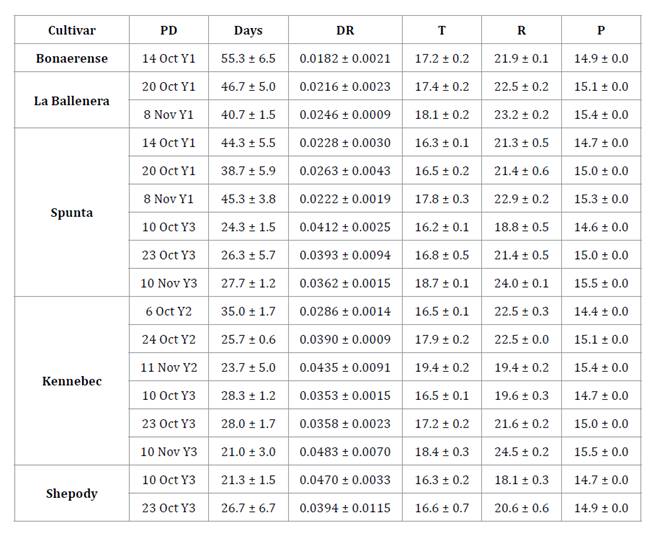
Data are means of three planting densities, each with four replicates.
Los datos son medias de tres densidades de siembra con cuatro repeticiones.
Regarding R, differences were observed among cultivars and growing seasons. In Year 1, R varied minimally between the first and last PDs, whereas in Year 3, it showed a wider range of values (table 3). Cv. Spunta in Year 1 and cv. Kennebec in Year 2 experienced different temperature levels but similar radiation levels, resulting in a lower DR for cv. Spunta, likely because of its lower temperatures. During Year 3, all environmental factors tended to increase from the first to the last PD. Unlike cv. Spunta, cv. Kennebec showed a positive association between DR and these increases. Thermal amplitude, which is known to enhance tuber formation (Ewing, 1997; Manrique and Bartholomew, 1991a), was greater in Year 3 than in the other growing seasons (figure 1). In addition to the favorable radiation levels, which may advance tuber initiation (Ewing, 1997), temperatures were not sufficiently high to promote faster development.
The response of cv. Bonaerense La Ballenera to the ambient factors was less evident because of the narrow range of environmental conditions. This cultivar emerged later than cv. Spunta in Year 1 and was exposed to higher levels of the environmental factors, resulting in lower DR values than those of cv. Spunta, except at the last PD. This response of cv. Bonaerense La Ballenera may be related to the physiological age of its seed tubers, which were too young at the early PD (Caldiz and Gaspari, 1997). However, the cultivar might also be more sensitive to low temperatures than cv. Spunta. Additionally, mean temperatures in November and December in Year 1 were approximately 2°C lower than those during the corresponding periods in Years 2 and 3 (figure 1). These thermal conditions could have contributed to the slower DR observed in both cvs. Spunta and cv. Bonaerense La Ballenera. Moreover, these environmental conditions favored a higher number of tubers per plant in cv. Spunta in Year 1 than in Year 3 (Saluzzo et al., 2026).
Cv. Kennebec (medium maturity) showed a trend in Years 2 and 3 similar to that observed for cv. Bonaerense La Ballenera (late maturity) in Year 1: DR increased as PD was delayed. As discussed for the late-maturing cultivar, the medium-maturing cultivar also appeared to be affected by the physiological age of the seed tubers, unlike cv. Spunta. Because the storage conditions of the seed tubers were the same for both cultivars, and storage conditions are considered the main factor affecting tuber physiological age (Ewing, 1997), another factor may have been involved. Nevertheless, cv. Kennebec appeared to be slightly more sensitive to changes in PD than cv. Spunta in Year 3, as indicated by the significant increase in the number of stems per plant at the latest PD at medium and low plant densities (Saluzzo et al., 2026). Stem number per plant responds to variations in the physiological age of seed tubers (Ewing and Struik, 1992), and ground cover and tuber yield may be reduced when aged seed tubers are used (Caldiz, 2009). Taking these factors into consideration, total and marketable tuber yields were not affected by PD in Years 1 and 3 (Saluzzo et al., 2026).
In cv. Shepody, DR tended to decrease as T, R, and P at emergence increased; however, the absence of a third PD may have affected this outcome.
Period 2: Tuber Initiation to End Leaf Growth
This period was analyzed in relation to the environmental factors T, R, and P. Temperature was selected as the primary variable because it showed the highest correlation coefficient. Significant coefficients of determination were obtained only for cv. Kennebec and cv. Spunta in Year 3, with opposite slope signs (table 4). Temperature varied little between the first and last PDs and remained within the optimal thermal range (table 5) (Ewing and Sandlan, 1995; Van Dam et al., 1996). Photoperiod was determined at tuber initiation for this phase. The critical photoperiod is likely higher for cv. Spunta than for cv. Kennebec; during this period, P exceeded 15.5 h, potentially delaying tuber formation in cv. Kennebec (Regel and Sands, 1983).
Table 4. Linear regression statistics for the effect of temperature (T, °C) on the development rate (DR; day-1) during the tuber initiation-to-end of leaf growth period.
Tabla 4. Estadísticas de regresión lineal del efecto de la temperatura (T, °C) sobre la tasa de desarrollo (día-1) durante el período de inicio del tubérculo y fin del crecimiento foliar.
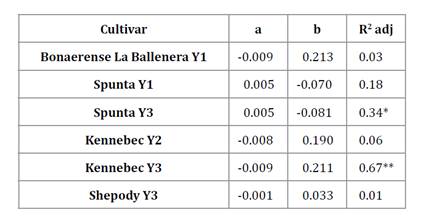
The cultivar name is followed by the year of the growing cycle. (DR = aT + b). ** (p<0.01), * (p<0.05).
Nombre del cultivar seguido del año del ciclo de crecimiento (día-1 = tasa de desarrollo = aT + b). ** (p<0,01), * (p<0,05).
Table 5. Development rate (DR; day-1, s.d.) during the tuber initiation-to-end of leaf growth period for different potato cultivars as affected by planting date (PD) in relation to ambient factors temperature (T, °C), radiation (R, MJ m-2 d-1) and photoperiod (P, h). PD and cultivar interacted for DR (p<0.01).
Tabla 5. Tasa de desarrollo (DR) (día-1, d.e.) durante el período de iniciación del tubérculo - crecimiento de las hojas finales para diferentes cultivares de papa afectados por la fecha de siembra (PD) en relación con los factores ambientales temperatura (T, oC), radiación (R, MJ m-2 d-1) y fotoperiodo (P, h). PD y Cultivar interactuaron en DR (p<0,01).
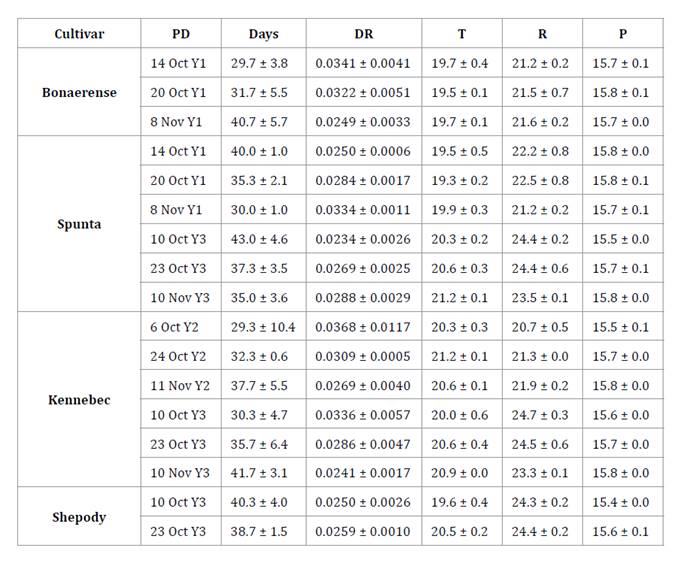
Data are means of three planting densities, each with four replicates.
Los datos son medias de tres densidades de siembra que tuvieron cuatro repeticiones.
Radiation and temperature levels were higher in Year 3, giving lower DR than in Year 1. In Year 3, resulting in lower DR than in Year 1. In Year 3, tuber initiation during this period coincided with an increasing photoperiod resulting from delayed PD. Conversely, in Year 1, tuber initiation in cv. Spunta and cv. Bonaerense La Ballenera occurred with minimal changes in photoperiod, near the maximum photoperiod at this latitude, shortly before or after the summer solstice. This process also began at lower temperatures than in the other growing seasons.
In Year 1, despite the longer photoperiods, lower temperatures favored a higher DR in cv. Spunta. These findings suggest that, under long-day conditions, temperatures were not sufficiently high to restrict dry matter allocation to tubers, as reported by other authors (Ewing and Sandlan, 1995; Struik, 2007). Moreover, under long-day conditions and mean temperatures close to 19-20°C, cv. Spunta may tuberize reasonably well. In general, high temperatures combined with long photoperiods reduce the partitioning of assimilates to tubers. However, these temperatures are similar to those reported by other authors as being within the optimal range of 15-19°C for tuber initiation (Ewing and Sandlan, 1995; Van Dam et al., 1996). For cv. Bonaerense La Ballenera, the DR response to environmental factors showed little variation because of the relatively small changes in these variables. Moreover, DR decreased as PD was delayed, contrary to the trend observed for cv. Spunta during the same growing cycle.
During this phase, temperature played a critical role in driving dry matter allocation, whereas photoperiod had limited effects on tuber growth because temperatures remained within the optimal range; consequently, shorter photoperiods appeared to enhance tuber growth (Kooman, 1995). Differences in the critical photoperiod thresholds for tuber initiation likely explain the variation observed among cultivars.
Period 3: End of Leaf Growth to Maturity
DRs during this period were analyzed in relation to environmental factors, with temperature emerging as the most influential variable (table 6). In general, as temperature increased, the DR tended to decrease; however, this trend was not consistent across all cultivars and growing seasons. Cv. Spunta began this phase under different photoperiods across growing seasons, with the higher DR observed in Year 1 being associated with a shorter photoperiod (table 7). In contrast, cv. Kennebec showed minimal differences between growing cycles, with slightly higher DR values than cv. Spunta. Notably, cv. Kennebec appeared to mature slightly earlier than cv. Spunta. A common characteristic of this phase was the sharp decline in photoperiod after the second PD.
Table 6. Linear regression statistics for the effect of temperature (T, °C) on development rate (DR; day-1) during the end of leaf growth-to-maturity period. The cultivar name is followed by the year of the growing cycle (DR = aT + b).
Tabla 6. Estadísticas de regresión lineal del efecto de la temperatura (T, °C) sobre la tasa de desarrollo (día-1) al final del período de crecimiento foliar - madurez. Nombre del cultivar seguido del año del ciclo de crecimiento (día-1 = tasa de desarrollo = aT + b).
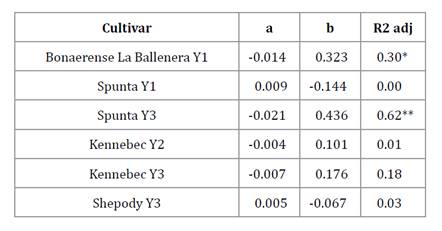
The cultivar name is followed by the year of the growing cycle. (DR = aT + b). ** (p<0.01), * (p<0.05).
Nombre del cultivar seguido del año del ciclo de crecimiento (día-1 = tasa de desarrollo = aT + b). ** (p<0,01), * (p<0,05).
Table 7. Development rate (DR; day-1, s.d.) during the end of leaf growth-to-maturity period for different potato cultivars as affected by planting dates (PD) in relation to ambient factors: temperature (T, °C), radiation (R, MJ m-2 d-1) and photoperiod (P, h). PD and cultivar interacted for DR (P<0.01).
Tabla 7. Tasa de desarrollo (DR) (día-1, d.e.) durante el período de crecimiento de la hoja final - período de madurez para diferentes cultivares de papa afectados por las fechas de siembra (PD) en relación con los factores ambientales temperatura (T, oC), radiación (R, MJ m-2 d-1) y fotoperiodo (P, h). PD y cultivar interactuaron para DR (P<0,01).
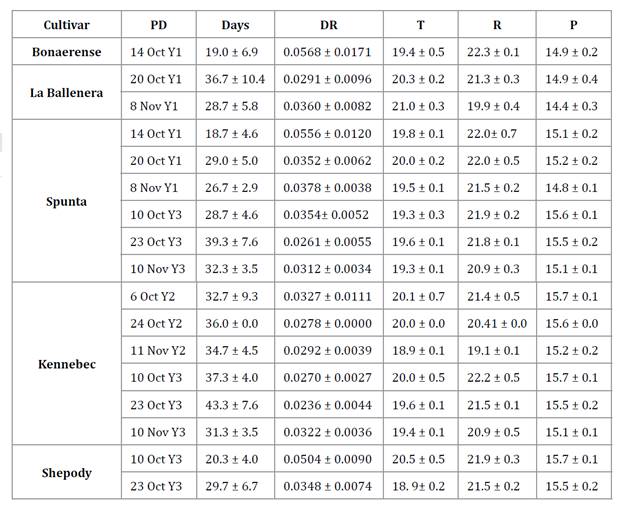
Data are means of three planting densities, each with four replicates.
Los datos son medias de tres densidades de siembra que tuvieron cuatro repeticiones.
Temperature was the most influential factor in Period 3; however, its effects were not consistent across cultivars and growing seasons. Temperature and radiation levels were relatively consistent across cultivars, whereas photoperiod may also have contributed to the observed differences. In Year 1, cv. Spunta and cv. Bonaerense La Ballenera began this phase after the summer solstice, under shorter photoperiods. This condition likely contributed to their higher DR. Evidence suggests that when photoperiods are sufficiently short to permit tuberization, even under high temperatures, growth and development may be accelerated (Ewing and Sandlan, 1995; Lorenzen and Ewing, 1990).
Relations Between Growth Stages
The duration of Period 1 was inversely related to the combined duration of Periods 2 and 3 (figure 2). As the duration of Period 1 increased, the subsequent periods tended to become shorter, but at different rates. This relationship was more evident for the first and third PDs. The relationship was negative and linear, indicating a consistent response across cultivars. Finally, at the second PD, variation in the duration of Period 1 resulted in minimal, nonsignificant changes in the duration of the subsequent phases.
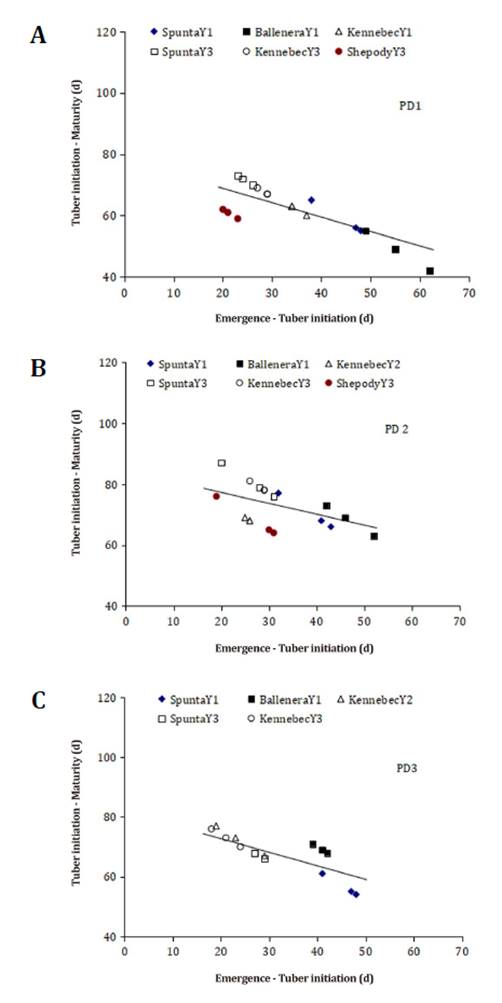
Data represent plant density effects and means of four replicates. Regression equations are provided below. More details can be found in table 2.
Los datos representan los efectos de la densidad de plantas y las medias de cuatro repeticiones. Ver abajo las ecuaciones de regresión. Más detalles en la tabla 2.
Figure 2. Relationship between the duration of the emergence-to-tuber-initiation period (days) and the period from tuber initiation to harvest, as affected by planting date (PD) PD1 (A); PD2 (B); PD3 (C) and potato cultivar across three growing cycles (Year 1, Year 2, and Year 3).
Figura 2. Relación entre la duración del período de emergencia e iniciación de la tuberización (días) y los períodos de iniciación de la tuberización e iniciación de la tuberización a la cosecha, según tres fechas de siembra PD1 (A); PD2 (B); PD3 (C) y cultivares de papa en tres ciclos de cultivo (años 1, 2 y 3).
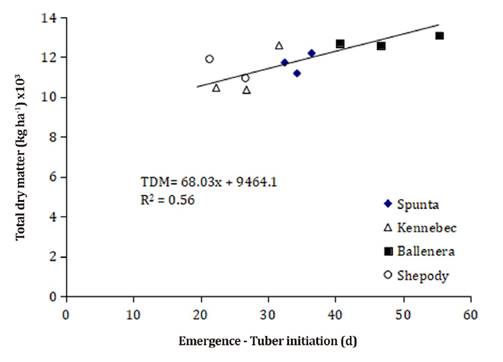
Data are means of three planting dates combined with three plant densities, with four replicates, from one year for Bonaerense La Ballenera and Shepody and two years for Kennebec and Spunta. More details are provided in table 2.
Los datos corresponden a la media de tres fechas de siembra combinadas con tres densidades de plantación con cuatro repeticiones en un año (Bonaerense La Ballenera y Shepody) y en dos años (Kennebec y Spunta). Más detalles en la tabla 2.
Figure 3. Relationship between the duration of the emergence-to-tuber initiation period (d) and total dry matter production (kg ha-1) for different potato cultivars (P<0.01).
Figura 3. Relación entre la duración del período de emergencia e iniciación de la tuberización (d) y la producción total de materia seca (kg ha-1) para diferentes cultivares de papa (P<0,01).
Regression equations:
Regression PD1: y = -0.53x + 80.11, R2 =0.69 (p<0.01)
Regression PD2: y = -0.44x + 85.13, R2 =0.37 (p<0.05)
Regression PD3: y = -0.53x + 84.52, R2 =0.67 (p<0.01)
An increase in the duration of Period 1 does not imply a corresponding increase in the duration of the following two periods. Early or late planting accelerated plant growth processes without significantly altering the total duration of the growth cycle. This finding largely explains the minimal differences in tuber yield among potato maturity classes across the PDs used in these trials (Saluzzo et al., 2026).
Photoperiod was close to its maximum at the summer solstice during the tuber initiation stage for most cultivars. Similarly, the stage marking the end of leaf growth occurred when the photoperiod was slightly shorter than that at the summer solstice. Our findings suggest that temperature was the most influential factor during the last two periods, although some results were contradictory. The limited range of PDs and maturity classes represented by the potato cultivars prevented clearer conclusions.
The relationship between the duration of Period 1 and total dry matter (TDM) production across the potato cultivars used in these trials was analyzed and showed a positive linear correlation (figure 3). As the duration of Period 1 increased, TDM production also increased. Agronomic factors, such as the physiological age of tubers, cultivar selection, nutrient availability, and seed-piece spacing, as well as environmental factors that promote the extension of Period 1, are likely to enhance total dry matter production. Moreover, the onset of tuber bulking is associated with physiological changes, particularly assimilate distribution, and morphological changes, including the growth of plant organs, that are modulated by environmental conditions and related to final potato yield (Khan et al., 2019b). Therefore, selecting an appropriate PD is essential to maximizing dry matter production per degree day accumulated. This requires medium plant density and a high harvest index to avoid conditions that favor excessive dry matter allocation to foliage.
Conclusions
Agronomic practices such as PD and plant density affected the yield of potato cultivars by influencing plant morphology, tuber number and size, and tuber dry matter content. The magnitude of these effects varied among the four cultivars studied. Analysis of plant growth in relation to temperature conditions helped explain changes in dry matter production in some plant organs, particularly foliage and tubers, across planting dates. Crop DRs during the three phenological periods were primarily influenced by photoperiod and temperature. These climatic factors modulated plant development and resulted in cultivar-specific responses under the conditions of these trials.
The range of potato cultivars and PDs evaluated in these trials was narrower than desired, limiting our ability to identify conditions that could improve potato production and further understanding of potato crop responses in this region. Nevertheless, the results suggest that tuber physiological age, cultivar selection, nutrient availability, and seed-piece spacing are important factors for achieving better crop performance. Selecting an appropriate PD and using a medium plant density should be combined with the selection of cultivars characterized by a high harvest index to avoid excessive dry matter allocation to aerial, non-harvestable organs.
An integrated understanding of external factors (environmental conditions) and internal factors (plant physiological processes), together with genetic factors (genotype), is crucial for improving potato production in this region. Moreover, evaluating additional cultivars is important for the southeastern region of the province, given that genotype has been found to explain most of the variation in yield. Furthermore, ecophysiological models may contribute to understanding differences in tuber yield among potato cultivars and to developing potato ideotypes based on individual physiological traits.
Acknowledgements
The authors appreciate the assistance provided by the Asociación Cooperadora del Instituto Nacional de Tecnología Agropecuaria Balcarce and the staff of the Estación Experimental Agropecuaria del Instituto Nacional de Tecnología Agropecuaria Balcarce.
Al-Mamun, A., Al-Mahmud, A., Zakaria, M., Hossain, M. & Hossain, T. (2016). Effects of planting times and plant densities of top-shoot cuttings on multiplication of breeder seed potato. Agriculture and Natural Resources, 50, 26-31. http://dx.doi.org/10.1016/j.anres.2014.08.001
Begun, F., Kundu, B. C. & Hossain, M. I. (2015). Physiological analysis of growth and yield potato in relation to planting date. Journal of Bangladesh Academy of Sciences, 39(1), 45-51. https://doi.org/10.3329/jbas.v39i1.23657
Cacace, J. E., Huarte, M. A. & Monti, M. C. (1994). Evaluation of potato quality in Argentina. American Potato Journal, 71,145-153. https://doi.org/10.1007/BF02849049
Caldiz, D. O. (2009). Physiological age research during the second half of the twentieth century. Potato Research, 52, 295-304. DOI 10.1007/s11540-009-9143-4
Caldiz, D. O. & Gaspari, F. J. (1997). Análisis de los factores determinantes del rendimiento en papa (Solanum tuberosum L.) con especial referencia a la situación Argentina. Revista de la Facultad de Agronomía, 102(2), 203-229.
Cantos, E. (1988). Rendimiento potencial del cultivo de papa en Balcarce. Causas que limitan la productividad real [Thesis M.Sc. Facultad de Ciencias Agrarias. Universidad Nacional de Mar del Plata]. 51 pp
Della Maggiora, A. (1995). Estimación de la evapotranspiración. Aplicación para la programación de riego en el cultivo de papa [Thesis M.Sc. Facultad de Ciencias Agrarias. Universidad Nacional de Mar del Plata].
Ewing, E. E. (1997). Potato. In: Wien HC (ed.) The physiology of vegetable crops. CAB International. pp 295-344
Ewing, E. E. & Struik, P. C. (1992). Tuber Formation in Potato: Induction, Initiation, and Growth. In Horticultural Reviews, J. Janick (Ed.). pp. 89-198. https://doi.org/10.1002/9780470650523.ch3
Ewing, E. E., & Sandlan, K. P. (1995). II-1: Biomass partitioning in the potato: considerations for modelling. In Modelling and Parameterization of the Soil-Plant-Atmosphere System. Wageningen Academic. pp. 7-19. https://doi.org/10.1163/9789004684348_004
Fleisher, D. H., Timlin, D. J. & Reddy, V. R. (2006). Temperature influence on potato leaf and Branch distribution and on canopy photosynthetic rate. Agronomy Journal, 98, 1442-52. https://doi.org/10.2134/agronj2005.0322
Gawronska, H. & Dwelle, R. B. (1989). Partitioning of photoassimilates by potato plants (Solanum tuberosum L.) as influenced by radiation. I. Partitioning patterns in cultivar Russet Burbank grown under high and low irradiance. American Potato Journal, 66, 201-213. https://doi.org/10.1007/BF02853443
Giletto, C. M., Echeverria, H. E., & Sadras, V. (2003). Fertilización nitrogenada de cultivares de papa (Solanum tuberosum) en el sudeste bonaerense. Ciencia del Suelo, 21(2), 44-51.
Hou, X. Q., Niu, Y. W., Wu, W. L., Xu, J. P., Shi, L., Tang, S. Y., Ma, X., & Li, R. (2018). Effect of planting density on the growth, water use efficiency and yield of dry-farming potato under rainfall year types. Acta Agronomica Sinica, 44(10), 1560-1569. Doi:10.3724/SP.J.1006.2018.01560
Hou, X. Q., Li, R., He, W., & Ma, K. (2020). Effects of plant density on potato growth, yield, and water use efficiency during years with variable rainfall on the Loess Plateau, China. Agricultural Water Management, 230, 105982. https://doi.org/10.1016/j.agwat.2019.105982
InfoSstat/P. (2020). Software estadístico. Universidad Nacional de Córdoba. http://www.infostat.com. ar
Khan, M. S., Yin, X. & Struik, P. C. (2014). An ecophysiological model analysis of yield differences within a set of contrasting cultivars and an F1 segregating population of potato (Solanum tuberosum L.) grown under diverse environments. Ecological Modelling, 290, 146-154. http://dx.doi.org/10.1016/j.ecolmodel.2013.11.015
Khan, M. S., Struik, P. C., van der Putten, P. E. L., Jansen, H. J., van Eck, H. J., van Eeuwijk, F. A., & Yin, X. (2019a). A model-based approach to analyse genetic variation in potato using standard cultivars and a segregating population. I. Canopy cover dynamics. Field Crops Research, 242, 107581. https://doi.org/10.1016/j.fcr.2019.107581
Khan, M. S., Yin, X., van der Putten, P. E. L., Jansen, H. J., van Eck, H. J., van Eeuwijk, F. A., & Struik, P. C. (2019b). A model-based approach to analyse genetic variation in potato using standard cultivars and a segregating population. II. Tuber bulking and resource use efficiency. Field Crops Research, 242, 107582. https://doi.org/10.1016/j.fcr.2019.107582
Kooman, P. L. (1995). Yielding ability of potato crops as influenced by temperature and daylength [Ph.D. Thesis Wageningen University]. 155 pp.
Krug, H. (1997). Environmental influences on development, growth and yield. 1997. In: Wien HC (ed) The physiology of vegetable crops. CAB International. pp. 101-180.
Kwambai, T. K., Struik, P. C., Gorman, M., Nyongesa, M., Rop, W., Kemboi, E., & Griffin, D. (2024). Understanding genotype × environment interactions in potato production to guide variety adoption and future breeding strategies. Potato Research, 67, 663-694. https://doi.org/10.1007/s11540-023-09650-8.
Lizana, X. C., Avila, A., Tolaba, A., & Martinez, J. P. (2017). Field responses of potato to increased temperature during tuber bulking: projection for climate change scenarios, at high-yield environments of Southern Chile. Agric for Meteorol., 239, 192-201. https:// doi. org/10.1016/j. agrfo rmet. 2017. 03. 012
Lorenzen, J. A. & Ewing, E. E. (1990). Changes in tuberization and assimilate partitioning in potato (Solanum tuberosum L.) during the first 18 days of photoperiod treatment. Annals of Botany, 66, 457-64. https://doi.org/10.1093/oxfordjournals.aob.a088048
Manrique, L. A. & Bartholomew, D. P. (1991a). Growth and yield performance of several potato clones grown at three elevations in Hawaii I Dry matter production and efficiency of partitioning. Crop Science, 31, 367-72. https://doi.org/10.2135/cropsci1991.0011183X003100020029x
Manrique, L. A., Kiniry, J. R., Hodges, T., & Axness, D. S. (1991b). Dry matter production and radiation interception of potato. Crop Science, 31, 1044-1049. https://doi.org /10.2135/cropsci1991.0011183X003100040040x
Naawe, E. K., Yavuz, C., Demirel, U., & Çaliskan, M. E. (2024). Effects of Elevated Temperature on Agronomic, Morphological, Physiological and Biochemical Characteristics of Potato Genotypes: 2. Physiological and Biochemical Traits. Potato Res. 68, 2167-2204 https://doi.org/10.1007/s11540-024-09815-z
Ospina, C. A., Lammerts van Bueren, E. T., Allefs, J. J. H. M., Engel, B., van der Putten, P. E. L., van der Linden, C. G., & Struik, P. C. (2014). Diversity of crop development traits and nitrogen use efficiency among potato cultivars grown under contrasting nitrogen regimes. Euphytica, 199, 13-29. DOI 10.1007/s10681-014-1203-4
Prysiazhniuk, L., Sonets, T., Shytikova, Y., Melnyk, S., Dikhtiar, I., Mazhuha, K. & Sorochinsky, B. (2023). The environmental and generic factors affect the productrivity and quality of potato cultivars. Zemdirbyste-Agriculture, 110(4), 319-329. DOI 10.13080/z-a. 2023. 110.036
Regel, P. A., & Sands, P. J. (1983). A model of the development and bulking of potatoes (Solanum tuberosum L.) IV Daylength, plant density and cultivars effects. Field Crops Research, 6,1-23. https://doi.org/10.1016/0378-4290(83)90044-8
Sale, P. M. J. (1973a). Productivity of vegetable crops in a region for high solar input I Growth and development of the potato (Solanum tuberosum L.). Australian Journal of Agricultural Research, 24, 733-749. https://doi.org/10.1071/AR9730733
Sale, P. M. J. (1973b). Productivity of vegetable crops in a region for high solar input II Yield and efficiencies of water use and energy. Australian Journal of Agricultural Research, 24, 751-762. https://doi.org/10.1071/AR9730751
Saluzzo, J. A. (1994a). Comportamiento de cultivares de papa con distinto ciclo en respuesta a la fertilización nitrogenada [Thesis M.Sc. Facultad de Ciencias Agrarias. Universidad Nacional de Mar del Plata]. 52 pp.
Saluzzo, J. A. (2001). Concentración de nitratos en pecíolos y rendimiento de los cultivares de papa Kennebec y Shepody en relación a la fertilización nitrogenada. AgriScientia, 28, 21-26. https://doi.org/10.31047/1668.298x.v18.n0.2637
Saluzzo, J. A., Echeverría, H. E., Andrade, F., & Huarte, M. A. (1994b). Producción de materia seca y tubérculos de papa (cv. Huinkul MAG) en respuesta a la fertilización nitrogenada en Balcarce (Argentina). Revista de la Facultad de Agronomía La Plata, 70, 81-89.
Saluzzo, J. A., Struik, P. C., & Huarte, M. A. (2026). Effects of agronomic and environmental factors on potato cultivars 1 Yield and tuber quality [Manuscrito no publicado]. Universidad Nacional de Mar del Plata.
Struik, P. C. (2007). Response of the potato plant to temperature. In: Vreugdenhil D (ed. with Bradshaw J, Gebhardt C, Govers F, MacKerron DKL, Taylor MA, and Ross HA) Potato biology and biotechnology: Advances and perspectives. Elsevier. pp. 367-393.
Tessema, L., Mohammed, W., & Abebe, T. (2020). Evaluation of potato (Solanum tuberosum L.) varieties for yield and some agronomic traits. Open Agriculture, 5, 63-74. https://doi.org/10.1515/opag-2020-0006
Van Dam, J., Kooman, P. L., & Struik, P. C. (1996). Effects of temperature and photoperiod on early growth and final number of tubers in potato (Solanum tuberosum L.). Potato Research, 39, 51-62. https://doi.org/10.1007/BF02358206
Vander Zaag, P., Demagante, A. L., & Ewing, E. E. (1990). Influence of plant spacing on potato (Solanum tuberosum L.) morphology, growth and yield under two contrasting environments. Potato Research, 33, 313-23. https://doi.org/10.1007/bf02359305
Wurr, D. C. E., Hole, C. C., Fellows, J. R., Milling, J., Lynn, J. R., & O´Brien, P. J. (1997). The effect of some environmental factors on potato tuber numbers. Potato Research, 40, 297-306. https://doi.org/10.1007/BF02358011
Yasmin, F., & Zakaria, M. (2019). Combination of planting time and plant density in better potato production. International Journal of Applied Research, 5(1),113-118.
Zheng, S. L., Wang, L. J., Wan, N. X., Zhong, L., Zhou, S. M., He, W., & Yuan, J. C. (2016). Response of potato tuber number and spatial distribution to plant density in different growing seasons in Southwest China. Frontiers in Plant Science, 7, 365. https://doi.org/10.3389/fpls.2016.00365