Rev. FCA UNCuyo | 2026 | 58(1) | ISSN 1853-8665
Ecophysiology and Crop Management
https://doi.org/10.48162/rev.39.216
Calcium Chloride as a Regulator of Floral Stem Bending in Cut-Flower Gerbera (Gerbera jamesonii L.)
Cloruro de calcio como regulador de la curvatura del tallo floral en gerberas de corte (Gerbera jamesonii L.)
Analia Verónica Puerta 1,
Carlos Alberto Bouzo 2,
1 Instituto de Floricultura. Centro de Investigación en Recursos Naturales (INTA). De los Reseros y Nicolas Repetto. Hurlingham. Argentina.
2 Universidad Nacional del Litoral. Facultad de Ciencias Agrarias. Cátedra de Fisiología Vegetal. Santa Fe. Argentina.
* mantilla.gunther@inta.gob.ar
Abstract
Gerbera is an ornamental plant with vibrant and striking colours. However, postharvest stem bending reduces commercial quality and limits vase life by impairing water uptake. Calcium plays a key role in regulating and strengthening the stem structure, thereby reducing curvature and preserving tissue integrity. This study evaluated the effects of calcium chloride (CaCl2) on histochemical, metabolic and structural traits associated with vase life quality in Gerbera jamesonii L. cv. ‘Ruby Red’. Plants were cultivated under greenhouse conditions in a soilless system, and two vase solutions were applied postharvest: 0 and 0.5 g L-1 CaCl2. Measurements were conducted over 17 days in a postharvest room. The 0.5 g L-1 CaCl2 treatment significantly enhanced postharvest quality by extending vase life by 7 days, preserving stem length, increasing tissue calcium content, and promoting favourable histochemical and structural attributes. The findings contribute to the understanding of flower stem physiology and offer an effective strategy to enhance postharvest quality in gerbera.
Keywords: cut flower, postharvest quality, stem turgor loss, water uptake, vase life
Resumen
La gerbera es una planta ornamental con colores vibrantes y llamativos. Sin embargo, la curvatura del tallo poscosecha reduce la calidad comercial y limita la vida en florero al afectar la absorción de agua. En este sentido, el calcio ayuda a regular y fortalecer la estructura del tallo, reduciendo su curvatura y protegiendo la integridad estructural del tejido. Este estudio evaluó los efectos del cloruro de calcio (CaCl2) en los caracteres histoquímicos, metabólicos y estructurales asociados con la calidad de vida en florero en Gerbera jamesonii L. cv. ‘Ruby Red’. Las plantas se cultivaron en condiciones de invernadero en un sistema sin suelo, y se aplicaron dos soluciones de florero poscosecha: 0 y 0,5 g L-1 CaCl2. Las mediciones se realizaron durante 17 días en una cámara de poscosecha. El tratamiento con 0,5 g L-1 CaCl2 mejoró significativamente la calidad poscosecha al extender la vida en florero en 7 días, preservar la longitud del tallo, aumentar el contenido de calcio en el tejido y promover atributos histoquímicos y estructurales favorables. Los hallazgos contribuyen a la comprensión de la fisiología del tallo floral y ofrecen una estrategia eficaz para mejorar la calidad poscosecha de la gerbera.
Palabras clave: flor de corte, calidad poscosecha, pérdida de turgencia del tallo, consumo de agua, vida en florero
Originales: Recepción: 16/07/2025 - Aceptación: 09/04/2026
Introduction
Gerbera is a genus of perennial ornamental plants widely cultivated for cut flower production. However, its postharvest longevity is compromised by premature stem bending, a critical quality disorder that affects its commercial acceptance (Alikhani et al., 2021). Stem bending in gerbera is primarily associated with water imbalance, insufficient mechanical strength, and degradation of cell wall components of the stem during vase life (Manzoor et al., 2024).
The maintenance of stem rigidity is closely related to the integrity of cell walls and middle lamella, where calcium (Ca2+) plays a fundamental role by forming cross-links with pectins, enhancing tissue firmness and preventing cell disintegration (Wdowiak et al., 2024). In addition, calcium participates in signaling pathways regulating senescence and stress responses, thereby contributing to postharvest stability (Ge et al., 2019).
Postharvest treatments based on calcium supplementation have been widely studied as a strategy to improve stem strength and extend vase life in cut flowers. Cheng et al. (2020) demonstrated that calcium delays structural degradation and reduces membrane permeability. Similarly, García-González et al. (2022) reported an increase in mechanical resistance and stem firmness in gerbera when calcium was supplied in vase solutions. Mohammadi et al. (2024) also confirmed the effectiveness of Ca2+ treatments in reducing bending incidence and preserving cytological integrity. Milani et al. (2019) observed that calcium application improved the mechanical properties of cell walls, contributing to higher postharvest longevity in gerbera flowers. The study aimed to evaluate the effects of CaCl2 and its relationship with histochemical, metabolic, and structural traits associated with vase life quality in cut flowers Gerbera jamesonii L. cv. ‘Ruby Red’.
Materials and Methods
Experimental Design and Treatment Application
The experiment was conducted using G. jamesonii cv. ‘Ruby Red’ plants grown in a greenhouse during the summer. Seedlings were purchased from Florist Holland and transplanted individually in December into 12-L black polyethylene pots containing a soilless substrate composed of Sphagnum peat moss and perlite (3:2, v/v). A drip fertigation system with a flow rate of 2 L h-1 was used, with one emitter installed per pot.
Harvesting was carried out at the same floral developmental stage -when 1-3 rows of male florets were visible- to ensure uniform maturity across harvest times. The floral stems were cut diagonally to a length of 35 cm from the base of the floral head. Then weighed and placed in 250 mL Erlenmeyer flasks, each containing 200 mL of the designated treatment solution. The flasks were sealed with plastic film to reduce evaporation. Two treatments were applied: distilled water (control, T1) and an aqueous solution of CaCl2 at 0.5 g L-1 (T2). Postharvest settings were maintained at 20 ± 2°C, 65% relative humidity, and a 12-hour photoperiod using white fluorescent lamps (900 lux). The calcium chloride and water solutions were maintained throughout the vase life, without replacement. Ten flower stems were used for each treatment. Therefore, 30 stems were evaluated for each treatment, and the experimental unit was the vase.
Measurements were performed at two time points: at the beginning (Initial) and at the end (Final) of the postharvest period. Day 0 corresponded to the day of harvest and placement of the stems in the vase solution. The endpoint was defined as the termination of vase life, characterized by visual signs of loss in commercial quality (Mohsin et al., 2023), including visible symptoms and reduced visual appeal compromising the comercial acceptance of the product, such as curvature of the floral stem, wilting of the inflorescences, signs of dehydration, and the fall of the first ray florets. The end-of-life date was recorded when at least 50% of the flowers sho wed senescence symptoms, indicating unsuitability for marketing or ornamental use.
To compare the evolution of parameters during vase life, a Daily Variation Rate (DVR) was calculated for each measurement. The coefficient was derived from the mean values at the initial and final time points, divided by the mean vase life of each treatment according to the formula:
DVR = (Final mean value - Initial mean value) / Mean vase life
A positive DVR indicates an increase in the variable over time, while a negative DVR denotes a reduction relative to the initial value. The control treatment (stems held in distilled water without calcium supplementation) was subjected to the same sampling procedures and DVR calculation to provide a baseline for comparison. Measurements were conducted on the capitulum and along two segments of the floral stem: segment 1 (0-15 cm below the capitulum) and segment 2 (15-35 cm) (figure 1).
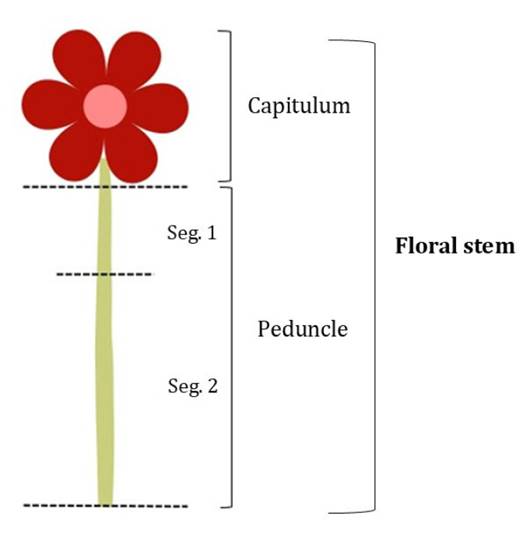
Capitulum, Segment 1 (Seg. 1) and 2 (Seg. 2) of the peduncle.
Capítulo, Segmento 1 (Seg. 1) y 2 (Seg. 2) del pedúnculo.
Figure. 1. Parts of the floral stem.
Figura. 1. Partes del tallo floral.
Study of Vase Life and Quality of Flowers
Vase life was considered terminated when the floral stem exhibited noticeable deterioration, including peduncle bending or ligule wilting, or abscission (Mohsin et al., 2023). Bending severity was assessed using a three-grade scale: Grade I (0°-45°), Grade II (45°-90°), and Grade III (>90°), following the scale adapted from Celikel & Reid (2002) for cut flowers.
Calcium content in the capitulum and segments 1 and 2 was determined according to Bárbaro et al. (2024). Stem length was recorded again at the end of the vase life period. Individual floral stem weight and water uptake were determined using a digital scale (Ohaus SP402, USA). Water consumption was calculated by weighing the flasks with and without the floral stem at both time points and pH and electrical conductivity in the solution vase were determined using a digital conductivity meter (Orion Thermo Scientific, 145, USA) and pH meter (Horiba, M-12, Japan). Soluble sugar concentrations were analysed in 10 stems per treatment, assessing the entire floral stem. Samples were preserved in liquid nitrogen, ground, and centrifuged at 6500 rpm for 5 minutes at 4°C (Thermo Scientific Heraeus Primo R, France). The supernatant was filtered for analysis. Sucrose, D-glucose, and D-fructose contents were quantified using UV-spectrophotometry with enzymatic BioAnalysis kits (Boehringer Mannheim/R-Biopharm, Darmstadt, Germany). Absorbance was measured at 340 nm (Perkin Elmer, USA).
Anatomical characteristics of peduncle segments 1 and 2 were examined using transverse sections. Ten peduncle samples per treatment were randomly selected from flowers exhibiting the average curvature response of each treatment, ensuring that the analysed tissues were representative of the overall postharvest condition. Samples were fixed in FAA solution (formaldehyde, alcohol, acetic acid) for 48 hours, stored in 70% ethanol, and dehydrated through an ethanol series. Cross-sections (8-10 μm thick) were stained with safranin-fast green and mounted in Canada balsam. Observations were made using a fluorescent microscope (Olympus BX50, Japan) at 4× magnification, and images were captured with CellSens Standard Imaging Software.
Additionally, the peduncle surface area and cell sections from segment 1 (curvature zone) were analysed at the beginning and end of the experiment using a stereoscopic magnifying glass (Olympus SZX9, 25×). Images of representative samples were processed with CellSens Standard Imaging Software. The total peduncle area, pith area, and cellular tissue area (μm2) were measured using the “2-point circle” and “rotated ellipse” tools. The proportions of cellular tissue and pith relative to the total peduncle area were calculated according to the formula:
Tissue proportion= Mean tissue area (μm2) /Total area (μm2)
Pith proportion = Mean pith area (μm2) /Total area (μm2).
Statistical Analysis
The experimental design was completely randomized with three replicates per treatment, using 10 floral stems per treatment [T1, control: floral stems kept in distilled water, T2: floral stems kept in aqueous solution of CaCl2, at 0.5 g L-1]. Measurements were subjected to analysis of variance (ANOVA), and when differences between means were detected, they were compared using Tukey’s test at a 95% significance level (Di Rienzo et al., 2020).
Results and Discussion
Floral stems maintained in distilled water (T1) exhibited peduncle bending, whereas stems placed in the calcium solution (T2) remained upright throughout the evaluation period. The incorporation of calcium into the vase solution effectively prevented bending and extended vase life by 7 days. In T1, peduncle bending defined the end of vase life, occurring 10 days after harvest. The degree of curvature in treatment was highly pronounced, exceeding 120°. Floral stems in water showed a degree III curvature (126.25°), making them unsuitable for commercialization as cut flowers. In contrast, in T2, the curvature changed by less than 1° from the initial measurement (5.50°) (degree I), thereby maintaining their commercial quality. The vase life was 17 days, and its end was due to flower opening and the subsequent ligule drop (figure 2).
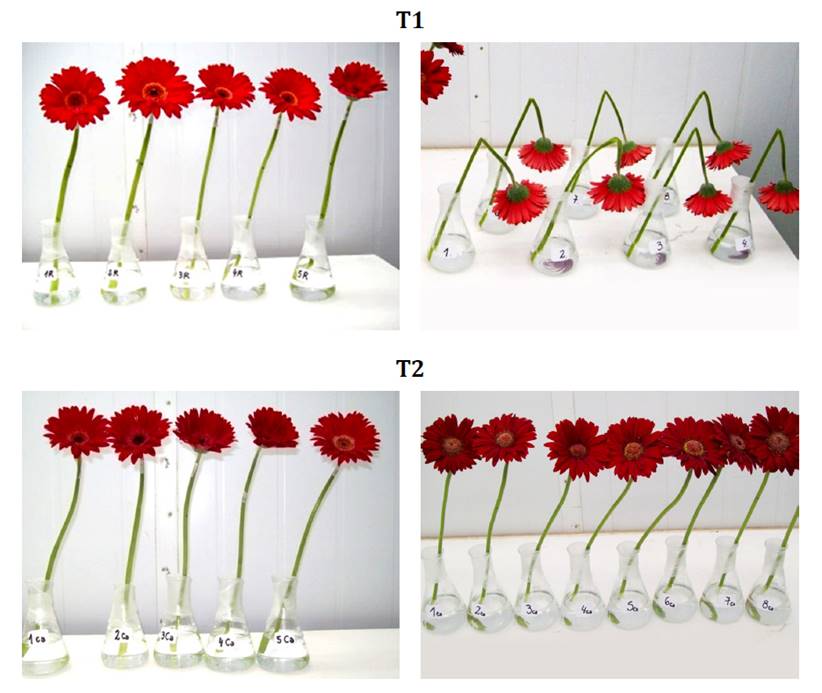
T1 (floral stems kept in distilled water) and T2 (floral stems kept in CaCl2 solution), at the Initial (left) and Final (right) of the experiment, 17 days after harvest, in G. jamesonii cv. ‘Ruby red’.
T1 (tallos florales mantenidos en agua destilada) y T2 (tallos florales mantenidos en solución de CaCl2), al inicio (izquierda) y al final (derecha) del experimento, 17 días después de la cosecha, en G. jamesonii cv. ‘Ruby red’.
Figure 2. Effect of vase solution on stem curvature degree and floral opening.
Figura 2. Efecto de la solución de florero sobre el grado de curvatura del tallo y apertura floral.
The floral stems kept in the calcium solution showed no peduncle bending at any point during their postharvest life and exhibited an increase in calcium content in their tissues, including the capitulum and segments 1 and 2 (figure 2, table 1). The effect of calcium was also evident in the length of the floral stem, as the stems maintained in the calcium solution retained their length during vase life (35.48 cm). In contrast, stems maintained in water showed a significant increase in length (40.33 cm), particularly in the distal portion, which coincided with the bending zone. Furthermore, the daily variation rate (DVR) of length was significantly higher, 0.4 cm d-1. While in the stem kept in calcium, it was 0.03 cm. d-1.
Table 1. Calcium content in the capitulum and in segments 1 and 2 of the floral stem at the beginning of the experiment (initial Ca content) and daily variation rate of calcium content (DVR Ca) in stems kept in water (control) and CaCl2 solution (0.5 g L-1) during the postharvest experiment of G. jamesonii cv. ‘Ruby red’.
Tabla 1. Contenido de calcio en el capítulo y en los segmentos 1 y 2 del tallo floral al inicio del experimento (contenido inicial de Ca) y tasa de variación diaria del contenido de calcio (DVR Ca) en tallos mantenidos en agua (control) y en solución de CaCl2 (0,5 gL-1) durante el experimento de poscosecha de G. jamesonii cv. ‘Ruby red’.
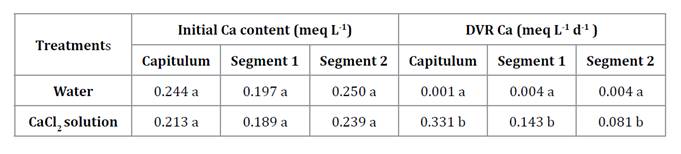
Lowercase letters indicate statistically significant values in columns (p<0.05).
Letras minúsculas en columnas indican valores estadísticamente diferentes (p<0,05).
The results obtained support the idea that calcium plays a relevant role in preserving stem architecture by acting as a structural modulator at the cellular level (Alikhani et al., 2021, Cheng et al., 2020). Furthermore, a functional interaction between calcium and auxin can be hypothesized, in which the Ca2+ may influence hormonal signalling pathways, potentially attenuating the gravitational response and contributing to stem postural stability (Hartmann et al., 2021).
Additionally, the floral stems kept in water (T1) exhibited a higher water uptake and a higher rate of fresh weight loss (table 2). Since evaporation was controlled by sealing the tops of the vases, the observed weight loss is primarily attributed to transpiration. The results indicate a higher transpiration rate (T1), suggesting a greater metabolic rate compared to T2.
Table 2. Vase solution uptake, daily variation rate (DVR) of vase solution uptake, initial fresh weight in the entire floral stem (FW) and DVR of FW in stems kept in water (control) and CaCl2 solution (0.5 g L-1) during the postharvest experiment of G. jamesonii cv. ‘Ruby red’.
Tabla 2. Absorción de la solución de florero, tasa de variación diaria (TDR) de la absorción de la solución de florero, peso fresco inicial del tallo floral (PF) y TDR de PF en tallos mantenidos en agua (control) y en solución de CaCl2 (0,5 gL-1) durante el experimento de poscosecha de G. jamesonii cv. ‘Ruby red’.
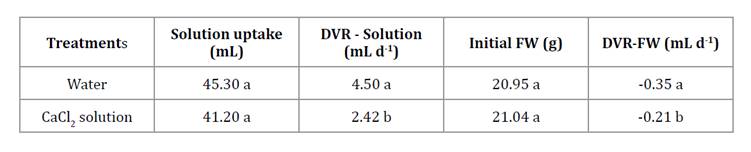
Lowercase letters indicate statistically significant values in columns (p<0.05).
Letras minúsculas en columnas son estadísticamente diferentes (p<0,05).
Several studies have indicated calcium deficiency can cause loss of firmness in stems and leaves, negatively affecting the structural rigidity of tissues (Park et al., 2022). The incorporation of calcium in postharvest treatments has shown positive effects by reinforcing cellular structure and reducing the incidence of curvature and other disorders related to mechanical integrity loss (Tonooka et al., 2023). Such effects arise from the stabilizing role of calcium, which strengthens both the cell wall and the plasma membrane by interacting with pectin in the cell wall (Xia et al., 2025), thereby increasing rigidity and helping maintain tissue shape (Parvin et al., 2019).
Thus, an increase in fresh mass is a clear indicator of greater water retention capacity, higher turgidity, and reduced stem bending. A lower daily water loss and a lower transpiration rate in the T2 (table 2).
The main route of water loss in cut flowers occurs through stomata. In Gerbera sp. flowers, stomata are distributed on different parts of the flower (Huang et al., 2018). An increase in cytosolic free calcium promotes the efflux of K⁺ and anions, leading to a marked decrease in osmotic potential and a consequent loss of guard cell turgidity, ultimately resulting in stomatal closure (Gupta et al., 2023). This effect, produced by endogenous calcium, can be replicated by exogenous supply, such as the application of CaCl2 provided by CaCl2 (Ciriello et al., 2024). Thus, results could explain the lower weight loss observed in gerbera in the T2 treatment (table 2), prolonging vase life by reducing the incidence of stem bending (Timalsina et al., 2023). Park and Kim (2022) reported that pre-harvest spraying with CaCl₂ in Gerbera ‘Harmony’ increased stem hardness, internal calcium content, and cellular pectin levels, improving the tissue’s ability to resist water loss.
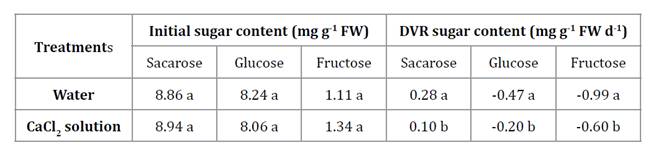
The effect of calcium was also evident in postharvest sugar metabolism, showing a positive relationship with the physiological performance of stems during vase life. At the beginning of the experiment, sugar concentrations in the floral stems did not differ significantly between treatments. However, throughout the vase life period, a progressive decline in sugar levels was observed in both treatments; this reduction was more pronounced in the control (T1) compared with the calcium-treated stems (T2) (table 3).
Table 3. Sugar content expressed on a fresh weight (FW) in the entire floral stem at the beginning of the experiment (initial sugar content) and daily variation rate of sugar content (DVR sugar content) in stems kept in water (control) and CaCl2 solution (0.5 g L-1) during the postharvest experiment of G. jamesonii cv. ‘Ruby red’.
Tabla 3. Contenido de azúcar expresado en peso fresco (PF) en el tallo floral al inicio del experimento (contenido inicial de azúcar) y tasa de variación diaria del contenido de azúcar (contenido de azúcar DVR) en tallos mantenidos en agua (control) y en solución de CaCl2 (0,5 gL-1) durante el experimento de poscosecha de G. jamesonii cv. ‘Ruby red’.
Lowercase letters indicate statistically significant values in columns (p<0.05).
Letras minúsculas en columnas son estadísticamente diferentes (p<0,05).
The difference suggests that stems in T1 consumed their available sugars more rapidly, likely to meet energy demands and sustain postharvest stress responses, which may have accelerated senescence. In contrast, stems in T2 exhibited a slower rate of sugar depletion, indicating greater metabolic stability and reduced tissue collapse.
The observed correlation between sugar content and stem bending can be attributed to the dual role of carbohydrates in plant metabolism. Besides serving as energy substrates, they act as osmotic regulators, maintaining cellular water balance and turgor (Borghi & Fernie, 2017).
Furthermore, variations in carbohydrate content during vase life have been reported to result from a redistribution among different sugar types. Thus, a decline in certain sugar forms may be accompanied by an increase in others, reflecting active transport and metabolic conversion processes within stem tissues (Kim and Oh, 2021). Previous studies have also suggested an accumulation of certain low-molecular-weight polysaccharides in the bending zone of cut gerbera stems during vase life, potentially contributing to structural and functional alterations associated with peduncle curvature (Cheng et al., 2020; Ali and Asal, 2023).
Previous studies have shown that the presence of carbohydrates can extend vase life (Seyed Hajizadeh et al., 2024, Verdonk et al., 2023), since they play a key role in plant metabolism (Perik et al., 2012), giving rigidity and firmness to the stems without weight loss, as T1 where low tissue resistance was evident (Tang et al., 2023) and a decrease in sugars.
The results of the morphochemical determinations presented here are consistent with the histological characterization and help explain the effect of using the calcium solution in the postharvest process (figure 3 and figure 4). Histological sectioning revealed possible changes in the anatomical structure of the stem floral in T1 and T2 during the postharvest life.
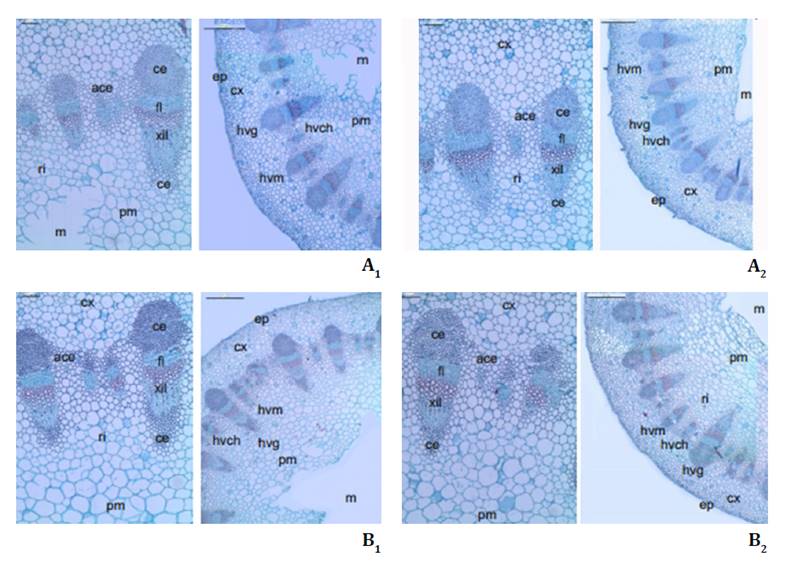
cells, ce: sclerenchyma cap, cx: cortex, ep: epidermis, fl: phloem, hvch: small vascular bundle, hvg: large vascular bundle, hvm: médium vascular bundle, m: medulla, pm: medullary parenchyma, ri: interfascicular region, xil: xylem, pca: flattened cortical parenchyma, pma: flattened medullary parenchyma, pxila: flattened xylem parenchyma, xil: xylem.
ace: anillo de células esclerificadas, ce: casquete esclerenquimático, cx: corteza, ep: epidermis, fl: floema, hvch: haz vascular pequeño, hvg: haz vascular grande, hvm: haz vascular mediano, m: médula, pm: parénquima medular, ri: región interfascicular, xil: xilema, pca: parénquima cortical aplanado, pma: parénquima medular aplanado, pxila: parénquima xilemático aplanado, xil: xilema.
Figure 3. Histological section of the floral stem of T1 (floral stems kept in water) and T2 (floral stems kept in CaCl2 solution), at the beginning of the postharvest experiment, showing the distal region or segment 1 (A1 and A2) and the basal region or segment 2 (B1 and B2) in G. jamesonii cv. ‘Ruby red’.
Figura 3. Corte histológico del tallo floral de T1 (tallos florales mantenidos en agua) y T2 (tallos florales mantenidos en solución de CaCl2), al inicio del experimento poscosecha, mostrando la región distal o segmento 1 (A1 y A2) y la región basal o segmento 2 (B1 y B2) en G. jamesonii cv. ‘Ruby red’.
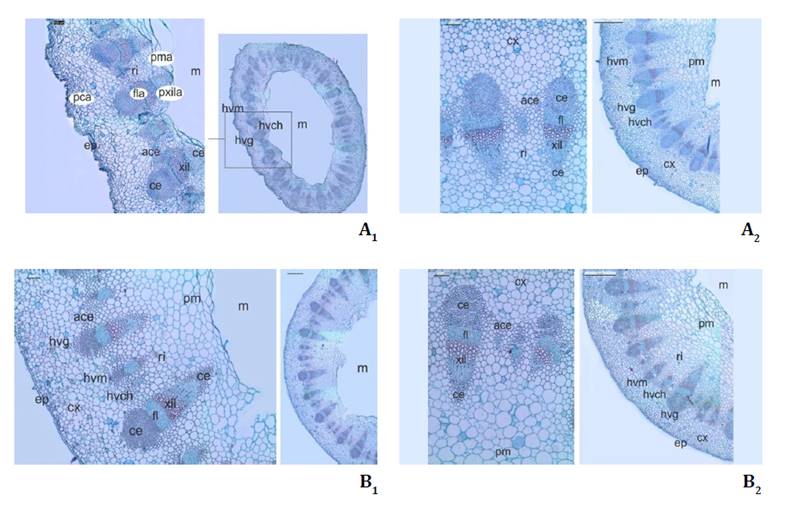
ace: ring of sclerified cells, ce: sclerenchyma cap, cx: cortex, ep: epidermis, fl: phloem, hvch: small vascular bundle, hvg: large vascular bundle, hvm: medium vascular bundle, m: medulla, pm: medullary parenchyma, ri: interfascicular region, xil: xylem, pca: flattened cortical parenchyma, pma: flattened medullary parenchyma, pxila: flattened xylem parenchyma, xil: xylem.
ace: anillo de células esclerificadas, ce: casquete esclerenquimático, cx: corteza, ep: epidermis, fl: floema, hvch: haz vascular pequeño, hvg: haz vascular grande, hvm: haz vascular mediano, m: médula, pm: parénquima medular, ri: región interfascicular, xil: xilema, pca: parénquima cortical aplanado, pma: parénquima medular aplanado, pxila: parénquima xilemático aplanado, xil: xilema.
Figure 4. Histological section of the floral stem of T1 (floral stems kept in water) and T2 (floral stems kept in CaCl2 solution) at the end of the postharvest experiment, showing the distal region or segment 1 (A1, A2) and the basal region or segment 2 (B1, B2) in G. jamesonii cv. ‘Ruby red’.
Figura 4. Corte histológico del tallo floral de T1 (tallos florales mantenidos en agua) y T2 (tallos florales mantenidos en solución de CaCl2) al final del experimento poscosecha, mostrando la región distal o segmento 1 (A1, A2) y la región basal o segmento 2 (B1, B2) en G. jamesonii cv. ‘Ruby red’.
Figure 3 shows the histological characteristics of T1 (floral stems kept in water) and T2 (floral stems kept in calcium solution) at the beginning of the experiment. In both treatments, an unilayered epidermis and a cortex composed of parenchymal cells with collateral vascular bundles of various sizes were observed. The vascular bundles were surrounded by sclerenchyma caps at the phloem and xylem poles, while in the sclerification stage, forming a continuous ring of sclerified cells. The sclerenchyma cells are arranged in caps (Crang et al., 2018) and have thicker walls than collenchyma. They are separated by parenchyma cells and contain small intercellular spaces.
The differentiation of tissues forming the vascular bundles, starting with the sclerenchyma in the adaxial region, allowed for the visualization of thicker walls in all tissues, and their cells in longitudinal view appeared ellipsoidal. The study showed uniformity in histology between segments 1 and 2. However, there are significant differences in the organization and arrangement of the cortex, as well as the shapes and sizes of cells between the tissues at the end of the vase life experiment (figure 4).
Although cell disintegration at the end of the vase life occurred in both treatments, the process was more pronounced in segment 1 of the T1 treatment, which also showed a lower degree of sclerenchymatization (figure 4 and figure 5).
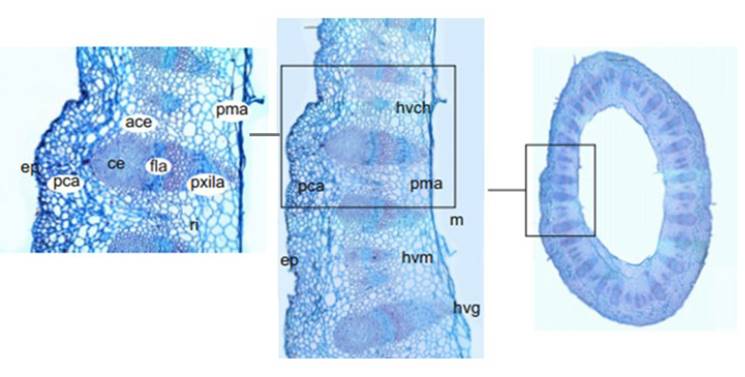
Figure 5. Histological section of the floral stem of T1 (floral stems kept in water) at the end of the postharvest experiment, showing cellular disintegration in the bending zone (segment 1) in G. jamesonii cv. ‘Ruby red’.
Figura 5. Corte histológico del tallo floral de T1 (tallos florales mantenidos en agua) al final del experimento poscosecha, mostrando desintegración celular en la zona de flexión (segmento 1) en G. jamesonii cv. ‘Ruby red’.
The pith cavity in T1 was significantly larger than T2. Measurements of pith and tissue proportion in segment 1, taken at the beginning and end of the postharvest experiment, revealed a marked increase in pith proportion in T1 during vase life, accompanied by a significant reduction in tissue proportion (figure 6, table 4). Additionally, the increase in medulla size may be associated with the disintegration of cells near it (Wang et al., 2023), which could explain the bending observed in the stems.
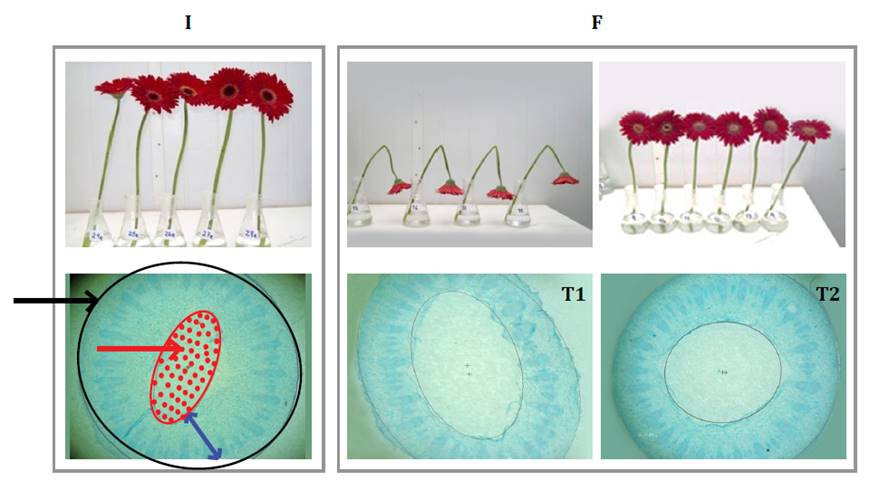
Figure 6. Histological section of segment 1 of floral stems and measurement of total area (black arrow), pith area (red arrow), and Tissue area (blue arrow) in T1 (floral stems kept in water) and T2 (floral stems kept in CaCl2 solution) at Initial (I) and Final (F) of the postharvest experiment in G. jamesonii cv. ‘Ruby red’.
Figura 6. Corte histológico del segmento 1 de tallos florales y medición del área total (flecha negra), área de médula (flecha roja) y área de tejido (flecha azul) en T1 (tallos florales mantenidos en agua) y T2 (tallos florales mantenidos en solución de CaCl2) al inicio (I) y al final (F) del experimento poscosecha en G. jamesonii cv. ‘Ruby red’.
Table 4. Relative proportion of tissue (tissue) and relative proportion of pith (pith) in segment 1 of the floral stem at the beginning (Initial) and end (Final) of the postharvest experiment in stems kept in water (control) and CaCl2 solution (0.5 g L-1) during the postharvest experiment of G. jamesonii cv. ‘Ruby red’.
Tabla 4. Proporción relativa de tejido (tejido) y proporción relativa de médula (médula) en el segmento 1 del tallo floral al inicio (Inicial) y final (Final) del experimento de poscosecha en tallos mantenidos en agua (control) y en solución de CaCl2 (0,5 gL-1) durante el experimento de poscosecha de G. jamesonii cv. ‘Ruby red’.
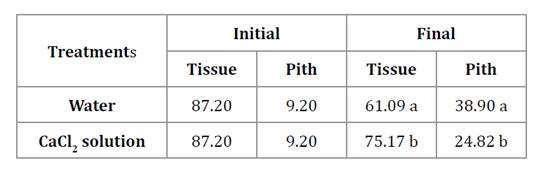
Lowercase letters indicate statistically significant values in columns (p<0.05).
Letras minúsculas en columnas son estadísticamente diferentes (p<0,05).
The calcium-treated stems showed less expansion of the medullary cavity and a smaller reduction in cellular tissue compared with stems kept in water (figure 4, figure 6 and table 4). The evidence suggests that calcium contributes to reduced cell disintegration and increased stem firmness, thereby preventing bending. A higher proportion of supporting tissue and lignin in the mid-stem is associated with reduced stem curvature (Abd-Elkader et al., 2020; Lear et al., 2022). Overall, the pattern reinforces the idea that calcium enhances stem strength by increasing lignin content and promoting its association with pectin in the cell wall (Balk et al., 2023).
The interaction between calcium and pectin, particularly through the formation of calcium-pectate complexes, plays a crucial role in maintaining cell wall integrity and resistance to enzymatic degradation. Thus, it can reduce cavity expansion and preserve vascular function, ensuring adequate water transport and maintaining turgor during postharvest life (Sun et al., 2025).
Consequently, the anatomical stabilization provided by calcium could delay stem bending by preserving both the mechanical strength and water continuity in the tissue (Delmer et al., 2024). Histological analyses confirm a close relationship between the higher calcium content observed in the floral stems kept in calcium solution (T2) and their greater cellular integrity, which contributes to the prevention of stem bending, maintaining superior structural integrity and firmness, exhibiting no bending. Parenchymatous and sclerified cells in these treated tissues displayed reduced compression and enhanced sclerenchyma integrity. In contrast to floral stems kept in distilled water (T1), which bent due to the loss of structural support. Calcium treatment effectively preserved the turgidity and stability of the floral stems.
Calcium is known to stabilize cell walls by forming cross-links with pectic acids, strengthening the middle lamella, and maintaining membrane integrity, which reduces cell disintegration (Mohsin et al., 2023). Furthermore, during vase life, the pH and electrical conductivity (EC) of the vase solution containing stems kept in distilled water (T1) increased significantly (EC: initial 2.6 to final 30.94 μS cm-1; pH: initial 5.5 to final 6.58), suggesting ion leakage from damaged tissues. Associated with the loss of membrane selectivity and increased permeability due to senescence-induced degradation (Ehsanimehr et al., 2024). In contrast, the calcium treatment (T2) showed no significant variations in EC or pH during vase life and maintained membrane stability and ionic homeostasis. These results align with previous findings indicating that calcium mitigates ion leakage by preserving the integrity of plasma membranes and regulating ion transport across cells (El-Bana et al., 2023).
Numerous studies have identified calcium as a key stabilizer of membrane integrity, contributing to wall rigidity by binding to pectins in the middle lamella (Narwal et al., 2024, Taiz et al., 2018). In T2, the calcium absorbed by the tissues (table 1) may have enhanced membrane stability, delayed senescence processes, and supported cell compartmentalization, thereby reducing or preventing electrolyte leakage.
The results underscore the role of calcium in sustaining metabolic activity and structural stability, thereby maintaining stem firmness and integrity over time. Overall, the findings from this experiment provide meaningful insights into the physiological effects of calcium treatment, consistent with recent research seeking technological alternatives to extend the postharvest life of Gerbera jamesonii (Granados et al., 2025).
Conclusions
There is a direct relationship between the calcium content in the vase solution and the histochemical, metabolic, and structural characteristics in the postharvest quality of Gerbera jamesonii L. cv. ‘Ruby Red’. Calcium application has proven to be a critical factor in improving the quality and structural resilience floral stem. The evidence findings indicate that adequate calcium supplementation not only strengthens the physical structure of stems but also supports more harmonious and efficient plant development.
Abd-Elkader, H. H., Massoud, H. Y., El-Baz, T. T., El-Erian, M. A. (2020). Effect of amino acids spray on growth, flowering and keeping quality of Gerbera jamesonii L. as a pot plant. Journal of Plant Production, 11(2), 201-206. https://doi.org/10.21608/jpp.2020.79110
Ali, K. K., & Asal, K. N. A. (2023). Effect of Foliar Application of Calcium and Nano-Chitosan on the Growth of Rose Seedlings. IOP Conference Series: Earth and Environmental Science, 1158(4), 42032. https://doi.org/10.1088/1755-1315/1158/4/042032
Alikhani, T. T., Tabatabaei, S. J., Torkashvand, A. M., Talei, D. (2021). Silica nanoparticles and calcium on the histological characteristics and stem bending in Gerbera cut flowers. Ornamental Horticulture, 27(3), 334-343. https://doi.org/10.1590/2447-536x.v27i3.2308
Balk, M., Sofia, P., Neffe, A. T., Tirelli, N. (2023). Lignin, the Lignification Process, and Advanced, Lignin-Based Materials. International Journal of Molecular Sciences, 24(14), 11668. https://doi.org/10.3390/ijms241411668
Bárbaro, L. A., Rubio, E., Karlanián, M. A. & Iwasita, B. E. (2024). Substrate pH Management Strategies in the Production of Yerba Mate Seedlings (Ilex paraguariensis A. St.-Hil.). Chilean journal of agricultural & animal sciences, 40(3), 530-544. https://dx.doi.org/10.29393/chjaas40-44emlb40044
Borghi, M., Fernie, A. R. (2017). Floral Metabolism of Sugars and Amino Acids: Implications for Pollinators’ Preferences and Seed and Fruit Set. Plant Physiol.,75(4): 1510-1524. doi:10.1104/pp.17.01164.
Çelikel, F. G., Reid, M. S. (2002). Storage temperature affects the quality of cut flowers from the Asteraceae. HortScience, 37(1), 148-150. https://doi.org/10.21273/hortsci.37.1.148
Cheng, G., Wang, L., He, S., Liu, J., Huang, H. (2020). Involvement of pectin and hemicellulose depolymerization in cut gerbera flower stem bending during vase life. Postharvest Biology and Technology, 167, 111231. https://doi.org/10.1016/j.postharvbio.2020.111231.
Ciriello, M., Campana, E., Colla, G., De Pascale, S., Rouphael, Y. (2024). Preharvest calcium application boosts the biostimulatory effect of protein hydrolysate by improving the postharvest life of gerbera cut flower. Scientia Horticulturae, 331, 113140. https://doi.org/10.1016/j.scienta.2024.113140
Crang, R., Lyons-Sobaski, S., Wise, R. (2018). Parenchyma, Collenchyma, and Sclerenchyma. In: Plant Anatomy. Springer, Cham. https://doi.org/10.1007/978-3-319-77315-5_6
Delmer, D., Dixon, R. A., Keegstra, K., Mohnen, D. (2024). The plant cell wall-dynamic, strong, and adaptable-is a natural shapeshifter. Plant Cell, 1;36(5):1257-1311. https://doi: 10.1093/plcell/koad325.
Di Rienzo, J. A., Casanoves, F., Balzarini, M. G., González, L., Tablada, M. (2020). InfoStat versión 2020. Grupo InfoStat, FCA, Universidad Nacional de Córdoba. http://www.infostat.com.ar
Ehsanimehr, N., Hosseinifarahi, M., Abdipour, M. (2024). Improving postharvest quality and vase life of cut rose flowers by pre-harvest foliar co-applications of γ-aminobutyric acid and calcium chloride. Sci Rep, 14, 14520. https://doi.org/10.1038/s41598-024-64021-8
El-Bana, H. S., & Ennab, H. A. (2023). Post-harvest application of some calcium forms to improve quality and shelf life of mandarin fruits during storage. Alexandria Journal of Agricultural Sciences, 68(3), 141-151.https://doi.org/10.21608/alexja.2023.222162.1039
García-González, A., Soriano-Melgar, L. D. A. A., Cid-López, M. L., Cortez-Mazatán, G. Y., Mendoza- Mendoza, E., Valdez-Aguilar, L. A., Peralta-Rodríguez, R. D. (2022). Effects of calcium oxide nanoparticles on vase life of Gerbera cut flowers. Scientia Horticulturae, 291, 110532. https://doi.org/10.1016/j.scienta.2021.110532
Ge, Y., Lai, Q., Luo, P., Liu, X., Chen, W. (2019). Transcriptome profiling of Gerbera hybrida reveals that stem bending is caused by water stress and regulation of abscisic acid. BMC Genomics, 20(1). https://doi.org/10.1186/s12864-019-5961-1
Granados Ortiz, S. A.; Visentini, F. F.; Panigo, E. S.; Muñoz, F. F.; Malano, J. P.; Derita, M. G.; Daurelio, L. D.; Bouzo, C. A.; Pérez Rubin, A. A.; Céccoli, G. (2025). Green Synthesis and Foliar Application of Copper Nanoparticles in Sunflower (Helianthus annuus L.) to Improve Physiological Parameters and Yield. Revista de la Facultad de Ciencias Agrarias. Universidad Nacional de Cuyo. 57(2): 187-198. DOI: https://doi.org/10.48162/rev.39.182
Gupta, S., Kaur, N., Kant, K., Jindal, P., Ali, A., Naeem, M. (2023). Calcium: A master regulator of stress tolerance in plants. South African Journal of Botany, 163, 580-594. https://doi.org/10.1016/j.sajb.2023.10.047
Hartmann, F. P., Tinturier, E., Julien, J.-L., Leblanc-Fournier, N. (2021). Between Stress and Response: Function and Localization of Mechanosensitive Ca2+ Channels in Herbaceous and Perennial Plants. International Journal of Molecular Sciences, 22(20), 11043. https://doi.org/10.3390/ijms222011043
Huang, X., Lin, S., He, S., Lin, X., Liu, J., Chen, R., Li, H. (2018). Characterization of stomata on floral organs and scapes of cut ‘Real’ Gerberas and their involvement in postharvest wáter loss. Postharvest Biology and Technology, 142, 39-45. https://doi.org/10.1016/jpostharvbio.2018.04.001
Kim, J., & Oh, W. (2021). Cold Storage Period of Bulbs Influences Their Sugar Contents and Post-Storage Growth and Flowering in Lilium Oriental Hybrids. Agriculture, 11(11), 1080. https://doi.org/10.3390/agriculture11111080
Lear, B., Casey, M., Stead, A. D., Rogers, H. J. (2022). Peduncle necking in Rosa hybrida induces stressrelated transcription factors, upregulates galactose metabolism, and downregulates phenylpropanoid biosynthesis genes. Frontiers in Plant Science, 13. https://doi.org/10.3389/fpls.2022.874590
Manzoor, A., Bashir, M. A., Naveed, M. S., Akhtar, M. T., & Saeed, S. (2024). Postharvest Chemical Treatment of Physiologically Induced Stem End Blockage Improves Vase Life and Water Relation of Cut Flowers. Horticulturae, 10(3), 271. https://doi.org/10.3390/horticulturae10030271
Milani, M., Pradella, E. M., Heintze, W., Schafer, G., & Bender, R. J. (2019). The effects of supplemental nitrogen and calcium on the quality and postharvest life of cut gerbera. Ornamental Horticulture, 25(4), 365-373. https://doi.org/10.1590/2447-536X.v25i4.2028
Mohammadi, M., Ranjbar, M. E., Eghlima, G. (2024). Impact of gibberellic acid and calcium chloride treatments on neck bending prevention and vase life extension of Gerbera cut flowers. Journal of Plant Growth Regulation, 43(4), 1093-1102. https://doi.org/10.1007/s00344-023-11164-z
Mohsin, R. M., Asal, K. A., Kamaluddin, A. A., Zaky, A. A. (2023). Genotypes and storage duration effects on the quality of cut flower-Gerbera (Gerbera jamesonii Hook). Sabrao J. Breed. Genet, 55(1), 260-267. https://doi.org/10.54910/sabrao2023.55.1.24
Narwal, P., Negi, N. P. (2024). Exogenous Calcium Enhances Osmotic Regulation, Photosynthetic Machinery and Stomatal Characteristics in Banana Under Dehydration Stress. Indian Journal of Agricultural Biochemistry, 37(1), 24-30. https://doi.org/10.5958/0974-4479.2024.00004.4
Park, J., Kim, W. S. (2022). Preharvest Spraying of CaCl2 Alleviates the Scape Bending of Gerbera ‘Harmony’ Flowers by Strengthening the Pectin Crosslinks through Ca2+ Bonds. Horticulturae, 8(6), 523. https://doi.org/10.3390/horticulturae8060523
Parvin, K., Nahar, K., Hasanuzzaman, M., Bhuyan, M. H. M. B., Fujita, M. (2019). Calcium-Mediated Growth Regulation and Abiotic Stress Tolerance in Plants. In: Hasanuzzaman, M., Hakeem, K., Nahar, K., Alharby, H. (eds). Plant Abiotic Stress Tolerance. Springer, Cham. https://doiorg/10.1007/978-3-030-06118-0_13
Perik, R. R., Razé, D., Harkema, H., Zhong, Y., Van Doorn, W. G. (2012). Bending in cut Gerbera jamesonii L. flowers relates to adverse water relations and lack of stem sclerenchyma development, not to expansion of the stem central cavity or stem elongation. Postharvest Biology and Technology, 74, 11-18. https://doi.org/10.1016/j.postharvbio.2012.06.009
Seyed Hajizadeh, H., Bayrami Aghdam, S., Fakhrghazi, H., Karakus, S., Kaya, O. (2024). Physico-Chemical Responses of Alstroemeria spp. cv. Rebecca to the presence of Salicylic Acid and Sucrose in vase solution during postharvest life. BMC Plant Biology, 24(1). https://doi.org/10.1186/s12870-024-04814-1
Sun, M., Wang, F., Ci, J., Liu, Y., Li, K., Wang, D., Yu, W., Zhuang, Y., & Xiao, Y. (2025). Effects of Different Calcium Preparations on Fresh-Cut Quality and Storage Quality of Starkrimson Apple. Plants, 14(9), 1293. https://doi.org/10.3390/plants14091293
Taiz, L., Zeiger, E., Møller, I, Murphy, A. (2018). Fundamentals of Plant Physiology. Oxford University Press. 561 p.
Tang, Y., Lu, L., Sheng, Z., Zhao, D., Tao, J. (2023). An R2R3-MYB network modulates stem strength by regulating lignin biosynthesis and secondary cell wall thickening in herbaceous peony. The Plant Journal, 113(6), 1237-1258, doi: 10.1111/tpj.16107.
Timalsina, S., Poudel, P. R., Acharya, A. K., Pathak, R., & Pun, U. K. (2023). Effect of calcium chloride and floral preservatives in the vase life of gerbera cut flower. Nepal Agriculture Research Journal, 15(1), 125-135. https://doi.org/10.3126/narj.v15i1.51538
Tonooka, M., Homma, Y., Toyoizumi, T., Ichimura, K. (2023). Stem bending in cut Gerbera under the condition of suppressing bacterial proliferation is associated with the weakening of the stem strength. Scientia Horticulturae, 319, 112153, doi: 10.1016/j.scienta.2023.112153
Verdonk, J. C., Van Ieperen, W., Carvalho, D. R. A., Van Geest, G., Schouten, R. E. (2023). Effect of preharvest conditions on cut-flower quality. Front. Plant Sci., 14, 1281456. doi: 10.3389/fpls.2023.1281456
Wang, L., Chen, Y., Wu, M., Dai, F., Ye, M., Chen, F., Huang, H. (2023). Involvement of lignin deposition and cell wall degradation in stem senescence of Chinese flowering cabbage during storage. Postharvest Biology and Technology, 198, 112256. https://doi.org/10.1016/j.postharvbio.2023.112256
Wdowiak, A., Podgórska, A. & Szal, B. (2024). Calcium in plants: an important element of cell physiology and structure, signaling, and stress responses. Acta Physiol Plant, 46, 108. https://doi.org/10.1007/s11738-024-03733-w
Xia, C., Cao, Y., Gan, W., Lin, H., Li, H., Lin, F., Lu, Z., Chen, W. (2025). Optimal Vase Solution for Gerbera hybrid Cut Flower Keeping Fresh by Activating SA and Cytokinin Signaling and Scavenging Reactive Oxygen Species. Biology, 14(1), 18. https://doi.org/10.3390/biology14010018