Revista de la Facultad de Ciencias
Agrarias. Universidad Nacional de Cuyo. Tomo 57(2). ISSN (en línea) 1853-8665.
Año 2025.
Original article
Strategic
Pathways for the Olive Oil Chain in Argentina: Profitability, Sustainability
and Oleo tourism
Rutas
estratégicas para la cadena de aceite de oliva en Argentina: rentabilidad,
sostenibilidad y oleoturismo
Alejandro Juan
Gennari1,
Vanina Fabiana
Ciardullo1,
Leonardo Javier
Santoni1
1Universidad Nacional de Cuyo. Facultad de Ciencias Agrarias.
Cátedra de Economía y Política Agraria. Almirante Brown 500. M5528AHB. Chacras
de Coria. Mendoza. Argentina.
*pwinter@fca.uncu.edu.ar
Abstract
The olive oil
agri-food chain in Argentina is strategically relevant for rural development,
employment, exports and tourism. Despite quality production and industrial
capacity, the sector faces structural problems: high labour and energy costs,
limited domestic consumption, and dependence on subsidized international
competitors. This study analyses the chain using multicriteria programming
across five dimensions: productive, economic-financial, commercial,
environmental and tourism-territorial. The baseline was built from data
collected between 2018 and 2024 (Agricultural Census 2018, official reports and
international benchmarks), covering the country’s most representative producing
regions (Catamarca, La Rioja, San Juan and Mendoza), which together account for
over 90% of national output. Results from scenario simulations reveal
trade-offs: export-oriented strategies maximize profit but increase
vulnerability to global prices; internal consumption growth strengthens resilience
yet moderates revenues; environmental sustainability improves efficiency
through lower water use; and balanced development with olive oil tourism
achieves robust outcomes across all dimensions. A novel contribution is the
quantitative inclusion of tourism, showing its potential to generate rural
employment and enhance brand value. The findings support forward-looking
strategies that combine technological reconversion, market diversification,
efficient resource use and tourism integration, offering policy guidelines for
sustainable territorial development.
Keywords: olive oil supply
chain, costs, competitiveness, sustainability, bioeconomy, tourism, Argentina
Resumen
La cadena
agroalimentaria del aceite de oliva en Argentina es estratégica para el
desarrollo rural, el empleo, las exportaciones y el turismo. A pesar de su
calidad productiva y capacidad industrial, el sector enfrenta problemas
estructurales: altos costos laborales y energéticos, bajo consumo interno y
dependencia de competidores internacionales subsidiados. Este estudio analiza
la cadena mediante programación multicriterio en cinco dimensiones: productiva,
económico-financiera, comercial, ambiental y turística-territorial. El
escenario base se construyó con datos relevados entre 2018 y 2024 (Censo
Agropecuario 2018, informes oficiales y referencias internacionales), abarcando
las provincias más representativas (Catamarca, La Rioja, San Juan y Mendoza), que
concentran más del 90% de la producción nacional. Los resultados de las
simulaciones por escenarios evidencian compensaciones: las estrategias
orientadas a la exportación maximizan beneficios pero aumentan la
vulnerabilidad a precios globales; el desarrollo del consumo interno fortalece
la resiliencia aunque reduce ingresos; la sostenibilidad ambiental mejora la
eficiencia al reducir uso de agua; y un desarrollo equilibrado con oleoturismo
logra resultados robustos en todas las dimensiones. El aporte novedoso es la
incorporación cuantitativa del turismo, que muestra su potencial para generar
empleo rural y valor de marca. Los hallazgos sustentan estrategias prospectivas
que combinan reconversión tecnológica, diversificación de mercados, uso
eficiente de recursos e integración turística, ofreciendo lineamientos para
políticas públicas y desarrollo sustentable.
Palabras clave: cadena de valor del
aceite de oliva, costos, competitividad, sustentabilidad, bioeconomía, turismo,
Argentina
Originales: Recepción: 28/07/2025 - Aceptación: 08/10/2025
Introduction
Argentina’s olive
oil sector holds strategic relevance not only for its product but also for its
role in rural development, employment, and the diversification of semi-arid
territories. Extra virgin olive oil (EVOO) from Argentina has achieved
international recognition for quality (Benencia et al., 2014), supported by
industrial capacity and technological advancement. However, the sector faces
persistent structural problems: high labour and energy costs compared to
competitors (Ministerio
de Economía, 2024), strong dependence on subsidized producers such as Spain and
Italy, and limited domestic demand (CREA, 2021). These factors
have hindered competitiveness and limited the capacity to capture value at
national level. Argentina ranks 10th worldwide in olive oil
production, with annual outputs fluctuating between 28,000 and 36,000 tons in
peak years (IOC,
n. d.; Ministerio de Economía, 2024). The sector employs around 30,000 temporary rural workers,
equivalent to nearly three million daily wages per year (CREA,
2021),
representing 8.1% of the national agricultural labour requirement. Despite this
production capacity, domestic consumption remains extremely low (180-250 cc per
capita annually), far below Mediterranean standards (Spain: ~15 litters per
capita). This imbalance highlights a major challenge: while Argentina has
structural potential, it captures limited value internally, depending heavily
on exports and leaving domestic demand underdeveloped. These structural
conditions justify the need for a comprehensive approach that analyses the
chain not only in economic terms but also through its productive, commercial,
environmental and territorial dimensions. Beyond its productive dimension, the
olive oil chain must be understood as a networked agri-food system, where
interdependencies extend to logistics, marketing, tourism and environmental
management (García-Cascales
et al., 2021). This broader view enables policies to shift from a narrow
“sectoral plan” to a flexible “roadmap” capable of adapting to disruptive
changes in technology, trade and regulations (Romero, 1993). Moreover, the
concept of bioeconomy reinforces this approach: olive cultivation generates
biomass, by-products and ecosystem services whose valorisation expands the
economic and territorial impacts (Stark et al., 2021). The present
study therefore adopts an integrated five-dimension perspective: (i) productive
efficiency, (ii) economic-financial profitability, (iii) logistics and
commercialization, (iv) environmental sustainability, and (v) tourism and
territorial valorisation. This framework moves beyond isolated analysis of
costs or yields, proposing instead a systemic evaluation of Argentina’s olive
oil chain as both a production network and a driver of local development. The
research is guided by the following objectives:
(a) analyse the
chain’s structure and bottlenecks.
(b) simulate
scenarios of value creation through multicriteria programming; and
(c) evaluate
trade-offs between profitability, sustainability, domestic demand and oleo
tourism.
The central
hypothesis is that multicriteria programming can identify optimal strategic
pathways for the olive oil chain in western Argentina, showing that a balanced
approach integrating technological reconversion, sustainability and tourism
improve resilience and competitiveness compared to purely export-oriented
strategies. The analysis focuses on Argentina’s main producing provinces
(Catamarca, La Rioja, San Juan and Mendoza), which together account for over
90% of national olive oil output. While the baseline data correspond to
2018-2024, the scenarios are prospective, designed to explore strategic
pathways for the future of the sector.
Materials
and Methods
Methodological
Approach: Multicriteria Linear Programming (MCP)
The methodological
framework chosen was Multicriteria Linear Programming (MCP), as it enables the
simultaneous evaluation of multiple, and often conflicting, objectives relevant
to the olive oil value chain. This approach goes beyond single-objective
optimization by capturing trade-offs between profitability, production, market
allocation, environmental impacts and tourism valorisation. The focus of this
study is not on statistical sampling, but on the integration of aggregated data
from national censuses, official sectoral reports and international benchmarks.
In this sense, concepts such as “sample” or “survey” are not applicable, since
the analysis is systemic and chain oriented. The model is structured across five
dimensions -productive, economic-financial, commercial, environmental, and
tourism-territorial- which together reflect the sustainability and strategic
development goals of the sector. Within this framework, MCP was applied to
determine the optimal allocation of land, production, investments and market
shares under real-world constraints. The method allows the generation of
Pareto-efficient solutions, making visible the compromises between objectives
and enabling the design of alternative strategic scenarios. This orientation
provides a rigorous yet flexible analytical tool, adaptable not only to olive
oil but also to other perennial crop systems embedded in similar ecological and
territorial contexts (García-Cascales et al, 2021; Romero, 1993).
Justification
of Multicriteria Programming (MCP vs. MCDM)
The choice of
Multicriteria Linear Programming (MCP) is justified by the complexity of the
olive oil value chain, where multiple and often conflicting objectives must be
considered simultaneously. Traditional single-objective models fail to capture
trade-offs between profitability, domestic consumption, exports, environmental
impact and tourism valorisation. MCP provides a quantitative framework that
integrates these dimensions and generates optimal solutions under real-world
constraints. It is important to distinguish MCP from Multicriteria Decision
Making (MCDM) approaches: while MCDM is designed to select among a finite set
of alternatives (qualitative decision-making), MCP allows continuous
optimization of resource allocation across multiple objectives. This
distinction is relevant because the study does not evaluate pre-defined options
but rather allocates hectares, production volumes and investments dynamically,
reflecting real strategic planning needs.
The capacity of MCP to explore Pareto-efficient solutions and
identify trade-offs among objectives strengthens its applicability to agri-food
systems embedded in uncertain international markets and resource constraints (García-Cascales
et al, 2021; Romero, 1993).
Data
Collection and Update
Data consolidation
was carried out by integrating official and sectoral sources rather than
through statistical sampling. The structural base was provided by the 2018
National Agricultural Census (INDEC, 2019), complemented
with annual sectoral reports from the Ministerio de Economía (2024),
CREA (2021), and international benchmarks (IOC, 2015). Production
volumes, costs and yields were compiled from these sources, covering the four
main olive-producing provinces (Catamarca, La Rioja, San Juan, Mendoza). Given
Argentina’s inflationary context, all values were expressed in constant U.S.
dollars, updated through official price indices. This procedure ensured
comparability with international cost studies and positioned Argentina in a
medium-to-high cost range relative to major competitors such as Spain and Portugal.
As a result, the estimated average cost of a 500 ml bottle of olive oil was
US$3.26, distributed as 50% primary production, 19% industrial processing and
31% packaging and fractionation. This calculation does not stem from a
statistical survey but from sector-wide structural data, reflecting the
systemic focus of chain analysis. Therefore, terms like “sample” or “survey”
are not applicable: the analysis is based on censual and aggregated information
integrated into the programming model income. From a bioeconomy perspective,
olive cultivation also generates by-products such as pomace, pits, leaves, and
pruning residues. These can be valorised through energy (biofuels, pellets),
compost and soil amendments, animal feed, as well as tourism and ecosystem services.
Although not explicitly included as decision variables in the model, these
alternatives were acknowledged as part of the conceptual framework.
Continuous
Decision Variables
The following
decision variables capture the strategic choices available to the olive oil
chain. They are associated mainly with the productive, commercial and tourism
dimensions, representing cultivated hectares, production volumes, market
allocation, and visitor flows. These variables are optimized by the model to
explore alternative scenarios and resource allocation strategies.
• Htrad:
Hectares in production of traditional olive groves (ha).
• Hint:
Hectares in production of intensive olive groves (ha).
• Qtrad:
Olive oil production obtained from traditional systems (ton).
• Qint:
Olive oil production obtained from intensive systems (ton).
• E: Volume of
olive oil destined for export (ton).
• D: Volume of
olive oil destined for the domestic market (ton).
• M: Investment in
marketing and promotion for the domestic market (millions of USD).
• Ti:
Number of tourists visiting province i (persons), quantifying olive oil tourism
activity in each region.
• Ii:
Investment in tourism infrastructure and promotion in province i (millions of
USD), reflecting strategic capital allocation for tourism development.
• (Horg):
Hectares under organic certification (optional, if a specific organic
production objective is modelled).
Parameters
(Fixed by Scenario or Context):
The parameters
correspond to fixed or contextual values that condition the system. They
include aspects of the productive dimension (yields, water and energy use), the
economic-financial dimension (costs, prices, taxes), the environmental dimension
(emission coefficients, water limits), and the tourism-territorial dimension
(capacity, income per visitor). By defining these constants, the model ensures
comparability across scenarios and consistency with official and international
data sources.
rtrad, rint:
Oil yield per hectare (ton/ha) for traditional and intensive systems,
respectively (e.g., rtrad=0.5,
rint=1.5
ton/ha).
αtrad, αint:
Water requirement per hectare (m³/ha) for traditional and intensive systems
(e.g., αtrad=3000, αint=5000).
βtrad, βint:
Energy consumption per hectare (kWh/ha) for traditional and intensive systems
(e.g., βtrad=50, βint=200).
Pexp,
Pdom: Price
per ton of oil in the export and domestic market (e.g., Pexp=4000,
Pdom=3500
USD/ton).
texp: Export tax rate (decimal, e.g.,
texp=0.05).
ctrad, cint:
Total cost per ton of oil produced in each system (e.g., ctrad=3800,
cint=2300
USD/ton).
Cmkt:
Marketing cost per ton for the domestic market (e.g., Cmkt=500
USD/ton).
Wmax:
Total water availability for irrigation (m³) (e.g., Wmax=300×106
m³).
Hmax:
Maximum usable area for cultivation (ha) (e.g., Hmax=90,000
ha).
pi: Average income
per tourist in province i (USD/tourist).
eiT: Associated jobs
per tourist in province i (jobs/tourist).
eiA: Associated jobs
per ton of oil produced in province i (jobs/ton).
ciT: CO₂ emission
coefficient per tourist in province i (kg CO₂/tourist).
ciA: CO₂ emission
coefficient per ton of oil in province i (kg CO₂/ton).
capacitate: Installed tourist
capacity limit in province i (persons/day).
σ: Tourist
seasonality coefficient (decimal).
Cmax:
Maximum allowed CO₂ emissions limit (kg CO₂).
personal disponible: Total
available rural labour (jobs).
Objective
Functions of the Integrated Model
The model
incorporates multiple objective functions, each reflecting a strategic goal of
the olive oil chain. Together, they cover the five sustainability dimensions:
•
Economic-financial: profitability maximization.
• Productive: total
oil production.
• Commercial: exports and domestic demand.
• Environmental:
efficient use of resources and reduced footprint.
•
Tourism-territorial: revenues, employment and territorial valorisation.
This configuration
allows the model to simulate different policy or market priorities and to
quantify their trade-offs.
Economic (Zecon): Maximization
of Net Profit
This function
maximizes the net margin, considering sales revenues (export and domestic) and
total costs (agricultural, industrial, commercial, taxes, marketing).
Zecon=(1-texp)PexpE+PdomD-ctradQtrad-cintQint-CmktD
Technical
(Ztec):
Maximization of Total Oil Production
This objective
reflects the pursuit of productive efficiency and optimal input use, boosting
agricultural and industrial yields.
Ztec=Qtrad+Qint
Commercial-External
(Zcom-ext):
Maximization of Exported Volume
This objective
incentivizes allocating the largest possible production to external markets,
capitalizing on the quality advantage of Argentine oil and consolidating
international presence.
Zcom−ext=E
Commercial-Internal
(Zcom-int)
Maximization of
Volume Destined for the Domestic Market
This objective
seeks to increase internal olive oil consumption in Argentina, contributing to
food security and cultural product development.
Zcom−int=D
Environmental
(Zamb)
Minimization of
Environmental Impact (Water and Carbon Footprint)
This objective
focuses on reducing the value chain’s environmental impact, promoting long-term
sustainability. It is formulated as the minimization of water and energy use,
and total CO₂ emissions from both oil production and tourist activities.
Zamb=−(αtradHtrad+αintHint)−γ(βtradHtrad+βintHint)−Σi(ciT
Ti+ciAAi)
where
γ = a weighting
factor for energy.
Productive
(Zsup)
Maximization of
Olive Grove Area in Production
This objective
seeks to expand the olive agricultural frontier and rehabilitate underutilized
plantations, increasing sectoral productive potential.
Zsup=Htrad+Hint
Tourism-Revenue
(Ztur−ing)
Maximization of
Olive Oil Tourism Revenue
This function
maximizes income generated by visits to oil mills, tastings, tourist product
sales, and accommodation services.
Ztur-ing=ΣipiTi
Tourism-Employment
(Ztur-emp)
Maximization
of Rural Employment Associated with Tourism
This
objective focuses on maximizing job creation in rural areas, including guides,
accommodation, and catering staff, contributing to curbing depopulation.
Ztur−emp=Σi
(eiTTi+eiAAi)
Tourism-Territorial
Valorisation (Ztur-val)
Maximization
of Territorial Valorization
This
objective, partly qualitative, seeks to intensify the social and economic
recognition of the olive growing landscape as a heritage resource. It can be
modelled as a tourist satisfaction index, a brand score, or a weighted sum of
income per tourist and quality certifications (DOP/IG), reflecting public
appreciation for authenticity, quality, and local culture.
Restrictions of the Integrated Model
The
restrictions define the operational, resource and environmental boundaries
within which the system must operate. They ensure feasibility of the solutions
by linking production with demand, limiting land and water use, respecting
labor and capacity constraints, and capping environmental impacts. In this way,
restrictions reflect the real conditions faced by the olive oil chain and
guarantee that the scenarios generated are both consistent and applicable:
Production-Market Balance
All
oil production must be assigned to a market (internal or external), assuming no
significant stock variations.
Qtrad+Qint=D+E
Production
Limits per System
The
oil production of each system cannot exceed its potential yield per hectare.
Qtrad≤rtradHtrad
Qint≤rintHint
Water
Availability
Total
water consumption for irrigation cannot exceed the maximum available annual
allocation.
αtradHtrad+αintHint≤Wmax
Land
Availability
The
total cultivated area cannot exceed the maximum usable area.
Htrad+Hint≤Hmax
Maximum
Internal Demand
The
demand of the internal market can be limited by its maximum consumption
potential.
D≤Dmax
Installed
Tourist Capacity
The
number of tourists in each province cannot exceed the physical capacity of
local tourist infrastructures.
Ti≤Capacity
(e.g., Mendoza’s olive oil tourism providers can serve
about 2,533 people per day).
Tourist
Seasonality
The
annual tourist offer may be limited by seasonal factors, reflected by a
coefficient.
Ti≤Capacity×Operative days
CO₂
Emissions Limit
Total
emissions generated by production and tourism must not exceed a maximum
threshold, reflecting a commitment to environmental sustainability.
Σi(ciTTi+ciAAi)≤Cmax
Labour
Balance
The
total rural labour required for agricultural and tourist activities cannot
exceed the availability of personnel.
Σi(wiTTi+wiAAi)≤personal
disponible (where wiT and wiA are labour coefficients
per tourist and per ton of oil, respectively).
Budgetary
Restrictions for Tourist Investment
Investment
in tourism in each province may be limited by available financing.
Ii≤
Tourism Investment Budget
Non-Negativity
All
decision variables must be greater than or equal to zero.
Htrad,
Hint, Qtrad, Qint, D, E, M, Ti, Ii
≥0
Transformation to Goal or Weighted Model
To
solve this multi-objective programming problem, the approach of weighted goal
programming or the weighted sum of objective functions can be adopted. Goal
programming allows for the establishment of a desired level for each objective,
subsequently minimizing deviations from these targets using deviation variables
(di-,di+ ) to represent non-compliance or excess.
Alternatively,
and often more intuitively for scenario exploration, a single scalar function
can be defined as the weighted sum of all individual objective functions:
maxZtotal=ωeconZecon+ωtecZtec+ωcom-extE+ωcom-int
D+ωamb Zamb+ωsupH+ωtur-ing Ztur-ing+ωtur-empZtur-emp+ωtur-val
Ztur-val
Here,
ωk represents the weights assigned to each objective, reflecting its strategic
priority in a given scenario. It is crucial to normalize or scale the objective
functions prior to assigning weights, as their units and magnitudes vary
significantly (e.g., Zecon in millions of USD, Ztec in
thousands of tons, Zamb in millions of m³ or kg CO₂). This
normalization ensures that the weights accurately reflect the relative
importance of each objective. By adjusting these weights, this method enables
the emulation of various strategic scenarios and the identification of
efficient Pareto solutions, which represent the best possible compromises among
conflicting objectives.
Results
Descriptive Overview of the Argentine Olive Oil Sector
As described in the Introduction, Argentina is a mid-scale
producer with low domestic consumption. Building on this context, the following
overview summarizes sectoral features relevant for scenario modelling. The low
domestic consumption, despite Argentina being a producing nation, suggests
either a market failure or a lack of strategic focus on developing internal
demand. This presents one of the most significant opportunities for the
Argentine olive oil business strategy: internal consumption could potentially
increase by 500% to reach one litter per capita per year, though even this
would remain minimal compared to European averages. Globally, olive oil
consumption has seen an average annual growth of approximately 3.5% over the
last five years, indicating a favourable international trend.
In 2021, the sector’s total turnover, encompassing both internal
consumption and exports, reached US$223 million, with olive oil accounting for
57% and table olives for 43%. The predominant primary production system in
Argentina is traditional, although newer plantations have adopted more
efficient crown systems (MAGyP, 2023).
The country boasts excellent olive varieties and the potential for qualifying
specific geographical indications. The industrial oil sector comprises
approximately 120 processing establishments, which vary in size, personnel, and
performance.
For the domestic
market, which accounts for about 20% of total production, sales volume is
distributed across major regions: AMBA (Área Metropolitana de Buenos Aires)
(CABA Ciudad Autónoma de Buenos Aires and 40 municipalities of Provincia de
Buenos Aires) (50-58%), Interior de Buenos Aires) (15%), Litoral and NEA (NEA:
Northeast Area) (10-11%), Cuyo and NOA (Nordeste Argentino) (9-10%), Córdoba
(6-7%), and the Patagonia (Patagonia: South Area) Area (3-4%). The 500cc
container is the best-selling format, comprising 89% of the market,
significantly outpacing the 1-liter container (7.4%). PET containers are the
most widely used (35-45%), followed by cans (30-35%), while glass accounts for
12-17% of sales. Approximately four brands (SolFrut/Oliovita, Nucete, AGD/
Zuelo, Laur/Fam. Millán) dominate the market as the dominant finge and the rest
integrate the competitive fringe in the mixed oligopoly structure.
Quantitative
Performance by Scenario
The multicriteria model quantifies the Argentine olive oil value
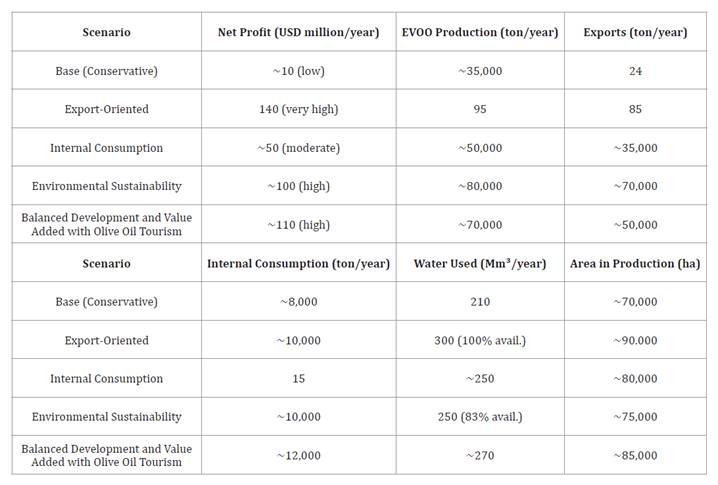
chain’s performance under various strategic priorities. Table 1
summarizes key outcomes: estimated annual net profit, total olive oil
production, exports, internal consumption, annual irrigation water usage, and
total cultivated area. For the balanced development and value added with olive
oil tourism scenario, values are hypothetical, showing the potential of this
integrated approach.
Table 1. Quantitative
performance by scenario.
Tabla 1. Rendimiento
cuantitativo por escenario.
A novel
contribution of this study is the quantitative inclusion of olive oil tourism
as a modelled variable. This expands traditional economic-environmental
analyses by incorporating territorial valorisation and rural employment,
aspects rarely integrated in optimization models of agri-food chains. The Base
(Conservative) scenario shows low profit (~US$10 million) from narrow margins
and low production (~35,000 tons). Most production (24,000 tons) is exported,
with minimal domestic consumption (8,000 tons). Despite not maxing out water
use, it’s inefficient, with high water consumption per ton and underutilized
capacity.
The Export-Oriented
scenario achieves the highest profit (US$140 million) by nearly tripling
production (95,000 tons) and massively increasing exports (85,000 tons). This
model uses maximum land (90,000 ha) and all available water (300 Mm³). While
water efficiency improves, domestic consumption barely rises, showing a strong
external market focus.
The Internal
Consumption scenario significantly boosts domestic availability, with 15,000
tons for local use, nearly doubling current levels. Total production rises to
50,000 tons, reducing exports to 35,000 tons. Net profit is US$50 million,
lower than the export scenario but much higher than the base. Water use (250
Mm³) is below maximum, and cultivated area reaches 80,000 ha. This approach
prioritizes the domestic market, accepting some trade-off in export revenue.
The Environmental
Sustainability scenario balances high production (80,000 tons) and exports
(70,000 tons) with substantial profit (US$100 million). Notably, it achieves
this while using 50 Mm³ less water than the export scenario, highlighting
water-saving technologies. Its water efficiency is highest, and it uses less
land (75,000 ha) for significant volume. Domestic consumption remains low. This
shows that high volumes are possible with reduced water impact, even if profit
is slightly lower due to initial costs or less aggressive resource use. It
demonstrates that a balanced approach yields broader benefits than maximizing a
single objective.
Finally, the
Balanced Development and Value Added with Olive Oil Tourism scenario offers a
well-rounded profile. With US$110 million profit, it produces 70,000 tons,
exporting 50,000 and allocating 12,000 to domestic consumption. Water use (270
Mm³) is efficient, and it uses 85,000 ha. While not maximizing any single
objective, it shows the chain’s ability to generate significant income and
rural employment through tourism, while performing strongly across production,
commerce, and environment (Guida-Johnson et al., 2024). The comparative
visualizations reinforce the multidimensional nature of trade-offs, directly
linking results to the five sustainability dimensions outlined in the
Introduction
Figure 1, visually compares
these scenarios using a radar chart, showing their relative performance across
five key areas: Economic Benefit, Total Production, Internal Consumption, Water
Efficiency, and Area Used. Each axis is normalized from 0 (worst) to 100 (best).
(Elaboration
based on the conceptual radar chart described in the source document)

Figure
1. Comparison of relative performance of strategic
scenarios on key criteria.
Figura
1. Comparación de desempeño relativo
de los escenarios estratégicos en criterios clave en las principales provincias
productoras.
The export-oriented scenario (orange line) excels in Economic
Benefit, Total Production, Area Used, and Water Efficiency, but lags in
Internal Consumption. The internal consumption scenario (red line) leads in
Internal Consumption, but scores lower in Economic Benefit and Water
Efficiency. The environmental sustainability scenario (magenta line) is
balanced, with high Water Efficiency and strong performance in Production, Area
Used, Economic Benefit, and Internal Consumption. The base scenario (yellow
line) consistently underperforms. The Balanced Development and Value Added with
Olive Oil Tourism scenario (blue line, hypothetical) shows solid, consistent
performance across all dimensions, including additional benefits from tourism
not directly shown here, like tourism revenues and rural employment. Figure
2, presents radar charts comparing the performance of Argentina’s
four main olive-producing provinces (Catamarca, La Rioja, Mendoza, and San
Juan) under different strategic scenarios.

Figure
2. Impacts of each scenario in the main producing
provinces.
Figura 2. Impactos
de cada escenario en las principales provincias productoras.
This visual analysis confirms that no single strategy is
universally best; the optimal choice depends on specific priorities. The
results also identify leverage points for improvement, particularly
technological reconversion in primary production to reduce unit costs,
diversification of products and markets to stabilize demand, and investment in
tourism infrastructure to enhance value creation. These elements extend beyond
descriptive analysis, offering actionable strategies for sectoral
competitiveness.
Iterations
and Sensitivity Analysis
While scenarios provide specific performance points, sensitivity
analysis and gradual iterations are crucial to understand how optimal solutions
shift with changing priorities or parameters, defining the Pareto frontier.
This helps answer questions about trade-offs, such as how much economic gain
must be sacrificed for water savings or increased domestic consumption.
Sensitivity
to Domestic Objective Weight (ωD)
Increasing the
importance of domestic consumption (ωD) in an export-focused model shows how production
shifts from external to local markets. Initially, small increases in domestic
consumption have minor profit impacts. However, pushing domestic consumption
beyond 12,000-15,000 tons leads to significant economic losses, as the model
must sacrifice profitable exports or expand production less efficiently. This
indicates diminishing returns for boosting internal consumption; a compromise
point around 12,000 tons allows maintaining about 75% of original exports.
Beyond this, each extra domestic ton roughly replaces an export ton, further
reducing profit. This analysis is vital for setting realistic domestic
consumption targets.
Sensitivity
to Water Limit (Wmax)
Reducing water
availability in the export-oriented model by 10% (from 300 Mm³ to 270 Mm³) cut
optimal production by about 15% and exports by 18%. This means a small water
reduction leads to a proportionally larger drop in exportable output, as the
model replaces water-intensive intensive hectares with less productive
traditional ones or leaves land uncultivated. In contrast, the environmental
sustainability scenario saw less than a 10% production drop with the same water
restriction, as it already operates efficiently. This suggests that
environmentally optimized olive growing is more resilient to water scarcity,
highlighting sustainability practices as enhancing operational resilience.
Impact of
International Price
A significant drop
in international olive oil prices (e.g., from US4,000
to US3,000 per ton) would drastically reduce the export-oriented model’s
profitability, potentially halving sectoral benefit. In such a case, the
optimal strategy would shift towards the domestic market, as the price
difference narrows. This suggests that promoting internal consumption can act
as a counter-cyclical policy, providing a stable domestic market buffer against
global price volatility (Pérez-Aleman, 2012).
Pareto
Analysis (Benefit vs. Water Footprint)
A Pareto analysis
showed that the first 50 Mm³ of additional water (from 200 to 250 Mm³)
significantly boost production and profit. However, beyond 250-260 Mm³, the
marginal profit from additional water diminishes, following the law of
diminishing returns. This indicates an optimal point where further water use
yields minimal economic gain, making water conservation highly justifiable.
Around 250-260 Mm³, conserving 40-50 Mm³ (about 15%) barely reduces maximum
profit by 5-10%. This provides a quantitative basis for sustainable water
management.
Land vs.
Technology (Intensive vs. Traditional Hectares)
Optimized model
runs consistently showed that intensive hectares (Hint)
are maximized before expanding traditional ones (Htrad),
as intensive systems are more resource efficient. Only when Hint
was artificially limited did the model expand Htrad
significantly, but this led to lower overall production and no
notable water savings. This confirms the importance of technological
reconversion: prioritizing modern, productive systems is more advantageous for
maximizing yield and efficiency than simply increasing cultivated land.
Sensitivity
to Olive Oil Tourism Integration
Integrating olive oil tourism allows evaluating how increased
tourism investment (Ii) impacts visitors (Ti), tourism revenues, rural
employment, and overall economic benefit. For example, analysing Mendoza’s
tourist capacity (approx. 2,500 people/day) reveals tourism growth potential
with infrastructure expansion or diversified offerings to reduce seasonality. A
Pareto analysis between tourism revenues and carbon footprint (including
transport emissions) would show trade-offs between tourism growth and
environmental goals. If olive oil tourism enhances brand image and quality
perception (e.g., through certifications), it could increase export
prices (Pexp) for
premium products, mitigating economic trade-offs and generating quantifiable
intangible benefits. Beyond direct revenue, tourism acts as a marketing
multiplier, boosting brand value and potentially increasing premium product
export prices, creating a virtuous cycle between tourism and product sales.
Overall, these
iterations demonstrate the multicriteria model’s sensitivity to varying
preferences and parameters, allowing a comprehensive exploration of how optimal
solutions shift with altered assumptions or strategic emphases, providing
valuable planning information. This sensitivity analysis not only validates the
robustness of the model but also supports the central hypothesis: balanced strategies
integrating economic, environmental and tourism variables yield more resilient
outcomes than single-objective approaches.
Discussion
The multicriteria
optimization results confirm the initial hypothesis: no single-objective
strategy is sufficient to ensure competitiveness and sustainability in
Argentina’s olive oil chain. Balanced approaches that integrate economic,
environmental and territorial objectives provide more resilient outcomes,
particularly under resource and price volatility. The Export-Oriented scenario
demonstrates the sector’s potential to generate high revenues yet reinforces
dependence on international markets and exposes vulnerability to price
fluctuations. Similar dynamics have been observed in Spain, where strong export
orientation has increased exposure to EU policy shifts and global price cycles
(IOC,
2015).
By contrast, the Internal Consumption scenario highlights opportunities for
domestic market development. Previous studies confirm that per capita
consumption below 0.3 litters is anomalously low for a producing country (Benencia
et al., 2014), suggesting that targeted campaigns and tax incentives could
unlock latent demand. The Environmental Sustainability scenario reveals that
water and energy-efficient technologies allow significant production while
reducing resource pressure. Comparable findings have been reported in Portugal,
where reconversion to super-intensive systems doubled yields while reducing unit
costs (Branquinho
et al., 2021). The novelty of this study lies in the Balanced Development
with Olive Oil Tourism scenario, which integrates agricultural and
service-based activities. Olive oil tourism has been qualitatively addressed in
prior works (Enolife,
2025),
but this model quantitatively demonstrates its capacity to generate revenues,
rural employment and territorial branding. From a broader perspective, the
olive oil chain should be understood as an agri-food network or “entramado”,
not just a linear chain (Díaz-Chao et al., 2016). This resonates
with bioeconomy approaches that emphasize valorisation of biomass and
by-products, ranging from pomace energy use to ecosystem services.
Incorporating this perspective enriches the interpretation of results:
scenarios that prioritize diversification, circular use of resources and
tourism services achieve more robust territorial impacts. Overall, the findings
demonstrate that policy strategies for the olive oil sector must balance
profitability, sustainability and territorial development. These results
contribute to the literature on multicriteria programming applied to agri-food
systems by explicitly incorporating tourism and territorial valorisation (Millán-Vázquez
de la Torre et al., 2017). They also provide actionable insights for public policy,
suggesting that integrated sectoral planning should foster innovation,
sustainability and experiential marketing as complementary drivers of
competitiveness. The acknowledgment of these biomass valorisation
pathways reinforces the interpretation of the olive oil chain as a bioeconomic
network, extending its impact beyond oil production toward energy,
environmental services, and territorial development.
Recommendations
Strengthen
The Domestic Market
• Increase per capita consumption (≈0.3-0.5 kg) through fiscal
incentives, educational campaigns and promotional programs.
• This provides a buffer against international price volatility.
Promote
Technological Reconversion
• Modernize groves
(super-intensive systems, mechanization, replanting).
• Reduces unit costs and improves competitiveness, following
experiences in Chile and Portugal (Vargas & Garrido, 2019).
Diversify
Products And Markets
• Expand exports beyond Brazil/USA toward emerging markets
(China, India) and regional partners (Mexico, Colombia).
• Prioritize
bottled EVOO under Argentine brands to capture more value.
Leverage
Sustainability As Opportunity
• Implement
certifications (organic, carbon-neutral, GAP).
• Access premium
markets and align with global consumer trends.
Ensure
Efficient Water Use
• Generalize technified irrigation, promote wastewater reuse and
solar-powered pumping.
• Avoid exceeding
thresholds where marginal returns diminish.
Integrate
Olive Oil Tourism Strategically
• Develop routes,
infrastructure and certified experiences.
• Generates rural
employment, strengthens territorial identity and enhances brand value.
• Promote
sustainable practices to minimize environmental trade-offs.
Conclusions
The results of the multicriteria programming model confirm that
no single-objective strategy is sufficient to ensure competitiveness and
sustainability in Argentina’s olive oil chain. Instead, a balanced approach
-integrating economic profitability, technological reconversion, environmental
sustainability and tourism- yields the most resilient outcomes under volatile
market and resource conditions. The analysis highlights three key findings:
Technological reconversion in primary production is the most effective lever
for reducing costs and improving international competitiveness. Domestic market
development is feasible up to moderate levels, strengthening resilience without
severely compromising export revenues. Olive oil tourism, when modelled
quantitatively, emerges as a central driver of value creation, rural employment
and territorial branding. These findings validate the initial hypothesis:
balanced strategies outperform purely export-oriented or consumption-focused
approaches. They also expand the literature by incorporating tourism and
territorial valorisation into an optimization framework, offering a broader
bioeconomic interpretation of value chains. Finally, the study provides
actionable insights for public policy and sectoral planning: fostering
innovation, sustainability and experiential marketing can consolidate
Argentina’s olive oil sector as a competitive and resilient player in global
markets.
Benencia, R.,
Quaranta, G., & Pedreño Cánovas, A. (2014). Mercados de trabajo,
instituciones y trayectorias en distintos escenarios migratorios. Ediciones
CICCUS.
Branquinho, S.,
Rolim, J., & Teixeira, J. L. (2021). Climate Change Adaptation Measures in
the Irrigation of a Super-Intensive Olive Orchard in the South of Portugal. Agronomy,
11(8), 1658. https://doi.org/10.3390/agronomy11081658
CREA. (2021). Reporte
de actualidad agro. Movimiento CREA. https://proyectos.crea.org.ar/
reporte-de-actualidad-agro/
Díaz-Chao, Á.,
Sainz-González, J., & Torrent-Sellens, J. (2016). The competitiveness of
small network-firm: A practical tool. Journal of Business Research, 69(5),
1867-1872. https:// doi. org/10.1016/j.jbusres.2015.10.053
Enolife. (21 de
mayo de 2025). Mendoza ya tiene 21 almazaras y olivares que ofrecen
oleoturismo. Enolife.com.ar. https://enolife.com.ar/es/mendoza-ya-tiene-21-almazaras-y-olivares-que-ofrecen-oleoturismo-con-120-000-visitantes-al-ano/
García-Cascales, M.
S., Molina-García, A., Sánchez-Lozano, J. M., Mateo-Aroca, A., & Munier, N.
(2021). Multi-criteria analysis techniques to enhance sustainability of water
pumping irrigation. Energy Reports, 7, 4623-4632.
https://doi.org/10.1016/j.egyr.2021.07.026
Guida-Johnson, B.;
Vignoni, A. P.; Migale, G. M.; Aranda, M. A.; Magnano, A. 2024. Rural
abandonment and its drivers in an irrigated area of Mendoza (Argentina). Revista de la Facultad de Ciencias Agrarias.
Universidad Nacional de Cuyo. Mendoza. Argentina. 56(1): 35-47. DOI:
https://doi.org/10.48162/rev.39.121
INDEC. (2019).
Censo Nacional Agropecuario 2018: Resultados finales.
https://www.indec.gob.ar/indec/web/Nivel4-Tema-3-8-71
International Olive
Oil Council. (2015). Estudio internacional sobre los costes de producción
del aceite de oliva.
https://www.internationaloliveoil.org/wp-content/uploads/2019/11/ESTUDIO-INTERNACIONAL-SOBRE-COSTES-DE-PRODUCCI%C3%93N-DEL-ACEITE-DE-OLIVA.pdf
International Olive
Oil Council. (n.d.). International Olive Oil Council. https://www.internationaloliveoil.
org/
Millán-Vázquez de
la Torre, M. G., Arjona-Fuentes, J. M., & Amador-Hidalgo, L. (2017). Olive
oil tourism: Promoting rural development in Andalusia (Spain). Tourism
Management Perspectives, 21, 100-108. https://doi.org/10.1016/j.tmp.2016.12.003
MAGyP (Ministerio
de Agricultura, Ganadería y Pesca). (2023). Informe
síntesis. Economía regional Olivo. 1-13.
https://alimentosargentinos.magyp.gob. ar/HomeAlimentos/economias-regionales/producciones-regionales/informes/INFORME_
DE_Olivo2023.pdf
Ministerio de
Economía de la República Argentina. (2024). Informe sectorial: Olivícola (Año
9 N° 80).
https://www.argentina.gob.ar/sites/default/files/informe_sectorial_olivo.pdf
Pérez-Aleman, P.
(2012). Global standards and local knowledge building: Upgrading small
producers in global value chains. Proceedings of the National Academy of
Sciences, 109(31), 12344-12349. https://doi.org/10.1073/pnas.1000968108
Romero, C. (1993). Teoría
de la decisión multicriterio: conceptos, técnicas y aplicaciones. Alianza
Editorial.
Stark, S.,
Biber-Freudenberger, L., Dietz, T., Escobar, N., Förster, J., Henderson, J.,
Laibach, N., Börner, J. (2022). Sustainability implications of transformation
pathways for the bioeconomy. Science Direct, 29, 215-227.
https://doi.org/10.1016/j.spc.2021.10.011
Vargas, R., & Garrido, A. (2019). Competitiveness of
Mediterranean olive oil production: A comparative analysis of Spain and
Portugal. Spanish Journal of Agricultural Research, 17(4), e0112.
https://doi.org/10.5424/sjar/2019174-14535