Rev. FCA UNCuyo | 2026 | 58(2) | ISSN 1853-8665
Production and animal health
https://doi.org/10.48162/rev.39.228
Heat Stress During the Dry Period in Crossbred Dairy Cows and its Impact on Subsequent Productive and Reproductive Performance
Estrés por calor durante el periodo seco en vacas lecheras y su impacto en el rendimiento productivo y reproductivo de la lactancia siguiente
Andrés Santiago Jácome-Aucay 1*,
Ermes R. Rodas 2,
Ernesto Quercia 3,
Nicolás Lopez-Villalobos 4,
1 Universidad Nacional de Rosario. Facultad de Ciencias Veterinarias. BV. Ovidio Lagos y Ruta 33. s/n. C. P S2170HGJ. Casilda. Santa Fe. Argentina.
2 Universidad de Cuenca. Facultad de Ciencias Agropecuarias. Cuenca. Av. 12 de Octubre y Diego de Tapia. s/n. C. P. 10101 Cuenca. Azuay. Ecuador.
3 Estancia La Cabañita S. A. Zona rural s/n. C. P. 3023. Hipatia. Santa Fe. Argentina.
4 Massey University. Institute of Veterinary. Animal and Biomedical Sciences. Tennent Drive, Private bag 11 222. Palmerston North 4410. New Zealand.
5 Universidad Nacional de Rosario. Facultad de Ciencias Veterinarias. Cátedra de Producción de Bovinos Lecheros.
6 Universidad Nacional de Rosario. Carrera del Investigador Científico. Maipú 1065. 2do piso. Oficina 209. C. P. S2000. Rosario. Santa Fe. Argentina.
* andrestvet.jacome@hotmail.com
Abstract
The dry period of a dairy cow is the time between the end of one lactation (when the cow is no longer milking) and the start of the next calving and lactation. The objective of this study was to evaluate the effect of heat stress during the dry period on milk production and reproductive performance during the first 100 days of the subsequent lactation in crossbred dairy cows managed in a pasture-based herd in Santa Fe, Argentina. Ninety-five multiparous cows were classified into three groups based on their exposure to heat stress: no stress, low stress, and high stress. Cows in the no stress group produced 274 kg more milk than those in the high stress group (P < 0.05) and showed higher conception rate at first service (P < 0.05). Heat stress during the dry period negatively affected early productive and reproductive performance, emphasizing the importance of mitigating heat stress in dry cows under pasture-based systems.
Keywords: heat stress, pasture-based, crossbreeding, THI, reproductive efficiency, milk production
Resumen
El período seco en vacas lecheras corresponde al intervalo entre el final de una lactancia (cuando la vaca deja de ser ordeñada) y el inicio del siguiente parto y lactancia. El objetivo del presente estudio fue evaluar el impacto del estrés por calor durante el período seco en vacas lecheras cruzas sobre la producción de leche y la eficiencia reproductiva durante los primeros 100 días de la lactancia siguiente, en un sistema de pastoreo en la provincia de Santa Fe, Argentina. Se evaluaron 95 vacas multíparas, clasificadas en tres grupos según su nivel de exposición al estrés térmico: sin estrés, bajo estrés y alto estrés. Las vacas del grupo sin estrés produjeron 274 kg más de leche en comparación con aquellas del grupo con alto estrés (P < 0.05) y presentaron una mayor tasa de concepción al primer servicio (P < 0,05). El estrés por calor durante el período seco afectó negativamente el desempeño productivo y reproductivo temprano, lo que resalta la importancia de implementar estrategias de mitigación del estrés térmico en vacas secas manejadas bajo sistemas pastoriles.
Palabras clave: estrés por calor, pastoreo, cruzamientos, ITH, eficiencia reproductiva, producción lechera
Introduction
Global warming is one of the main challenges for livestock production in the 21st century, its impact advancing at an unprecedent rate (IPCC, 2023). In 2022, the increase in global temperature reached approximately 1.3°C compared with the previous century. As a result, episodes of extreme heat are becoming more frequent, more intense and longer (IPCC, 2023). A moderate rise in temperature during the coldest time of the year may enhance milk production and pasture biomass in grazing systems (Cañete et al., 2025; Phelan et al., 2016). However, in warmest times this increase has direct negative effects on dairy production by intensifying the impact of heat stress (HS) in dairy cows (Mylostyvyi & Chernenko, 2019). According to Veissier et al. (2018) the effects of HS due to high temperatures are expected to be more severe in grazing systems, because the cows are directly exposed to the environment and solar radiation.
The impacts of HS have been studied in all stages of lactation in dairy cows. Lactating cows affected by HS exhibited reduced milk, impaired immune function, poor reproductive performance and increased disease incidence (Tao et al., 2020). Similarly, dry cows exposed to HS have shown decreased milk yield in the underlaying lactation, impaired immune response during the transition period and more days open (Fabris et al., 2019; Tao et al., 2011). Moreover, it has been demonstrated that HS during the dry period resulted in a reduction in dairy industry performance comparable to that of HS during lactation, with estimated losses of up to US 810 million annually in the United States when no heat stress mitigation strategies were implemented (Ferreira et al., 2016).
In Argentina, dairy cows are exposed to HS for at least 100 days per year in the most important dairy regions (Lazzarini et al., 2024). However, limited information is available regarding the effects of HS on milk production and reproductive efficiency in grazing dairy systems in the Pampa region of Argentina. The aim of this study was to evaluate the impact of heat stress during the dry period in a pasture-based system on milk production and reproductive efficiency during the first 100 days of lactation in triple crossbreed dairy cows in the province of Santa Fe.
Materials and Methods
Study Site and General Farm Description
This observational study included 95 multiparous dairy cows (3.2 ± 1 calvings) that underwent a dry period between February and May 2024 on a commercial dairy farm in the province of Santa Fe, Argentina (58 meters above sea level; latitude: -32.1211 N; longitude: -61.0614 E). The farm operates under a pasture-based system, with paddocks primarily composed of alfalfa pasture (Medicago sativa L.) and seasonal forage crops. The estimated average daily forage allowance of 20 ± 1 kg of dry matter per cow. Conserved forages and concentrates were also supplied to meet the nutritional requirements of the lactating cows. Forages and concentrates were delivered twice daily in feed bunks, prior to pasture access.
The herd averaged approximately 1,100 lactating cows annually, and individual animal performance was monitored through routine milk recording using farm management software. This study was observational and based on existing farm production and reproductive records; therefore, no experimental procedures were performed on animals. A seasonal breeding program was implemented from May to October based on visual estrus detection (twice daily before each milking), prostaglandin treatments, and fixed-time artificial insemination protocols. All cows were inseminated under a three-breed rotational crossbreeding scheme involving Holstein, Jersey and Montbeliarde breeds. Cows were classified into three breed groups according to the dominant breed (≥66% Holstein, ≥66% Jersey and ≥66% Montbeliarde).
At dry-off, cows were moved to paddocks with similar characteristics to those allocated to lactating cows. There were no active cooling systems and natural shade was insufficiently limited to scattered trees. In contrast, lactating cows were exposed to fans and sprinklers in the milking parlor, which operated automatically during hot season to reduce the heat load. Water was available ad libitum all times. These conditions represent typical management practices in commercial pasture-based dairies of the region, where the mitigation of HS in the paddock relies in natural ventilation and grazing schedules. The dry cows remained in the paddocks until 23 ± 7 days before their expected calving date, when they were moved to prepartum pens. In the prepartum period, cows were fed a diet consisting of corn silage, soybean expeller, ground corn, soybean hulls, hay and anionic salts, with no grazed grass. The daily ration corresponded to 2% of body weight and was provided two times per day. Milk production and reproductive performance data during the first 100 days of the subsequent lactation were obtained from dairy management software Protambo Master (Version 4.0 DIRSA, Buenos Aires, Argentina).
Ambient temperature and humidity data were obtained from NOAA Global Forecast System (GFS) website, which provides global atmospheric, and wave forecast with a spatial resolution of 13 km. This updates every 6 hours (00:00, 06:00, 12:00 and 18:00).
Heat Stress Determination Based on Temperature-Humidity Index
Daily THI values were calculated using data obtained from the GFS data set, and these values were used to determine the number of heat stress days experienced during the dry period. The Temperature-Humidity Index (THI) was calculated using the equation described by Mader et al. (2006):
THI = (0.8 × AT) + [(RH/100) × (AT - 14.4)] + 46.4
where:
AT = ambient temperature (°C)
RH = relative humidity (%).
All cows were managed under the same environmental and management conditions during the dry period. No specific heat stress mitigation strategies were implemented for dry cows. Therefore, the classification into heat stress groups was performed retrospectively based on the numbers of days that THI exceed the threshold of 72 during the dry period for each cow.
Cows were classified into three groups based on their THI exposure the dry period as: No stress (NS; THI <72 throughout the entire dry period), low stress (LS; THI >72 for fewer than 10 days) and high stress (HS; THI >72 for more than 10 days). These specific THI categories were selected to resemble previous studies conducted under moderate milk production and similar environmental conditions (Roman et al., 2019). The 10-day cutoff was established to reflect the management conditions of the commercial dairy farm where the study was conducted.
Estimation of Milk Production During the First 100 Days of Lactation
Total milk yield during the first 100 days in milk (100d-milk) was estimated using a third-order orthogonal polynomial fitted individually for each cow, as described by Lembeye et al. (2016). The polynomial was defined as:
Yt = α0P0 + α1P1t + α2P2t + α3P3t
where:
αi = regression coefficients for milk production. The Legendre polynomial functions were calculated as follows:
P0t = 1, P1t = xt, P2t = ½ (3xi2 – 1), P3t = ½ (5xt3 - 3xt)
where:
xt = -1 + 2 × (t - 1)/ (100 - 1).
The reproductive variables analyzed within the first 100 days in milk were: days to first service, conception rate and conception rate at the first service. Five cows that were not inseminated due to culling were excluded from the analysis.
Statistical Analysis
All statistical analyses were performed using SAS software version 9.4 software (SAS Institute Inc., Cary, NC, USA) with the following linear model:
yijkl = μ + Si + Bj + Ck + β1Lijkl + β2L2ijkl + β3Dijkl + eijkl
where:
yijkl = response variable
μ = general mean
Si = effect of the ith class of heat stress group (high stress, low stress or no stress)
Bj = effect of the jth breed group (Holstein, Jersey and Montbeliarde)
Ck = effect of the kth class of calf sex (male and female)
L = lactation number
D = number of days in dry period
β1 and β2 = regression coefficients associated with the linear and quadratic effects of lactation number
β3 = regression coefficient associated with the linear effect of number of days in dry period
eijkl = residual error.
Milk production was assumed to have a normal distribution and analyzed with the MIXED procedure. Means and standard errors were obtained and used for multiple mean comparisons using the Fisher’s LSD test. Days to first insemination had a skewed distribution and analyzed with the GLIMMIX procedure after a logarithm transformation. Means and standard errors were back transformed for presentation. Conception rate within the first 100 days and conception rate at first service had a binomial distribution and were analyzed with the GLIMMIX procedure after a logit transformation. Means and standard errors were back transformed for presentation.
Results
In total 95 cows were included, where 47 cows (49%) were exposed to HS, 13 cows experienced LS (14%) and 35 cows with NS (37%). The descriptive statistics as means, standard deviations, and the F-values and associated probabilities for dependent variables are shown in table 1. Average milk production during the first 100 days was 2,976 kg per cow. Days to first insemination was 61 days with the pregnancy rate at first service of 43%, and pregnancy rate within the first 100 days in milk was 63%.
Table 1. Mean, standard deviation and F-values of milk production and reproductive variables within first 100 days in milk in crossbred dairy cows managed in a pasture-based system.
Tabla 1. Media, desviación estándar y F-values producción de leche y variables reproductivas en los primeros 100 días de lactancia en vacas lecheras triple cruza a pastoreo.
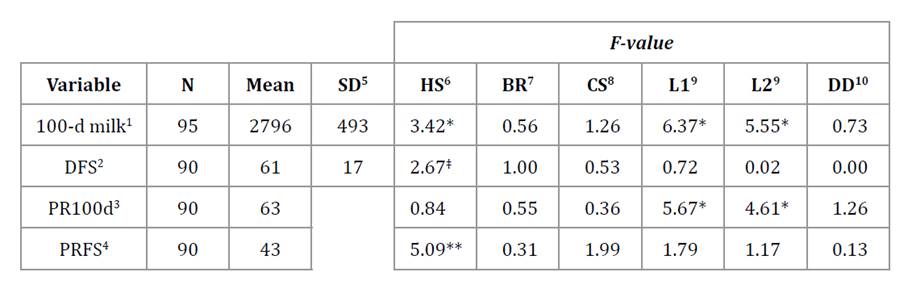
1 100-d milk = milk production within first 100 days in milk. 2 DFS = days at the first service. 3 PR100d = pregnancy rate within first 100 days in milk. 4 PRFS = pregnancy rate at first service. 5 SD= standard deviation. 6 HS = heat stress group. 7 BR: representing the dominant breed in each cow (≥66% Holstein, ≥66% Jersey, ≥66% Montbeliarde). 8 CS = sex of calf. 9 L1 and L2 Linear and quadratic effect of lactation number. 10 DD=number of days of dry period. Statistical significance is given as: ‡P < 0.10; *P <0.05; **P < 0.01.
1 100-d milk = producción de leche en los primeros 100 días de lactancia. 2 DFS = días al primer servicio. 3 PR100d = taza de preñez en los primeros 100 días de lactancia. 4 PRFS = taza de preñez al primer servicio. 5 SD = desviación estandar. 6 GEC = Grupo estrés por calor. 7 BR: representa la raza dominante en cada vaca (≥66% Holstein, ≥66% Jersey, ≥66% Montbeliarde). 8 CD = sexo de la cría. 9 L1 y L2 = Efecto lineal y cuadrático del número de lactancia. 10 DD= número de días del periodo seco. Diferencias estadísticas dadas como: ‡P < 0,10; *P <0,05; **P < 0,01.
The heat-stress group has a decreased effect in estimated milk production (P < 0.05) and pregnancy rate at first service (P < 0.01). Although there was not an effect of heat stress on days at first insemination, a trend was observed (P = 0.07). Linear and quadratic effects of lactation number were significant on milk production (P < 0.05) and pregnancy rate (P < 0.05) in the first 100 days. Breed and dry period length had no significant effect on all response variables in this study.
Table 2 presents the least squares means and standard errors of all dependent variables for different factors considered as class factors in the model. Cows in NS group produced 274 kg more milk than cows exposed to high heat stress (P < 0.05). Although cows with low heat stress showed an average increase of 2 kg per day compared with cows with high stress, this difference was not statistically significant. Cows in non-HS group had a significantly shorter time to first artificial insemination compared to cows in high HS group (P < 0.05). Cows in the low HS group did not differ significantly from those in the high HS group. Conception rate within the first 100 DIM did not differ statistically among the HS groups. Nevertheless, the conception rate at first service was higher in non-HS group compared with high HS group (P < 0.01). The low HS group did not show any difference compared to either of the other HS groups.
Table 2. Least squares (±SE) of milk production and reproductive variables within first 100 days in milk for different factors in crossbred dairy cows managed in a pasture-based system.
Tabla 2. Cuadrados mínimos (±EE) para producción de leche y variables reproductivas dentro de los primeros 100 días en lactancia para diferentes factores en vacas lecheras triple cruza a pastoreo.
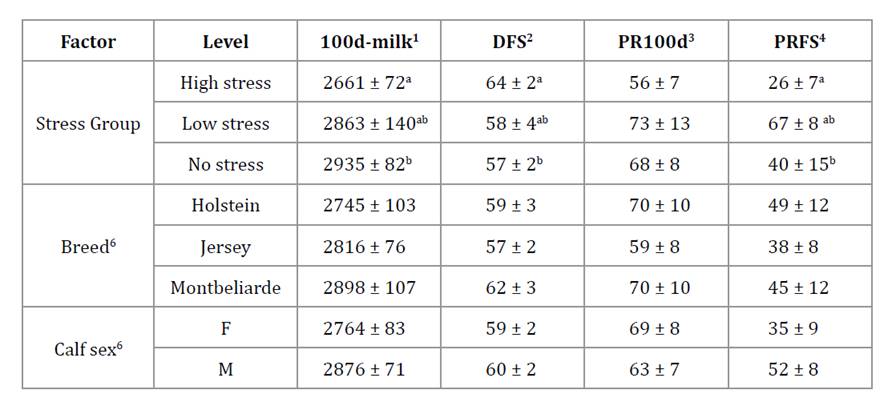
1 100-d milk = milk production within first 100 days in milk. 2 DFS = days at the first service. 3 PR100d = pregnancy rate within first 100 days in milk. 4 PRFS = pregnancy rate at first service. 5 Breed = representing the dominant breed in each cow (≥66% Holstein, (≥66% Jersey, (≥66% Montbeliarde). 6 Calf sex = represent M for male and F for female calves. a, b Least squares means with different superscripts within effect, are significantly different (P < 0.05).
1 100-d milk = producción de leche en los primeros 100 días de lactancia. 2 DFS = días al primer servicio. 3 PR100d = taza de preñez en los primeros 100 días de lactancia. 4 PRFS = taza de preñez al primer servicio. 5 Breed: representa la raza dominante en cada vaca (≥66% Holstein, ≥66% Jersey, ≥66% Montbeliarde). 6 Calf sex = representa sexo de la cría, M para macho y F para hembra. a, b Cuadrados mínimos con diferentes superíndices dentro de efecto son significativamente diferentes (P < 0,05).
Discussion
Milk Production
Heat stress has long been recognized as one of the major stressors affecting productivity and reproductive performance in lactating dairy cows (Collier et al., 2017). The factors that significantly affected 100d-milk were heat stress and linear and quadratic lactation number. Lactation numbers may also influence the response to heat stress. Multiparous cows typically have greater milk production and metabolic heat production compared with younger animals, which may increase their susceptibility to heat stress (Collier et al., 2017). Therefore, physiological status should be considered when evaluating the effects of heat stress on productive performance. The effect of HS during the dry period is consistent with findings from other studies conducted under different conditions, such as intensive systems. Fabris et al. (2017) reported that cows exposed to HS (THI > 68) during the dry period produced less milk compared to cooled cows with fans and nebulizers. In that study, during the first 9 weeks of lactation, heat-stressed cows produced approximately 4.8 kg less milk per day than those managed under cooling conditions. In our study, cows exposed to high HS (26 ± 8 days) produced less milk than those that were without HS during the dry period. These results may be explained by thermoregulatory adaptations such as reduced metabolic rate, higher vasodilation and increased respiration (Collier & Gebremendhin, 2015; Renaudeau et al., 2012), as well as altered grazing behavior (Jurkovich et al., 2024; Morales-Piñeryrúa et al., 2022). All these changes may increase energy demand and compromise milk production.
It is also important to consider that the classification of heat stress exposure during the dry period was inherently associated with the timing of the dry period, which may introduce potential confounding with seasonal conditions. Although all animals in this study were managed within the same commercial farm under similar nutritional and management conditions, environmental factors such as forage availability, solar radiation, and photo period inevitably varied across the study period.
To evaluate this potential limitation, we explored the inclusion of the start date of the dry period as a covariate using cyclical transformations of the day of year to account for seasonal variation. However, this approach resulted in substantial collinearity with the heat stress classification, leading to reduced model interpretability. Consequently, it was not possible to clearly disentangle the independent effects of heat stress and seasonal conditions within the same model. These findings highlight the inherent challenges of studies where environmental and seasonal factors are closely intertwined. Therefore, the observed effects of heat stress should be interpreted considering that part of the variation may also reflect underlying seasonal influences, even under relatively uniform management conditions.
Differences in heat tolerance among breeds may also influence the response to heat stress. Previous studies have reported that breeds tend to be more heat tolerant than Holstein cows due to their lower metabolic heat production (Hansen, 2004). In crossbreeding systems, the combination of breeds may provide resilience to environmental stressors. However, in the present study breed composition did not significantly affect milk production or reproductive variables during first 100 days of lactation.
Reproductive Variables
Cows in the non-HS group had a significantly shorter interval of days to first artificial insemination than cows in the high HS group (57 vs 64 days respectively). Additionally, lactation number was a factor that significantly affected this dependent variable.
The negative effects of HS on reproductive performance in dairy cows have been well documented, both during lactation and the dry period. Heat stress affected estrus expression (Roth, 2020), calving conception interval and conception rate (Penev et al., 2021). A study conducted in Holstein cows in commercial dairy farms (Thompson & Dahl, 2012) reported that cows undergoing a dry period during the summer months had significantly poorer reproductive outcomes than those dried off during cooler months, in terms of days to first service (97.0 ± 0.74 vs. 91.8 ± 0.92) and days to pregnancy (131.1 ± 0.085 vs 125.9 ± 1.06), respectively. Interval of days to pregnancy was not evaluated in the present study, but similar results were observed in terms of days to first service; cows exposed to high HS had longer time to first service compared to cows with non-HS cows, which is consistent with findings of Thompson & Dahl (2012), although the absolute values observed in our study were lower. This difference may be related to the sample size, the average milk production of the cows, and to the crossbred nature of the herd.
Conception rate within the first 100 days of lactation did not differ statistically among the HS groups. These results suggest that the overall ability to conceive within the 100-day window was not significantly impaired. However, the conception rate at first insemination was higher in the non-HS group compared with the high HS group.
In lactating dairy cows, conception rates have been shown to drop from 14% to 27% when animals experience HS in days prior to insemination, whereas cows not exposed to HS can reach conception rates of up to 71% (Schüller et al., 2014). A study in Holstein cows exposed to HS during the dry period (Avedaño-Reyes et al., 2010) found that although climatic variables did not significantly affect days open or number of services per conception, cows that calved during the warmest months of the year required 0.68 to 1.46 more services per conception, this being statistically significant. These findings are consistent with the present study, which also found no significant differences in overall conception rate within the first 100 days of lactation, however, differences on the number of services per conception were observed depending on HS exposure. On the other hand, the significant differences observed in conception rate at first service highlight that HS directly compromises the success of the first insemination, due to reduced ovulation rates, lower oocyte quality, or impaired uterine environment (De Rensis & Scaramuzzi, 2003).
From a management perspective, several strategies have been proposed to mitigate heat stress in dairy production systems, including shade structures, improved ventilation, sprinklers, and adjustments in grazing schedules (Oliveira et al., 2025). In pasture-based systems such as the one evaluated in this study, the availability of shade and adequate access may play an important role in reducing the impact of heat stress during the dry period. Those strategies applied for dry cows could help performance of dairy cows in the subsequent lactation.
Conclusions
Heat stress during the dry period of dairy cows in pasture-based dairy systems negatively affected both productive and reproductive efficiency. These findings highlight the importance of minimizing heat stress events during the dry period of the cows. This may ensure optimal milk production and reproductive performance in the subsequent lactation, while reducing costs associated with extended days open and reduced pregnancy at first lactation. Future studies should evaluate the effects of HS on animal welfare, effectiveness and economic feasibility of mitigating those strategies in pasture-based systems of subtropical regions.
Acknowledgements
The authors acknowledge the “la Cabañita” dairy farm for giving access to the data and allowing to use it for research.
Avendaño-Reyes, J., Fuquay, J. W., Moore, R. B., Liu, Z., Clark, B. L. & Vierhout, C. (2010). Relationship between accumulated heat stress during the dry period, body condition score, and reproduction parameters of Holstein cows in tropical conditions. Tropical Animal Health and Production, 42(2), 265-273. https://doi.org/10.1007/s11250-009-9415-7
Cañete, V.; Lazzarini, B.; Alesso, A.; Baudracco, J.; Marini, P. R. (2025). Milk Production, Age at First Calving, and Calving-to-Conception Interval in Holstein, Brown Swiss, and Holstein x Brown Swiss Cows. Revista de la Facultad de Ciencias Agrarias. Universidad Nacional de Cuyo. 57(2): 148-154. DOI: https://doi.org/10.48162/rev.39.178
Collier, R. J. & Gebremedhin, K. G. (2015). Thermal biology of domestic animals. Annual Review of Animal Biosciences, 3, 513-532. https://doi.org/10.1146/annurev-animal-022114-110659
Collier, R. J., Renquist, B. J., & Xiao, Y. (2017). A 100-Year Review: Stress physiology including heat stress. Journal of Dairy Science, 100(2), 10367-10380.
De Rensis, F. & Scaramuzzi, J. R. (2003). Heat stress and seasonal effects on reproduction in the dairy cow - a review. Theriogenology, 60, 1139-1151. https://doi.org/doi:10.1016/S0093-691X(03)00126-2
Fabris, T. F., Laporta, J., Corra, F. N., Torres, Y. M., Kirk, D. J., McLean, D. J., Chapman, J. D. & Dahl, G. E. (2017). Effect of nutritional immunomodulation and heat stress during the dry period on subsequent performance of cows. Journal of Dairy Science, 100(8), 6733-6742. https://doi.org/10.3168/jds.2016-12313
Fabris, T. F., Laporta, J., Skibiel, A. L., Corra, F. N., Senn, B. D., Wohlgemuth, S. E. & Dahl, G. E. (2019). Effect of heat stress during early, late, and entire dry period on dairy cattle. Journal of Dairy Science, 102(6), 5647-5656. https://doi.org/10.3168/jds.2018-15721
Ferreira, F. C., Gennari, R. S., Dahl, G. E. & De Vries, A. (2016). Economic feasibility of cooling dry cows across the United States. Journal of Dairy Science, 99(12), 9931-9941. https://doi.org/10.3168/jds.2016-11566
Hansen, P. J. (2004). Physiological and cellular adaptations of zebu cattle to thermal stress. Animal Reproduction Science, 82, 349-360. https://doi.org/10.1016/j.anireprosci.2004.04.011
IPCC. (2023). Current status and trends. In Climate Change 2023: Synthesis Report. Lee H. & Romero, J. (eds), pp. 42-66. https://doi.org/10.59327/IPCC/AR6-9789291691647
Jurkovich, V., Hejel, P. & Kovács, L. (2024). A Review of the Effects of Stress on Dairy Cattle Behaviour. Animals, 14(14), 2038. https://doi.org/10.3390/ani14142038
Lazzarini, B., Llonch, P. & Baudracco, J. (2024). Animal welfare on Argentinean dairy farms based on the Welfare Quality® protocol framework. Journal of Animal Behaviour and Biometeorology, 12(2): e20244010. https://doi.org/10.31893/jabb.2024010
Lembeye, F., López-Villalobos, N., Burke, J. L., Davis, S. R., Richardson, J., Sneddon, N. W. & Donaghy, D. J. (2016). Comparative performance in Holstein-Friesian, Jersey and crossbred cows milked once daily under a pasture-based system in New Zealand. New Zealand Journal of Agricultural Research, 59, 351-362. https://doi.org/10.1080/00288233.2016.1207669
Mader, T. L., Davis, M. S. & Brown-Brandl, T. (2006). Environmental factors influencing heat stress in feedlot cattle 1,2. Journal of Animal Science, 84, 712-719.
Morales-Piñeyrúa, J. T., Damián, J. P., Banchero, G. & Sant`Anna, A. C. (2022). The effects of heat stress on milk production and the grazing behavior of dairy Holstein cows milked by an automatic milking system. Journal of Animal Science, 100(9), 1-4. https://doi.org/10.1093/jas/skac225
Mylostyvyi, R. & Chernenko, O. (2019). Correlations between environmental factors and milk production of holstein cows. Data, 4(3). https://doi.org/10.3390/data4030103
Oliveira, C. P., Sousa, F. C. d., Silva, A. L. d.., Schultz, E. B., Valderrama-Londoño, R. I., Souza, A. R. (2025). Heat Stress in Dairy Cows: Impacts, Identification, and Mitigation Strategies - A Review. Animals, 15(2), 249. https://doi.org/10.3390/ani15020249
Penev, T., Dimov, D., Vasilev, N., Mitev, J., Miteva, Tch., Marinov, I. & Stojnov, M. (2021). Influence of heat stress on reproductive performance in dairy cows and opportunities to reduce its effects -A review. Agricultural Science and Technology, 13(1), 3-11. https://doi.org/10.15547/ast.2021.01.001
Phelan, P., Morgan, E. R., Rose, H., Grant, J. & O’Kielly, P. (2016). Predictions of future grazing season length for European dairy, beef and sheep farms based on regression with bioclimatic variables. Journal of Agricultural Science, 154(5), 765-781. https://doi.org/10.1017/S0021859615000830
Renaudeau, D., Collin, A., Yahav, S., De Basilio, V., Gourdine, J. L. and Collier, R. J. (2012). Adaptation to hot climate and strategies to alleviate heat stress in livestock production. Animal, 6, 707-728. https://doi.org/10.1017/S1751731111002448
Roman, L., Saravia, C., Astigarraga, L., Betancour, O. & La Manna, A. (2019). Shade access in combination with sprinkling and ventilation effects performance of Holstein cows in early and late lactation. Animal Production Science, 59(2), 347-358. https://doi.org/10.1071/AN16571
Roth, Z. (2020). Reproductive physiology and endocrinology responses of cows exposed to environmental heat stress - Experiences from the past and lessons for the present. Theriogenology, 155, 150-156. https://doi.org/10.1016/j.theriogenology.2020.05.040
Schüller, L. K, Burfeind, W. & Heuwieser, W. (2014). Impact of heat stress on conception rate of dairy cows in the moderate climate considering different temperature-humidity index thresholds, periods relative to breeding, and heat load indices. Theriogenology, 81, 1050-1057.
Tao, S., Bubolz, J. W., do Amaral, B. C., Thompson, I. M., Hayen, M. J., Johnson, S. E. & Dahl, G. E. (2011). Effect of heat stress during the dry period on mammary gland development. Journal of Dairy Science, 94(12), 5976-5986. https://doi.org/10.3168/jds.2011-4329
Tao, S., Orellana-Rivas, R. M., Marins, T. N., Chen, Y. C., Gao, J. & Bernard, J. K. (2020). Impact of heat stress on lactational performance of dairy cows. Theriogenology, 150, 437-444. https://doi.org/10.1016/j.theriogenology.2020.02.048
Thompson, I. M. & Dahl, G. E. (2012). Dry-period seasonal effects on the subsequent lactation. The Professional Animal Scientist, 28, 628-631.
Veissier, I., Van laer, E., Palme, R., Moons, C. P. H., Ampe, B., Sonck, B., Andanson, S. & Tuyttens, F. A. M. (2018). Heat stress in cows at pasture and benefit of shade in a temperate climate region. International Journal of Biometeorology, 62, 585-595. https://doi.org/10.1007/s00484-017-1468-0