Rev. FCA UNCuyo | 2026 | 58(2) | ISSN 1853-8665
Genetics and Plant Breeding
https://doi.org/10.48162/rev.39.224
Induction of Genetic Variability in Cosmos atrosanguineus (Hook.) Voss by Gamma Irradiation: A Model for Conserving Mexican Endemic Species
Inducción de variabilidad genética en Cosmos atrosanguineus (Hook.) Voss mediante irradiación gamma: un modelo para conservar especies endémicas mexicanas
Rosa Isela Martínez-Contreras 1,
José Luis Rodríguez-de la O 1,
María Teresa Beryl Colinas y León 1,
Guadalupe Stefanny Aguilar Moreno 2*
1 Universidad Autónoma Chapingo. Departamento de Fitotecnia. Carretera México-Texcoco km 38.5. Texcoco. Estado de México. C. P. 56230. México. * mt13dam@gmail.com
2 Secretaría de Ciencia, Humanidades, Tecnología e Innovación (SECIHTI) – Universidad Autónoma Chapingo, Departamento de Fitotecnia, Carretera México-Texcoco km 38.5, Texcoco, Estado de México, C. P. 56230, México
* stefanny.aguilar.m@gmail.com
Abstract
Chocolate cosmos (Cosmos atrosanguineus (Hook.) Voss) is an endemic Mexican ornamental species characterized by low genetic variability and limited propagation. Gamma irradiation-induced mutagenesis represents a valuable strategy for generating genetic variation and supporting conservation programs. This study evaluated the effects of different cobalt-60 (60Co) irradiation doses (0, 10, 20, 30, and 40 Gy) on the morphological response of in vitro-cultured axillary buds of chocolate cosmos and determined its median lethal dose (LD50). Explants cultured on MS medium were irradiated and evaluated in two stages: post-irradiation recovery and multiple sprouting. Morphological variables (explant length, number of shoots, and leaves) and the presence of roots and callus were assessed. Data were analyzed using nonparametric and Fisher’s exact tests. The LD50 was estimated by simple linear regression. Survival was 100% in all treatments. The 10 Gy dose stimulated sprouting and leaf number. Morphogenetic development was significantly inhibited from 20 Gy onwards. Root formation was limited in all treatments, while callus formation declined sharply at higher doses. The estimated LD50 was 20 Gy (R2=0.94). These findings provide a basis for future mutation-breeding and conservation programs of chocolate cosmos.
Keywords: ionizing radiation, in vitro mutagenesis, hormesis, genetic improvement,
radiosensitivity
Resumen
Cosmos chocolate (Cosmos atrosanguineus (Hook.) Voss) es una especie ornamental endémica de México con escasa variabilidad genética y limitada propagación. La mutagénesis inducida por radiación gamma representa una estrategia útil para generar variación genética y apoyar programas de conservación. El objetivo de este estudio fue evaluar los efectos de diferentes dosis de cobalto-60 (0, 10, 20, 30 y 40 Gy) sobre la respuesta morfológica de yemas axilares de cosmos chocolate cultivadas in vitro, y determinar su dosis letal media (DL50). Los explantes cultivados en medio MS se irradiaron y evaluaron en dos etapas: recuperación posirradiación y brotación múltiple. Se evaluó longitud, número de brotes y hojas, así como presencia de raíces y callos. Los datos se analizaron mediante pruebas no paramétricas y la prueba exacta de Fisher. La DL50 se estimó mediante regresión lineal simple. La supervivencia fue 100% en todos los tratamientos. La dosis de 10 Gy estimuló la brotación y el número de hojas. El desarrollo morfogenético se inhibió a partir de 20 Gy. La formación de raíces fue mínima, mientras que la formación de callos se redujo drásticamente con dosis altas. La DL50 se estimó en 20 Gy (R2=0,94). Estos resultados establecen parámetros base para programas de mutagénesis y conservación de cosmos chocolate.
Palabras clave: radiación ionizante, mutagénesis in vitro, hormesis, mejoramiento genético,
radiosensibilidad
Originals: Received: 22/09/2025 - Accepted: 16/06/2026
Introduction
Cosmos atrosanguineus (Hook.) Voss, commonly known as chocolate cosmos, is an endemic Mexican species of the Asteraceae family valued for the dark coloration of its flowers and its characteristic chocolate-like aroma (Amamiyaa & Iwashina, 2016). Despite its commercial potential, C. atrosanguineus remains underutilized because of its reproductive limitations. Due to self-incompatibility, it does not produce viable seeds and therefore depends mainly on vegetative propagation (Hind & Fay, 2003). In addition, chocolate cosmos is considered a micro-endemic species with specific environmental requirements and is currently at risk of extinction in its natural habitat (Castro-Castro et al., 2017).
These limitations have restricted the large-scale propagation of chocolate cosmos and encouraged the development of biotechnological strategies for its conservation and improvement. Among these approaches, gamma irradiation is widely used to induce genetic variability in plant species (Rojas-Vergara et al., 2018). This type of ionizing radiation, commonly generated by isotopes such as cobalt-60 (60Co), can generate random mutations in plant DNA without introducing exogenous genetic material (Blagojevic et al., 2019). Such mutations may result in morphological, physiological, or biochemical variations (Alphonse et al., 2022). Furthermore, induced mutagenesis has been explored as a strategy to obtain traits associated with adaptation to environmental stress conditions (Rojas-Vergara et al., 2018).
The use of gamma irradiation in in vitro cultures has proven effective for generating mutants in different plant species because it allows precise control of irradiation doses and direct evaluation of their effects on specific tissues such as axillary buds, which are key structures for clonal plant regeneration (Kapare et al., 2017). In ornamental species, this approach has enabled the development of new varieties with desirable agronomic characteristics, including increased flower production, enhanced pigmentation, and improved tolerance to environmental stress (Kaur et al., 2017; Sarkar et al., 2016). Pallavi et al. (2017) evaluated the effect of three doses of gamma irradiation (75, 100, and 125 Gy) on seeds of Zinnia elegans var. Dreamland and observed that some phenotypic characteristics (such as plant height, number, and diameter of flowers) were highly significant compared to the control; in addition, they obtained eight floral variations with novel shapes and colors. On the other hand, Soto et al. (2021) recommend doses below 200 Gy for Selliera radicans seeds since higher doses do not allow the development of seedlings. Furthermore, once the seedling formed, irradiation did not improve foliar or root length.
In species of the genus Cosmos, moderate sensitivity to gamma irradiation has been reported, although the response varies according to the irradiation dose and the type of tissue exposed. Elizar et al. (2018) irradiated seeds of C. caudatus Kunth and observed a decrease in agronomic characteristics compared with the control, whereas seeds exposed to 100 Gy showed a higher concentration of secondary metabolites. Similarly, Thongtam na Ayudhaya et al. (2022) studied the survival rate and morphological change of C. sulphureus Cav. plants obtained from irradiated seeds with 100, 200, and 300 Gy, and highlighted that doses between 100 and 200 Gy promoted germination and mutation of the species, so they could be used to improve Cosmos varieties.
Despite the ornamental importance of Cosmos species in Mexico, information regarding the radiosensitivity of chocolate cosmos remains limited. To date, no studies have evaluated the response of C. atrosanguineus (Hook.) Voss to gamma irradiation, which has limited the implementation of mutation-breeding programs in this species. Therefore, this study aimed to evaluate the effects of different doses of gamma irradiation (60Co) on the morphological characteristics of in vitro-cultured axillary buds of C. atrosanguineus (Hook.) Voss and to determine its median lethal dose (LD50).
Materials and Methods
Experimental Design
The experimental strategy was divided into two phases. In the first phase, chocolate cosmos explants were prepared for irradiation. In the second phase, two in vitro culture stages with different culture media were established to evaluate the effect of irradiation on selected morphological variables. The experiment was conducted using a completely randomized design with five treatments (0, 10, 20, 30, and 40 Gy) and four replicates, for a total of 20 experimental units. Each experimental unit consisted of a Petri dish with 10 explants.
Plant Material, in vitro Establishment, and Explant Irradiation
Axillary buds of chocolate cosmos were obtained from plants cultivated in vitro using the multiple shoot induction protocol described by Bidabadi and Jain (2020) at the Plant Tissue Culture Laboratory of the Universidad Nacional de Chapingo, Mexico. Subsequently, a basic culture medium (pH 5.7) without growth regulators was prepared, containing 4.3 g∙L-1 vitamin-supplemented MS medium (Murashige & Skoog, 1962), 60 mg∙L-1 L-cysteine, 80 mg∙L-1 adenine hemisulfate, 3% sucrose, and 8 g∙L-1 agar. In Petri dishes containing 20 mL of the prepared medium, 10 explants, approximately 1.0 ± 0.05 cm in length, without leaves and with two axillary buds (figure 1a), were placed. The plant material was transported to the National Institute of Nuclear Research (ININ), located in La Marquesa, Ocoyoacac, State of Mexico, where it was irradiated with 60Co using a Transelektro irradiator (model LGI-01). During the irradiation process, the explants remained under sterile conditions inside the Petri dishes to prevent contamination and ensure treatment uniformity.
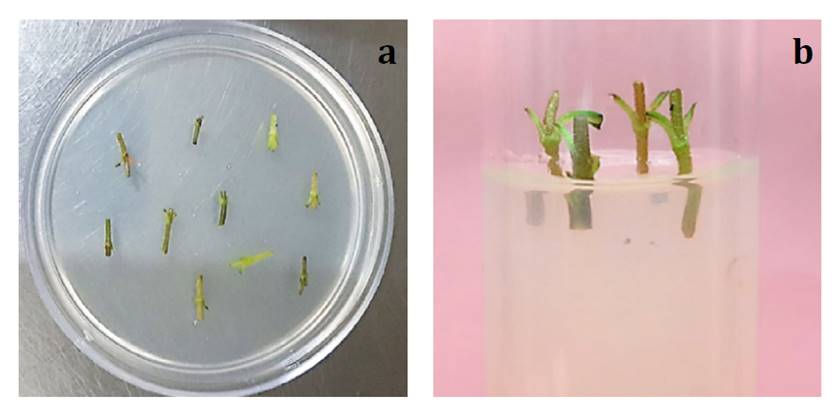
Figure 1. a) Chocolate cosmos (Cosmos atrosanguineus [Hook.] Voss) explants irradiated with cobalt-60 and b) sowing of explants after exposure to gamma rays.
Figura 1. a) Explantes de cosmos chocolate (Cosmos atrosanguineus [Hook.] Voss) irradiados con cobalto-60 y b) siembra de explantes después de la exposición a rayos gamma.
Material Handling
After irradiation, two stages (stage I, stage II) of material handling were established. In the first stage, the explants were placed in test tubes containing 20 mL of fresh basic culture medium, with the same composition as described above, to promote their recovery from the stress caused by irradiation and to evaluate the survival of the plant material. Four explants were placed in each tube and kept at room temperature for 35 days (figure 1b).
In the second stage, a multiple sprouting medium was prepared to promote shoot formation. The culture medium contained the same components as the previous one plus 3 mg∙L-1 of benzyladenine (BA). In this case, 75 mL of the medium were placed in 500-mL flasks. Each flask contained 10 explants, which were incubated at room temperature for 45 days under a photoperiod of 16/8 h (light/dark) and a light intensity of 12.9 μmol∙m-2∙s-1.
Evaluated Variables
In the first stage, the variables evaluated were explant length (measured with a vernier caliper and reported in cm), number of shoots, and presence of roots and calluses, determined at 7 and 35 days after irradiation (dai). The presence of roots and calluses was reported as a percentage, calculated as:

In the second stage, shoot length and number of leaves were recorded 45 days after transplanting (dat) into the flasks. Five days after the last evaluation, the LD50 was determined based on the survival of the irradiated shoots (Eq. 2) and analyzed using a simple linear regression model.

Statistical Analysis
The data were analyzed to verify compliance with the assumptions of normality and homoscedasticity using the Shapiro-Wilk and Levene tests, respectively. As the data did not meet the assumptions of normality, non-parametric tests were used. Shoot length, number of shoots, and number of leaves were analyzed using the Kruskal-Wallis test (for comparisons between treatments at each measurement date, with α = 0.05), followed by a multiple comparison of means using Dunn’s test and Bonferroni correction. To compare the effect of time (in stage I), the paired Wilcoxon test was applied (α = 0.05).
Root and callus formation (as binary categorical variables: yes/no) were analyzed using Fisher’s exact test (α = 0.05), due to the presence of low frequencies in some cells (treatments with zero responses). When treatment effects were detected (p < 0.05), pairwise comparisons among treatments were performed, and p-values were adjusted using the Bonferroni method to control type I error in multiple comparisons (McDonald, 2014). All statistical analyses were performed using R software, version 4.5.1 (R Core Team, 2025).
Results and Discussion
During the recovery phase, explants showed 100% survival in all five treatments, indicating a possible high initial tolerance of chocolate cosmos tissue to the evaluated doses (0-40 Gy). This result is relevant considering that, in other species, lethality is reported even at lower doses. For example, Gupta et al. (2018) observed a drastic reduction in the survival of strawberry plants irradiated with 30 Gy. The initial tolerance observed in chocolate cosmos suggests an advantage for mutation induction without immediate loss of plant material. Although this tolerance was not reflected in morphogenetic development (as will be discussed later), previous studies suggest that some anomalies can be reversed after subculturing, indicating that the variations could be related to temporary physiological disturbances (Hasbullah et al., 2012).
Regarding explant length, significant differences (p < 0.05) were observed among treatments and evaluation dates (table 1). Treatments with 0, 10, and 20 Gy exhibited an inverse relationship between dose and plant length; that is, the greater the irradiation, the shorter the plant length. At 7 and 35 dai, explants from the control treatment (0 Gy) showed the greatest growth (1.31 and 4.57 cm, respectively), with statistical differences compared to the other treatments. The 10 Gy treatment exhibited lower growth than the control, although significantly different from the other treatments, which showed a marked inhibition.
Table 1. Mean comparisons of the response of chocolate cosmos (Cosmos atrosanguineus [Hook.] Voss) to cobalt-60 at 7 and 35 days after irradiation (dai).
Tabla 1. Comparación de medias de la respuesta de cosmos chocolate (Cosmos atrosanguineus [Hook.] Voss) al cobalto-60 a los 7 y 35 días después de la irradiación (ddi).
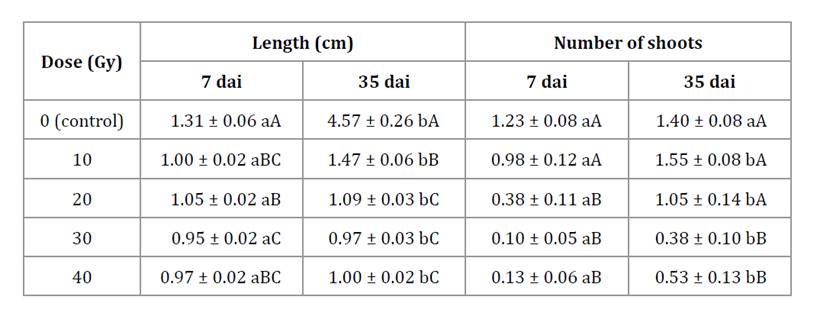
Values are the mean of four replicates of 10 explants ± standard error (n = 40). Means followed by lowercase letters correspond to the comparison between dates for each treatment and variable, and uppercase letters correspond to the comparison among treatments for each date and the variable. Different letters indicate statistical differences according to the Wilcoxon and Dunn tests, respectively (p ≤ 0.05).
Los valores corresponden a la media de cuatro réplicas de 10 explantes ± error estándar (n = 40). Las medias seguidas de letras minúsculas corresponden a la comparación entre las fechas de cada tratamiento y variable, y las seguidas de letras mayúsculas, a la comparación entre los tratamientos para cada fecha y variable. Las letras diferentes indican diferencias estadísticas según las pruebas de Wilcoxon y Dunn, respectivamente (p ≤ 0,05).
The sensitivity of plant species to gamma irradiation is documented in previous research. Hernández-Muñoz et al. (2017) reported that doses higher than 35 Gy significantly reduced plant size in Laelia autumnalis. Salomón et al. (2017) observed a strong negative relationship between gamma-ray dose and plant height, as the higher the radiation, the smaller the plants were. In contrast, Elizar et al. (2018), when evaluating the effect of different gamma irradiation doses (50-300 Gy) on C. caudatus Kunth seeds, observed a delayed effect on growth in the irradiated treatments; however, by week nine, no significant differences were detected between the control (non-irradiated) and the 50 and 100 Gy treatments. These authors also indicated that doses above 200 Gy are lethal to plants. Piña-de Jesús et al. (2024) evaluated the effects of gamma rays on gladioli and found no significant differences in plant height compared to the control (non-irradiated plants), but observed a reduction as the irradiated dose increased.
These findings indicate that the response to gamma irradiation depends on both the plant species and the type of irradiated tissue. Likewise, plant sensitivity to external factors that influence growth rate depends on the dose, the type of factor (in this case, the type of ionizing radiation), and the conditions under which damage recovery occurs (Akshatha & Chandrashekar, 2014).
Shoot proliferation showed a response pattern similar to that observed for explant length, with significant differences (p < 0.05) among treatments and dates (table 1). At 7 dai, non-irradiated explants had the highest average number of shoots (1.23), with no significant difference from the 10 Gy treatment (0.98), but different from the remaining treatments. This pattern suggests an initial sensitivity to radiation stress. By the second evaluation (35 dai), explants irradiated with 10 Gy produced more shoots (1.55) than both the control (1.40) and the 20 Gy treatment (1.05), although without significant differences (p > 0.05) among these three treatments.
In contrast, the 30 Gy treatment produced the lowest number of shoots, but did not differ significantly (p > 0.05) from the 40 Gy treatment at any date, indicating a potential inhibitory effect of high irradiation doses on axillary bud regenerative capacity. The pattern suggests a non-linear dose-response relationship, in which intermediate doses can cause greater inhibition than either low or high doses. Notably, all treatments, except for the control, showed a significant (p < 0.05) increase in the number of shoots in the second evaluation, highlighting a potential stimulatory effect of gamma rays on this variable. Comparable responses have been reported in other in vitro-cultured species. Gupta et al. (2018) observed maximum shoot proliferation in strawberry at 10 Gy, whereas doses above 30 Gy had an inhibitory effect. Likewise, Alphonse et al. (2022) reported enhanced shoot formation in Gentiana kurro Royle when callus and shoots were irradiated with 10 Gy, while higher doses completely suppressed shoot development.
The patterns observed for both shoot length and number suggest that low gamma irradiation doses could have a stimulating effect on morphogenesis, potentially related to an adaptive response or hormesis phenomena, as documented in other species (Khalil et al., 2015). The reduction in certain morphological characteristics with increasing gamma irradiation doses could be linked to disruptions in hormonal balance and enzymatic activities (Wi et al., 2007). Abdulhafiz et al. (2018) point out that high concentrations of gamma irradiation may induce alterations in biochemical processes related to cell division and elongation. High gamma-ray doses may kill or damage meristematic cells, reducing their ability to absorb nutrients and thereby restricting plant growth. Additionally, radiation-induced damage may cause deletions in nucleotide sequences within DNA, potentially altering reading frames, producing inactive proteins, or generating defective transcripts. Such changes can lead to abnormal cell division, cell death, mutations, tissue or organ failure, and overall reduced growth (Olasupo et al., 2016).
Fisher’s exact test showed no statistically significant differences in root formation among treatments at any evaluation date (table 2). This was due to the weak response of the control treatment (without application) to root formation (one and two explants at 7 and 35 dai, respectively) and the absence of rooting in the remaining treatments. The limited rooting observed in chocolate cosmos agrees with previous findings in irradiated ornamental tissues. Hernández-Muñoz et al. (2017) found no significant differences in root formation between irradiated and non-irradiated protocorms of Laelia autumnalis, except at 45 Gy. Similarly, Antúnez-Ocampo et al. (2017) described roots as highly sensitive organs to gamma irradiation. The poor root development observed in this study may be related to in vitro culture conditions or the plant’s characteristics, as adult plants usually develop roots approximately 3 cm in length (Gómez-Pedraza et al., 2024).
In contrast, callus formation showed a dose-dependent response to gamma irradiation (table 2). The control treatment exhibited the highest proportion of calluses, followed by the 10 Gy dose. At 7 and 35 dai, the control was statistically superior (p < 0.001) to all other treatments, presenting 12 and 35 explants, respectively, with the presence of calluses (30 and 87.5%, respectively). In the 10 Gy treatment, nine explants (22.5%) formed calluses at 35 dai, a value significantly lower (p < 0.001) than that reported for the control, but higher than the remaining treatments, which completely inhibited callus development.
Table 2. Mean comparisons of the percentages of chocolate cosmos (Cosmos atrosanguineus [Hook.] Voss) explants with roots and callus formation at 7 and 35 days after cobalt-60 irradiation (dai).
Tabla 2. Comparación de medias del porcentaje de explantes de cosmos chocolate (Cosmos atrosanguineus [Hook.] Voss) con formación de raíces y callos a los 7 y 35 días después de la irradiación (ddi) con cobalto-60.
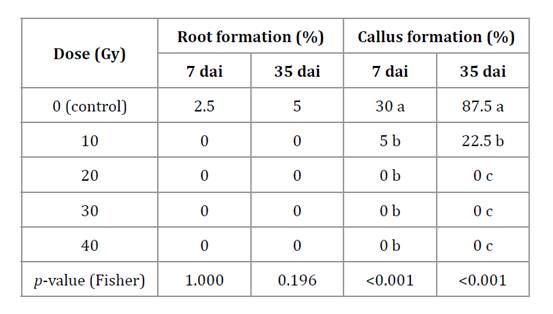
Values followed by different letters within each date indicate statistical differences (Fisher’s exact test with Bonferroni adjustment, p ≤ 0.05).
Los valores seguidos de letras diferentes dentro de cada fecha indican diferencias estadísticas (prueba exacta de Fisher con ajuste de Bonferroni, p ≤ 0,05).
The marked reduction in callus formation at high irradiation doses suggests inhibition of cellular dedifferentiation and proliferation processes. According to Martirena-Ramírez et al. (2015), high gamma irradiation doses may arrest the cell cycle during somatic division and induce genome-wide damage. Nevertheless, the absence of growth regulators in the culture medium may also have contributed to the reduced callogenic response observed in irradiated explants. This is because the interaction between irradiation dose and phytohormones can negatively affect cell division (Khalil et al., 2015).
During the second stage, the response of irradiated explants was evaluated under multiple-shoot induction conditions using BA. At 45 dat, significant differences were observed in both shoot length and leaf number among treatments (table 3). Overall, the response was dose-dependent, with non-linear behavior.
Table 3. Mean comparisons of the response of chocolate cosmos (Cosmos atrosanguineus [Hook.] Voss) to cobalt-60 irradiation at 45 days after transplanting.
Tabla 3. Comparación de medias de la respuesta de cosmos chocolate (Cosmos atrosanguineus [Hook.] Voss) a la irradiación con cobalto-60 a los 45 días después del trasplante.
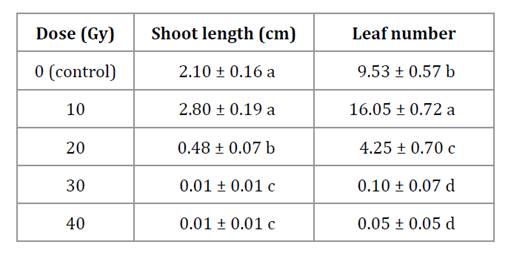
Values are the mean of four replicates of 10 shoots ± standard error (n = 40). Means followed by different letters within each column indicate statistical differences (Dunn, p ≤ 0.05).
Los valores corresponden a la media de cuatro réplicas de 10 brotes ± error estándar (n = 40). Las medias seguidas de letras diferentes dentro de cada columna indican diferencias estadísticas (Dunn, p ≤ 0,05).
Regarding shoot length, the 10 Gy treatment showed similar development to the control (2.80 and 2.10 cm, respectively), with no significant difference (p > 0.05) between them. However, from 20 Gy onward, shoot elongation decreased drastically (table 3), and the higher-dose treatments showed abnormal cell masses and shoot encapsulation. Hasbullah et al. (2012) also reported abnormalities in shoots obtained from explants exposed to 30, 40, 50, and 60 Gy. These results indicate that elongation capacity is severely affected by doses above 20 Gy, possibly due to damage to meristematic tissues or alterations in the expression of growth-related genes (Khan et al., 2016). This pattern reflects a hormesis effect, in which high doses induce abnormalities and plant death (Kaur et al., 2017).
The results obtained are consistent with those reported by Gálvez et al. (2023), who studied the effect of gamma irradiation on roselle seeds on some agronomic characteristics, and reported larger plants in the control and low-dose treatments, while plants did not survive at the highest doses. Similarly, Serrano-Fuentes et al. (2022) found that vanilla shoots irradiated with different doses of gamma irradiation exhibited the best shoot length response between 0 and 20 Gy. Abdulhafiz et al. (2018) also obtained longer shoots in both the control (without irradiation) and 10 Gy treatment in the banana crop.
Leaf development was significantly stimulated (p < 0.05) at 10 Gy (table 3), supporting the hypothesis of a hormesis response at low irradiation doses. However, leaf production declined sharply at 20 Gy and was nearly absent at the highest irradiation levels, where necrosis and explant death were also observed. This is because irradiation affects the plant cell wall and membrane, reducing tissue growth, altering cell morphology, and impairing water absorption into cells (Khan et al., 2016). Similar trends have been reported in Tagetes erecta (Sarkar et al., 2016) and Calendula officinalis (Kaur et al., 2017), where intermediate doses promoted initial development, followed by inhibition at higher doses.
Overall, the results demonstrate that chocolate cosmos exhibits dose-dependent sensitivity to gamma irradiation. Low doses promoted morphogenetic response, whereas moderate and high doses severely inhibited regeneration. These findings confirm the usefulness of gamma irradiation as a tool for inducing variability in ornamental species, although irradiation doses must be applied with caution to minimize deleterious mutations (de la Cruz Díaz-Juárez et al., 2022).
Median Lethal Dose (LD50)
LD50 is widely used in mutation-breeding studies to determine the irradiation threshold that reduces explant viability by 50%. In this study, LD50 was estimated using survival data obtained after the multiple-shoot induction stage through linear regression analysis. The resulting model was: Survival (%) = -2.75x + 100.5, R2 = 0.95. This indicates a statistically robust fit (figure 2), in which 95% of the observed survival is explained by the irradiation dose.
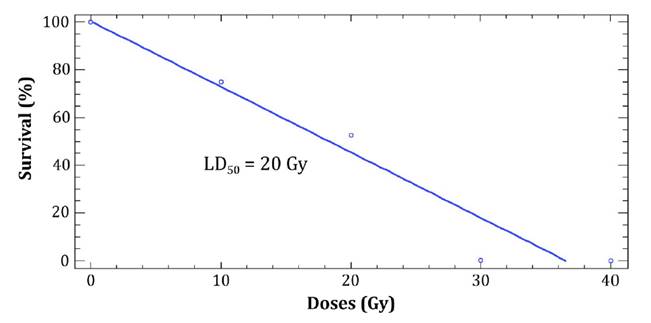
Figure 2. Linear regression used to estimate the median lethal dose (LD50) of axillary buds of chocolate cosmos (Cosmos atrosanguineus [Hook.] Voss) exposed to different doses of cobalt-60 gamma irradiation.
Figura 2. Regresión lineal utilizada para estimar la dosis letal media (DL50) de yemas axilares de cosmos chocolate (Cosmos atrosanguineus [Hook.] Voss) expuestas a diferentes dosis de irradiación gamma de cobalto-60.
The estimated LD50 for chocolate cosmos was 20 Gy (52.5% survival), the value at which maximum mutation occurs with minimum damage to the buds. The negative linear trend observed reflects the decrease in survival as the radiation dose increased, with complete mortality recorded at 30 and 40 Gy. Similar values have been reported for Sesuvium portulacastrum (Kapare et al., 2017) and Tagetes erecta (Sarkar et al., 2016), while in beans this value was 30 Gy (Martirena et al., 2018).
The high mortality rate in plants irradiated with high doses of gamma rays is associated with cellular damage induced by exposure, as the DNA repair mechanism is unable to repair it, leading to cell death (Rene et al., 2014). Another contributing factor may be the type of material used; sensitivity must be considered, as seeds generally tolerate higher doses than material lacking a protective coat, such as axillary buds or callus tissue. For example, Thongtam na Ayudhaya et al. (2022) reported an LD50 of 253 Gy when irradiating C. sulphureus Cav. seeds.
Determining LD50 is essential for establishing effective mutagenesis protocols because doses near this threshold maximize the frequency of beneficial mutations without completely compromising material regeneration. This information is relevant for establishing reproducible protocols for genetic improvement through mutagenesis, especially in species with limited natural genetic variability, such as C. atrosanguineus [Hook.] Voss. According to several studies, ornamental species are suitable for genetic improvement by mutation because specific traits can be altered without modifying other desirable characteristics of the original ideotype (Hasbullah et al., 2012).
Conclusions
Cosmos atrosanguineus (Hook.) Voss exhibited marked sensitivity to gamma irradiation, with significant inhibition of morphogenetic development at doses >20 Gy. The 10 Gy treatment stimulated shoot proliferation and leaf development, whereas 30 and 40 Gy completely inhibited growth, suggesting a possible hormesis effect. Root formation was limited in all treatments, indicating the need to optimize culture conditions for rooting. The estimated LD50 of 20 Gy provides a valuable reference for future mutation-breeding programs in chocolate cosmos.
This study is the first report on the radiosensitivity of Cosmos atrosanguineus (Hook.) Voss under in vitro conditions and establishes a technical basis for future genetic improvement and conservation strategies for this endemic ornamental species.
Abdulhafiz, F., Kayat, F., & Zakaria, S. (2018). Effect of gamma irradiation on the morphological and physiological variation from in vitro individual shoot of banana cv. Tanduk (Musa spp.). Journal of Plant Biotechnology, 45(2),140-145. https://doi.org/10.5010/JPB.2018.45.2.140
Akshatha, & Chandrashekar, K. R. (2014). Gamma sensitivity of forest plants of Western Ghats. Journal of Environmental Radioactivity, 132, 100-107. https://doi.org/10.1016/j.jenvrad.2014.02.006
Alphonse, M., Thiagarajan, K., Fulzele, D. P., Pillay, M., Satdive, R. K., Kamble, S. N., Raina, R., Ramamoorthy, S., & Chandrasekaran, R. (2022). Effect of gamma radiation on gentiopicroside production in Gentiana kurroo Royle in vitro cultures. Industrial Crops and Products, 176, 114392. https://doi.org/10.1016/j.indcrop.2021.114392
Amamiya, K., & Iwashina, T. (2016). Qualitative and quantitative analysis of flower pigments in chocolate cosmos, Cosmos atrosanguineus, and its hybrids. Natural Product Communications,11(1), 77-78. https://doi.org/10.1177/1934578X1601100122
Antúnez-Ocampo, O. M., Cruz-Izquierdo, S., Sandoval-Villa, M., Santacruz-Varela, A., Mendoza-Onofre, L. E., de la Cruz-Torres, E., & Peña-Lomelí, A. (2017). Induced variability in physiological characters of Physalis peruviana L. through 60co gamma rays applied to the seed. Revista Fitotecnia Mexicana, 40(2), 211-218. https://doi.org/10.35196/rfm.2017.2.211-218
Bidabadi, S. S., & Jain, S. M. (2020). Cellular, molecular, and physiological aspects of in vitro plant regeneration. Plants, 9(6), 702. https://doi.org/10.3390/plants9060702
Blagojevic, D., Lee, Y., Brede, D. A., Lind, O. C., Yakovlev, I., Solhaug, K. A., Fossdal, C. G., Salbu, B., Olsen, J. E. (2019). Comparative sensitivity to gamma radiation at the organismal, cell and DNA level in young plants of Norway spruce, Scots pine and Arabidopsis thaliana. Planta, 250, 1567-1590. https://doi.org/10.1007/s00425-019-03250-y
Castro-Castro, A., Vargas-Amado, G., Castañeda-Nava, J. J., Harker, M., Munguía-Lino, G., Santacruz- Ruvalcaba, F., & Rodríguez, A. (2017). Chromosomic numbers for three species of Cosmos section Discopoda (Asteraceae, Coreopsideae), with cytogeographic notes. Acta Botánica Mexicana, 118, 41-51. https://doi.org/10.21829/abm118.2017.1199
de la Cruz Díaz-Juárez, R., Hernández-Arenas, M., Santacruz-Varela, A., Silva-Cifuentes, E. G., de la Cruz-Torres, E., Barrios-Gómez, E. J., Trejo-Pastor, V., & Muñoz-Orozco, A. (2022). High doses of gamma radiation (Cobalt60) decrease the phenotypic expression of characters in sugarcane (Saccharum officinarum L.). Brazilian Journal of Animal and Environmental Research, 5(4), 3694-3709. https://doi.org/10.34188/bjaerv5n4-021
Elizar, I., Sinuraya, M., & Sipayung, R. (2018). The effect of gamma rays irradiation on the growth and flavonoid content of kenikir (Cosmos caudatus Kunth.). Journal of Physics: Conference Series, 1116(5), 052020. https://doi.org/10.1088/1742-6596/1116/5/052020
Gálvez-Marroquín, L. A., Avendaño-Arrazate, C. H., Ariza-Flores, R., Gomez-Simuta, Y., Martínez-Bolaños, M., & Cruz-López, J. A. (2023). Gamma radiation in roselle seeds to induce morphological variation and selection of mutants. Revista Mexicana de Ciencias Agrícolas, 14(5), 27-37. https://doi.org/10.29312/remexca.v14i5.3010
Gómez-Pedraza, D. E., Cruz-Álvarez, O., & Martínez-Damián, M. T. (2024). Chocolate cosmos (Cosmos atrosanguineus Sherff): An endemic and undervalued ornamental species in Mexico. CIENCIA ergo-sum, 31(1), e240. https://doi.org/10.30878/ces.v31n0a25
Gupta, R., Wali, V. K., Bakshi, P., Singh, G., Shah, R. A., & Rani, S. (2018). Effects of gamma irradiation on shoot, root and survival percent in strawberry cv. Chandler under in vitro conditions. International Journal of Current Microbiology and Applied Sciences, 7(3), 1173-1182. https://doi.org/10.20546/ijcmas.2018.703.139
Hasbullah, N. A., Taha, R. M., Saleh, A., & Mahmad, N. (2012). Irradiation effect on in vitro organogenesis, callus growth and plantlet development of Gerbera jamesonii. Horticultura Brasileira, 30(2), 252-257. https://doi.org/10.1590/S0102-05362012000200012
Hernández-Muñoz, S., Pedraza-Santos, M. E., López, P. A., de la Cruz-Torres, E., Fernández-Pavía, S. P., Martínez-Palacios, A., & Martínez-Trujillo, M. (2017). LD50 and GR50 determination with gamma rays (60CO) on in vitro Laelia autumnalis protocorms. Agrociencia, 51(5), 507-524. https://agrociencia-colpos.org/index.php/agrociencia/article/view/1307/1307
Hind, N., & Fay, M. F. (2003). Plate 461. Cosmos atrosanguineus Compositae. Curtis’s Botanical Magazine, 20(1), 40-48. https://doi.org/10.1111/1467-8748.00369
Kapare, V., Satdive, R., Fulzele, D. P., & Malpathak, N. (2017). Impact of gamma irradiation induced variation in cell growth and phytoecdysteroid production in Sesuvium portulacastrum. Journal of Plant Growth Regulation, 36, 919-930. https://doi.org/10.1007/s00344-017-9697-3
Kaur, R., Kapoor, M., Kaur, R., & Kumar, A. (2017). Effect of gamma irradiation on cyto-morphology, total phenolic content and antioxidant activity of calendula. Journal of Hill Agriculture, 8(4), 395-402. https://doi.org/10.5958/2230-7338.2017.00078.7
Khalil, S. A., Ahmad, N., & Zamir, R. (2015). Gamma radiation induced variation in growth characteristics and production of bioactive compounds during callogenesis in Stevia rebaudiana (Bert.). New Negatives in Plant Science, 1, 1-5. https://doi.org/10.1016/j.neps.2015.06.002
Khan, S. A., Rahman, L. U., Verma, R., & Shanker, K. (2016). Physical and chemical mutagenesis in Stevia rebaudiana: variant generation with higher UGT expression and glycosidic profile but with low photosynthetic capabilities. Acta Physiologiae Plantarum, 38(4), 1-12. https://doi.org/10.1007/s11738-015-2003-8
Martirena-Ramírez, A., Veitía, N., García, L., Collado, R., Torres, D., Rivero, L., & Ramírez-López, M. (2015). Respuesta in vitro de semillas de Phaseolus vulgaris L. cultivar ‘Ica Pijao’ irradiadas con diferentes dosis de radiación Gamma. Biotecnología Vegetal, 15(1), 9-15. https://revista.ibp.co.cu/index.php/BV/article/view/5/3
Martirena-Ramírez, A., Veitía, N., García, L. R., Collado, R., Torres, D., Rivero, L., & Ramírez-López, M. (2018). Optimal dose of gamma radiation for Phaseolus vulgaris L. cultivar ‘BAT-93’ in vitro plants regeneration. Biotecnología Vegetal, 18(1), 21-29.
McDonald, J. H. (2014). Handbook of biological statistics (3rd ed). Sparky House Publishing.
Murashige, T., & Skoog, F. (1962). A revised medium for rapid growth and bio assays with tobacco tissue cultures. Physiologia Plantarum, 15(3), 473-497. https://doi.org/10.1111/j.1399-3054.1962.tb08052.x
Olasupo, F. O., Ilori, C. O., Forster, B. P., & Bado, S. (2016). Mutagenic effects of gamma radiation on eight accessions of Cowpea (Vigna unguiculata [L.] Walp.). American Journal of Plant Sciences, 7(2), 339-351. https://doi.org/10.4236/ajps.2016.72034
Pallavi, B., Nivas, S. K., D’souza, L., Ganapathi, T. R., & Hegde, S. (2017). Gamma rays induced variations in seed germination, growth and phenotypic characteristics of Zinnia elegans var. Dreamland. Advances in Horticultural Science, 31(4), 267-274. https://doi.org/10.13128/ahs-20289
Piña-de Jesús, E., Sánchez-Pale, R. J., Castañeda-Vildozola, Á., Franco-Mora, O., & de la Cruz-Torres, E. (2024). Efecto de irradiación con rayos gamma de 60Co en gladiolo (Gladiolus communis L.) cultivares roja borrega y blanca borrega. Acta Agrícola y Pecuaria, 10, e0101013. https://www.researchgate.net/publication/387963214_Efecto_de_irradiacion_con_rayos_gamma_de_60Coen_gladiolo_Gladiolus_communis_L_cultivares_roja_borrega_y_blanca_borrega
R Core Team. (2025). R: A language and environment for statistical computing [software]. R Foundation for Statistical Computing. https://www.R-project.org/
Rene, Y. A., Rashid, K., Tajudin, A., Zainoldin, K. H., Daran, A. B., Nezhadahmadi, A., & Golam, F. (2014). The contribution of muslim scientists in botanical science: Studies on the using of gamma rays for ginger plants (Zingiber officinale). Stem Cell, 5(4), 88-94. https://www.sciencepub.net/stem/stem0504/010_27756stem050414_88_94.pdf
Rojas-Vergara, P., Aguirre, P., Durán, O., & Nario, A. (2018). Aplicaciones de tecnologías nucleares en conservación y mejoramiento genético forestal bajo un escenario de cambio climático. Ciencia & Investigación Forestal, 24(3), 116-127. https://doi.org/10.52904/0718-4646.2018.506
Salomón, J. L., González, M. C., Castillo, J., & Varela, M. (2017). Behavior of “Barna”, cultivar of potato (Solanum tuberosum L.) at different doses of gamma rays Cobalt-60 source. Cultivos Tropicales, 38(4), 127-130. https://ediciones.inca.edu.cu/index.php/ediciones/article/view/1407
Sarkar, J., Singh, S. K., Singh, K. P., & Guha, S. K. (2016). In-vivo and in-vitro mutagenesis in marigold (Tagetes erecta) using 60Co gamma rays. The Indian Journal of Agricultural Sciences, 86(7), 870-5. https://doi.org/10.56093/ijas.v86i7.59738
Serrano-Fuentes, M. K., Gómez-Merino, F. C., Cruz-Izquierdo, S., Spinoso-Castillo, J. L., & Bello-Bello, J. J. (2022). Gamma radiation (60Co) induces mutation during in vitro multiplication of vanilla (Vanilla planifolia Jacks. ex Andrews). Horticulturae, 8(6), 503. https://doi.org/10.3390/horticulturae8060503
Soto, F., Peñaloza, P., Oyanedel, E., Schiappacasse, F., Durán, O., & Vidal, A. (2021). Germination and development of M1 seedlings of two Selliera radicans Cav. accessions subjected to gamma radiation. Revista de la Facultad de Ciencias Agrarias. Universidad Nacional de Cuyo, 53(2), 36-46. https://doi.org/10.48162/rev.39.037
Thongtam na Ayudhaya, P., Konsanuk, S., & Vongvanrungrueng, A. (2022). Effect of acute gamma radiation on survival rate and morphological change from seed of Cosmos sulphureus Cav. Wichcha Journal Nakhon Si Thammarat Rajabhat University, 41(1), 108-118. https://li01.tci-thaijo.org/index.php/wichcha/article/view/254207
Wi, S. G., Chung, B. Y., Kim, J. S., Kim, J. H., Baek, M. H., Lee, J. W., & Kim, Y. S. (2007). Effects of gamma irradiation on morphological changes and biological responses in plants. Micron, 38(6), 553-564. https://doi.org/10.1016/j.micron.2006.11.002