Rev. FCA UNCuyo | 2026 | 58(2) | ISSN 1853-8665
Natural Resources and Environment
https://doi.org/10.48162/rev.39.221
Understanding Stakeholders’ Interest and Influence in Agroecosystems Through Social Network Analysis
Comprender los intereses e influencia de los actores clave en los agroecosistemas a través del análisis de redes sociales
Esteban Kowaljow 1,
Fernando Zamudio 1
1 Universidad Nacional de Córdoba. Instituto Multidisciplinario de Biología Vegetal. Consejo Nacional de Investigaciones Científicas y Técnicas. Av. Vélez Sarsfield 1611. Edificio de Investigaciones Biológicas y Tecnológicas. Ciudad Universitaria. C. P. 5000. Córdoba. Argentina.
* mvillarruel@imbiv.unc.edu.ar
Abstract
The sustainability of agroecosystems constitutes a global challenge that requires integration of ecological and social dimensions. This study identifies key actors, their interests, influence on decision-making, and their relationships. We chose a representative area of the Espinal ecoregion (Argentina) as a case study. We conducted in-depth and semi-structured interviews with producers, agricultural advisors, and other stakeholders. Membership and information-flow networks were analysed and complemented with an actor map to characterise interest, influence, and relationships. The results indicated that producers based their decisions on information from agricultural advisors, private producer groups, and agricultural input cooperatives. The information network was more integrated than the membership network, and central institutions structured the communities. Private organisations predominated in these central positions. A public research and extension institution (INTA) stood out for its central position as a source and intermediary in the information flow; however, this role is weakening due to funding constraints. Producers reported conflictual relationships with society and the national government, mainly driven by environmental and economic tensions. These findings highlight the importance of understanding stakeholder relationships for agroecosystem management and sustainable production systems.
Keywords: social actor map, organisational networks, information flow, decision-making, Innovation, institutions
Resumen
La sostenibilidad de los agroecosistemas constituye un desafío global que requiere integrar dimensiones ecológicas y sociales. En este marco, resulta clave identificar a los actores clave, sus intereses, sus influencias en la toma de decisiones y sus relaciones. Se seleccionó un área representativa de la ecorregión del Espinal en Argentina y se realizaron entrevistas en profundidad y semiestructuradas con productores y otros actores relevantes. Se analizaron redes de pertenencia y de flujo de información, junto con un mapa de actores para caracterizar intereses, niveles de influencia y tipos de relaciones. Los resultados indicaron que los productores tomaron decisiones a partir de la información de asesores agrícolas, de grupos privados de productores y de cooperativas de insumos. La red de información fue más integrada que la de pertenencia y las comunidades se estructuraron en torno a instituciones centrales. Las organizaciones privadas predominaron en estas posiciones. Si bien una institución pública (INTA) se destacó por su posición central en la red de información, su rol parece debilitarse debido a restricciones de financiamiento. Asimismo, los productores experimentaron relaciones conflictivas con la sociedad y con el gobierno nacional, impulsadas por tensiones ambientales y económicas. Comprender cómo se estructuran estas relaciones entre actores resulta fundamental para la gestión de los agroecosistemas y para avanzar hacia sistemas productivos más sostenibles.
Palabras clave: mapa de actores sociales, redes organizacionales, flujo de información, toma de decisiones, innovación, instituciones
Originales: Recepción: 30/10/2025 - Aceptación: 18/05/2026
Introduction
Agroecosystems are socioecological systems designed and managed by people to maximise the provision of specific ecosystem services (ES). However, they also depend on other ES, such as soil structure and fertility regulation (Lescourret et al., 2015; Power, 2010). The sustainability of these systems depends on whether actors consider the multiple effects of management practices on the overall set of ES (Lescourret et al., 2015). Managing trade-offs between agricultural production and maintaining ES constitutes a major challenge, with increasing relevance in global agendas (FAO, 2021). Addressing this challenge requires integrating ecological and social dimensions to achieve sustainable production (Allen et al., 2022). This requires identifying decision-makers, their information sources, and their interactions with one another and with institutions.
Stakeholders are individuals, organisations, or institutions with interests or influence over agroecosystem management (Prell et al., 2009; Reed et al., 2009). They can influence, affect, or be affected by land management decisions, either directly or indirectly (Prell et al., 2009; Reed et al., 2009). Stakeholder analysis involves identifying and categorising actors by their roles and levels of interest or influence, and examining their relationships (Reed et al., 2009). This information supports the development of social actor maps that visualize and recognise different stakeholders’ types (key actors, context setters, subjects, and crowd) (Reed et al., 2009; Tapella, 2023; Figure S1). These maps support understanding socioecological systems and designing inclusive management strategies (Reed et al., 2009; Tapella, 2023).
Social processes, such as information diffusion, governance, and decision-making, can be analysed using social network analysis (SNA) (Allen et al., 2022). In agroecosystems, these networks involve multiple actors, including individual farmers, agricultural organisations, NGOs, and technical advisors (Isaac, 2012). Previous studies show that farmers’ decisions are mainly influenced by interactions with other farmers, technical advisors, and seed or fertiliser suppliers (Knoot & Rickenbach, 2011; Pahl-Wostl et al., 2008). Farmers connected to regional extension actors tend to implement better management practices than those without such connections (Baird et al., 2016). Although these relationships are key for the exchange of information and the adoption of innovations or sustainable agricultural practices (Baird et al., 2016; Bodin et al., 2012; Isaac, 2007), they typically occur in common-pool resource management. However, in private agricultural systems, decisions are mostly made at the individual or farm level (Isaac, 2012). Thus, understanding farmer information exchange is essential (Prell et al., 2009). These interactions are critical for designing participatory management strategies (Allen et al., 2022; Prell et al., 2009).
In Argentina, few studies have examined stakeholders involved in agroecosystems (Gras & Hernández, 2008, 2016; Maldonado & Bustamante, 2019). These contributions highlight heterogeneous actors whose roles and influence are reshaped by political and economic transformations. In particular, Gras and Hernández (2008, 2016) emphasise the centrality of agribusiness entrepreneurs, producer organisations, technical experts, and institutional actors in consolidating the agribusiness model. Complementarily, Maldonado and Bustamante (2019) identify producers, extension agents, cooperatives, governmental bodies, and academic institutions as relevant social actors in productive dynamics and decision-making at the territorial level. However, these studies have not explicitly examined information diffusion from a network perspective, particularly in relation to farmers’ decision-making. Moreover, no studies address this topic in the Espinal ecoregion, characterised by distinct ecological and historical conditions.
This study addresses the following research questions: Who are the key stakeholders in agroecosystems, and how are their social networks structured with respect to information exchange and organisational membership? The objectives of this study are: 1) to analyse membership and information-flow networks, and the role of public and private institutions; 2) to construct a social actor map including levels of interest and influence, and cooperative and conflictive relationships, to identify key actors in agroecosystems management. We hypothesise that producers are the central actors in agroecosystem social networks and establish close relationships with private producer organisations of which they are members for information exchange. Furthermore, they collaborate with public research organisations and government institutions to obtain reliable information for decision-making.
Materials and methods
Study Area
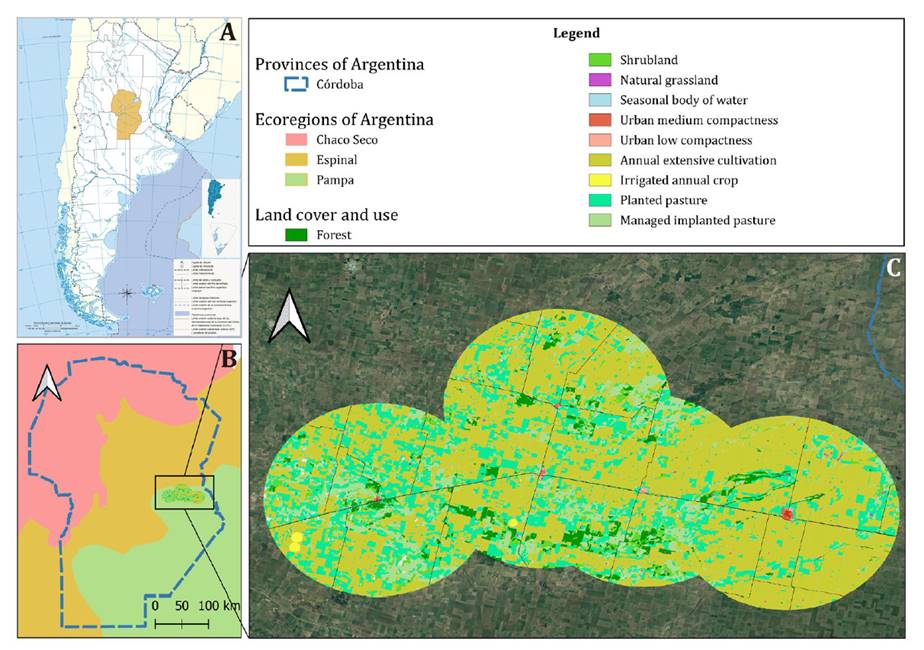
The study area (figure 1) is located in central Argentina, in the north-eastern part of the Unión Department, Córdoba Province. This department includes approximately 1,500 agricultural holdings with defined boundaries, covering a total area of about 980,000 ha (INDEC, 2021), and ranks third in the province in terms of agricultural production (INDEC, 2021). The area belongs to the Espinal ecoregion (Burkart et al., 1999) and the Espinal phytogeographic province of Argentina (Cabrera, 1976).
Source/Fuente: IGN and Google satellite image.
Base maps for panels (A) and (B) were obtained from Argenmap (National Geographic Institute of Argentina, IGN), whereas the background imagery in panel (C) corresponds to Google Satellite.
Study area in Córdoba Province, central Argentina. (A) Location of the study area within Córdoba Province, Argentina. (B) Location of the study area within Córdoba Province and its corresponding ecoregions (Chaco Seco, Espinal, and Pampa) according to Burkart et al. (1999). (C) Land cover and land use composition of the study area derived from INTA et al., 2020 land cover and land use data, including forest, shrubland, natural grassland, seasonal water bodies, urban areas, annual crops, irrigated crops, planted pastures, and managed implanted pastures.
Área de estudio en la provincia de Córdoba, centro de Argentina. (A) Ubicación del área de estudio en la provincia de Córdoba, Argentina. (B) Ubicación del área de estudio dentro de la provincia de Córdoba y sus ecorregiones correspondientes (Chaco Seco, Espinal y Pampa) según Burkart et al. (1999). (C) Composición de la cobertura y el uso del suelo del área de estudio derivada de los datos de cobertura y uso del suelo de INTA et al., 2020, que incluyen bosque, matorral, pastizal natural, cuerpos de agua estacionales, áreas urbanas, cultivos anuales, cultivos bajo riego, pasturas implantadas y pasuras implantadas con manejo (ganadería).
Figure 1. Map of the study area showing land cover and land use types.
Figura 1. Mapa del área de estudio con las diferentes coberturas y usos de la tierra.
The original vegetation of the Espinal ecoregion, composed of woody species such as Neltuma alba, Neltuma nigra, Celtis tala, and Trithrinax campestris, along with a spiny shrub and grass layer of varying coverage, currently persists in remnant patches of native forest (Lewis et al., 2006). These patches are embedded within a matrix of croplands under different degrees of use (Lewis et al., 2006) (figure 1), and some are protected under Argentina’s Native Forest Environmental Protection Law (Law No. 26331).
Historical Context of Land Use
Historically, land use in the Espinal region was dominated by extensive livestock ranching, with pastures, natural grasslands, and forests used for cattle grazing (Gavier-Pizarro et al., 2012). Despite the predominance of class V-VII soils (INTA et al., 2020), locally known as “overos” (mixed soils) and characterised by severe limitations for agricultural cultivation (Cabido et al., 2003), a large proportion of these lands has been converted to oilseed crop production since the 1990s (Potapov et al., 2022). This process has reduced livestock production and led to rural population decline (Aizen et al., 2009; Villarruel-Parma et al., 2024).
Currently, different production systems coexist: agricultural, livestock, mixed systems (combining both), and dairy farms. The area has experienced changes in hydrological cycles, including increased flood frequency, rising water tables, and the consequent soil salinization (Houspanossian et al., 2023). These changes have resulted in losses in ecosystem functioning and agricultural production (Bertram & Chiacchiera, 2013).
Data Collection
We collected data from May 2022 to April 2025 using both primary and secondary sources (figure 2). We conducted six in-depth interviews with key informants: (1) an agricultural advisor, producer, and former employee of a multinational agrochemical and seed company; (2) members of a local municipality (mayor, councillor, and secretary); (3) a phytosanitary advisor from one of the localities, who is also a councillor, teacher, and producer; (4) a mixed producer; (5) an agricultural producer (formerly dedicated to livestock production); and (6) an extension technician from the INTA agency in a locality within the study area. These key informants were selected purposively to represent different actor groups (Tapella, 2023; Villarruel-Parma et al., 2024). Guiding questions included: Who are the actors involved in the productive system? How do they interact? What levels of interest and influence do they hold in decision-making?
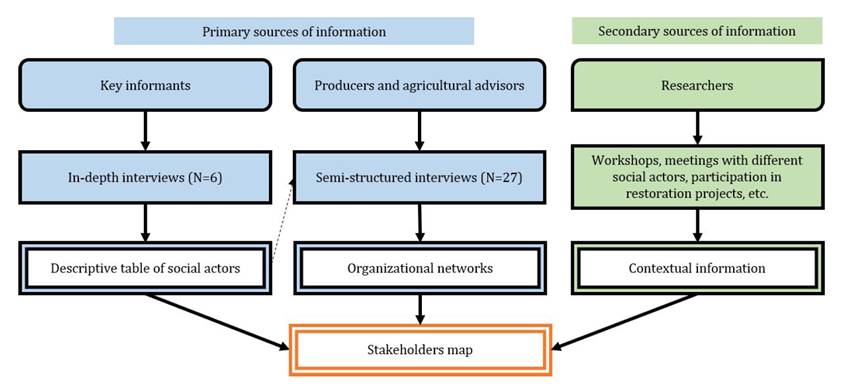
Figure 2. Overview of the methodological approach and data sources.
Figura 2. Descripción general del enfoque metodológico y fuentes de información.
Based on this initial approach, we conducted semi-structured interviews with producers and agricultural advisors (figure 2). We interviewed 27 participants. Data collected included: sociodemographic information (age, residence, educational level, occupation), production characteristics (type of production, farm size, land tenure, and forest patches use), and relational data on organizational membership and information exchange (e.g. “Which institutions do you belong to?”, “From which institutions do you obtain information?”; “What type of information do you share?”).
Data Analysis
We conducted social network analysis using the igraph package in R (R Core Team). We identified communities using the Louvain algorithm, scaled node size by normalized betweenness centrality, labelled nodes by degree centrality, and generated layouts using the Fruchterman-Reingold algorithm.
We assigned levels of interest and influence based on a qualitative, comparative assessment combining primary and secondary data (figure 2). We defined interest as the degree of involvement and commitment of each actor in decision-making processes. We defined influence as the actor’s perceived capacity to affect such decision-making processes. We classified both dimensions into low, medium, or high levels through a comparative, context-dependent evaluation that considered actors’ roles, access to resources, participation in decision-making and exchange spaces, and their institutional or informal authority.
We positioned actors in an interes-influence matrix (Reed et al., 2009). These categories are relational and context-dependent, and we used them as analytical tools to interpret actor positions and interactions. Finally, we constructed a social actor map integrating interest, influence, cooperative and conflictive relationships, and membership and information-flow networks.
Results
Characteristics of Participants
Table S2 presents the main characteristics of participants. Most participants identified as producers (77.8%), and 33.3% as agronomists. Overall, 70.4% had a university degree. The age distribution showed two distinct generations, with 37% aged 35-44, and 29.6% were aged 65-74. In terms of locality, 37% resided in Noetinger, the most densely populated area, and 25.9% in San Antonio de Litín, the second most densely populated locality.
Interviewees mentioned that the region was historically dedicated to livestock production; however, much of the land was converted to agricultural production starting in the 1990s. Current production types include: mixed systems (66.7%), dairy (22.2%), livestock production (11.1%), and exclusive agriculture (11.1%). Regarding farm size, 48.1% of producers had medium-sized holdings (200-1000 ha), while 33.3% had large or very large holdings (>1000 ha). Most producers (63%) owned their land and leased additional plots. Finally, 66.7% reported having native forest patches of varying sizes. Among them, 55.6% integrated these patches into production, mainly for cattle grazing.
Stakeholders Recognized
Based on the qualitative and quantitative analysis of the collected information, we constructed a descriptive table of the roles, functions, and levels of power and interest for each social actor (Table S1). We identified sixteen types of social actors (Table S2), and we grouped them into six categories: (1) individuals: independent producers or agricultural business owners, and agricultural advisors; (2) producer groups or organizations: CREA (Regional Consortia for Agricultural Experimentation) and AAPRESID (Argentine Association of No-Till Producers); (3) public institutions: INTA (National Institute of Agricultural Technology) and national universities (e.g. Universidad Nacional de Córdoba); (4) private companies or businesses: grain collectors, cooperatives, input suppliers, and contractors; (5) government agencies: national, provincial, and municipal agencies, consortia, and liaison committees; and (6) society: citizens and general local businesses. We summarised their primary roles and functions in Table S2.
We recognised different types of producers. Most manage farms as family enterprises, although some employ managers or establish partnerships with other producers. Producers emerged as the primary decision-makers and land managers, acting individually or with advisors (agronomists and veterinarians).
A particular type of producer, referred to as the “gringo”, was identified. Interviewees described this group as older adults residing in nearby towns, generally landowners who no longer manage their farms directly but lease them and derive income from land rent. They tend to make conservative production decisions, limiting expenditures in low-yield years, and investing in machinery or personal assets during high-yield periods. They invest in “machinery” (e.g., tractors, agricultural equipment) and personal vehicles. This producer type was relevant because, despite owning the land, they show low propensity to adopt agricultural innovations.
Membership and Information Networks
In the membership network (figure 3a), the most central institutions, measured by degree (i.e., the number of links) and betweenness centrality (i.e., intermediation degree), were agricultural input cooperatives, CREA, and AAPRESID, which connect with various producer groups (Table S3). In particular, the INTA “Rural Change” programme, which involved producers and other public and private organizations, was no longer active. Several communities were observed (figure 3a). The main community was associated with central institutions (i.e., CREA, AAPRESID, and agro-input cooperatives). Smaller communities were associated with dairy cooperatives, consortia, and producers without institutional membership (“NA”).
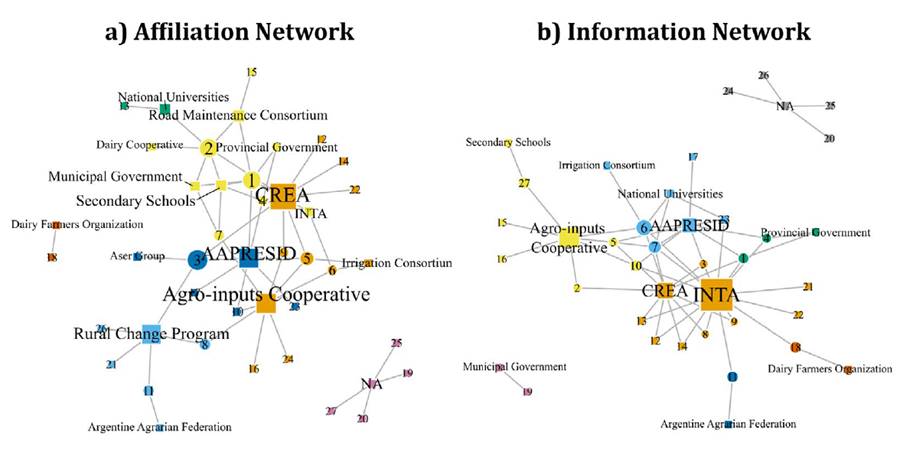
Node types: circles represent producers, squares represent institutions or organizations. Node size indicates betweenness, related to position within the network. Label size indicates degree centrality, measured as the number of links. Different colours represent different communities.
Tipos de nodos: los círculos representan a productores y los cuadrados, a instituciones u organizaciones. El tamaño del nodo indica el grado de intermediación y está relacionado con su posición en la red. El tamaño de la etiqueta indica el grado de centralidad, medido como el número de vínculos. Diferentes colores representan diferentes comunidades.
Figure 3. a) Membership network, b) Information network.
Figura 3. a) Red de pertenencia, b) Red de información.
In the information network (figure 3b), the most frequently mentioned institutions/organizations were similar (i.e., CREA, AAPRESID, and agricultural input cooperatives). However, INTA played a particularly central role due to its many connections and its structural position within the network (Table S3). In this network, INTA connected CREA, AAPRESID, cooperatives, and many producers.
While the main communities remained similar to those in the membership network, the information exchange network was more integrated (figure 3b). In this network, INTA and CREA acted as the primary intermediaries in the information flow. Although some producers reported only one or two information sources, the majority cited INTA as a key source. A subset of producers reported no institutional sources of information (figure 3b). Overall, both networks showed communities structured around central institutions, along with smaller, more isolated communities. In the membership network, each community was organised around a main institution, with only a few producers linked to it (3-5 per community). In contrast, in the information network, INTA and CREA formed a denser and more connected core, integrating a larger number of producers (figure 3b).
These patterns reflected differences in producer profiles across networks (figure 3a and 3b, Table S3). Some producers belonged to multiple institutions or organizations, resulting in more central positions (e.g., producers “1,” “2,” and “3” in figure 3a. In contrast, we found other producers were linked to only a single institution or organization (figure 3a) and occupied more peripheral positions.
In the information network (figure 3b), the most central producers were different (e.g., producers “6” and “7”) from those in the membership network. They were connected to both central institutions (CREA, INTA) and more peripheral ones (Table S3).
Finally, we analysed the positions of different institutions and organizations by management type (public, private, or public-private). Private organizations predominated in central network positions. This pattern was especially evident for CREA, AAPRESID, and agricultural input cooperatives (figures 4a, 4b). This pattern suggests that private actors occupy more central roles in both information flows and membership communities.
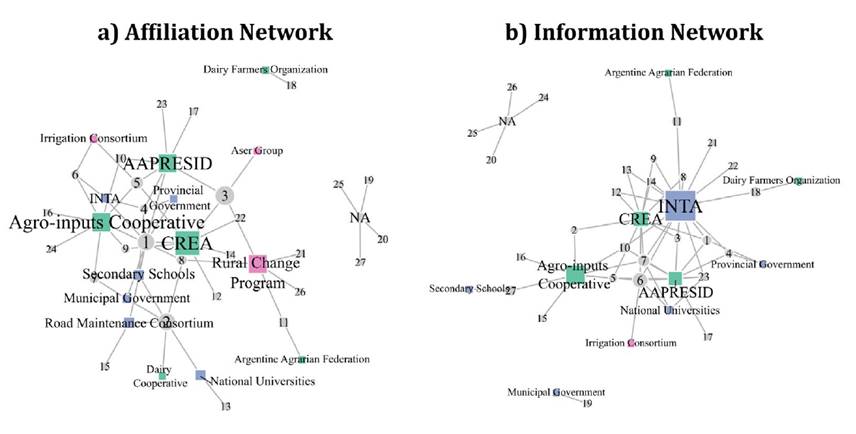
Different colours by management type: blue for public institutions, green for private institutions, purple for public-private institutions. Node size indicates betweenness, related to position within the network. Label size indicates degree centrality, measured as the number of links.
Los colores varían según el tipo de gestión: azul para instituciones públicas, verde para instituciones privadas y violeta para instituciones públicoprivadas. El tamaño del nodo indica el grado de intermediación y está relacionado con su posición en la red. El tamaño de la etiqueta indica el grado de centralidad, medido como el número de vínculos.
Figure 4. Centrality of institutions and organizations by management type in the membership network (a) and the information exchange network (b).
Figura 4. Centralidad de las instituciones y organizaciones según su tipo de gestión en la red de miembros (a) y en la de intercambio de información (b).
In the information network (figure 4b), INTA stood out as the leading public institution. It was also the only state entity recognized by producers. Other public research and academic institutions (e.g., CONICET and national universities) showed low relevance or were absent. This result suggested limited integration between scientific knowledge production and local information exchange networks.
Social Actor Map
We constructed a social actor map integrating roles, levels of interest and influence, conflict and cooperation relationships, and membership and information exchange ties (figure 5). Based on their positions, key actors included producers, agricultural advisors, CREA, and INTA (figure 5), all of whom showed high levels of interest and influence. Context setters included the society and the municipal government. They showed medium to high interest and moderate influence. Actors classified as subjects included the National Government and AAPRESID, with medium to high power but medium to low interest. Finally, we classified actors with low interest and influence as the crowd. These included the provincial government, consortia, national universities, and private companies such as grain collectors, cooperatives, and service providers/contractors (figure 5).
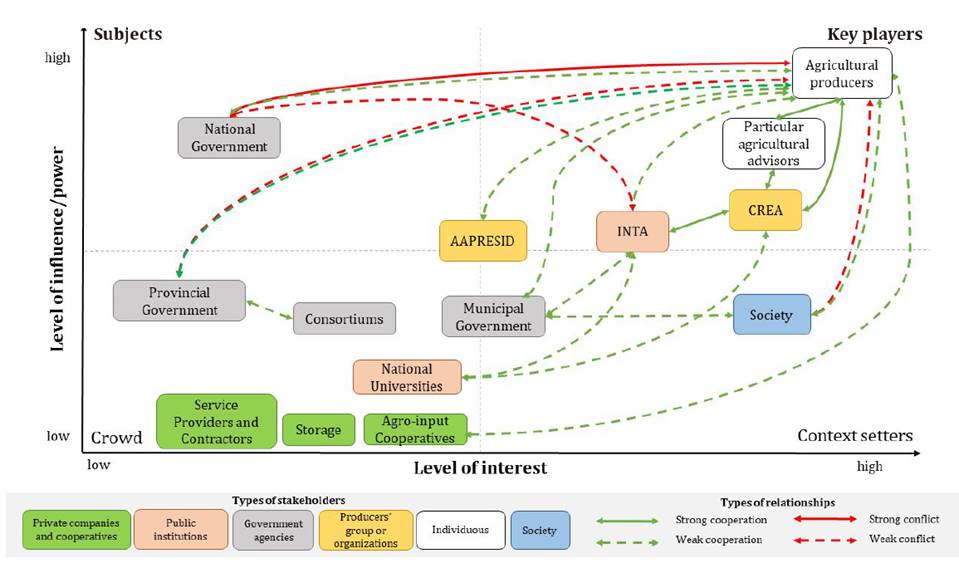
Figure 5. Social actor map, showing actors’ levels of interest and influence, and their cooperative and conflictual relationships.
Figura 5. Mapa de actores sociales, en función de su interés, influencia y relaciones de cooperación y conflicto.
Producers established both cooperative and conflictual relationships (figure 5). They cooperated primarily with advisors, CREA groups, AAPRESID, and INTA. These interactions were related to information exchange for decision-making and to organizational membership. In contrast, they established conflictual relationships with society and the National Government.
Agricultural advisors emerged as key actors in this study (figure 5). They were mostly agronomists or veterinarians, and in some cases, producers as well. They have been understudied in previous research. We found that their role included advising on production decisions (e.g., species selection, sowing and harvesting timing, agrochemical applications), financial planning, and technological innovations. Advisors often worked with multiple producers or groups (e.g., CREA). These relationships gave them substantial influence over production decision-making. However, they showed limited interest in the management of remnant forest patches or potential native forest restoration.
Producers recognised CREA groups as both membership organizations and sources of information for decision-making. These groups typically included 10-12 producers and a technical advisor. They facilitated regular field visits and meetings. They used these meetings to exchange and discuss information on production, financial, and management aspects, as well as social and personal issues. We identified at least two CREA groups in the study area. CREA also organizes congresses and maintains a data platform (“DATEx”). It collaborated with INTA and, in some cases, universities. These collaborations included training programs and experimental trials (e.g., seed yield tests), contributing to applied knowledge generation.
Producers not affiliated with CREA reported cooperation with other private organisations, such as AAPRESID and agro-input cooperatives. They obtained information from these organizations. They also relied on agricultural input vendors who provided advisory services. Cooperatives primarily provide technical assistance linked to input provision (e.g., agrochemicals, herbicides, fertilizers).
AAPRESID operated through regional groups and a “farm system” distributed throughout the country. This system generated technical information through experimental trials. This private organization also organized scientific-technical congresses for producers, advisors, and members of agricultural companies. On the other hand, INTA emerged as a central public institution, with both historical and current presence in the study area. It operated through a local agency in Noetinger, staffed by a small technical team (a technical extensionist and an assistant). INTA connected with multiple actors and participated in local advisory spaces (figure 5). Although recognised as a public institution that generates technical-scientific knowledge, some older producers recalled its former social role: “INTA, when we arrived in the area, not only helped with production but also with social aspects, providing schools and integrating the community”. Collaborators noted that INTA has experienced severe underfunding in recent years, markedly reducing its territorial influence. National Universities were another public institution mentioned, primarily recognized as prestigious training centres and sources of technical information and collaboration. In some cases, producers hosted students or requested technical guidance to address specific problems (e.g., livestock diseases, crop fungi). In turn, we found that when they cooperate with CREA or INTA, their influence over the productive sector could increase (figure 5).
The conflictive relationships between producers and society (figure 5) were a prominent topic in formal and informal conversations in the territory. Producers reported that society perceived them as responsible for environmental pollution, particularly due to the use of agrochemicals. However, they also acknowledged their contribution to the local economy (figure 5). In this sense, we found that society currently has a low to medium level of influence. However, this influence could increase over time, particularly through citizen participation in environmental or restoration activities or through complaints about certain practices, such as agrochemical drift.
The conflictive relationship between the national government and producers stemmed from the government’s influence over the productive system. The interviewees mentioned that the government exerted this influence through export taxes. Producers perceived these regulations as top-down and unstable.
In the case of municipal governments, while primarily influencing urban areas, they maintained weak, sporadic cooperative relations with producers (figure 5). These interactions typically included machinery sharing, road maintenance, participation in social initiatives, and the provision of event spaces. A key source of conflict with municipalities has been the control of agrochemical prescriptions (figure 5). Municipal advisors are responsible for this control, which includes monitoring prescriptions before agrochemical application. It is mainly in response to societal concerns over peri-urban drift.
The relationship between producers and the provincial government was also weakly conflictual (figure 5). This relationship was mainly due to current legislation. In Córdoba, the Provincial Government legislated the “Provincial Agroforestry Plan” (Law No. 10467) in 2017. This law requires that 2-5% of agricultural land be covered with trees. This requirement has generated tensions with producers. Currently, the provincial government, through the Ministry of Bioagroindustry, provides trees and payments for ecosystem services. This action could increase the influence and acceptance of this forestry program in the future. It also promotes the certification of good agricultural practices (with associated economic benefits) and the formation of producer consortia, fostering a cooperative that is still weak.
Discussion
The current productive system of the Pampean and extrapampean regions of Argentina relies on industrial inputs and technical, scientific, and financial information (Maldonado & Bustamante, 2019). This intensification-based model consolidated in the 1990s with the expansion of no-till farming, trade liberalization, the introduction of transgenic crops, and the adoption of new technologies, such as precision agriculture (Gras & Hernández, 2008). These transformations altered productive practices and reshaped the agrarian social structure, redefining actors, roles, and social networks (Maldonado & Bustamante, 2019). Although sustainable development of agroecosystems and ecosystem restoration have gained prominence in global political agendas, proposed solutions focus on ecological objectives and technocratic responses and overlook socio-cognitive dimensions, such as social and learning networks that influence decision-making (Chaudhuri et al., 2021; Tedesco et al., 2023). This study addresses this gap using the Espinal ecoregion, a less explored agricultural region in Argentina.
In this study, agricultural producers emerged as key social actors, identified as modern business producers (Gras & Hernández, 2008; Maldonado & Bustamante, 2019). They combine ownership of fixed capital-usually land-with professionalized management of agronomic and economic aspects, either directly or via private advisors. They dedicate time and build relationships specifically to acquire knowledge and information. This link enables them to integrate technical and scientific knowledge with inherited familial experience to make informed, anticipatory decisions (Gras & Hernández, 2008). This reliance on technical-scientific knowledge distinguishes them from more traditional or peasant producers, who base decisions on different forms of experience, training, and community organization (Gras & Hernández, 2008). In this sense, agricultural advisors, both private and organisational, emerged as key players with significant influence over productive decisions, second only to producers. This role remains underexplored in the agrarian network literature. In the current agroindustry model, where technical and financial knowledge has become a productive resource comparable to land or capital (Gras & Hernández, 2008), advisors provide private advisory services? replacing roles previously occupied by public institutions or peer-based organisations. They act as intermediaries between the observation of agricultural systems, producers, and production decision-making. However, they can distance producers from the observation of their lands, which leads to a dependence on standardized knowledge to the detriment of local practical knowledge, an emblematic process of the change towards a business model that outsources control and cognition (van der Ploeg, 2008).
Analysis of organizational networks shows that some producers are closely linked to organizations, while others maintain ties with only one institution or none at all. Previous studies indicate that organizational links and participation in extension programs improve access to information and promote adoption of innovative or best agricultural practices (Baird et al., 2016; Isaac, 2012; Knoot & Rickenbach, 2011). Moreover, these links facilitate bidirectional exchanges (Isaac, 2012). Private institutions predominated in both membership and information networks. AAPRESID was historically one of the first private producer organisations to promote the central role of knowledge biotechnology, management, business administration, and information and communication technologies-targeted at an entrepreneurial and innovative producer profile (Gras & Hernández, 2019). While some producers still belong to and obtain information from this institution, in this study, CREA groups appear to have replaced it as the main reference. These groups of producers and private advisors, in addition to promoting process-technology-based production models, foster links among producers and organizations around an ethics of the “common good,” primarily associated with soil conservation (Maldonado & Bustamante, 2019). The current goal of CREA groups is to facilitate the exchange of technical and business knowledge among members to improve enterprise profitability (Gras & Hernández, 2016), incorporating technical advisors alongside producers. Among public institutions, actors only recognized INTA as a reference institution. Participants indicated that INTA maintains ties with both public actors (municipal governments, national universities, CONICET) and private actors (producers, CREA groups, agro-input cooperatives). Those links position INTA as an intermediary between sources of scientific-technological knowledge and end users (Albornoz, 2015). INTA’s extension work has been recognized for excellence, valued not only for its agricultural contributions but also for its social contributions in rural areas (Arboleya & Restaino, 2004). However, reductions in institutional funding and in programs that integrate diverse social actors (e.g., rural change groups), a trend observed globally (Swanson, 2008), threaten the continuity of these functions. In our case, producers who receive information from INTA also participate in, or are willing to participate in, its experimental trials, which further strengthens relationships among producers. Consistent with Prell et al. (2009), extension agents connect with key producers who act as “demonstrators” of new agricultural practices. In our study, producers themselves identified colleagues acting as innovators. For example, one producer stated: “(...) I am rather conservative… I prefer to wait for PM or JM (producers 1 and 3) to try the innovative practice, see if it works, and then I do it.” The mentioned producers, as references, are, in turn, closely connected to the INTA and CREA groups. Therefore, to promote agroecosystem management practices aimed at achieving more sustainable productions or incorporating innovations, it is essential to consider both organizational and peer networks. Organizational networks facilitate the introduction of new paradigms. Peer networks (of friendship and advisory) influence the adoption and institutionalisation of innovations (Chaudhuri et al., 2021).
From a broader analytical perspective, our findings can be interpreted in light of the concept of the productivity of social networks, as proposed in studies of socio-environmental conflicts (Merlinsky, 2020). Beyond their instrumental role in information exchange, the networks identified here appear to generate collective capacities. They sustain channels of cooperation among heterogeneous actors and reinforce institutional legitimacy. In this sense, organisational links, such as those established among private producers, CREA groups, and INTA, not only facilitate knowledge transfer. They also contribute to the social and institutional productivity of agroecosystem networks. These links enable learning processes, coordination, and the persistence of shared practices over time. The weakening of these networks, therefore, threatens not only technical support functions. It also undermines the broader relational infrastructure that underpins sustainable agroecosystem management.
Conclusions
Our results confirm that the agrarian social networks include actors with diverse histories, interests, and influences. Combining stakeholder analysis with social network analysis provides a robust framework for identifying central actors (e.g., CREA groups, key innovator producers), asymmetries in influence and interest, and the pathways through which information circulates. In this sense, understanding the structure and functioning of these social networks is essential for integrating social dimensions into sustainable agroecosystem management. This approach can inform the design of extension strategies and governance arrangements. It can strengthen relational capacities, reduce information gaps, and ultimately support more sustainable agroecosystems.
Aizen, M. A., Garibaldi, L. A., & Dondo, M. (2009). Expansión de la soja y diversidad de la agricultura argentina. Ecología Austral, 19(1), 45-54. https://ojs.ecologiaaustral.com.ar/index.php/Ecologia_Austral/article/view/1367
Albornoz, M. (2015). Cambio tecnológico y cultura institucional: el caso del INTA. Revista Iberoamericana de Ciencia, Tecnología y Sociedad, 10(29), 41-64. DOI:10.52712/issn.1850-0013-515
Allen, W. J., Bufford, J. L., Barnes, A. D., Barratt, B. I. P., Deslippe, J. R., Dickie, I. A., Goldson, S. L., Howlett, B. G., Hulme, P. E., Lavorel, S., O’Brien, S. A., Waller, L. P., & Tylianakis, J. M. (2022). A network perspective for sustainable agroecosystems. Trends in Plant Science, 27(8), 769-780. https://doi.org/10.1016/j.tplants.2022.04.002
Arboleya, J., & Restaino, E. (2004). Agricultural extension models in South America: A description of systems in use in Argentina, Brazil, Paraguay, and Uruguay. HortTechnology, 14(1), 14. DOI:10.21273/HORTTECH.14.1.0014
Argentina. Poder Legislativo Nacional. (2007). Ley N.° 26.331. Presupuestos Mínimos de Protección Ambiental de los Bosques Nativos. 26 de diciembre de 2007. Boletín Oficial de la República Argentina. https://servicios.infoleg.gob.ar/infolegInternet/anexos/135000-139999/136125/norma.htm
Baird, J., Jollineau, M., Plummer, R., & Valenti, J. (2016). Exploring agricultural advice networks, beneficial management practices and water quality on the landscape: A geospatial social-ecological systems analysis. Land use policy, 51, 236-243. DOI:10.1016/j.landusepol.2015.11.017
Bertram, N., & Chiacchiera, S. (2013). Ascenso de napas en la Región Pampeana:¿ Consecuencia de los cambios en el uso de la tierra. Informe Técnico. INTA. https://www.produccion-animal.com.ar/agua_bebida/193-inta_napas_mjz_13.pdf
Bodin, Ö., & Tengö, M. (2012). Disentangling intangible social-ecological systems. Global Environmental Change, 22(2), 430-439. DOI:10.1016/j.gloenvcha.2012.01.005
Burkart, R., Bárbaro, N. O., Sánchez, R. O., & Gómez, D. A. (1999). Eco-regiones de la Argentina. Banco Interamericano de Desarrollo. Componente Educación Ambiental del PRODIA. 41 p.
Cabido, D., Cabido, M., Garré, S. M., Gorgas, J. A., Miatello, R., Rambaldi, S., Ravelo, A., & Tassile, J. L. (2003). Regiones naturales de la provincia de Córdoba. Agencia Córdoba D.A.C.yT. Dirección de Ambiente.
Cabrera, A. L. (1976). Regiones fitogeográficas argentinas. En W. F. Kugler (ed.). Enciclopedia Argentina de Agricultura y Jardinería. 2.ª edición. Tomo 2, 1-85. Acme.
Chaudhuri, S., Roy, M., McDonald, L. M., & Emendack, Y. (2021). Reflections on farmers’ social networks: a means for sustainable agricultural development? Environment, Development and Sustainability, 23(3), 2973-3008. DOI:10.1007/s10668-020-00762-6
Córdoba. Poder Legislativo. (2017). Ley N.° 10467. Plan Provincial Agroforestal. 16 de agosto de 2017. Boletín Oficial de la Provincia de Córdoba. https://boletinoficial.cba.gov.ar/wpcontent/4p96humuzp/2017/09/1_Secc_13092017.pdf
FAO (Food and Agriculture Organization of the United Nations). (2021). The State of Food and Agriculture 2021: Making agrifood systems more resilient to shocks and stresses. FAO. https://openknowledge.fao.org/server/api/core/bitstreams/1e61f82a-618c-467a-a37f-545580094a1d/content
Gavier-Pizarro, G. I., Calamari, N. C., Thompson, J. J., Canavelli, S. B., Solari, L. M., Decarre, J., Goijman, A. P., Suarez, O. R., Murriello, S. O., & Zaccagnini, M. E. (2012). Expansion and intensification of row crop agriculture in the Pampas and Espinal of Argentina can reduce ecosystem service provision by changing avian density. Agriculture, Ecosystems & Environment, 154, 44-55. https://doi.org/10.1016/j.agee.2011.08.013.
Gras, C., & Hernández, V. (2008). Modelo productivo y actores sociales en el agro argentino. Revista Mexicana de Sociología, 70(2), 227-259. https://www.redalyc.org/pdf/321/32112521001.pdf
Gras, C., & Hernández, V. (2016). Hegemonía, innovación tecnológica e identidades empresariales: 50 años de revoluciones agrícolas en Argentina. Universidad Autónoma de Zacatecas. Estudios Críticos del Desarrollo, VI(11), 107-128.
Gras, C., & Hernández, V. (2019). Radiografía del nuevo campo argentino: del terrateniente al empresario transnacional. Siglo XXI Editores. 154, 44-55.
Houspanossian, J., Giménez, R., Whitworth-Hulse, J. I., Nosetto, M. D., Tych, W., Atkinson, P. M., Rufino, M. C., & Jobbágy, E. G. (2023). Agricultural expansion raises groundwater and increases flooding in the South American plains. Science, 380(6652), 1344-1348. https://doi.org/10.1126/science.add5462
INDEC (Instituto Nacional de Estadística y Censos de la República Argentina). (2021). Censo Nacional Agropecuario 2018. Resultados definitivos. https://www.indec.gob.ar/ftp/cuadros/economia/cna2018_resultados_definitivos.pdf
INTA Centro Regional Córdoba; Secretaría de Agricultura-Ministerio de Agricultura y Ganadería; IDECOR-Ministerio de Finanzas. (2020). Mapa de Cartas de Suelos de la Provincia de Córdoba. Informe Técnico.
Isaac, M. E., Erickson, B., Quashie-Sam, S., & Timmer, V. (2007). Transfer of knowledge on agroforestry management practices: the structure of farmer advice networks. Ecology and Society, 12(2): 32. http://www.ecologyandsociety.org/vol12/iss2/art32/
Isaac, M. E. (2012). Agricultural information exchange and organizational ties: The effect of network topology on managing agrodiversity. Agricultural systems, 109, 9-15. DOI:10.1016/j.agsy.2012.01.011
Knoot, T. G., & Rickenbach, M. (2011). Best management practices and timber harvesting: the role of social networks in shaping landowner decisions. Scandinavian Journal of Forest Research, 26(2), 171-182. DOI:10.1080/02827581.2010.545827
Lescourret, F., Magda, D., Richard, G., Adam-Blondon, A. F., Bardy, M., Baudry, J., Doussan, I., Dumont, B., Lefèvre, F., Litrico, I., Martin-Clouaire, R., Montuelle, B., Pellerin, S., Plantegenest, M., Tancoigne, E., Thomas, A., Guyomard, H., & Soussana, J. F. (2015). A social-ecological approach to managing multiple agro-ecosystem services. Current Opinion in Environmental Sustainability, 14, 68-75. https://doi.org/10.1016/j.cosust.2015.04.001
Lewis, J. P., Prado, D. E., & Barberis, I. M. (2006). La situación ambiental argentina 2005. En: Vida Silvestre Argentina (Eds.), Los remanentes de bosques del Espinal en la provincia de Córdoba (pp. 254-260).
Maldonado, M., & Bustamante, G. I. (2019). Una tipología de los actores sociales en el agro pampeano del sur cordobés, Argentina. Cuadernos Geográficos, 58(3), 234-258. DOI: 10.30827/cuadgeo.v58i3.8769
Merlinsky, M. G. (2020). The productivity of environmental conflicts and their contribution to social innovation. Agrociencia, 24(spe). DOI: 10.31285/AGRO.24.358
Pahl-Wostl, C., Mostert, E., & Tàbara, D. (2008). The growing importance of social learning in water resources management and sustainability science. Ecology and society, 13(1). http://www.ecologyandsociety.org/vol13/iss1/art24/
Potapov, P., Turubanova, S., Hansen, M. C., Tyukavina, A., Zalles, V., Khan, A., Song, X. P., Pickens, A., Shen, Q., & Cortez, J. (2022). Global maps of cropland extent and change show accelerated cropland expansion in the twenty-first century. Nature food, 3(1), 19-28. https://doi.org/10.1038/s43016-021-00429-z
Power, A. (2010). Ecosystem services and agriculture: tradeoffs and synergies. Philos Trans R Soc Lond B Biol Sci, 365(1554), 2959-2971. DOI: 10.1098/rstb.2010.0143
Prell, C., Hubacek, K., & Reed, M. (2009). Stakeholder analysis and social network analysis in natural resource management. Society and natural resources, 22(6), 501-518. DOI:10.1080/08941920802199202
R Core Team (2024). R: A Language and Environment for Statistical Computing. R Foundation for Statistical Computing, Viena, Austria. https://www.R-project.org/
Reed, M. S., Graves, A., Dandy, N., Posthumus, H., Hubacek, K., Morris, J., Prell, C., Quinn, C. H., & Stringer, L. C. (2009). Who’s in and why? A typology of stakeholder analysis methods for natural resource management. Journal of environmental management, 90(5), 1933-1949. https://doi.org/10.1016/j.jenvman.2009.01.001
Swanson, B. E. (2008). Global review of good agricultural extension and advisory service practices. FAO. 82 p.
Tapella, E. (2023). El mapeo de actores claves: una herramienta al servicio de la evaluación participativa. Programa de Estudios del Trabajo, el Ambiente y la Sociedad (PETAS), San Juan, Argentina. https://evalparticipativa.net/wp-content/uploads/2023/06/MAPEODE-ACTORESCLAVES-E.TAPELLA-EVALPARTICIPATIVApdf.pdf
Tedesco, A. M., López-Cubillos, S., Chazdon, R., Rhodes, J. R., Archibald, C. L., Pérez-Hämmerle, K. V., Brancalion, P. H., Wilson, K., Oliveira, M., Correa, D., Ota, L., Morrison, T., Possingham, H., Mills, M., Santos, F., & Dean, A. (2023). Beyond ecology: ecosystem restoration as a process for social-ecological transformation. Trends in Ecology & Evolution, 38(7), 643-653. DOI: 10.1016/j.tree.2023.02.007
van der Ploeg, J. D., van Broekhuizen, R. E., Brunori, G., Sonnino, R., Knickel, K., Tisenkopfs, T., & Oostindië, H. A. (2008). Towards a Framework for Understanding Regional Rural Development. In J. D. van der Ploeg, & T. Marsden (Eds.), Unfolding Webs - The Dynamics of Regional Rural Development (p. 1-28). Van Gorcum. https://edepot.wur.nl/368782
Villarruel-Parma, M., Zamudio, F., & Kowaljow, E. (2024). ¿Qué se valora del bosque nativo y cómo se pueden restaurar los agroecosistemas? Percepciones y preferencias de productores agrícola-ganaderos del Espinal, al sureste de Córdoba. Ecología Austral, 34(2), 256-271.DOI: 10.25260/EA.24.34.2.0.2322
https://drive.google.com/file/d/1idt_aJV-VduBvK-yghFPtGZzKcuk6sFt/view?usp=drive_link