Rev. FCA UNCuyo | 2026 | 58(2) | ISSN 1853-8665
Natural resources and environment
https://doi.org/10.48162/rev.39.231
Using ERA5 Meteorological Reanalysis to Characterize Phytochemical Variability and Antibacterial Activity in Larrea species from the Calchaquí Valleys
Uso de reanálisis meteorológico ERA5 para la caracterización de la variabilidad fitoquímica y actividad antibacteriana en especies de Larrea de los Valles Calchaquíes
Daniela Agustina Albarracín 1,
Antonio Mario Fortuna 1,
Cecilia Carolina Cundon 3,
Ximena Blanco Crivelli 3,
César Emmanuel Ale 1,
1 Universidad Nacional de Tucumán. Facultad de Agronomía, Zootecnia y Veterinaria. Avenida Presidente N. Kirchner 1900. T4000. San Miguel de Tucumán. Tucumán. Argentina.
2 Universidad Nacional de Tucumán. Facultad de Bioquímica, Química y Farmacia. Batalla de Ayacucho 471. T4000INI. San Miguel de Tucumán. Argentina.
3 Universidad de Buenos Aires. Facultad de Ciencias Veterinarias. Av. Chorroarín 280. C1427CWO. Buenos Aires. Argentina.
* diego.sampietro@fbqf.unt.edu.ar
Abstract
Larrea divaricata and L. cuneifolia are medicinal plants from arid zones of Argentina whose aerial parts vary in phytochemical composition, complicating raw material standardization. This study explored ERA5 meteorological reanalysis to characterize the relationship between environmental patterns, phytochemical variability, and antibacterial activity. Nine marker compounds and total phenolic content (TPC) were quantified in extracts from aerial parts collected at San Carlos, El Desmonte and Ampimpa in the Calchaquí Valleys during February 2022 and 2023. Monthly ERA5 data for temperature, relative humidity, and precipitation showed robust correlations (r = 0.89-0.99) with local weather station measurements, unlike direct solar radiation and wind speed. Analysis of historical ERA5 data (2014-2024) identified warmer and drier conditions as the primary driver for higher levels of marker compounds, with plant samples from San Carlos showing the highest accumulations in both Larrea species. Extracts from plants under such conditions showed the strongest antibacterial activity against Escherichia coli strains causing lamb diarrhea. This bioactivity was inversely correlated to NDGA (nordihydroguaiaretic acid) and TPC contents (r = -0.60 to -0.96). ERA5 data are proposed for pre-selection of collection sites under persistent stress, guaranteeing plant materials suitable for the development of veterinary products.
Keywords: ERA5 reanalysis data, environmental stress, medicinal plants, secondary metabolites, diarrhea in lambs
Resumen
Larrea divaricata y L. cuneifolia son plantas medicinales de zonas áridas de Argentina cuyas partes aéreas varían en composición fitoquímica, dificultando la estandarización de la materia prima. Este estudio exploró el reanálisis meteorológico ERA5 para caracterizar la relación entre los patrones ambientales, la variabilidad fitoquímica y la actividad antibacteriana. Se cuantificaron nueve compuestos marcadores y el contenido de fenoles totales (TPC) en extractos de partes aéreas recolectadas en San Carlos, El Desmonte y Ampimpa (Valles Calchaquíes) durante febrero de 2022 y 2023. Los datos mensuales de ERA5 para temperatura, humedad relativa y precipitación mostraron correlaciones robustas (r = 0,89-0,99) con estaciones meteorológicas locales, a diferencia de la radiación solar directa y la velocidad del viento. Series históricas de ERA5 (2014-2024) señalaron condiciones cálidas y secas como principales impulsoras de la acumulación de marcadores, destacando San Carlos en ambas especies. Dichos extractos presentaron la mayor actividad antibacteriana contra Escherichia coli causante de diarrea en corderos; esta bioactividad correlacionó inversamente con los contenidos de NDGA y TPC (r = -0,60 a -0,96). Los datos de ERA5 se proponen para preseleccionar sitios de cosecha con estrés persistente, garantizando materiales vegetales apropiados para el desarrollo de productos veterinarios.
Palabras clave: Reanálisis ERA5, estrés ambiental, plantas medicinales, metabolitos secundarios, diarrea en corderos
Originals: Received: 11/03/2026 - Accepted: 03/09/2026
Introduction
Larrea divaricata and L. cuneifolia are shrubs of the Zygophyllaceae family native to the arid and semi-arid regions of Argentina (Zeballos et al., 2023). They grow at altitudes ranging from sea level to 2300 meters and often coexist in similar ecological niches. L. divaricata is prevalent throughout the Monte Phytogeographic Province, extending from Southern Jujuy (approximately 29° S latitude) to Chubut province (42-43° S latitude). It also appears in some zones of the Chaco region, while L. cuneifolia primarily inhabits the arid piedmont region of the Precordillera in Western Argentina (Zeballos et al., 2023). Well-adapted to harsh environments, their aerial parts have long served in traditional medicine to treat respiratory and gastrointestinal infections, and mycoses (Moreno et al., 2020). These therapeutic effects are attributed to nordihydroguaiaretic acid (NDGA), a key chemical marker in the Larrea genus (Conta et al., 2025), although other compounds such as phenolic acids, flavonoids and alkaloids also have been associated with the antimicrobial activity (Boiteux et al., 2023; Moreno et al., 2018).
Several studies have primarily focused on improved extraction methods to maximize yields of bioactive compounds from aerial parts (Conta et al., 2025; Espino et al., 2019), though less frequently on strategies ensuring the collection of raw materials with high bioactive content (Barrera et al., 2025; Varela et al., 2016). Significant variations in the phytochemical profile of Larrea species have been reported across different locations and years (Barrera et al., 2025; Lorenzo et al., 2019), suggesting that environmental factors are the primary drivers of these fluctuations (Fernández et al., 2019). However, the direct relationship between specific meteorological variables and the production of bioactive compounds in these species remains largely unexplored (Barrera et al., 2025; Lorenzo et al., 2019). A practical alternative is the characterization of collection sites using long-term meteorological data series to ensure plant materials with high levels of bioactive compounds. To be viable, this approach requires the identification of chemical markers ensuring the standardization of antimicrobial potency (Zhang et al., 2019). Larrea extracts have gained growing interest in veterinary medicine. A prominent example is the creosote bush (L. tridentata) native from North America deserts. Research has shown that adding its leaf extracts to poultry litter intended for beef cattle feed enhances digestibility and significantly reduces coliform bacteria levels, which frequently include pathogenic Escherichia coli strains (Herrera-Medina et al., 2021). Furthermore, the inclusion of 1% dry leaves of L. tridentata in broiler feed improved growth performance and reduced liver enzyme levels without inducing adverse effects on digestive organs (Vanoye-Lara et al., 2025). In small ruminants, diets containing 10% L. tridentata biomass markedly reduced fecal protozoa and oocyst counts, significantly enhancing gastrointestinal health (Herrera-Medina et al., 2021). The ability of Larrea extracts to control Enterobacteriaceae is particularly relevant for lamb production, where E. coli is a leading cause of diarrhea, resulting in significant economic losses in Argentina and other sheep-producing countries (Sun et al., 2022). Therefore, this study aimed to characterize the relationship between environmental patterns and phytochemical variability by quantifying marker compounds and total phenolic content (TPC) in L. divaricata and L. cuneifolia collected from three Calchaquí Valley sites in Argentina, namely San Carlos (Salta province), El Desmonte (Catamarca province), and Ampimpa (Tucumán province). By integrating ERA5 meteorological reanalysis, this work looks for the identification of climatic drivers of secondary metabolite accumulation and chemical markers that define antibacterial efficacy against lamb-isolated E. coli strains.
Materials and Methods
Collection of Plant Materials
Aerial parts (twigs with leaves from the upper canopy) of Larrea divaricata and L. cuneifolia were collected from three sites during mid-February of 2022 and 2023 (Supplementary Material 1). Sites were located at San Carlos (25.86°S 65.95°W, 1662 m a. s. l., Salta province), El Desmonte (26.86° S 66.09° W, 2056 m a. s. l., Catamarca province), and Ampimpa (26.59° S 65.87° W, 2212 m a. s. l., Tucumán province). They were positioned in alluvial fans located at the Eastern piedmont of Sierra de Quilmes (San Carlos), or at the Western piedmont either of Cumbres Calchaquíes (Ampimpa) or Sierra del Aconquija (El Desmonte), and showed alluvial soils with gravel in a fine sandy matrix, with an important amount of calcareous and pH values varying from 7.5 to 9.0. They differed in the general slope which was 1.9% to the West, and 2.9% and 4.0% to the East. At each site, a one-hectare area was surveyed and divided into three quadrants, in order to capture possible uneven environmental or biological factors influencing the plant populations within each site, as wild plants tend to be distributed non-uniformly due to microhabitat variability, resource availability, or clumping effects (Denney et al., 2020). One independent sample was obtained from each quadrant, each consisting of approximately 1 kg of plant material equally harvested from 5 different healthy, mature plants. Each sample consisted of twigs with leaves from the upper third of the canopy of the shrubs, collected at vegetative phenological stage at middle morning. The twigs were collected using clean pruning shears, placed in labeled paper bags, transported to the laboratory, and dried in a forced-air circulation oven at 60°C for 72 hours. Then, each sample was milled using a Wiley mill to obtain a powder. Composite samples were prepared by combining equal weights of powders obtained from the three individual samples collected at each site. Forty-five grams of each powder were then immersed in 500 mL of 96% ethanol and macerated for 72 hours at 25°C. After maceration, the extract was filtered through filter paper, and the filtrate was evaporated under reduced pressure at 30°C. The resulting residue was lyophilized to remove any remaining moisture. Extraction yields were calculated as:
Extraction yield (%) = (The MIC was defined as the lowest concentration inhibiting visible growth dry weight of extract/dry weight of plant material) ×100
Then, the dry extracts were stored at -20°C until further use.
Total Phenolic Content
The total phenolic content was assessed using the Folin-Ciocalteu method. A 0.2 mL aliquot of sample solution (250 μg/mL) or gallic acid standards (ranging from 10 to 100 μg/mL) was mixed with 0.5 mL of Folin-Ciocalteu reagent (diluted 1:10 with deionized water) and 0.8 mL of 7.5% (w/v) sodium bicarbonate solution. The mixture was incubated at room temperature (28 ± 2°C) for 30 minutes with intermittent shaking. Absorbance was measured at 765 nm using a UV-visible spectrophotometer (PerkinElmer, USA). The phenolic content was calculated using a gallic acid calibration curve and expressed as milligrams of gallic acid equivalents (GAE) per gram of extract. To estimate the total phenolic compounds per gram of dry plant material, these values were adjusted based on the extraction yield of each collected plant sample. Results represent the mean ± standard deviation (n = 3).
Phytochemical Analyses
Ethanol extracts were analyzed using a Shimadzu Nexera LC-40 HPLC system coupled to an SPD-M30A PDA detector, equipped with a Phenomenex PhenoSphere-NEXT C18 column (5 μm, 250 × 4.6 mm). The mobile phase consisted of (A) water and (B) acetonitrile, both with 0.1% formic acid at a flow rate of 1.0 mL/min. All solvents were HPLC-grade (Sintorgan SA, Argentina). The 35-min gradient program was: 0 min (15% B), 4 min (24% B), 7 min (39% B), 15 min (50% B), 23-27 min (75% B), and 29-35 min (15% B). Injection volume was 25 μL and absorbance was monitored at 200-500 nm (chromatograms at 280 nm; sensitivity 0.5 AUFS). Data were processed using LabSolutions v.5.117.
Constituents were identified by comparing UV-VIS spectra and co-injection with standards (Sigma-Aldrich): theophylline, caffeic, p-coumaric, ferulic, and rosmarinic acids, naringenin, quercetin, NDGA, and piperine. Quantitation used triplicate calibration curves. LOD and LOQ (S/N 3 and 10) ranged from 0.10-0.50 μg/mL and 0.30-1.5 μg/mL, respectively. Results, expressed as mean ± SD (μg/g or mg/g dry weight of aerial part), accounted for individual extraction yields. Statistical differences among sites and years were determined by one-way ANOVA followed by Games-Howell post hoc tests (p<0.05), which was performed due to heteroscedasticity.
Meteorological Data
Data were obtained from Davis automatic weather stations located at Colalao del Valle (26.38° S, 65.96° W, 1680 m a.s.l.) and San Carlos, and from the Meteoblue History+ Service (Basel, Switzerland). The latter integrates the ECMWF ERA5 global reanalysis (Hersbach et al., 2020) with the NEMS numerical model to provide continuous, gap-free hourly series. Monthly means of temperature, relative humidity, wind speed, precipitation, and direct solar radiation were calculated from both datasets (2016–2022) for validation. Statistical agreement between data sources was evaluated using Pearson correlation (r), Mean absolute error (MAE), and root mean square error (RMSE). Additionally, scatter and Bland-Altman plots were obtained, with estimation of mean bias and 95% limits of agreement, including tests for proportional bias. Missing in-situ data at San Carlos (Jan-16, Feb-17, Jul-17, Dec-17, Mar-20, Apr-22, Jun-Nov-22) were excluded from the corresponding ERA5 records on a variable-by-variable basis to ensure valid comparisons. Then, annual ERA5 values (2014 to 2024) were calculated for mean temperature, mean relative humidity, and cumulative precipitation at the collection sites of El Desmonte, Ampimpa and San Carlos to establish a long-term climatic baseline for each site, accounting for the multi-year climate legacy effects expected on woody shrubs (Anderegg et al., 2015). The annual datasets were compared using Friedman’s non‑parametric test for repeated measures, with year treated as a blocking factor. Pairwise differences (p < 0.05) were identified using post hoc procedure of Nemeyi. They also were plotted as bars or line graphs to readily visualize climatic variations among the sites.
Bacterial Strains
Five strains of Escherichia coli isolated from healthy lambs raised on pasture in Tierra del Fuego, Argentina, were used in this study. The panel included four atypical enteropathogenic E. coli (aEPEC) strains that were OV.5.1.I (O32:H8), OV.36.1.VII (O108:H21), OV.52.1.VII (O56:H6), and OV.398.1 (O177:H25), and two Shiga toxin-producing E. coli (STEC) strains named OV.388.1 (O128ab:H2) and OV.72.1.III (O70:HNT) (Blanco Crivelli et al., 2021). Each strain carries virulence factors implicated in pathogenicity under conditions such as immune suppression and microbiota imbalance. Antibiotic susceptibility profiles for these strains are presented in Supplementary Material 2.
Antibacterial Activity of the Ethanol Extracts
The antibacterial activity of the ethanol extracts was tested by the broth microdilution assay according to CLSI guidelines. Extract solutions were prepared by first dissolving the residue of each dry extract in 96% ethanol and then bringing to final volume with water to obtain 50% hydroalcoholic solutions at concentrations of 3.4, 1.7, 0.85, 0.43, and 0.21 mg/mL. The bacterial inoculum was prepared by adjusting a fresh culture to a turbidity equivalent to 0.5 McFarland standard (~1.5 × 10⁸ CFU/mL). The final volume of each well was 200 μL, composed of 100 μL of the ethanol extract solution and 100 μL of the bacterial inoculum. Plates were incubated at 37°C for 18-24 hours, and bacterial growth was visually assessed by turbidity. The minimum inhibitory concentration (MIC) was defined as the lowest concentration inhibiting visible growth. Positive control was performed with ampicillin, and negative control was prepared without extract addition. Each extract concentration was tested in triplicate. Sterility controls (medium without bacteria) were also included to confirm the absence of contamination. The MIC values obtained for each strain and extract were statistically analyzed to assess differences among collection sites and years. Due to non-normal distribution and heterogeneity of variances, the non-parametric Kruskal-Wallis test was applied, followed by multiple pairwise comparisons using the Conover-Iman test to identify significant differences among groups. All assays were performed in triplicate (p < 0.05). Multivariate statistical analysis was applied to relate marker compound concentrations at the collection sites with their antibacterial activity (MIC). They were principal component analysis (PCA), including Pearson correlation matrices to explore pairwise associations, and heatmaps generated via hierarchical cluster analysis using Euclidean distance and linkage method of Ward. All analyses were conducted at p < 0.05, using IBM SPSS Statistics 25 and the XLSTAT add-in for Microsoft Excel (version 2024.1.5, Addinsoft).
Results and Discussion
Phytochemical Profile and Dynamics of Marker Metabolites
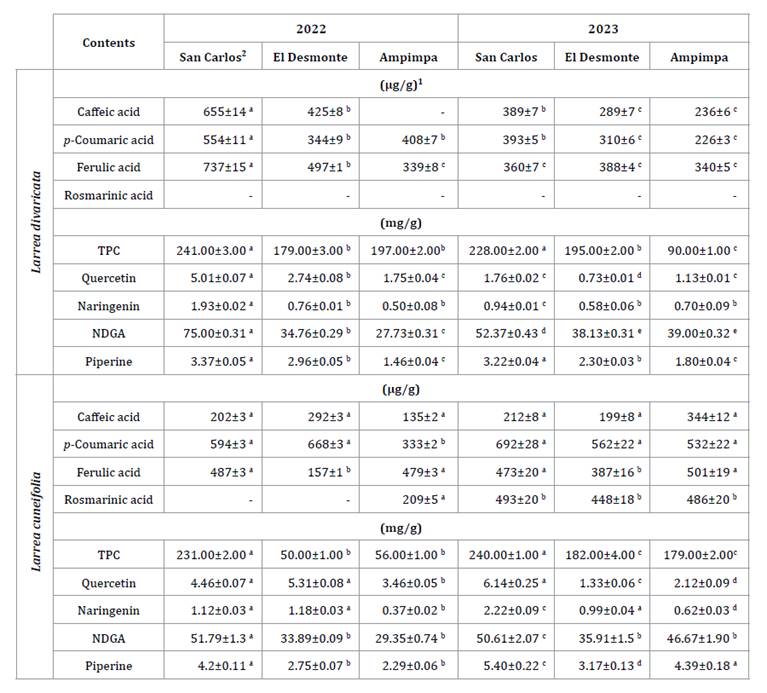
The aerial parts of Larrea divaricata and L. cuneifolia showed marked phytochemical variability among sites and years. Contents normalized to dry weight (DW) according to extraction yields (19.65-27.44%) revealed TPC values between 90-241 and 50-240 mg GAE/g DW, respectively (table 1). San Carlos consistently exhibited the highest accumulation, exceeding other locations by up to 2.5-fold in L. divaricata and 4.8-fold in L. cuneifolia. HPLC-DAD quantifications based on the UV-VIS spectra of the marker metabolites (Supplementary material 3) identified NDGA at 27-75 mg/g DW in L. divaricata and 29-50 mg/g DW in L. cuneifolia, accounting for 20-30% of TPC, with higher NDGA/TPC ratios in samples with low overall TPC (e.g., L. cuneifolia at El Desmonte 2022: 68%; L. divaricata at Ampimpa 2023: 46%). In contrast, flavonoids and piperine occurred in the low mg/g range (0.37-6.14 mg/g and 1.46-5.40 mg/g, respectively), while phenolic acids were detected at the μg/g level. Theophylline was not detected, whereas rosmarinic acid was confirmed as an exclusive marker of L. cuneifolia (Espino et al., 2019). The more constrained variation of NDGA and piperine (< 2.8-fold) compared to flavonoids (~7-fold for quercetin) suggests a constitutive defense role for the former and a more plastic adaptive response for the latter (Conta et al., 2025; Sun & Shahrajabian, 2023).
Table 1. Phenolic compounds and marker metabolites in L. divaricata and L. cuneifolia (2022-2023).
Tabla 1. Compuestos fenólicos y metabolitos marcadores en L. divaricata y L. cuneifolia (2022-2023).
1 Different letters in a same row indicate significant differences between means, as determined by the Game-Howell test (p < 0.05). 2 NDGA: nordihydroguaiaretic acid.
1 Las letras diferentes en una misma fila indican diferencias significativas entre las medias, según lo determinado por la prueba de Game-Howell (p < 0,05). 2 NDGA: ácido nordihidroguaiarético.
Earlier studies linked Larrea phytochemical variation to landforms, seasons, or collection at a specific time of the day. For instance, L. cuneifolia showed higher TPC in plains than in piedmont zones during autumn (Lorenzo et al., 2019), while L. divaricata exhibited an autumn TPC peak in Patagonia or maxima during spring mornings in the Calchaquí Valleys (Barrera et al., 2025; Varela et al., 2016). However, the inter-annual fluctuations observed here suggest that these approaches alone can not guarantee high metabolite yields. Instead, identifying sites with persistent historical stress may be a more reliable indicator of phytochemical potential. Consequently, the following section evaluates the performance of ERA5 meteorological variables to determine if multi-year climatic series based on them act as robust predictors of the observed metabolite dynamics.
Validation of ERA5 Reanalysis Data Against in situ Meteorological Data
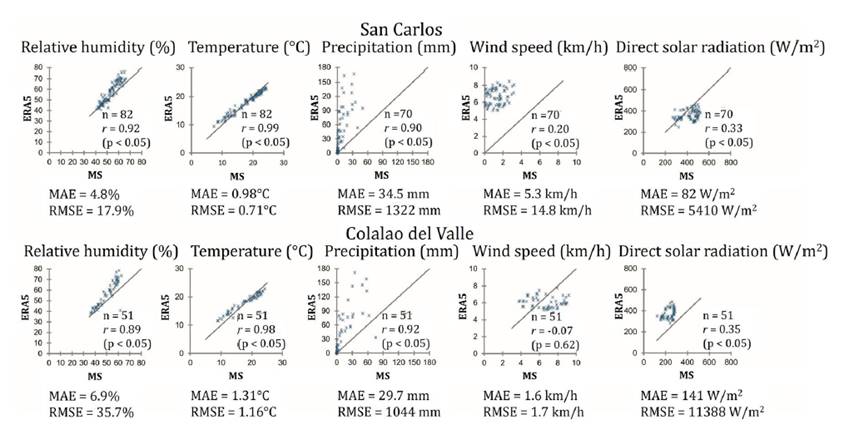
Due to the lack of in situ observations at most sites, ERA5 reanalysis was used to characterize climatic conditions (Hersbach et al., 2020). Validation was necessary to correct possible systematic biases common in mountainous regions (Wang et al., 2025). Monthly ERA5 estimates of direct solar radiation, 10-m wind speed, precipitation, air temperature, and relative humidity were compared against weather stations at San Carlos and Colalao del Valle. Scatter and Bland Altman plots (figures 1 and 2) show temperature with an excellent agreement (r = 0.98-0.99), characterized by low errors (MAE = 0.98-1.31°C; RMSE = 0.71-1.16°C) and minimal bias (0.1-0.2°C) consistent with findings in other complex terrains (Karaman & Akyuyek, 2023). Relative humidity also correlated strongly (r = 0.89-0.92), though with a significant scatter (MAE = 4.8-6.9%; RMSE = 17.9-35.7%), and moderate 3-6% bias often observed at high altitudes due to limitations in cloud formation parameterization (Wei et al., 2025). While precipitation correlated well (r = 0.90-0.92), the large RMSE values (1322-1044 mm) confirmed a systematic overestimation of cumulative monthly amounts, consistent with previous studies (Tarek et al., 2020). Conversely, wind speed and direct solar radiation yielded negligible correlations and high MAE, likely due to poorly resolved local topographic effects (Jiang et al., 2020). Consequently, only temperature, humidity, and precipitation were considered sufficiently robust for further analysis.
Comparison for Colalao del Valle and San Carlos stations against ERA5.
Comparativa de las estaciones Colalao del Valle y San Carlos frente a ERA5.
Figure 1. Scatter plots with unity lines (1:1) for monthly meteorological variables (ERA5 vs. station observations).
Figura 1. Gráficos de dispersión con líneas de unidad (1:1) para variables meteorológicas mensuales (ERA5 vs. observaciones de estación).
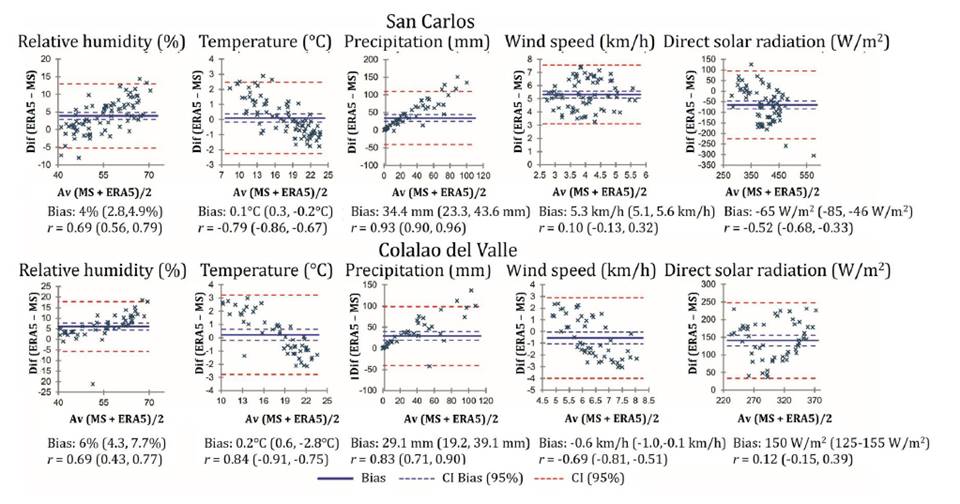
Lines: mean bias (solid blue), 95% CI (dashed blue), and 95% limits of agreement (dashed red). Data of Jan-16, Feb-17, Jul-17, Dic-17, Mar-20, Apr-22, Jun to Nov-22 were excluded for wind speed, precipitation and direct solar radiation, as they were unavailable at the meteorological station of San Carlos.
Lineas: sesgo medio (línea azul continua), IC 95% (azul discontinua) y límites de confianza del 95% (rojo discontinua). Se excluyeron datos de Ene-16, Feb-17, Jul-17, Dic-17, Mar-20, Abr-22, Jun a Nov-22 para velocidad del viento, precipitación y radiación solar directa, por no estar disponibles en estación meteorológica de San Carlos.
Figure 2. Bland-Altman plots of monthly meteorological variables (ERA5 vs. station observations). Comparison for Colalao del Valle and San Carlos stations against ERA5.
Figura 2. Gráficos de Bland-Altman para series mensuales de variables meteorológicas (ERA5 vs. observaciones locales). Comparativa de las estaciones Colalao del Valle y San Carlos frente a datos ERA5.
Identification of Climatic Drivers for Secondary Metabolite Accumulation
Site-specific climatic profiles were characterized using ERA5 time series of 2014-2024 (figure 3). San Carlos was consistently warmer and drier (18.0±0.6°C; 58±2% RH) than the cooler, more humid sites of Ampimpa and El Desmonte (≈12°C; 72% RH). ERA5-estimated precipitation followed this trend, with San Carlos receiving significantly less rainfall (47±17 mm) than Ampimpa (94±33 mm) and El Desmonte (274±93 mm) (test of Nemenyi, p < 0.05). Hence, San Carlos should suffer a greater water deficit than the remaining sites. Plants typically upregulate phenolic and flavonoid biosynthesis to mitigate such stress, a response previously documented in Larrea divaricata under high evaporative demand (Varela et al., 2016). Consequently, the elevated metabolite accumulation observed in both Larrea species at San Carlos represents an adaptive response to xeric conditions, reinforcing the role of polyphenols in drought and heat tolerance within arid-zone shrubs (Varela et al., 2016).
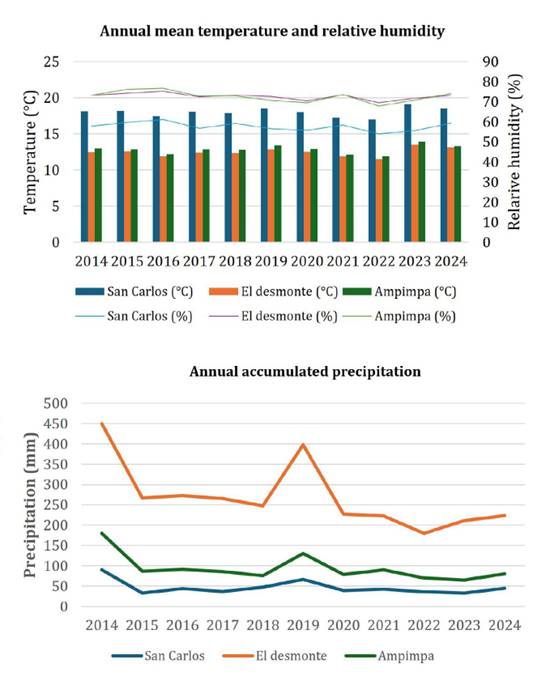
Significant differences among sites (Friedman/Nemenyi tests, year as block): temperature (San Carlos > Ampimpa = El Desmonte), humidity (San Carlos < Ampimpa = El Desmonte), and precipitation (El Desmonte > Ampimpa > San Carlos).
Diferencias significativas entre sitios (pruebas de Friedman/ Nemenyi, año como bloque): temperatura (San Carlos > Ampimpa = El Desmonte), humedad (San Carlos < Ampimpa = El Desmonte), y precipitación (El Desmonte > Ampimpa > San Carlos).
Figure 3. Annual climate variables (ERA5) for the study sites (2014-2024).
Figura 3. Variables climáticas anuales (ERA5) para los sitios de estudio (2014-2024).
Antibacterial Activity of Larrea Extracts and Identification of Chemical Predictors
The antibacterial activity of the ethanolic extracts of L. divaricata and L. cuneifolia (2022-2023) against E. coli strains (table 2) was categorized as high (MIC ≤ 0.625 mg/mL), moderate (0.626-1.25 mg/mL), or weak (> 1.25 mg/mL) (26). The observed MICs align with the broad range reported for Larrea preparations (≈0.2–≥1 mg/mL), where variability stems from solvent systems, phenolic/lignan enrichment, and strain resistance profiles (Conta et al., 2025; Gómez et al., 2021). Consistent with prior findings, inhibition was weaker against E. coli than Gram-positive counterparts, which typically exhibit MICs < 0.1 mg/mL (Morales-Ubaldo et al., 2022). While the marker compounds identified (NDGA, quercetin, naringenin, and piperine) are known to disrupt membrane integrity and modulate cell envelope permeability of E. coli (Visser et al., 2023), their individual contributions were further elucidated through PCA to identify robust chemical predictors of bioactivity (Supplementary material 4). The first two principal components, F1 and F2, accounted for 85.69% (L. divaricata) and 79.06% (L. cuneifolia) of the total variance. Across all E. coli strains, MIC values exhibited strong negative correlations with both TPC and NDGA (r = -0.60 to -0.96). This relationship is evidenced by the alignment of their vectors opposite to the bacterial strains in the biplots and their intense clustering in the heatmaps (figure 4). Conversely, the remaining constituents showed weak or inconsistent correlations, suggesting they are unlikely to be the primary drivers of antibacterial activity. Instead, these minor components may co-vary with truly bioactive compounds or participate in complex synergistic/antagonistic interactions within the phytochemical matrix (Vaou et al., 2022). Collectively, the PCA-correlation analysis identifies TPC and NDGA as the most reliable chemical predictors of antibacterial performance in these Larrea extracts.
Table 2. MIC values (mg/mL) for extracts of the Larrea species tested against the E. coli strains.
Tabla 2. Valores de CIM (mg/mL) de los extractos de las especies de Larrea contra cepas de E. coli.
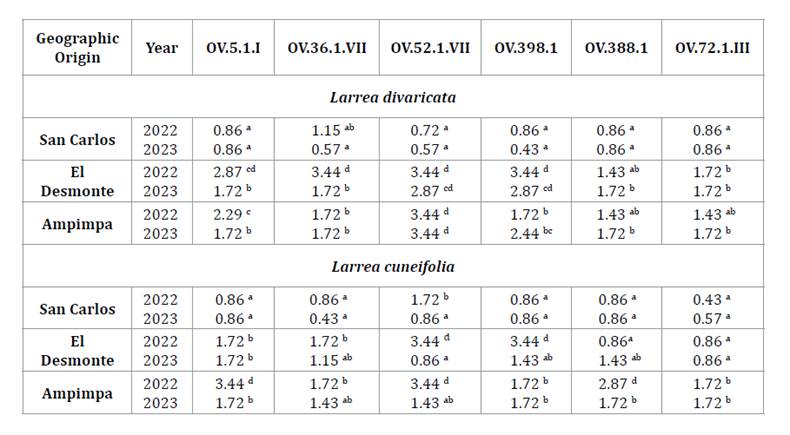
1 Different letters in the same column indicate significant differences according to Conover- Iman test (p < 0.05).
1 Letras diferentes en la misma columna indican diferencias significativas según la prueba de Conover- Iman (p < 0,05).
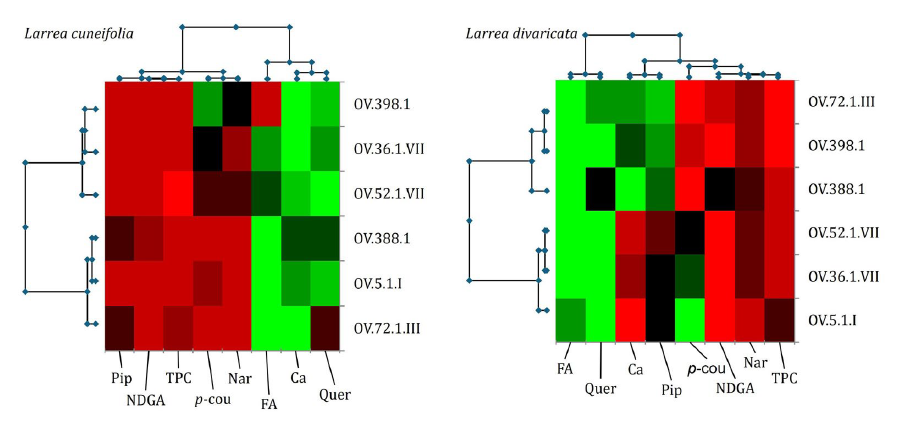
Red and green tones indicate negative and positive correlations, respectively. Ca: caffeic acid; p-cou: p-coumaric acid; FA: ferulic acid; Quer: quercetin; Nar: naringenin; NDGA: nordihydroguaiaretic acid; Pip: piperine; TPC: total phenolic compounds.
Los tonos rojos y verdes indican correlaciones negativas y positivas, respectivamente. Ca: ácido cafeico; p-cou: ácido p-cumárico; FA: ácido ferúlico; Quer: quercetina; Nar: naringenina; NDGA: ácido nordihidroguaiaretico; Pip: piperina; TPC: compuestos fenólicos totales.
Figure 4. Pearson correlation heatmaps between extract constituents and MIC values against E. coli strains for the Larrea species.
Figura 4. Mapas de calor de correlación de Pearson entre los constituyentes del extracto y los valores de MIC frente a cepas de E. coli para las especies de Larrea.
Conclusions
This study suggests that ERA5 meteorological reanalysis is a valuable tool for characterizing the relationship between environmental patterns and the phytochemical quality of Larrea species. The integration of long-term data series (2014-2024) indicated that warmer and drier environmental patterns, such as those identified in San Carlos, may contribute significantly to the higher accumulation of NDGA and TPC. Furthermore, these specific phytochemical markers were associated with stronger antibacterial activity against diarrheagenic E. coli strains. Therefore, the use of ERA5 data for air temperature, relative humidity and precipitations variables is proposed as a methodology for identifying sites with persistent environmental stress, facilitating the selection of plant materials with consistent phytochemical profiles promising for veterinary use.
Acknowledgments
The authors thank National University of Tucumán and University of Buenos Aires for providing the undergraduate and graduate education of the researchers and their institutional infrastructure. This work was supported by ANPCyT (PICT-2019-03228) and CONICET (PIP 2209).
Anderegg, W. R., Schwalm, C., Biondi, F., Camarero, J. J., Koch, G., Litvak, M., Ogle, K., Shaw, J. D., Shevliakova, E., Williams, A. P., Wolf, A., Ziaco, E., & Pacala, S. (2015). Pervasive drought legacies in forest ecosystems and their implications for carbon cycle models. Science, 349, 528-532. https://doi.org/10.1126/science.aab1833
Barrera, M. C., Rosa, M. D., Zampini, I. C., & Isla, M. I. (2025). Impact of daily and seasonal variation on the phytochemical profile of Larrea cuneifolia in Northwestern Argentina. Plants, 14(21), 3332. https://doi.org/10.3390/plants14213332
Blanco Crivelli, X., Bonino, M. P., Sanin, M. S., Petrina, J. F., Disalvo, V. N., Massa, R., Miliwebsky, E., Navarro, A., Chinen, I. & Bentancor, A. (2021). Potential zoonotic pathovars of diarrheagenic Escherichia coli detected in lambs for human consumption from Tierra del Fuego, Argentina. Microorganisms, 11, 1710. https://doi.org/10.3390/microorganisms9081710
Boiteux, J.; Fernández, M. de los Á.; Espino, M.; Silva, M. F.; Pizzuolo, P. H. & Lucero, G. S. (2023). In vitro and in vivo efficacy of Larrea divaricata extract for the management of Phytophthora palmivora in olive trees. Revista de la Facultad de Ciencias Agrarias. Universidad Nacional de Cuyo. 55(2): 97-107. https://doi.org/10.48162/rev.39.112
Conta, A., Simirgiotis, M. J., Martinez Chamás, J., Isla, M. I., & Zampini, I. C. (2025). Extraction of bioactive compounds from Larrea cuneifolia Cav. using natural deep eutectic solvents: A contribution to the plant green extract validation of its pharmacological potential. Plants, 14(7), 1016. https://doi.org/10.3390/plants14071016
Denney, D., Jameel, M., Bemmels, J., Bemmels, J., Rochford, M., & Anderson, J. (2020). Small spaces, big impacts: contributions of micro-environmental variation to population persistence under climate change. AoB Plants, 12(2), plaa005. https://doi.org/10.1093/aobpla/plaa005
Espino, M., Solari, M., Fernández, M. L. Á., Boiteux, J., Gómez, M. R., & Silva, M. F. (2019). NADESmediated folk plant extracts as novel antifungal agents against Candida albicans. Journal of Pharmaceutical and Biomedical Analysis, 167, 15-20. https://doi.org/10.1016/j.jpba.2019.01.026
Fernández, M. E.; Cony, M. A. & Passera, C. B. (2019). Germination temperatures and seed dormancy of two Larrea species (Zygophyllaceae) from the Monte Desert, Argentina a species. Revista de la Facultad de Ciencias Agrarias. Universidad Nacional de Cuyo. 51(2): 235-247.
Gómez, J., Simirgiotis, M. J., Manrique, S., Piñeiro, M., Lima, B., Bórquez, J., Feresin, G. E., & Tapia, A. (2021). UHPLC-ESI-OT-MS phenolics profiling, free radical scavenging, antibacterial and nematicidal activities of “Yellow-Brown Resins” from Larrea spp. Antioxidants, 10(2), 185. https://doi.org/10.3390/antiox10020185
Herrera-Medina, R. E., Álvarez-Fuentes, G., Contreras-Servín, C., & García-López, J. C. (2021). Creosote Bush (Larrea tridentata) phytochemical traits and its different uses: A review. Journal of Applied Life Sciences International, 24(2), 34-45. https://doi.org/10.9734/JALSI/2021/V24I230221
Hersbach, H., Bell, B., Berrisford, P., Hirahara, S., Horányi, A., Muñoz-Sabater, J., Radu, R., Schepers, D., Simmons, A., Soci, C., Abdalla, S., Abellan, K., Balsamo, G., Balsamo, G., Diamantakis, M., Dragani, M., Flemming, J., Forbes, A., Haiden, M. & Thépaut, J. (2020). The ERA5 global reanalysis. Quarterly Journal of the Royal Meteorological Society, 146(730), 1999-2049. https://doi.org/10.1002/qj.3803
Jiang, H., Yang, Y., Bai, Y., & Wang, H. (2020). Evaluation of the total, direct, and diffuse solar radiations from the ERA5 reanalysis data in China. IEEE Geoscience and Remote Sensing Letters, 17(1), 47-51. https://doi.org/10.1109/LGRS.2019.2916410
Karaman, Ç., & Akyürek, Z. (2023). Evaluation of near-surface air temperature reanalysis datasets and downscaling with machine learning based random forest method for complex terrain of Turkey. Advances in Space Research, 71(12), 5256-5281. https://doi.org/10.1016/j.asr.2023.02.006
Lorenzo, M. E., Gómez, P. E., Segovia, A. F., Quiroga, A., Figueroa, L. C., & Baroni, M. V. (2019). Phenolic content and antioxidant activity of ethanolic extracts of Larrea divaricata Cav., Larrea cuneifolia Cav. and Sarcomphalus mistol (Griseb.) Hauenschild, coming from different areas of the Catamarca central valley. Revista del CIZAS, 20, 31-51. https://doi.org/10.3390/foods_2020-07645
Morales-Ubaldo, A. L., Rivero-Perez, N., Valladares-Carranza, B., Madariaga-Navarrete, A., Higuera- Piedrahita, R. I., Delgadillo-Ruiz, L., Bañuelos-Valenzuela, R., & Zaragoza-Bastida, A. (2022). Phytochemical compounds and pharmacological properties of Larrea tridentata. Molecules, 24(17), 5393. https://doi.org/10.3390/molecules27175393
Moreno, M. A., Córdoba, S., Zampini, I. C., Mercado, M. I., Ponessa, G., Sayago, J. E., Pino Ramose, L. L., Schmeda-Hirschmann, G., & Isla, M. I. (2018). Argentinean Larrea dry extracts with potential use in vaginal Candidiasis. Natural Product Communications, 13(2), 171-174. https://doi.org/10.1177/1934578X1801300215
Moreno, M. A., Zampini, I. C., & Isla, M. I. (2020). Antifungal, anti-inflammatory and antioxidant activity of bi-herbal mixtures with medicinal plants from Argentinean highlands. Journal of Ethnopharmacology, 253, 112642. https://doi.org/10.1016/j.jep.2020.112642
Sun, J., Chen, W., & Yuan, Z. (2022). Characterization of Intestinal Microbiota in Lambs with Different Susceptibility to Escherichia coli F17. Veterinary Sciences, 9(12), 670. https://doi.org/10.3390/vetsci9120670
Sun, W., & Shahrajabian, M. H. (2023). Therapeutic potential of phenolic compounds in medicinal plants-natural health products for human health. Molecules, 28(4), 1845. https://doi.org/10.3390/molecules28041845
Tarek, M., Brissette, F., & Arsenault, R. (2020). Evaluation of the ERA5 reanalysis as a potential reference dataset for hydrological modelling over North America. Hydrology and Earth System Sciences, 24(5), 2527-2544. https://doi.org/10.5194/hess-24-2527-2020
Vanoye-Lara, F. F., Pinos-Rodríguez, J. M., García-López, J. C., López-Aguirre, S., Vicente-Martínez, J. G., & Flores-Primo, A. (2025). Larrea tridentata as a feed additive to improve liver development and functionality in broilers. Revista Mexicana de Ciencias Pecuarias, 16(2), 446-454. https://doi.org/10.22319/rmcp.v16i2.6540
Vaou, N., Stavropoulou, E., Voidarou, C., Tsakris, Z., Rozos, G., Tsigalou, C., & Bezirtzoglou, E. (2022). Interactions between medical plant-derived bioactive compounds: focus on antimicrobial combination effects. Antibiotics, 11(8), 1014. https://doi.org/10.3390/antibiotics11081014
Varela, M. C., Arslan, I., Reginato, M. A., Cenzano, A. M., & Luna, M. V. (2016). Phenolic compounds as indicators of drought resistance in shrubs from Patagonian shrublands (Argentina). Plant Physiology and Biochemistry, 104, 81-91. https://doi.org/10.1016/j.plaphy.2016.03.014
Visser, J. A., Yager, D., Chambers, S. A., Lim, J. Y., Cao, X., & Cegelski, L. (2023). Nordihydroguaiaretic acid inhibits CsgA polymerization, bacterial amyloid biogenesis, and biofilm formation. Chembiochem, 24(11), e202300266. https://doi.org/10.1002/cbic.202300266
Wang, J., Li, Z., Liang, Y., & Ke, J. (2025). An assessment of the applicability of ERA5 reanalysis boundary layer data against remote sensing observations in mountainous Central China. Atmosphere, 16(10), 1152. https://doi.org/10.3390/atmos16101152
Wei, Y., Sun, Y., Ma, Y., Tan, Y., Ren, X., Peng, K., Yang, S., Lin, Z., Zhou, X., Ren, Y., Ahmed, M., Tian, Y., Xin, J. & Xin, J. (2025). Deviations of boundary layer height and meteorological parameters between ground-based remote sensing and ERA5 over the complex terrain of the Mongolian Plateau. Remote Sensing, 17(3), 393. https://doi.org/10.3390/rs17030393
Zeballos, S. R., Acosta, A. R. T., Agüero, W. D., Ahumada, R. J., Almirón, M. G., Argibay, D. S., Arroyo, D. N., Blanco, L. J., Biurrun, F. N., Cantero, J. J., Márquez, J., Quiroga, A., Quiroga, R. E., Cabido, M. R. & Cabido, M. R. (2023). Vegetation types of the Arid Chaco in Central Western Argentina. Vegetation Classification and Survey, 4, 167-188. https://www.doi.org/10.3897/VCS.100532
Zhang, C., Yang, D., Liang, Z., Liu, J., Yan, K., Zhu, Y., & Yang, S. (2019). Climatic factors control the geospatial distribution of active ingredients in Salvia miltiorrhiza Bunge in China. Scientific Reports, 9, 1-10. https://doi.org/10.1038/s41598-018-36729-xº