Rev. FCA UNCuyo | 2026 | 58(2) | ISSN 1853-8665
Ecophysiology and crop management
https://doi.org/10.48162/rev.39.227
Effect of Temperature, Water Potential and Salinity on Seed Germination of Four Native Perennial Grasses of the Monte (Argentina)
Efecto de la temperatura, potencial agua y salinidad en la germinación de cuatro especies de gramíneas perennes nativas del Monte (Argentina)
Carmen Elena Sartor 1,
Inés Hugalde 2,
Juan Bruno Cavagnaro 2ϯ
1 Universidad Nacional de Cuyo. Facultad de Ciencias Agrarias. Cátedra de Ecología. Almirante Brown 500. M5528AHB. Chacras de Coria. Mendoza. Argentina.
2 Instituto Nacional de Tecnología Agropecuaria (INTA). Estación Experimental Agropecuaria (EEA) Mendoza. San Martin 3853. Luján de Cuyo (5507). Mendoza. Argentina. ϯ In memoriam.
3 Universidad Nacional de Cuyo. Facultad de Ciencias Agrarias. Cátedra de Fisiología Vegetal. Almirante Brown 500. M5528AHB. Chacras de Coria. Mendoza. Argentina.
* sgreco@fca.uncu.edu.ar
Abstract
Seed germination is critical for successful restoration in degraded desert ecosystems. This study aimed to determine thermal requirements and tolerance limits to water and salt stress of four key forage species: Aristida mendocina, Digitaria californica, Pappophorum caespitosum, and Leptochloa crinita. Controlled laboratory experiments were conducted to evaluate constant temperature regimes (5, 15, 20, 25, 30, 35, 40, and 45°C), one alternating-temperatures regime (45-15°C), water potentials (0, -0.38, -0.58, -0.97, -1.30, -1.52, and -1.77 MPa) simulated with Polyethyleneglycol (PEG) solutions, and NaCl concentrations (0.1, 0.3, and 0.5 M). We recorded final germination percentage and germination rate (Maguire Index). The species exhibited different environmental plasticity. L. crinita and P. caespitosum showed the broadest thermal ranges, achieving optimal germination (>80%) between 25 and 35°C. P. caespitosum demonstrated the highest tolerance to salinity and water stress, being the only species capable of germinating in 0.5 M NaCl solutions (20%) and at -1.77 MPa (20%). In contrast, *A. mendocina* and *D. californica* were the most sensitive; the former restricted its optimum to 20-30°C, and both reduced their germination by half with just 0.1 M NaCl.
Keywords: temperatures, drought, NaCl, Pappophorum caespitosum, Digitaria califórnica, Aristida mendocina, Leptochloa crinita, restoration
Resumen
La germinación de semillas es una de las fases más críticas para asegurar el éxito de la restauración en ecosistemas degradados de zonas áridas. El objetivo de este trabajo fue determinar los requerimientos térmicos y los límites de tolerancia al estrés hídrico y salino de cuatro especies forrajeras clave: Aristida mendocina, Digitaria californica, Pappophorum caespitosum y Leptochloa crinita. Se realizaron ensayos controlados de laboratorio evaluando: 1) temperaturas constantes (5, 15, 20, 25, 30, 35, 40, 45°C) y alternantes (45-15°C); 2) potenciales hídricos (0, -0,38, -0,58, -0,97, -1,30, 1,52 y -1,77 MPa) simulados mediante soluciones de Polietilenglicol (PEG); y 3) concentraciones salinas de NaCl (0,1, 0,3 y 0,5 M). Se registró el porcentaje final de germinación y la velocidad de germinación mediante el Índice de Maguire. Las especies mostraron una clara diferenciación en su plasticidad ambiental. L. crinita y P. caespitosum presentaron los rangos más amplios, con germinaciones óptimas (>80%) entre 25 y 35°C. P. caespitosum se destacó por una alta tolerancia salina e hídrica, siendo la única capaz de germinar en soluciones de 0,5 M de NaCl (20%) y bajo un estrés hídrico de -1,77 MPa (20%), condiciones donde el éxito de las demás especies fue nulo. Por el contrario, A. mendocina y D. californica resultaron ser las más sensibles; la primera restringió su óptimo a los 20-30°C y ambas redujeron su germinación a la mitad con sólo 0,1 M de NaCl.
Palabras clave: temperatura, sequía, NaCl, Pappophorum caespitosum, Digitaria califórnica, Aristida Mendocina, Leptochloa crinita, restauración
Originals: Received: 18/03/2026 - Accepted: 29/07/2026
Introduction
Seed germination and seedling emergence are critical phases for the successful establishment of new plants in desert ecosystems. Only about 5 to 10% of seeds develop into established seedlings (Kildischeva et al., 2016). Germination is influenced by genotype and abiotic factors such as temperature, water stress, salinity, and photoperiod (Baskin & Baskin, 2014; Dágata et al., 2021; Guden et al., 2024; Gutterman, 1993; Okumus & Şekerci, 2024). In deserts, germination relies on water availability to ensure subsequent seedling growth (Bewley & Black, 1994; Corvalán Videla et al., 2021). Some desert species only germinate after rainfall exceeding 12-15 mm. Furthermore, a 15 mm rainfall is more effective at removing germination water-soluble inhibitors when it occurs over several hours rather than in a single hour (Lundholm & Larson, 2004; Schwinning & Sala, 2004). This provides seeds with a trigger mechanism that guarantees germination when soil moisture supports seedling establishment and growth (Bewley & Black, 1994). For example, Leptochloa crinita and Pappohorum caespitosum need 40 mm of water to trigger seedling emergence (Greco et al., 2013; Sartor et al., 2024).
Soil temperature and salinity also influence seed germination. Seeds germinate within a defined temperature range (Bewley & Black, 1994), and the time required to reach maximum germination, i.e., germination rate or germinative energy, varies with temperature (Kigel, 1995; Mnif Fakhfakh et al., 2025). On the other hand, soil interface in desert ecosystems is an extremely harsh environment. Intense solar radiation and low air humidity cause water evaporation and rapid desiccation of the soil surface, facilitating salt accumulation on or near the surface. This hinders germination in surface layers even after rainfall events (Kigel, 1995, Baskin & Baskin, 2014). In this sense, seed sensitivity to saline solutions constitutes one mechanism for seeds to detect when rainfall is sufficient (Bewley & Black, 1994; Mansouri & Kheloufi, 2024, Singh, 2025; Nikolic et al., 2023).
Monte is a biogeographic province characterized by shrubby steppes composed of Zygophyllaceae species, with an herbaceous stratum dominated by perennial grasses (Roig, 1970a; Roig et al., 2009). Grass cover in the Monte Desert is affected by climatic settings, particularly scarce, erratic, and highly variable rainfall (Noy-Meir, 1973; Villagra et al., 2011), and by the presence of cattle and human-induced conditions (overgrazing and fire). The C4 species Pappophorum caespitosum, Digitaria californica, Aristida mendocina, and Leptochloa crinita are dominant perennial and summer-cycle species in the area (Cavagnaro, 1988). Given their distribution and nutritional quality, native perennial grasses constitute an important forage resource for extensive livestock farming (Guevara et al., 1997; 2009). At some places, fire, grazing, or deforestation has reduced cover to less than 20% of its potential (Guevara et al., 1997, 2009; Marchi et al., 1991). In this context, the addition of seeds is mentioned as a successful strategy for restoration in arid livestock areas (Quiroga et al., 2018). Beyond their natural environments, these species are gaining value for xerophytic gardens and as inter-row permanent cover in drip-irrigated crops (Ferrari & Parera, 2015). Even considering these significant instances, knowledge about germination conditions of these perennial species is scarce.
Although these perennial grasses coexist in arid and semiarid conditions, they inhabit different soils and precipitation gradients. L. crinita is associated with clayey and saline soils, D. californica and A. mendocina grow in sandy soils, and P. caespitosum is found in sandy- loam and saline soils (Candia & Guevara, 1973; Flores et al., 2015; Roig, 1970b). On the other hand, L. crinita, P. caespitosum, and A. mendocina inhabit areas with 100 to 600 mm of precipitation, while D. californica is frequently found between 300 and 600 mm (Cabido et al., 1993). Habitat differences among these perennial grass species could be due to different seed germination strategies.
Previous studies mention seed germination of L. crinita and D. californica under abiotic stress (Ferrari & Parera, 2015). Meglioli et al., 2024 studied temperature and light on germination of L. crinita, P. caespitosum, and D. californica; Zabala et al., (2011) studied temperature, seed weight, and maternal effects in L. crinita and L. pluriflora, while Marinoni et al., (2018, 2022) registered seed germination under osmotic and saline stress and seed coating (Meglioli et al., 2026). While one study observed germination of L. crinita and Digitaria eriantha subjected to osmotic stress at different temperatures (Di Giambatista et al., 2010), Quiroga et al., (2018) investigated the importance of rain and temperature on the conserved climatic niche of L. crinita in North and South America. This underlines the relevance of arid conditions in species adaptation.
Thus, germination strategies under different temperatures, water potentials, and salinity, especially in these opportunistic species, ensure successful seedling establishment. To the best of our knowledge, no previous studies have assessed temperature effects on germination of A. mendocina, nor seed response of A. mendocina. P. caespitosum and D. californica to different saline solutions and water potentials. We aimed to describe germination responses to temperature, salinity, and drought in the native perennial species Aristida mendocina, Digitaria californica, Pappophorum caespitosum, and Leptochloa crinita.
Materials and Methods
Seeds of Aristida mendocina, Digitaria californica, and Pappophorum caespitosum were collected at the Experimental Field of the Centro Científico Tecnológico (CCT), Mendoza, Argentina. Seeds of Leptochloa crinita Genotype N°3 (Ñacuñán) were harvested from the genotype collection of the Facultad de Ciencias Agrarias (Universidad Nacional de Cuyo), Mendoza, Argentina. Seeds were kept in paper envelopes, in the dark. Before the experiments, D. californica, P. caespitosum, and L. crinita were threshed, while A. mendocina seeds were directly sown. Seed viability was tested via the Tetrazolium test (ISTA, 2021) before germination assays.
All germination assays were performed in 9 cm diameter Petri dishes, with cotton and filter-sterilized paper discs on top. To avoid fungal infection, we moistened each disc with 10 ml of a 0.1% Benomyl solution in distilled water. We carried out all assays in darkness, using incubators (Precision Scientific Model Inc. 818) with automatic temperature control (±0.1°C).
The emergence of a 1 mm radicle indicated germinated seeds. All trials lasted 10 days. Germination was recorded as percentage of geminated seeds (%), and germination rates were calculated using the Maguire equation (Maguire, 1962):
M = n1/t1 + n2/t2+...+n9/t9
where:
n1,n2,...n9 = number of germinated seeds at each date.
And t1, t2,...t9 = times in days.
Germination Assay at Different Temperatures
Seeds germinated in incubators at 5°C, 15°C, 20°C, 25°C, 30°C, 35°C, 40°C, 45°C, and 50°C. The trial was completely randomized, with 5 replicates of 25 seeds per treatment and genotype.
Germination Assay at Constant and Alternating Temperatures
Five Petri dishes with 30 seeds per species were placed in growth chambers under the following treatments: a) 16 hours at 15°C and 8 hours at 45°C; b) continuous 30°C; c) continuous 45°C.
Germination Assay at Different Water Potentials
The trial consisted of a completely randomized design with 4 replicates of 50 seeds per treatment. All Petri dishes were placed in an incubator at 30°C. We conducted 8 treatments: a control with distilled water and Polyethylene glycol (PEG) solutions. PEG solutions were prepared at 143.18, 213.64, 267.98, 313.88, 354.36, 390.99 g PEG L-1 distilled water. Osmotic potentials at 30°C were -0.38, -0.58, -0.97, -1.3, -1.52, and -1.77 MPa, respectively. Ten mL of each solution was initially added to each Petri dish.
Germination Assay with Saline Solutions
This trial was completely randomized with 4 replicates of 50 seeds per treatment. Petri dishes were placed in an incubator at 30°C. We used 4 treatments: a control with distilled water and 3 different Sodium Chloride (NaCl) solutions. Molal solutions of NaCl were 0.1, 0.3, and 0.5 mol kg-1, weighing 5.84 g/L., 17.53 g/L. and 29.22 g/L, respectively. Twenty mL of the corresponding solution was added to each Petri dish. Osmotic potential at 30°C was -0.47 MPa, -1.39 MPa, and -2.32 MPa, respectively.
Statistical Analysis
Final germination percentages were transformed via arcsine of the square root (arcsine (√x̄) and germination rates were transformed with the square root (x + 0.5) to meet ANOVA assumptions. Both variables were analyzed using ANOVA and Tukey test (p < 0.05).
Results
Germination at Different Temperatures
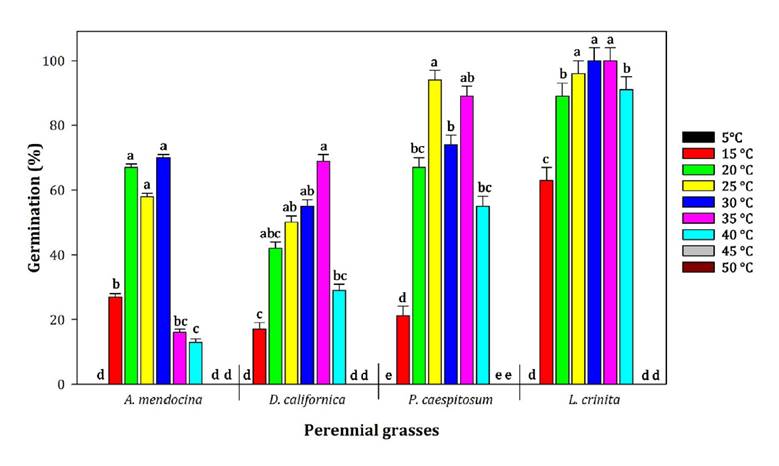
None of the four species germinated at 5, 45, or 50°C (figure 1). A. mendocina seed germination was 60-70% (maximum for this species) at 20, 25, and 30°C (figure 1).
Different letters indicate significant differences in temperature within each species at p < 0.05.
Las letras diferentes indican diferencias significativas entre las temperaturas dentro de cada especie, p < 0,05.
Figure 1. Average percentage of germinated seeds (+ standard error) of Aristida mendocina, Digitaria californica, Pappophorum caespitosum, and Leptochloa crinita incubated at different temperatures (5, 15, 20, 25, 30, 35, 40, 45°C).
Figura 1. Porcentaje promedio de semillas germinadas (+ error estándar) de Aristida mendocina, Digitaria californica, Pappophorum caespitosum y Leptochloa crinita incubadas a distintas temperaturas (5, 15, 20, 25, 30, 35, 40, 45°C).
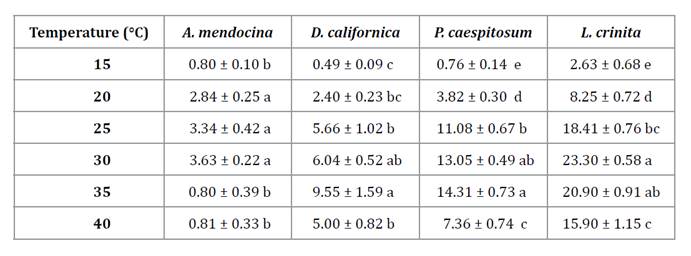
Germination reached 27% at 15°C, and 10% at 35 and 40°C on the same date. Similarly, equal germination rates were recorded at 20, 25, and 30°C (table 1), with significant differences from 15°C, 35°C, and 40°C.
Table 1. Germination rates (Maguire Index ± standard error) of Aristida mendocina, Digitaria californica, Pappophorum caespitosum and Leptochloa crinita incubated at different temperatures.
Tabla 1. Tasas de germinación (Índice de Maguire ± error estándar) de semillas de Aristida mendocina, Digitaria californica, Pappophorum caespitosum y Leptochloa crinita incubadas a diferentes temperaturas.
Different letters indicate significant differences between treatments for the same species at p < 0.05.
Letras diferentes indican diferencias significativas entre tratamientos para una misma especie a p < 0,05.
D. californica seed germination was 64% at 35°C (maximum for this species), and 50% between 25 and 30°C, with no significant differences among these treatments. At 20 and 40°C, 30% of seeds germinated, while only 15% germinated at 15°C (figure 1). The highest germination rate was obtained at 25, 30, and 35°C (table 1).
P. caespitosum germination was 94% at 25°C, 89% at 35°C, 74% at 30°C, 67% at 20°C, 55% at 40°C and 24% at 15°C. Significant differences were observed at 25 and 35°C with respect to the other treatments. Forty percent of the seeds germinated at 30 and 35°C on day one of incubation, corresponding to the highest germination rates (table 1).
L. crinita achieved 95-100% at 25, 30, and 35°C on day 2 of incubation. On day 7, at 20 and 40°C, this percentage significantly dropped to 88%. On day 9 at 15°C, 69% of seeds germinated, significantly differing from the other treatments (figure 1). Notably, a high proportion of seeds from this species germinated on day 1 of incubation at 25, 30, and 35°C, with the highest germination rates at 30 and 35°C (table 1).
Germination at Constant and Alternating Temperatures
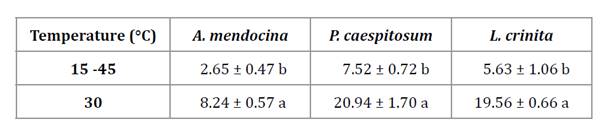
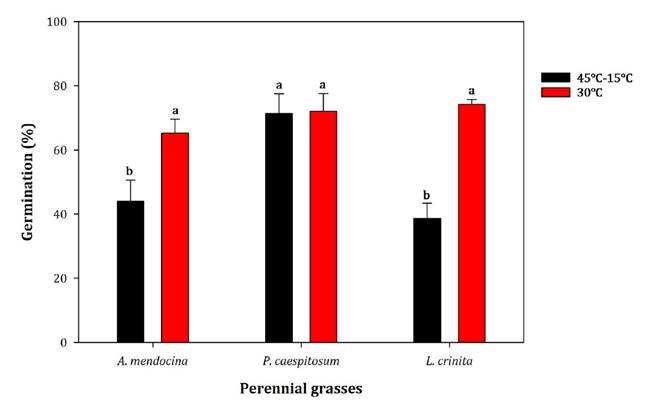
No germination occurred at 45°C. Alternating temperatures (15- 45°C) did not affect germination in P. caespitosum (table 2). A. mendocina. and L. crinita showed lower germination percentages when alternating temperature than under constant 30°C (figure 2). Similarly, germination rates of A. mendocina and L. crinita decreased by approximately threefold when seeds were incubated at alternating temperatures under 30°C (table 2). D. californica seeds did not germinate due to fungal infection in Petri dishes.
Table 2. Germination rates (Maguire Index ± standard error) of Aristida mendocina, Pappophorum caespitosum, and Leptochloa crinita incubated at constant (30°C) and alternating temperatures(15-45°C).
Tabla 2. Tasas de germinación (Índice de Maguire ± error estándar) de semillas de Aristida mendocina, Pappophorum caespitosum y Leptochloa crinita incubadas a temperaturas alternantes (15-45°C) y a temperatura constante (30°C).
Different letters indicate significant differences between treatments for the same species at p < 0.05.
Letras diferentes indican diferencias significativas entre tratamientos para una misma especie a p < 0,05.
Different letters indicate significant differences in temperature within each species at p < 0.05.
Las letras diferentes indican diferencias significativas entre las temperaturas dentro de cada especie, p < 0,05.
Figure 2. Average percentage of germinated seeds(+ standard error) of Aristida mendocina, Pappophorum caespitosum, and Leptochloa crinita incubated at alternating temperatures of 45 and 15°C, and at a constant 30°C.
Figura 2. Porcentaje promedio de semillas germinadas (+ error estándar) de Aristida mendocina, Pappophorum caespitosum y Leptochloa crinita incubadas a temperaturas alternantes de 45 y 15°C y a temperatura constante de 30°C.
Germination at Different Water Potentials
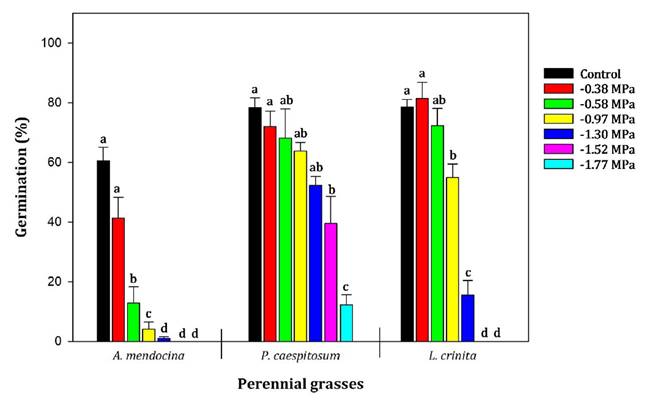
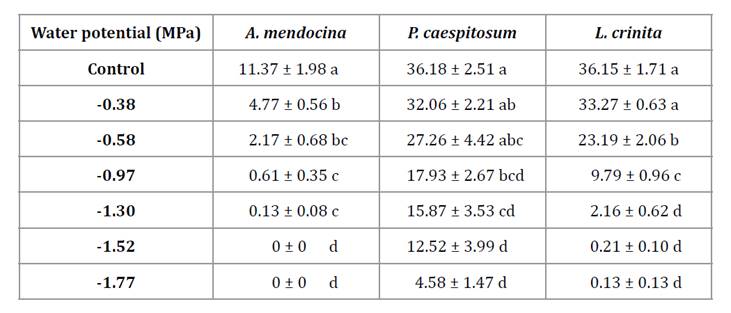
Final germination of A. mendocina was similar between -0.38 MPa and control conditions. However, -0.58, -0.97, and -1.3 MPa solutions significantly decreased final germination. Null germination was recorded at -1.5 and -1.7 MPa (figure 3). Under increasing PEG solutions, germination rates decreased (table 3).
Different letters indicate significant differences between treatments within each species at p < 0.05.
Las letras diferentes indican diferencias significativas entre tratamientos dentro de cada especie con un nivel de significancia de p < 0,05.
Figure 3. Average percentage of germinated seeds (+ standard error) of Aristida mendocina, Pappophorum caespitosum, and Leptochloa crinita incubated at different water potentials (control, -0.38, -0.58, -0.97, -1.30, -1.52, and -1.77 MPa).
Figura 3. Porcentaje promedio de semillas germinadas (+ error estándar) de Aristida mendocina, Pappophorum caespitosum y Leptochloa crinita incubadas a diferentes potenciales agua (control, -0.38 MPa, -0.58 MPa, -0.97 MPa, -1.30 MPa, 1.52 MPa y -1.77 MPa).
Table 3. Germination rates (Maguire Index ± standard error) of Aristida mendocina, Pappophorum caespitosum, and Leptochloa crinita incubated at different water potentials.
Tabla 3. Tasas de germinación (Índice de Maguire ± error estándar) de semillas de Aristida mendocina, Pappophorum caespitosum y Leptochloa crinita incubadas a diferentes potenciales agua.
Different letters indicate significant differences between treatments for the same species at p < 0.05.
Letras diferentes indican diferencias significativas entre tratamientos para una misma especie a p < 0,05.
P. caespitosum seeds germinated in all PEG solutions. Even at -1.3 and -1.7 MPa, P. caespitosum achieved 60% and 20%, respectively (figure 3). Germination rates followed the same pattern as final germination percentage (table 3).
Seed germination percentage in L. crinita significantly decreased compared to the control, from -0.97 MPa onward, with no germination under -1.5 MPa (figure 3). Germination rates decreased from -0.58 onward (table 3).
D. californica seeds did not germinate due to fungal infection in the Petri dishes.
Germination in Different Saline Solutions
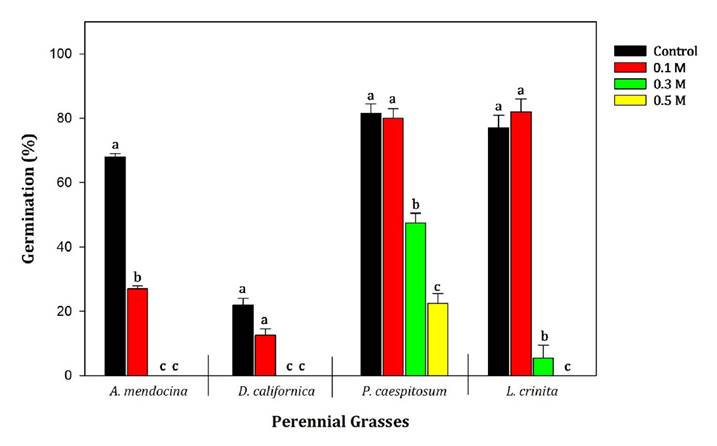
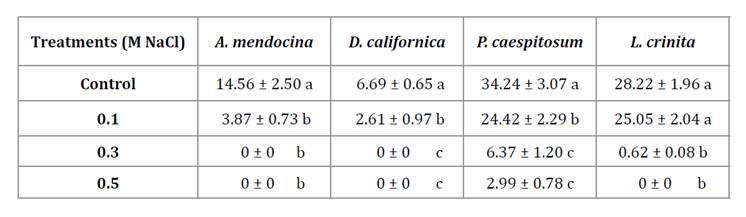
Neither A. mendocina nor D. californica germinated at 0.3 and 0.5 M NaCl treatments (figure 4). At 0.1 M, the percentage of germinated A. mendocina seeds was halved compared to the control. The percentage of germinated seeds for control D.californica did not reach 25%. Germination rates of both species at 0.1M were lower than the control (table 4).
Different letters indicate significant differences between treatments within each species at p < 0.05.
Las letras diferentes indican diferencias significativas entre tratamientos dentro de cada especie, p < 0,05.
Figure 4. Average percentage of germinated seeds (+ standard error) of Aristida mendocina, Digitaria californica, Pappophorum caespitosum, and Leptochloa crinite incubated with different saline solutions (control, 0.1, 0.3, and 0.5M NaCl).
Figura 4. Porcentaje promedio de semillas germinadas (+ error estándar) de Aristida mendocina, Digitaria californica, Pappophorum caespitosum y Leptochloa crinita incubadas con diferentes soluciones salinas (control, 0.1 M, 0.3 M y 0.5 M NaCl).
Table 4. Germination rates (Maguire Index ± standard error) of Aristida mendocina, Digitaria californica, Pappophorum caespitosum, and Leptochloa crinita incubated in different saline solutions.
Tabla 4. Tasas de germinación (Índice de Maguire ± error estándar) de semillas de Aristida mendocina, Digitaria californica, Pappophorum caespitosum y Leptochloa crinita incubadas en diferentes soluciones salinas.
Different letters indicate significant differences between treatments for the same species at p < 0.05.
Letras diferentes indican diferencias significativas entre tratamientos para una misma especie a p < 0,05.
Despite P. caespitosum seeds incubated in 0.1 M NaCl reached equal germination percentages as the control, their germination rate was slower (table 4). Significant differences were found between 0.3, 0.5 M NaCl, and control treatments (figure 4).
L. crinita seeds germinated (figure 4) in equal proportions and rates (table 4) in 0.1M and distilled water. The 0.3 M treatment germinated 5.5%, and the 0.5 M had no germination.
Discussion
Germination of A. mendocina, D. californica, P. caespitosum, and L. crinita differs in response to temperature, water potential, and salinity. P. caespitosum and L. crinite germinated at a wider range of temperatures, salinity, and water potential than A. mendocina and D. californica. Besides, L. crinita germinated at a wider range of temperatures than P. caespitosum, but the latter germinated at lower water potential and more saline solutions than L. crinita. A. mendocina germinated at a narrower temperature range than the other species. These results may explain landscape-scale differences exhibited by these species within the Monte Desert, where P. caespitosum and L. crinita inhabit saline soils and clay or sandy textures, and A. mendocina and D. californica only inhabit sandy soils (Candia & Guevara,1973; Roig, 1970; Vega Riveros et al., 2020).
These four perennial grasses germinate during the warm rainy season in the Monte desert (Labraga & Villalba, 2009). The highest germination percentage of L. crinita was recorded at 25, 30, and 35°C. Our data agree with previous reports of 85% at 28 and 35°C (Zabala et al., 2011), 90% at 25 and 45°C (Di Giambattista et al., 2010), and 70% at 20, 25, and 35°C (Meglioli et al., 2024). We also recorded germination rates close to 90% at 20 and 40°C, showing slightly higher thermal tolerances than previously reported. We obtained the fastest germination in darkness at 30 and 35°C, in accordance with Meglioli et al., (2024) at 35°C. About 90% of P. caespitosum seeds germinated at 25 and 35°C, but germination at 20, 30, and 40°C was between 55% and 80%. However, Meglioli et al., (2024) reported the highest germination percentage at 30°C (74%).
The fastest emergences occurred at 30 and 35°C, as previously reported (Meglioli et al., 2024). However, maximum germination percentages of D. californica occurred at 35°C, in contrast with Meglioli et al., (2024), who reported dramatic germination decreases at that temperature, and optimum at 25°C. Even after preventive Benomyl applications, fungal infection of D. californica in our assays might explain lower germination percentages than in previous studies (Ferrari & Parera, 2015; Meglioli et al., 2024). Aristida mendocina germinated between 60-70% at 20, 25, and 30°C, its optimal range. Outside this range (15, 35, and 40°C), germination significantly dropped. Notably, 45 and 50°C are lethal to all species. Also, alternating temperatures reduced germination in A. mendocina and L. crinita, compared to constant 30°C.
In the Monte Desert, perennial grasses establish in unusually wet years (Marone et al., 2000). In sandy soils, L. crinita and P. caespitosum require a minimum pulse of 40 mm to emerge (Greco et al., 2013; Sartor et al., 2024). Di Giambattista et al., (2010) conducted L. crinite germination tests at osmotic potentials of 0 MPa (control), -0.5, -1, and -1.5 MPa and under 17°C, 25°C, and 35°C, finding the highest germination percentages at 0 and -0.5 MPa, sharply falling at -1MPa, regardless of temperature. Even using a finer scale, our results were similar, showing maximum germination (80%) at 0, -0.38, and -0.58 MPa, close to 50% at -0.97 MPa, and a sharp drop from -1.3 MPa onwards. Osmotic stress tolerance during germination of this species is tightly related to seed weight (Marinoni et al., 2022). Populations with heavier seeds produced heavier seedlings under osmotic stress.
P. caespitosum was the most drought-tolerant species in the group, germinating at all evaluated potentials, and reaching a remarkable 60% germination at -1.3 MPa while maintaining 20% even at -1.77 MPa. In contrast, A. mendocina showed low tolerance to water stress. Although -0.38 MPa showed no significant differences with the control, germination dramatically declined at -0.58, -0.97, and -1.3 MPa, being completely absent at -1.5 and -1.7 MPa. Variations in water stress tolerance among these species likely account for their different distribution across the Monte landscape. In drying fine-textured soils, water potential becomes more negative than in coarse-textured soils. Considering this, only P. caespitosum and L. crinita could germinate in loamy or clayey soils.
Similarly, germination results at different salinities are consistent with the abundance of P. caespitosum and L. crinita in saline soils. In this study, P. caespitosum was the only species capable of germinating in high salt concentrations, achieving 50% germination at 0.3 M NaCl and maintaining 20% at 0.5 M. At 0.1 M, germination percentage equaled control. L. crinita at 0.1 M NaCl germinated at the same rates and speeds as the control. However, germination was low at 0.3 M and null at 0.5 M. Similarly, at a slightly higher concentration (0.12 M), Marinoni et al., (2018) observed a significantly lower emergence percentage than the control, suggesting a strict tolerance limit for this species close to 0.1 M. On the other hand, A. mendocina and D. californica proved to be salt-sensitive. At 0.1 M NaCl, their germination percentage was lower than the control, and zero at 0.3 M and 0.5 M.
These results were obtained under controlled laboratory conditions; therefore, responses in natural environments may differ due to complex ecological interactions. Further studies should consider multiple environmental interactions.
Conclusions
Even considering the four perennial grasses studied are C4 photosynthetic types and originated from the same phytogeographic region (Monte, Argentina), they showed different temperature requirements and exhibited dissimilar germination tolerances to salinity and water stress.
The four species germinated between 15 and 40°C. No germination occurred at 5 or 45-50°C. A. mendocina optimally germinated between 20 and 30°C, while D. californica, P. caespitosum, and L. crinita had an optimal range between 25 and 35°C, with peaks at 25-30°C for A. mendocina and at 35°C for D. californica. In saline solutions, D. californica and L. crinita did not germinate under high concentrations of 0.3 M and 0.5 M, while P. caespitosum showed some tolerance in 0,3M and 0,5 M ClNa solutions. Regarding water potential, L. crinita and P. caespitosum germinated under moderate stress (approximately -0.38 to -0.97 MPa), with P. caespitosum reaching 60% germination, even at -1.3 MPa.
Different germination traits explain species segregation in the Monte Desert. The tolerant species P. caespitosum and L. crinita inhabit clayey and saline soils, while the sensitive A. mendocina is restricted to sandy ones. These findings allow for the optimization of genotype selection aimed at ecological and productive restoration programs in environments with varying levels of degradation.
Baskin, C. C. & Baskin, J. M. (2014). Seeds: Ecology, biogeography, and evolution of dormancy and germination. Academic Press.
Bewley, J. D. & Black, M. (1994). Seeds: Physiology of development and germination. Springer Science and Business Media. 445 pp.
Cabido, M., González, C., Acosta, A. & Díaz, S. (1993). Vegetation changes along a precipitation gradient in Central Argentina. Vegetatio, 109(1), 5-14. https://doi.org/10.1007/BF00149541
Candia, R. J. & Guevara, J. C. (1973). Las comunidades vegetales del campo fiscal de La Llave y su valor forrajero. Deserta, 4.
Cavagnaro, J. B. (1988). Distribution of C3 and C4 grasses at different altitudes in a temperate arid region of Argentina. Oecologia, 76, 273-277.
Corvalán Videla, M. E., Aranibar, J. N. & Greco, S. (2021). Biological soil crusts from the Monte desert affect soil moisture and nutrients, and improve Leptochloa crinita grass development. Acta Oecologica, 110, 103712. https://doi.org/10.1016/j.actao.2021.103712
Dagata, S., Fernández, M. E. & Passera, C. B. (2021). Environmental factors affecting germination of Mimosa ephedroides (Fabaceae), an endemic shrub from Monte Desert, Argentina. Revista de la Facultad de Ciencias Agrarias. Universidad Nacional de Cuyo. 53(1), 139-149. https://doi.org/10.48162/rev.39.014
Di Giambatista, G., Garbero, M., Ruiz, M. & Pedranzani, A. G. H. (2010). Germinación de Trichloris crinita y Digitaria eriantha en condiciones de estrés abiótico. Pastos y Forrajes, 33(4), 1-10.
Ferrari, F. N. & Parera, C. A. (2015). Germination of six native perennial grasses that can be used as potential soil cover crops in drip-irrigated vineyards in semiarid environs of Argentina. Journal of Arid Environments, 113, 1-5. https://doi.org/10.1016/j.jaridenv.2014.09.002
Flores, D. G., Suvires, G. & Dalmasso, A. (2015). Distribución de la vegetación nativa en ambientes geomorfológicos cuaternarios del Monte Árido Central de Argentina. Revista Mexicana de Biodiversidad, 86(1), 72-79.
Greco, S. A., Sartor, C. E. & Villagra, P. E. (2013). Minimum water input event for seedling emergence of three native perennial grasses of the Central Monte desert (Argentina) influenced by the effect of shade and the season of the year. Revista de la Facultad de Ciencias Agrarias. Universidad Nacional de Cuyo,45(2), 197-209.
Guden, B., Kiemde, O., Akşahin, M. Ç. & Uzun, B. (2024). Effects of salt stress on germination, seedling growth, and ion content of sweet sorghum. Mediterranean Agricultural Sciences, 37(2), 91-98.
Guevara, J. C., Cavagnaro, J. B., Estevez, O. R., Le Houerou, H. N. & Stasi, C. R. (1997). Productivity, management and development problems in the arid rangelands of the central Mendoza plains (Argentina). Journal of Arid Environments, 35, 575-600.
Guevara, J. C., Grunwaldt, E. G., Estevez, O. R., Bisigato, A. J., Blanco, L. J., Biurrun, F. N., Ferrando, C. A., Chirino, C. C., Morici, E., Fernández, B., Allegretti, L. I. & Passera C. B. (2009). Range and livestock production in the Monte Desert, Argentina. Journal of Arid Environments, 73(2): 228-237. https://doi.org/10.1016/j.jaridenv.2008.02.001
Gutterman, Y. (1993). Seed Germination in Desert Plants. By Y. Gutterman. Berlin and Heidelbeg: Springer-Verlag (1993), pp. 252, DM 198.00.
International Seed Testing Association. (2021). International Rules for Seed Testing. https://www.seedtest.org/en/publications/international-rules-seed-testing.html
Kigel, J. (1995). Seed germination in arid and semiarid regions. In: Seed development and Germination. Ed. by Kigel & Galili. Dekker, New Cork. 645-701.
Kildisheva, O. A., Erickson, T. E., Merritt, D. J. & Dixon, K. W. (2016). Setting the scene for dryland recovery: an overview and key findings from a workshop targeting seed-based restoration. Restoration Ecology. 24(2): 36-42.
Labraga J. C. and Villalba, R. (2009). Climate in the Monte Desert: Past trends, present conditions, and future projections. Journal of Arid Environments, 73(2): 154-163.
Lundholm, J. T. & Larson, D. W. (2004). Experimental separation of resource quantity from temporal variability: Seedling responses to water pulses. Oecologia, 141(2), 346-352. https://doi.org/10.1007/s00442-003-1454-6
Maguire, J. D. (1962). Speed of germination: aids in selection and evaluation for seedling emergence and vigor. Crop Science, 2: 176-177.
Mansouri, L. M. & Kheloufi, A. (2024). Salinity effects on germination of Portulaca oleracea L.: A multipurpose halophyte from arid rangelands. Journal of Applied Research on Medicinal and Aromatic Plants, 41, 100549.
Marchi, A., Guevara J. C., Borsetto, O., Estevez, O. R., Stassi, C. R., Candia, R. J., Silva, J. H., Orionte, E. L. (1991). La cría de bovinos en el centro de la llanura de Mendoza. Posibilidades y limitaciones. IADIZA-INTA. Boletín de Información Técnica N°1. Pp 2.
Marinoni, L., Zabala, J. M., Parra-Quijano, M., Fernández, R. J. & Pensiero, J. F. (2018). Genetic and environmental variation of seed weight in Trichloris species (Chloridoideae, Poaceae) and its association with seedling stress tolerance. Plant Ecology and Diversity, 11(2), 173-184. https://doi.org/10.1080/17550874.2018.1449262
Marinoni, L., Richard, G. A., Bustos, D., Taleisnik, E., Pensiero, J. F. & Zabala, J. M. (2020). Differential response of Trichloris crinita ecotypes from different habitats to drought and salt stress. Theoretical and Experimental Plant Physiology, 32, 213-229. https://doi.org/10.1007/s40626-020-00182-x
Marinoni, L., Zabala, J. M., Quiroga, R. E., Richard, G. A. & Pensiero, J. F. (2022). Seed Weight and Trade- Offs: An Experiment in False Rhodes Grasses under Different Aridity Conditions. Plants (Basel), 11(21): 2887. DOI: 10.3390/plants11212887
Marone, L., Horno, M. & Gonzalez del Solar, R. (2000). Post dispersal fate of seeds in the Monte desert of Argentina: patterns of germination in successive wet and dry years. Journal of Ecology, 88, 1-11.
Meglioli, C., Scaglia, J. A. & Parera, C. A. (2024). Factores que afectan la germinación de tres pastos de zonas áridas: Leptochloa crinita, Pappophorum caespitosum y Digitaria califórnica (Poaceae). Acta Botánica Mexicana, (131).
Meglioli, C.; Kuchen, B.; Ormeño, L.; Vazquez, F.; Parera, C. A. (2026). Statistical Optimization of Seed Coating in Arid-Zone Grass Species Used as Cover Crops in Woody Agroecosystems. Revista de la Facultad de Ciencias Agrarias. Universidad Nacional de Cuyo. 58(1): 1-14.DOI: https://doi.org/10.48162/rev.39.189
Mnif Fakhfakh, L., Abassi, S., & Chaieb, M. (2025). Effect of temperature, salinity and water potential on seed germination of annual grass Stipa capensis. Arid Land Research and Management, 39(1), 87-103.
Nikolić, N., Ghirardelli, A., Schiavon, M. & Masin, R. (2023). Effects of the salinity-temperature interaction on seed germination and early seedling development: a comparative study of crop and weed species. BMC Plant Biology, 23(1), 446.
Noy-Meir, I. (1973) Desert Ecosystems: Environment and Producers. Annual Review of Ecology and Systematics, 4, 25-51.
Okumuş, O. & Şekerci, A. D. (2024). Effects of different salt stress and temperature applications on germination in mung bean (Vigna radiata (L.) R. Wilczek) genotypes. Black Sea Journal of Agriculture, 7(3), 310-316.
Quiroga, R. E., Premoli, A. C. & Fernández, R. J. (2018). Climatic niche shift in the amphitropical disjunct grass Trichloris crinita. PLoS ONE. 13(6): e0199811. https://doi.org/10.1371/journal.pone.0199811
Roig, F. A. (1970a). Bosquejo fisonómico de la vegetación de la provincia de Mendoza. Boletín de la Sociedad Argentina de Botánica, 13 (Suppl.): 49-80.
Roig, F. A. (1970b). Flora y Vegetación de la Reserva Forestal de Ñacuñán. Deserta, 1:25-222.
Roig, F., Roig-Juñent, S. & Corbalán, V. (2009). Biogeography of the Monte desert. Journal of Arid Environments, 73(2), 164-172. https://doi.org/10.1016/j.jaridenv.2008.07.016
Sartor, C. E., Greco, S. A., Allegretti, L. I., Arancibia, C., Pucheta, E., Villagra, P. E. & Passera, C. B. (2024). Influence of Neltuma flexuosa and rainfall event on the germination of Leptochloa crinita and Pappophorum caespitosum in two different locations along a stress gradient in the central Monte desert. Ecological Research, 40(1), 65-75. https://doi.org/10.1111/1440-1703.12517
Schwinning, S. & Sala, O. E. (2004). Hierarchy of responses to resource pulses in arid and semi-arid ecosystems. Oecologia, 141(2), 211-220. https://doi.org/10.1007/s00442-004-1520-8
Singh, G. (2025). Seed Germination. In Seed Biology and Biotechnology. Editors: H. V. Bhoot, P. Karthikeyan, Dr. Geetika Singh, Pavithra Sivakumar and Akanksha Lakra. Haryana 136118 (India). P. 1-17.
Vega Riveros, C., Villagra P. & Greco S. (2020). Different root strategies of perennial native grasses under two contrasting water availability conditions: implications for their spatial distribution in desert dunes. Plant Ecology, 221:633-646
Villagra, P. E., Giordano, C., Alvarez, J. A., Cavagnaro, J. B., Guevara, A., Sartor, C. E., Passera, C. B. & Greco, S. (2011). Ser planta en el desierto: Estrategias de uso de agua y resistencia al estrés hídrico en el Monte Central de Argentina. Ecología Austral, 21(1), 29-42.
Zabala, J. M., Widenhorn, P. & Pensiero, J. F. (2011). Germination patterns of species of the genus Trichloris in arid and semiarid environments. Seed Science and Technology, 39, 338-353.