Rev. FCA UNCuyo | 2026 | 58(2) | ISSN 1853-8665
Economy and agricultural politics
https://doi.org/10.48162/rev.39.232
Structural Legal Norms of Oasis Economies
Normas legales estructurales de las economías de oasis
Mauricio José Buccheri 1, 2, 3,
1 Universidad Nacional de Cuyo. Facultad de Ciencias Agrarias. Cátedra de Economía y Política Agraria. Almirante Brown 500. M5528AHB. Chacras de Coria. Mendoza. Argentina.
2 Universidad del Aconcagua. Facultad de Ciencias Económicas y Jurídicas. Catamarca 147. Mendoza. Argentina.
3 Instituto Nacional del Agua. Centro Regional Andino. Belgrano 210 (M5500FIF). Mendoza. Argentina.
* dmartin@fca.uncu.edu.ar
Abstract
This paper analyzes the legal institutions that configure and consolidate oasis economies in arid and semi-arid contexts, where water resources constitute a structuring element of the territory. To this end, it examines the articulation between territorial planning instruments governing land and water uses, with the aim of identifying regulatory strategies that strengthen the territorial development of oasis regions. The study addresses the allocation of water-use rights to rural properties, the eventual fiscal capture of land economic value differential derived from the allocation of such rights, and the economic and functional interrelation between water uses and the physical dimension of agricultural units. The study concludes that legal institutions governing water allocation, land-use planning, and the physical dimension of agricultural units operate as territorial structuring mechanismsthat contribute to the long-term stability of oasis economies. Their effectiveness depends on the integration of legal, economic, environmental, and technical criteria to promote sustainable territorial development in arid and semi-arid regions.
Keywords: water, land economic value differential, perpetuity of water uses, economic unit, principle of inherence, agricultural units
Resumen
Este trabajo analiza las instituciones jurídicas que configuran y consolidan las economías de oasis en contextos áridos y semiáridos donde el recurso hídrico constituye un elemento estructurante del territorio. Para ello, se examina la articulación entre los instrumentos de ordenamiento territorial que regulan al uso del suelo y del agua, con el objetivo de identificar las estrategias normativas que fortalecen el desarrollo territorial de las regiones de oasis. El estudio aborda la asignación de los derechos de uso del agua a los predios rurales, la eventual captación fiscal del diferencial del valor económico de la tierra derivado de la asignación de dichos derechos, y la interrelación económica y funcional entre los usos del agua y la dimensión física de las unidades agrícolas. El estudio concluye que las instituciones jurídicas que regulan la asignación del agua, la planificación del uso del suelo y la dimensión física de las unidades agrícolas actúan como mecanismos estructurantes del territorio que contribuyen a la estabilidad a largo plazo de las economías de oasis. Su efectividad depende de la integración de criterios jurídicos, económicos, ambientales y técnicos para promover un desarrollo territorial sostenible en regiones áridas y semiáridas.
Palabras clave: agua, diferencial del valor económico de la tierra, usos perpetuos del agua, unidad económica mínima, principio de inherencia, unidades agrícolas
Originals: Received: 01/04/2026 - Accepted: 15/09/2026
Introduction
Problem and General Objective
Understanding the functioning of an oasis economy in arid or semi-arid environments requires analyzing the legal water regime that defines the physical and economic boundaries between areas with access to water use and the rest of the territory affected by water scarcity. In this context, the territory is structured around the management of water resources.
The central issue lies in determining whether the institutions comprising such legal regimes operate as mechanisms that organize land uses, condition development alternatives, and generate incentives or disincentives aimed at providing stability to the “oasis” territorial model as endogenous structures of the system, as observed in the case study.
The research proposes to review and analyze the main legal institutions of the water regime that affect land uses in the province of Mendoza. These institutions are understood as regulatory mechanisms that provide stability over time, determine territorial patterns, and contribute to consolidating the productive matrix characteristic of oasis economies.
Within this framework, the allocation of water use rights to rural properties, the eventual fiscal capture of land economic value differential derived from such allocation, and the economic and functional interrelationship between productive water uses and the physical dimensions of agricultural units constitute concrete expressions of regulation that impact the consolidation of anthropogenic oases. These dynamics are key to understanding the economic, territorial and productive processes that characterize the Mendoza oasis economy.
General Hypothesis
In the province of Mendoza, the legal institutions regulating the allocation and management of water resources directly affect land uses, acting as autonomous mechanisms of territorial planning. These institutions contribute to configuring and consolidating the endogenous territorial oasis pattern and its associated economy, generating the necessary incentives to sustain the prevailing model over time.
Theoretical Framework
Regulation Theory constitutes the conceptual framework guiding this research. This approach studies the institutions and social and political structures that influence economic dynamics, as well as the regulatory forms that organize the production and exchange of goods and services, providing stability to a given economic regime. The orthodox French regulationist school has defined various forms of regulation linked to wages, currency, competition, the role of the state and the international regime.
However, this research assigns theoretical primacy to the close relationship between society and the natural resources of its environment. This perspective, developed primarily by the Austrian regulationist school, has been addressed locally by authors such as Buccheri & Pinto (2023), Jofré & Ferreyra (2010), among others, who have referred to this form of regulation as “Environmental Restriction or Dimension”.
In oasis economies developed in arid and semi-arid contexts, legal water regulations that incorporate this Environmental Restriction or Dimension decisively influence the configuration and consolidation of the territory, where water resources constitute a structuring element and water scarcity is the common denominator of public policies.
Within this framework, the oasis is conceived as a socio-institutional construction: an enclave of life and a culture that prioritizes the conquest of the desert (Pinto & Martín, 2015a) or, in other words, the antithesis of the desert (Pinto et al., 2024a). Its sustainability and productive development depend on a sophisticated system of hydro-territorial regulations based on legally stable institutions. Thus, oasis economies achieve permanence and prosperity through the planning and efficient management of scarce water resources.
Although previous studies have examined water law, territorial planning, and the economic implications of water allocation as separate fields, limited attention has been paid to the integrated analysis of these regulatory institutions as key elements in structuring and stabilizing oasis economies. This paper contributes to the literature by using an integrated doctrinal approach that analyzes these institutions as endogenous mechanisms of territorial organization within Regulation Theory, highlighting their combined influence on land-use planning, water governance, and the long-term territorial sustainability of oasis economies in arid and semi-arid regions.
Case Study
The province of Mendoza constitutes a paradigmatic case study of water regulation in an arid context. Its socio-productive development is concentrated in limited areas -the oasis- where the intensive use of water resources, with historical roots in the pre-Columbian Huarpe culture, laid the foundations for a tradition of collective irrigation that has extended from the colonial period to the present. These oases cover approximately 4% of the provincial territory and clearly demonstrate the economic value of water.
The consolidation of the oasis model came with the enactment of the Water Law of 1884 and subsequent complementary regulations. These legal institutions, capable of managing the scarcity dilemma, provided stability to a model characterized by high urban density and an agro-industrial economy dominated by viticulture and other fruit crops. However, the contemporary diversification and transformation of the productive matrix test the resilience and adaptability of the model, making the study of the exposed issue particularly relevant.
Materials and Methods
The research employed a descriptive-interpretative methodological design aimed at identifying the regulatory strategies and institutional mechanisms that structure water resource management and consolidate oasis systems in arid and semi-arid contexts, with particular emphasis on the province of Mendoza, Argentina. To this end, an extensive review of diverse sources was conducted, including laws, regulations, institutional practices, and multidisciplinary technical documents reports issued by public and academic bodies involved in land and water-use planning.
Key legal instruments were analyzed, such as the perpetuity and inherence principles of water-use rights assigned to land, the definition and application of the economic unit, and the increase in property value associated with the allocation of such rights. The institutions selected for analysis were chosen because they are directly related to the legal allocation of water-use rights to land, which constitutes the central legal institution underlying oasis economies.
The methodological approach combined doctrinal interpretation from law and economics with juridical-institutional analysis and its practical application, allowing an assessment of how these legal instruments have structured and consolidated the development of oasis economies in Mendoza, based on the distribution of water resources as a central element and a driver of multiple territorial dynamics.
Results
Water as a Territorial Structuring Agent in Oasis Economies
In desert and semi-desert areas where water scarcity presents itself as a limitation factor, the spatial distribution of economic-productive activities is concentrated according to the water net that enables access to water, generating oasis economies (Rodríguez Vázquez, 2018). An oasis is a small area of intensive agriculture that stands as an exception in a region generally unsuitable for cultivation because it is a desert or semi-desert; so the oasis is in principle conceptualized as the antithesis of the desert. Agro-industrial oases are generated from the mobilization of water for irrigation and other socioeconomic uses, making scarce water the basis of territorial occupation (George, 1966).
In this way, in arid areas, economies are structured in oases, where population concentrates and fundamental aspects of social and economic life are developed (Richard-Jorba et al., 2006); the territory is articulated through the rational use of water resources, which transforms specific areas -both economically and experientially- into essential support spaces for the population (Zamorano, 1992).
Oases constitute one of the best examples of how society transforms territory and nature, developing crops in places where environmental conditions limit or hinder agricultural activities. To this end, based on engineering works that allow water to be collected, stored and distributed, the available water resources are organized to enable a very intensive productive use of the soil (Ministerio de Educación, Ciencia y Tecnología, 2007).
Oases can therefore be conceptualized as environments historically constructed through intensive and systematic water management, which allows them to be analyzed from a perspective that challenges the usual society-nature dualism (Larsimont & Ivars, 2021), as they constitute produced natures (Smith, 2008) or cultivated environments (Cano, 1978). These are built environments (Harvey, 2007) or domesticated environments (Raffestin, 1997) that merge nature and society inseparably (Swyngedouw, 2015).
Yet the diversion of rivers to these areas results in strong territorial fragmentation, with irrigated areas being presented as "green islands in the middle of vast unirrigated and relatively unpopulated desert spaces" (Larsimont & Ivars, 2021).
This gives rise to a particular territorial organization based on two very different realities. On the one hand, territorial spaces -oases- where water is intensively used for different uses: human, agriculture, industry, among others; and on the other hand, comparatively marginal areas, made up of drylands in which certain extensive economic activities are carried out, with a rural reality very different from that of the oasis, which requires real challenges of territorial integration (Filippini, 2022).
Consequently, in organized societies in oasis economies, territorial planning is notoriously linked to the spatial allocation of water, with water resources being an important vector of territorial organization and structure (Pinto, 2010), justifying in these cases the combined analysis of water management and the techniques and institutions of territorial planning (Pinto et al., 2017).
The following sections analyze regulatory aspects of oasis economies in Argentina, with particularization around the rules that regulate the use of water and territory.
Interaction Between the Regulation and Planning of Land and Water Uses
Given that in oasis economies water is a structuring factor in territorial occupation, a fundamental aspect to consider is the interaction between water and territorial regulations. Within the analysis of this issue, certain elements can be identified in the regulations specific to arid and semi-arid regions in which water acquires special relevance when planning territorial development. Therefore, it is suggested that in these geographies, water legislation be elaborated with a territorial integrity that makes it compatible with the remaining regulations on natural resources (Magnani, 2015). Similarly, the articulation of water management with other sectoral policies is emphasized as a substantial necessity for territorial planning (D’Inca et al., 2024).
In the practical implementation of such articulation, the territorial fragmentation that characterizes oasis economies leads to water resources taking a preponderant place when it comes to territorial planning (D’Inca et al., 2024; Larsimont & Ivars, 2021).
Thus, for example, in province of Mendoza, territorial regulations consider the "oasis" and the "non-irrigated areas" as the two large units in which the territory is structured, and establish the need for territorial planning to "incorporate" to the water policy set by the water authority (articles 14 and 21 of Law 8051).
Regulations such as the one referred to lead to the fact that in many cases there is a predominance of water legislation and planning that conditions the territorial itself (Pinto, 2010), which is reaffirmed by the nature of water as a public domain asset on which private uses can be granted as a territorial management technique (Pinto & Martín, 2015b). It is not uncommon that the regulations establish that the definition of the new territorial areas to expand the oases must be legally defined after the water authority carries out the pertinent studies (Pinto, 2012b).
Inherence and Perpetuity of the Water Allocated to the Territory
If oasis economies are based on the planned allocation of water across the territory, it is pertinent that mechanisms exist to consolidate the irrigated area.
These mechanisms, in the Argentine experience, have taken place through two specific institutions: the principle of inherence and the perpetuity of uses. It is the spatial assignment of water use rights in a definitive form (perpetuity) and immovable (inherence) that consolidates an oasis economy as a territorial development strategy.
It has been observed in this regard that perpetuity of concessions and their inherence to the property are typical regulations of arid regions (Cano, 1956; López, 1984). It is not surprising that regulations systemically integrate these topics, since both seek to consolidate the development of the oasis in a stable framework (Pinto et al., 2019).
Perpetuity implies a situation in which water use is assigned without a time limit, such that, as long as the concessionaire does not breach the conditions of granting, the right of use subsists without a term. A third of Argentine provinces have established perpetuity terms for water use rights (Martín & Pinto, 2022), even going so far as to consider that if a public water concessionaire were to find themselves in a situation of expiration, the State may choose to expropriate the property to award it to a new owner (Art. 35 Law 2577 of Catamarca’s province), which denotes a clear strategy of maintaining the oasis area.
From the perspective of domain theory, the existence of public water uses granted in perpetuity has been questioned, arguing that this entails a virtually alienating or alienating effect of the public domain that makes this concession modality questionable (Martín, 2013). Although this observation is consistent with some aspects of such theorization from a patrimonialist perspective, the problem is particularly complex and cannot be reduced to this mere dogmatic postulate. Definitely the concessions for the exclusive use of public waters -beyond the obvious particular interest of each user benefiting from them- are assigned within state planning with a view to the satisfaction of a public interest (Pinto, 2013), interest that turns out to be the generic principle and the basis of any private use of public goods, including water (Martín, 2010).
Therefore, it is possible to grant concessions sine die, which subsist as long as they are used under the conditions originally granted, since this is consistent with the nature of a socioeconomic oasis system based on crops developed with the intention of territorial permanence. Otherwise, if upon the expiration of a term the water resource were assigned to a new interested individual elsewhere in the territory, the public infrastructure (channel network) and private infrastructure (crop infrastructure) would be left idle, and the oasis would lose all meaning as a territorial configuration strategy (Pinto et al., 2019).
That is to say, there is no alienation from public domain to the extent that it is assigned with an economic and territorial strategy aimed at the development of a productive oasis as a social support, the owner of each use of water being strongly conditioned in the modality of the exercise of his right, even to the extent of being sanctioned in the event that he does not use the water granted to them for the purpose that justifies the concession (Pinto, 2013). It should not be forgotten that, although public domain in principle entails a common or general use by the entire population, water system organization with emphasis on private uses does not seek as its main purpose access to water for the entire population, but precisely to channel -in the face of water scarcity- those uses considered of greater interest from public policy, which in an oasis economy is necessarily related to the territorial area where the water will be used.
In these cases, Marienhoff (1960) explains from the analysis of the domain theory, contrary to what happens with the common use of the public domain, that the recipient of the private uses granted by concession or permit is not the entire public, but a specific one, formed and integrated exclusively by the holders of the rights of use granted by the State. Although the domain remains public, its use ceases to be general, to be intended only for a smaller portion of the public.
This regulatory strategy is justified in certain circumstances, the better achievement of public interest that justified the publication of such goods may require that it be excluded from general use, and in a certain way be "privatized" through a permit or concession of special or private use of that good to a private individual. Pimiento Echeverri (2010) explains in this regard that the restriction of the public use of certain goods is in many cases necessary for their proper management, thus improving in some cases the use by individuals; and Lafuente Benaches (1988) observes that the administration grants exclusive use of public goods so that it results in a more productive and rational use of it.
The concept behind these considerations is none other than the "tragedy of the commons" proposed by Garret Hardin, who, in the face of common resources that could be overexploited, offered the option of "keeping them as public property, but properly assigning who has to enter" (Hardin, 1968). In short, it is the need to restrict access to water resources through an allocation system established according to their carrying capacity (Celume Byrne, 2013; Pinto et al., 2023), but on this basis, there is a temporal stability in its territorial assignment as a consequence of the organization of the use in oases as a policy based on the public interest.
Regarding this, a regime of private use in perpetuity is justified as a requirement for good water management within the framework of a policy of assigning scarce water to the territory through a territorial organization based on oases, wherein the water and private infrastructure is generated according to such ordering, without being reasonable for it to change location over time.
In any case, in this type of private use allocation, it is essential that conditions and consequences of the restriction on general use are regulated in a clear and general way, within the context of identity of the territorial structure to be formed (Martín & Pinto, 2020). Along these lines, balance between indefinite duration and public domain is possible when rigidity of the content of a use concession is modulated in its density, that means, the scope of the right is established as severely flexible based on the same public interest that justifies its sine die nature. This requires the regulation of mechanisms for strong public intervention in water use with minimum standards of efficiency, continuity, restrictions, and fundamentally the possibility of reviewing the scope of the concession title based on the variable hydrological planning (Martín & Pinto, 2022).
Along with perpetuity, the principle of inherence of the right to water to the property that is granted is another distinctive element for the consolidation of an oasis economy. Inherence entails an ascription of the right to use water to the land on which such use is authorized, so that the rights over one and the other cannot be transferred independently, but in solidum (Batista Medina, 1996). In this way, the disposition of the water right is prevented regardless of the property to which it was granted, including its seizure or sale separately, thus guaranteeing the spatial situation with which it was granted.
The purpose of the principle of inherence is, from the perspective or interest of the user, to provide a guarantee and/or legal security to a wealth incorporated into his patrimony, preventing an essential element such as water from being dispossessed of the property in which important investments are made for an intensive agricultural exploitation (Mató de Castro, 1994), thus protecting each productive unit that makes up the oasis.
But from the public perspective focused on territorial development, the principle of inherence–together with the perpetuity of rights– consolidates the planned oasis area, establishing the use of water in the territory in a stable way, which provides security for public policies and investments linked to construction of necessary infrastructures –such as reservoirs and canals- for an oasis strategy (Pinto, 2004), and ensures sustainability of supply networks of which maintenance and operation requires a minimum scale (Martín & Pinto, 2022). In Argentina, all provinces -excepting Entre Ríos- have incorporated in their regulations the inherence of water rights to the property to which it was granted, with more intense regulations in provinces where water resources are scarce (Rugoso, 2017). Even in some cases -such as the provinces of Jujuy, Salta, Santiago del Estero, Catamarca, La Rioja, San Juan, and Mendoza- the regime has been implemented with constitutional hierarchy, which reflects its importance for these territories (Martín & Pinto, 2022).
In a system of granting rights centralized in the state authority, such as the one adopted by all Argentine provinces, the inherence of water to the property finds a clear logic and it seems difficult to make it compatible with the tendency to incorporate market schemes that has emerged in other regions (such as Mexico, Spain, Chile, Australia, United States of America) over recent decades. Half of Argentine provinces, in this sense, have stipulated a rigid legal regime, in which the principle of inherence is absolute and prevents any type of transfer that alters the initial territorial configuration (Pinto & Martín, 2020).
However, the other half of the provinces have considered the possibility of modulating it through possible transfers of water rights independently of the land, either in certain specific cases expressly regulated and/or in general when the authority expressly authorizes it. This regulatory option opens the possibility to greater flexibility in territorial policies, favouring a dynamism in the management of the oasis economy and the needs arising from them with respect to the use of water and soil, being in any case the state control and authorisation of the transfer the ideal mechanism necessary to ensure that the new use is not contradictory to the public interest that justified the granting of the original right to the exclusive use of water (Pinto & Martín, 2015b).
The latter is important when considering that, although inherence is useful for territorially consolidating irrigated areas and their adequate scale, its rigorous application is sometimes accused as a cause of inefficiency in the use of water (Batista Medina, 1996), since it prevents reassignments that would maximize benefits (Duarte, 2010), and it also excludes the possibility of taking advantage of surpluses generated from efficiency works on other properties (Pinto, 2012a). These aspects require a pragmatic analysis to define the rigidity-flexibility relationship of the rules in the face of the challenges that are looming in contexts of climate change and increasing pressure on water resources.
Land Value Differential Derived From the Allocation of Water Uses
Within legal and dogmatic developments on territorial planning, the concept of land value differential has been recognized as one of the economic-financial instruments aimed at the effective compliance with principles on which the theoretical framework of such regulations are based. This section analyzes certain aspects and questions that make such an institution within the theme of territorial planning, and there it seeks to particularize the effect of the allocation of water on oasis economies.
According to the doctrine studying territorial planning, land value differential is referred to as the increased economic value of a property that "generally results from actions outside owner's control, and more notably derives from public action, whether through infrastructure investments or regulatory decisions regarding urban land use. Despite this, these increases in land value, without public sector intervention to recover them, are privately appropriated by the owners of the benefited land" (Smolka & Furtado, 2001).
Faced with this situation, territorial regulations have promoted the recovery of land value differential, that is, "the process by which all or part of the increase in the value of land, attributable to community effort, is recovered by public sector either through its conversion into fiscal revenue through taxes, contributions, levies or other fiscal mechanisms, or more directly through local improvements for the community benefit" (Smolka & Amborski, 2003). Various local governments in Latin America have incorporated several instruments into their policies to capture land value differential generated by regulations or public investments, although only a few cases have proven successful (Smolka & Amborski, 2003). These policies have also been promoted in various Argentine provinces (Pinto et al., 2017). Jaramillo González (1998) distinguishes two causes or actions that give rise to and justify land value differential: on one hand, public investments in general works, mainly urban equipment and services; and, on other hand, changes or mutations in land use regulation that favor or restrict its use.
However, there are many questions about the theoretical foundation of land value differential tax as an instrument of territorial planning, listing in the doctrine certain contradictions or inconsistencies that make the legitimacy and tax legality of such an institute.
Within this problematization, the basis of land value differential is questioned, that finds the origin of the increase in real estate value in the regulation of land uses, pointing out instead that such regulation harmonizes a process that exists in itself and reflects what the market values, although with corrections -regulations- in cases where the absence of limits produces socially unacceptable consequences (Jaramillo González et al., 2011).
Therefore, the real cause of real estate land value differential does not reside in territorial regulation; rather, it lies in the situations that led the market to assign a certain price to property within the framework of existing regulations. Under this approach, territorial regulation is a regulatory limit to activities that individuals intend to carry out in society, but these activities never begin with a regulatory mandate, they only develop within the regulated framework (Pinto et al., 2017).
With respect to public investments in infrastructure works that affect land economic value, tensions have also been observed regarding its validity as a basis for land value differential and its recovery. In part, because in many cases State requires individuals to develop such infrastructures as a condition for licenses and authorizations required for their ventures, invalidating the possibility of justifying the state recovery of the higher real estate value; and also because, even when the State executes the work, the financing usually comes from the tax reimbursement provided by individuals.
In this way, the costs of such infrastructures are usually assumed by interested parties themselves -through the works they must do as an imposed condition on the real estate entrepreneur- or tax-wise through the so-called "contribution for improvements" to which they are usually affected as a result of the new work.
In other words, real estate value increases in an area of the territory is not really linked to legal or regulatory zoning, but rather to the suitability of the area for certain uses that is recognized by land use regulations. Therefore, if public works and infrastructures that have been paid by the beneficiaries through taxes -such as the contribution for improvements- interfere on generation of this aptitude, in that case the recovery of land value differential would be unfounded and would imply an undue situation of double taxation (Buccheri, 2022; Pinto et al., 2017).
In contrast, the foundation of land value differential encounters a strong obstacle in the absence of recognition of disadvantages that territorial regulations often produce (Buccheri, 2022; Jaramillo González et al., 2011). If state actions that generate increases in real estate value should be captured through state levies, actions that lead to a decrease in that value should give rise to compensatory payments; which in the territorial planning regulations is fundamentally at odds with that legal principle that stipulates that the limitations, restrictions and inequalities imposed on land use do not confer upon landowners any right to claim compensation (Taller & Antik, 2011). This principle -a contrario sensu- precludes the possibility of imposing contributions when such limitations are repealed under a new regulatory regime that is more favourable to the owner's activities.
However, as Pierre George in 1966 has observed, from the perspective of territorial development based on the mobilisation of water to sustain oasis economies, scarce water resources constitute the economic basis without which land would be worthless, which calls for an analysis of the relationship between the allocation of water to the territory, land value differential and their recovery.
As a starting point for this examination, it should be noted that in oasis areas, the allocation of water rights has a significant impact on land values (Cano, 1967; Marienhoff, 1939), which not only reflects the economic significance of water resources in situations of scarcity (Pinto, 2005), but also -and ultimately- opens up an analysis around the concept of water-induced land value differential as an institute of economic management whose legitimacy appears clearer than that of traditional land value differential.
In this way, water-induced land value differential is directly linked to private land ownership and legal mechanisms for allocating water rights to each property. Since water rights are in the public domain, they require authorization by competent authority through a permit or concession. In other words, a clear form of state determinism is reflected in determining which specific uses are socially prioritized in the face of competing demands for a scarce resource. In this regard, the principle of inherence of the right to use water to the benefited property becomes important not only to consolidate the territoriality of the irrigated areas -productive oasis- but also to generate and sustain the added value of that fertile land (Buccheri, 2022).
Unlike the questioning of land value differential based on investments in infrastructure or regulatory decisions concerning land use, the valuation of a property benefiting from a water concession does not depend on land-use regulations or water-supply infrastructure, but on the water quota allocated to it as an additional value. An accessory that ontologically enhances the productive capacity of the property in a very significant way, giving it an aptitude that it previously lacked to function as a productive unit.
Despite this, regulatory systems do not usually establish taxes which directly tax the capital improvement implied by a concession for water use, and contradictorily with the foregoing, in a practically universal way, the rules recognize the impact on land price generated by the economic value of water in those cases where the concession for water use must be revoked to satisfy uses of general interest. In the latter case, if the State recovers an allocated water right, it must compensate the concessionaire for the loss of the concession (for example: articles 55.2, 60, 65.3, 76 of the Consolidated Text of the Water Law of Spain; and in Argentina, article 117 of the Water Law of Mendoza; article 75 of the Water Code of San Juan).
“There is no doubt, that the allocation or reallocation of water has an impact on land value, although current legislation emphasizes this only to compensate for the economic losses generated by the revocation or expropriation of an already granted right, omitting to value and tax the benefits generated by assigning such a right” (Pinto et al., 2017).
This situation generates a strong economic imbalance between the community -represented by the State- and water concessionaire, an imbalance that leads to a situation of unjust enrichment in the one that receives a water use right free of charge, but then must be compensated whenever said resource is necessary for a greater good.
In this regard, and while recognizing that "the right to access water and the obligations it entails are mainly enrolled in the particularities of distributive justice, the content of commutative justice should not be completely forgotten" (Pinto et al., 2017).
It happens that, although in distributive justice the attribution rule is based on proportionality, sometimes proportionality requires arithmetic equality, an example of this being the compensatory price based on market value that is set in expropriation processes (Carrillo Donair et al., 2006).
However, legal systems which in most cases omit to require pecuniary contributions when the State grants a water concession, but do provide for compensation when the State itself revokes the concession, are axiologically imperfect. Such asymmetry implies imbalances between the allocation of benefits and the charges related to water as public domain goods: while the concession increases the concessionaire's assets without any consideration, the revocation also generates a benefit that materializes in compensation in its favour, without this imbalance being seen in conditions of suitability, necessity and reasonableness that justify such compensation in favor of the concessionaire (Pinto et al., 2023).
A similar situation arises on legal systems where the principle of inherence does not apply, and market mechanisms that allow the concessionaire to freely transfer his water right use have been established, as is determined, for example, in Chilean regulations. There, water rights are acquired free of charge through a concession granted by the State, but holder may then transfer them to other private individuals for a fee (Vergara Blanco, 2002); this implies a commercialization that reflects a situation of commutative justice between buyer and seller, but which does not correspond in equity terms with initial free acquisition. Bauer (1993) accuses the absence of an initial cost as a serious imperfection of water market that contradicts the Coase Theorem, in a system that departs from economic principles and generates a high social cost by allowing the unrestricted disposal of goods acquired free of charge, which encourages speculative hoarding that runs counter to the efficient use of water.
The lack of a contribution that recovers the land value differential resulting from the granting of a water-use right is a clear asymmetrical situation in contrast with the existence of the payment for disadvantage that occurs when the right is revoked by the State or sold to another individual. In short, contrary to the value of justice, "a disproportionate distribution is generated between what the concessionaire receives and what it returns, generating an externality in favor of the concessionaire as soon as it receives a state concession free of charge, but disposes of it in an onerous way" (Pinto, et al., 2017).
This scenario is precisely the opposite of the criticisms expressed regarding land value differential. While in this case, the State does not take responsibility for the handicap generated by territorial regulations and only claims -with a certain vice of legitimacy- to participate in recovering land value differential. With regard to the allocation of water it seems that in general the State does not capture the value differential generated by the allocation of water rights but it does recognize and compensate for the losses generated by revoking such concessions.
From this perspective, the recovery of land value differential generated by the water right use would balance the relationship of justice, equating what the concessionaire receives and contributes both at the creation and loss of their right. Conversely, the absence of the recovery of land value differential raises the same question of legitimacy as the lack of recognition of territorial disadvantage: the fact that the concessionaire is compensated by society based on the loss of a right they obtained free of charge from that same society constitutes a marked conflict of legitimacy.
In Argentine legal framework there is only one exception to the shortcoming observed: article 257 of the Water Code of San Juan establishes the payment of an economic-financial contribution linked to the increase in the real estate value implied by the assignment of a water concession: "The Department of Hydraulics shall receive only once in each case, at the time of being granted, a special concession right that shall be determined annually by that division when sanctioning its budget”. The special concession right shall be at least equal to seventy-five per cent of the difference in value between, on the one hand, the value corresponding to a hectare of arable land, unimproved and without water rights, and, on the other hand, an equivalent hectare with a water allocation granted under a legal concession. Concessions granted for non-consumptive uses, such as hydropower, may be exempt from this tax. In order to establish the current market values referred to in this article, prior reports shall be required from the Bank of San Juan, the Bank of the Argentine Nation, and the College or Association of Auctioneers.
De lege ferenda, the Draft Water Code for the province of Mendoza (Pinto, Martín & Andino, 2024c) contemplates in article 138 a tax based on the land value differential generated by the allocation of water; and, in seeking to establish an explicit proportionality with cases in which the right to use water is revoked, stipulates that the corresponding compensation shall not exceed the amount paid as a contribution under this provision.
Economic Unit and Water Use Rights
The economic sustainability of an oasis economy requires not only safeguarding its physical configuration, but also the entity of the fractions that compose it.
Díaz Araujo & Iuvaro (2006) have observed that when parameters are not established to regulate the minimum surface area of the plots with water rights, a gradual process of unlimited hereditary division takes place and converts a large part of the irrigated oasis into plots that -due to their small size- become uneconomical smallholdings that do not allow for adequate profitability, making their owners unable to meet the costs or make the minimum investments.
A common technique that territorial planning provides to address this problem is the Economic Unit, which has been defined as "surface that a rural property must have with a direct link to its being productive, in accordance with the agricultural techniques of each region" (Pastorino, 2009); or also as “that surface capable of achieving income that covers all operating costs, that allows reinvestments in infrastructure, machinery and implements, and allows covering the opportunity cost of capital” (Brandi, 2009). In short, it is an instrument through which "it seeks to regulate the division of land and guarantee the sustainability of land use through areas of adequate management so that they do not become unproductive or so that cultural patterns of territorial organization do not change" (D’Inca et al., 2024).
The term “unit” refers to a standardized quantity, a certain physical magnitude, and this measurement -called an Economic Unit- reflects the most appropriate extension of a property to carry out a profitable undertaking (Pernizza, 2012).
The agrarian economy has promoted a concept of Economic Unit made up of various factors: technical, agroecological, economic, sociological and legal, and its initial implementation was Pinto’s opinion “associated with the first colonization laws and agrarian reforms that sought to counteract the unequal concentration of rural lands” (Pinto et al., 2024a).
The notion of Economic Unit can be identified with the Family Agricultural Unit contemplated by Colombian regime, generated so that the allocation of land is made in consideration of a basic production enterprise, through an extension of land that incorporates a sustainable agricultural project and that in the future avoids its uneconomical division (Correa Medina, 2017; Forero, 2018). However, in the case of Argentina, the scope of unity is not determined within a reform strategy that seeks to guarantee access to land ownership for agricultural workers, but rather is directed only at the spatial sustainability of agricultural activity (Pinto & Buccheri, 2024b).
In Argentina, the basic rule is found in the Civil and Commercial Code, which prohibits dividing a thing when its use and exploitation becomes uneconomical, even when it can be divided into real portions without being destroyed. It is up to the local authorities of each province to regulate the division of real estate (articles 228 and 2375). On this basis, various provinces have issued regulations that specify this institute to the local reality. Article 82 of the Constitution of Neuquén; article 68 of the Constitution of Santa Cruz; article 45 of the Constitution of Formosa; article 74 of the Constitution of Jujuy; article 35 of the Constitution of La Pampa; article 75 of the Constitution of Río Negro; articles 53 and 54 of the Constitution of Misiones; article 82 of the Constitution of Tierra del Fuego; article 115 of the Constitution of San Juan; article 63 of the Constitution and Law 7594 of La Rioja; article 109 of the Constitution of Santiago del Estero; Resolution 194/2012 Ministry of Agriculture, Livestock and Food of Córdoba; Law 7616 (Rural Code) and Decree 1573/1983 of Buenos Aires; article 42 of the Constitution and Law 3727 (Rural Code) of Chaco; Laws 9319 and 12749 and Decrees 242/1994 and 1346/2008 of Santa Fe; article 52 of the Constitution and Laws 2252, 2577 and 4086 of Catamarca; Laws 8051 and 8999 of Mendoza.
From the perspective of oasis economy, although it presents marked procedural deficits that prevent a homogeneous calculation for all situations (Pinto & Buccheri, 2024b), it has been observed that the Economic Unit is still an institute that acquires significance in regulatory experiences where the property size is valued to define and regulate land and water use, considering from said magnitude if a property carries out such uses for agricultural purposes, or if the original agricultural use has been extinguished or has changed towards urban uses -such as irrigation of public trees or recreational gardens- (Pinto & Buccheri, 2016). The provincial practice is varied, with examples including regulations from Mendoza (Laws 8397 and 8522 and Resolutions 107/1993, 636/2014, 620/2018, 334/2021 of the Honorable Administrative Tribunal of the General Department of Irrigation), Corrientes (Resolution 651/2012 of the Corrientes Institute of Water and the Environment), Jujuy (article 28.e of Law 4090), Neuquén (article 33.a of Law 899), La Pampa (articles 8 and 12 of Law 894) and Catamarca (articles 35, 36, 55, 56, 57 and 62 of Law 2577.
Discussion
Oasis economies are those developed in arid or semi-arid environments and are characterized by water acting as the main territorial structuring force, whereby water availability and management shape land uses and determine the sustainability of economic and social activities.
In these systems, water is more than a productive resource, it is a key factor in public policies that channel the configuration of territory, allowing the construction of a human environment merging nature and culture in an inseparable way.
Consequently, the regulations governing access and distribution of water resources are vital in the space organization, directly shaping the territory configuration, generating long-term effects on its economic and social structure.
In this context, the regulation and planning of land and water use are intrinsically linked, and territorial management units often consider the dichotomy between oasis and drylands, creating real challenges for territorial integration.
Among the central principles stipulated by regulations to consolidate oasis economies are the principles of inherence and perpetuity of water allocated to the territory. Thus, in arid and semi-arid regions, the right to use water is often permanently linked to the land, generating legal and patrimonial stability. However, it also poses challenges in the context of climate change and increasing pressure on water resources, making it necessary to move beyond dogmatic or rigid approaches that preclude the adoption of alternative solutions.
In addition, the assignment of water uses generates land value differential, since the availability of water resources is an undisputed determinant of the economic value of land and its potential for use, as evidenced by Ciardullo & Gennari (2025), who identified land price differences in the Mendoza River basin. In oasis economies, this phenomenon can lead to speculation or inequities, making it necessary to establish effective mechanisms for their recovery in order to balance development and sustainability.
Finally, the importance of the Economic Unit -that is, the area properties must have- and its relationship to water use rights that benefit them is highlighted. In oasis economies, when clear parameters are not established to ensure the minimum land area, a gradual process of unlimited inheritance division occurs, converting a large part of an irrigated oasis into uneconomical smallholdings. Defining an appropriate scale for water resource management is the key to ensure its efficient and equitable distribution based on actual uses.
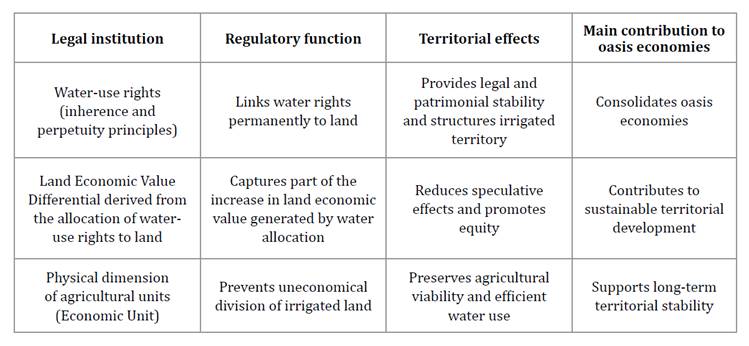
To summarize the main findings of this study, table 1 synthesizes legal institutions analyzed and their respective contributions to territorial configuration and long-term stability of oasis economies.
Table 1. Comparative synthesis of legal institutions analyzed and their contributions to territorial configuration and long-term stability of oasis economies.
Tabla 1. Síntesis comparativa de las instituciones jurídicas analizadas y sus contribuciones a la configuración territorial y a la estabilidad a largo plazo de las economías de oasis.
Conclusion
In conclusion, the interaction between territorial planning and water regulation must be based not only on legal criteria, but also and especially on economic, technical, environmental and social considerations. Through this legal framework, the institutions analyzed in this study make it possible to build and consolidate oasis economies as sustainable productive systems, thereby shaping a differentiated territorial organization between irrigated oases and surrounding drylands, where the availability of water resources determines distinct patterns of settlement, land use, and economic development. This underscores the need for sustainable territorial policies tailored to the specific characteristics of both environments in arid and semi-arid regions.
Acknowledgments
The authors declare having used a generative artificial intelligence tool (ChatGPT, OpenAI) exclusively for language editing and stylistic improvement purposes, without implying any delegation of responsibility for the content.
Batista Medina, J. A. (1996). Respondiendo a la escasez del agua de riego: cambio institucional y mercado de agua. Estudio de un caso en las Islas Canarias. Revista Española de Economía Agraria, 175, 167-198.
Bauer, C. (1993). Los Derechos de Agua y el Mercado: Efectos e implicancias del Código de Aguas Chileno de 1981. Revista de Derecho de Agua de Universidad de Atacama, VI, 17-63.
Brandi, A. (2009). Unidad Económica Mínima. Resultados para el cultivo de Durazno industria. Instituto de Desarrollo Rural.
Buccheri, M. J. (2022). Las regulaciones hídricas y la generación de valor en los oasis de la provincia de Mendoza. La plusvalía territorial como fundamento del régimen de acumulación actual. Periodo de análisis 1884-2017 [Tesis doctoral]. Universidad Nacional de Cuyo.
Buccheri, M. J. & Pinto, M. (2023). La recuperación estatal de la plusvalía hídrica como instrumento de gestión ambiental y territorial en Mendoza. En: Bertoni, J. C., Spalletti, P. D. y Kazimierski, L. D., XXVII Congreso Nacional del Agua (CONAGUA 2023) (pp. 746-747). Instituto Nacional del Agua.
Ciardullo, V. F.; Gennari, A. J. (2025). Agricultural Land Valuation-Hedonic Pricing and Geostatistical Advances: A State-of-the-Art Review. Revista de la Facultad de Ciencias Agrarias. Universidad Nacional de Cuyo. 57(2): 224-236. DOI: https://doi.org/10.48162/rev.39.185
Cano, G. (1956). Las Leyes de Aguas en Sudamérica. Organización de las Naciones Unidas para la Agricultura y la Alimentación.
Cano, G. (1967). Reseña crítica de la Legislación y Administración de Aguas de Mendoza.
Cano, G. (1978). Derecho, Política y Administración Ambientales. Depalma.
Carrillo Donair, J., Guichot Reina, E. & López Menudo, F. (2006). La expropiación forzosa. Lex Nova.
Celume Byrne, T. (2013). Régimen público de las aguas. Thomson Reuters.
Correa Medina, J. A. (2017). Aspectos esenciales de la Unidad Agrícola Familiar (UAF): definición, características y su utilidad en el marco del derecho de tierras. En García Pachón, M., Lecturas sobre Derecho de Tierras (pp. 245-277). Univ. Externado de Colombia.
Díaz Araujo, E. & Iuvaro, M. J. (2006). El recurso suelo. La unidad económica y el proyecto de ley de uso del suelo en Mendoza. En Facciano, L. A. (coord.), Derecho Agrario (pp. 353-358). Nova Tesis.
D’Inca, V., Andino, M., Martín, L. & Rázquin, O. (2024). Política hídrica y territorial: articulaciones y desencuentros. Caso de estudio: cuenca del río Mendoza, Área metropolitana de Mendoza, Argentina. Revista Proyección, Estudios Geográficos y de Ordenamiento Territorial, XVIII(36), 144-171.
Duarte, L. (2010). Hacia una estrategia para el manejo integrado del agua de riego en Argentina. Ministerio de Agricultura, Ganadería y Pesca de la Nación.
Filippini, M. F. (2022). Ordenamiento territorial y agroecología en la interfase urbano-rural. El cinturón verde de Mendoza. En: Instituto de Capacitación Parlamentaria (ICaP), Gobernar espacios metropolitanos. Un análisis federal sobre los continuos urbanos en Argentina (pp. 151-169). Teseo.
Forero, G. (2018). Acumulación de Unidades Agrícolas Familiares y de predios inicialmente adjudicados como baldíos. En García Pachón, M. (comp.), Lecturas sobre Derecho de Tierras (pp. 341-385). Universidad Externado de Colombia.
George, P. (1966). Ensayo de tipología de los oasis. Boletín de Estudios Geográficos, 51, 117-133. https://bdigital.uncu.edu.ar/objetos_digitales/11199/01-george.pdf
Hardin, G. (1968). The tragedy of the commons. Science, 162, 1243-1248.
Harvey, D. (2007). Espacios del capital. Hacia una geografía crítica. Akal.
Jaramillo González. S. (1998). Consideraciones teóricas sobre la participación de los municipios en las plusvalías urbanas. Desarrollo Urbano en cifras, 4, 164-176.
Jaramillo González, S., Moncayo, V, & Alfonso, Ó. (2011). Plusvalías urbanas. Fundamentos económicos jurídicos. Universidad Externado de Colombia.
Jofré, J. & Ferreyra, M. (2010). Elementos regulacionistas para una aproximación al ordenamiento territorial. Revista Proyección, 8, 7-20.
Lafuente Benaches, M. M. (1988). La concesión de dominio público (Estudio especial de la declaración de caducidad). Montecorvo.
Larsimont, R. & Ivars, J. (2021). Conquistar el desierto al servicio de una dieta global: la agricultura de oasis del centro-oeste argentino en el auge de la ecología mundo capitalista. Relaciones Internacionales, 47, 181-200. https://doi.org/10.15366/relacionesinternacionales2021.47.009
López, J. (1984). La concesión de uso de aguas públicas para riego. Revista Ambiente y Recursos Naturales, I(4), 29-36.
Magnani, C. (2015). Nuevas tendencias latinoamericanas en la formulación de políticas y legislaciones regulatorias del recurso hídrico y medio ambiente. IDEARIUM, 23/26, 221-247.
Marienhoff, M. (1939). Régimen y Legislación de las aguas públicas y privadas. Valerio Abeledo.
Marienhoff, M. (1960). Tratado del dominio público. TEA.
Martín, L. (2010). Derecho de Aguas. Estudio sobre el uso y dominio de las aguas públicas. Abeledo Perrot.
Martín, L. (2013). Instituciones y principios matrices del derecho de aguas: contradicciones entre teoría y práctica. Actas de Derecho de Aguas, 3, 105-121.
Martin, L., Pinto, M. (2020). Ordenamiento territorial y dominio público vial: Un estudio de caso. Universidad Nacional de Cuyo. 79-95.
Martín, L. & Pinto, M. (2022). Derechos de agua para riego. Análisis comparado de la regulación provincial en Argentina. En: García Pachón, M., Derecho de Aguas (pp. 359-392). Universidad Externado de Colombia.
Mató de Castro, T. O. (1994). El agua para regadío y la inherencia al terreno. Departamento General de Irrigación.
Ministerio de Educación, Ciencia y Tecnología. (2007). Geografía: cartas satelitales para analizar territorios. https://backend.educ.ar/refactor_resource/get-attachment/23593
Pastorino, L. (2009). Derecho Agrario Argentino. Abeledo Perrot.
Pernizza, R. G. (2012). Current Aspects for the Juridical Regulation of the Unit of Agrarian Exploitation. In: Bandlerová, A., Bohátová, Z. & Bumbalová, M. (eds.), Legal aspects of sustainable agriculture, XII World UMAU Congress (pp. 198-210). Slovak University of Agriculture.
Pimiento Echeverri, J. A. (2010). Teoría de los bienes de uso público. Universidad Externado de Colombia.
Pinto, M. (2004). Mercados de agua y su posible implementación jurídica. La Ley Gran Cuyo, 2004, 87-96.
Pinto, M. (2005). Reconocimiento jurídico del valor económico del agua. La Ley Gran Cuyo, 2005, 225-233.
Pinto, M. (2010). Coordinación entre la nueva Ley de Ordenamiento Territorial y el régimen hídrico mendocino. Revista de Derecho Ambiental, 23, 245-255.
Pinto, M. (2012a). Estrategias de adaptación al cambio climático desde la Política y Legislación de Aguas en Argentina. Actas de Derecho de Aguas, 2, 143-186.
Pinto, M. (2012b). La integración de los instrumentos de gestión territorial y ambiental. Necesidad de una coordinación reglamentaria. Revista Proyección, Estudios Geográficos y de Ordenamiento Territorial, VI(13), 30-55.
Pinto, M. (2013). El interés público como fundamento de la concesión de aguas y la caducidad por no uso. La Ley Gran Cuyo, 2013, 698-619.
Pinto, M. & Martín, L. (2015a). El ordenamiento ambiental del territorio frente a los complejos urbanísticos cerrados. La desnaturalización del dominio público mediante la asignación de usos privativos. Revista de Derecho Ambiental, 41, 344-358.
Pinto, M. & Martín, L. (2015b). Los mecanismos legales de acceso al agua en las provincias áridas del oeste argentino: principios y características comunes. Revista de la Facultad de Ciencias Agrarias. Universidad Nacional de Cuyo, 47(1), 145-157.
Pinto, M. & Buccheri, M. J. (2016). La Unidad Económica Agrícola como técnica de ordenamiento ambiental del territorio y su relación con los usos del agua. Revista de Derecho Ambiental, 46, 103-114.
Pinto, M., Buccheri, M. J. & Andino, M. (2017). La asignación de derechos de agua y los mecanismos de recuperación de plusvalía territorial. En: Pinto, M., Estrella, J. & Gennari, A. (comp.), Agua y Sociedad (pp. 179-216). Lajouane.
Pinto, M., Andino, M. & Rogero, G. (2019). Ley de Aguas de 1884 Comentada y Concordada. Vol. I. Departamento General de Irrigación.
Pinto, M. & Martín, L. (2020). Water permits and concessions for irrigation in Argentina. Status quaestionis and trends in comparative perspective. Revista de la Facultad de Ciencias Agrarias. Universidad Nacional de Cuyo, 52(2), 204-214.
Pinto, M., Gennari, A. & Riera, S. (2023). Nuevos derechos de uso de aguas públicas en cuencas agotadas. Regulación de mecanismos para ampliar la oferta hídrica. En García Pachón, M., Derecho de Aguas (pp. 287-320). Universidad Externado de Colombia.
Pinto, M., Buccheri, M. J. & Martín, D. (2024a). La unidad económica como instituto de gestión territorial. Análisis de experiencias hacia una futura reglamentación. Revista Proyección, Estudios Geográficos y de Ordenamiento Territorial, XVIII(35), 163-180.
Pinto, M. & Buccheri, M. J. (2024b). Tensiones e inconsistencias en la implementación de la Unidad Económica como técnica de ordenamiento territorial. En: Montes Cortés, C. (ed.), Lecturas de derecho de tierras (pp. 201-224). Universidad Externado de Colombia.
Pinto, M., Martín, L. & Andino, M. (2024c). Proyecto de Código de Agua para la Provincia de Mendoza. Consejo Federal de Inversiones.
Raffestin, C. (1997). Le rôle des sciences et des techniques dans les processus de territorialisation”. Revue européenne des sciences sociales, 35(108), 93-106. https://archive-ouverte.unige.ch/unige:4387
Richard-Jorba, R., Pérez Romagnoli, E., Barrio, P. & Sanjurjo, I. (2006). La región vitivinícola argentina: transformaciones del territorio, la economía y la sociedad, 1870-1914. Universidad Nacional de Quilmes.
Rodríguez Vázquez, F. (2018). Trayectorias frutícolas y regulaciones estatales en una provincia vitivinícola (Mendoza Argentina) (1918-1943). En Coloquio Internacional Tópicos, debates y perspectivas de investigación en Historia Agraria de América Latina, 1800 al presente. Universidad Santiago de Chile. https://www.cehal.cl/wp-content/uploads/2018/12/Rodr%C3%ADguez-V%C3%A1zquez.pdf
Rugoso, M. (2017). El principio de inherencia. Análisis. Regulación legal. Particularidades del caso de la Provincia de Mendoza. Revista República y Derecho, II(2), 1-34. http://revistaryd.derecho.uncu.edu.ar/index.php/revista/issue/view/3/showToc
Smith, N. (2008). Uneven development. Nature, capital, and the production of space. University of Georgia Press.
Smolka, M. & Furtado, F. (2001). Ensayo introductorio: recuperación de plusvalías en Latinoamérica: ¿bravura o bravata? En Smolka, M. & Furtado, F. (eds.), Recuperación de plusvalías en América Latina: alternativas para el desarrollo urbano (pp. XIIIXLI). LOM Ediciones. https://www.lincolninst.edu/app/uploads/legacy-files/pubfiles/recuperacion-de-plusvalias-enamerica-latina-full.pdf
Smolka, M. & Amborski, D. (2003). Recuperación de plusvalías para el desarrollo urbano: una comparación interamericana. Revista Eure, XXIX(88), 55-77.
Swyngedouw, E. (2015). Liquid power. Contested hydro-modernities in twentieth century Spain. Massachusetts Institute of Technology.
Taller, A. & Antik, A. (2011). Curso de Derecho Urbanístico. Rubinzal-Culzoni.
Vergara Blanco, A. (2002). Las aguas como bien público (no estatal) y lo privado en el derecho chileno: evolución legislativa y su proyecto de reforma. Revista de Derecho Administrativo Económico, IV(I), 63-79.
Zamorano, M. (1992). Región cuyana de los oasis agroindustriales. En Roccatagliata, J. (coord.) y García, M., La Argentina; geografía general y marcos regionales (pp. 613-659). Planeta.