DOSSIER
Descartes: Mind and Space
Descartes: Mente y Espacio
Descartes: mente e espaço
Descartes: L'esprit et l'espace
Декарт: разум и пространство


Descartes: Mind and Space
Cuadernos de historia del arte, núm. 40, pp. 293-305, 2023
Universidad Nacional de Cuyo
Recepción: 16 Marzo 2023
Aprobación: 15 Mayo 2023
Abstract: The principal objective of this article is to provide the reader with a simple and brief introduction to René Descartes, his life, and his main thoughts and works. The figure of Descartes arrives on the European scene at a crucial time in its history: with the Scientific Revolution in full throttle, the impact he makes, not only for philosophy, but for the sciences, particularly math, remains to this day. We shall also, at the end, briefly analyse the relationship between the concept of space held by Descartes and the concept of space present in the contemporary (to him) Baroque Era.
Keywords: Method, truth, motion, space.
Resumen: El principal objetivo de este artículo es ofrecer al lector una simple y breve introducción a René Descartes, su vida, y sus principales ideas y obras. La figura de Descartes se presenta en la escena europea en un tiempo crucial de su historia: con la Revolución científica en pleno auge, el impacto que produce, no sólo en el ámbito de la filosofía, sino también en la ciencia, especialmente la matemática, persiste hasta nuestros días. Brevemente analizaremos, a modo de conclusión, la relación existente entre el concepto de espacio sostenido por Descartes y el concepto de espacio presente en el período barroco coetáneo.
Palabras clave: Método, verdad, movimiento, espacio.
Resumo: O principal objetivo desate artigo é oferecer ao leitor uma simples e breve introdução a René Descartes, a sua vida, e as suas principais ideias e obras. A figura de Descartes se apresenta na cena europeia em um tempo crucial da sua história: com a Revolução científica em pleno auge, o impacto que produz, não só no âmbito da filosofia, mas também na ciência, especialmente a matemática, persiste até os nossos dias. Brevemente analisaremos, a modo de conclusão, a relação existente entre o conceito de espaço sustentado pelo Descartes e o conceito de espaço presente no período barroco coetâneo.
Palavras-chave: Método, verdade, movimento, espaço.
Résumé: L’objectif principal de cet article est d’offrir au lecteur une brève introduction à René Descartes, sa vie, ses principales idées et œuvres. La figure de Descartes se présente sur la scène européenne à un moment crucial de son histoire : avec la révolution scientifique en plein essor, l’impact qu’elle produit, non seulement dans le domaine de la philosophie, mais aussi dans la science, notamment la mathématique, persiste jusqu’à nos jours. En conclusion, nous analyserons brièvement la relation entre le concept d’espace soutenu par Descartes et le concept d’espace présent dans la période baroque contemporaine.
Mots clés: Méthode, vérité, mouvement, espace.
Pезюме: Основная цель этой статьи — предложить читателю простое и краткое введение в Рене Декарта, его жизнь, основные идеи и работы. Фигура Декарта появляется на европейской арене в решающий момент ее истории: когда научная революция в самом разгаре, влияние, которое она оказывает не только в области философии, но и в науке, особенно в математике, сохраняется и по сей день. . Кратко проанализируем, в качестве заключения, соотношение между концепцией пространства, поддерживаемой Декартом, и концепцией пространства, существующей в эпоху современного барокко.
Ключевые слова: метод, истина, движение, пространство.
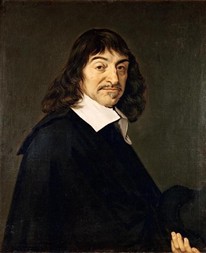
Fig. 1
Descartes[1]
Introduction
In a 2005 book entitled “Intervista sul Novecento”, the art historian and critic Giulio Carlo Argan touches upon a possible parallel between Descartes and a current Baroque artist, Gian Lorenzo Bernini. Because of this, we thought it interesting to explore a possible relation between the Baroque spirit and the philosophical currents of the time, mainly that of Descartes.
This article also aims to inform readers of the basics of Cartesian thought. To do so, the article is organized in a way to best understand his thought. First of all, a small paragraph on his life to contextualize it. After that, we present the main issue at the center of his thought. It is important to showcase this at the beginning as it is from this that we are able to understand everything else in his philosophy. We then continue on to the role that God has for Descartes, after having understood the main crux of his thought. Once we have explained the place that God holds for Descartes, we can finally reach and understand his concept of the Spatial Dimension, which we tie into the representation of space in the Baroque Era, highlighted by a presentation of a fresco by Pietro da Cortona.
Life
René Descartes was born in La Haye-en-Touraine in France in 1596. He soon moves to La Fleche to receive a Jesuit education. After completing his education, in 1616 he moved to Paris and around the same time he enrolled in the Dutch Army to fight in the Thirty Years War. After this short military episode, he settled permanently in the Dutch Republic, where the main bulk of his philosophical works would come to fruition: Les Météores, La Dioptrique, and La G éométrie. These would all be published in 1637, following a preface entitled Discours de la méthode. In 1641 he would publish another very influential text, the Meditations on First Philosophy. Invited by Queen Christina of Sweden in 1649, he moved to her court, only to die a year later.
The main problem and the Cogito
Descartes approaches philosophy as something practical, not only theoretical. His main concern is how one may come about to know the truth, and to discern true from false. To do this, he must develop a strict method to be able to reach a certain point where he can be certain of something. What this point is we shall see later on. He describes this method in his Discourse on the Method. It consists of various steps: Intuition, Analysis, Synthesis, Enumeration and Revision. But for this method to be acceptable, he must justify it. To go about this, he first imagines the possibility of an evil genius deceiving him constantly. Because of this, Descartes, or really anybody, can’t trust anything. He adopts a sort of radical scepticism for the time being. He doubts every sensory and non-sensory perception. However, he reaches a point that he cannot doubt. To even be able to doubt in the first place, he must exist. He doubts, therefore he exists (Cogito ergo sum).
But what is the nature of this being that thinks? He affirms that this existence is the existence of a “Subject who thinks” (res cogitans), that is to say, Reason itself. This concept of the Cogito has drawn much criticism. Among the many critics was Hobbes, who directed the criticism at the second part of the statement. Simply because I am doing an act, it does not mean I am that act. Simply because I am thinking, it does not mean I am a thought. This highlights the issue that the subject could very well be something material, as opposed to what Descartes thought. An important point regarding the res cogitans is its opposition to the res extensa, the actual material substance which takes up space. This dichotomy is important not only for his thought but for the whole of Western thought that came after, as it introduced Cartesian Dualism, or Substance dualism, and it introduces the challenge of how the “thinking substance” interacts with the “material substance” (for Descartes, this mediatory role was to be found in the pineal gland in the brain).
The Role of God in Cartesian thought
God has a very important place in Descartes’ arguments. Once he has reached a point upon which he can doubt no longer, he must then justify the existence of everything else. He must prove that there is not, in fact, an evil genius who is trying to trick us all. And to do this, he must prove the existence of God.
While Descartes offers three proofs, we will highlight only the first and third proof. The first proof consists in dividing ideas into three categories: Innate ideas, External ideas, and Factitious ideas. The first two are rather clear: ideas that come from within and always present, and ideas that come from an external world. The last type of ideas is simply when different ideas combine to form a new one (for example, the idea of a mythical creature could be the combination of ideas of two existing creatures). This division occurs because Descartes is preoccupied with finding the reason for these ideas existing. He then reflects on the idea of God. God, for Descartes, is synonymous with infinity. But we are not infinite creatures, we are finite rather. Therefore, to him, it is impossible for us to innately conjure the idea of infinity, given our very own nature. The natural conclusion is that the idea of God is external to us, and thus he concludes affirming God’s existence. However, to quote Hume in his “Enquiry concerning Human Understanding'', “ []and that all this creative power of the mind amounts to no more than the faculty of compounding, transposing, augmenting, or diminishing the materials afforded us by the senses and experience ”. It then seems rather easy to think of the idea of the infinite, both as a negation and opposite of finiteness, or as an extreme augmentation of finiteness. As for the third proof, he relies on the classic ontological proof of God: God is the most perfect being, and as such, existence is part of his perfection, else he would not be perfect. In addition to the criticism that has been mentioned above, it is important to mention Kant’s refutation of the ontological proof: “Existence is not a predicate”, that is to say, existence is not an innate property of anything, but is something which one confirms or denies with observation. However for Descartes these proofs are enough and he is satisfied. He therefore has no doubt any more than an evil genius does not exist, and that there is a God who is not tricking him: “But only after establishing the existence of God does he find a basis for believing in the reality of things beyond himself and his thoughts or ideas… God he understands to be a perfect, and therefore supremely good, being who cannot be conceived of as letting falsehoods appear evident to an attentive human mind intent on finding the truth”.[2]
Scientific views and the concept of space in Descartes
Descartes was not only a prominent philosopher, but a prominent mathematician as well. He introduced Cartesian Coordinates, combining algebra with geometry. However we shall in this part focus on his views of the physical world and how he described it. First and foremost, he was a strong believer of determinism: every event necessarily has a prior cause that gave way to said event. To him, the physical world had two essential qualities: extension and movement. Every other quality that we may assign to material objects would ultimately depend on these two. Material space was infinite, and everything was in motion. Both of these qualities would ultimately derive from God, who would set everything in motion. Every moving body would preserve its movement unless another body would alter it (the principle of inertia), and the quantity of motion distributed among all the bodies would always stay the same (principle of conservation of momentum). According to Descartes, movement could only be transmitted through physical contact.
This concept of mechanical determinism that he held would inevitably clash with the aforementioned Cartesian Dualism. On the one hand, Descartes holds the view of a mechanically determined world, which has its causes in said world, but on the other hand he affirms the existence of a res cogitans that exercises its control over the res extensa ( in this case, our body). In addition, if movement could only be altered through physical contact, there would be no way for the res cogitans to interact with the res extensa. This contradiction remains unsolved: “This part of his theory was abandoned by his school-first by his Dutch disciple Geulincx, and later by Malebranche and Spinoza. The physicists discovered the conservation of momentum, according to which the total quantity of motion in the world in any given direction is constant. This showed that the sort of action of mind on matter that Descartes imagined is impossible. []in the second place, since the physical series was rigidly determined by natural laws, the mental series, which ran parallel to it must be equally deterministic.[] This view would be difficult to reconcile with Christian ethics and the punishment of sin.”[3]
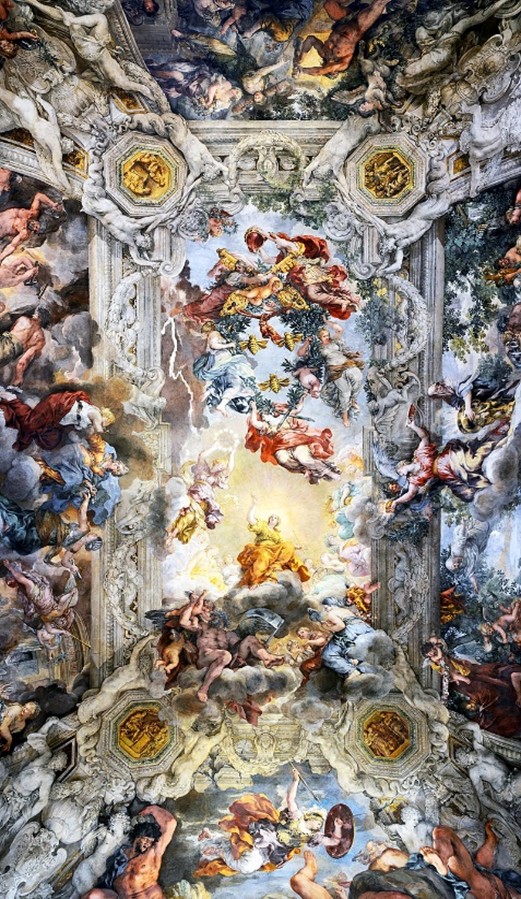
Fig.2
Ceiling of Palazzo Barberini[4]
Another characteristic of his thought regarding the physical world is the absence of empty space. For him, extension was only something a substance that existed had. In a void there would be nothing, and since “nothingness” is not a substance, if there was nothing, there would simply be no space. We can connect this to certain elements of Baroque art of his time. Let us examine this fresco found in Palazzo Barberini, in Rome, in the 1630s, entitled “Allegory of Divine Providence and Barberini Power”, painted by Pietro da Cortona, whose artistic production necessitates new schemes of perception able to interpret the depicted facts, which cannot be traced back anymore to the traditional concept of imitation of nature. It perfectly represents and aligns with the concept of there being no empty space, and of all of space being in constant movement. Upon a first glance, there is no fixed, clear point on which the eye can stop, except perhaps the Divine Providence in the middle, bathed in sunlight. We can take this, in light of Descartes’ interpretation of reality, to represent God, who does not participate in the motion of our physical reality. As for the rest, it is all occupied by figures and decoration. The onlooker has no time to stop and admire for there is always something to see. It is almost as if the fresco were in an infinite motion with no void between the various components, just like the vision that Descartes had of our physical reality.
Final Reflection
As we draw to the end, we must reflect on what we have learned. Descartes starts from the lowest possible point, the negation of all of reality except his thought, and from that derives an organized and, at least to Descartes’ eyes, a robust system through which he no longer doubts himself and the totality of reality. We have drawn a parallel between his thought and the Baroque painter Pietro da Cortona, not to necessarily show that Descartes influenced such artistic thought or vice versa, but to showcase two sides of the same coin. Descartes represents the intellectual and philosophical expression of the spirit of the time, so to say, and Pietro da Cortona represents the artistic expression of said spirit.
When taking into account the historical occurrences of the time, the world is orderly no more. war ravages Europe, the Scientific Revolution sweeps away the old, and all foundations are profoundly shaken (but not entirely destroyed). In Descartes this is expressed through radical scepticism (for which he finds a solution, that being, God, one of the foundations that clearly remains) and in Baroque artists this is found in the motion and fluidity that is present in their works. The Perspective of the Renaissance era is no more, and as scientists are able to explore the workings of the world that surrounds them, Baroque artists are able to explore various configurations of the space in their art, which is not fixed to a single, imposing point on the canvas.
Bibliography
Nicola Abbagnano e Giovanni Fornero. La ricerca del pensiero. Storia, testi e problemi della filosofia, Vol.2 , Dall’Umanesimo all’Empirismo. Milano-Torino: Pearson Italia, 2020.
René Descartes. Meditazioni metafisiche. Bari-Roma: Editori Laterza, 2021.
David Hume. Ricerca sull’intelletto umano. Bari-Roma: Editori Laterza, 2021.
Alexander Koyré. From the closed world to the infinite universe. Kettering: Angelico Press, 2016.
Bertrand Russell. The History of Western Philosophy. New York: Simon & Schuster, 1967
Gianni Carlo Sciolla. Studiare l’arte. Torino: UTET, 2010.
Tom Sorell. Descartes. A very short introduction. New York: Oxford University Press, 2000.
Gary Hatfield. "René Descartes", The Stanford Encyclopedia of Philosophy (Summer 2018 Edition), Edward N. Zalta (ed.), URL = <https://plato.stanford.edu/archives/sum2018/entries/descartes/>.
Notes
Información adicional
redalyc-journal-id: 6038