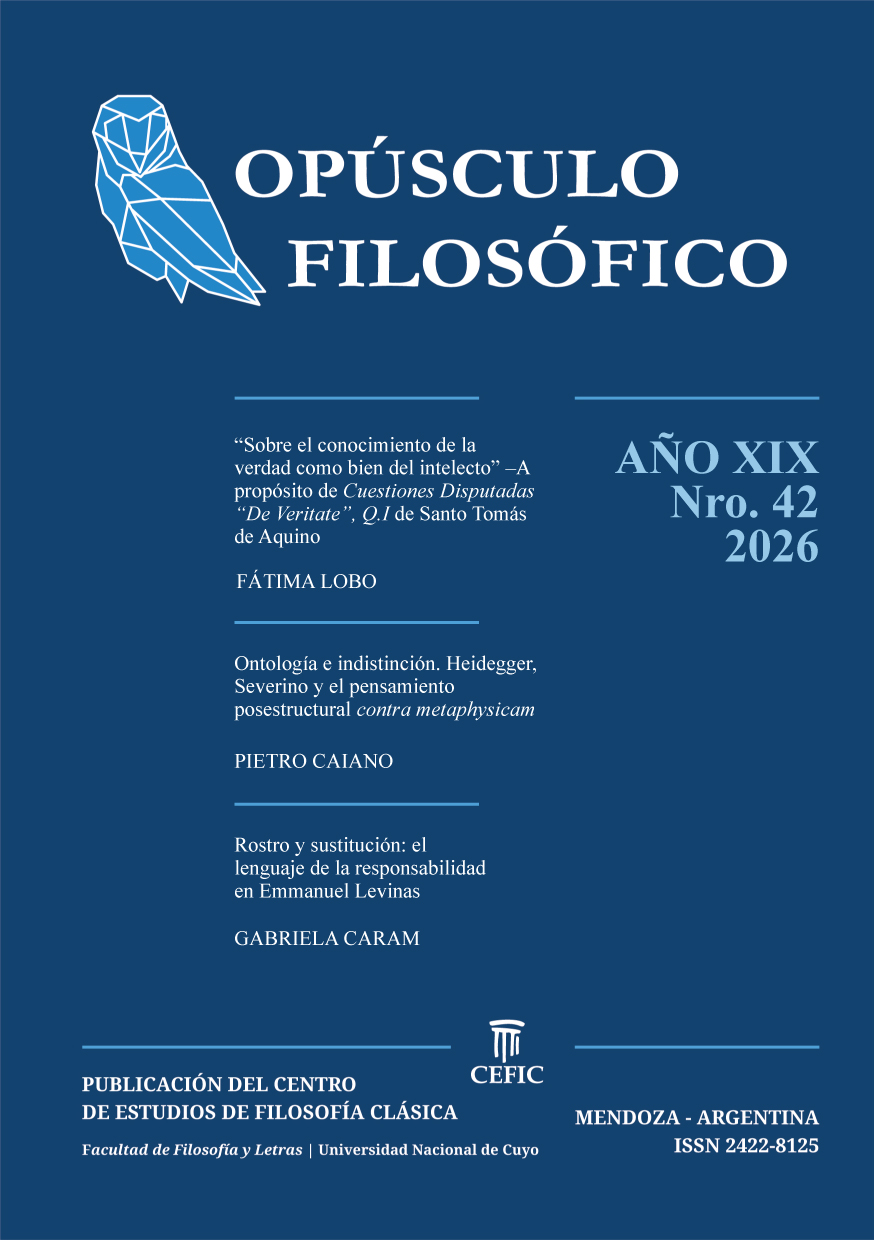
“On the Knowledge of Truth as the Good of the Intellect”
Concerning Question I of Disputed Questions on Truth by Thomas Aquina
Keywords:
truth, good, knowledge, adequacy, intellectAbstract
In the first question of Disputed Questions on Truth –De Veritate–, in the body of article eight, Saint Thomas presents us the true itself as good of the intellect. And in the same place he gives as a reason for this that “the good of each thing consists in the perfect operation of the thing itself, and the operation of the intellect is not perfect but according the intellect knows the true, hence in that consists its good as such”.
In this sense we ask ourselves: ¿what does this operational perfection of the intellect consists of, which constitutes its most proper good?
Our search will be oriented as follows: 1°) we will try to show the general framework in which our question is inserted, namely, the presentation of truth as a transcendental and, more precisely, as a relational transcendental. 2°) We will try to establish the specificity of truth in the general framework of the trascendentals: what verum and only it, adds entity, and, finally, we will show why this operational perfection is properly fulfilled in the judgment of the intellect (adaequatio) and not in the simple apprehension (asimilatio). Our main source will be the famous Quaestio Prima of Saint Thomas Aquinas’ De Veritate.
Downloads
References
Tomás de Aquino. (2005). Quaestiones disputatae de veritate: Quaestio prima. En Reflexiones en torno a la verdad. Facultad de Filosofía y Letras, Universidad Nacional de Tucumán.
Santo Tomás de Aquino. (2011). Suma Teológica. I. B.A.C.
Aristóteles. (1994). A cerca del alma. Gredos.
Aristóteles. (2014). Ética a Nicómaco. Centro de Estudios Políticos y Constitucionales.
Maritain, Jacques. (1983). Los grados del saber. Distinguir para unir. Club de lectores.
Gilson, Etienne. (1989). El tomismo. Introducción a la filosofía de Santo Tomás de Aquino. Universidad de Navarra.
Aráoz San Martín, Jaime. (1999). Filosofía aristotélica del lenguaje. Universidad de Navarra.
Araoz San Martín, Jaime. (2019). “Tomás de Aquino y el concepto tradicional de la verdad según Heidegger, Ser y Tiempo parágrafo 44”. En Anales del Seminario Historia de la Filosofía. Complutenses, 36(2). ISSNe 1988-2564, 477-493.
Cruz Gonzalez-Ayesta. (2010). “El amor a la verdad en Santo Tomás de Aquino”. En Revista Española de Filosofía Medieval, 17. ISNN: 1133-0902, 37-46.
Cruz Gonzalez-Ayesta. (2002). Hombre y verdad. Gnoseología y antropología. Universidad de Navarra.
Downloads
Published
How to Cite
Issue
Section
License

This work is licensed under a Creative Commons Attribution-NonCommercial 4.0 International License.
Se permite la reproducción de los artículos siempre y cuando se cite la fuente.
Los autores/as conservarán sus derechos de autor y garantizarán a la revista el derecho de primera publicación de su obra.
Opúsculo Filosófico proporciona un acceso abierto inmediato a su contenido, y no cobra ninguna tasa por los textos publicados ni por los textos sometidos para evaluación, revisión, publicación, distribución o descarga. La revista no cobra cargos por APC y utiliza la siguiente licencia Creative Commons para sus contenidos:
Atribución-NoComercial 4.0 Internacional (CC BY-NC 4.0)
Los usuarios son libre de:
- Compartir — copiar y redistribuir el material en cualquier medio o formato
- Adaptar — remezclar, transformar y construir a partir del material
- La licenciante no puede revocar estas libertades en tanto usted siga los términos de la licencia
Bajo los siguientes términos:
- Atribución — Usted debe dar crédito de manera adecuada, brindar un enlace a la licencia, e indicar si se han realizado cambios. Puede hacerlo en cualquier forma razonable, pero no de forma tal que sugiera que usted o su uso tienen el apoyo de la licenciante.
- No Comercial — Usted no puede hacer uso del material con propósitos comerciales.
- No hay restricciones adicionales — No puede aplicar términos legales ni medidas tecnológicas que restrinjan legalmente a otras a hacer cualquier uso permitido por la licencia.