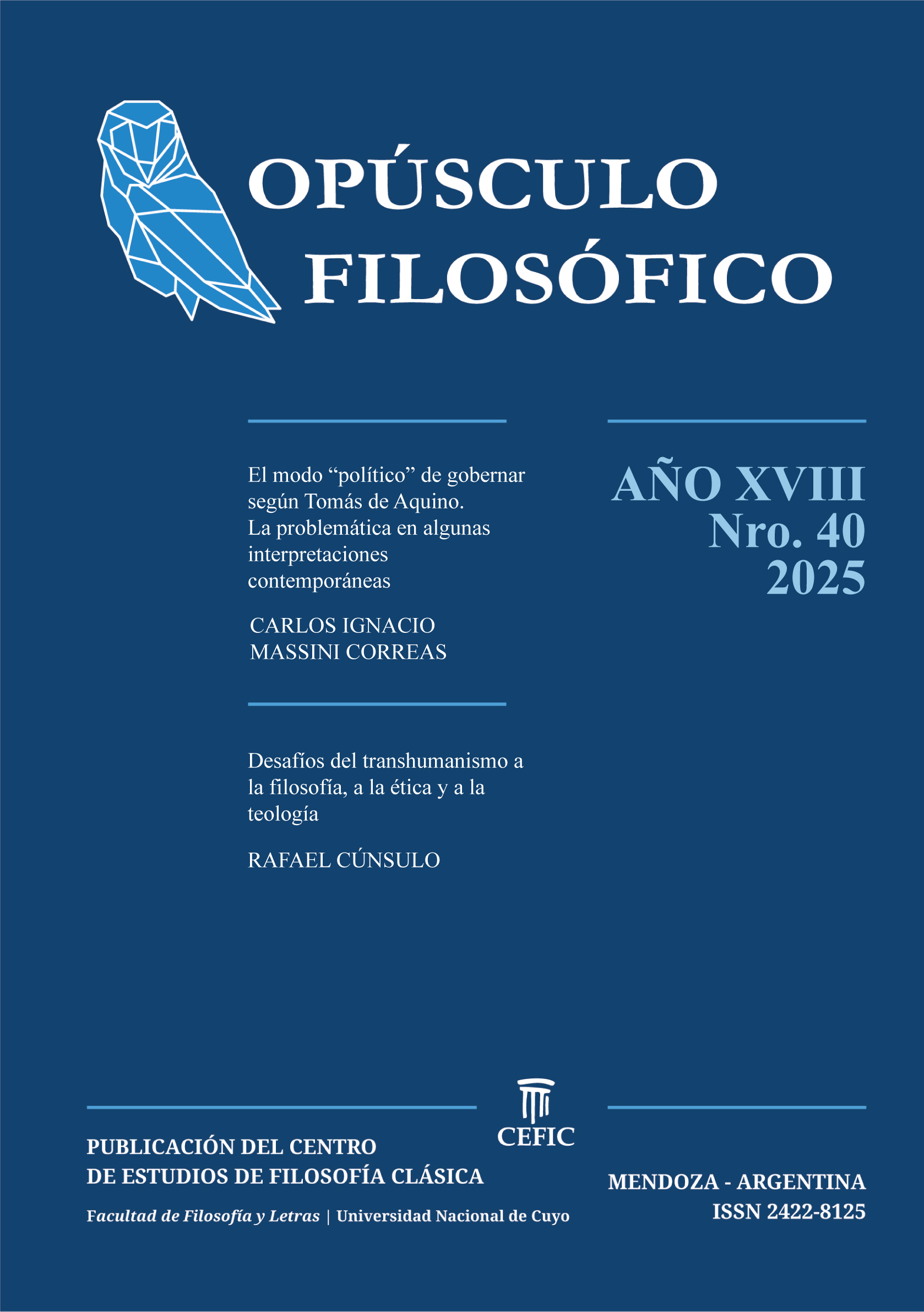
The “Political” Mode of Governing According to Thomas Aquinas
The Problem in Some Contemporary Interpretations
Keywords:
politics, government, modes of governance, Thomas Aquinas, rule of law, practical reasonAbstract
In the political sphere, Thomas Aquinas not only studied the "forms of government" but also the "modes of governing," that is, the different ways in which government actions are exercised. For Aquinas, the central or paradigmatic case of government is what he calls "political," as opposed to "despotic," "royal," or "tyrannical" modes. This doctrine has been renewed and developed by several contemporary philosophers, including François Daguet, John Finnis, and Francesco Viola. This article analyzes their contributions to the development of this doctrine, as well as its possible applications to contemporary political praxis.
Downloads
References
Abba, G. (1989). Quale impostazione per la filosofía morale?, LAS.
Abba, G. (2018). Le virtù per la felicità, LAS.
Aristóteles (1970a). Ética a Nicómaco, Instituto de estudios políticos.
Aristóteles (1970b). Política, Instituto de estudios políticos.
Armstrong, R. (1966). Primary and Secondary Precepts in Thomistic Natural Law Teaching, Martinus Nijhoff.
Aspe, V. (2011). “Sobre Isidoro de Sevilla y su influencia en Novohispanía”. En González, A.L. & Zorroza, M.I (ed), In umbra intellientiae. Estudios en homenaje al Prof. Juan C. Cruz, EUNSA, pp. 79-93.
Bastit, M. (1990). Naissance de la loi moderne, PUF.
Berlin, I. (1995). The Crooked Timber of Humanity: Chapters in the History of Ideas. En George, R.P., Making Men Moral. Civil Liberties and Public Morality, Clarendon Press.
Blanco, P. (2005). “Joseph Ratzinger: razón y cristianismo”. En M. Cartabia, M. & Simoncini, A. (eds.), Pope Benedict XVI’s Legal Thought, Cambridge University Press.
Bouillon, V. (1965). La política de Santo Tomás, Editorial Nuevo Orden.
Boyle, J. (1994). “Natural Law and the Ethics of Tradition”. En George R.P. (ed.), Natural Law Theory: Contemporary Essays, Clarendon Press, pp. 3-30.
Budziszewsi, J. (2014). Commentary on Thomas Aquinas’s Treatise of Law, Cambridge University Press.
Cardona, C. (1966). La metafísica del bien común, Rialp.
Carvajal, C.S. & Horwood (eds.) (2003). The Oxford Spanish Dictionary, University Press.
Cianciardo, J. & Zambrano, P. (2019). La inteligibilidad del derecho, Marcial Pons.
Clavier, P. (2010). Qu’est-ce que le bien?, Vrin.
Composta, D. (1971). Natura e ragione. Studio sulle inclinazione naturali in rapporto all diritto naturale, PAS-Verlag.
Copleston, F.C. (1991). Aquinas, Penguin.
Coyle, S. (2014). Modern Jurisprudence. A Philosophical Guide, Hart Publishing.
Crowe, J. (2017). “Metaphysical Foundations of Natural Law Theories”. En Duke G. & R.P. George (eds), The Cambridge Companion to Natural Law Jurisprudence, Cambridge University Press, pp. 103-129.
Daguet, F. (2015). Du politique chez Thomas d’Aquin, Librairie Philosophique J. Vrin.
Davies, B. (1993). The Thought of Thomas Aquinas, Clarendon.
de Aquino, T. (1964a). De Veritate, Marietti.
de Aquino, T. (1964b). Summa Theologiae. Biblioteca de autores cristianos.
de Aquino, T. (1966). In octo libros Politicorum Aristotelis expositio, Marietti.
de Aquino, T. (1979). Comentario al libro Del Alma de Aristóteles, Fundación Arché.
de Aquino, T., de Alvernia, Pedro (2001). Comentario a la Política de Aristóteles, EUNSA.
De Sevilla, I. (1982). Etimologías, I, BAC.
Demongeot, M. (1959). El mejor régimen político según Santo Tomás, BAC.
Fabro, C. (1983). Introduzione a San Tommaso. La metafisica tomista e il pensiero moderno, Edizioni Ares.
Ferrater Mora, J. (1979). Diccionario de Filosofía, 3, Alianza.
Finnis, J. (1986). “Natural Law”. En Collected Essays-Volume I-Reason in Action, Oxford University Press.
Finnis, J. (1998). Aquinas. Moral, Political and Legal Theory, Oxford University Press.
Finnis, J. (2008). “La tradición de la ley natural”. Ideas y Derecho, 6.
Finnis, J. (2011a). “Is and Ought in Aquinas”. En Collected Essays-I-Reason in Action, Oxford University Press.
Finnis, J. (2011b). “Limited Government”. En Collected Essays-III-Human Rights & Common Good, Oxford University Press. (Título originario del artículo de 1996: “Is Natural Law Theory Compatible with Limited Government?”).
Finnis, J. (2011c). Natural Law and Natural Rights, Oxford University Press, pp. 59-99.
Forment, E. (1994). “La filosofía del bien común”. En Anuario Filosófico, XXVII/2, (Objetividad y Libertad. Jornadas sobre la obra filosófica de Antonio Millán-Puelles), pp. 797-815.
Fuller, L. (1969). The Morality of Law, Yale University Press.
Gambra, J.M. (2002). La analogía en general, EUNSA.
George, R.P. (2001a). “Reason, Freedom, and the Rule of Law: Their Significance in the Natural Law Tradition”. En The American Journal of Jurisprudence, 46, pp. 249-256;
George, R.P. (2001b). In Defense of Natural Law, Oxford University Press, pp. 15-91.
Gilson, È. (1981). El espíritu de la filosofía medieval, Rialp.
González, A.M. (2009). La ética explorada, EUNSA, pp. 13-34.
Grisez, G., Boyle, J. y Finnis, J. (1987). “Practical Principles, Moral Truth and Ultimate Ends”. The American Journal of Jurisprudence, 32.
Haldane, J. (2009). Practical Philosophy: Ethics, Society and Culture, Imprint Academic.
Hardie, W.F.R. (1985). Aristotle’s Ethical Theory, Clarendon Press.
Hervada, J. (1987). Historia de la ciencia del derecho natural, EUNSA.
Hittinger, R. (1987). A Critique of the New Natural Law Theory, University of Notre Dame Press.
Kelly, J.M. (1994). A History of Western Legal Theory, Clarendon Press.
Kraut, R. (2002). Aristotle. Political Philosophy, Oxford University Press.
Kraut, R. (2007). What is Good and Why. The Ethics of Well Being, Harvard University Press.
Kraut, R. y Blackwell Publishing (eds.). (2006). The Blackwell Guide to Aristotle’s Nicomachean Ethics, Malden-Oxford-Carlton.
Kretzmann, N. & E. Stump (ed.) (1995). The Cambridge Companion to Aquinas, Cambridge University Press.
Kriele, M. (1980). Introducción a la Teoría del Estado, Depalma.
Kuhn, H. (1979). El estado. Una exposición filosófica, Rialp.
Lagor, J-L. (1948). La philosophie politique de Saint Thomas, Les Éditions Nouvelles.
Lisska, A. (1997). Aquinas’s Theory of Natural Law. An Analytic Reconstruction, Clarendon Press.
Long, S.A. (2004). “Natural Law or Autonomous Practical Reason”. En Goyette J. (ed.). Thomas Aquinas and the Natural Law Tradition. Contemporary Perspectives, The Catholic University of America Press, pp. 165-193.
Maccormick, N. (2009). Practical Reason in Law and Morality, Oxford University Press.
Maccormick, N. (1994). “Natural Law and the Separation of Law and Morals”. En George, R.P., Natural Law Theory. Contemporary Essays, Clarendon Press.
MacIntyre, A. (1988). Whose Justice? Which Rationality?, Duckworth.
MacIntyre, A. (2006). Ethics and Politics, Cambridge University Press.
Maritain, J. (1966). Humanismo Integral, Carlos Lohlé.
Martínez Barrera, J. (2001). “La política en Aristóteles y Tomás de Aquino”. Cuadernos de Anuario Filosófico.
Massini-Correas, C. I. (2002). “Tradición, universalidad y dialéctica de las filosofías prácticas”. En Delgado, G. y M. Sacchi (eds.). Scientia, fides & sapientia. Escritos dedicados a Gustavo Eloy Ponferrada. UCALP, pp. 373-385.
Massini-Correas, C. I. (2012). “Entre reductivismo y analogía. Sobre el punto de partida de la filosofía del derecho”. Persona & Derecho, 67, pp. 353-385
Massini-Correas, C. I. (2019a). Alternativas de la ética contemporánea. Constructivismo y realismo ético, Rialp.
Massini-correas, C. I. (2019b). Jurisprudencia analítica y derecho natural. Análisis del pensamiento filosófico-jurídico de John Finnis, Marcial Pons.
Massini-Correas, C.I. (1980). La desintegración del pensar jurídico clásico en la edad moderna, Ableledo-Perrot.
Massini-Correas, C.I. (1994). “Privatización y comunidad del bien humano. El liberalismo deontológico y la respuesta realista”. Anuario filosófico, 27, 2, pp. 817-828.
Massini-Correas, C.I. (1999). “Verdad, libertad y el paradigma ético contemporáneo. Consideraciones a partir de un texto de Joseph Ratzinger”. Sapientia, 206, pp. 427-435.
Massini-Correas, C.I. (2011). “Nota sobre el rule of law y la ética de la virtud”. Philosophia, 71, pp. 147-153.
Massini-Correas, C.I. (2014). “Sobre bienes humanos, naturaleza humana y ley natural. Reflexiones a partir de las ideas de Javier Hervada y John Finnis”. Persona & Derecho, 70-71, pp. 229-256.
Massini-Correas, C.I. (2017). “Racionalidad y Estado de Derecho. El rule of law en los discursos de Joseph Ratzinger”. Humanitas, 85, pp. 334-349.
Massini-Correas, C.I. (2020). “La dignidad humana y el sentido del derecho”. En A. Zabalza, A. & Grard, C. (eds.), Les personnes et les choses, du Droit Civil à la Philosophie du Droit et de l’Ètat. Mélanges en l’honneur du Professeur Jean-Marc Trigeaud. Éditions Bière, pp. 17-34.
Massini-Correas, C.I. (2021). Gobierno del derecho y razón práctica, Thomson-Reuters.
Mauri, M. (1997). “Autoridad y tradición”. En Modernidad y tradición. Una reflexión ética sobre la sociedad contemporánea, EDIT-EURO, pp. 7-21.
May, W.E. (2004). “Contemporary Pespectives on Thomistic Natural Law”. En Goyette J. (ed.). Thomas Aquinas and the Natural Law Tradition. Contemporary Perspectives, The Catholic University of America Press, pp. 113-156.
Melendo, T. (1999). Dignidad humana y bioética, EUNSA.
Murphy, M. (2007). Philosophy of Law. The Fundamentals, Blackwell Publishing.
Murphy, M. (2019). "The Natural Law Tradition in Ethics". En Edward N. Zalta (ed.) The Stanford Encyclopedia of Philosophy (Winter 2011 Edition). URL = https://plato.stanford.edu/archives/win2011/entries/natural-law-ethics/.
Pizzorni, R. (1974). “Il contenuto del diritto naturale secondo Tommaso d’Aquino”. En San Tommaso e la filosofia del diritto oggi, Studi Tomistici.
Pope, S. J. y Washington D.C. (eds.) (2002). The Ethics of Aquinas, University Press.
Ramírez, S. (1956). Pueblo y gobernantes al servicio del bien común, Euramérica.
Ratzinger, J. (2004). “Freedom and Truth”. En Truth and Tolerance, Ignatius Press.
Reale, M. (2000). La sabiduría antigua, Herder.
Russell, D. C. (2011). Practical Inteligence and the Virtues, Clarendon Press.
Schneewind, J.B. (2012). Essays on the History of Moral Philosophy, Oxford University Press.
Spaemann, R. (2008). “Benedicto XVI y la luz de la razón”. En Benedicto XVI et alii, Dios salve a la razón, Encuentro, p. 165-183.
Strauss, L. (1988a). “De laudibus legum angliae, by Sir John Fortescue”. En What is Political Philosophy? And Others Studies, University of Chicago Press.
Strauss, L. (1988b). What is Political Philosophy? The University of Chicago Press, pp. 95-133.
Strauss, L. (2005). Sobre la tiranía, Ediciones Encuentro.
Torrell, Jean-P. (2002). Iniciación a Tomás de Aquino: su persona y su obra, EUNSA.
Vergnières, S. (1995). Éthique et Politique chez Aristote, PUF.
Villey, M. (1962). Lecons d’histoire de la philosophie du droit, Dalloz, 1962.
Villey, M. (1975). La formation de la pensée juridique moderne, Montchrestien.
Villey, M. (1976). Critique de la pensé juridique moderne, Dalloz.
Viola, F. (2009). “Legge umana, rule of law ed ética delle virtù in Tommaso D’Aquino”. En Mangini, M. & Viola, F., Diritto naturale e liberalismo. Dialogo o conflitto?, Giappichelli Editore.
Viola, F. (2020). “El rule of law como idea de sociedad”. Revista Jurídica Austral, 1/1 https://ojs.austral.edu.ar/
Viola, F. (2011). Rule of Law. Il governo della legge ieri ed oggi, Giappichelli Editore.
Weisheipl, J. A. (1983). Friar. Thomas D’Aquino: his life, thought, and works, The Catholic University of America Press.
Westberg, D. (2002). Right Practical Reason. Aristotle, Action, and Prudence in Aquinas, Oxford University Press.
Yarza, I. (2001). La racionalidad de la ética de Aristóteles, EUNSA.
Downloads
Published
How to Cite
Issue
Section
License

This work is licensed under a Creative Commons Attribution-NonCommercial 4.0 International License.
Se permite la reproducción de los artículos siempre y cuando se cite la fuente.
Los autores/as conservarán sus derechos de autor y garantizarán a la revista el derecho de primera publicación de su obra.
Opúsculo Filosófico proporciona un acceso abierto inmediato a su contenido, y no cobra ninguna tasa por los textos publicados ni por los textos sometidos para evaluación, revisión, publicación, distribución o descarga. La revista no cobra cargos por APC y utiliza la siguiente licencia Creative Commons para sus contenidos:
Atribución-NoComercial 4.0 Internacional (CC BY-NC 4.0)
Los usuarios son libre de:
- Compartir — copiar y redistribuir el material en cualquier medio o formato
- Adaptar — remezclar, transformar y construir a partir del material
- La licenciante no puede revocar estas libertades en tanto usted siga los términos de la licencia
Bajo los siguientes términos:
- Atribución — Usted debe dar crédito de manera adecuada, brindar un enlace a la licencia, e indicar si se han realizado cambios. Puede hacerlo en cualquier forma razonable, pero no de forma tal que sugiera que usted o su uso tienen el apoyo de la licenciante.
- No Comercial — Usted no puede hacer uso del material con propósitos comerciales.
- No hay restricciones adicionales — No puede aplicar términos legales ni medidas tecnológicas que restrinjan legalmente a otras a hacer cualquier uso permitido por la licencia.