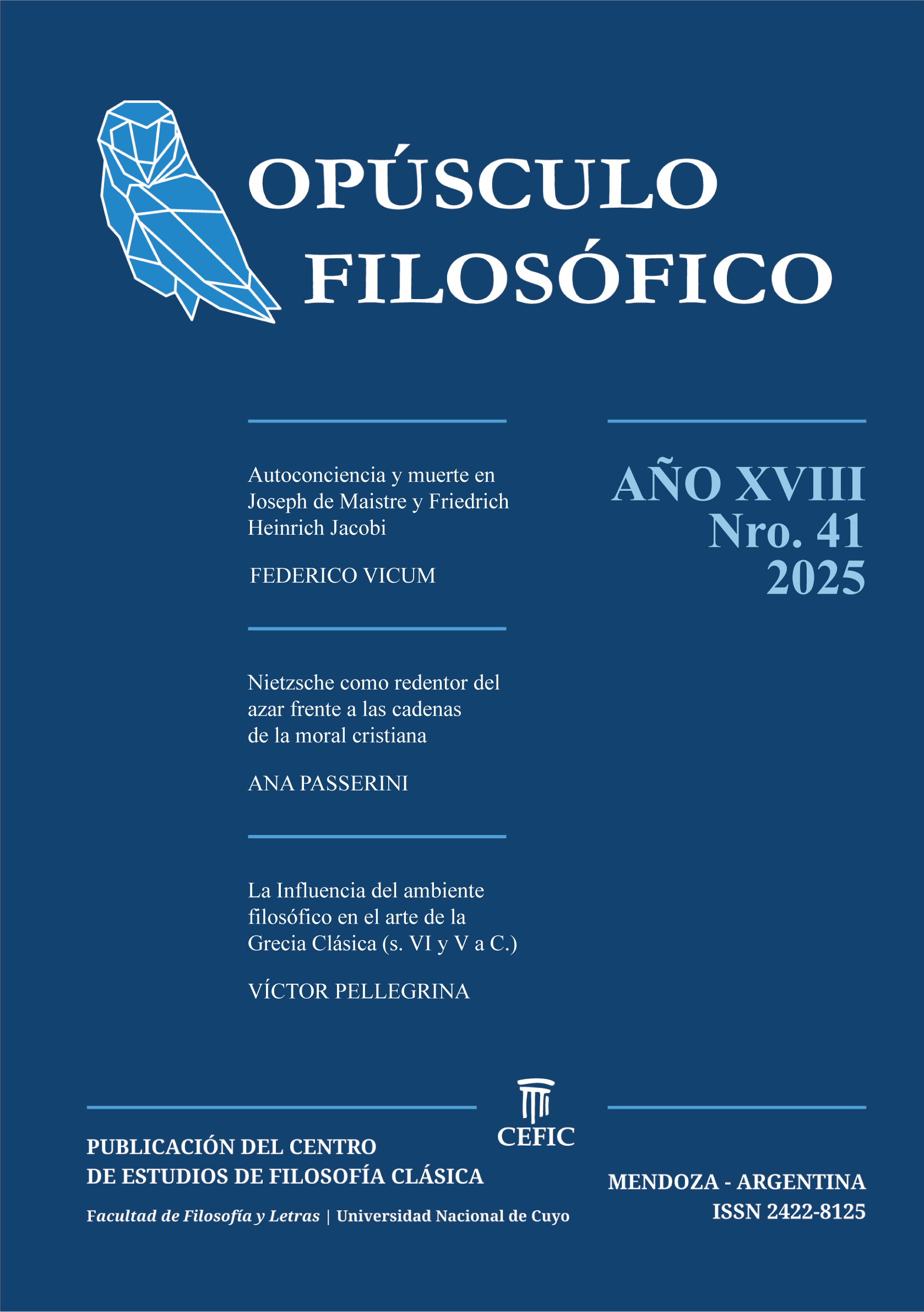
Self-consciousness and Death in Joseph de Maistre and Friedrich Heinrich Jacobi
Keywords:
self-consciousness, death, sacrifice, reflection, faithAbstract
Although it is not usual to study them together, there are many similarities between Joseph de Maistre and Friedrich Heinrich Jacobi. However, there are also many clear differences. It is useful, therefore, to address both in detail. We believe that in this way we can obtain a more articulate picture of the philosophical thought that opposed the dominant trends in modern philosophy in the 18th century. Here we consider some of those points where there are similarities and differences: the relation to Cartesianism, the kind of praxis and the concept of creation (and causality) that can be found both in Maistre and in Jacobi. This will lead us to the main conclusion of the article: Jacobi's philosophy can shed light on one aspect of Maistre's thought (namely, faith as something necessary, as a presupposition, for thought), and Maistre's philosophy can shed light on a little-worked aspect of Jacobi's philosophy: namely, the essential link between faith and the voluntary decision to die out of love for something of a higher order than our own life.
Downloads
References
Armenteros, Carolina (2011). The French Idea of History. Joseph de Maistre and his heirs. 1794-1854. Ithaca: Cornell University Press. doi: https://doi.org/10.7591/
cornell/9780801449437.001.0001. [Trad. cast.: La idea francesa de la historia: Joseph de Maistre y sus herederos. Trad. de Vladimir López. Prensas de la Universidad de Zaragoza, 2017].
Bacon, Francis (1988). El avance del saber. Trad. de María Luisa Balseiro. Alianza.
Berlin, Isaiah (2013a). Against the Current: Essays on the History of Ideas. Princeton University Press.
Berlin, Isaiah (2013b). The Crooked Timber of Humanity: Chapters in the History of Ideas. Princeton University Press.
Bollnow, Otto (1933). Die Lebensphilosophie F. H. Jacobis. Kohlhammer.
Bradley, Owen, (1999). A Modern Maistre: The Social and Political Thought of Joseph de Maistre. University of Nebraska Press.
Congar, Yves (1960). «III. L'ecclésiologie, de la Révolution française au Concile du Vatican, sous le signe de l'affirmation de l'autorité». Revue des Sciences Religieuses 34, no. 2-4: pp. 77-114. doi : https://doi.org/10.3406/rscir.1960.2256.
Di Giovanni, George (1994). «Introduction: The Unfinished Philosophy of Friedrich Heinrich Jacobi». En Jacobi, Friedrich Heinrich. The Main Philosophical Writings and the Novel Allwill (pp. 3–167). McGill-Queen's University Press.
Di Giovanni, George (1998). «Hume, Jacobi, and Common Sense. An Episode in the Reception of Hume in Germany at the Time of Kant». Kant-Studien 89, no. 1: pp. 44–58. doi: https://doi.org/10.1515/kant.1998.89.1.44.
Garrard, Graeme (2006). Counter-Enlightenments: From the Eighteenth Century to the Present. Routledge.
Hedley, Douglas (2011a). «“The Monstrous Centaur”? Joseph de Maistre on Reason, Passion and Violence». Faith and Philosophy 28 no. 1: pp. 71–81. doi: https://doi.org/10.5840/faithphil201128117.
Hedley, Douglas (2011b).«Enigmatic images of an invisible world: sacrifice, suffering and theodicy in Joseph de Maistre». En Armenteros, C./Lebrun, R. (eds.), Joseph de Maistre and the legacy of Enlightenment (pp. 125-146). Voltaire Foundation.
Jacobi, Friedrich Heinrich (1812-1825), Werke. Gerhard Fleischer. Citada como WW.
Jacobi, Friedrich Heinrich (1998f). Werke: Gesamtausgabe. Meiner–Frommann-Holzboog. Citada como JWA.
Lauth, Reinhard (1971). «Fichtes Verhältnis zu Jacobi unter besonderer Berücksichtigung der Rolle Friedrich Schlegels in dieser Sache». En Hammacher, K. (ed.), Friedrich Heinrich Jacobi: Philosoph und Literat der Goethezeit (pp. 165–197). Frankfurt am Main: Vittorio Klostermann.
Lévy-Bruhl, Lucien (1894). La philosophie de Jacobi. Félix Alcan.
Maistre, Joseph (1884-1886). Oeuvres complètes. Vitte et Perrussel. Citada como OC.
Maistre, Joseph (2005). «Sur la philosophie de Kant». En Barthelet, P. (ed.), Joseph de Maistre. L’Age d’Homme, pp. 223–248.
Michel, Arlette (1989). «Sacré et sacrifice dans la pensée de Joseph de Maistre». Bulletin de l'Association Guillaume Budé, nº 2 (junio): pp. 189-203. doi : https://doi.org/10.3406/bude.1989.1393
Nisenbaum, Karin (2018). For the Love of Metaphysics: Nihilism and the Conflict of Reason from Kant to Rosenzweig. Oxford University Press.
Ortlieb, Cornelia (2010). Friedrich Heinrich Jacobi und die Philosophie als Schreibart. Wilhelm Fink. doi: https://doi.org/10.30965/9783846749388.
Pachet, P. (1981). «Le sang et l’action à distance selon Joseph de Maistre». Romantisme no. 31, pp. 9–16. doi : https://doi.org/10.3406/roman.1981.4468.
Pranchère, Jean-Yves (2004). L’autorité contre les Lumières: La philosophie de Joseph de Maistre. Droz.
Sandkaulen, Birgit (2000). Grund und Ursache: Die Vernunftkritik Jacobis. Wilhelm Fink.
Sandkaulen, Birgit (2019). Jacobis Philosophie. Über den Widerspruch zwischen System und Freiheit. Felix Meiner.
Sarrazin, Bernard (1976). «Le comte et le sénateur ou la double religion de Joseph de Maistre». Romantisme no. 11, pp. 15–27. doi : https://doi.org/10.3406/roman.1976.5027.
Schelling, Friedrich Wilhelm (1967). «Denkmal der Schrift von den göttlichen Dingen u. des Herrn Friedrich Heinrich Jacobi und der ihm in derselben gemachten Beschuldigung eines absichtlich täuschenden, Lüge redenden Atheismus». En Weischedel, W. (ED.), Streit um die göttlichen Dinge. Die Auseinandersetzung zwischen Jacobi und Schelling (pp. 357–474). Darmstadt: Wissenschaftliche Buchgesellschaft.
Schick, Stefan (2019). Die Legitimität der Aufklärung: Selbstbestimmung der Vernunft bei Immanuel Kant und Friedrich Heinrich Jacobi. Vittorio Klostermann.
Stiening, Gideon (2021). «Der geheime Handgriff des Schöpfers«. Jacobis theonome Epistemologie». En Ortlieb, C./Vollhardt, F. (eds.), Friedrich Heinrich Jacobi (1743 – 1819): Romancier–Philosoph–Politiker (pp. 171–190). De Gruyter. doi: https://doi.org/10.1515/9783110727340.
Verçosa Filho, Élcio (2011). «The Pedagogical Nature of Maistre’s Thought». En Armenteros, C./Lebrun, R. (eds.), Joseph de Maistre and the Legacy of Enlightenment (pp. 191-219). Voltaire Foundation.
Verra, Valerio (1963). F. H. Jacobi: Dall’Illuminismo all’Idealismo. Edizioni di «Filosofia».
Villacañas Berlanga, José Luis (1989). Nihilismo, especulación y cristianismo en F. H. Jacobi. Un ensayo sobre los orígenes del irracionalismo contemporáneo. Anthropos–Universidad de Murcia.
Weindel, P. (1950). «Fr. H. Jacobis Einwirkung auf die Glaubenswissenschaft der katholischen Tübinger Schule». En Steinbüchel, T./Müncker, T. (eds.), Aus Theologie und Philosophie. Festschrift für Fritz Tillmann zu seinem 75. Geburtstag (pp. 573–596). Patmos.
Downloads
Published
How to Cite
Issue
Section
License

This work is licensed under a Creative Commons Attribution-NonCommercial 4.0 International License.
Se permite la reproducción de los artículos siempre y cuando se cite la fuente.
Los autores/as conservarán sus derechos de autor y garantizarán a la revista el derecho de primera publicación de su obra.
Opúsculo Filosófico proporciona un acceso abierto inmediato a su contenido, y no cobra ninguna tasa por los textos publicados ni por los textos sometidos para evaluación, revisión, publicación, distribución o descarga. La revista no cobra cargos por APC y utiliza la siguiente licencia Creative Commons para sus contenidos:
Atribución-NoComercial 4.0 Internacional (CC BY-NC 4.0)
Los usuarios son libre de:
- Compartir — copiar y redistribuir el material en cualquier medio o formato
- Adaptar — remezclar, transformar y construir a partir del material
- La licenciante no puede revocar estas libertades en tanto usted siga los términos de la licencia
Bajo los siguientes términos:
- Atribución — Usted debe dar crédito de manera adecuada, brindar un enlace a la licencia, e indicar si se han realizado cambios. Puede hacerlo en cualquier forma razonable, pero no de forma tal que sugiera que usted o su uso tienen el apoyo de la licenciante.
- No Comercial — Usted no puede hacer uso del material con propósitos comerciales.
- No hay restricciones adicionales — No puede aplicar términos legales ni medidas tecnológicas que restrinjan legalmente a otras a hacer cualquier uso permitido por la licencia.