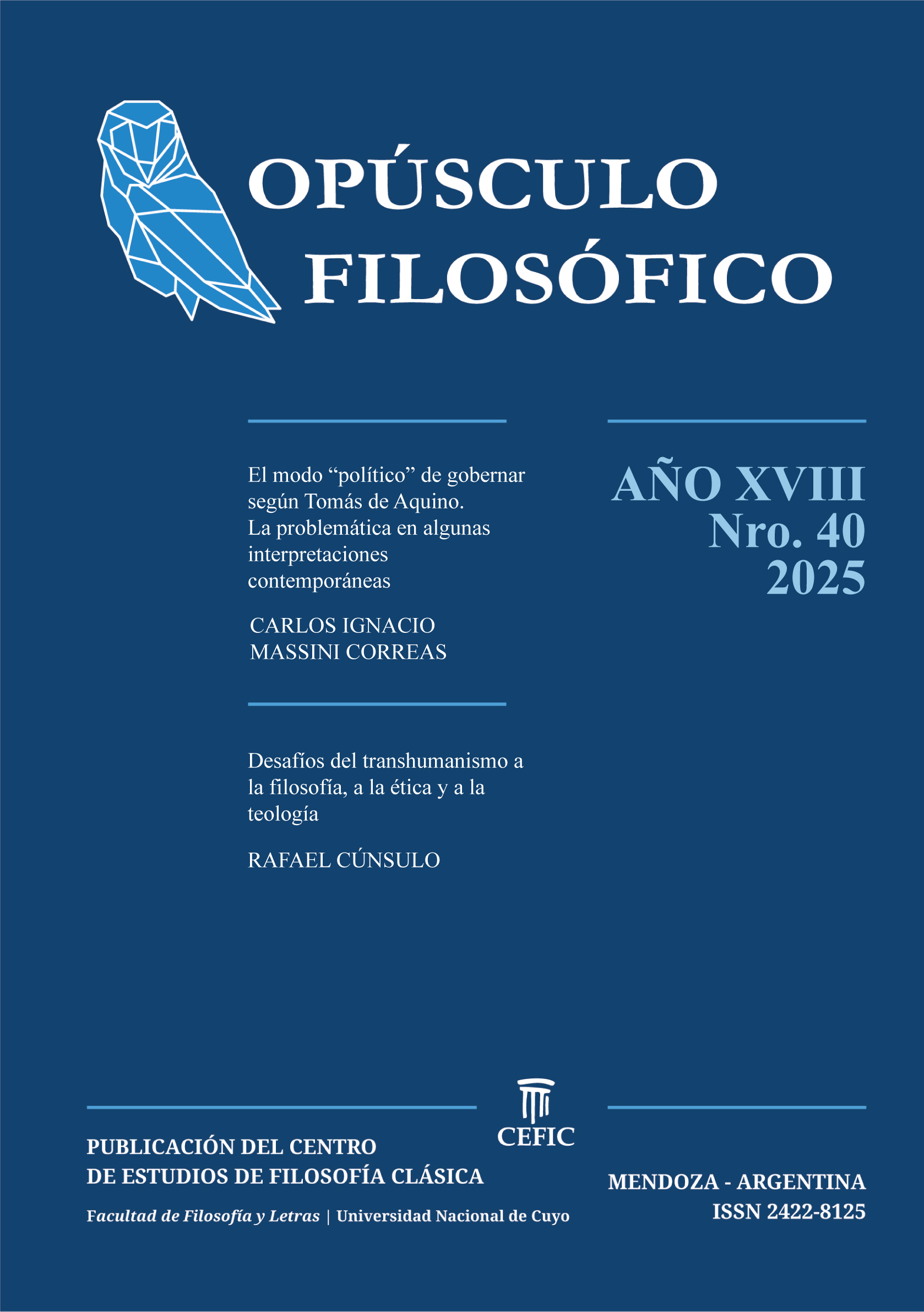
Desafíos del transhumanismo a la filosofía, a la ética y a la teología
Palabras clave:
Perfeccionamiento humano, naturaleza, libertad, don, tarea, causa auxiliarResumen
Partimos de la definición que el transhumanismo da de sí mismo para vincularlo con nociones básicas de la filosofía, como lo son naturaleza y libertad. Desde la libertad y la "perfección" tomamos los desafíos éticos, para culminar con la donación como categoría teológica para referenciar el último desafío. Descubrimos que tanto la naturaleza como la perfección son frutos de la donación y de la tarea humana. Solo en la tarea, el transhumanismo es causa auxiliar de la naturaleza y del don para potenciar el perfeccionamiento.
Descargas
Citas
AI4People. (2018). Ethical framework for a good AI society: Opportunities, risks, principles and recommendations. Minds and Machines, 28, 689–707.
Allenby, B. R., & Sarewitz, D. (2011). The techno-human condition. Cambridge: The MIT Press.
Amor Pan, J. R. (2018). Mejora humana, posthumanismo, liberalismo y capitalismo: ¿Los cuatro jinetes del capitalismo? En D. García-Marzá, J. F. Lozano, E. Martínez y J. C. Siurana (Eds.), Ética y filosofía política. Madrid: Tecnos.
Amor Pan, J. R. (2019). El sueño de Gilgames hecho realidad: Somos la última generación humana mortal. Diálogo filosófico, 103.
Apel, K.-O. (1985). La transformación de la filosofía (Vol. I). Madrid: Taurus.
Artigas, M. (2003). Filosofía de la naturaleza. Pamplona: Eunsa.
Asla, M. (2018). El transhumanismo como ideología: Ambigüedades y dificultades de la fe en el progreso. Scio, 15, 12–13.
Beorlegui, C. (2021). Humanos: Entre lo prehumano y lo pos- o transhumano. Madrid: UPCO.
Boden, M. A. (2016). AI: Its nature and future. Oxford: Oxford University Press.
Boden, M. A. (2017). Inteligencia artificial. Madrid: Turner Noema.
Bostrom, N. (2005). A history of transhumanist thought. Journal of Evolution and Technology, 14.
Bostrom, N. (2014). Superintelligence: Paths, dangers, strategies. Oxford: Oxford University Press.
Brooks, R. A. (2003). Cuerpos y máquinas: De los robots humanos a los hombres robots. Barcelona: Ediciones B.
Burdett, M. S. (2011). Contextualizing a Christian perspective on transcendence and human enhancement. En R. Cole-Turner (Ed.), Transhumanism and transcendence: Christian hope in an age of technological enhancement. Washington, DC: Georgetown University Press.
Carr, N. (2014). The glass cage: Automation and us. New York: W. W. Norton & Company.
Casas, R. (2020). La esperanza de liberarnos de lo que somos: Una mirada cristiana sobre la ideología transhumanista. Iglesia Viva, 281.
Cole, A., & Singer, P. (2020). Burn-in.
Conill, J. (2006). Ética hermenéutica. Madrid: Tecnos.
Conill, J. (2019). Intimidad corporal y persona humana: De Nietzsche a Ortega y Zubiri. Madrid: Tecnos.
Cordeiro, J. L., & Wood, D. (2018). La muerte de la muerte. Barcelona: Deusto.
Cortina, A. (2007). Ética de la razón cordial. Oviedo: Nobel.
Cortina, A. (2013). Neuromejora moral: ¿Un camino prometedor ante el fracaso de la educación? Anales de la Real Academia de Ciencias Morales y Políticas, 90.
Cortina, A. (2017). Aporofobia: El rechazo al pobre. Barcelona: Paidós.
Crevier, D. (1993). AI: The tumultuous history of the search for artificial intelligence. New York: Basic Books.
De la Torre, J. (2016). La religión posthumanista. En Cultura de la mejora humana y vida cotidiana. Madrid: UPCO.
Delio, I. (2011). The emergent Christ: Exploring the meaning of Catholic in an evolutionary universe. New York: Orbis Books.
Diéguez, A. (2017). Transhumanismo: La búsqueda tecnológica del mejoramiento humano. Barcelona: Herder.
Diéguez, A. (2021). Cuerpos inadecuados: El desafío transhumanista a la filosofía. Barcelona: Herder.
Feito, L. (2019). El transhumanismo. Diálogo filosófico, 103.
Ferry, L. (2017). La révolution transhumaniste: Comment la technomédecine et l’ubérisation du monde vont transformer nos vies. Paris: Plon.
Foerst, A. (2004). God in the machine: What robots teach us about humanity and God. New York: Dutton.
Foerst, A. (2008). Keeping Homo sapiens 1.0. Artifact, 2(3–4).
Ford, K. M., & Hayes, P. J. (2002). On computational wings: Rethinking the goals of artificial intelligence. En Scientific American (Ed.), Understanding artificial intelligence. New York: Warner Books.
Ford, M. (2015). The rise of the robots: Technology and the threat of mass unemployment. London: Oneworld Publications.
Frankish, K., & Ramsey, W. M. (2014). The Cambridge handbook of artificial intelligence. Cambridge: Cambridge University Press.
Garreau, J. (2005). Radical evolution: The promise and peril of enhancing our minds, our bodies, and what it means to be human. New York: Broadway Books.
Génova, F. J., & Foerst, A. (2016). Dimensión religiosa de la búsqueda de inteligencia artificial. Barcelona: Edicions de la Facultat de Teologia de Catalunya.
Geraci, R. (2010). Apocalyptic AI: Visions of heaven in robotics, artificial intelligence, and virtual reality. New York: Oxford University Press.
Gratton, L., & Scott, A. (2018). La vida de cien años. Bilbao: Lettera Publicaciones.
Habermas, J. (1984a). Ciencia y técnica como “ideología”. En Ciencia y técnica como ideología. Madrid: Tecnos.
Habermas, J. (1984b). Conocimiento e interés. En Ciencia y técnica como ideología. Madrid: Tecnos.
Haught, J. F. (2000). God after Darwin: A theology of evolution. Oxford: Westview Press.
Haught, J. F. (2010). Making sense of evolution: Darwin, God, and the drama of life. Louisville, KY: Westminster John Knox Press.
Herzfeld, N. (2005). Co-creator or co-creator: The problem with artificial intelligence. En U. Görman, W. B. Drees y H. Meisinger (Eds.), Creative creatures: Values and ethical issues in theology, science and technology. New York: T&T Clark International.
High-Level Expert Group on Artificial Intelligence. (2019). Ethics guidelines for trustworthy AI. European Commission.
Hughes, J. (2004). Citizen cyborg: Why democratic societies must respond to the redesigned human of the future. Cambridge, MA: Westview Press.
Huxley, J. (1927). Religion without revelation. London: E. Benns.
Jordan, J. (2016). Robots. Cambridge: The MIT Press.
Kant, I. (1956). Kritik der reinen Vernunft. Hamburg: Felix Meiner Verlag.
Keane, J. (2019). La nueva era de la revolución de las máquinas. Letras Libres, 18, 24–32.
Kelly, K. (2016). The inevitable: Understanding the 12 technological forces that will shape our future. New York: Penguin Books.
Kurzweil, R. (2000). The age of spiritual machines: When computers exceed human intelligence. New York: Penguin Books.
Kurzweil, R. (2006). The singularity is near: When humans transcend biology. New York: Penguin Books.
Lara, F., & Savulescu, J. (Eds.). (2021). Más (que) humanos: Biotecnología, inteligencia artificial y ética de la mejora. Madrid: Tecnos.
Latorre, J. I. (2019). Ética para máquinas. Barcelona: Ariel.
Levy, D. (2007). Love and sex with robots: The evolution of human-robot relationships. New York: HarperCollins.
Llopis, R. (2019). La inteligencia artificial como factor de innovación en la empresa. Conferencia pronunciada en el Seminario de la Fundación ÉTNOR, 14 de marzo.
López de Mántaras, R., & Meseguer, P. (2017). Inteligencia artificial. Madrid: Los Libros de la Catarata/CSIC.
Lumbreras, S. (2019). Respuestas al transhumanismo: Cuerpo, autenticidad y sentido. Madrid: Digital Reasons.
Martínez, F. (2021). Humanos, sencillamente humanos. Madrid: San Pablo.
Mazis, G. A. (2008). Humans, animals, machines: Blurring boundaries. New York: SUNY Press.
Monterde, R. (2021). El ocaso de la humanidad: La singularidad tecnológica como fin de la historia [Tesis doctoral]. Universidad Católica de Valencia.
More, M., & Vita-More, N. (Eds.). (2013). The transhumanist reader: Classical and contemporary essays on the science, technology, and philosophy of the human future. Chichester, UK: Wiley-Blackwell.
Nicolelis, M. (2011). Beyond boundaries: The neuroscience of connecting brains with machines and how it will change our lives. New York: St. Martin’s Griffin.
Noble, D. F. (1999). The religion of technology: The divinity of man and the spirit of invention. New York: Knopf.
Ruiz de la Peña, J. L. (1988). Imagen de Dios: Antropología teológica fundamental. Santander: Sal Terrae.
Ruiz de la Peña, J. L. (1995). Crisis y apología de la fe: Evangelio y nuevo milenio. Santander: Sal Terrae.
Searle, J. R. (1980). Minds, brains and programs. Behavioral and Brain Sciences, 3.
Susskind, D., & Susskind, R. (2015). The future of the professions: How technology will transform the work of human experts. Oxford: Oxford University Press.
Teilhard de Chardin, P. (1967). El porvenir del hombre. Madrid: Taurus.
Teilhard de Chardin, P. (2005). Lo que yo creo. Madrid: Trotta.
Turse, N., & Engelhardt, T. (2012). Terminator planet: The first history of drone warfare 2001–2050. Marston Gate: Dispatch Books.
Vallancien, G. (2017). Homo artificialis: Plaidoyer pour un humanisme numérique. Paris: Michalon Éditeur.
Whitby, B. (1996). Reflections on artificial intelligence: The legal, moral and ethical dimensions. Bristol: Intellect Books.
Humanity+. (s. f.). Declaración transhumanista [Traducción del inglés]. Humanity+. https://www.humanityplus.org
Yonck, R. (2017). Heart of the machine: Our future in a world of artificial emotional intelligence. New York: Arcade Publishing.
Descargas
Publicado
Cómo citar
Número
Sección
Licencia

Esta obra está bajo una licencia internacional Creative Commons Atribución-NoComercial 4.0.
Se permite la reproducción de los artículos siempre y cuando se cite la fuente.
Los autores/as conservarán sus derechos de autor y garantizarán a la revista el derecho de primera publicación de su obra.
Opúsculo Filosófico proporciona un acceso abierto inmediato a su contenido, y no cobra ninguna tasa por los textos publicados ni por los textos sometidos para evaluación, revisión, publicación, distribución o descarga. La revista no cobra cargos por APC y utiliza la siguiente licencia Creative Commons para sus contenidos:
Atribución-NoComercial 4.0 Internacional (CC BY-NC 4.0)
Los usuarios son libre de:
- Compartir — copiar y redistribuir el material en cualquier medio o formato
- Adaptar — remezclar, transformar y construir a partir del material
- La licenciante no puede revocar estas libertades en tanto usted siga los términos de la licencia
Bajo los siguientes términos:
- Atribución — Usted debe dar crédito de manera adecuada, brindar un enlace a la licencia, e indicar si se han realizado cambios. Puede hacerlo en cualquier forma razonable, pero no de forma tal que sugiera que usted o su uso tienen el apoyo de la licenciante.
- No Comercial — Usted no puede hacer uso del material con propósitos comerciales.
- No hay restricciones adicionales — No puede aplicar términos legales ni medidas tecnológicas que restrinjan legalmente a otras a hacer cualquier uso permitido por la licencia.