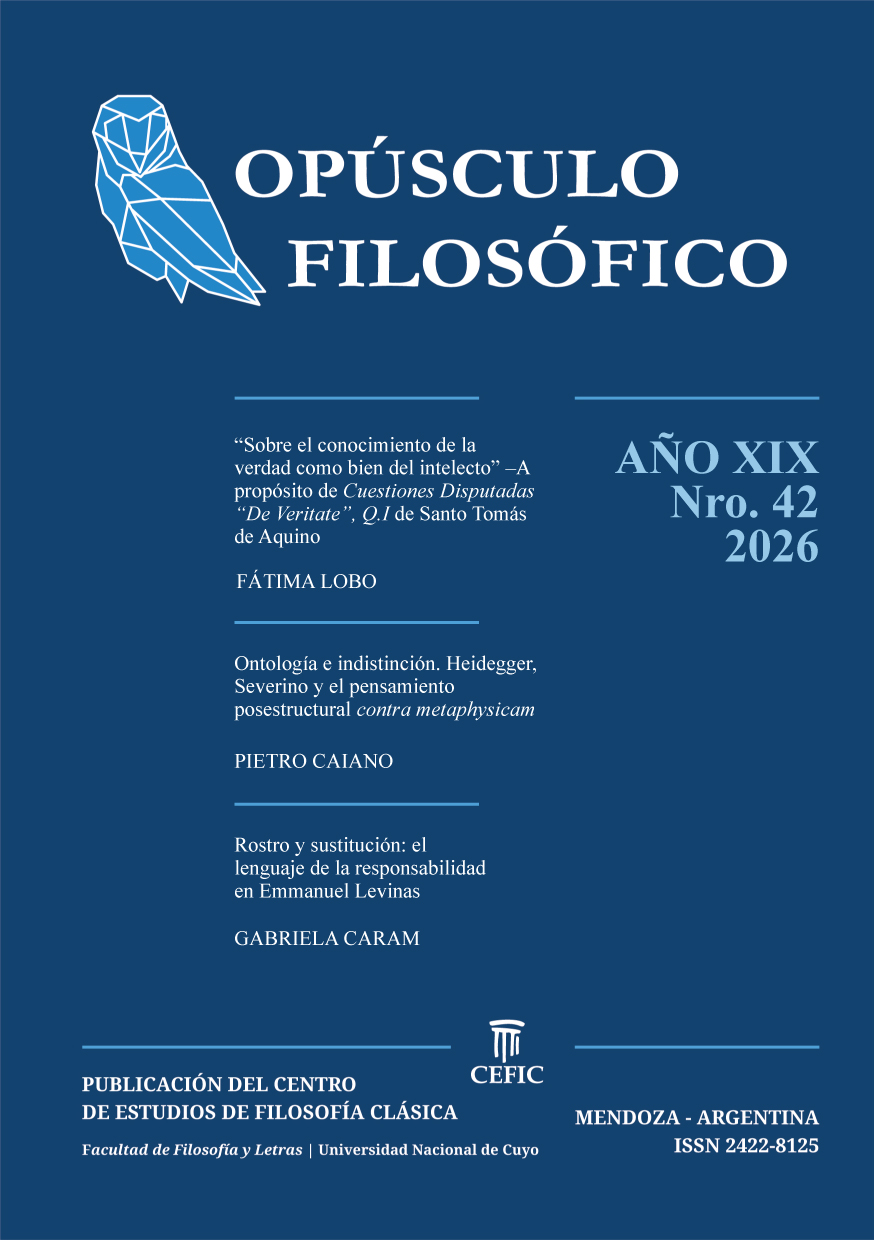
Face and Substitution
The Language of Responsibility in Emmanuel Levinas
Keywords:
Emmanuel Levinas, language of responsibility, ethics as first philosophy, face, substitutionAbstract
In previous works we have referred to the philosophy of Emmanuel Levinas, whose work introduces a decisive inflection in the traditional way of thinking about subjectivity and the relation with the Other. Far from simply fitting within the inherited frameworks of Western philosophy, his reflection attempts a shift that affects both the content and the very language of philosophical inquiry.
Although his thought draws from the phenomenological tradition, Levinas dismantles its assumptions by situating ethics not as a derivative discipline, but as the original domain from which any consideration of alterity becomes possible. In this turn, the relation with the Other cannot be reduced to an act of knowledge or to a thematizable experience, but rather imposes itself as a prior demand, irreducible to the logic of the Same.
It is within this framework that subjectivity ceases to be understood as self-sufficiency or closed identity, and is instead conceived as exposure, openness, and response. Levinasian reflection thus points toward a conception of the human defined less by autonomy than by responsibility that precedes all choice, and that is inscribed in an asymmetrical relation with the Other. Notions such as proximity, responsibility, and substitution make it possible to deepen this shift, in which the face emerges as an epiphany of the infinite.
Downloads
References
Caram, G. de los Á. (2024). Pensar el presente con Emmanuel Levinas: La ética como filosofía primera y la concepción del Otro como infinito. En M. Rodríguez de Grzona & P. M. Meier (Comps.), Pensar el presente: Escritos y archivos multimedia del Congreso Internacional de Filosofía (pp. 205–214). Jagüel Editores.
Celiméndiz Ferrández, C. (2018). Emmanuel Levinas: La noción de “rostro” y su relación con la fenomenología de Husserl. UNED.
Correa, O. A. (2019). El pensamiento de Emmanuel Levinas y su relevancia para la teología. Revista Teología, 56(128), 77–102.
De Nigris, F. (2015). Intencionalidad, pasividad y autoconciencia en la fenomenología de Husserl. Ideas y Valores, 64(157), 219–237.
Guillot, L. (2002). El humanismo del otro hombre: Una introducción al pensamiento de Emmanuel Levinas. Ediciones del Signo.
Herrero Hernández, F. J. (2000). Alteridad e infinito: La substitución en Levinas. Cuadernos Salmantinos de Filosofía, 27, 243–277. https://doi.org/10.36576/
summa.1116
Herrero Hernández, F. J. (2005). De Husserl a Levinas: Un camino en la fenomenología. Publicaciones Universidad Pontificia de Salamanca.
Husserl, E. (1991). Meditaciones cartesianas. Fondo de Cultura Económica.
Levinas, E. (1974). En découvrant l’existence avec Husserl et Heidegger. Vrin.
Levinas, E. (1987). La teoría de la intuición en la fenomenología de Husserl (A. Sevilla, Trad.). Anthropos. (Trabajo original publicado en 1930)
Levinas, E. (2000 a). De la existencia al existente (J. F. Ledesma, Trad.). Arena Libros. (Trabajo original publicado en 1947)
Levinas, E. (2000 b). Ética e infinito (J. M. Ayuso Díez, Trad.). Machado Libros.
Levinas, E. (2002). Totalidad e infinito: Ensayo sobre la exterioridad (A. Aparicio, Trad.). Sígueme. (Trabajo original publicado en 1961)
Levinas, E. (2003). De otro modo que ser o más allá de la esencia (A. Pintor Ramos, Trad.). Sígueme.
Levinas, E. (2004). Difícil libertad: Ensayos sobre el judaísmo.
Levinas, E. (2005). Descubriendo la existencia con Husserl y Heidegger. Síntesis.
Navarro, O. (2008). El «rostro» del otro: Una lectura de la ética de la alteridad de Emmanuel Lévinas. Contrastes. Revista Internacional de Filosofía, 13, 177–194.
Parra, F. (2009). El tiempo, el otro y la muerte a través de Emmanuel Levinas. Teología y Vida, 50(3), 565–598.
Pinardi, S. (2010). Notas acerca del decir y lo dicho en el pensamiento de Levinas. Episteme NS, 30(2), 33–47.
Pinardi, S. E. (2014). Expresión y desnudez: Un acercamiento a la noción de justicia en el pensamiento de Emmanuel Lévinas. Eidos: Revista de Filosofía de la Universidad del Norte, 21, 104–126.
Pintor Ramos, R. (2003). Emmanuel Lévinas: Una filosofía de la alteridad. Sígueme.
Paul Ricoeur (1999). De otro modo: Lectura de “De otro modo que ser o más allá de la esencia”, de Emmanuel Levinas. Anthropos Editorial.
Rimbaud, A. (2002). Obras completas (M. A. Vázquez, Trad.). Cátedra.
Solé, J. (2016). Levinas: La ética del Otro. EMSE EDAPP.
Downloads
Published
How to Cite
Issue
Section
License

This work is licensed under a Creative Commons Attribution-NonCommercial 4.0 International License.
Se permite la reproducción de los artículos siempre y cuando se cite la fuente.
Los autores/as conservarán sus derechos de autor y garantizarán a la revista el derecho de primera publicación de su obra.
Opúsculo Filosófico proporciona un acceso abierto inmediato a su contenido, y no cobra ninguna tasa por los textos publicados ni por los textos sometidos para evaluación, revisión, publicación, distribución o descarga. La revista no cobra cargos por APC y utiliza la siguiente licencia Creative Commons para sus contenidos:
Atribución-NoComercial 4.0 Internacional (CC BY-NC 4.0)
Los usuarios son libre de:
- Compartir — copiar y redistribuir el material en cualquier medio o formato
- Adaptar — remezclar, transformar y construir a partir del material
- La licenciante no puede revocar estas libertades en tanto usted siga los términos de la licencia
Bajo los siguientes términos:
- Atribución — Usted debe dar crédito de manera adecuada, brindar un enlace a la licencia, e indicar si se han realizado cambios. Puede hacerlo en cualquier forma razonable, pero no de forma tal que sugiera que usted o su uso tienen el apoyo de la licenciante.
- No Comercial — Usted no puede hacer uso del material con propósitos comerciales.
- No hay restricciones adicionales — No puede aplicar términos legales ni medidas tecnológicas que restrinjan legalmente a otras a hacer cualquier uso permitido por la licencia.