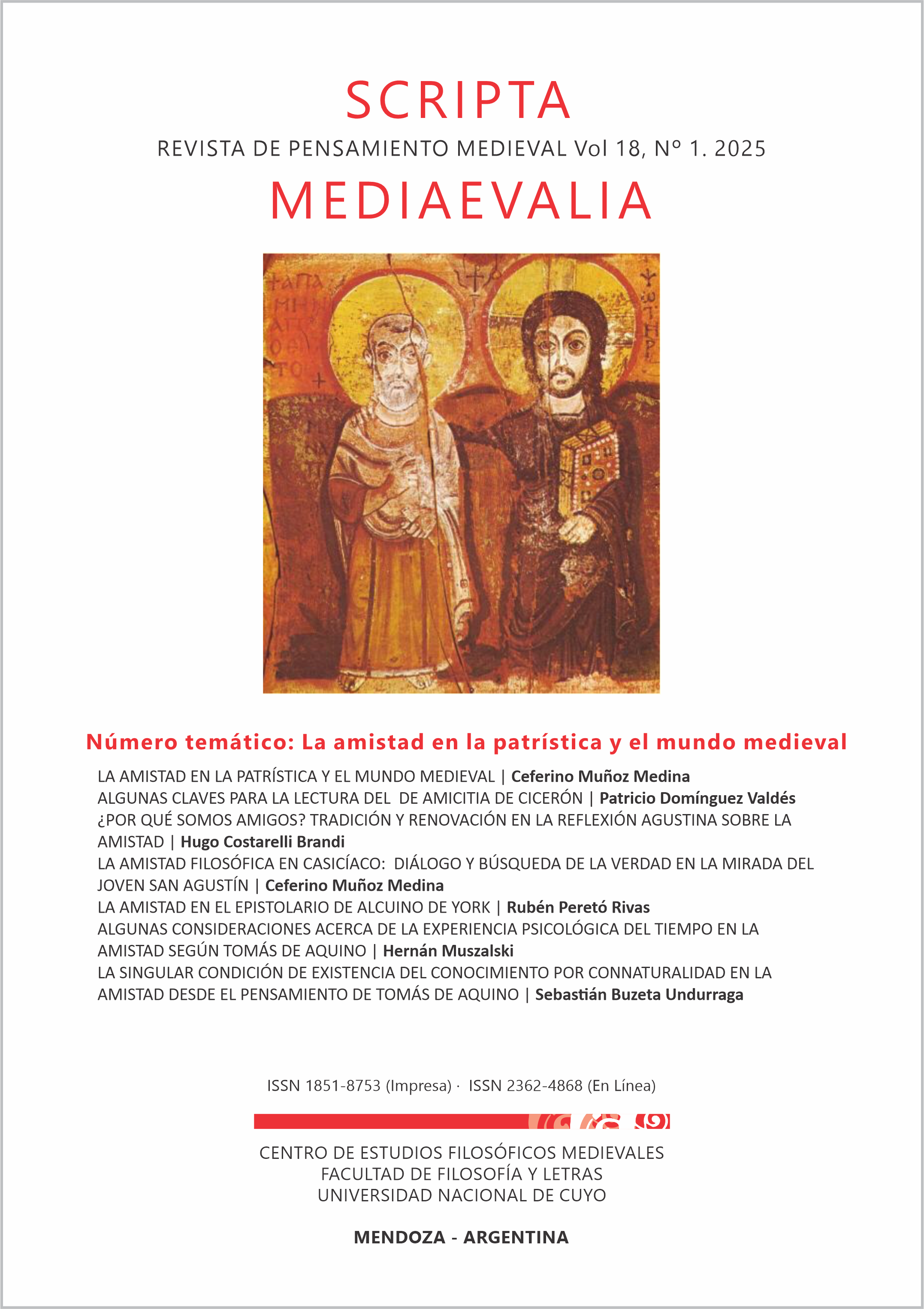
La amistad en el epistolario de Alcuino de York
DOI:
https://doi.org/10.48162/rev.35.047Palabras clave:
Amistad, caritas Christi, fidelitas, afecto, santidadResumen
El epistolario de Alcuino de York ofrece una visión profunda de la amistad en la Alta Edad Media, donde no solo se concebía como un vínculo afectivo, sino como un medio para la vida espiritual y el acercamiento a Dios. Inspirado en la tradición patrística, Alcuino desarrolla su concepción de la amistad a partir de la caritas Christi, viendo en sus amigos un reflejo de la divinidad. Su correspondencia evidencia que la amistad era fundamental en la estructura social y política de la época, involucrando a abades, monjes, reyes y laicos. En sus cartas, resalta la fidelitas como el pilar esencial de la verdadera amistad, subrayando la necesidad de confianza, sinceridad y compromiso mutuo. Además, su estilo epistolar está cargado de un intenso afecto, expresado mediante metáforas y referencias bíblicas. Para Alcuino, la amistad no es solo un don de Dios, sino un camino hacia la santidad, una riqueza espiritual que perdura más allá de la vida terrenal.
Descargas
Citas
Alcuino de York. Epistolae. MGH Epistolarum IV, Karolini Aevi II. Editado por Ernst Düemmler. Berlín: Societas Aperiendis Fontibus, 1895. 18-481.
Alcuino de York. Lettres. Editado por Christiane Veyrard-Cosme. Sources chrétiennes 597. Paris: Cerf, 2018.
Alcuino, De dialéctica, PL 101, 949-975.
Bullough, Donald A. Alcuin: Achievement and Reputation. Leiden: Brill, 2004.
Calabrese, Claudio & Junco, Ethel. “Lectura, plegaria y cor meum en san Agustín: Las repuestas a “quién soy” como camino hacia Dios”. Scripta Mediaevalia, 17-1, 2024, pp. 11–32.
Constable, Giles. Letters and letter-collections. Turnhout: Brepols, 1976.
Conybeare, Catherine. Paulinus Noster: Self and Symbols in the Letters of Paulinus of Nola. Oxford: Oxford University Press, 2000.
Cristiani, Marta. “Le vocabulaire de l’enseignement dans la correspondance d’Alcuin”. En Vocabulaire des écoles et des méthodes d’enseignement au moyen âge. editado por Olga Weijers, 13-32. Turnhout: Brepols, 1992.
Duchesne, Franz, ed. Historiae francorum scriptores coetanei. Vol. II. Paris: Sumptibus Sebastiani Cramoisy, 1636.
Edelstein, Wolfgang. Eruditio und sapientia Weltbild und Erziehung in der Karolingerzeit Rombach: Freiburg: , 1965.
Elredo de Rieval. La amistad espiritual. Burgos: Monte Carmelo, 2012.
Fabre, Pierre. Saint Paulin de Nole et l’amitié Chrétienne. E. de Boccard, 1949.
Fiske, Adele. “Alcuin and mystical friendship”. Studi Medievali 2 (1961): 549-575.
Garrison, Mary. “Les Correspondants d´Alcuin”. Annales de Bretagne et Des Pays de l´Ouest 111, núm. 3 (2004): 219–331.
Hans-Werner, Goetz. “The Concept of Friendship in Letters”. En Friendship in Medieval Europe, editado por Julian Haseldine, 230-254. Sutton: Thrupp, 1999.
Haseldine, Julian. Friendship in Medieval Europe. Editado por Julian Haseldine. Sutton: Thrupp, 1999.
Isidoro de Sevilla. Etimologías. PL 82. Madrid: Biblioteca de Autores Cristianos, 2004.
Jerónimo de Estridón. Epistolae. Parte I. Epistulae I-LXX. Editado por Isidor Hilberg. CSEL 54. Viena, F. Tempsky, 1910.
Leclerqc, Jean. “Le genre épistolaire au Moyen Age”. Revue du Moyen Age Latin 2 (1946): 55-72.
Lupo de Ferrières. Epistolae. Editado por Peter K. Marshal. Leipzig: Bibliotheca Teubneriana, 1984.
Page, Ralph B. “The letters of Alcuin”.Tesis doctoral. Columbia University, 1909.
Paulino de Nola. Epistulae. Sancti Pontii Meropii Paulini Nolani opera. Editada por G. von Hertel. CSEL XXIX. Viena, Pragae et Vindobonae, 1894.
Paulino de Nola. Selections from the Poems of Paulinus of Nola. Including the Correspondence with Ausonius. Editado por Alex Dressler. Abingdon, Routledge, 2023.
Peretó Rivas, Rubén. “Elementos de filosofía en el epistolario de Alcuino de York”. Patristica & Mediaevalia 23 (2002): 4-15.
Platón. Banquete. Traducido por Marcos Martínez Hernández. Madrid: Gredos, 2014.
Sturgeon, Thomas G. “The letters of Alcuin. Part I. The Aachen Period (782-796)”. Tesis doctoral. Harvard University, 1953.
Trout, Dennis E. Paulinus of Nola: Life, Letters, and Poems. California: University of California press, 1999.
Veyrard-Cosme, Christiane. “Les motifs épistolaires dans la correspondence d´Alcuin’. Annales de Bretagne et des Pays de l´Ouest 111, núm 3 (2004): 193–205.
Wallach, Luitpold. Alcuin and Charlemagne. Studies in Carolingian History and Litterature. Ithaca: Cornell University Press, 1959.
Descargas
Publicado
Cómo citar
Número
Sección
Licencia
Derechos de autor 2025 Rubén Peretó Rivas

Esta obra está bajo una licencia internacional Creative Commons Reconocimiento-NoComercial-CompartirIgual 3.0.