
Population dynamics of orchard grass stalks (Dactylis glomerata L.) and perennial ryegrass (Lolium perenne L.) associated with white clover (Trifolium repens L.)
Keywords:
rate of occurrence, death, survival, weight per stemAbstract
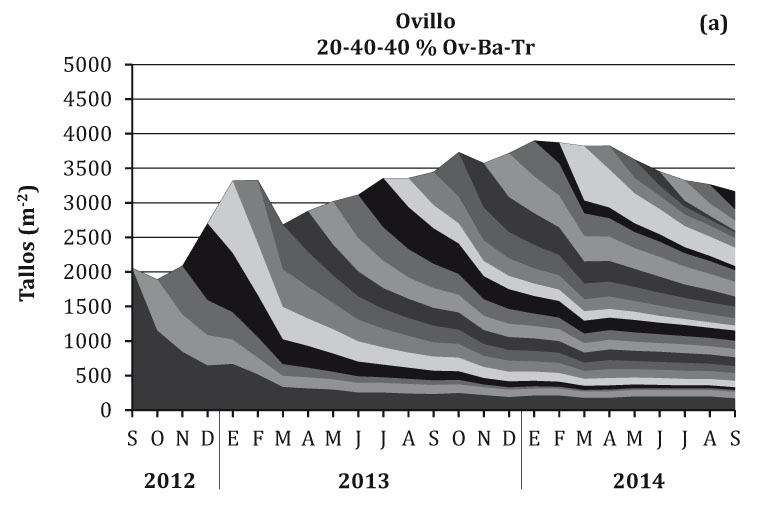
The objective of this research was to evaluate four associations of two grass and a legumein different percentages. Sowing was done in February 2010, in the Graduate College, Campus Montecillo, Mexico; based on the densities of 20, 30 and 5 kg ha-1 for orchard grass (Ov), perennial ryegrass (Ba) and white clover (Tr), respectively. Treatments consisted of the following associations: 20-40-40, 00-50-50, 40-20-40, 50-00-50% Ov, Ba and Tr. The four treatments were randomly distributed in 12 experimental plots of 9 by 8 m according to a design of a randomized complete block with three replications. The association 50-00-50 of Ov-Ba-Tr is the one with greater density orchard grass stalks with an average of 4,250 m2 stems, and lower the association 20-40-40 of Ov-Ba-Tr with an average of 3,400 m2 stems (p = 0.05). The association 20-40-40 of Ov-Ba-Tr showed greater weight orchard grass stem in both years with an average of 0.3 g stem-1 and lower weight partnership 50-00-50 with 0.23 g stem-1. In conclusion it is recommended to use the association 20-40-40 of Ov-Ba-Tr since I obtained the highest weight per stem in both grasses and the smallest population dynamics of stems, therefore, there was compensation size/density, which was reflected in the increased forage yield; with a frequency of 4 weeks in spring-summer and every 5 to 6 weeks in autumn and winter.
Downloads
Downloads
Published
How to Cite
Issue
Section
License

This work is licensed under a Creative Commons Attribution-NonCommercial-ShareAlike 3.0 Unported License.
Authors who publish with this journal accept the Editorial Policies.
 RevFCAUNCuyo






.jpg)