
Climatic Normals in Chacras de Coria. Evolution of Air Temperature for the 1959-2020 Period
DOI:
https://doi.org/10.48162/rev.39.210Keywords:
climatology , climate change, ClimPACTAbstract
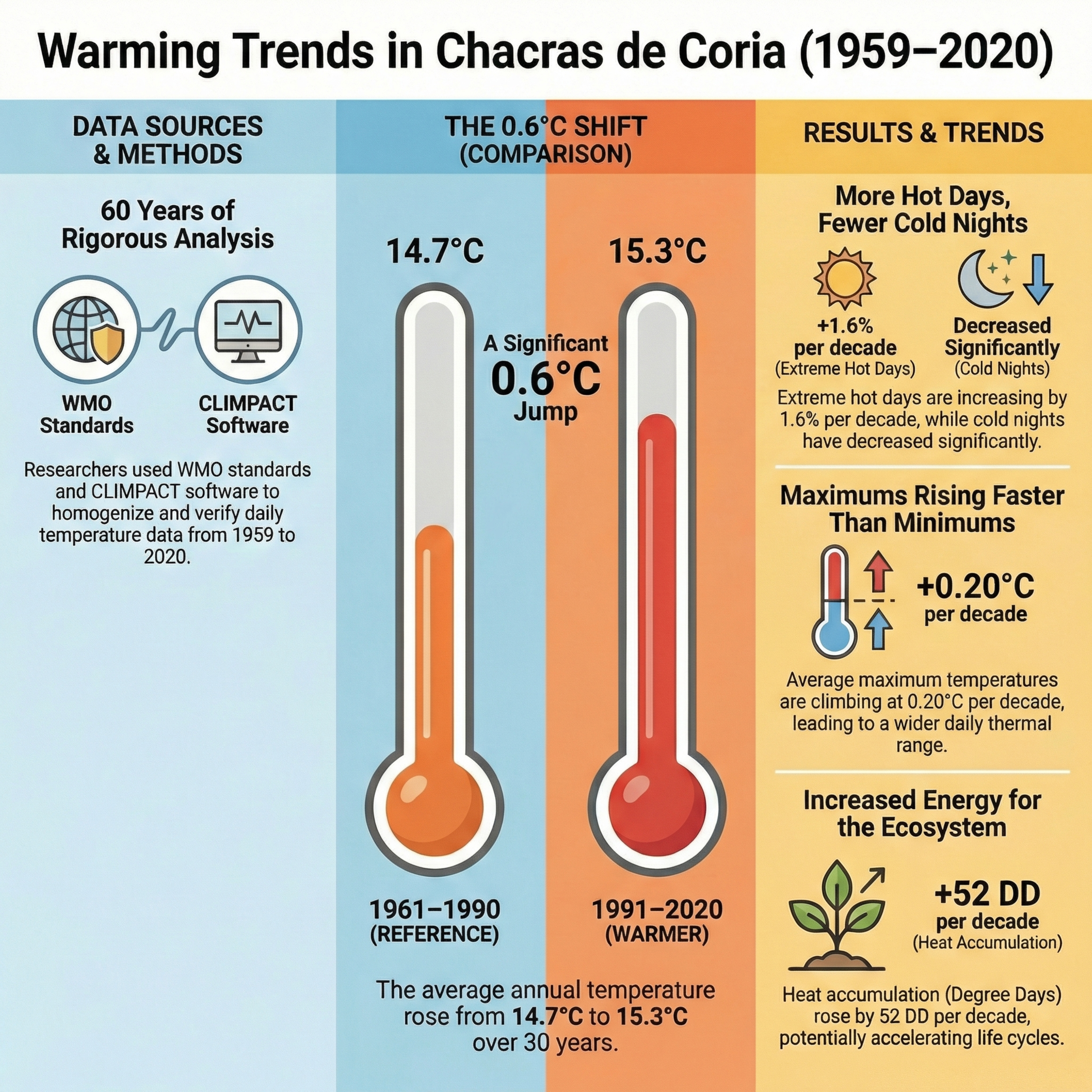
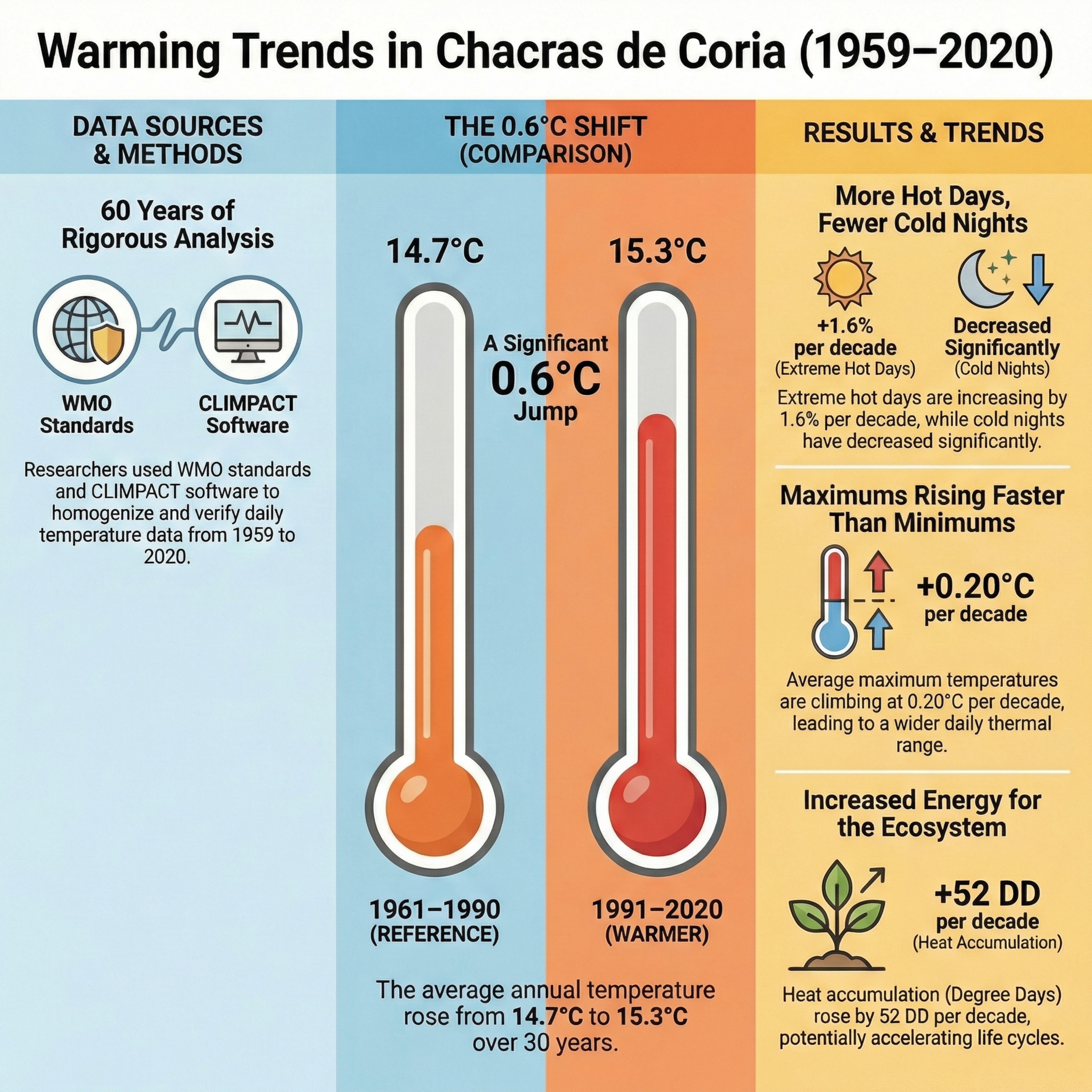
Air temperature data registered from 1959 to 2020 by the Chacras de Coria meteorological station (32°59' S Lat.; 68°52' W Long.) were analyzed to characterize the site and identify trends considering the climate change scenario. We ensured quality and homogeneity of the time series following the procedures of the Standard World Meteorological Organization, calculating reference (1961-1990) and regulatory (1991-2020) climatological normals. The CLIMPACT package detected trends in temperature-related indices, including extreme values, daily thermal amplitude, and degree days. The results reveal that the 1991-2020 period was 0.6°C warmer than 1961-1990. Significant increases were observed in average minimum (0.12°C/decade) and average maximum (0.20°C/decade) temperatures. Extreme minimum and maximum temperatures also increased by 0.11°C/decade and 0.33°C/decade, respectively, resulting in fewer cold nights (-0.49%/decade) and more hot days (1.6%/decade). Daily temperature ranges increased by 0.11°C/decade, and degree days by 52 DD/decade. These findings are consistent with global warming evidence. A corrected and homogenized database spanning over 60 years is available for future climatological studies.
Highlights:
- A 62-year (1959–2020) homogenized and quality-controlled daily temperature database was established for Chacras de Coria using WMO standards and the CLIMPACT package.
- The regulatory climate normal period (1991–2020) was 0.6 °C warmer than the reference normal period (1961–1990).
- The Daily Thermal Range (DTR) increased by 0.11 °C per decade; maximum temperatures rose significantly faster (0.20 °C/decade) than minimum temperatures (0.12 °C/decade), an asymmetrical increase of 66.6%.
- Analysis of extreme indices reveals a decrease in cold nights (-0.49%/decade) and a significant rise in hot days (1.6%/decade).
- Annual Grow Degree Days (GDD) increased by 52 DD per decade, indicating higher energy availability that may shorten the cycles of ectothermic organisms.
Downloads
References
Alabar, F.; Valdiviezo Corte, M.; Moreno, C.; Hurtado, R. 2022. Temperaturas extremas registradas en estaciones del noroeste argentino. XIX Reunión Argentina de Agrometeorología: Producción Armónica y Sustentable. Asociación Argentina de Agrometeorología. https://www.siteaada.org/_files/ugd/ cf1a17_2f530752296445dc92edabb44abeeecc.pdf
Aneise, A. J.; Möhle, E.; Risaro, D. B.; Schteingart, D. 2024. Cambio climático. Argendata. Fundar. https://argendata.fund.ar/topico/cambio-climatico/. Retrieved June 19th, 2025.
Araneo, D. 2015. Foro de Cambio Climático. Efectos del Cambio Climático en Mendoza y propuestas de adaptabilidad. UNCUYO-ONU. https://www.uncuyo.edu.ar/centroasuntosglobales/upload/foro-de-cambio-climatico-presentacion-diego-araneo.pdf
Commission for Climatology (CCl). 2024. Expert Team on Climate Risk and Sector-Specific Climate Indices (ETCRSCI). Climpact user guide. https://github.com/ARCCSS-extremes/climpact/ blob/master/www/user_guide/Climpact_user_guide.md. Retrieved February 27th, 2024.
Córdoba, M.; Vallone, R.; Paccioretti, P.; Corvalán, F.; Balzarini, M. 2025. Data-driven Method for the Delimitation of Viticultural Zones: Application in the Mendoza River Oasis, Argentina. Revista de la Facultad de Ciencias Agrarias. Universidad Nacional de Cuyo. Mendoza. Argentina. 57(2): 57-68. DOI: https://doi.org/10.48162/rev.39.171
Di Rienzo, J. A.; Casanoves, F.; Balzarini, M.; Gonzalez, L.; Tablada, M.; Robledo, C. W. 2020. InfoStat versión 2020. Centro de Transferencia InfoStat. FCA. Universidad Nacional de Córdoba.
Farreras González, V. I.; Lauro, C.; Abraham, L.;Salvador, P. F. 2026. Social Welfare Effects of Water Security Improvements in Arid Regions: The Case of Mendoza, Argentina. Revista de la Facultad de Ciencias Agrarias. Universidad Nacional de Cuyo. e8916. DOI: https://doi.org/10.48162/rev.39.195
Huang, X.; Dunn, R. J.; Li, L. Z.; McVicar, T. R.; Azorin-Molina, C.; Zeng, Z. 2023. Increasing Global Terrestrial Diurnal Temperature Range for 1980-2021. Geophysical Research Letters, 50(e2023GL103503). doi.org/https://doi.org/10.1029/2023GL103503
IPCC. 2013. Annex III: Glossary [Planton, S. (ed.)]. In: Climate Change 2013: The Physical Science Basis. Contribution of Working Group I to the Fifth Assessment Report of the Intergovernmental Panel on Climate Change [Stocker, T. F., D. Qin, G.-K. Plattner, M. Tignor, S.K. Allen, J. Boschung, A. Nauels, Y. Xia, V. Bex and P.M. Midgley (eds.)]. Cambridge University Press.
Mulena, G. C.; Araneo, D. C. 2018. Variabilidad y tendencia de los extremos de temperatura sobre la provincia de Mendoza, Argentina. CONGREMET XIII. https://cenamet.org.ar/congremet/wp-content/uploads/2018/11/T0099_MULENA.pdf
Müller, G. V.; Lovino, M. A.; Sgroi, L. C. 2021. Observed and Projected Changes in Temperature and Precipitation in the Core Crop Region of the Humid Pampa, Argentina. Climate. 9(3): 40. https://doi.org/10.3390/cli9030040
Ruiz Murcia, J. F.; Melo Franco, J. Y.; Herrera Aponte, S. M.; Fonseca Gutiérrez, E. K.; Vega Burgos, A. 2023. Cálculo de indicadores (evidencias) de cambio climático para Colombia 1981-2020. IDEAM-METEO / 004-2023. Instituto de Hidrología, Meteorología y Estudios Ambientales. Grupo de modelamiento numérico de tiempo y clima. Grupo de gestión de datos y red meteorológica. IDEAM.
Rusticucci, M.; Barrucand, M. 2004. Observed trends and changes in temperature extremes over Argentina. Journal of Climate. 17(20): 4099-4107.
Rusticucci, M.; Barrucand, M.; Collazo, S. 2016. Temperature extremes in the Argentina central region and their monthly relationship with the mean circulation and ENSO phases. International Journal of Climatology. 37(6): 3003-3017. https://doi.org/10.1002/joc.4895
Sen, P. K. 1968. Estimates of the Regression Coefficient Based on Kendall’s Tau. Journal of the American Statistical Association. 63(324): 1379-1389. doi.org/10.1080/01621459.1968.10480934
Tencer, B.; Rusticucci, M. 2012. Analysis of interdecadal variability of temperature extreme events in Argentina applying EVT. Atmósfera. 25(4): 327-337. http://www.scielo.org.mx/scielo. php?script=sci_arttext&pid=S0187-62362012000400002&lng=es&tlng=en
Wang, X. L. 2008a. Accounting for autocorrelation in detecting mean-shifts in climate data series using the penalized maximal t or F test. J. Appl. Meteor. Climatol. (47): 2423-2444. doi. org/10.1175/2008JAMC1741.1
Wang, X. L. 2008b. Penalized maximal F-test for detecting undocumented mean-shifts without trend-change. J. Atmos. Oceanic Tech. V (3): 368-384. doi.org/10.1175/2007/JTECHA982.1
Wang, X. L.; Feng, Y. 2013. RHtestsV4 User Manual. Climate Research Division, Atmospheric Science and Technology Directorate. Science and Technology Branch Environment. http:// etccdi.pacificclimate.org/software.shtml
WMO and Green Climate Fund (GCF) Secretariats. 2022. Developing the Climate Science Information for Climate Action WMO-No. 1287. World Meteorological Organization. https://library.wmo.int/idurl/4/53280
World Meteorological Organization. 2017. WMO Guidelines on the Calculation of Climate Normals WMO-No. 1203. World Meteorological Organization. https:// library.wmo.int/viewer/55797/download?file=1203_en.pdf&type=pdf&navigator=1
World Meteorological Organization. 2020. Guidelines on Homogenization WMO-No. 1245. World Meteorological Organization. https://library.wmo.int/ idurl/4/57130
World Meteorological Organization. 2023. Guide to Climatological Practices WMO-No. 100. World Meteorological Organization. https://library.wmo.int/ idurl/4/60113
World Meteorological Organization. 2023. The Global Climate 2011-2020. A decade of accelerating climate change. WMO-No. 1338. World Meteorological Organization. https:// library.wmo.int/idurl/4/68585
Zwiers, F. W.; Zhang, X. 2009. Guidelines on Analysis of extremes in a changing climate in support of informed decisions for adaptation WMO/TD-No. 1500. World Meteorological Organization. https://library.wmo.int/idurl/4/48826
Published
How to Cite
Issue
Section
License

This work is licensed under a Creative Commons Attribution-NonCommercial-ShareAlike 3.0 Unported License.
Authors who publish with this journal accept the Editorial Policies.
 RevFCAUNCuyo






.jpg)