Effects of Agronomic and Environmental Factors on Potato (Solanum tuberosum L.) Cultivars: II. Phenological Phases and Dry Matter Production
DOI:
https://doi.org/10.48162/rev.39.230Keywords:
dry matter production, plant development, phenological phase, planting dateAbstract
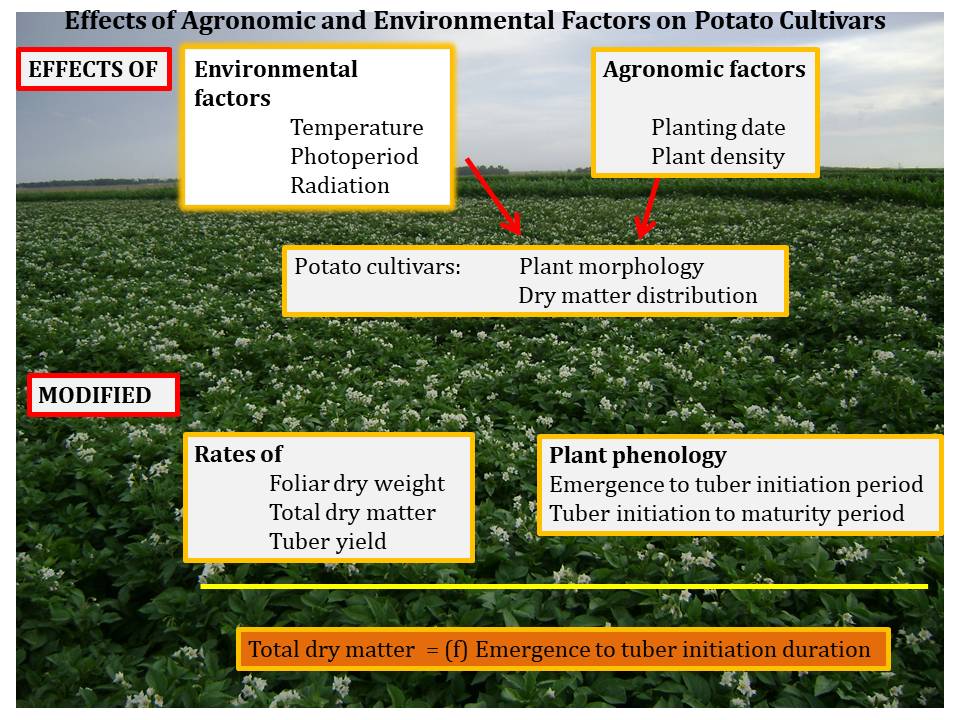
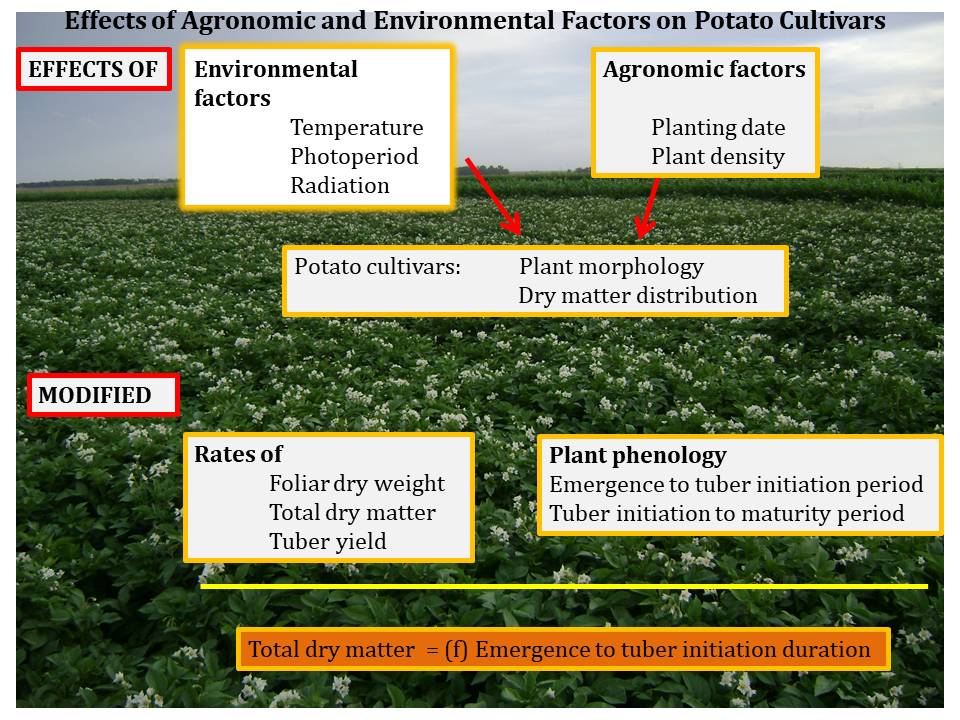
Potato (Solanum tuberosum ssp. tuberosum L.) ecophysiology, including growth, development, and dry matter distribution, is influenced by agronomic and environmental factors. This study analyzed plant phenology and dry matter production in contrasting potato cultivars grown in southeastern Buenos Aires Province, Argentina, considering interactions among environmental factors (temperature, radiation, and photoperiod) and agronomic factors (planting date, PD, and plant density). The study evaluated three PDs in a randomized complete block design with four replications using four cultivars differing in maturity class. Later planting shortened the emergence-to-tuber initiation (E-Ti) period in two cultivars. Later planting shortened the tuber initiation-to-end of leaf growth period in “Spunta” but lengthened it in “Kennebec.” The period from end of leaf growth to maturity was affected by cultivar and PD, being generally shorter for the first PD and longer for the second. Temperature, radiation, and photoperiod influenced dry matter accumulation, depending on the phenological phase. Photoperiod influenced the E-Ti period, whereas temperature influenced later stages of crop development. A longer E-Ti period for the first and last PDs significantly shortened subsequent periods. The second PD appeared to be the most conducive to potato production in this region. Moreover, duration of the E-Ti period was inversely related to the combined duration of the other periods, explaining 56% of the variation in total dry matter. The longer duration of this phenological period contributed to higher dry matter production across the range of PDs analyzed in this region. Therefore, selecting an appropriate PD is essential for maximizing dry matter production. Maximizing yield requires moderate plant density and conditions favoring high harvest indices while avoiding excessive investment in foliage.
Highlights:
- The effects of planting date of four potato cultivars on tuber dry weight, tuber fresh weight, total dry weight, and foliage dry weight were analyzed.
- Planting date affected potato yield by influencing length of phenological periods and dry matter distribution, depending the maturity class of the cultivars studied (Shepody, Kennebec, Spunta, Bonaerense La Ballenera).
- Phenological phases emergence to tuber initiation, tuber initiation to the end of leaf growth, and the end of leaf growth to maturity were characterized by mean ambient temperature, incoming radiation, and photoperiod at the beginning of each phase.
- Crop development rates during these three phenological phases were primarily influenced by photoperiod and temperature, in a cultivar-specific manner.
- A longer emergence to tuber initiation phase did not imply a longer duration of the following two phases. Early or late planting accelerated plant growth processes without significantly altering the total duration of the growth cycle.
Downloads
References
Al-Mamun, A., Al-Mahmud, A., Zakaria, M., Hossain, M. & Hossain, T. (2016). Effects of planting times and plant densities of top-shoot cuttings on multiplication of breeder seed potato. Agriculture and Natural Resources, 50, 26-31. http://dx.doi.org/10.1016/j.anres.2014.08.001
Begun, F., Kundu, B. C. & Hossain, M. I. (2015). Physiological analysis of growth and yield potato in relation to planting date. Journal of Bangladesh Academy of Sciences, 39(1), 45-51. https://doi.org/10.3329/jbas.v39i1.23657
Cacace, J. E., Huarte, M. A. & Monti, M. C. (1994). Evaluation of potato quality in Argentina. American Potato Journal, 71,145-153. https://doi.org/10.1007/BF02849049
Caldiz, D. O. (2009). Physiological age research during the second half of the twentieth century. Potato Research, 52, 295-304. DOI 10.1007/s11540-009-9143-4
Caldiz, D. O. & Gaspari, F. J. (1997). Análisis de los factores determinantes del rendimiento en papa (Solanum tuberosum L.) con especial referencia a la situación Argentina. Revista de la Facultad de Agronomía, 102(2), 203-229.
Cantos, E. (1988). Rendimiento potencial del cultivo de papa en Balcarce. Causas que limitan la productividad real [Thesis M.Sc. Facultad de Ciencias Agrarias. Universidad Nacional de Mar del Plata]. 51 pp
Della Maggiora, A. (1995). Estimación de la evapotranspiración. Aplicación para la programación de riego en el cultivo de papa [Thesis M.Sc. Facultad de Ciencias Agrarias. Universidad Nacional de Mar del Plata].
Ewing, E. E. (1997). Potato. In: Wien HC (ed.) The physiology of vegetable crops. CAB International. pp 295-344
Ewing, E. E. & Struik, P. C. (1992). Tuber Formation in Potato: Induction, Initiation, and Growth. In Horticultural Reviews, J. Janick (Ed.). pp. 89-198. https://doi.org/10.1002/9780470650523.ch3
Ewing, E. E., & Sandlan, K. P. (1995). II-1: Biomass partitioning in the potato: considerations for modelling. In Modelling and Parameterization of the Soil-Plant-Atmosphere System. Wageningen Academic. pp. 7-19. https://doi.org/10.1163/9789004684348_004
Fleisher, D. H., Timlin, D. J. & Reddy, V. R. (2006). Temperature influence on potato leaf and Branch distribution and on canopy photosynthetic rate. Agronomy Journal, 98, 1442-52. https://doi.org/10.2134/agronj2005.0322
Gawronska, H. & Dwelle, R. B. (1989). Partitioning of photoassimilates by potato plants (Solanum tuberosum L.) as influenced by radiation. I. Partitioning patterns in cultivar Russet Burbank grown under high and low irradiance. American Potato Journal, 66, 201-213. https://doi.org/10.1007/BF02853443
Giletto, C. M., Echeverria, H. E., & Sadras, V. (2003). Fertilización nitrogenada de cultivares de papa (Solanum tuberosum) en el sudeste bonaerense. Ciencia del Suelo, 21(2), 44-51.
Hou, X. Q., Niu, Y. W., Wu, W. L., Xu, J. P., Shi, L., Tang, S. Y., Ma, X., & Li, R. (2018). Effect of planting density on the growth, water use efficiency and yield of dry-farming potato under rainfall year types. Acta Agronomica Sinica, 44(10), 1560-1569. Doi:10.3724/SP.J.1006.2018.01560
Hou, X. Q., Li, R., He, W., & Ma, K. (2020). Effects of plant density on potato growth, yield, and water use efficiency during years with variable rainfall on the Loess Plateau, China. Agricultural Water Management, 230, 105982. https://doi.org/10.1016/j.agwat.2019.105982
InfoSstat/P. (2020). Software estadístico. Universidad Nacional de Córdoba. http://www.infostat.com. ar
Khan, M. S., Yin, X. & Struik, P. C. (2014). An ecophysiological model analysis of yield differences within a set of contrasting cultivars and an F1 segregating population of potato (Solanum tuberosum L.) grown under diverse environments. Ecological Modelling, 290, 146-154. http://dx.doi.org/10.1016/j.ecolmodel.2013.11.015
Khan, M. S., Struik, P. C., van der Putten, P. E. L., Jansen, H. J., van Eck, H. J., van Eeuwijk, F. A., & Yin, X. (2019a). A model-based approach to analyse genetic variation in potato using standard cultivars and a segregating population. I. Canopy cover dynamics. Field Crops Research, 242, 107581. https://doi.org/10.1016/j.fcr.2019.107581
Khan, M. S., Yin, X., van der Putten, P. E. L., Jansen, H. J., van Eck, H. J., van Eeuwijk, F. A., & Struik, P. C. (2019b). A model-based approach to analyse genetic variation in potato using standard cultivars and a segregating population. II. Tuber bulking and resource use efficiency. Field Crops Research, 242, 107582. https://doi.org/10.1016/j.fcr.2019.107582
Kooman, P. L. (1995). Yielding ability of potato crops as influenced by temperature and daylength [Ph.D. Thesis Wageningen University]. 155 pp.
Krug, H. (1997). Environmental influences on development, growth and yield. 1997. In: Wien HC (ed) The physiology of vegetable crops. CAB International. pp. 101-180.
Kwambai, T. K., Struik, P. C., Gorman, M., Nyongesa, M., Rop, W., Kemboi, E., & Griffin, D. (2024). Understanding genotype × environment interactions in potato production to guide variety adoption and future breeding strategies. Potato Research, 67, 663-694. https://doi.org/10.1007/s11540-023-09650-8.
Lizana, X. C., Avila, A., Tolaba, A., & Martinez, J. P. (2017). Field responses of potato to increased temperature during tuber bulking: projection for climate change scenarios, at high-yield environments of Southern Chile. Agric for Meteorol., 239, 192-201. https:// doi. org/ 10.1016/j. agrfo rmet. 2017. 03. 012
Lorenzen, J. A. & Ewing, E. E. (1990). Changes in tuberization and assimilate partitioning in potato (Solanum tuberosum L.) during the first 18 days of photoperiod treatment. Annals of Botany, 66, 457-64. https://doi.org/10.1093/oxfordjournals.aob.a088048
Manrique, L. A. & Bartholomew, D. P. (1991a). Growth and yield performance of several potato clones grown at three elevations in Hawaii I Dry matter production and efficiency of partitioning. Crop Science, 31, 367-72. https://doi.org/10.2135/cropsci1991.0011183X003100020029x
Manrique, L. A., Kiniry, J. R., Hodges, T., & Axness, D. S. (1991b). Dry matter production and radiation interception of potato. Crop Science, 31, 1044-1049. https://doi.org /10.2135/cropsci1991.0011183X003100040040x
Naawe, E. K., Yavuz, C., Demirel, U., & Çaliskan, M. E. (2024). Effects of Elevated Temperature on Agronomic, Morphological, Physiological and Biochemical Characteristics of Potato Genotypes: 2. Physiological and Biochemical Traits. Potato Res. 68, 2167-2204 https://doi.org/10.1007/s11540-024-09815-z
Ospina, C. A., Lammerts van Bueren, E. T., Allefs, J. J. H. M., Engel, B., van der Putten, P. E. L., van der Linden, C. G., & Struik, P. C. (2014). Diversity of crop development traits and nitrogen use efficiency among potato cultivars grown under contrasting nitrogen regimes. Euphytica, 199, 13-29. DOI 10.1007/s10681-014-1203-4
Prysiazhniuk, L., Sonets, T., Shytikova, Y., Melnyk, S., Dikhtiar, I., Mazhuha, K. & Sorochinsky, B. (2023). The environmental and generic factors affect the productrivity and quality of potato cultivars. Zemdirbyste-Agriculture, 110(4), 319-329. DOI 10.13080/z-a. 2023. 110.036
Regel, P. A., & Sands, P. J. (1983). A model of the development and bulking of potatoes (Solanum tuberosum L.) IV Daylength, plant density and cultivars effects. Field Crops Research, 6,1-23. https://doi.org/10.1016/0378-4290(83)90044-8
Sale, P. M. J. (1973a). Productivity of vegetable crops in a region for high solar input I Growth and development of the potato (Solanum tuberosum L.). Australian Journal of Agricultural Research, 24, 733-749. https://doi.org/10.1071/AR9730733
Sale, P. M. J. (1973b). Productivity of vegetable crops in a region for high solar input II Yield and efficiencies of water use and energy. Australian Journal of Agricultural Research, 24, 751-762. https://doi.org/10.1071/AR9730751
Saluzzo, J. A. (1994a). Comportamiento de cultivares de papa con distinto ciclo en respuesta a la fertilización nitrogenada [Thesis M.Sc. Facultad de Ciencias Agrarias. Universidad Nacional de Mar del Plata]. 52 pp.
Saluzzo, J. A. (2001). Concentración de nitratos en pecíolos y rendimiento de los cultivares de papa Kennebec y Shepody en relación a la fertilización nitrogenada. AgriScientia, 28, 21-26. https://doi.org/10.31047/1668.298x.v18.n0.2637
Saluzzo, J. A., Echeverría, H. E., Andrade, F., & Huarte, M. A. (1994b). Producción de materia seca y tubérculos de papa (cv. Huinkul MAG) en respuesta a la fertilización nitrogenada en Balcarce (Argentina). Revista de la Facultad de Agronomía La Plata, 70, 81-89.
Saluzzo, J. A., Struik, P. C., & Huarte, M. A. (2026). Effects of agronomic and environmental factors on potato cultivars 1 Yield and tuber quality [Manuscrito no publicado]. Universidad Nacional de Mar del Plata.
Struik, P. C. (2007). Response of the potato plant to temperature. In: Vreugdenhil D (ed. with Bradshaw J, Gebhardt C, Govers F, MacKerron DKL, Taylor MA, and Ross HA) Potato biology and biotechnology: Advances and perspectives. Elsevier. pp. 367-393.
Tessema, L., Mohammed, W., & Abebe, T. (2020). Evaluation of potato (Solanum tuberosum L.) varieties for yield and some agronomic traits. Open Agriculture, 5, 63-74. https://doi.org/10.1515/opag-2020-0006
Van Dam, J., Kooman, P. L., & Struik, P. C. (1996). Effects of temperature and photoperiod on early growth and final number of tubers in potato (Solanum tuberosum L.). Potato Research, 39, 51-62. https://doi.org/10.1007/BF02358206
Vander Zaag, P., Demagante, A. L., & Ewing, E. E. (1990). Influence of plant spacing on potato (Solanum tuberosum L.) morphology, growth and yield under two contrasting environments. Potato Research, 33, 313-23. https://doi.org/10.1007/bf02359305
Wurr, D. C. E., Hole, C. C., Fellows, J. R., Milling, J., Lynn, J. R., & O´Brien, P. J. (1997). The effect of some environmental factors on potato tuber numbers. Potato Research, 40, 297-306. https://doi.org/10.1007/BF02358011
Yasmin, F., & Zakaria, M. (2019). Combination of planting time and plant density in better potato production. International Journal of Applied Research, 5(1),113-118.
Zheng, S. L., Wang, L. J., Wan, N. X., Zhong, L., Zhou, S. M., He, W., & Yuan, J. C. (2016). Response of potato tuber number and spatial distribution to plant density in different growing seasons in Southwest China. Frontiers in Plant Science, 7, 365. https://doi.org/10.3389/fpls.2016.00365
Published
How to Cite
Issue
Section
License

This work is licensed under a Creative Commons Attribution-NonCommercial-ShareAlike 3.0 Unported License.
Authors who publish with this journal accept the Editorial Policies.
 RevFCAUNCuyo