
Integrating Professional and Crowdsourced Data to Address Biodiversity Knowledge Gaps in Under-Sampled Semi-Arid Wetlands
DOI:
https://doi.org/10.48162/rev.39.215Keywords:
Monte Desert wetlands, scientific collections, citizen science, biodiversity monitoringAbstract
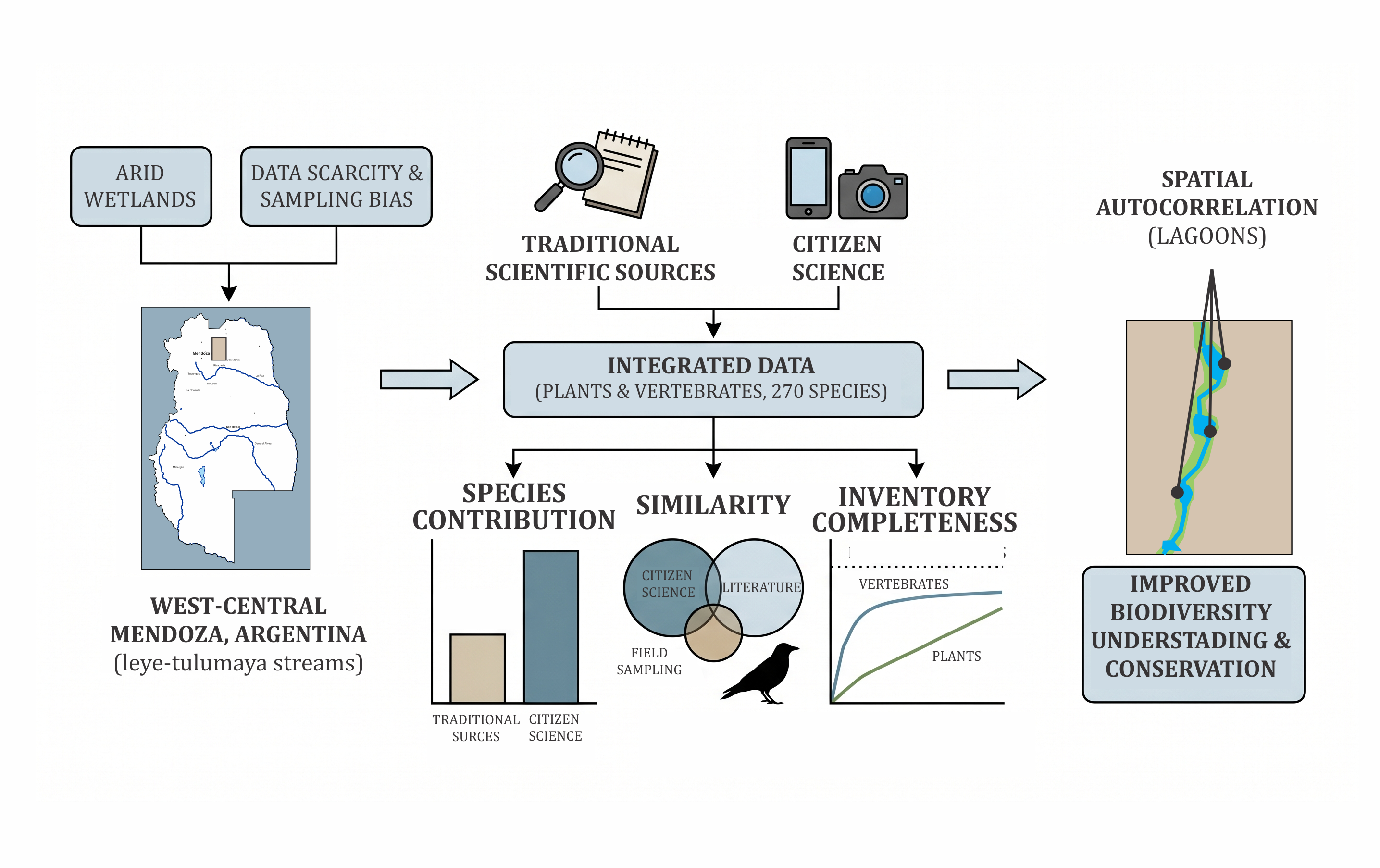
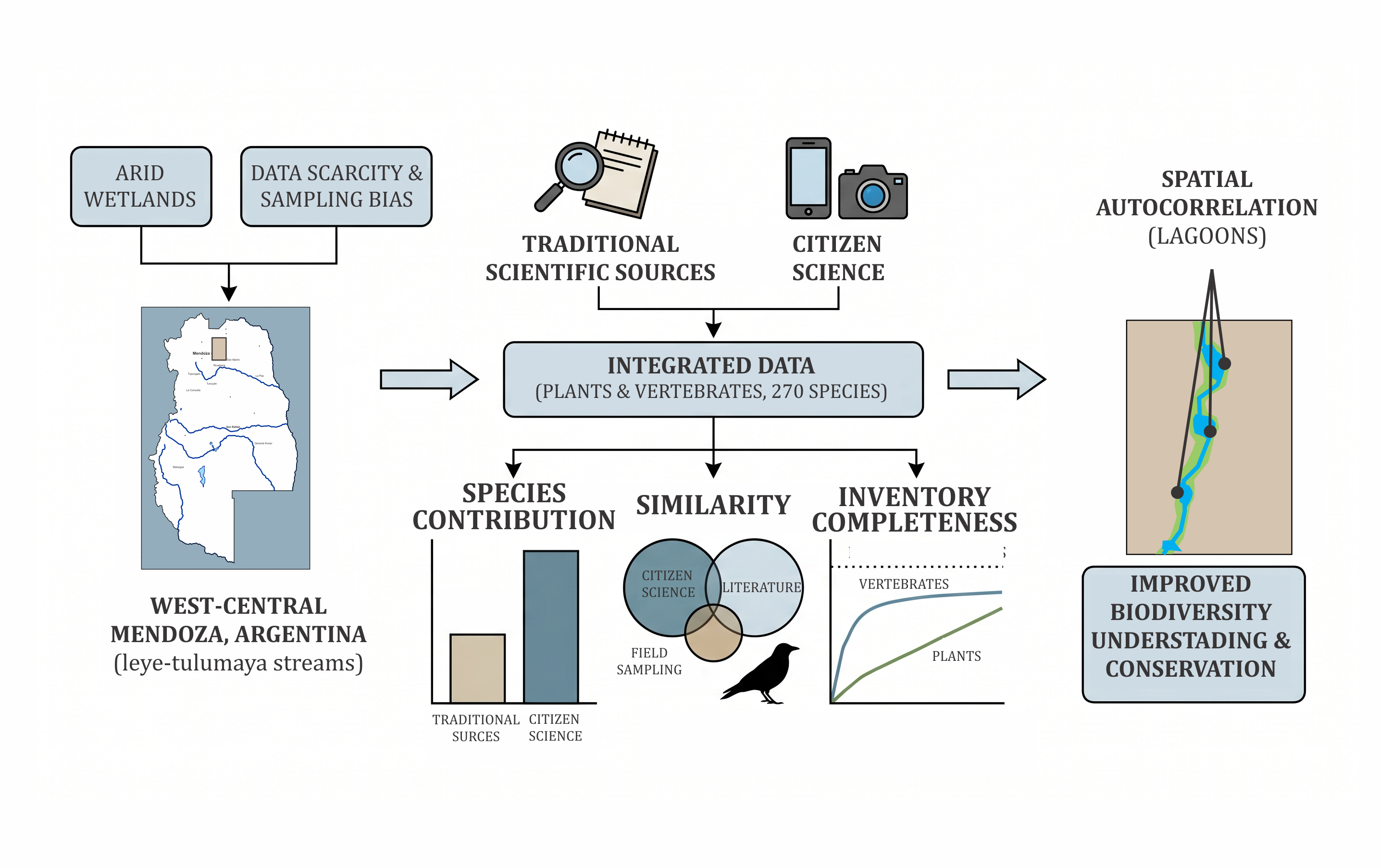
Arid wetlands are vulnerable ecosystems affected by natural and human factors. Their study and conservation are limited by data scarcity and sampling bias. In a wetland of west-central Mendoza, Argentina (Leyes-Tulumaya streams), we explored the contribution of plant and vertebrate records from traditional scientific sources and citizen science. Of 270 recorded species, citizen science contributed the majority of records and unique species. Similarity between databases was greatest between citizen science and literature, with birds dominating among vertebrates. The vertebrate inventory stabilized over time, although estimated richness exceeded observed richness. Accumulation curves for plants did not reach asymptote, suggesting incomplete sampling. Positive spatial autocorrelation of records was detected, indicating data clustering in lagoons. The integration and joint analysis of data sources proved crucial to obtain a more complete and robust understanding of biodiversity and its spatial distribution. Citizen science contributions, in particular, expand databases in understudied arid ecosystems, complementing traditional methods and addressing spatial and temporal information gaps.
Highlights:
- Combining citizen science, literature, and collections revealed 270 species, bridging critical information gaps in under-sampled arid wetlands.
- Citizen science provided the most records and unique species, offering a sustainable and massive data source for long-term monitoring.
- Professional collections provide essential taxonomic validation for cryptic groups, effectively offsetting the "charismatic species" bias of citizen data.
- Accumulation curves show a stabilized vertebrate inventory, but indicate that plant richness remains significantly underestimated and incomplete.
- Significant spatial autocorrelation reveals data clustering in accessible lagoons, identifying the need for sampling in remote connecting riparian areas.
Downloads
References
Amezaga, J. M., Santamaría, L. & Green, A. J. (2002). Biotic wetland connectivity-supporting a new approach for wetland policy. Acta Oecologica, 23(3), 213-222. https://doi.org/10.1016/S1146-609X(02)01152-9
Anselin, L., Syabri, I., & Kho, Y. (2009). GeoDa: an introduction to spatial data analysis. In Handbook of applied spatial analysis: Software tools, methods and applications. Springer. 73-89.
Bonney, R., Shirk, J. L., Phillips, T. B., Wiggins, A., Ballard, H. L., Miller-Rushing, A. J., Parrish, J. K. (2014). Next steps for citizen science. Science, 343(6178), 1436-1437. https://doi.org/10.1126/science.1251554
Bowler, D. E., Bhandari, N., Repke, L., Beuthner, C., Callaghan, C. T., Eichenberg, D., Henle, K., Klenke, R., Ritcher, A., Jansen, F., Bruelheide, H. & Bonn, A. (2022). Decision-making of citizen scientists when recording species observations. Scientific reports, 12(1), 11069. https://doi.org/10.1038/s41598-022-15218-2
Callaghan, C. T., Poore, A. G., Mesaglio, T., Moles, A. T., Nakagawa, S., Roberts, C., Rowley, J., Vergés, A., Wilshire, J. H., Cornwell, W. K. (2021). Three frontiers for the future of biodiversity research using citizen science data. BioScience, 71(1), 55-63. https://doi.org/10.1093/biosci/biaa131
Chandler, M., See, L., Copas, K., Bonde, A. M., López, B. C., Danielsen, F., Legind, J. K., Masinde, S., Miller-Rushing, A. J., Newman, G., Rosemartin, A., Turak, E. (2017). Contribution of citizen science towards international biodiversity monitoring. Biological Conservation, 213, 280-294. https://doi.org/10.1016/j.biocon.2016.09.004
Ciardullo, F. V, & Gennari, A. J. (2025). Agricultural Land Valuation-Hedonic Pricing and Geostatistical Advances: A State-of-the-Art Review. Revista de la Facultad de Ciencias Agrarias. Universidad Nacional de Cuyo. 57(2): 224-236. DOI: https://doi.org/10.48162/rev.39.185
Colwell, R. K., & Elsensohn, J. E. (2014). EstimateS turns 20: Statistical estimation of species richness and shared species from samples, with non‐parametric extrapolation. Ecography, 37(6), 609-613. https://doi.org/10.1111/ecog.00814
Contreras, J. R., & Fernandez, A. (1980). Ecología de la avifauna de la laguna del Viborón, Departamento Maipú, Provincia de Mendoza. Revista del Museo de Historia Natural de San Rafael, 8, 3-14.
Daru, B. H., Park, D. S., Primack, R. B., Willis, C. G., Barrington, D. S., Whitfeld, T. J, Seidler, T. G., Sweeney, P. W., Foster, D. R., Ellison, A. M., Davis, C. C. (2018). Widespread sampling biases in herbaria revealed from large‐scale digitization. New Phytologist, 217(2), 939-955. https://doi.org/10.1111/nph.14855
Díaz-Calafat, J., Jaume-Ramis, S., Soacha, K., Álvarez, A., & Piera, J. (2024). Revealing biases in insect observations: A comparative analysis between academic and citizen science data. Plos one, 19: e0305757. https://doi.org/10.1371/journal.pone.0305757
eBird. 2021. eBird: An online database of bird distribution and abundance [web application]. eBird, Cornell Lab of Ornithology, Ithaca, New York. Available: http://www.ebird.org.
Flora Argentina. Flora vascular de la República Argentina y del Cono Sur. http://www.floraargentina.edu.ar/
Freitas, H., & Gouveia, A. C. (2025). Biodiversity futures: Digital approaches to knowledge and conservation of biological diversity. Web Ecology, 25(1), 29-37. https://doi.org/10.5194/we-25-29-2025
Galván, S., Barrientos, R., & Varela, S. (2022). No bird database is perfect: citizen science and professional datasets contain different and complementary biodiversity information. Ardeola, 69(1), 97-114. https://doi.org/10.13157/arla.69.1.2022.ra6
García-Vega, D., & Newbold, T. (2020). Assessing the effects of land use on biodiversity in the world’s drylands and Mediterranean environments. Biodiversity and Conservation, 29(2), 393-408. https://doi.org/10.1007/s1053
Gouraguine, A., Moranta, J., Ruiz-Frau, A., Hinz, H., Reñones, O., Ferse, S. C., Jompa, J., & Smith, D. J. (2019). Citizen science in data and resource-limited areas: A tool to detect long-term ecosystem changes. PLoS One, 14: e0210007. https://doi.org/10.1371/journal.pone.0210007
Herrera‐Lopera, J. M., Solé, M., & Cultid‐Medina, C. A. (2025). Mapping the Missing: Assessing Amphibian Sampling Completeness and Overlap With Global Protected Areas. Ecology and Evolution, 15: e71137. https://doi.org/10.1002/ece3.71137
Hochachka, W. M., Fink, D., Hutchinson, R. A., Sheldon, D., Wong, W. K., & Kelling, S. (2012). Data-intensive science applied to broad-scale citizen science. Trends in Ecology & Evolution, 27(2), 130-137. https://doi:10.1016/j.tree.2011.11.006
iNaturalist. 2025. iNaturalist observations. https://www.inaturalist.org/observations
Klemann-Junior, L., Villegas Vallejos, M. A., Scherer-Neto, P., & Vitule, J. R. S. (2017). Traditional scientific data vs. uncoordinated citizen science effort: A review of the current status and comparison of data on avifauna in Southern Brazil. PloS one, 12: e0188819. https://doi.org/10.1371/journal.pone.0188819
MapBiomas Argentina - Colección 2 de la Serie anual de Mapas de Cobertura y Uso del Suelo de Argentina, https://argentina.mapbiomas.org/
Mason, B. M., Mesaglio, T., Heitmann, J. B., Chandler, M., Chowdhury, S., Gorta, S. B. J., Grattarola, F., Groom, Q., Hitchcock, C., Hoskins, L., Lowe, S. K., Marquis, M., Pernat, N., Shirey, V. Baasanmunkh, S., & Callaghan, C. T. (2025). iNaturalist accelerates biodiversity research. BioScience, 75(11), 953-965. https://doi.org/10.1093/biosci/biaf104
Miller, S. E., & Edwards, S. E. (2016). Citizen Science and Entomology: An Introduction to New Possibilities and Old Challenges. Annals of the Entomological Society of America, 109, 629-633.
Milton, S. J., & Dean, W. R. J. (2010). Plant invasions in arid areas: Special problems and solutions: a South African perspective. Biological Invasions, 12(12), 3935-3948. https://doi:10.1007/s10530-010-9820-x
Pocock, M. J., Tweddle, J. C., Savage, J., Robinson, L. D., & Roy, H. E. (2017). The diversity and evolution of ecological and environmental citizen science. PloS one, 12(4), e0172579. https://doi.org/10.1371/journal.pone.0172579
Prieto, M. D. R., Rojas, J. F., Castrillejo, T. N., & Hernández, F. (2012). Procesos ambientales y construcción del territorio a partir de un estudio de caso: la ciénaga del Bermejo, oasis Norte de Mendoza 1810-1930. Revista de Historia Americana y Argentina, 47, 175-207.
Reis, R. E., Albert, J. S., Di Dario, F., Mincarone, M. M., Petry, P., & Rocha, L. A. (2016). Fish biodiversity and conservation in South America. Journal of Fish Biology, 89(1), 12-47. https://doi:10.1111/jfb.13016
Rodriguez Forti, L., Passetti, A., Oliveira, T., Lima, J., Queiros, A., Lopes, M. A. D. F., & Szabo, J. K. (2024). Declining representation of imperiled Atlantic Forest birds in community-science datasets. Perspectives in Ecology and Conservation, 22(3), 277-287. https://doi.org/10.1016/j.pecon.2024.02.001
SAREM. Sociedad Argentina para el Estudio de los Mamíferos. https://www.sarem.org.ar/es/lista-de-mamiferos-de-argentina-2024/
Stephenson, P. J., Ntiamoa-Baidu, Y., & Simaika, J. P. (2020). The use of traditional and modern tools for monitoring wetlands biodiversity in Africa: Challenges and opportunities. Frontiers in Environmental Science, 8, 61. https://doi.org/10.3389/fenvs.2020.00061
Suarez, A. V., & Tsutsui, N. D. (2004). The value of museum collections for research and society. BioScience, 54(1), 66-74. https://doi.org/10.1641/0006-3568(2004)054[0066:TVOMCF]2.0.CO;2
Tallei, E., Benavidez, A., Schaaf, A., Isola, P., & Zanotti, M. (2021). Seasonal dynamics of waterbirds from a relict wetland in the central Monte Desert, Argentina. Neotropical Biology and Conservation, 16(2), 333-349. https://doi:10.3897/neotropical.16.e61672
Theobald, E. J., Ettinger, A. K., Burgess, H. K., DeBey, L. B., Schmidt, N. R., Froehlich, H. E., Wagner, C., HilleRisLambers, J., Tewksbury, J., Harsch, M. A., Parrish, J. K. (2015). Global change and local solutions: Tapping the unrealized potential of citizen science for biodiversity research. Biological Conservation, 181, 236-2. https://doi.org/10.1016/j.biocon.2014.10.021
Troudet, J., Grandcolas, P., Blin, A., Vignes-Lebbe, R., & Legendre, F. (2017). Taxonomic bias in biodiversity data and societal preferences. Scientific reports, 7(1), 9132. https://doi.org/10.1038/s41598-017-09084-6
van Rees, C. B., Geist, J., & Arthington, A. H. (2025). Grasping at water: a gap‐oriented approach to bridging shortfalls in freshwater biodiversity conservation. Biological Reviews, 100(5), 1970-1991. https://doi.org/10.1111/brv.70030
Wolf, S., Mahecha, M. D., Sabatini, F. M., Wirth, C., Bruelheide, H., Kattge, J., Moreno, A., Martínez, K. M., & Kattenborn, T. (2022). Citizen science plant observations encode global trait patterns. Nature ecology & evolution, 6(12), 1850-1859. https://doi.org/10.1038/s41559-022-01904-x
Zermoglio, P. F., Chapman, A. D., Wieczorek, J. R., Luna, M. C., Bloom, D. A. (2020). Georeferencing Quick Reference Guide. Copenhagen: GBIF Secretariat. https://doi.org/10.35035/e09p-h128
Published
How to Cite
Issue
Section
License

This work is licensed under a Creative Commons Attribution-NonCommercial-ShareAlike 3.0 Unported License.
Authors who publish with this journal accept the Editorial Policies.
 RevFCAUNCuyo






.jpg)