
Understanding Stakeholders’ Interest and Influence in Agroecosystems Through Social Network Analysis
DOI:
https://doi.org/10.48162/rev.39.221Keywords:
social actor map , organisational networks, information flow, decision-making, innovation, institutionsAbstract
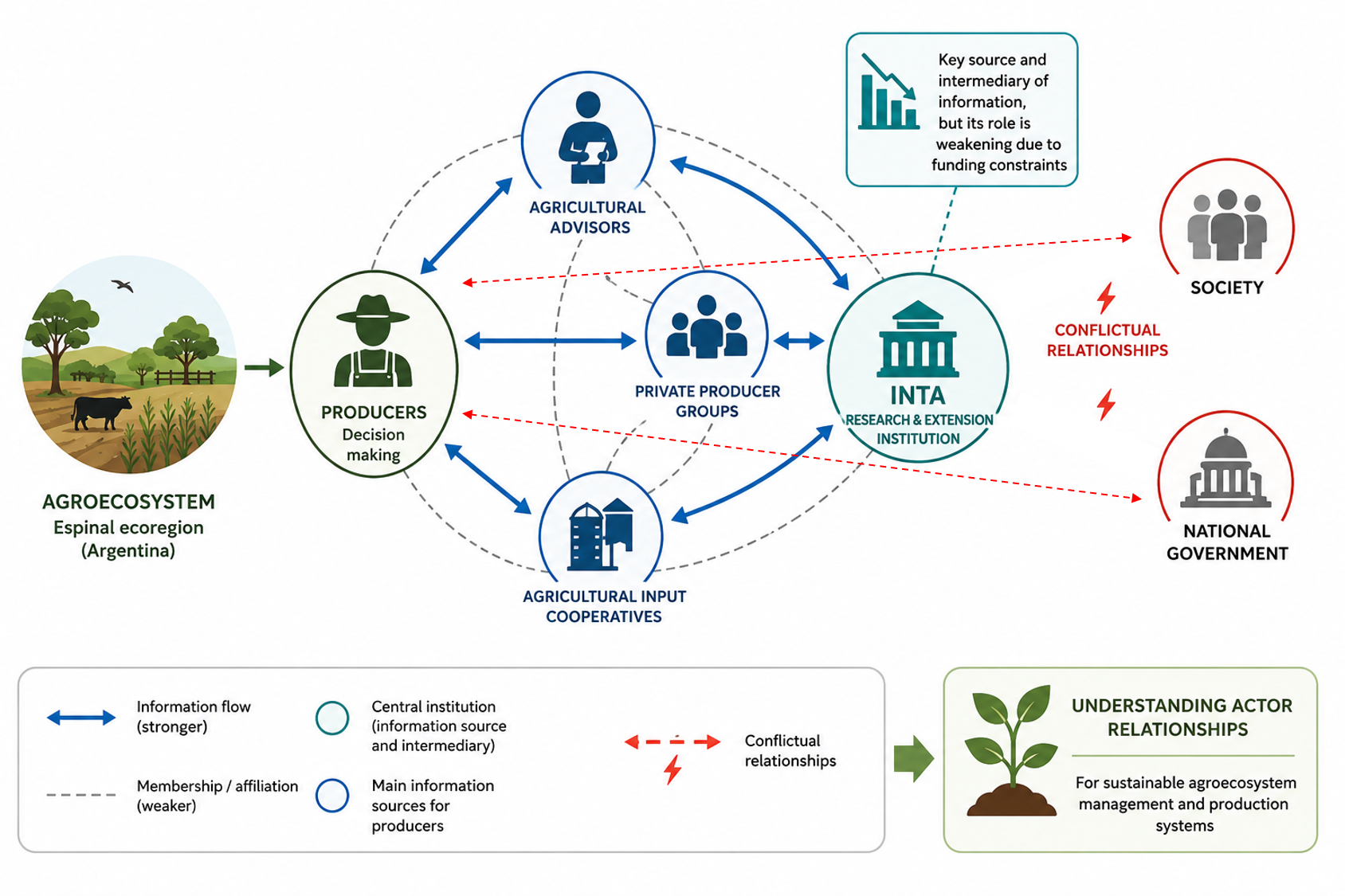
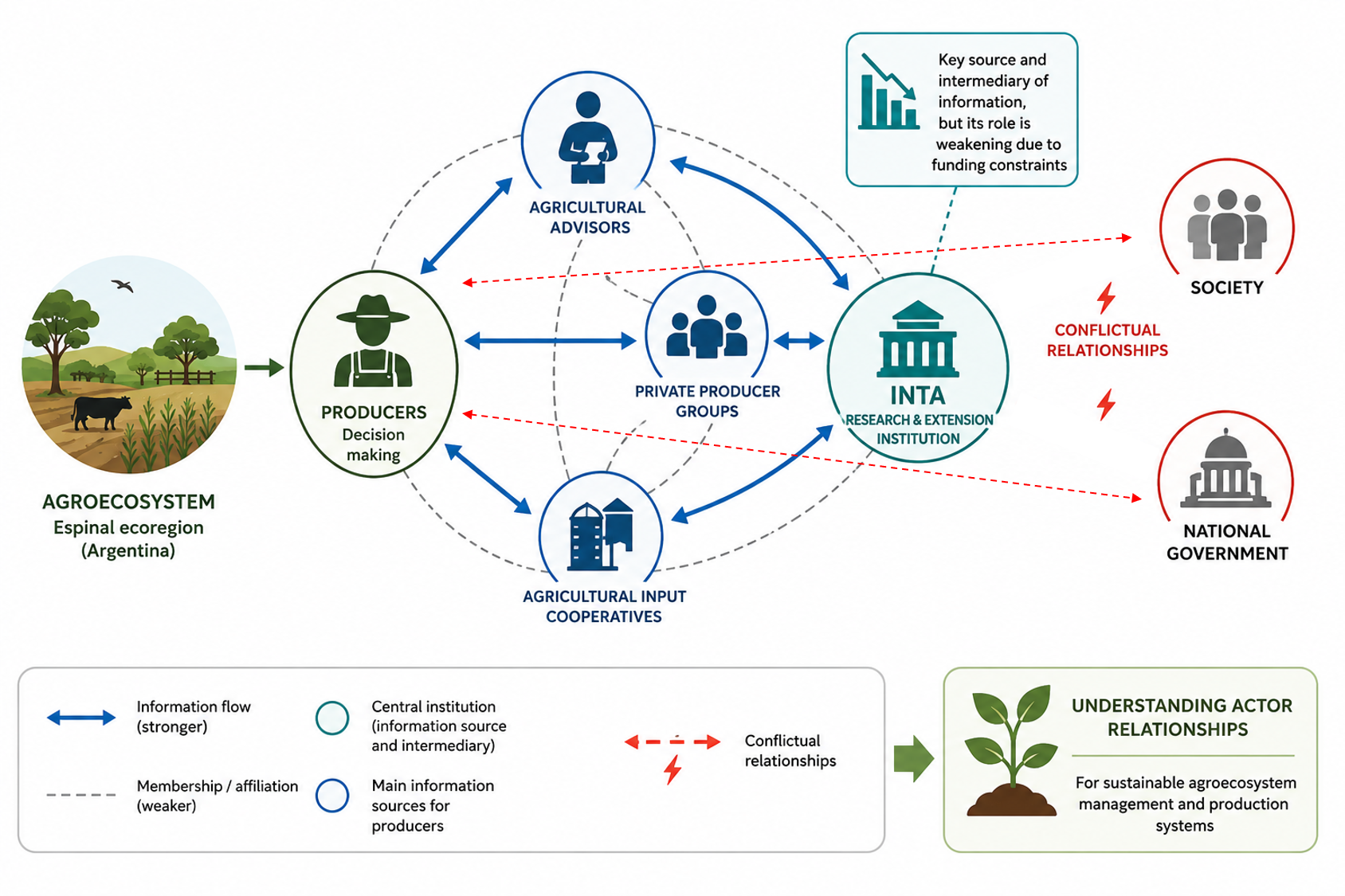
The sustainability of agroecosystems constitutes a global challenge that requires integration of ecological and social dimensions. This study identifies key actors, their interests, influence on decision-making, and their relationships. We chose a representative area of the Espinal ecoregion (Argentina) as a case study. We conducted in-depth and semi-structured interviews with producers, agricultural advisors, and other stakeholders. Membership and information-flow networks were analysed and complemented with an actor map to characterise interest, influence, and relationships. The results indicated that producers based their decisions on information from agricultural advisors, private producer groups, and agricultural input cooperatives. The information network was more integrated than the membership network, and central institutions structured the communities. Private organisations predominated in these central positions. A public research and extension institution (INTA) stood out for its central position as a source and intermediary in the information flow; however, this role is weakening due to funding constraints. Producers reported conflictual relationships with society and the national government, mainly driven by environmental and economic tensions. These findings highlight the importance of understanding stakeholder relationships for agroecosystem management and sustainable production systems.
Highlights:
- Social network analysis was combined with actor mapping to assess stakeholder influence.
- Membership and information networks revealed different patterns of actor connectivity.
- Agricultural advisors strongly influenced production decisions across producer groups.
- Private organisations dominated central positions in agroecosystem networks.
- INTA served as a critical bridge for information exchange despite declining capacity.
Downloads
References
Aizen, M. A., Garibaldi, L. A., & Dondo, M. (2009). Expansión de la soja y diversidad de la agricultura argentina. Ecología Austral, 19(1), 45-54. https://ojs.ecologiaaustral.com.ar/index.php/Ecologia_Austral/article/view/1367
Albornoz, M. (2015). Cambio tecnológico y cultura institucional: el caso del INTA. Revista Iberoamericana de Ciencia, Tecnología y Sociedad, 10(29), 41-64. DOI:10.52712/issn.1850-0013-515
Allen, W. J., Bufford, J. L., Barnes, A. D., Barratt, B. I. P., Deslippe, J. R., Dickie, I. A., Goldson, S. L., Howlett, B. G., Hulme, P. E., Lavorel, S., O’Brien, S. A., Waller, L. P., & Tylianakis, J. M. (2022). A network perspective for sustainable agroecosystems. Trends in Plant Science, 27(8), 769-780. https://doi.org/10.1016/j.tplants.2022.04.002
Arboleya, J., & Restaino, E. (2004). Agricultural extension models in South America: A description of systems in use in Argentina, Brazil, Paraguay, and Uruguay. HortTechnology, 14(1), 14. DOI:10.21273/HORTTECH.14.1.0014
Argentina. Poder Legislativo Nacional. (2007). Ley N.° 26.331. Presupuestos Mínimos de Protección Ambiental de los Bosques Nativos. 26 de diciembre de 2007. Boletín Oficial de la República Argentina. https://servicios.infoleg.gob.ar/infolegInternet/anexos/135000-139999/136125/norma.htm
Baird, J., Jollineau, M., Plummer, R., & Valenti, J. (2016). Exploring agricultural advice networks, beneficial management practices and water quality on the landscape: A geospatial social-ecological systems analysis. Land use policy, 51, 236-243. DOI:10.1016/j.landusepol.2015.11.017
Bertram, N., & Chiacchiera, S. (2013). Ascenso de napas en la Región Pampeana: ¿Consecuencia de los cambios en el uso de la tierra. Informe Técnico. INTA. https://www.produccion-animal.com.ar/agua_bebida/193-inta_napas_mjz_13.pdf
Bodin, Ö., & Tengö, M. (2012). Disentangling intangible social-ecological systems. Global Environmental Change, 22(2), 430-439. DOI:10.1016/j.gloenvcha.2012.01.005
Burkart, R., Bárbaro, N. O., Sánchez, R. O., & Gómez, D. A. (1999). Eco-regiones de la Argentina. Banco Interamericano de Desarrollo. Componente Educación Ambiental del PRODIA. 41 p.
Cabido, D., Cabido, M., Garré, S. M., Gorgas, J. A., Miatello, R., Rambaldi, S., Ravelo, A., & Tassile, J. L. (2003). Regiones naturales de la provincia de Córdoba. Agencia Córdoba D.A.C.yT. Dirección de Ambiente.
Cabrera, A. L. (1976). Regiones fitogeográficas argentinas. En W. F. Kugler (ed.). Enciclopedia Argentina de Agricultura y Jardinería. 2.ª edición. Tomo 2, 1-85. Acme.
Chaudhuri, S., Roy, M., McDonald, L. M., & Emendack, Y. (2021). Reflections on farmers’ social networks: a means for sustainable agricultural development? Environment, Development and Sustainability, 23(3), 2973-3008. DOI:10.1007/s10668-020-00762-6
Córdoba. Poder Legislativo. (2017). Ley N.° 10467. Plan Provincial Agroforestal. 16 de agosto de 2017. Boletín Oficial de la Provincia de Córdoba. https://boletinoficial.cba.gov.ar/wp-content/4p96humuzp/2017/09/1_Secc_13092017.pdf
FAO (Food and Agriculture Organization of the United Nations). (2021). The State of Food and Agriculture 2021: Making agrifood systems more resilient to shocks and stresses. FAO. https://openknowledge.fao.org/server/api/core/bitstreams/1e61f82a-618c-467a-a37f-545580094a1d/content
Gavier-Pizarro, G. I., Calamari, N. C., Thompson, J. J., Canavelli, S. B., Solari, L. M., Decarre, J., Goijman, A. P., Suarez, O. R., Murriello, S. O., & Zaccagnini, M. E. (2012). Expansion and intensification of row crop agriculture in the Pampas and Espinal of Argentina can reduce ecosystem service provision by changing avian density. Agriculture, Ecosystems & Environment, 154, 44-55. https://doi.org/10.1016/j.agee.2011.08.013.
Gras, C., & Hernández, V. (2008). Modelo productivo y actores sociales en el agro argentino. Revista Mexicana de Sociología, 70(2), 227-259. https://www.redalyc.org/pdf/321/32112521001.pdf
Gras, C., & Hernández, V. (2016). Hegemonía, innovación tecnológica e identidades empresariales: 50 años de revoluciones agrícolas en Argentina. Universidad Autónoma de Zacatecas. Estudios Críticos del Desarrollo, VI(11), 107-128.
Gras, C., & Hernández, V. (2019). Radiografía del nuevo campo argentino: del terrateniente al empresario transnacional. Siglo XXI Editores. 154, 44-55.
Houspanossian, J., Giménez, R., Whitworth-Hulse, J. I., Nosetto, M. D., Tych, W., Atkinson, P. M., Rufino, M. C., & Jobbágy, E. G. (2023). Agricultural expansion raises groundwater and increases flooding in the South American plains. Science, 380(6652), 1344-1348. https://doi.org/10.1126/science.add5462
INDEC (Instituto Nacional de Estadística y Censos de la República Argentina). (2021). Censo Nacional Agropecuario 2018. Resultados definitivos. https://www.indec.gob.ar/ftp/cuadros/economia/cna2018_resultados_definitivos.pdf
INTA Centro Regional Córdoba; Secretaría de Agricultura-Ministerio de Agricultura y Ganadería; IDECOR-Ministerio de Finanzas. (2020). Mapa de Cartas de Suelos de la Provincia de Córdoba. Informe Técnico.
Isaac, M. E., Erickson, B., Quashie-Sam, S., & Timmer, V. (2007). Transfer of knowledge on agroforestry management practices: the structure of farmer advice networks. Ecology and Society, 12(2): 32. http://www.ecologyandsociety.org/vol12/iss2/art32/
Isaac, M. E. (2012). Agricultural information exchange and organizational ties: The effect of network topology on managing agrodiversity. Agricultural systems, 109, 9-15. DOI:10.1016/j.agsy.2012.01.011
Knoot, T. G., & Rickenbach, M. (2011). Best management practices and timber harvesting: the role of social networks in shaping landowner decisions. Scandinavian Journal of Forest Research, 26(2), 171-182. DOI:10.1080/02827581.2010.545827
Lescourret, F., Magda, D., Richard, G., Adam-Blondon, A. F., Bardy, M., Baudry, J., Doussan, I., Dumont, B., Lefèvre, F., Litrico, I., Martin-Clouaire, R., Montuelle, B., Pellerin, S., Plantegenest, M., Tancoigne, E., Thomas, A., Guyomard, H., & Soussana, J. F. (2015). A social-ecological approach to managing multiple agro-ecosystem services. Current Opinion in Environmental Sustainability, 14, 68-75. https://doi.org/10.1016/j.cosust.2015.04.001
Lewis, J. P., Prado, D. E., & Barberis, I. M. (2006). La situación ambiental argentina 2005. En: Vida Silvestre Argentina (Eds.), Los remanentes de bosques del Espinal en la provincia de Córdoba (pp. 254-260).
Maldonado, M., & Bustamante, G. I. (2019). Una tipología de los actores sociales en el agro pampeano del sur cordobés, Argentina. Cuadernos Geográficos, 58(3), 234-258. DOI: 10.30827/cuadgeo.v58i3.8769
Merlinsky, M. G. (2020). The productivity of environmental conflicts and their contribution to social innovation. Agrociencia, 24(spe). DOI: 10.31285/AGRO.24.358
Pahl-Wostl, C., Mostert, E., & Tàbara, D. (2008). The growing importance of social learning in wáter resources management and sustainability science. Ecology and society, 13(1). http://www.ecologyandsociety.org/vol13/iss1/art24/
Potapov, P., Turubanova, S., Hansen, M. C., Tyukavina, A., Zalles, V., Khan, A., Song, X. P., Pickens, A., Shen, Q., & Cortez, J. (2022). Global maps of cropland extent and change show accelerated cropland expansion in the twenty-first century. Nature food, 3(1), 19-28. https://doi.org/10.1038/s43016-021-00429-z
Power, A. (2010). Ecosystem services and agriculture: tradeoffs and synergies. Philos Trans R Soc Lond B Biol Sci, 365(1554), 2959-2971. DOI: 10.1098/rstb.2010.0143
Prell, C., Hubacek, K., & Reed, M. (2009). Stakeholder analysis and social network analysis in natural resource management. Society and natural resources, 22(6), 501-518. DOI:10.1080/08941920802199202
R Core Team (2024). R: A Language and Environment for Statistical Computing. R Foundation for Statistical Computing, Viena, Austria. https://www.R-project.org/
Reed, M. S., Graves, A., Dandy, N., Posthumus, H., Hubacek, K., Morris, J., Prell, C., Quinn, C. H., & Stringer, L. C. (2009). Who’s in and why? A typology of stakeholder analysis methods for natural resource management. Journal of environmental management, 90(5), 1933-1949. https://doi.org/10.1016/j.jenvman.2009.01.001
Swanson, B. E. (2008). Global review of good agricultural extension and advisory service practices. FAO. 82 p.
Tapella, E. (2023). El mapeo de actores claves: una herramienta al servicio de la evaluación participativa. Programa de Estudios del Trabajo, el Ambiente y la Sociedad (PETAS), San Juan, Argentina. https://evalparticipativa.net/wp-content/uploads/2023/06/MAPEODE-ACTORES-CLAVES-E.TAPELLA-EVALPARTICIPATIVApdf.pdf
Tedesco, A. M., López-Cubillos, S., Chazdon, R., Rhodes, J. R., Archibald, C. L., Pérez-Hämmerle, K. V., Brancalion, P. H., Wilson, K., Oliveira, M., Correa, D., Ota, L., Morrison, T., Possingham, H., Mills, M., Santos, F., & Dean, A. (2023). Beyond ecology: ecosystem restoration as a process for social-ecological transformation. Trends in Ecology & Evolution, 38(7), 643-653. DOI: 10.1016/j.tree.2023.02.007
van der Ploeg, J. D., van Broekhuizen, R. E., Brunori, G., Sonnino, R., Knickel, K., Tisenkopfs, T., & Oostindië, H. A. (2008). Towards a Framework for Understanding Regional Rural Development. In J. D. van der Ploeg, & T. Marsden (Eds.), Unfolding Webs - The Dynamics of Regional Rural Development (p. 1-28). Van Gorcum. https://edepot.wur.nl/368782
Villarruel-Parma, M., Zamudio, F., & Kowaljow, E. (2024). ¿Qué se valora del bosque nativo y cómo se pueden restaurar los agroecosistemas? Percepciones y preferencias de productores agrícola-ganaderos del Espinal, al sureste de Córdoba. Ecología Austral, 34(2), 256-271. DOI: 10.25260/EA.24.34.2.0.2322
Published
How to Cite
Issue
Section
License

This work is licensed under a Creative Commons Attribution-NonCommercial-ShareAlike 3.0 Unported License.
Authors who publish with this journal accept the Editorial Policies.
 RevFCAUNCuyo






.jpg)