
Compensatory Growth in Pinus ponderosa (Dougl Ex Laws) Plantations Under Early Silvicultural Treatments
DOI:
https://doi.org/10.48162/rev.39.169Palabras clave:
crecimiento compensatorio, arquitectura hidráulica, respuesta adaptativaResumen
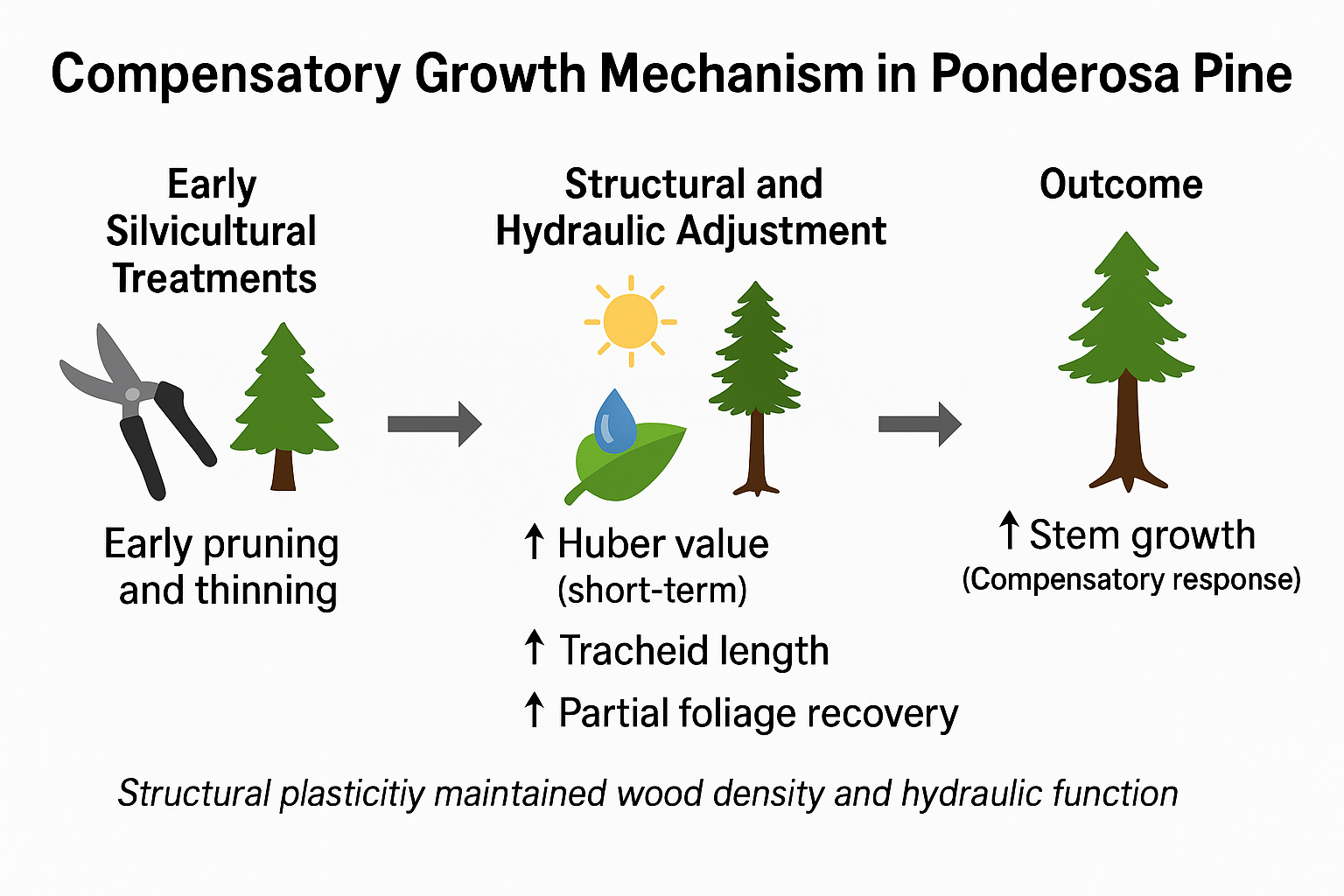
Early pruning and thinning in Pinus ponderosa, plantations in Andean Patagonia triggered compensatory growth, characterized by greater trunk growth and structural adjustments. We used a factorial design and mixed-effects models to evaluate stem growth, crown light dynamics, tracheid length (TL), foliar biomass (FB), wood density (WD), and Huber values (Hv) five years after treatment. Trees under combined pruning and thinning (PT) showed the greatest basal area increment, indicating resource reallocation to supportive structures despite early foliage loss. Pruned trees maintained higher Hv and achieved partial recovery of FB. Tracheid elongation was greatest in treated trees, suggesting accelerated xylem maturation, while WD remained unchanged. These results demonstrate the structural plasticity of P. ponderosa, which maintains hydraulic function and growth after canopy disturbance. Our findings provide useful guidance for silvicultural planning in temperate plantations.
Highlights:
- Early pruning and thinning triggered compensatory stem growth through hydraulic and structural adjustments, guiding adaptive management in Andean Pinus ponderosa plantations.
- The Huber value (Hv) captured the balance between conductive tissue and leaf biomass, revealing hydraulic rebalancing after canopy modification in young plantations.
- Tracheid elongation indicated accelerated xylem maturation in treated trees without affecting wood density.
- Findings highlight the potential of early canopy interventions to enhance productivity and hydraulic resilience in managed temperate conifer plantations.
Descargas
Citas
Andenmatten, E.; Letourneau, F. J. 1997. Funciones de intercepción de crecimiento para predicción de índice de sitio en pino ponderosa, de aplicación en la Región Andino Patagónica de Río Negro y Chubut. Revista Quebracho. 5: 5-9.
Bates, D.; Mächler, M.; Bolker, B.; Walker, S. 2015. Fitting Linear Mixed-Effects Models Using lme4. Journal of Statistical Software. 67(1): 1-48. https://doi.org/10.18637/jss.v067.i01
Chapra, S. C.; Canale, R. P. 2015. Numerical Methods for Engineers, 7th ed. McGraw- Hill Education. https://archive.org/details/numerical-methods-for-engineers-7th-edit/mode/2up
Demidenko, E. 2013. Mixed models: Theory and applications with R (2nd ed.). John Wiley & Sons. (Wiley Series in Probability and Statistics). p 717.
Fernández, M. E.; Fernández Tschieder, E.; Letourneau, F. J.; Gyenge, J. E. 2011. Why do Pinus species have different growth dominance patterns than Eucalyptus species? A hypothesis based on differential physiological plasticity. Forest Ecology and Management. 261(6): 1061-1068. https://doi.org/10.1016/j.foreco.2010.12.028
Franklin, G. L. 1937. Permanent preparations of macerated wood fibres. Tropical Woods. 49: 21-22.
Garber, S. M.; Monserud, R. A.; Maguire, D. A. 2008. Crown recession patterns in three conifer species of the Northern Rocky Mountains. Forest Science. 54(6): 633-646. https://doi. org/10.1093/forestscience/54.6.633
Gregoire, T. G. 1984. The jackknife: A resampling technique with application to linear models. Canadian Journal of Forest Research. 14(3): 483-487. https://doi.org/10.1139/x84-092
Gyenge, J.; Fernández, M. E.; Schlichter, T. 2009. Effect of pruning on branch production and water relations in widely spaced ponderosa pines. Agroforest Syst. 77: 223-235. https://doi. org/10.1007/s10457-008-9183-9
Gyenge, J. E.; Fernández, M. E.; Schlichter, T. M. 2010. Effect of stand density and pruning on growth of ponderosa pines in NW Patagonia, Argentina. Agroforestry Systems. 78(3): 233-241. https://doi.org/10.1007/s10457-009-9240-z
Gyenge, J.; Fernández, M. E.; Varela, S. A. 2012. Short-and long-term responses to seasonal drought in ponderosa pines growing at different plantation densities in Patagonia, South America. Trees. 26(6): 1905-1917. https://doi.org/10.1007/s00468-012-0759-7
IAWA Committee. 2004. IAWA list of microscopic features for softwood identification. IAWA Journal. 25(1): 1-70. https://doi.org/10.1163/22941932-90000349
Lachenbruch, B.; McCulloh, K. A. 2014. Traits, properties, and performance: how woody plants combine hydraulic and mechanical functions in a cell, tissue, or whole plant. New Phytologist. 204(4): 747-764. https://doi.org/10.1111/nph.13035
Långström, B.; Hellqvist, C. 1991. Effects of different pruning regimes on growth and sapwood area of Scots pine. Forest Ecology and Management. 44: 239-254. https://doi.org/10.1016/0378- 1127(91)90011-J
Ledermann, T. 2011. A non-linear model to predict crown recession of Norway spruce (Picea abies [L.] Karst.) in Austria. Eur J Forest Res. 130: 521-531.
Lenth, R. V. 2024. Emmeans: Estimated Marginal Means, aka Least-Squares Means. R package version.
Letourneau, F. J.; Medina, A. A.; Pampiglioni, A.; Ancalao, M.; Saihueque, M.; González, A. 2016. Efecto de tratamientos silvícolas sobre la maduración de la madera de una plantación de Pino ponderosa. V Jornadas Forestales Patagónicas.
Li, C.; Barclay, H.; Roitberg, B.; Lalonde, R. 2021. Ecology and Prediction of Compensatory Growth: From Theory to Application in Forestry. Frontiers in Plant Science. 12. https://doi. org/10.3389/fpls.2021.655417
Macêdo Araújo da Silva, D.; Pereira da Silva Santos, N.; de Sousa Araújo Santos, E. E.; Alves Pereira, G.; Barbosa da Silva Júnior, G.; Gomes da Cunha, J. 2022. Effects of formative and production pruning on fig growth, phenology, and production. Revista de la Facultad de Ciencias Agrarias. Universidad Nacional de Cuyo. Mendoza. Argentia. 54(1): 13-24. DOI: https://doi.org/10.48162/rev.39.061
Martínez-Meier, A.; Fernández, M. E.; Dalla-Salda, G.; Gyenge, J.; Licata, J.; Rozenberg, P. 2015. Ecophysiological basis of wood formation in ponderosa pine: Linking water flux patterns with wood microdensity variables. Forest Ecology and Management. 346: 31-40. https:// doi.org/10.1016/j.foreco.2015.02.021
Maschinski, J.; Whitham, T. G. 1989. The continuum of plant responses to herbivory: The influence of plant association, nutrient availability, and timing. The American Naturalist. 134(1): 1-19. https://doi.org/10.1086/284962
McNaughton, S. J. 1983. Compensatory plant growth as a response to herbivory. Oikos. 40(3): 329-336. https://doi.org/10.2307/3544305
Mencuccini, M.; Rosas, T.; Rowland, L.; Choat, B.; Cornelissen, H.; Jansen, S.; Kramer, K.; Lapenis, A.; Manzoni, S.; Niinemets, Ü.; Reich, P. B.; Schrodt, F.; Soudzilovskaia, N.; Wright, I. J.; Martínez-Vilalta, J. 2019. Leaf economics and plant hydraulics drive leaf: wood area ratios. New Phytologist. 224(4): 1544-1556. https://doi.org/10.1111/nph.15998
Ministerio de Agroindustria. Unidad Para El Cambio Rural-CIEFAP. 2017. Inventario de Plantaciones Forestales en Secano. Región Patagonia. p. 136.
Muñiz, G.; Coradin, V. 1991. Norma de procedimientos em estudios de anatomía de madeira. II Gimnospermae. Brasília: Laboratorio de Produtos Florestais. Serie Técnica. 117 p.
Nakagawa, S.; Schielzeth, H. 2013. A general and simple method for obtaining R² from generalized linear mixed-effects models. Methods in Ecology and Evolution. 4(2): 133-142. https:// doi.org/10.1111/j.2041-210X.2012.00261.x
Piraino, S.; Roig, F. A. 2024. Landform heterogeneity drives multi-stemmed Neltuma flexuosa growth dynamics. Implication for the Central Monte Desert forest management. Revista de la Facultad de Ciencias Agrarias. Universidad Nacional de Cuyo. Mendoza. Argentina. 56(1): 26-34. DOI: https://doi.org/10.48162/rev.39.120
R Core Team. 2021. R: A language and environment for statistical computing. R Foundation for Statistical Computing.
Smith, D. M. 1954. Maximum moisture content method for determining specific gravity of small wood samples. Report N° 2014. USDA Forest Service. Forest Products Laboratory.
Sperry, J. S.; Hacke, U. G.; Pittermann, J. 2006. Size and function in conifer tracheids and angiosperm vessels. American Journal of Botany. 93(10): 1490-1500. https://doi.org/10.3732/ ajb.93.10.1490
Wang, Y.; Liu, Z.; Li, J.; Cao, X.; Lv, Y. 2024. Assessing the Relationship between Tree Growth, Crown Size, and Neighboring Tree Species Diversity in Mixed Coniferous and Broad Forests Using Crown Size Competition Indices. Forests. 15(633): 1-17. https://doi.org/10.3390/ f15040633
Zeng B. 2003. Aboveground biomass partitioning and leaf development of Chinese subtropical trees following pruning. Forest Ecology and Management 173: 135-144. https://doi. org/10.1016/S0378-1127(01)00821-0
Zhu, Z.; Kleinn, C.; Nölke, N. 2021. Assessing tree crown volume-a review. Forestry: An International Journal of Forest Research. 94(1): 18-35. https://doi.org/10.1093/forestry/cpaa037
Zingoni, M. I.; Andia, I.; Mele, U. 2007. Longitud de traqueidas y madera juvenil en el fuste de un árbol de pino ponderosa de 50 años-SO Neuquén. III Congreso Iberoamericano de Productos Forestales IBEROMADERA 2007.
Zuur, A. F.; Ieno, E. N.; Walker, N. J.; Saveliev, A. A.; Smith, G. M. 2009. Mixed effects models and extensions in ecology with R. Springer Science & Business Media. https://doi. org/10.1007/978-0-387-87458-6

Descargas
Publicado
Cómo citar
Número
Sección
Licencia

Esta obra está bajo una licencia internacional Creative Commons Reconocimiento-NoComercial-CompartirIgual 3.0.
Aquellos autores/as que tengan publicaciones con esta revista, aceptan las Políticas Editoriales.
 RevFCAUNCuyo






.jpg)