
Analysis of Grain-Anthocyanins in a Population of Maize Zea mays L. “Elotes Occidentales” Selected to Stabilize Color and Increase Anthocyanin Content
DOI:
https://doi.org/10.48162/rev.39.222Keywords:
Zea mays L., recurrent selection, pigments, quality, pozoleAbstract
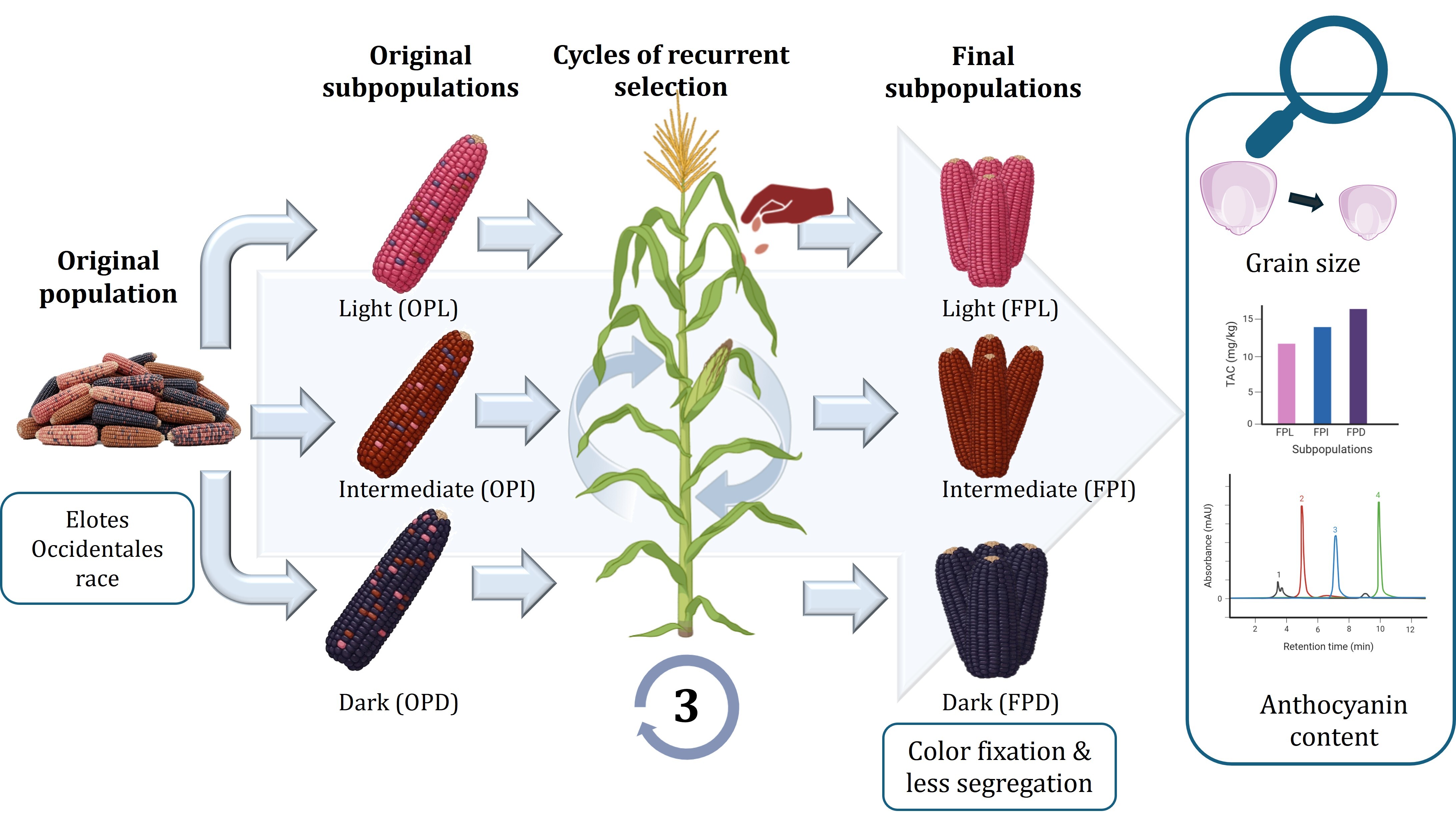
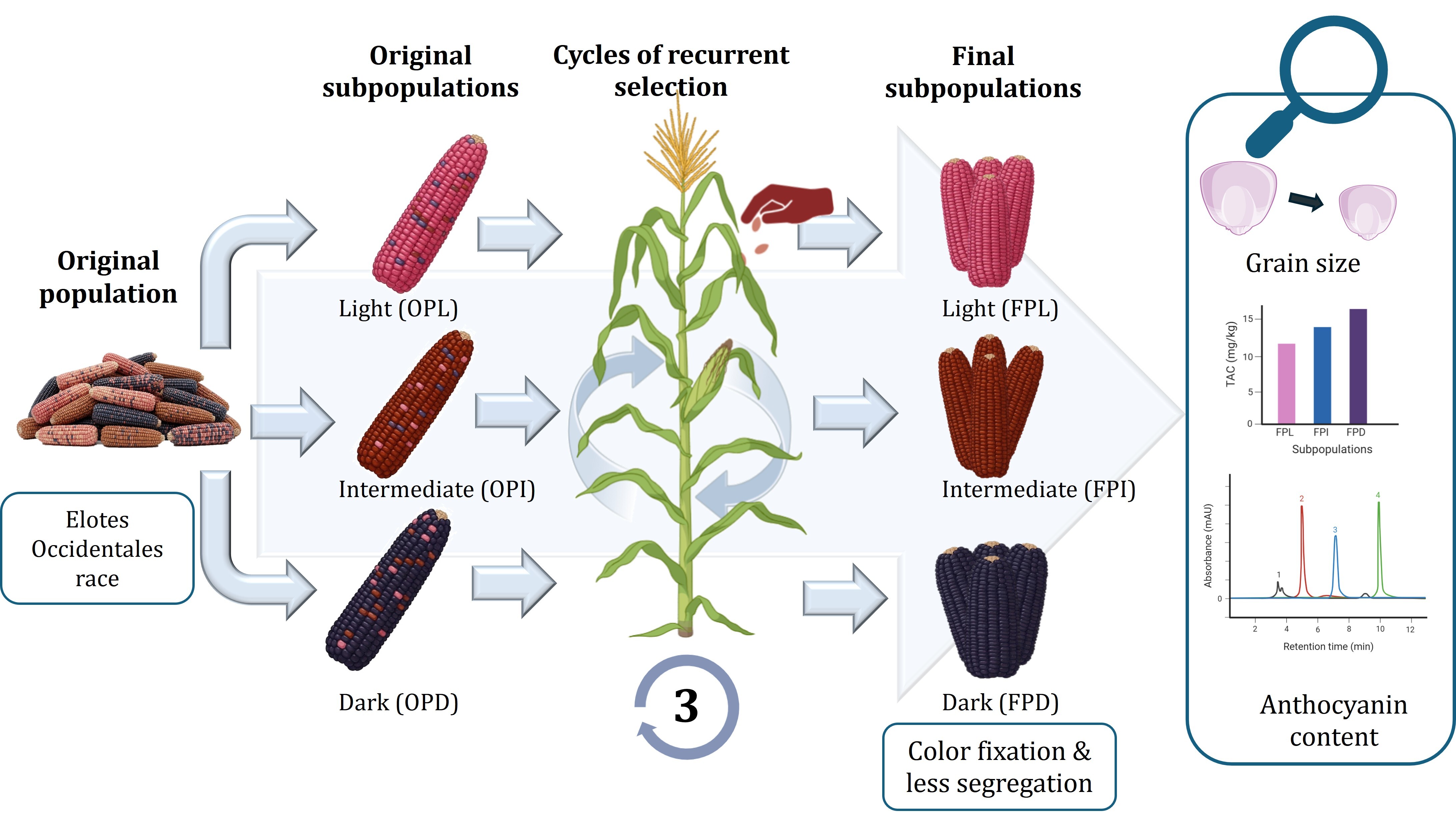
This study analyzed grain anthocyanin contents of an Elotes Occidentales (EO) maize population subjected to recurrent selection to stabilize grain color and increase anthocyanin content. The original EO population was derived from native varieties collected in Jalisco, Mexico. This original (O) population contributed three subpopulations selected for grain color: a) light (OPL), b) intermediate (OPI), and c) dark (OPD). Recurrent selection cycles of S3 lines within each subpopulation allowed selecting grain color in each selfing generation. Grains of the synthetic populations of each grain color, (FPL, FPI, and FPD) were analyzed for color, size, total anthocyanin content (TAC), and pigment profile. After one cycle of recurrent selection, grains of OPL were lighter, while OPD hue changed from orange-yellow to purple-red. Grain size decreased in all subpopulations, whereas TAC was not significantly affected. The anthocyanin profile was modified for relative proportions of some pigments. Selection cycles stabilized grain color in the subpopulations, decreased grain size, and did not affect anthocyanin content.
Highlights:
- Recurrent selection stabilized grain color in Elotes Occidentales maize subpopulation.
- Total Anthocyanin content was not significantly affected by selection cycle.
- Grain size decreased in all final subpopulations.
- Grain color segregation decreased after one cycle of recurrent selection.
Downloads
References
Badu-Apraku, B.; Oyekunle, M.; Menkir, A.; Obeng-Antwi, K.; Yallou, C. G.; Usman, I. S.; Alidu, H. 2013. Comparative performance of early maturing maize cultivars developed in three eras under drought stress and well-watered environments in West Africa. Crop Sci. 53: 1298-1311. 10.2135/cropsci2012.11.0640
Barrientos-Ramírez, L.; Ramírez-Salcedo, H. E.; Fernández-Aulis, M. F.; Ruíz-López, M. A.; Navarro-Ocaña, A.; Vargas-Radillo, J. J. 2018. Anthocyanins from rose maize (Zea mays L.) grains. Interciencia. 43(3): 188-192.
Bonifacio, V. E. I.; Salinas-Moreno, Y.; Ramos-Rodríguez, A.; Carrillo-Ocampo, A. 2005. Calidad pozolera en colectas de maíz cacahuacintle. Revista Fitotecnia Mexicana. 28(3): 253-260.
Chatham, L. A.; Juvik, J. A. 2021. Linking anthocyanin diversity, hue, and genetics in purple corn. G3 Genes|Genomes|Genetics. 11(2):1-18. https://doi.org/10.1093/g3journal/jkaa062
Cone, K. C. 2007. Anthocyanin synthesis in maize aleurone tissue. In Endosperm: Developmental and Molecular Biology. Berlin. Springer Berlin Heidelberg. 121-139.
Cruz, G. A. 2017. Composición fenólica de accesiones de maíz (Zea mays L.) con grano rojo cereza y rojo ladrillo de razas mexicanas. Tesis de grado de licenciatura. Departamento de Ingeniería Agroindustrial. Universidad Autónoma Chapingo. México. 83 p.
de Pascual‐Teresa, S.; Santos‐Buelga, C.; Rivas‐Gonzalo, J. C. 2002. LC-MS analysis of anthocyanins from purple corn cob. Journal of the Science of Food Agriculture. 82(9): 1003-1006.
Fossen, T.; Slimestad, R.; Andersen, Ø.M. 2001. Anthocyanins from Maize (Zea mays) and Reed Canarygrass (Phalaris arundinacea). Journal of Agricultural and Food Chemistry. 49: 2318-2321. doi:10.1021/jf001399d.
García-Cruz, L.; Vázquez-Carrillo, M. G.; Preciado-Ortiz, R. E. 2023. Flowered grain quality and phytochemical content of non-conventional maize hybrids from the Mexican Subtropics across three growing cycles. Plants. 12(14): 2691. https://doi.org/doi.org/10.3390/plants12142691
Gonzalez-Manzano, S.; Perez-Alonso, J. J.; Salinas-Moreno, Y.; Mateus, N.; Silva, A. M.; de Freitas, V.; Santos-Buelga, C. 2008. Flavanol–anthocyanin pigments in corn: NMR characterisation and presence in different purple corn varieties. Journal of Food Composition Analysis. 21(7): 521-526. https://doi.org/doi.org/10.1016/j.jfca.2008.05.009
Hallauer, A. R., 1992. Recurrent selection in maize. Plant breed rev. Wiley. 9: 115-179.
Hallauer, A. L.; Carena, M. J. 2012. Recurrent selection methods to improve germplasm in maize. Maydica. 57(4): 266-283.
Harborne, J. B.; Grayer, R. J. 1988. The anthocyanins. In J. B. Harborne (Ed.), The Flavonoids: Advances in Research since 1980. Boston. MA. Springer US. 1-20.
Hong, H. T.; Netzel, M. E.; O’Hare, T. J. 2020. Optimisation of extraction procedure and development of LC-DAD-MS methodology for anthocyanin analysis in anthocyanin-pigmented corn kernels. Food Chemistry. 319: 126515. https://doi.org/https://doi.org/10.1016/j.foodchem.2020.126515
Hu, K.; Han, K.; Silan, D. 2010. Regulation of Plant Anthocyanin Synthesis and Pigmentation by Environmental Factors. Chinese Bulletin of Botany. 45(03): 307-318.
Kato, T. Á.; Mapes, C.; Mera, L. M.; Serratos, J. A.; Bye, R. A. 2009. Origen y diversificación del maíz: una revisión analítica. Universidad Nacional Autónoma de México, Comisión Nacional para el Conocimiento y Uso de la Biodiversidad (CONABIO). México. DF. 116.
Khamkoh, W.; Ketthaisong, D.; Lomthaisong, K.; Lertrat, K.; Suriharn, B. 2019. Recurrent selection method for improvement of lutein and zeaxanthin in orange waxy corn populations. Australian Journal of Crop Science. 13(4): 566-573. https://doi.org/doi/10.3316/informit.457650111889237
Khamphasan, P.; Lomthaisong, K.; Harakotr, B.; Scott, M. P.; Lertrat, K.; Suriharn, B. 2020. Effects of Mass Selection on Husk and Cob Color in Five Purple Field Corn Populations Segregating for Purple Husks. Agriculture. 10(8): 311. https://doi.org/doi.org/10.3390/agriculture10080311
Li, T.; Zhang, W.; Yang, H.; Dong, Q.; Ren, J.; Fan, H.; Zhou, Y. 2019. Comparative transcriptome analysis reveals differentially expressed genes related to the tissue-specific accumulation of anthocyanins in pericarp and aleurone layer for maize. Scientific Reports. 9(1): 2485. https://doi.org/10.1038/s41598-018-37697-y
McGuire, R. G. 1992. Reporting of objective color measurements. HortScience. 27(12): 1254-1255.
Okporie, E.; Chukwu, S.; Onyishi, G. 2013. Phenotypic recurrent selection for increase yield and chemical constituents of maize (Zea mays L.). World Appl. Sci. J. 21(7): 994-999.
Paulsmeyer, M.; Chatham, L.; Becker, T.; West, M.; West, L.; Juvik, J. 2017. Survey of Anthocyanin Composition and Concentration in Diverse Maize Germplasms. Journal of Agricultural and Food Chemistry. 65(21): 4341-4350. https://doi.org/10.1021/acs.jafc.7b00771
Rodríguez, V. M.; Soengas, P.; Landa, A.; Ordás, A.; Revilla, P. 2013. Effects of selection for color intensity on antioxidant capacity in maize (Zea mays L.). Euphytica. 193(3): 339-345. https://doi.org/10.1007/s10681-013-0924-0
Salinas-Moreno, Y. 2000. Antocianinas en granos de maíces criollos mexicanos. Tesis de grado de doctor. Colegio de Posgraduados. Montecillo. México. 102 p.
Salinas, M. Y.; Soto-Hernández, M.; Martínez-Bustos, F.; González-Hernández, V.; Ortega-Paczka, R. 1999. Análisis de antocianinas en maíces de grano azul y rojo provenientes de cuatro razas. Revista Fitotecnia Mexicana. 22(2): 161-161. https://doi.org/doi.org/10.35196/rfm.1999.2.161
Salinas-Moreno, Y.; Sánchez, G. S.; Hernández, D. R.; Lobato, N. R. 2005. Characterization of anthocyanin extracts from maize kernels. Journal of Chromatographic Science. 43: 483-487.
Salinas-Moreno, Y.; Pérez-Alonso, J. J.; Vázquez-Carrillo, G.; Aragón-Cuevas, F.; Velázquez-Cardelas, G. A. 2012. Antocianinas y actividad antioxidante en maíces (Zea mays L.) de las razas Chalqueño, Elotes Cónicos y Bolita. Agrociencia. 46(7): 693-706.
Salinas-Moreno, Y.; Ramírez Díaz, J. L.; Alemán de la Torre, I.; Bautista-Ramírez, E.; Ledesma Miramontes, A. 2021. Evaluación de dos procedimientos de medición de color en granos de maíces pigmentados. Revista mexicana de ciencias agrícolas. 12(7): 1297-1303.
Sharma, M.; Cortes-Cruz, M.; Ahern, K. R.; McMullen, M.; Brutnell, T. P.; Chopra, S. 2011. Identification of the Pr1 Gene Product Completes the Anthocyanin Biosynthesis Pathway of Maize. Genetics. 188(1): 69-79. https://doi.org/10.1534/genetics.110.126136
Vázquez-Carrillo, M. G.; Hernández-Montes, A.; Palacios-Rojas, N.; García-Cruz, L.; Rosales-Nolasco, A.; Molina, A.; Palacios-Pola, G. 2024. Comparing traditional and commercial nixtamalization of three maize landraces: impact on pozole quality and consumer acceptance. Journal of Ethnic Foods. 11: 11. https://doi.org/10.1186/s42779-024-00227-5
Wellhausen, E. J.; Roberts, L. M.; Xolocotzi, E. H. 1951. Razas de maíz en México, su origen, características y distribución. Secretaría de Agricultura y Ganadería. México. Aldina. 5: 237 p.
Willcox, M. C.; Castillo-Gonzalez, F.; Aragón-Cuevas, F., & Castro-Garcia, F. H. 2019. Native maize in Mexico: Participatory breeding and connections to culinary markets. In Farmers and Plant Breeding. New York, NY. Routledge. 80-90.
Wu, Y.; Han, T.; Lyu, L.; Li, W.; Wu, W. 2023. Research progress in understanding the biosynthesis and regulation of plant anthocyanins. Scientia Horticulturae. 321: 112374. doi.org/10.1016/j.scienta.2023.112374
Xia, Z.; Hirsch, C. N.; Sekhon, R. S.; Leon, N. D.; Kaeppler, S. M. 2016. Evidence for maternal control of seed size in maize from phenotypic and transcriptional analysis. J. Exp. Bot. 67: 1907-1917. https://doi.org/10.1093/jxb/erw006
Žilić, S; Serpen, A.; Akıllıoğlu, G.; Gökmen, V.; Vančetović, J. 2012. Phenolic Compounds, Carotenoids, Anthocyanins, and Antioxidant Capacity of Colored Maize (Zea mays L.) Kernels. Journal of Agricultural and Food Chemistry. 60: 1224-1231. https://doi.org/10.1021/jf204367z
Published
How to Cite
Issue
Section
License

This work is licensed under a Creative Commons Attribution-NonCommercial-ShareAlike 3.0 Unported License.
Authors who publish with this journal accept the Editorial Policies.
 RevFCAUNCuyo






.jpg)