
Mortality of the Toad Grasshopper (Bufonacris claraziana Saussure) Caused by Beauveria bassiana (Balsamo) Vullemin (Hypocreales: Clavicipitaceae) by Two Inoculation Methods under Field-Cage Conditions
DOI:
https://doi.org/10.48162/rev.39.209Keywords:
field-cage experience, baits and spraying inoculations, Bufonacris claraziana , Patagonia Argentina, entomopathogenic fungusAbstract
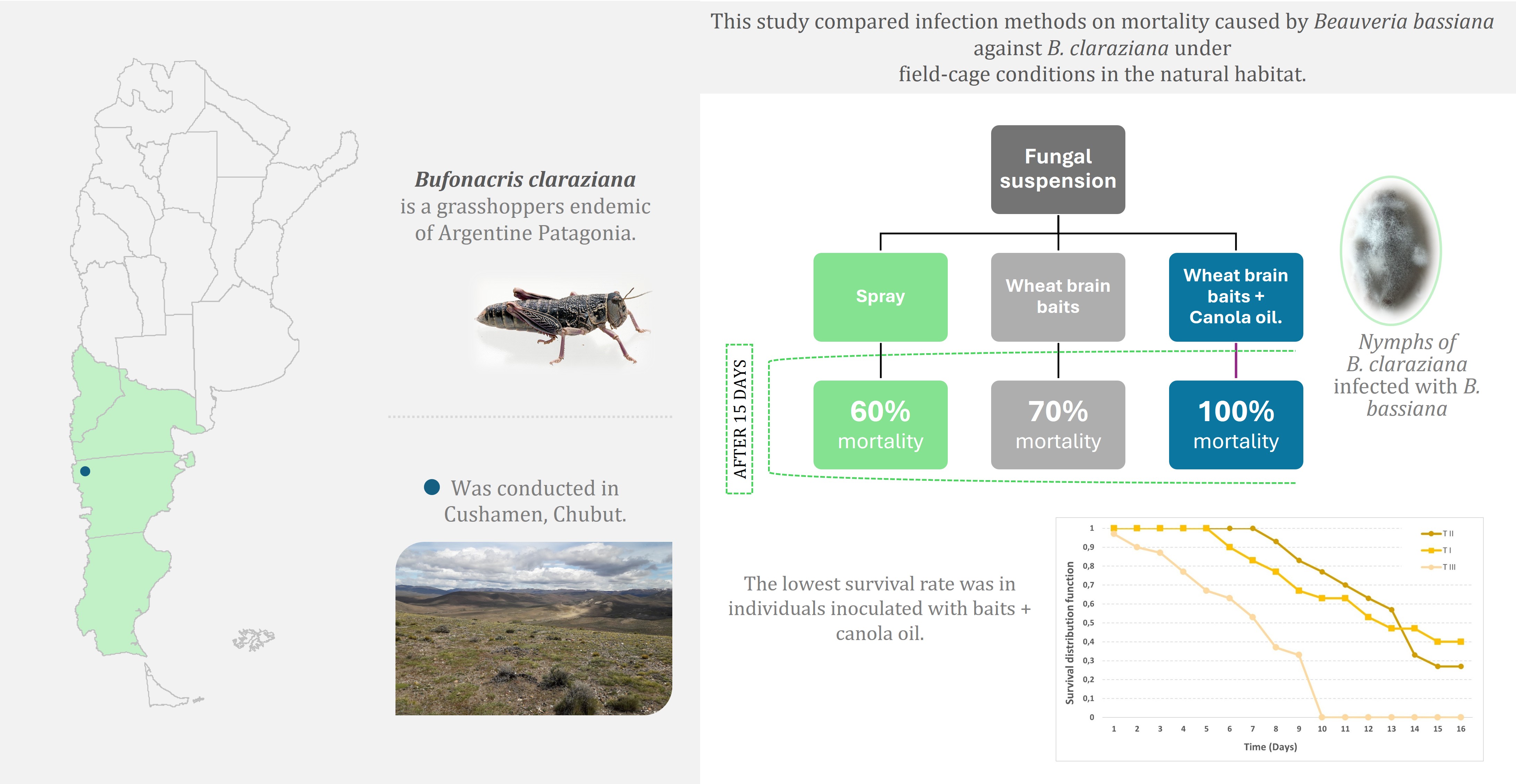
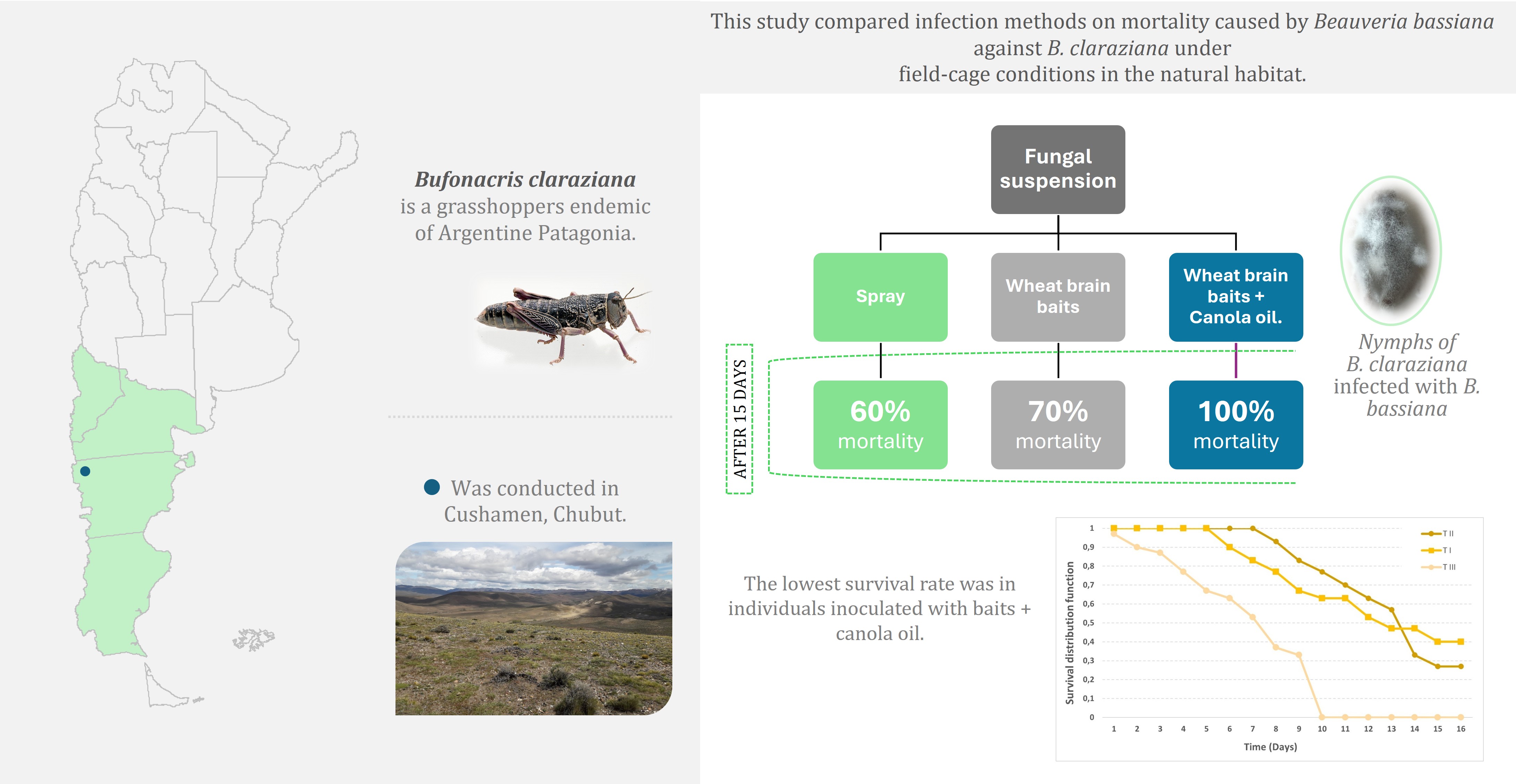
Bufonacris claraziana Saussure (Orthoptera: Tristiridae) is a pest grasshopper species in Patagonia, Argentina. Outbreaks of B. claraziana have gained frequency in recent years. This study compared three infection methods (spraying and baits) on B. claraziana mortality caused by Beauveria bassiana under field-cage conditions in the natural habitat. The study was conducted in Cushamen, a typical outbreak area in Chubut province. Three treatments were tested: Treatment I involved spraying with a fungal suspension (1×10⁸ conidia/ml), treatment II used wheat bran baits with the same suspension, and treatment III used wheat bran baits with added canola oil as a phagostimulant. Mortality rates were monitored every 24 hours for 15 days. Total mortality differed among the treatments (F: 17.58; p: 0.0007). After 15 days, mortality was 60%, 70%, and 100% for treatments I, II, and III, respectively. No mortality was observed in treatments I and II until day 5, while treatment III showed 36.7% mortality by day 5 and reached 100% by day 10. Kaplan-Meier survival curves indicated significant differences in survival among treatments, with the lowest survival in treatment III (log-rank test p<0.05). Wheat bran bait with canola oil (treatment III) was the most effective inoculation.
Highlights:
- This is the first study comparing two infection methods of Beauveria bassiana against Bufonacris claraziana under field-cage conditions.
- Total mortality reached 60%, 70%, and 100% for spray, bait, and bait + canola oil treatments, respectively.
- Survival analysis revealed significantly lower survival in the bait + canola oil treatment.
- Wheat bran baits with canola oil enhanced fungal efficacy by protecting conidia and stimulating nymph feeding, being the most effective treatment in this study.
- Results confirm B. bassiana as a promising biocontrol agent for managing B. claraziana outbreaks in Patagonia.
Downloads
References
Álvarez, M.; du Mortier, C.; Fernández Cirelli, A. 2013. Behaviour of insecticide chlorpyrifos on soils and sediments with different organic matter content from provincia de Buenos Aires, República Argentina. Water Air Soil Pollution. https://doi.org/10.1007/s11270-013- 1453-0.
Cabrera, A. L.; Willink, A. 1973. Biogeografía de América Latina. Monogr. Ser. Biol. 13.
Cabrera, A. L. 1976. Regiones fitogeográficas argentinas. In: Kugler, W. F. (Ed). Enciclopedia Argentina de Agricultura y Jardinería, II. ACME. 1-85.
Carbonell, C. S.; Cigliano, M. M.; Lange, C. E. 2024. Acridomorph (Orthoptera) species of Argentina and Uruguay. http://163.10.203.2/ACRIDOMORPH/
Ceccheto, F.; Villalba, A.; Vazquez, N. D.; Ramirez, C. L.; Maggi, M. D.; Miglioranza, K. S. B. 2023. Occurrence of chlorpyrifos and organochlorine pesticides in a native bumblebee (Bombus pauloensis) living under different land uses in the southeastern Pampas, Argentina. Science of the total Environment. https://doi.org/10.1016/j.scitotenv.2023.167117
Cigliano, M. M.; Pocco, M. E.; Lange, C. E. 2014. Acridoideos (Orthoptera) de importancia agroeconómica en la República Argentina. In: Roig Juñent, S.; Claps, L.; Morrone, J. J. (Eds). Biodiversidad de Artrópodos Argentinos. Editorial INSUE-UNT. 3: 11-36.
Cigliano, M. M.; Lange, C. E. 2019. Toad grasshopper, Bufonacris claraziana (Saussure, 1884) (Orthoptera: Tristiridae). In: Lecoq, M.; Zhang, L. (Eds). Encyclopedia of pest Orthoptera of the World. China Agricultural University Publisher. 235-238.
Dinerstein E.; Olson, D. M.; Graham, D. J.; Webster, A. L.; Primm, S. A.; Bookbinder, M. P.; Ledec, G. 1955. A conservation assessment of the terrestrial ecoregions of Latin America and the Caribbean. World Bank.
Di Rienzo, J. A.; Casanoves, F.; Ballarin, M. G.; González, L.; Tablada Robledo, C. W. 2011. Grupo InfoStat, FCA, Universidad Nacional de Córdoba. Argentina. http://www.infostat.com.ar
Goettel, M. S.; Inglis, G. D. 1997. Hyphomycetes. In: Lacey, L. (Ed). Manual of techniques in Insect Pathology, Academic Press. 213-248.
Goldstein, M. I.; Lacher, T. E.; Woodbridge, B.; Bechard, M. J.; Canavelli, S. B.; Zaccagnini, M. E.; Cobb, G. P.; Scollon, E. J.; Tribolet, R.; Hooper, M. J. 1999. Monocrotophos - Induced mass mortality of Swainson’s Hawks in Argentina. 1995-96. Ecotoxicology. (8): 201-214.
Inglis, G. D.; Enkerli, J.; Goettel, M. S. 2012. Laboratory techniques used for entomopathogenic fungi: Hypocreales. In: Lacey, L.A. (Ed). Manual of techniques in Invertebrate Pathology. Elsevier. 189-253.
Lacey, L. A.; Brooks, W. M. 1997. Initial handling and diagnosis of diseased insects. In: Lacey, L. A. (Ed). Manual of techniques in Insect Pathology. Academic. 1-15.
Lange, C. E.; Mariottini, Y.; Plischuk, S.; Cigliano, M. M. 2020. Naturalized, newly associated microsporidium continues causing epizootics and expanding its host range. Protistology. 2020: (14): 32-37. http://dx.doi.org/10.21685/1680-0826-2020-14-1-4
Latchininsky, A. V.; VanDyke, K. A. 2006. Grasshopper and locust control with Poisoned baits: a renaissance of the old strategy? Outlooks Pest Management. (17): 105-111.
Liebermann, J. 1972. The current state of the locust and grasshopper problem in Argentina. In Proceeding of the international Study Conference on Current and Future Problems of Acridiology. 191-198.
Mariottini, Y.; Pelizza, S. A.; Lange C. E. 2019. Susceptibility of Bufonacris claraziana (Orthoptera: Tristiridae) to Beauveria bassiana (Ascomycota: Hypocreales) under controlled conditions. Biocontrol Science and Technology. (29): 817-821. http://dx.doi.or g/10.1080/09583157.2019.1597335
Mariottini, Y.; Lange, C. E.; Pelizza, S. A. 2022. Laboratory test of Beauveria bassiana (Balsamo-Crivelli) Vuillemin s.l. (Hypocreales: Clavicipitaceae) baits for the biocontrol of the Toad grasshopper pest, Bufonacris claraziana (Saussure) (Orthoptera: Tristiridae). Egyptian Journal of Biological Pest Control. 32:110. https://doi.org/10.1186/s41938-022- 00609-4
Medina, H.; Massola, M. P.; Zembo, E.; Verdejo, A.; Shicappacassi, M.; Azzaro, F.; Cienfuegos, M. S.; Sánchez, M.; Armento, F.; Mariottini, Y.; Fernández Arhex, V., Bobadilla, S.; Bobadilla, W.; Binda, S.; Napoli, S.; Camiña, D. 2020. Guía de recomendaciones para el manejo y control de la tucura sapo. SENASA. https://www.argentina.gob.ar/sites/default/files/guiade_recomendaciones_para_el_monitoreo_y_control_de_tucura_sapo.pdf
Mendez Casariego, H.; Bran, D. E.; Peralta, C. R.; Madariaga, M. C.; Huerta, G. J.; Villarreal, P.; Oliva, G. E.; López Raggi, F.; Santagni, A.; Easdale, M. H.; Sarmiento, A. C.; Giraudo, C. G.; Rial, P. E.; Escobar, J. M.; Marciani, S. N.; Martinez, R. S.; Elissalde, N. O. 2005. Programa Nacional de Ecorregiones. La región Patagonia: Centros Regionales Patagonia Norte y Patagonia Sur; INTA Centro Regional Patagonia Norte. EEA Bariloche. Comunicaciones Técnicas.
Olson, D.; Dinerstein, E. 2002. The Global 200: Priority Ecoregions for Global Conservation. Annals of Missouri Botanical Garden. 89(2): 199-224.
Oyarzabal, M.; Clavijo, J. R.; Oakley, L. J.; Biganzoli, F.; Tognetti, P. M.; Barberis, I.; Maturo, H. M.; Aragón, R.; Campanello, P. I.; Prado, D.; Oesterheld, M.; León, R. J. 2018. Unidades de vegetación de la Argentina; Asociación Argentina de Ecología. Ecología Austral. 28: (1-4): 40-63. https://doi.org/10.25260/EA.18.28.1.0.399
Paruelo, J.; Aguiar, M. 2003. Impacto humano sobre los ecosistemas. El caso de la desertificación. Ciencia Hoy. 13.
Paruelo, J.; Golluscio, R.; Jobbágy, E.; Canevari, M.; Aguiar, M. 2005. Situación ambiental en la estepa patagónica. In: Brown, A.; Martinez Ortiz, U.; Acerbi, M.; Corcuera, J. (Eds). La situación ambiental argentina. Buenos Aires: Fundación Vida Silvestre Argentina. 303-313.
Pelizza, S. A.; Mariottini, Y.; Russo, M. L.; Cabello, M. N., Lange, C. E. 2013. Survival and fecundity of Dichroplus maculipennis and Ronderosia bergi (Orthoptera: Acrididae: Melanoplinae) following infection by Beauveria bassiana (Ascomycota: Hypocreales) under laboratory conditions. Biocontrol Science and Technology. (23): 701-710. https://doi.org/10.1080/0 9583157.2013.791668
Pelizza, S. A.; Mariottini, Y.; Russo, L. M.; Vianna, M. F.; Scorsetti, A. C.; Lange, C. E. 2017. Beauveria bassiana (Ascomycota: Hypocreales) introduced as an endophyte in corn plants and its effects on consumption, reproductive capacity, and food preference of Dichroplus maculipennis (Orthoptera: Acrididae: Melanoplinae). Journal of Insect Science. 17(2): 53. https://doi.org/10.1093/jisesa/iex024
Pelizza, S. A.; Mariottini, Y.; Russo, L. M.; Vianna, F. M.; Scorsetti, A. C.; Lange, C. E. 2019. Application of Beauveria bassiana using diferent baits for the control of grasshopper pest Dichroplus maculipennis under field cage conditions. Journal of King Saudi University Science. 31(4): 1111-1115. https://doi.org/10.1016/j.jksus.2019.02.014
Pelizza, S. A.; Medina, H.; Ferreri, N. A.; Elíades, L. A.; Pocco, M. E.; Stenglein, S. A.; Lange, C. E.; 2020. Virulence and enzymatic activity of three new isolates of Beauveria bassiana (Ascomycota: Hypocreales) from the South American locust Schistocerca cancellata (Orthoptera: Acrididae). Journal of King Saudi University Science. (32): 44-47. https://doi. org/10.1016/j.jksus.2017.11.006
Pérez Panti, O.; García de la Cruz, R.; González Hernández, H.; Sánchez Soto, S.; Moscoso Ramírez, P. A.; Izquierdo Reyes, F. 2024. Bio-efficacy of entomopathogenic fungi and vegetable oils against the pink pineapple mealybug: Dysmicoccus brevipes (Cockerell). Revista de la Facultad de Ciencias Agrarias. Universidad Nacional de Cuyo. Mendoza. Argentina. 56(1): 83-93. DOI: https://doi.org/10.48162/rev.39.125
Sepúlveda, L.; Pietrantuono, A. L.; Buteler, M.; Fernández-Arhex, V. 2019. Effect of Vegetable Oils as Phagostimulants in Adults of Dichroplus vittigerum (Orthoptera: Acrididae). Journal of Economic Entomology. 112(6): 2649-2654. https://doi.org/10.1093/jee/toz190
Sokolova, Y. Y.; Lange, C. E.; Fuxa, J. R. 2006. Development, ultrastructure, natural occurrence, and molecular characterization of Liebermannia patagonica n. gen., n. sp., a microsporidium of the grasshopper Tristira magellanica. Journal of Invertebrate Pathology. (91): 168-182. https://doi.org/10.1016/j.jip.2006.01.003
Vega, F. E.; Meyling, N. V; Luangsaard, J. J.; Blackwell, M. 2012. Fungal entomopathogenes. In: Vega, F. E.; Kaya, H. K. (Eds). Insect Pathology. Elsevier. 171–220. DOI: 10.1016/ B978-0-12-384984-7.00006-3
Published
How to Cite
Issue
Section
License

This work is licensed under a Creative Commons Attribution-NonCommercial-ShareAlike 3.0 Unported License.
Authors who publish with this journal accept the Editorial Policies.
 RevFCAUNCuyo






.jpg)