
Impact of Ozone-Based Postharvest Treatment on the Quality and Shelf Life of Radish (Raphanus sativus L.) Microgreens
DOI:
https://doi.org/10.48162/rev.39.183Keywords:
micro-scale vegetables, Raphanus sativus, ozonated water, sanitization, storageAbstract
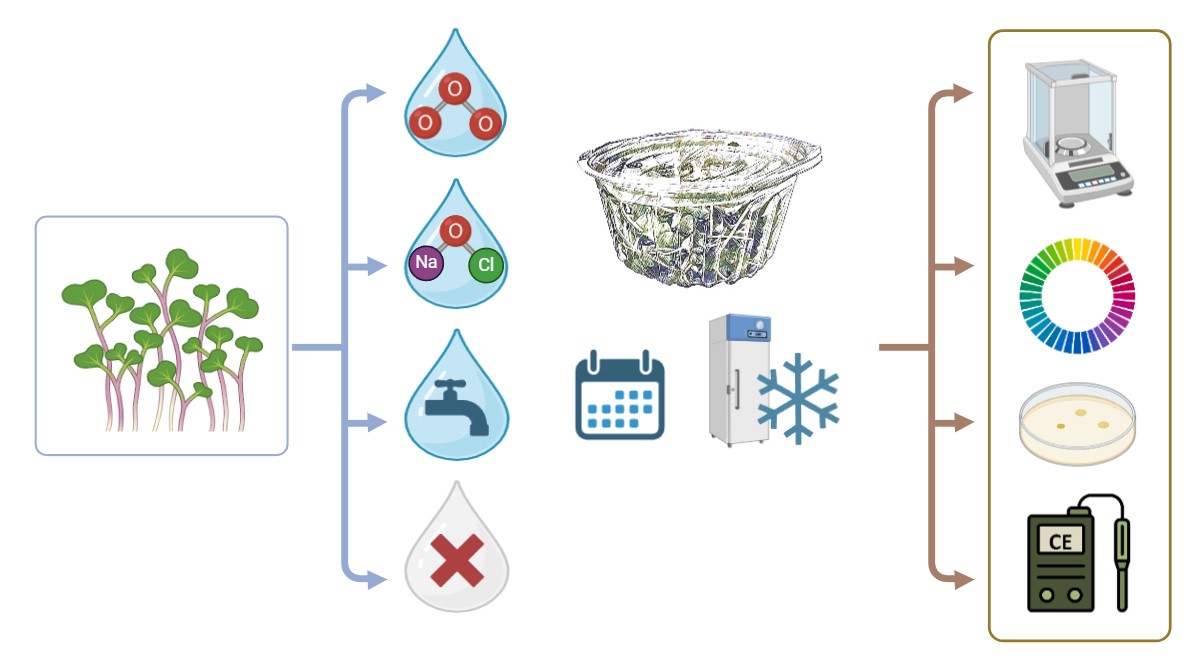
Microgreens are young vegetable seedlings that have garnered significant attention due to their high concentrations of health-promoting phytochemicals. However, their highly perishable nature presents a significant challenge for postharvest storage. Among the various preservation technologies available, ozone treatment applied to microgreens-an innovative and environmentally sustainable method-has not been extensively studied. This study evaluated the effect of ozone-based sanitization on the shelf life and quality of radish microgreens. Conventional washing treatments using chlorinated water and tap water were compared to ozonated water. During refrigerated storage, key quality parameters were systematically monitored, including fresh weight loss, electrolyte leakage, color changes, and microbial counts. Ozonated water effectively reduced the initial aerobic mesophilic bacterial populations, with no statistically significant differences compared to conventional chlorine treatment. Furthermore, ozone treatment had minimal impact on color, and the weight loss remained below 1%. Although tissue wilting was observed, it was significantly less severe than that associated with chlorine treatment. These findings suggest that ozonated water is a promising alternative to conventional postharvest treatments for enhancing the shelf life and microbiological safety of ready-to-eat microgreens.
Highlights:
- Addressing the issue of limited shelf life of microgreens.
- Innovative and sustainable ozone technology applied to the postharvest of microgreens.
- Ozone as an alternative to chlorine for sanitation of ready-to-eat microgreens.
- Aqueous ozone for initial control of aerobic mesophilic bacteria in microgreens.
- Minimal weight loss and no color change in ozone-washed microgreens.
Downloads
References
Ali, A.; Yeoh, W. K.; Forney, C. & Siddiqui, M. W. 2017. Advances in postharvest technologies to extend the storage life of minimally processed fruits and vegetables. Critical Reviews in Food Science and Nutrition. 58(15): 2632-2649. https://doi.org/10.1080/10408398.2017.13 39180
Ali, S.; Nawaz, A.; Naz, S.; Ejaz, S.; Hussain, S.; Anwar, R. 2022. Decontamination of Microgreens. In: Shah, M.A., Mir, S.A. (eds) Microbial Decontamination of Food. https://doi. org/10.1007/978-981-19-5114-5_6
Baenas, N.; Gómez-Jodar, I.; Moreno, D. A.; García-Viguera, C. & Periago, P. M. 2017. Broccoli and radish sprouts are safe and rich in bioactive phytochemicals. Postharvest Biology and Technology. 127: 60-67. http://dx.doi.org/10.1016/j.postharvbio.2017.01.010
Botondi, R.; Barone, M. & Grasso, C. 2021. A review into the effectiveness of ozone technology for improving the safety and preserving the quality of fresh-cut fruits and vegetables. Foods. 10(4): 748. https://doi.org/10.3390/foods10040748
Casajús, V.; Perini, M.; Ramos, R.; Lourenco, A. B.; Salinas, C.; Sánchez, E.; Fanello, D.; Civello, P.; Frezza, D. & Martínez, G. 2021. Harvesting at the end of the day extends postharvest life of kale (Brassica oleracea var. sabellica). Scientia Horticulturae. 276: 109757. https://doi. org/10.1016/j.scienta.2020.109757
Chandra, D.; Kim, J. G.; Kim, Y. P. 2012. Changes in microbial population and quality of microgreens treated with different sanitizers and packaging films. Horticulture, Environment, and Biotechnology. 53(1): 32-40. https://doi.org/10.1007/s13580-012-0075-6
Das, B. K.; Kim, J. G. 2010. Microbial quality and safety of fresh-cut broccoli with different sanitizers and contact times. Journal of Microbiology and Biotechnology. 20(2): 363-369. https:// doi.org/10.4014/jmb.0907.07009
Deng, L. Z.; Mujumdar, A. S.; Pan, Z.; Vidyarthi, S. K.; Xu, J.; Zielinska, M. & Xiao, H. W. 2019. Emerging chemical and physical disinfection technologies of fruits and vegetables: a comprehensive review. Critical Reviews in Food Science and Nutrition. 60(15): 2481-2508. https://doi.or g/10.1080/10408398.2019.1649633
Di Rienzo J. A.; Casanoves F.; Balzarini M. G.; Gonzalez, L.; Tablada, M.; Robledo, C. W. InfoStat versión 2020. Centro de Transferencia InfoStat. FCA. Universidad Nacional de Córdoba. Argentina. URL http://www.infostat.com.ar
Ghoora, M. D.; Srividya, N. 2020. Effect of packaging and coating technique on postharvest quality and shelf life of Raphanus sativus L. and Hibiscus sabdariffa L. microgreens. Foods. 9(5): 653. https://doi.org/10.3390/foods9050653
Huyskens-Keil, S.; Hassenberg, K.; Herppich, W. B. 2012. Impact of postharvest UV-C and ozone treatment on textural properties of white asparagus (Asparagus officinalis L.). Journal of Applied Botany and Food Quality. 84(2): 229.
Işık, H.; Topalcengiz, Z.; Güner, S. & Aksoy, A. 2020. Generic and Shiga toxin-producing Escherichia coli (O157:H7) contamination of lettuce and radish microgreens grown in peat moss and perlite. Food Control. 111: 107079. https://doi.org/10.1016/j.foodcont.2019.107079
Kou, L.; Luo, Y.; Yang, T.; Xiao, Z.; Turner, E. R.; Lester, G. E.; Wang, Q. 2013. Postharvest biology, quality and shelf-life of buckwheat microgreens. LWT-Food Science and Technology. 51(1): 73-78. https://doi.org/10.1016/j.lwt.2012.11.017
Kou, L.; Yang, T.; Liu, X.; Luo, Y. 2015. Effects of Pre-and Postharvest Calcium Treatments on Shelf Life and Postharvest Quality of Broccoli Microgreens. HortScience horts. 50(12): 1801-1808. https://doi.org/10.21273/HORTSCI.50.12.1801
Kyriacou, M. C.; Rouphael, Y.; Di Gioia, F.; Kyratzis, A.; Serio, F.; Renna, M.; De Pascale, S.; Santamaria, P. 2016. Micro-scale vegetable production and the rise of microgreens. Trends in Food Science & Technology. 57(Part A): 103-115. https://doi.org/10.1016/j.tifs.2016.09.005
Kyriacou, M.; El-Nakhel, C.; Graziani, G.; Pannico, A.; Soteriou, G. A.; Giordano, M.; Ritieni, A.; De Pascale, S.; Rouphael, Y. 2019. Functional quality in novel food sources: Genotypic variation in the nutritive and phytochemical composition of thirteen microgreens species. Food Chemistry. 227: 107-118. https://doi.org/10.1016/j.foodchem.2018.10.098.
Lu, Y.; Dong, W.; Yang, T.; Luo, Y.; Chen, P. 2021. Preharvest UVB application increases glucosinolate contents and enhances postharvest quality of broccoli microgreens. Molecules. 26(11): 3247. https://doi.org/10.3390/molecules26113247
Mersinli, E.; Koyuncu, M. A.; Erbaş, D. 2021. Quality retention of minimally processed spinach using low-dose ozonated water during storage. Turkish Journal of Agriculture and Forestry. 45(2): 133-143. https://doi.org/10.3906/tar-2004-75
Paradiso, V. M.; Castellino, M.; Renna, M.; Gattullo, C. E.; Calasso, M.; Terzano, R.; Allegretta, I.; Leoni, B.; Caponio, F.; Santamaria, P. 2018. Nutritional characterization and shelf-life of packaged microgreens. Food & function. 9(11): 5629-5640. https://doi.org/10.1039/ C8FO01182F
Patil, M.; Sharma, S.; Sridhar, K.; Anurag, R. K.; Grover, K.; Dharni, K.; Mahajan, S.; Sharma, M. 2024. Effect of postharvest treatments and storage temperature on the physiological, nutritional, and shelf-life of broccoli (Brassica oleracea) microgreens. Scientia Horticulturae. 327: 112805. https://doi.org/10.1016/j.scienta.2023.112805
Paulsen, E.; Barrios, S.; Baenas, N.; Moreno, D. A.; Heinzen, H.; Lema, P. 2018. Effect of temperature on glucosinolate content and shelf life of ready-to-eat broccoli florets packaged in passive modified atmosphere. Postharvest Biology and Technology. 138: 125-133. https://doi. org/10.1016/j.postharvbio.2018.01.006
Sarron, E.; Gadonna-Widehem, P.; Aussenac, T. 2021. Ozone treatments for preserving fresh vegetables quality: A critical review. Foods. 10(3): 605. https://doi.org/10.3390/ foods10030605
Turner, E. R.; Luo, Y.; Buchanan, R. L. 2020. Microgreen nutrition, food safety, and shelf life: A review. Journal of food science. 85(4): 870-882. https://doi.org/10.1111/1750- 3841.15049
Wang, H.; Feng, H.; Luo, Y. 2004. Microbial reduction and storage quality of fresh-cut cilantro washed with acidic electrolyzed water and aqueous ozone. Food Research International. 37(10): 949-956. https://doi.org/10.1016/j.foodres.2004.06.004
Wang, J.; Wang, S.; Sun, Y.; Li, C.; Li, Y.; Zhang, Q. & Wu, Z. 2019. Reduction of Escherichia coli O157: H7 and naturally present microbes on fresh-cut lettuce using lactic acid and aqueous ozone. RSC advances. 9(39): 22636-22643. https://doi.org/10.1039/C9RA03544C
Xiao, Z.; Lester, G. E.; Luo, Y.; Xie, Z. K.; Yu, L. L. & Wang, Q. 2014a. Effect of light exposure on sensorial quality, concentrations of bioactive compounds and antioxidant capacity of radish microgreens during low temperature storage. Food chemistry. 151: 472-479. https://doi. org/10.1016/j.foodchem.2013.11.086
Xiao, Z.; Luo, Y.; Lester, G. E.; Kou, L.; Yang, T.; Wang, Q. 2014b. Postharvest quality and shelf life of radish microgreens as impacted by storage temperature, packaging film, and chlorine wash treatment. LWT - Food Science and Technology. 55(2): 551-558. http://doi.org/10.1016/j. lwt.2013.09.009
Yan, H.; Li, W.; Chen, H.; Liao, Q.; Xia, M.; Wu, D.; Liu, C.; Chen, J.; Zou, L.; Peng, L.; Zhao, G.; Zhao, J. 2022. Effects of storage temperature, packaging material and wash treatment on quality and shelf life of Tartary buckwheat microgreens. Foods. 11(22): 3630. https://doi. org/10.3390/foods11223630
Zappia, A.; De Bruno, A.; Torino, R.; Piscopo, A.; Poiana, M. 2018. Influence of light exposure during cold storage of minimally processed vegetables (Valeriana sp.). Journal of Food Quality. 2018(1): 4694793. https://doi.org/10.1155/2018/4694793
Zhang, L.; Lu, Z.; Yu, Z. & Gao, X. 2005. Preservation of fresh-cut celery by treatment of ozonated water. Food control. 16(3): 279-283. https://doi.org/10.1016/j.foodcont.2004.03.007
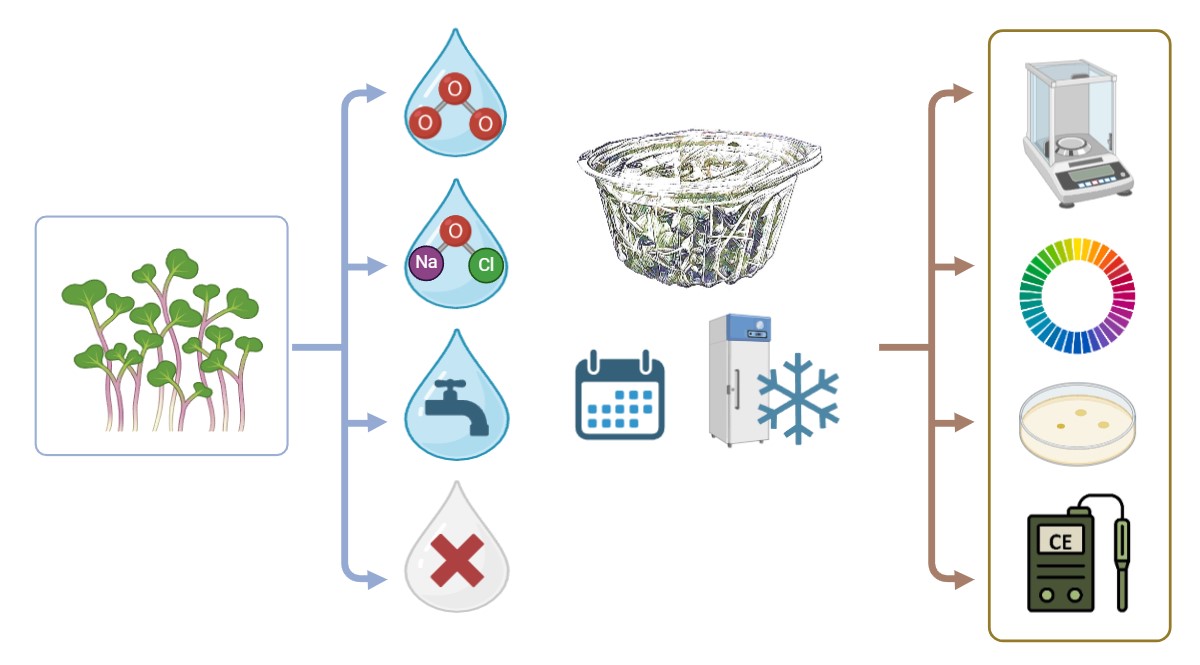
Published
How to Cite
Issue
Section
License

This work is licensed under a Creative Commons Attribution-NonCommercial-ShareAlike 3.0 Unported License.
Authors who publish with this journal accept the Editorial Policies.
 RevFCAUNCuyo






.jpg)