
Strategic Pathways for the Olive Oil Chain in Argentina: Profitability, Sustainability and Oleo tourism
DOI:
https://doi.org/10.48162/rev.39.173Keywords:
olive oil supply chain , costs, competitiveness, sustainability, bioeconomy , tourism , ArgentinaAbstract
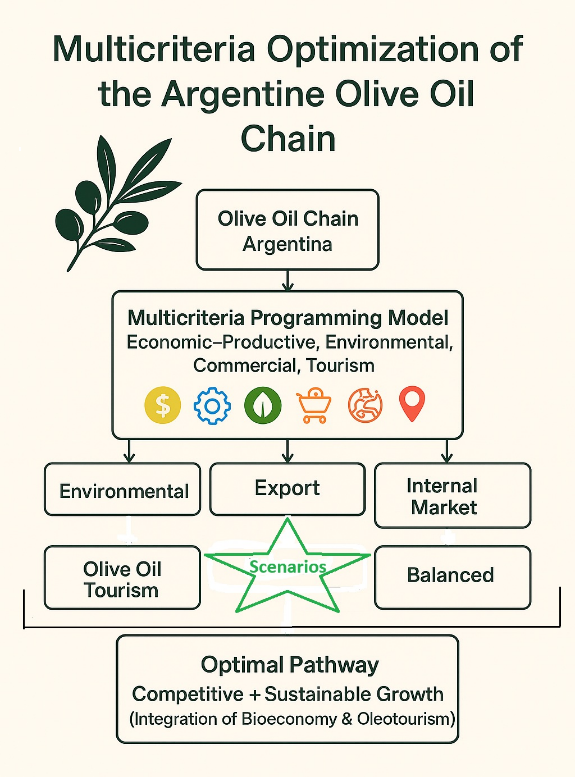
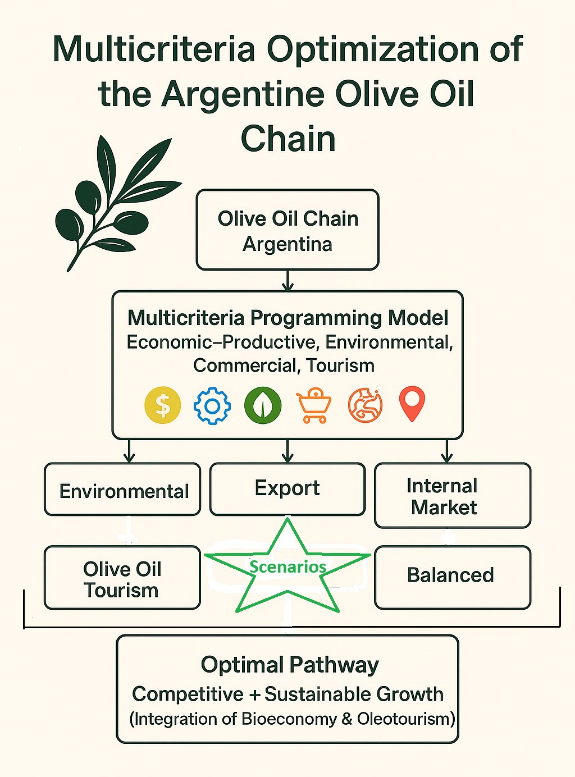
The olive oil agri-food chain in Argentina is strategically relevant for rural development, employment, exports and tourism. Despite quality production and industrial capacity, the sector faces structural problems: high labour and energy costs, limited domestic consumption, and dependence on subsidized international competitors. This study analyses the chain using multicriteria programming across five dimensions: productive, economic-financial, commercial, environmental and tourism-territorial. The baseline was built from data collected between 2018 and 2024 (Agricultural Census 2018, official reports and international benchmarks), covering the country’s most representative producing regions (Catamarca, La Rioja, San Juan and Mendoza), which together account for over 90% of national output. Results from scenario simulations reveal trade-offs: export-oriented strategies maximize profit but increase vulnerability to global prices; internal consumption growth strengthens resilience yet moderates revenues; environmental sustainability improves efficiency through lower water use; and balanced development with olive oil tourism achieves robust outcomes across all dimensions. A novel contribution is the quantitative inclusion of tourism, showing its potential to generate rural employment and enhance brand value. The findings support forward-looking strategies that combine technological reconversion, market diversification, efficient resource use and tourism integration, offering policy guidelines for sustainable territorial development.
Highlights:
- Multicriteria programming applied to the Argentine olive oil value chain.
- Integrated analysis of five dimensions: economic, productive, environmental, commercial, tourism.
- Scenarios reveal optimal strategies combining competitiveness and sustainability.
- Oleotourism emerges as a driver for regional value creation and diversification.
- Model supports bioeconomy-based policies for the olive oil sector’s future.
Downloads
References
Benencia, R., Quaranta, G., & Pedreño Cánovas, A. (2014). Mercados de trabajo, instituciones y trayectorias en distintos escenarios migratorios. Ediciones CICCUS.
Branquinho, S., Rolim, J., & Teixeira, J. L. (2021). Climate Change Adaptation Measures in the Irrigation of a Super-Intensive Olive Orchard in the South of Portugal. Agronomy, 11(8), 1658. https://doi.org/10.3390/agronomy11081658
CREA. (2021). Reporte de actualidad agro. Movimiento CREA. https://proyectos.crea.org.ar/reporte-de-actualidad-agro/
Díaz-Chao, Á., Sainz-González, J., & Torrent-Sellens, J. (2016). The competitiveness of small network-firm: A practical tool. Journal of Business Research, 69(5), 1867-1872. https://doi. org/10.1016/j.jbusres.2015.10.053
Enolife. (21 de mayo de 2025). Mendoza ya tiene 21 almazaras y olivares que ofrecen oleoturismo. Enolife.com.ar. https://enolife.com.ar/es/mendoza-ya-tiene-21-almazaras-y-olivares-que-ofrecen-oleoturismo-con-120-000-visitantes-al-ano/
García-Cascales, M. S., Molina-García, A., Sánchez-Lozano, J. M., Mateo-Aroca, A., & Munier, N. (2021). Multi-criteria analysis techniques to enhance sustainability of water pumping irrigation. Energy Reports, 7, 4623-4632. https://doi.org/10.1016/j.egyr.2021.07.026
Guida-Johnson, B.; Vignoni, A. P.; Migale, G. M.; Aranda, M. A.; Magnano, A. 2024. Rural abandonment and its drivers in an irrigated area of Mendoza (Argentina). Revista de la Facultad de Ciencias Agrarias. Universidad Nacional de Cuyo. Mendoza. Argentina. 56(1): 35-47. DOI: https://doi.org/10.48162/rev.39.121
INDEC. (2019). Censo Nacional Agropecuario 2018: Resultados finales. https://www.indec.gob.ar/indec/web/Nivel4-Tema-3-8-71
International Olive Oil Council. (2015). Estudio internacional sobre los costes de producción del aceite de oliva. https://www.internationaloliveoil.org/wp-content/uploads/2019/11/ESTUDIO-INTERNACIONAL-SOBRE-COSTES-DE-PRODUCCI%C3%93N-DEL-ACEITE-DE-OLIVA.pdf
International Olive Oil Council. (n.d.). International Olive Oil Council. https://www.internationaloliveoil. org/
MAGyP (Ministerio de Agricultura, Ganadería y Pesca). (2023). Informe síntesis. Economía regional Olivo. 1-13. https://alimentosargentinos.magyp.gob.ar/HomeAlimentos/economias-regionales/producciones-regionales/informes/INFORME_ DE_Olivo2023.pdf
Millán-Vázquez de la Torre, M. G., Arjona-Fuentes, J. M., & Amador-Hidalgo, L. (2017). Olive oil tourism: Promoting rural development in Andalusia (Spain). Tourism Management Perspectives, 21, 100-108. https://doi.org/10.1016/j.tmp.2016.12.003
Ministerio de Economía de la República Argentina. (2024). Informe sectorial: Olivícola (Año 9 N° 80). https://www.argentina.gob.ar/sites/default/files/informe_sectorial_olivo.pdf
Pérez-Aleman, P. (2012). Global standards and local knowledge building: Upgrading small producers in global value chains. Proceedings of the National Academy of Sciences, 109(31), 12344-12349. https://doi.org/10.1073/pnas.1000968108
Romero, C. (1993). Teoría de la decisión multicriterio: conceptos, técnicas y aplicaciones. Alianza Editorial.
Stark, S., Biber-Freudenberger, L., Dietz, T., Escobar, N., Förster, J., Henderson, J., Laibach, N., Börner, J. (2022). Sustainability implications of transformation pathways for the bioeconomy. Science Direct, 29, 215-227. https://doi.org/10.1016/j.spc.2021.10.011
Vargas, R., & Garrido, A. (2019). Competitiveness of Mediterranean olive oil production: A comparative analysis of Spain and Portugal. Spanish Journal of Agricultural Research, 17(4), e0112. https://doi.org/10.5424/sjar/2019174-14535
Published
How to Cite
Issue
Section
License

This work is licensed under a Creative Commons Attribution-NonCommercial-ShareAlike 3.0 Unported License.
Authors who publish with this journal accept the Editorial Policies.
 RevFCAUNCuyo






.jpg)