
Four Decades of Soil Fertility Change in Turkey’s Thrace Region: Rising Acidity, Phosphorus Accumulation, and Persistent Organic Matter Depletion
DOI:
https://doi.org/10.48162/rev.39.219Palabras clave:
monitoreo a largo plazo del suelo, desequilibrio de nutrientes , manejo sostenible del sueloResumen
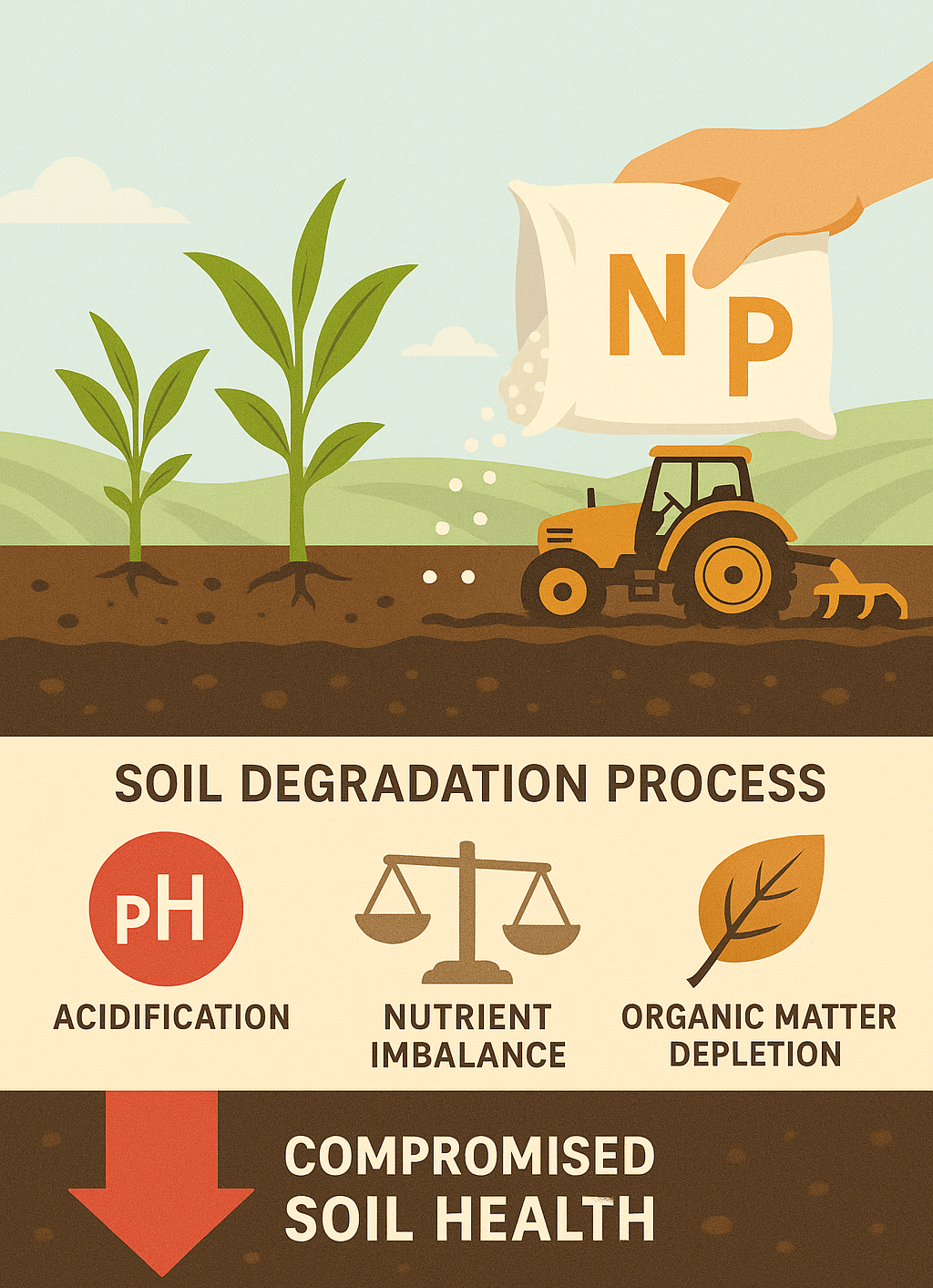
Long-term monitoring of soil fertility parameters is critical for evaluating the sustainability of agricultural practices and their environmental impacts. This study investigates soil pH, organic matter, and available phosphorus dynamics over a 34-year period in Turkey’s Thrace Region (Edirne, Kırklareli, Tekirdağ). For each province, soils were classified using the same threshold intervals in 1984 and 2018, and the proportion of samples in each class was compared between years (reported as percentages and percentage-point changes). The results show a marked shift toward soil acidification, with strongly acidic soils (pH < 4.5) emerging for the first time, now accounting for up to 3.1% of sampled soils. The share of neutral soils declined substantially, from 55.5% to 36.7% in Edirne. Soil organic matter levels remained critically low throughout the region, with over 80% of soils containing less than 20 g kg-1organic matter. Meanwhile, excessive phosphorus accumulation was observed: over 70% of soils were classified as “high” or “very high” in available P, indicating long-term over-application of phosphate fertilizers. These changes reflect the cumulative impact of conventional fertilization practices and insufficient organic matter inputs. The findings highlight the urgent need for corrective strategies, such as lime application, balanced fertilization, and organic amendments, to restore soil health and sustain agricultural productivity in the Thrace Region.
Highlights:
- Soil acidification increased across the Thrace Region between 1984 and 2018.
- Strongly acidic soils emerged in recent surveys, although they were absent in 1984.
- Soil organic matter remained critically low in most agricultural soils of the region.
- Available phosphorus accumulated markedly, indicating long-term overuse of phosphate fertilizers.
- Balanced fertilization, liming, and organic amendments are required to restore soil fertility.
Descargas
Citas
Abdi, B. T. (2024). Studies on the effects of liming acidic soil on improving soil physicochemical properties and yield of crops: A review. Middle East Research Journal of Agriculture and Food Science, 4(3), 95-103.
Acır, N., & Günal, H. (2019). Definition of soil quality and its importance for ecosystem functions and sustainable land management. Science and Technology in the 21st Century, 6(11), 19-30. https://doi.org/10.3769/fetek.2019.6.11.19-30
Alcalá Jáuregui, J. A.; Ramírez Cubos, M. F.; Rojas Velázquez, Á.; Diedhiou, I.; Filippini, M. F.; Cónsoli, D.; Martínez Carretero, E.; Rodríguez Ortiz, J. C.; Guillén Castillo, O. I.; Ontivero, M. (2025). Variations of Atmospheric Emissions in the Biomass Burning of Tree Species as an Environmental Indicator. Revista de la Facultad de Ciencias Agrarias. Universidad Nacional de Cuyo. 57(2): 69-86. DOI: https://doi.org/10.48162/rev.39.172
Alori, E. T., Glick, B. R., & Babalola, O. O. (2017). Microbial phosphorus solubilization and its potential for use in sustainable agriculture. Frontiers in Microbiology, 8, 971. https://doi.org/10.3389/fmicb.2017.00971
Arévalo-Aranda, Y., Toribio, E. R., Cordova, L. R., Díaz-Chuquizuta, H., Chávez, E. E. T., Cruz-Luis, J., & Pérez, W. E. (2024). Green manuring and fertilization on rice (Oryza sativa L.): A Peruvian Amazon study. Revista de la Facultad de Ciencias Agrarias. Universidad Nacional de Cuyo, 56(2), 1-13. https://doi.org/10.48162/rev.39.132
Atav, V., Yüksel, O., Namlı, A., & Gürbüz, M. A. (2024). Biogas liquid digestate application: Influence on soil microbial biomass and CO₂ respiration. Journal of Material Cycles and Waste Management, 26(6), 3525-3534. https://doi.org/10.1007/s10163-024-02055-w
Atav, V., Gürbüz, M. A., Kayali, E., & Yalinkiliç, E. (2025). Optimizing Nitrogen Management in Maize (Zea mays L.) Using Urease and Nitrification Inhibitors. Communications in Soil Science and Plant Analysis, 56(4), 528-541. https://doi.org/10.1080/00103624.2024.2424236
Bellitürk, K. (2011). Determination of nutrient status of agricultural soils in Uzunköprü County of Edirne Province. Journal of Tekirdağ Agricultural Faculty, 8(3), 8-15.
Blackwell, M. S. A., Darch, T., & Haslam, R. P. (2019). Phosphorus use efficiency and fertilizers: Future opportunities for improvements. Frontiers of Agricultural Science and Engineering, 6(4), 332-340. https://doi.org/10.15302/J-FASE-2019274
Bolan, N. S., Naidu, R., Syers, J. K., & Tillman, R. W. (1999). Surface charge and solute interactions in soils. Advances in Agronomy, 67, 87-140. https://doi.org/10.1016/S0065-2113(08)60514-3
Bolan, N. S., & Hedley, M. J. (2003). Role of carbon, nitrogen, and sulfur cycles in soil acidification. In Z. Rengel (Ed.), Handbook of Soil Acidity (p. 29–56). https://doi.org/10.1201/9780203912317
Braschi, I., Ciavatta, C., Giovannini, C., & Gessa, C. (2003). Combined effect of water and organic matter on phosphorus availability in calcareous soils. Nutrient Cycling in Agroecosystems, 67, 67-74. https://doi.org/10.1023/A:1025143809825
Campbell, E. E., & Paustian, K. (2015). Current developments in soil organic matter modeling and the expansion of model applications: A review. Environmental Research Letters, 10(12), 123004. https://doi.org/10.1088/1748-9326/10/12/123004
Cassani, M. T., Sabatte, M. L., Perez, S. P., & Massobrio, M. J. (2024). Different scenarios in land suitability assessment for Kernza®-intermediate wheatgrass (Thinopyrum intermedium), a novel perennial grain crop for Argentina. Revista de la Facultad de Ciencias Agrarias. Universidad Nacional de Cuyo. 56(2), 48-61. https://doi.org/10.48162/rev.39.136
Dvořáčková, H., Dvořáček, J., Hueso González, P., & Vlček, V. (2022). Effect of different soil amendments on soil buffering capacity. PLOS ONE, 17(2), e0263456. https://doi.org/10.1371/journal.pone.0263456
European Environment Agency. (2020). CORINE Land Cover 2018 (raster 100 m), Europe, 6-yearly - version 2020_20u1, May 2020 [Data set]. Copernicus Land Monitoring Service. https://doi.org/10.2909/960998c1-1870-4e82-8051-6485205ebbac
Eyüpoğlu, F. (1999). The fertility status of soils in Türkiye. Republic of Türkiye Prime Ministry. General Directorate of Rural Services. General Publication N°: 220, Technical Publication N°: T-67.
Fageria, N. K., & Baligar, V. C. (2003). Fertility management of tropical acid soils for sustainable crop production. In Z. Rengel (Ed.), Handbook of Soil Acidity (p. 359–385). CRC Press. https:// doi.org/10.1201/9780203912317-1
Foy, C. D. (1992). Soil Chemical Factors Limiting Plant Root Growth. In: Hatfield, J. L., Stewart, B. A. (eds) Limitations to Plant Root Growth. Advances in Soil Science, vol 19. Springer. https://doi.org/10.1007/978-1-4612-2894-3_5
Goldstein, A. H. (2000). Bioprocessing of rock phosphate ore: Essential technical considerations for the development of a successful commercial technology. In Proceedings of the 4th International Association for Technical Conference (p. 220-242).
Goulding, K. W., & Blake, L. (1998). Land use, liming and the mobilization of potentially toxic metals. Agriculture, Ecosystems & Environment, 67(2-3), 135-144. https://doi.org/10.1016/S0167-8809(97)00111-4
Goulding, K. W. T. (2016). Soil acidification and the importance of liming agricultural soils with particular reference to the United Kingdom. Soil Use and Management, 32(3), 390-399. https://doi.org/10.1111/sum.12270
Granados Ortiz, S. A.; Visentini, F. F.; Panigo, E. S.; Muñoz, F. F.; Malano, J. P.; Derita, M. G.; Daurelio, L. D.; Bouzo, C. A.; Pérez Rubin, A. A.; Céccoli, G. (2025). Green Synthesis and Foliar Application of Copper Nanoparticles in Sunflower (Helianthus annuus L.) to Improve Physiological Parameters and Yield. Revista de la Facultad de Ciencias Agrarias. Universidad Nacional de Cuyo. 57(2): 187-198. DOI: https://doi.org/10.48162/rev.39.182
Gürbüz, M. A. (2010). The effect of including legumes into the wheat–sunflower rotation on soil organic matter and nitrogen content in Thrace. In 1st National Soil and Water Resources Congress (p. 538-546). Türkiye.
Haynes, R. J. (1984). Lime and phosphate in the soil-plant system. Advances in Agronomy, 37, 249-315. https://doi.org/10.1016/S0065-2113(08)60456-3
Hojito, M. (1998). Productivity of acidified grassland caused by acidic nitrogen fertilizer and aluminum tolerance of grasses and legumes. Japan Agricultural Research Quarterly, 32, 87-96.
İlay, R., & Kavdır, Y. (2021). Effects of organic materials from different sources on the physical properties of sandy loam soils. Turkish Journal of Soil Science and Plant Nutrition, 9(1), 30-38. https://doi.org/10.33409/tbbbd.881352
Johnston, A. E., Poulton, P. R., & Coleman, K. (2009). Soil organic matter: Its importance in sustainable agriculture and carbon dioxide fluxes. Advances in Agronomy, 101, 1-57. https://doi.org/10.1016/S0065-2113(08)00801-8
Karabatak, İ. (2006). Effects of organic matter applications on mineral phosphorus fractions in calcareous soils (Master’s thesis, Mustafa Kemal University, Institute of Science).
Kariuki, S. K., Zhang, H., Schroder, J. L., Edwards, J., Payton, M., Carver, B. F., Raun, W. R., & Krenzer, E. G. (2007). Hard red winter wheat cultivar responses to a pH and aluminum concentration gradient. Agronomy Journal, 99(1), 88-98. https://doi.org/10.2134/agronj2006.0128
Kayalı, E., & Yüksel, O. (2024). Fertility status of agricultural soils in İstanbul province. Journal of Tekirdağ Agricultural Faculty, 21(5), 1336-1350. https://doi.org/10.33462/jotaf.1540727
Kurşun, İ., & Gürbüz, M. A. (2010). The effect of lime (CaCO₃) application on sunflower and wheat yield in acidic soils of the Thrace Region. In 1st National Congress on Soil and Water Resources (p. 538). Türkiye.
Lal, R. (2004). Soil carbon sequestration in sub-Saharan Africa: A review. Soil and Tillage Research, 78(1), 1-19. https://doi.org/10.1016/j.still.2004.03.002
Lewis, R. W., Barth, V. P., Coffey, T., McFarland, C., Huggins, D. R., & Sullivan, T. S. (2018). Altered bacterial communities in long-term no-till soils associated with stratification of soluble aluminum and soil pH. Soil Systems, 2(1), 7. https://doi.org/10.3390/soils2010007
Li, S., Chen, X., Wang, Z., Wu, D., Wang, M., Müller, T., Zou, C., Chen, X., & Zhang, W. (2024). Phosphorus fertilizer management for high yields in intensive winter wheat-summer maize rotation system: Integrating phosphorus budget and soil available phosphorus. Field Crops Research, 313, 109410. https://doi.org/10.1016/j.fcr.2024.109410
Liang, H., Tan, Y., Yin, J., Peng, Y., Wei, M., Chen, H., & Chen, Q. (2024). Phosphate fertilizers’ dual role in cadmium-polluted acidic agricultural soils: Dosage dependency and passivation potential. Agronomy, 14(10), 2201. https://doi.org/10.3390/agronomy14102201
Ministry of Rural Affairs and Cooperatives, General Directorate of Soil and Water. (1980). Marmara Basin soils (Publication N° 229, Report Series N° 91).
Okur, B., Yağmur, B., & Okur, N. (2022). Green manuring. In M. A. Özyazıcı & Ö. Ü. Açıkbaş (Eds.), Green Manuring (p. 79-101). IKSAD Publishing House.
Ova, E. A., Kutman, U. B., Öztürk, L., & Cakmak, I. (2015). High phosphorus supply reduced zinc concentration in wheat grown in natural soil but not in autoclaved soil or nutrient solution. Plant and Soil, 393(1-2), 147-162. https://doi.org/10.1007/s11104-015-2483-8
Page, A. L., Miller, R. H., & Keeney, D. R. (Eds.). (1982). Methods of soil analysis. Part 2: Chemical and microbiological properties (2nd ed., Agronomy Monograph N° 9). American Society of Agronomy; Soil Science Society of America.
Parker, D. R., Kinraide, T. B., & Zelazny, L. W. (1989). On the phytotoxicity of polynuclear hydroxyaluminum complexes. Soil Science Society of America Journal, 53(3), 789-796. https://doi. org/10.2136/sssaj1989.03615995005300030027x
Republic of Türkiye Ministry of Agriculture, Forestry and Rural Affairs. (1984a). Productivity Inventory and Fertilizer Requirement Report of Edirne Province (TOVEP Publication N° 14; General Publication N° 742). General Directorate of Topraksu Publications.
Republic of Türkiye Ministry of Agriculture, Forestry and Rural Affairs. (1984b). Productivity Inventory and Fertilizer Requirement Report of Kırklareli Province (TOVEP Publication N° 20; General Publication N° 752). General Directorate of Topraksu Publications.
Republic of Türkiye Ministry of Agriculture, Forestry and Rural Affairs. (1984c). Productivity Inventory and Fertilizer Requirement Report of Tekirdağ Province (TOVEP Publication N° 13; General Publication N° 741). General Directorate of Topraksu Publications.
Richardson, A. E., & Simpson, R. J. (2011). Soil microorganisms mediating phosphorus availability: Update on microbial phosphorus. Plant Physiology, 156(3), 989-996. https://doi.org/10.1104/pp.111.175448
Sattari, S. Z., Bouwman, A. F., Giller, K. E., & van Ittersum, M. K. (2012). Residual soil phosphorus as the missing piece in the global phosphorus crisis puzzle. Proceedings of the National Academy of Sciences, 109(16), 6348-6353. https://doi.org/10.1073/pnas.1113675109
Savala, C. E. N., Ndungu, P. G., Gitari, H. I., & Nyambati, S. Y. (2019). Cadmium contamination and its risk to human health through food chain: A review. International Journal of Environmental Sciences & Natural Resources, 22(2), 1-8. https://doi.org/10.19080/IJESNR.2019.22.556084
Sönmez, B., Özbahçe, A., Akgül, S., & Keçeci, M. (2018). Development of a geographic database for certain fertility parameters and total organic carbon (TOC) content of soils in Türkiye. (Project Final Report, TAGEM/TSKAD/11/A13/P03-Soil, Fertilizer and Water Resources Central Research Institute).
Taşova, H., & Akın, A. (2013). Determining, mapping and creating a database of soil nutrients in Marmara Region. Toprak Su Dergisi, 2(2), 83-95.
Turkish State Meteorological Service (TSMS). (2014). Long-term precipitation and temperature data. Retrieved January 14, 2014. http://www.mgm.gov.tr/veridegerlendirme/yilliktoplam-yagis-verileri.aspx
Ülgen, A. N., & Yurtsever, N. (1995). Türkiye gübre ve gübreleme rehberi. Toprak ve Gübre Araştırma Enstitüsü. Ministry of Agriculture Ankara.
Walsh, E., & McDonnell, K. P. (2012). The influence of added organic matter on soil physical, chemical, and biological properties: A small-scale and short-time experiment using straw. Archives of Agronomy and Soil Science, 58(sup1), S201-S205. https://doi.org/10.1080/03650340.2012.697999
Wang, X., Wang, X., Sheng, H., Wang, X., Zhao, H., & Feng, K. (2022). Excessive nitrogen fertilizer application causes rapid degradation of greenhouse soil in China. Polish Journal of Environmental Studies, 31(2). https://doi.org/10.15244/pjoes/142869
Weil, R. R., & Magdoff, F. (2004). Significance of soil organic matter to soil quality and health. In F. Magdoff & R. R. Weil (Eds.), Soil organic matter in sustainable agriculture (p. 1-43). CRC Press. https://doi.org/10.1201/9780203496374.ch1
Withers, P. J. A., Sylvester-Bradley, R., Jones, D. L., Healey, J. R., & Talboys, P. J. (2014). Feed the crop not the soil: Rethinking phosphorus management in the food chain. Environmental Science &Technology, 48(12), 6523-6530. https://doi.org/10.1021/es501670j
Woldeamlak, B., & Solomon, A. (2013). Land-use and land-cover change and its environmental implications in a tropical highland watershed, Ethiopia. International Journal of Environmental Studies, 70(1), 126-139. https://doi.org/10.1080/00207233.2012.755765
Yılmaz, H., & Altınbaş, S. (2019). Use of some materials affecting soil pH in cereal cultivation. Journal of Soil Science and Plant Nutrition, 7(2), 75-82. https://doi.org/10.21657/topraksu.655284
Yurdakul, İ., & Usta, S. (2023). Effects of soil components on some phosphorus fractions. Harran Journal of Agricultural and Food Science, 27(4), 610-623. https://doi.org/10.29050/harranziraat.1357243
Zeeshan, A., Waqas, M., Ramzan, M., Ghafoor, F., Usama, Ibrahim, M., Fatima, N., Rauf, A., Hussain, A., Abbas, M., Zahid, N., & Hanif, S. (2024). From fields to families: Understanding the health impacts of excessive soil fertilization. Journal of Health and Rehabilitation Research, 4(2), 990-995. https://doi.org/10.61919/jhrr.v4i2.955
Zeng, F., Wei, W., Li, M., Huang, R., Yang, F., & Duan, Y. (2015). Heavy metal contamination in rice-producing soils of Hunan Province, China and potential health risks. International Journal of Environmental Research and Public Health, 12(12), 15584-15593. https://doi.org/10.3390/ijerph121215005
Zhang, L., Zhao, Z., Jiang, B., Baoyin, B., Cui, Z., Wang, H., Li, Q., & Cui, J. (2024). Effects of Long-Term Application of Nitrogen Fertilizer on Soil Acidification and Biological Properties in China: A Meta-Analysis. Microorganisms, 12(8), 1683. https://doi.org/10.3390/microorganisms12081683
Zhao, X. Q., & Shen, R. F. (2018). Aluminum–nitrogen interactions in the soil-plant system. Frontiers in Plant Science, 9, 807. https://doi.org/10.3389/fpls.2018.00807
Zhu, Y., Zhang, H., & He, Y. (2018). Soil phosphorus transformation and plant uptake driven by phosphate-solubilizing microorganisms: A review. Geoderma, 337, 111-122. https://doi.org/10.1016/j.geoderma.2018.09.036
Zou, T., Zhang, X., & Davidson, E. A. (2022). Global trends of cropland phosphorus use and sustainability challenges. Nature, 611(7934), 81-87. https://doi.org/10.1038/s41586-022-05272-7
Descargas
Publicado
Cómo citar
Número
Sección
Licencia

Esta obra está bajo una licencia internacional Creative Commons Reconocimiento-NoComercial-CompartirIgual 3.0.
Aquellos autores/as que tengan publicaciones con esta revista, aceptan las Políticas Editoriales.
 RevFCAUNCuyo






.jpg)