
Allergenic Potential of Urban Green Spaces in the City of Corrientes (Argentina)
DOI:
https://doi.org/10.48162/rev.39.220Palabras clave:
alergenicidad, equitatividad y dominancia, flora urbana, índice de diversidad, polinosis, relevamiento florísticoResumen
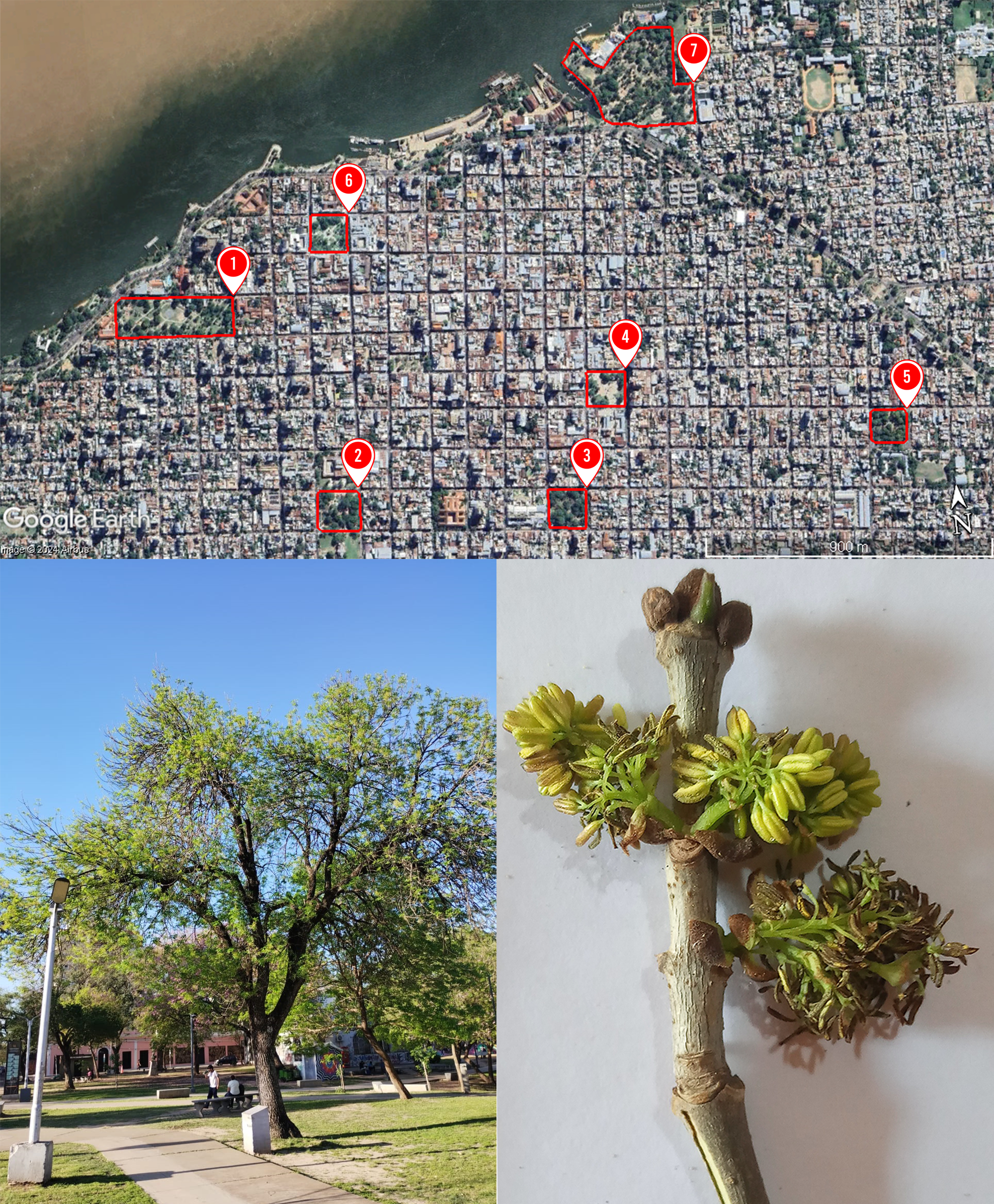
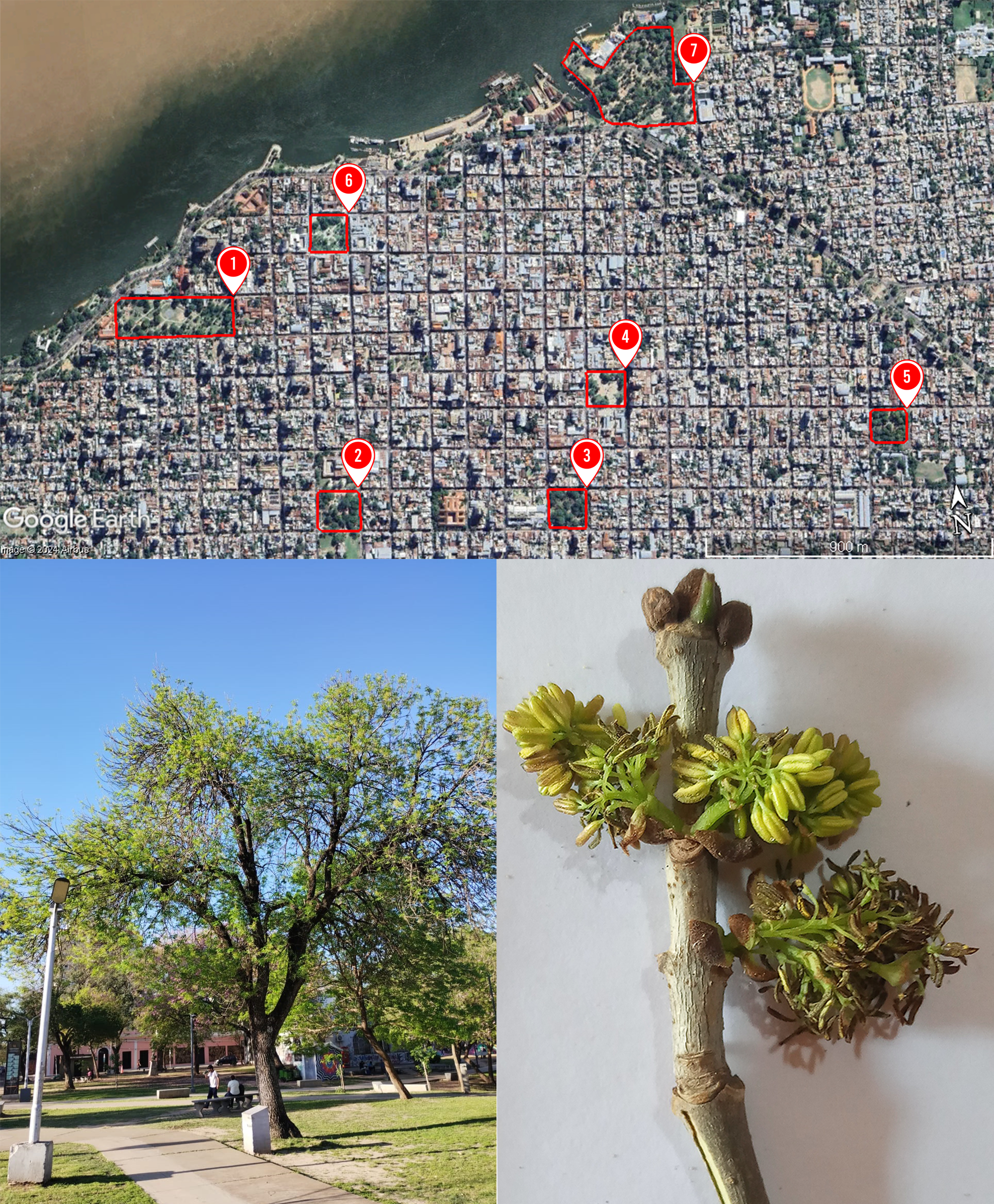
Urban green spaces provide ecosystem services, including well-being, recreation, improved air quality, and thermal regulation. However, certain species can cause adverse effects, such as pollinosis. This study evaluated the allergenic potential of urban green spaces in Corrientes, Argentina, considering species composition and specific botanical parameters. Fifteen censes were carried out in seven green spaces. For each taxon, habit, geographical status, pollen dispersal type, and whether it is a source of allergenic pollen were determined. Shannon diversity and evenness indices, Berger-Parker dominance, and Potential Allergenic Value (PAV) were calculated. A total of 2,251 individuals representing 40 families, 82 genera, and 77 species were recorded. Tree habit (85%), exotic status (66%), and non-allergenic taxa (60.2%) predominated. The indices indicated moderate diversity, with some species more represented than others, and low species dominance. According to the PAV, individuals with high allergenicity occurred in five green spaces, although individuals with null or unknown allergenic potential predominated. The information generated is intended to reevaluate urban flora and guide species selection by adding a criterion to tree planning to minimize the effects of pollinosis on the sensitive population.
Highlights:
- This study provides information on the potential allergenicity (PAV) of seven urban green spaces in Corrientes.
- It represents the first application of this index in a northeastern province of Argentina.
- According to the PAV, individuals with high allergenicity occurred in five green spaces.
- The taxa most frequently used as urban trees with allergenic pollen were Fraxinus and Thuja sp.
- This information will be essential for improving the diagnosis and treatment of pollinosis and for guiding future planting strategies.
Descargas
Citas
Abud Sierra, M. L., & Latorre, F. (2020). Diversidad, abundancia y estacionalidad del polen alergénico en la atmósfera de Mar del Plata (Argentina). Boletín de la Sociedad Argentina de Botánica, 5, 3-21. https://doi.org/10.31055/1851.2372.v55.n1.23094
Aerts, R., Bruffaerts, N., Somers, B., Demoury, C., Plusquin, M., Nawrot, T. S., & Hendrickx, M. (2021). Tree pollen allergy risks and changes across scenarios in urban green spaces in Brussels, Belgium. Landscape And Urban Planning, 207, 104001. https://doi.org/10.1016/j.landurbplan.2020.104001
Alcaraz, E. C., Mallo, A. C., & Nitiu, D. S. (2023). Análisis del potencial alergénico de la vegetación arbórea del “Parque Mujeres Argentinas”, Ciudad Autónoma de Buenos Aires. Boletín de la Sociedad Argentina de Botánica, 58 (Supl.), 49-50.
AllergoMe. (2024). The platform for allergen knowledge. https://www.allergome.org/
Bonjour, L., & Martínez-Carretero, E. (2020). Arecaceae Schultz-Sch. Multequina, 29(2), 1-12.
Camacho, I., Macías-de-la-Rosa, Á., Camacho, R., Grinn-Gofroń, A., & Cariñanos, P. (2024). The allergenic potential of green urban areas in the Macaronesian islands: The case of Funchal City (Madeira). The Urban Climate, 54, 101866. https://doi.org/10.1016/j.uclim.2024.101866
Cariñanos, P., Casares-Porcel, M., & Quesada-Rubio, L. M. (2014). Estimating the allergenic potential of urban green spaces: A case-study in Granada, Spain. Landscape And Urban Planning, 123, 134-144. http://dx.doi.org/10.1016/j.landurbplan.2013.12.009
Cariñanos, P., Adinolfi; C., Díaz de la Guardia, C., De Linares, C., & Casares-Porcel, M. (2016). Characterization of allergen emission sources in urban areas. Journal of Environmental Quality, 45(1), 244-252. https://doi.org/10.2134/jeq2015.02.0075
Cariñanos, P., & Casares-Porcel, M. (2017). Parámetros de alergenicidad y comportamiento alergénico de la flora ornamental. Asociación Española de Arboricultura, Valencia, 20-27.
Cariñanos, P., & Marinangeli, F. (2021). An updated proposal of the Potential Allergenicity of 150 ornamental Trees and shrubs in Mediterranean Cities. Urban Forestry & Urban Greening, 63, 127218. https://doi.org/10.1016/j.ufug.2021.127218
Contreras, F. I., Ferrelli, F., & Piccolo, M. C. (2020). Impactos de eventos secos y lluviosos sobre cuerpos de agua periurbanos subtropicales: aporte al ordenamiento del espacio urbano de Corrientes (Argentina). Finisterra, 55(114), 3-22. https://doi.org/10.18055/Finis19436
Cuadrado, G. (1978). Polen atmosférico de la ciudad de Corrientes (Argentina). FACENA, 2, 55-68.
Cuadrado, G. (1979). Calendario polínico preliminar para Corrientes (Argentina). FACENA, 3, 63-83.
D´Amato, G., Cecchi, L., Bonini, S., Nunes, C., Annesi-Maesano, I., Behrendt, H., Liccardi, G., Popov, T., & Van Cauwenberge, P. (2007). Allergenic pollen and pollen allergy in Europe. Allergy, 62(9), 976-990. https://doi.org/10.1111/j.1398-9995.2007.01393.x
Dimoudi, A., & Nikolopoulou, M. (2003). Vegetation in the urban environment: microclimatic análisis and benefits. Energy Build, 35, 69-76. https://doi.org/10.1016/S0378-7788(02)00081-6
Dobbs, C., Escobedo, F. J., & Zipperer, W. C. (2011). A framework for developing urban forest ecosystem services and goods indicators. Landscape And Urban Planning, 99(3-4), 196-206. https:// doi.org/10.1016/j.landurbplan.2010.11.004
Esch, R. E., Hartsell, C. J., Crenshaw, R., & Jacobson, R. S. (2001). Common allergenic pollens, fungi, animals, and arthropods. Clinical Reviews in Allergy & Immunology, 21, 261-292. https://doi.org/10.1385/CRIAI:21:2-3:261
Escobedo, F. J., Kroeger, T., & Wagner, J. E. (2011). Urban forests and pollution mitigation: Analyzing ecosystem services and disservices. Environmental Pollution, 159(8-9), 2078-2087. https://doi.org/10.1016/j.envpol.2011.01.010
Escobedo, F. J., Dobbs, C., Tovar, Y., & Cariñanos, P. (2023). Neotropical urban forest allergenicity and ecosystem disservices can affect vulnerable neighborhoods in Bogota, Colombia. Sustainable Cities and Society, 89, 104343. https://doi.org/10.1016/J.scs.2022.104343
Flores, R. R. (2022). Contribución de las especies nativas y exóticas del arbolado urbano a la diversidad de especies y provisión de servicios ecosistémicos en la ciudad de Rancagua. [Tesis para obtener el grado de Magíster]. Facultad de Ciencias Forestales y de la Conservación de la Naturaleza. Universidad de Chile. https://repositorio.uchile.cl/handle/2250/198919
Gaido, L., González, F., Recouso, M., Scheibler, G., & Vicent, M. (2017). Espacios verdes en la Ciudad de Buenos Aires (2015-2016). En: Cuestiones de Derecho Urbano. Ed.: Asociación de Derecho Administrativo de la Ciudad Autónoma de Buenos Aires.
García, C., & Reyes, S. (2018). ¿Producen alergia las áreas verdes urbanas de Santiago? Agronomía y Forestal, 54, 41-44.
García, S. M., Casado, M. A., & González, T. E. (2022). Evaluación de la Capacidad Alergénica real del ”Parque de Invierno” de la ciudad de Oviedo (Asturias, España). Boletín de Ciencias y Tecnología. 56, 343-374.
Green, B. J., Zinovia Mitakakis, T., & Tovey, E. R. (2003). Allergen detection from 11 fungal 33 species before and after germination. J. Clinical Reviews in Allergy & Immunology, 111, 285-289. https://doi.org/10.1067/mai.2003.57
Hussain, M. M., Mandal, J., & Bhattacharya, K. (2013). Airborne load of Cassia pollen in West Bengal, eastern India: its atmospheric variation and health impact. Environmental Monitoring and Assessment, 185(3), 2735-2744. https://doi.org/10.1007/s10661-012-2744-4
Instituto de Botánica Darwinion [IBODA]. (2018). Flora Argentina. https://www.floraargentina.edu. ar/.
Instituto de Botánica Darwinion [IBODA]. (2024). Flora del Cono Sur: Catálogo de plantas vasculares. https://www.darwin.edu.ar/.
Kottek, M., Grieser, J., Beck, C., Rudolf, B., & Rubel, F. (2006). World map of the Köppen-Geiger climate classification updated. Meteorologische Zeitschrift, 15(3), 259-263. https://doi. org/10.1127/0941-2948/2006/0130
Laffont, E. R., Godoy, M. C., Galdeano, E., Coronel, J. M., & Etcheverry, C. (2015). Arbolado de espacios verdes de la Ciudad de Corrientes: Relevamiento de plagas y enfermedades, asesoramiento y capacitación. Repositorio Institucional de acceso abierto de la Universidad Nacional del Nordeste, 2, 129-137.
Lafortezza, R., Carrus, G., Sanesi, G., & Davies, C. (2009). Benefits and well-being perceived by people visiting green spaces in periods of heat stress. Urban Forestry & Urban Greening, 8(2), 97-108. https://doi.org/10.1016/j.ufug.2009.02.003
Lara, B., Rojo, J., Blanco, J., Cardador, C., Serrano, J., Soriano, D., & Pérez-Badia, R. (2017). Flora ornamental y potencial alergénico de los espacios verdes urbanos. Comparativa en parques de la ciudad de Toledo. Salud Ambiente, 17(2), 176-186.
Latorre, F. (1999). Differences between airborne pollen and flowering phenology of urban trees with reference to production, dispersal and interannual climate variability. Aerobiologia, 15, 131-141.
Latorre, F., & Sánchez, A. A. (2011). Flora alergógena urbana y polen atmosférico de Diamante (Argentina). Archivos Alergia e Inmunología Clínica, 42(1), 15-23. 10.53108/AAIC/20111/0015-0023
Ledesma, M. (2008). Arbolado público. Conceptos. Manejo. INTA-EEA Manfredi. Córdoba. 77.
Lozano, E. C., & Zapater, M. A. (2008). Delimitación y estatus de Handroanthus heptaphyllus y H. impetiginosus. (Bignoniaceae, Tecomeae). Darwiniana nueva serie, 46(2), 304-317. https://doi.org/10.14522/darwiniana.2014.462.77
Luna, C. V., Fontana, M. L., Ortiz, N. L., & Talavera, G., & Cristiá, A. J. (2023). Caracterización ecológica cuantitativa de la vegetación arbórea de la costanera de la ciudad de Corrientes, Argentina. Revista de la Facultad de Agronomía UBA, 43(3), 202-215.
Magurran, A. (1988). Ecological diversity and its measurement. Princeton University Press. 179.
Mandal, J., Roy, I., Chatterjee, S., & Gupta-Bhattacharya, S. (2008). Aerobiological investigation and in vitro studies of pollen grains from 2 dominant avenue trees in Kolkata, India. Journal of Investigational Allergology and Clinical Immunology, 18(1), 22-30.
Marcó, L. N., & Pirovani, M. (2009). Relevamiento de flora alergógena en Concepción del Uruguay. Archivos Alergia e Inmunología Clínica, 40(2), 44-50.
Martinez, C. F., & Coelho-Duarte, A. P. (2023). Hazard indicators in urban trees. Case studies on Platanus x hispanica Mill. ex Münchh and Morus alba L. in Mendoza City-Argentina. Revista de la Facultad de Ciencias Agrarias. Universidad Nacional del Cuyo, 55(2), 152-165. https://doi.org/10.48162/rev.39.117.
Maruani, T., & Amit-Cohen, I. (2007). Open space planning models: A review of 34 approaches and methods. Landscape and Urban Planning,1(1-2), 1-13. https://doi.org/10.1016/j.landurbplan.2007.01.003
Missouri Botanical Garden. (2024). Tropicos. https://www.tropicos.org. (Accedido en septiembre de 2024).
Munuera-Gázquez, A., Munuera-Giner, M., & Martínez-Boscadas, M. (2017). Potencial alergénico de los espacios verdes del barrio de Santa María de Gracia (Murcia, SE España). Anales de Biología, 39, 177-190.
Murray, M. G., Galán, C., & Villamil, C. B. (2010). Airborne pollen in Bahía Blanca, Argentina: seasonal distribution of pollen types. Aerobiologia, 26, 195-20. https://doi.org/10.1007/s10453-010-9156-0
Nitiu, D. S., & Mallo, A. C. (2002). Incidence of allergenic pollen of Acer spp., Fraxinus sp. and Platanus spp. in the city of La Plata, Argentina: preliminary results. Aerobiologia, 18, 65-71. https://doi.org/10.1023/a:1014957628672
Olabuenaga, S., Bianchi, M. M., Vacchino, M., Ozores, C. C., & Fainstein, B. (2007). Polen y polinosis en San Carlos de Bariloche. Desde la Patagonia: difundiendo saberes, 4, 42-47.
Ortiz, N. L., & Luna, C. V. (2019). Diversidad e indicadores de vegetación del arbolado urbano en la ciudad de Resistencia, Chaco-Argentina. Revista de la Facultad de Agronomía UBA, 39(2), 54-68.
Parodi, L. R., & Dimitri, M. J. (1972). Enciclopedia Argentina de Agricultura y Jardinería. Editorial ACME S. A. C. I. Buenos Aires,1, 1-649.
Paul, R. M., Fernández, L. C., & Huk, L. H. (1998). Calendario polínico preliminar ciudad de Posadas (Argentina). Revista Ciencia y Tecnología, 1(1), 53-60.
Paul, R. M., Fernández, L. C., & Huk, L. H. (2000). Análisis de la lluvia polínica de la Ciudad de Posadas, Misiones, Argentina. Revista Ciencia y Tecnología, 3(1), 36-46.
Peñalosa-Londoño, E., Uribe Turbay, M., Yaver Licht, N., Ávila Barragán, G., Ramírez-Jaramillo, P., Fernández-Gómez, H., & Valencia-Montealegre, D. (2017). Reporte Técnico de Indicadores de Espacio Público 2017. Defensoría del Espacio Público. Bogotá, Colombia, 63.
Rodríguez, M. E., & Dematteis, M. (1999). Los árboles y arbustos cultivados en la ciudad de Posadas (Misiones, Argentina). Revista Ciencia y Tecnología, 2(1), 51-66.
Rodríguez, A., & Leal, F. J. (2000). Proteínas alergénicas de Fraxinus sinensis y Cecropia sp. y reactividad cruzada entre Oleáceas. Revista de la Asociación Colombiana de Alergia, Asma e Inmunología, 9(2), 33-42.
Rodríguez, B., Seleme, F., Palacios, R., Juri, C., Arévalo, E., Ledesma, E., Moya, J., Villegas-Marín, A., Santucho, G., & Aibar, E. (2015). Relevamiento del arbolado urbano de plazas y espacios verdes del centro histórico de la ciudad de San Fernando del Valle de Catamarca. Catamarca. Argentina. Biología en Agronomía, 5(2), 21-42.
Rojo, J., Serrano, J. I., Cariñanos, P., Casares-Porcel, M., & Pérez-Badia, R. (2017). El potencial alergénico de los espacios verdes urbanos y su estimación en Toledo: El Parque de las Tres Culturas. La Cultura del Árbol, 77, 28-37.
Sabariego, S., García-Ventura, C., & Cariñanos, P. (2021). Estimating the allergenic potential of urban green areas in the city of Madrid (Spain). Aerobiologia, 37(3), 561-573. https://doi.org/10.1007/s10453-021-09705-8
The Pollen Library. (2024). Tree and plant allergy info for research - Allergen and botanic reference library. Recuperado de https://www.pollenlibrary.com
Thompson, J. L., & Thompson, J. E. (2003). The urban jungle and allergy. Immunology and Allergy Clinics, 23(3), 371-387. https://doi.org/10.1016/s0889-8561(03)00006-7
Vara, A., Fernández-González, M., Aira, J. M., & Rodríguez-Rajo, F. J. (2016). Fraxinus pollen and allergen concentrations in Ourense (South-western Europe). Environmental Research, 147, 241-248. https://doi.org/10.1016/j.envres.2016.02.014
Descargas
Publicado
Cómo citar
Número
Sección
Licencia

Esta obra está bajo una licencia internacional Creative Commons Reconocimiento-NoComercial-CompartirIgual 3.0.
Aquellos autores/as que tengan publicaciones con esta revista, aceptan las Políticas Editoriales.
 RevFCAUNCuyo






.jpg)