Using ERA5 Meteorological Reanalysis to Characterize Phytochemical Variability and Antibacterial Activity in Larrea species from the Calchaquí Valleys
DOI:
https://doi.org/10.48162/rev.39.231Keywords:
ERA5 reanalysis data, environmental stress, medicinal plants, secondary metabolites , diarrhea in lambsAbstract
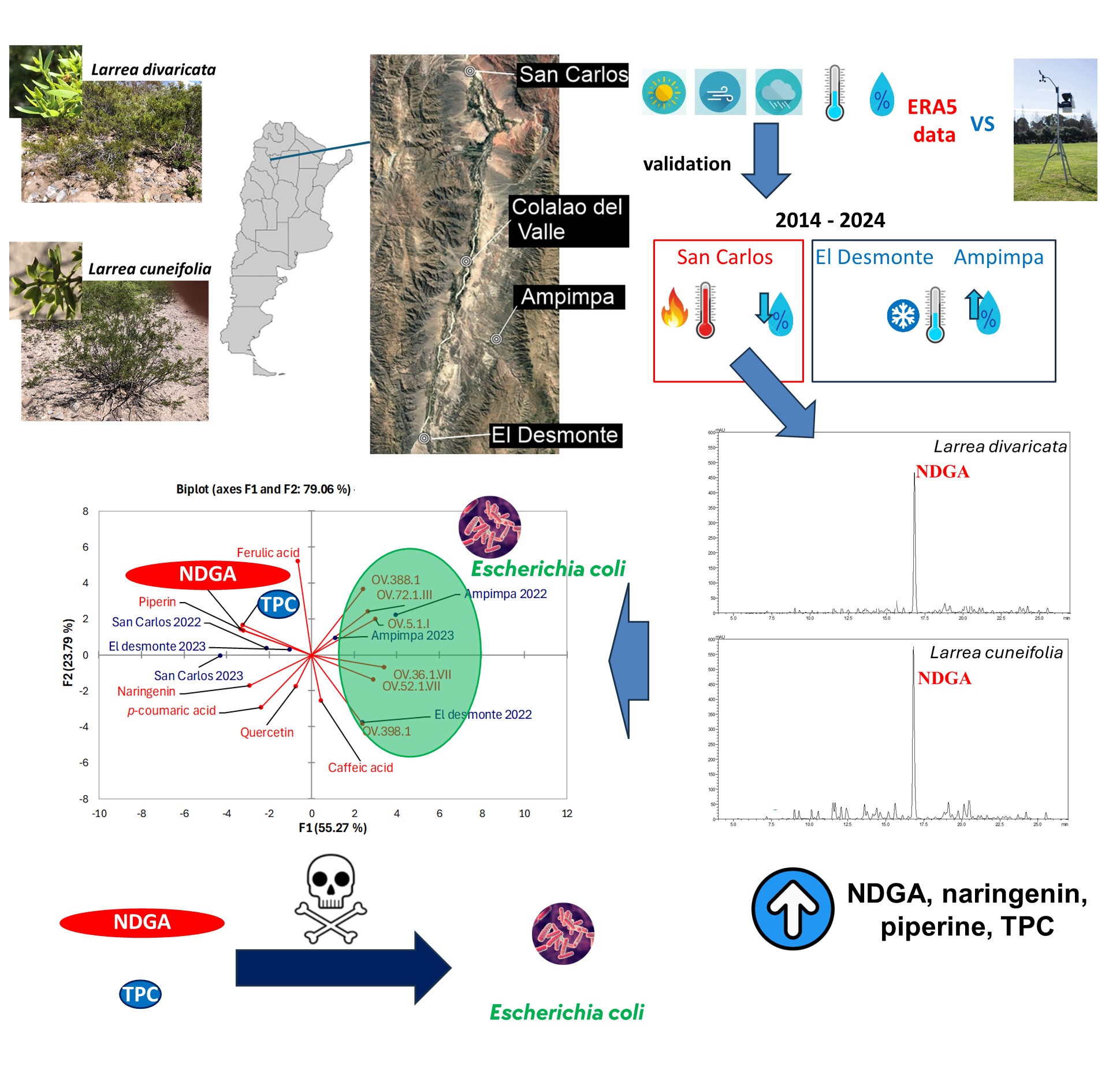
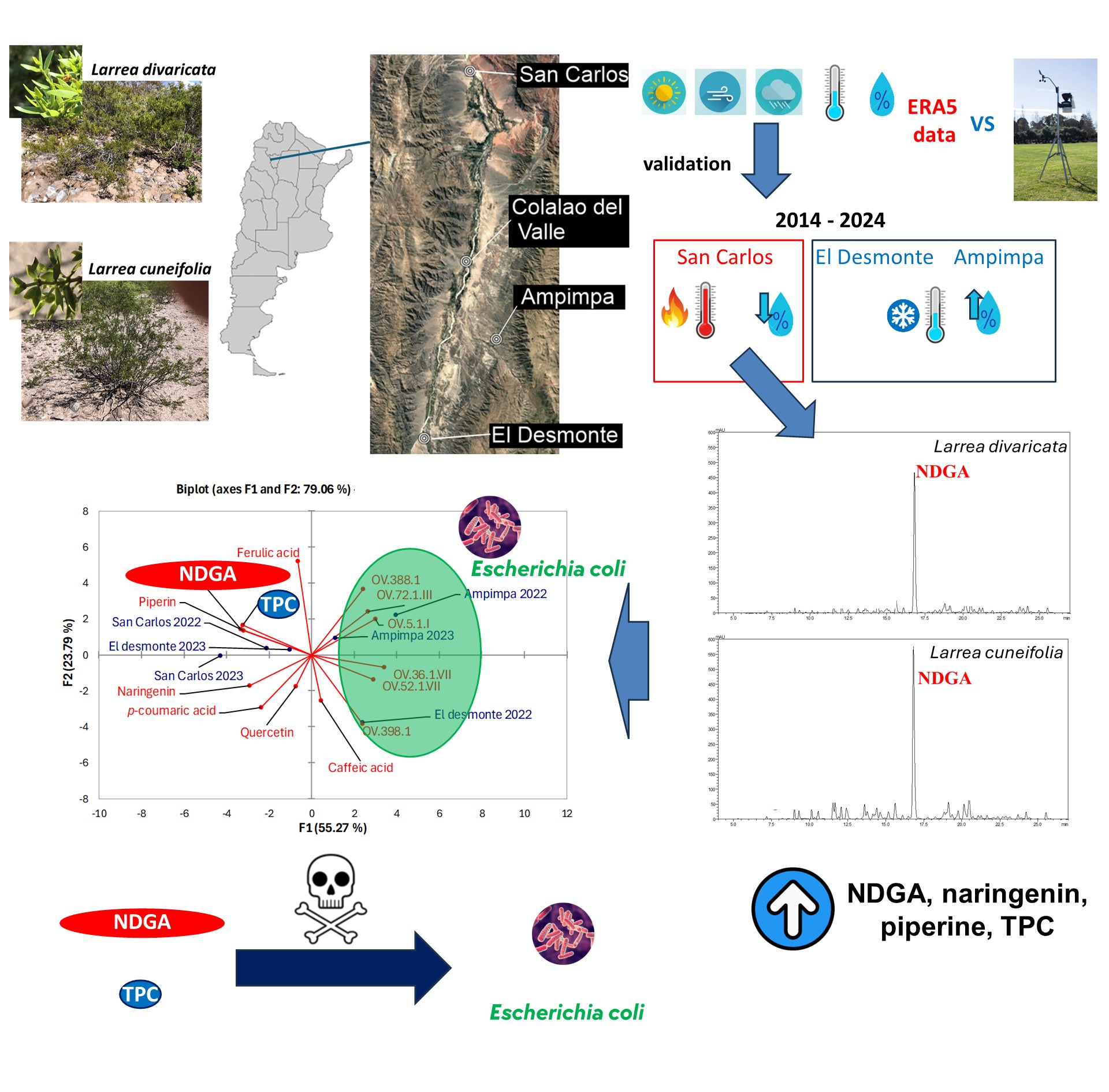
Larrea divaricata and L. cuneifolia are medicinal plants from arid zones of Argentina whose aerial parts vary in phytochemical composition, complicating raw material standardization. This study explored ERA5 meteorological reanalysis to characterize the relationship between environmental patterns, phytochemical variability, and antibacterial activity. Nine marker compounds and total phenolic content (TPC) were quantified in extracts from aerial parts collected at San Carlos, El Desmonte and Ampimpa in the Calchaquí Valleys during February 2022 and 2023. Monthly ERA5 data for temperature, relative humidity, and precipitation showed robust correlations (r = 0.89-0.99) with local weather station measurements, unlike direct solar radiation and wind speed. Analysis of historical ERA5 data (2014-2024) identified warmer and drier conditions as the primary driver for higher levels of marker compounds, with plant samples from San Carlos showing the highest accumulations in both Larrea species. Extracts from plants under such conditions showed the strongest antibacterial activity against Escherichia coli strains causing lamb diarrhea. This bioactivity was inversely correlated to NDGA (nordihydroguaiaretic acid) and TPC contents (r = -0.60 to -0.96). ERA5 data are proposed for pre-selection of collection sites under persistent stress, guaranteeing plant materials suitable for the development of veterinary products.
Highlights:
- ERA5 validates temperature, humidity, and rainfall in Calchaquí Valleys.
- Warmer and drier conditions increase secondary metabolites in Larrea.
- San Carlos showed the highest levels of NDGA and total phenolic content.
- Extracts under climate stress have higher bioactivity against coli.
- ERA5 data helps pre-select collection sites under persistent stress.
Downloads
References
Anderegg, W. R., Schwalm, C., Biondi, F., Camarero, J. J., Koch, G., Litvak, M., Ogle, K., Shaw, J. D., Shevliakova, E., Williams, A. P., Wolf, A., Ziaco, E., & Pacala, S. (2015). Pervasive drought legacies in forest ecosystems and their implications for carbon cycle models. Science, 349, 528-532. https://doi.org/10.1126/science.aab1833
Barrera, M. C., Rosa, M. D., Zampini, I. C., & Isla, M. I. (2025). Impact of daily and seasonal variation on the phytochemical profile of Larrea cuneifolia in Northwestern Argentina. Plants, 14(21), 3332. https://doi.org/10.3390/plants14213332
Blanco Crivelli, X., Bonino, M. P., Sanin, M. S., Petrina, J. F., Disalvo, V. N., Massa, R., Miliwebsky, E., Navarro, A., Chinen, I. & Bentancor, A. (2021). Potential zoonotic pathovars of diarrheagenic Escherichia coli detected in lambs for human consumption from Tierra del Fuego, Argentina. Microorganisms, 11, 1710. https://doi.org/10.3390/microorganisms9081710
Boiteux, J.; Fernández, M. de los Á.; Espino, M.; Silva, M. F.; Pizzuolo, P. H. & Lucero, G. S. (2023). In vitro and in vivo efficacy of Larrea divaricata extract for the management of Phytophthora palmivora in olive trees. Revista de la Facultad de Ciencias Agrarias. Universidad Nacional de Cuyo. 55(2): 97-107. https://doi.org/10.48162/rev.39.112
Conta, A., Simirgiotis, M. J., Martinez Chamás, J., Isla, M. I., & Zampini, I. C. (2025). Extraction of bioactive compounds from Larrea cuneifolia Cav. using natural deep eutectic solvents: A contribution to the plant green extract validation of its pharmacological potential. Plants, 14(7), 1016. https://doi.org/10.3390/plants14071016
Denney, D., Jameel, M., Bemmels, J., Bemmels, J., Rochford, M., & Anderson, J. (2020). Small spaces, big impacts: contributions of micro-environmental variation to population persistence under climate change. AoB Plants, 12(2), plaa005. https://doi.org/10.1093/aobpla/plaa005
Espino, M., Solari, M., Fernández, M. L. Á., Boiteux, J., Gómez, M. R., & Silva, M. F. (2019). NADESmediated folk plant extracts as novel antifungal agents against Candida albicans. Journal of Pharmaceutical and Biomedical Analysis, 167, 15-20. https://doi.org/10.1016/j. jpba.2019.01.026
Fernández, M. E.; Cony, M. A. & Passera, C. B. (2019). Germination temperatures and seed dormancy of two Larrea species (Zygophyllaceae) from the Monte Desert, Argentina a species. Revista de la Facultad de Ciencias Agrarias. Universidad Nacional de Cuyo. 51(2): 235-247.
Gómez, J., Simirgiotis, M. J., Manrique, S., Piñeiro, M., Lima, B., Bórquez, J., Feresin, G. E., & Tapia, A. (2021). UHPLC-ESI-OT-MS phenolics profiling, free radical scavenging, antibacterial and nematicidal activities of “Yellow-Brown Resins” from Larrea spp. Antioxidants, 10(2), 185. https://doi.org/10.3390/antiox10020185
Herrera-Medina, R. E., Álvarez-Fuentes, G., Contreras-Servín, C., & García-López, J. C. (2021). Creosote Bush (Larrea tridentata) phytochemical traits and its different uses: A review. Journal of Applied Life Sciences International, 24(2), 34-45. https://doi.org/10.9734/JALSI/2021/V24I230221
Hersbach, H., Bell, B., Berrisford, P., Hirahara, S., Horányi, A., Muñoz-Sabater, J., Radu, R., Schepers, D., Simmons, A., Soci, C., Abdalla, S., Abellan, K., Balsamo, G., Balsamo, G., Diamantakis, M., Dragani, M., Flemming, J., Forbes, A., Haiden, M. & Thépaut, J. (2020). The ERA5 global reanalysis. Quarterly Journal of the Royal Meteorological Society, 146(730), 1999-2049. https://doi.org/10.1002/qj.3803
Jiang, H., Yang, Y., Bai, Y., & Wang, H. (2020). Evaluation of the total, direct, and diffuse solar radiations from the ERA5 reanalysis data in China. IEEE Geoscience and Remote Sensing Letters, 17(1), 47-51. https://doi.org/10.1109/LGRS.2019.2916410
Karaman, Ç., & Akyürek, Z. (2023). Evaluation of near-surface air temperature reanalysis datasets and downscaling with machine learning based random forest method for complex terrain of Turkey. Advances in Space Research, 71(12), 5256-5281. https://doi.org/10.1016/j.asr.2023.02.006
Lorenzo, M. E., Gómez, P. E., Segovia, A. F., Quiroga, A., Figueroa, L. C., & Baroni, M. V. (2019). Phenolic content and antioxidant activity of ethanolic extracts of Larrea divaricata Cav., Larrea cuneifolia Cav. and Sarcomphalus mistol (Griseb.) Hauenschild, coming from different areas of the Catamarca central valley. Revista del CIZAS, 20, 31-51. https://doi.org/10.3390/foods_2020-07645
Morales-Ubaldo, A. L., Rivero-Perez, N., Valladares-Carranza, B., Madariaga-Navarrete, A., Higuera-Piedrahita, R. I., Delgadillo-Ruiz, L., Bañuelos-Valenzuela, R., & Zaragoza-Bastida, A. (2022). Phytochemical compounds and pharmacological properties of Larrea tridentata. Molecules, 24(17), 5393. https://doi.org/10.3390/molecules27175393
Moreno, M. A., Córdoba, S., Zampini, I. C., Mercado, M. I., Ponessa, G., Sayago, J. E., Pino Ramose, L. L., Schmeda-Hirschmann, G., & Isla, M. I. (2018). Argentinean Larrea dry extracts with potential use in vaginal Candidiasis. Natural Product Communications, 13(2), 171-174. https://doi.org/10.1177/1934578X1801300215
Moreno, M. A., Zampini, I. C., & Isla, M. I. (2020). Antifungal, anti-inflammatory and antioxidant activity of bi-herbal mixtures with medicinal plants from Argentinean highlands. Journal of Ethnopharmacology, 253, 112642. https://doi.org/10.1016/j.jep.2020.112642
Sun, J., Chen, W., & Yuan, Z. (2022). Characterization of Intestinal Microbiota in Lambs with Different Susceptibility to Escherichia coli F17. Veterinary Sciences, 9(12), 670. https://doi.org/10.3390/vetsci9120670
Sun, W., & Shahrajabian, M. H. (2023). Therapeutic potential of phenolic compounds in medicinal plants-natural health products for human health. Molecules, 28(4), 1845. https://doi.org/10.3390/molecules28041845
Tarek, M., Brissette, F., & Arsenault, R. (2020). Evaluation of the ERA5 reanalysis as a potential reference dataset for hydrological modelling over North America. Hydrology and Earth System Sciences, 24(5), 2527-2544. https://doi.org/10.5194/hess-24-2527-2020
Vanoye-Lara, F. F., Pinos-Rodríguez, J. M., García-López, J. C., López-Aguirre, S., Vicente-Martínez, J. G., & Flores-Primo, A. (2025). Larrea tridentata as a feed additive to improve liver development and functionality in broilers. Revista Mexicana de Ciencias Pecuarias, 16(2), 446-454. https://doi.org/10.22319/rmcp.v16i2.6540
Vaou, N., Stavropoulou, E., Voidarou, C., Tsakris, Z., Rozos, G., Tsigalou, C., & Bezirtzoglou, E. (2022). Interactions between medical plant-derived bioactive compounds: focus on antimicrobial combination effects. Antibiotics, 11(8), 1014. https://doi.org/10.3390/antibiotics11081014
Varela, M. C., Arslan, I., Reginato, M. A., Cenzano, A. M., & Luna, M. V. (2016). Phenolic compounds as indicators of drought resistance in shrubs from Patagonian shrublands (Argentina). Plant Physiology and Biochemistry, 104, 81-91. https://doi.org/10.1016/j.plaphy.2016.03.014
Visser, J. A., Yager, D., Chambers, S. A., Lim, J. Y., Cao, X., & Cegelski, L. (2023). Nordihydroguaiaretic acid inhibits CsgA polymerization, bacterial amyloid biogenesis, and biofilm formation. Chembiochem, 24(11), e202300266. https://doi.org/10.1002/cbic.202300266
Wang, J., Li, Z., Liang, Y., & Ke, J. (2025). An assessment of the applicability of ERA5 reanalysis boundary layer data against remote sensing observations in mountainous Central China. Atmosphere, 16(10), 1152. https://doi.org/10.3390/atmos16101152
Wei, Y., Sun, Y., Ma, Y., Tan, Y., Ren, X., Peng, K., Yang, S., Lin, Z., Zhou, X., Ren, Y., Ahmed, M., Tian, Y., Xin, J. & Xin, J. (2025). Deviations of boundary layer height and meteorological parameters between ground-based remote sensing and ERA5 over the complex terrain of the Mongolian Plateau. Remote Sensing, 17(3), 393. https://doi.org/10.3390/rs17030393
Zeballos, S. R., Acosta, A. R. T., Agüero, W. D., Ahumada, R. J., Almirón, M. G., Argibay, D. S., Arroyo, D. N., Blanco, L. J., Biurrun, F. N., Cantero, J. J., Márquez, J., Quiroga, A., Quiroga, R. E., Cabido, M. R. & Cabido, M. R. (2023). Vegetation types of the Arid Chaco in Central Western Argentina. Vegetation Classification and Survey, 4, 167-188. https://www.doi.org/10.3897/VCS.100532
Zhang, C., Yang, D., Liang, Z., Liu, J., Yan, K., Zhu, Y., & Yang, S. (2019). Climatic factors control the geospatial distribution of active ingredients in Salvia miltiorrhiza Bunge in China. Scientific Reports, 9, 1-10. https://doi.org/10.1038/s41598-018-36729-xº
Published
How to Cite
Issue
Section
License

This work is licensed under a Creative Commons Attribution-NonCommercial-ShareAlike 3.0 Unported License.
Authors who publish with this journal accept the Editorial Policies.
 RevFCAUNCuyo