
Resistance to Puccinia graminis f. sp. avenae in Oat Genotypes and Challenges for Genetic Breeding in Argentina
DOI:
https://doi.org/10.48162/rev.39.226Palabras clave:
roya del tallo en avena, genes pg, resistencia en plántula , Avena sativa, mejoramiento de la resistencia a royasResumen
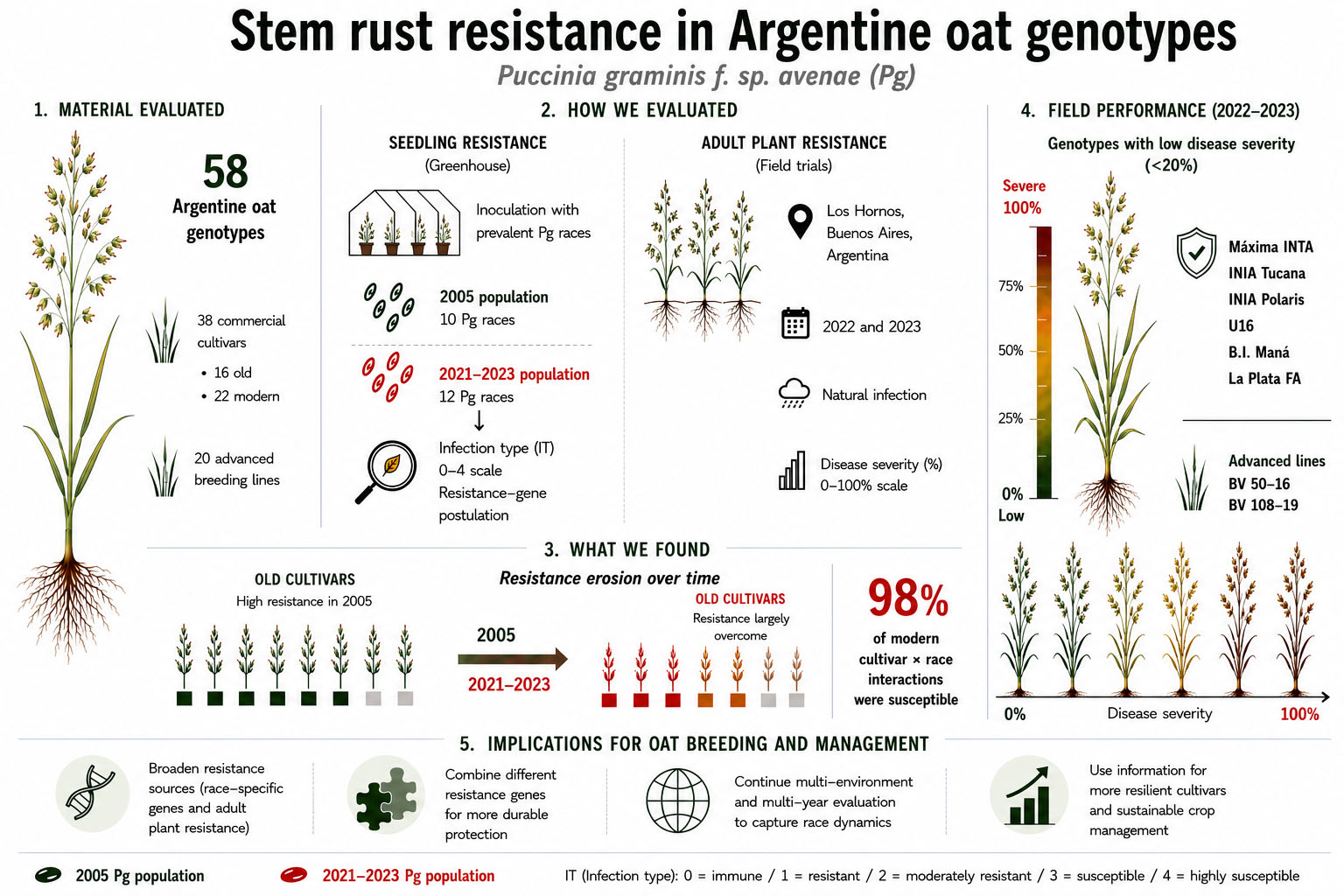
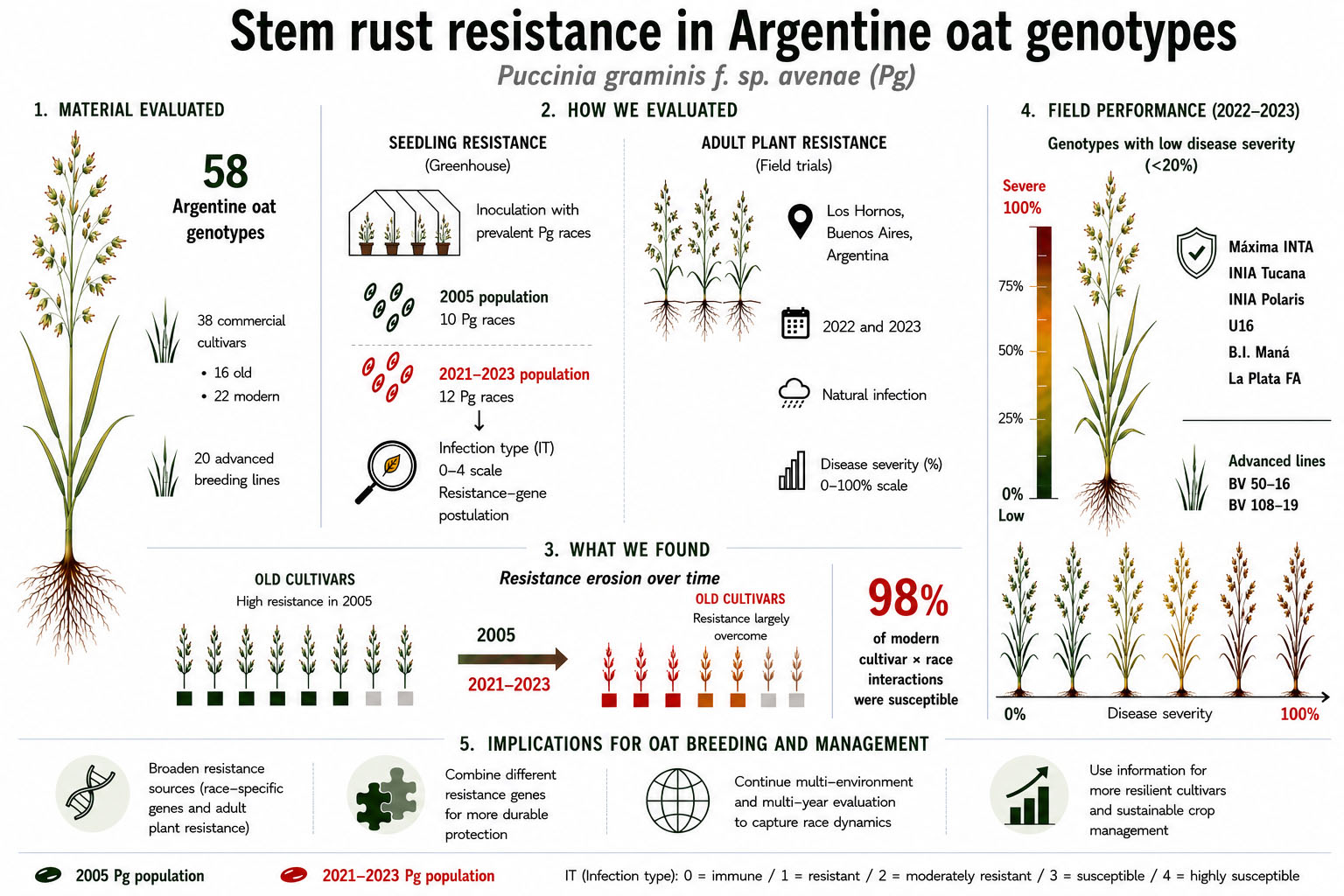
Oat stem rust caused by Puccinia graminis f. sp. avenae (Pg) significantly threatens oat cultivation globally and in some areas of Argentina, emphasizing the importance of studying local germplasm resistance. We evaluated 38 Argentine oat cultivars (16 old, 22 modern) and 20 breeding lines against prevalent Pg races (2005, 2021, 2022, and 2023) in both seedlings (greenhouse) and adult plants (field trials). We postulate several candidate genes (Pg3, Pg9, Pg10, Pg15, and Pga) in the tested germplasm. Seedling assays revealed a shift in cultivar resistance, with older cultivars becoming increasingly susceptible to recent Pg populations. Modern cultivars and lines exhibited limited seedling resistance, highlighting the vulnerability of current germplasm. Adult plant results showed variations in disease severity in some genotypes among years, suggesting shifts in Pg race prevalence and virulence. Resistance observed in cultivars such as Milagros, Payé, Aikén, and Yapa to specific races at the seedling stage may explain their favorable performance in certain seasons. Moreover, cultivars such as Máxima, Tucana, Polaris, U16, Maná, La Plata FA, and some lines showed severity values below 20% in the field. The findings provide useful insights into oat breeding programs and crop management strategies.
Highlights:
- Resistance to oat stem rust was evaluated in 58 Argentine oat genotypes using historical and recent populations of Puccinia graminis sp. avenae.
- Resistance genes Pg10, Pga, Pg9, Pg3, and Pg15were postulated in cultivars and advanced breeding lines.
- Old cultivars showed substantial losses in seedling resistance against recent pathogen races.
- Modern cultivars and breeding lines exhibited limited seedling resistance, revealing the vulnerability of modern oat germplasm.
- Máxima INTA, INIA Tucana, INIA Polaris, U16, B.I. Maná, and several breeding lines showed consistently low stem rust severity under field conditions.
Descargas
Citas
Ahmad, A.; Anjum, F. M.; Zahoor, T.; Nawaz, H.; Ahmed, Z. 2010. Extraction and characterization of β-glucan from oat for industrial utilization. International Journal of Biological Macromolecules. 46: 304-309.
Anderson, J. W.; Baird, P.; Davis, R. H.; Ferreri, S.; Knudtson, M.; Koraym, A.; Walters, V.; Williams, C. L. 2009. Health benefits of dietary fiber. Nutrition reviews. 67:188-205.
Balzarini, M. G.; Di Rienzo, J. A. 2016. InfoGen versión 2016. FCA. Universidad Nacional de Córdoba. Argentina. https://www.info-gen.com.ar/
Boshoff, W. H.; Visser, B.; Terefe, T.; Pretorius, Z. A. 2019. Diversity in Puccinia graminis f. sp. avenae and its impact on oat cultivar response in South Africa. European journal of plant pathology. 155: 1165-1177.
Campos, P.; Gimenez, F.; Tomaso, J.; Brach, A. 2008. Caracterización de la población patógena de Puccinia coronata (Roya de la hoja de la avena), en las campañas 2004-05-06 y comportamiento de cultivares frente al patógeno. VII Congreso Nacional de Trigo. V Simposio Nacional de Cereales de Siembra Otoño-Invernal. I Encuentro del MERCOSUR. Santa Rosa. La Pampa. p. SO4. https://www.researchgate.net/publication/371632340_Caracterizacion_de_la_poblacion_patogena_de_Puccinia_coronata_roya_de_la_hoja_de_la_avena_en_las_campanas_2004-05-06_y_comportamiento_de_cultivares_frente_al_patogeno
Campos, P.; Gimenez, F. 2011. Caracterización de la población patógena de Puccinia graminis f.sp. avenae, agente causal de roya del tallo de avena en Argentina en los años 2007-2008 y 2009. Actas del 2º Congreso Argentino de Fitopatología. p. 198. https://aafitopatologos.com.ar/wp/wp-content/uploads/2014/11/Libro-de-res%C3%BAmenes-2%C2%B0-CAF.pdf
Carson, M. L. 2011. Virulence in oat crown rust (Puccinia coronata f. sp. avenae) in the United States from 2006 through 2009. Plant Disease. 95:1528-1534. https://doi.org/10.1094/PDIS-09-10-0639
Chong, J.; Gruenke, J.; Dueck, R.; Mayert, W.; Fetch, J. M.; Mccartney, C. 2011. Virulence of Puccinia coronata f sp. avenae in the Eastern Prairie Region of Canada during 2007-2009. Canadian Journal of Plant Pathology. 33: 77-87.
Dietz, J. I. 2018. Características de sanidad, rendimiento y calidad en genotipos de avena en filiales avanzadas de un programa de mejoramiento. Trabajo final de Maestría en Protección vegetal. Universidad Nacional de La Plata. 153p. https://doi.org/10.35537/10915/68021
Dietz, J. I.; Schierenbeck, M.; Simón, M. R. 2019. Impact of foliar diseases and its interaction with nitrogen fertilization and fungicides mixtures on green leaf area dynamics and yield in oat genotypes with different resistance. Crop Protection. 121: 80-88. https://doi.org/10.1016/j.cropro.2019.03.017
Dietz, J. I.; Da Silva, L.; Schierenbeck, M.; Simón, M. R. 2022. Shading in the late stem elongation period generate the greatest grain yield reduction in oat (Avena sativa L.). Archives of Agronomy and Soil Science. 69(10): 1906-1919. https://doi.org/10.1080/03650340.2022.2126458
Dietz, J. I.; Da Silva, L. V.; Simón, M. R.; Campos, P. 2023. Evolution of the Puccinia coronata population in Argentina and identification of resistance genes useful in oat breeding programs. European Journal of Plant Pathology. https://doi.org/10.1007/s10658-023-02775-z
Dietz, J. I.; Da Silva, L. V.; Simón, M. R.; Campos, P. 2025a. Virulence characterization of Puccinia graminis f. sp. avenae in Argentina. European Journal of Plant Pathology. 172: 305-314. https://doi.org/10.1007/s10658-025-03004-5
Dietz, J. I.; Da Silva, L. V.; Schierenbeck, M.; Pardi, M.; Simón, M. R. 2025b. Photoperiod and vernalization requirements in Argentinian oat genotypes. Agronomy Journal. 117(3): e70078. https://doi.org/10.1002/agj2.70078
FAO (Food and Agriculture Organization of the United Nations). 2024. Food and agriculture data. http://www.fao.org/
Fetch, T. G.; Jin, Y. 2007. Letter code system of nomenclature for Puccinia graminis f.sp. avenae. Plant Disease. 91: 763-766. https://doi.org/10.1094/PDIS-91-6-0763
Gallaher, D. D. 2000. Dietary fiber and its physiological effects. In: M Schmidt & T Labuza (eds) Essentials of functional foods. Aspen Publishers, Inc. 271-292.
Gnocato, F. S. 2017. Ferrugem do colmo da aveia: fatores genéticos da virulência do patógeno e da resistência do hospedeiro. Tesis de Doctorado en Fitotecnia. Universidade Federal Do Rio Grande Do Sul. 113p. http://hdl.handle.net/10183/163923
Harder, D. 1994. Identification of new races of Puccinia graminis f.sp. avenae. Plant Disease. 78: 367-368.
Head, D. S.; Cenkowski, S.; Arntfield, S.; Henderson, K. 2010. Superheated steam processing of oat groats. LWT. Food Science Technology. 43: 690-694.
Huerta-Espino, J.; Ramírez-Ramírez, E. E.; Leyva-Mir, S. G.; Villaseñor-Mir, H. E.; Santa-Rosa, R. H.; Martínez-Cruz, E.; Rodríguez-García, M. F. 2022. Resistance evaluation of oat genotypes to stem rust (Puccinia graminis f. sp. avenae). Mexican Journal of Phytopathology. 40: 221-229. https://doi.org/10.18781/R.MEX.FIT.2202-1
Leonard, K. J. 2002. Oat lines with effective adult plant resistance to crown rust. Plant Disease, 86: 593-598.
Leyva, M. S.; Espitia, R. E.; Villaseñor, M. H. E.; Huerta, E. J. 2004. Pérdidas ocasionadas por Puccinia graminis f. sp. avenae Ericks. & Henn., causante de la roya del tallo en seis cultivares de avena (Avena sativa L.) en Valles Altos de México. Revista Mexicana de Fitopatología. 22:166-171. https://www.redalyc.org/pdf/612/61222202.pd
Li, T.; Xu, Y.; Zhang, X.; Wu, X.; Zhang, Y.; Xuan, Y.; Wang S. 2022. Virulence Characterization of Puccinia graminis f. sp. avenae and Resistance of Oat Cultivars in China. Plant Disease. 106: 901-905. https://doi.org/10.1094/PDIS-06-21-1239-RESECTIONSABSTRACTPDFSUPPLEMENTAL
MAGyP (Ministerio de Agricultura, Ganadería y Pesca). 2024. Estimaciones agrícolas. http://datosestimaciones.magyp.gob.ar/reportes.php?reporte=Estimaciones
Mariscal, A. L.; Huerta, E. J.; Villaseñor, M. H.; Leyva, M. S.; Sandoval, I. J.; Benítez, R. I. 2011. Selección de genotipos de avena para la identificación de razas de roya del tallo. Revista Mexicana de Ciencias Agrícolas. 2: 593-600. https://doi.org/10.29312/remexca.v2i4.1646
Martens, J. 1985. Oat stem rust. In: The cereal rusts. Roelfs A & Bushnell W (eds). Elsevier. 103-129.
Martinelli, J. 2000. Major diseases on oats in South America. In: Proc. VI International Oat Conference. Canterburry. p. 277-283.
Meldrum, S.; Oates, J. D. 1997. Oat stem rust. Annual report, Cereal Rust Survey 1996-97. Cobbity, University of Sydney. Camden: Plant Breeding Institute. p. 11-13.
Mideksa, T.; Fininsa, C.; Hundie, B. 2018. Analysis of climate variability effects on wheat stem rust (Puccinia graminis f. sp tritici) epidemics in Bale and Arsi Zones of Oromia Regional State, Ethiopia. American Journal of Biological and Environmental Statistics, 4: 49-65.
Person, C. 1966. Genetic polymorphism in parasitic systems. Nature. 212: 266-267.
Peterson, R.; Campbell, A.; Hannah, A. 1948. A diagrammatic scale for estimating rust intensity on leaves and stems of cereals. Canadian Journal of Research. 26: 496-500. https://doi.org/10.1139/cjr48c-033
Rasane, P.; Jha, A.; Sabikhi, L.; Kumar, A.; Unnikrishnan, V. S. 2015. Nutritional advantages of oats and opportunities for its processing as value added foods-a review. Journal of food science and technology. 52: 662-675.
Roelfs, A. P.; Long, D. L. 1980. Analysis of recent oat stem rust epidemics. Phytopathology. 70: 436-440.
Stakman, E. C.; Stewart, D. M.; Loegering, W. Q. 1962. Identification of physiologic races of Puccinia graminis var. tritici. Agricultural Research Service Technical Bulletin. No. E-617.
Steinberg, J. G.; Fetch, J. M.; Fetch Jr., T.G. 2005. Evaluation of Avena spp. accessions for resistance to oat stem rust. Plant disease. 89: 521-525.
Van Niekerk, B. D.; Pretorius, Z. A.; Boshoff, W. H. P. 2001. Potential yield losses caused by barley leaf rust and oat leaf and stem rust to South African barley and oat cultivars. South African Journal of Plant and Soil. 18: 108-113.
Villaseñor, M. H.; Huerta, E. J.; Rodríguez, G. M.; Hortelano, S. R.; Espitia, R. E.; Martínez, C. E. 2021. Mejoramiento genético de avena en México. Revista Mexicana de Ciencias Agrícolas. Publicación especial. 25: 21-25. https://doi.org/10.29312/remexca.v12i25.2808
Wehrhahne, L.; Storm, A. 2014. Evaluación de avena para producción de grano. http://inta.gob.ar/sites/default/files/script-tmp-inta_barrow_-_evaluacin_de_avena
Zadoks, J. C.; Chang, T.; Konzak, C. 1974. A decimal code for the growth stages of cereals. Weed Research. 14: 415-421.
Descargas
Publicado
Cómo citar
Número
Sección
Licencia

Esta obra está bajo una licencia internacional Creative Commons Reconocimiento-NoComercial-CompartirIgual 3.0.
Aquellos autores/as que tengan publicaciones con esta revista, aceptan las Políticas Editoriales.
 RevFCAUNCuyo