
Comparison of fatty acid profiles of sacha inchi oil (Plukenetia huayllabambana), sesame oil (Sesamum indicum), and peanut oil (Arachis hypogaea) using two extraction methods for food purposes
DOI:
https://doi.org/10.48162/rev.39.181Palabras clave:
ácidos grasos, agroalimentario, monoinsaturados, poliinsaturados, saturados, oleaginosasResumen
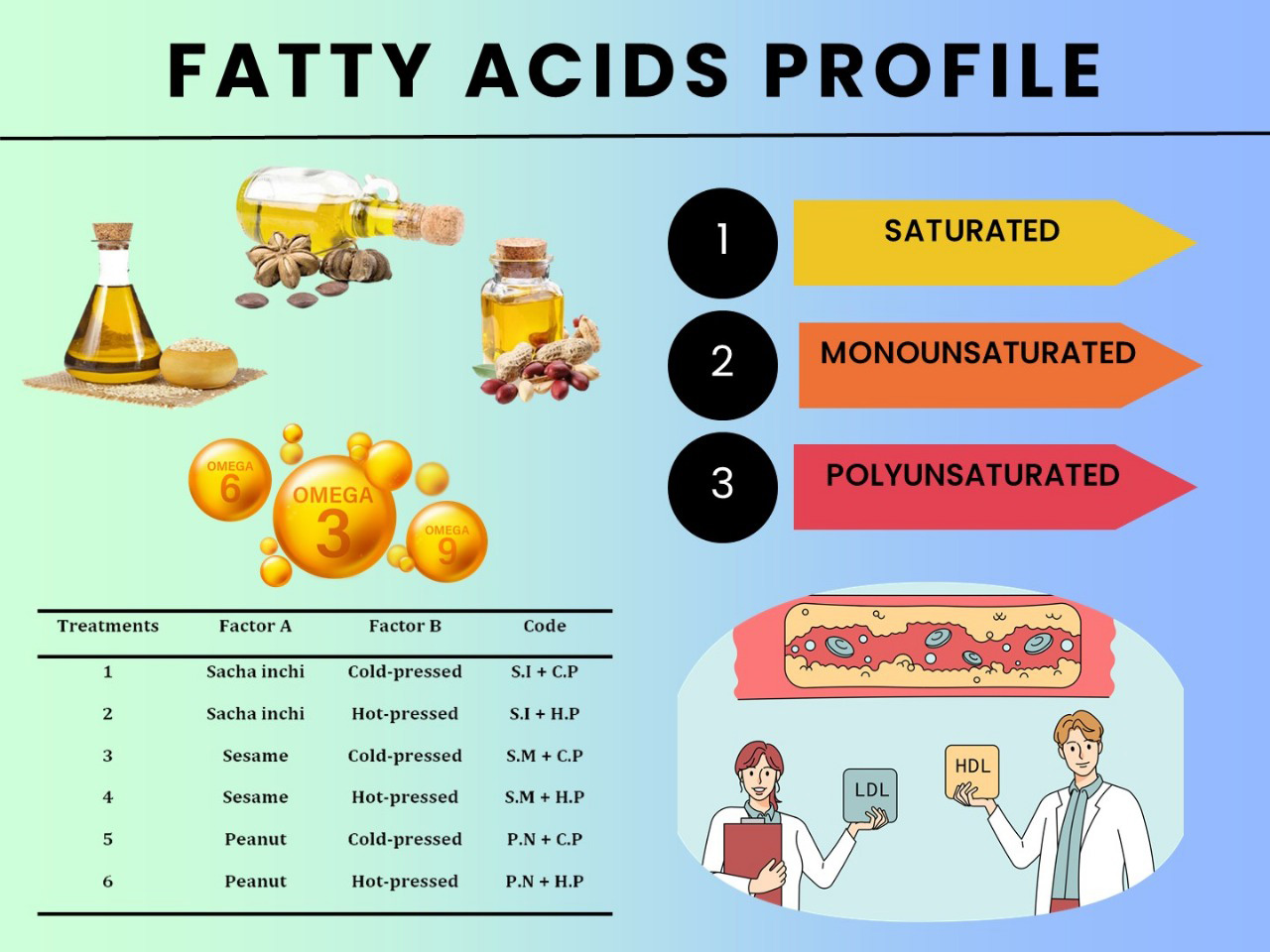
Vegetable oil consumption has increased in recent decades due to the high content of monounsaturated (Omega 9) and polyunsaturated (Omega 3 and 6) fatty acids. For this reason, this research compared the fatty acid profile of sacha inchi, sesame and peanut oils under two extraction methods for food purposes. A completely randomized experimental design considered an A*B factorial arrangement with 3 repetitions. Factor A corresponds to oilseed type and Factor B is extraction method. The results showed that both factors significantly influenced (p<0.05) bromatological characteristics (pH, acidity, peroxide value, relative density and ash). The lowest concentration of saturated fatty acids was obtained in sacha inchi oil + cold pressing (6.80 g/100 g), while monounsaturated fatty acids increased in peanut oil + hot pressing (51.51 g/100 g). Sacha inchi oil + cold pressing had the highest content of polyunsaturated fatty acids (84.36 g/100 g).
Highlights:
- Comparison of lipid profiles in sacha inchi, sesame, and peanut oils.
- Cold extraction preserves quality, hot extraction increases yield.
- Cold-pressed sacha inchi contains more polyunsaturated fatty acids.
- Hot-pressed peanut is more stable and has lower acidity.
- Sacha inchi provides omega-3, while peanut and sesame are more oxidation-stable.
Descargas
Citas
Abubakar, M.; Mohammed-Adewumi, A.; Amina-Ladidi, M.; Jibril -Hassan, L.; Agatha, N. 2024. Physicochemical properties of oil extracted from pumpkin (Cucurbita pepo) Seeds. Lafia Journal of Scientific & Industrial Research. 5-9. https://doi.org/10.62050/ljsir2024.v2n1.276
Akhtar, S.; Khalid, N.; Ahmed, I.; Shahzad, A.; Ansar, H.; Suleria. 2014. Physicochemical characteristics, functional properties, and nutritional benefits of peanut oil: A review. Critical Reviews in Food Science and Nutrition. 4. https://doi.org/10.1080/10408398.2011.644353
Alarcón-Rivera, R.; Pérez-Camino, M. C.; Chasquibol-Silva, N. 2019. Evaluation of the shelf life of microencapsulated sacha inchi oils (Plukenetia huayllabambana and Plukenetia volubilis). Journal of the Peruvian Chemical Society. 85(3). http://www.scielo.org.pe/scielo.php?script=sci_arttext&pid=S1810-634X2019000300005
Arab, R.; Casal, S.; Pinho, T.; Cruz, R.; Lamine Freidja, M.; Lorenzo, J.; Hano, C.; Mafani, K.; Makhlouf, L. 2022. Effects of seed roasting temperature on sesame oil fatty acid composition, lignan, sterol and
tocopherol contents, oxidative stability and antioxidant potential for food applications. Moleculas.
(4). https://doi.org/https://doi.org/10.3390/molecules27144508
Beshaw, T.; Demssie, K.; Tefera, M.; Guadie, A. 2022. Determination of proximate composition, selected
essential and heavy metals in sesame seeds (Sesamum indicum L.) from Ethiopian markets and
assessment of the associated health risks. Toxicology Reports, 1806-1812. https://doi.org/10.1016/j.
toxrep.2022.09.009
Bocanegra-Morales, N.; Galeano-Garcia, P. 2023. Chemical composition, fatty acid profile, and optimization of the sacha inchi (Plukenetia volubilis L.) seed-roasting process using response surface methodology: Assessment of oxidative stability and antioxidant activity. Foods. 12(18). https://doi.org/https://doi.org/10.3390%2Ffoods12183405
Bonku, R.; Yu, J. 2020. Health aspects of peanuts as an outcome of its chemical composition. Food Science and Human Wellness. 9(1): 21-30. https://doi.org/10.1016/j.fshw.2019.12.005
Bravo, A.; Navarro, E.; Rincón, C.; Soriano, M. 2018. Physicochemical characteristics and fatty acid profile of two cultivars. Revista de Ciencias Naturales y Agropecuarias. 5(15): 9-18. https://www.ecorfan.org/bolivia/researchjournals/Ciencias_Naturales_y_Agropecuarias/vol5num15/Revista_de_Ciencias_Naturales_y_Agropecuarias_V5_N15_3.pdf
Edmund, H.; Sam, P. 2017. Anti-inflammatory and antioxidant effects of sesame oil on atherosclerosis: A descriptive literature review. Cureus. 9(7). https://doi.org/10.7759%2Fcureus.1438
FEN (Spanish Nutrition Foundation). 2013. White paper on nutrition in spain madrid: Spanish
Foundation. Spanish Food Safety and Nutrition Agency. https://www.sennutricion.org/
media/Docs_Consenso/Libro_Blanco_Nutricion_Esp-2013.pdf
Haile, M.; Duguma, H. T.; Chameno, G.; Kuyu, C. G. 2019. Effects of location and extraction solvent on
physico chemical properties of Moringa stenopetala seed oil. Heliyon. 5(11). https://doi.org/10.1016/j.heliyon.2019.e02781
Hu, T.; Zhou, L.; Kong, F.; Wang, S.; Hong, K.; Lei, F.; He, D. 2023. Influence of oilseed type and extraction method on free fatty acid content in vegetable oils. Foods. 12(18): 3351.
https://doi.org/https://doi.org/10.3390/foods12183351
ICONTEC (Instituto Colombiano de Normas Técnicas). 2018. NTC 287:2018 - Animal and vegetable fats and oils. Determination of moisture and volatile matter content. Animal and vegetable fats and
oils. Determination of moisture and volatile matter content. https://tienda.
icontec.org/gp-grasas-y-aceites-animales-y-vegetales-determinacion-del-contenido-dehumedad-y-materia-volatil-ntc287-2018.html
INEN (Ecuadorian Institute for Standardization). 1973. Ecuadorian Technical Standard 0038. Edible fats and oils. Determination of acidity. Ecuadorian standardization service.
https://www.academia.edu/8969698/NTE_INEN_0038_Grasas_y_aceites_comestibles_
Determinaci%C3%B3n_de_la_acidez
INEN (Ecuadorian Institute for Standardization). 1978. Ecuadorian Technical Standard 277.
Fats and oils. Determination of the Peroxide Index. Ecuadorian standardization service.
https://es.scribd.com/document/405847035/Inen-277-Indice-de-Peroxido
INEN (Ecuadorian Institute for Standardization). 2012. Ecuadorian Technical Standard 0035.
Animal and vegetable oils and fats determination of relative density. Ecuadorian standardization service. https://es.scribd.com/document/339261140/NTE-INEN-35-1#:~:text=informaci%C3%B3n%20del%20documento-,Esta%20norma%20describe%20el%20m%C3%A9todo%20del%20picn%C3%B3metro%20para%20determinar%20la,relativa%20utilizando%20una%20f%C3%B3rmula%20dada.
INEN (Ecuadorian Institute for Standardization). 2012. Ecuadorian Technical Standard 34.
Blend of edible vegetable oils. Requirements. Ecuadorian standardization service.
https://es.scribd.com/document/339261140/NTE-INEN-35-https://es.scribd.com/
document/534182662/nte-inen-34-2-Mezcla-de-aceites
Kittibunchakul, S.; Hudthagosol, C.; Sanporkha, P.; Sapwarobol, S.; Temviriyanukul, P.;
Suttisansanee, U. 2022. Evaluation of sacha inchi (Plukenetia volubilis L.) by-products as
valuable and sustainable sources of health benefits. Horticulturae. 344: 8. https://doi.
org/https://doi.org/10.3390/horticulturae8040344
León-Sánchez, G.; Monteagudo-Borges, R.; Rodríguez-Jiménez, E. 2022. Characterization of the oil
extraction process of Moringa oleifera in relation to seed type. Tecnología Química. 42(1).
http://scielo.sld.cu/scielo.php?script=sci_arttext&pid=S2224-61852022000100024
Misganaw- Gedlu, A.; Amare -Aregahegn, D.; Atlabachew, M.; Abebe, W. 2021. Fatty acid composition, total phenolic contents and antioxidant activity of white and black sesame seed varieties from different localities of Ethiopia. Chemical and Biological Technologies in Agriculture. 8(1). https://doi.org/https://doi.org/10.1186/s40538-021-00215-w
Mohamed, A.; Ferhat, B.; Meklati, F. C. 2007. Comparison of different extraction methods: cold pressing, hydrodistillation, and solvent free microwave extraction, used for the isolation of
essential oil from Citrus fruits. Journal of Chromatography A. 1210(2): 139-147. https://
doi.org/10.1016/j.chroma.2008.09.085.
Montero-Torres, J. 2020. Nutritional and economic importance of peanut (Arachis hypogaea L.).
Journal of Agricultural Research and Innovation. 7(2). http://www.scielo.org.bo/scielo.
php?pid=S240916182020000200014&script=sci_abstract
Nagendra-Prasad, M.; Sanjay, K.; Deepika, S.; Vijay, N.; Kothari, R.; Nanjunda-Swamy, S. 2012. A
review on nutritional and nutraceutical properties of sesame. Nutrition & Foods Sciences. 2(127). https://doi.org/http://dx.doi.org/10.4172/2155-9600.1000127
Neira Mosquera, J. A.; Coello Culluzpuma, A.; Sanche LLaguno, S. N.; Plua Montiel, J.; Viteri García, I. P. 2021. Study on the effect of variety and extraction conditions of avocado (Persea americana) oil for food purposes in Ecuador. Clinical Nutrition and Hospital Dietetics. 94-98. https://www.revistanutricion.org/articles/study-of-the-effects-ofvariety-and-conditions-of-the-avocado-oil-persea-americana-extraction-process-forfood-purposes-.pdf
Neira-Mosquera, J. A.; Menéndez-Viteri, O. F.; Ullón-Arcia, J. A.; Sánchez-Llaguno, S. N. 2022. Study
of the vegetable oils of sacha inchi (Plukenetia huayllabambana), sesamum indicum and peanuts (Arachis hypogaea) and their influence on the preparation of “Frankfurt” type vegetable sausages, considering bromatological and organoleptic characteristic. Journal of Pharmaceutical Negative Results. 13(3): 623-627.
Oubannin, S.; Bijla, L.; Ahmed, M.; Ibourki, M.; El Kharrassi, Y.; Devkota, K.; Bouyahya, A.; Maggi, F.; Caprioli, G.; Sakar, E.; Gharby, S. 2024. Recent advances in the extraction of bioactive compounds from plant matrices and their use as potential antioxidants for vegetable oils enrichment. Journal of Food Composition and Analysis. 128. https://doi.org/https://doi.org/10.1016/j.jfca.2024.105995
Panpan Wei, F. W.; Xiaoyun, C.; Guige, H.; Qingguo, M. 2022. Sesame (Sesamum indicum L.): A
comprehensive review of nutritional value, phytochemical composition, health benefits, development of food, and industrial applications. Nutrients. 14(19): 4079. https://doi.org/10.3390/nu14194079
Peroné, J.; Ruiz-Gutiérrez, V.; Barrón, L. 1999. High performance liquid chromatography for the
separation of triglycerides from complex animal fats. Fats and Oils. 50(4): 298-311.
Rivera, M.; Ramos, M.; Silva, M.; Briceño, J.; Álvarez, M. 2022. Effect of pre-extraction temperature
on the yield and fatty acid profile of morete (Mauritia flexuosa L. F.) oil. La Granja. 35(1): 98-111. https://doi.org/10.17163/lgr.n35.2022.08
Rodríguez, G.; Villanueva, E.; Glorio, P.; Baquerizo, M. 2015. Oxidative stability and shelf life
estimation of sacha inchi (Plukenetia volubilis L.) oil. Scientia Agropecuaria. 6(3): 155-163.
http://dx.doi.org/10.17268/sci.agropecu.2015.03.02
Rodriguez Cruz, M.; Tovar Armando, R.; Del Prado, M.; Torres, N. 2005. Molecular mechanisms
of action of polyunsaturated fatty acids and their health benefits. Journal of Clinical Research. 57(3): 457-472. https://www.scielo.org.mx/pdf/ric/v57n3/v57n3a10.pdf
Romero- Hidalgo, L. E.; Valdiviezo- Rogel, C. J.; Bonilla -Bermeo, S. M. 2019. Characterization of sacha inchi (Plukenetia volubilis) seed oil from San Vicente, Manabí, Ecuador, obtained using non-thermal extrusion processes. La Granja. 30(2): 77-78. https://doi.org/https://doi.org/10.17163/lgr.n30.2019.07
Ruiz, S.; Sánchez, E.; Tabares Villareal, E.; Prieto, A.; Arias, J.; Gómez, R.; Castellanos, D.; García, P.; Chaparro, S. 2007. Biological and cultural diversity of the southern colombian amazon-diagnosis. Bogotá, Colombia: Coporamazonia, Humboldt Institute, Sinchi Institute. https://doi.org/https://repository.humboldt.org.co/entities/publication/a8f09059-7552-4fa8-968f-cd7a553af361
Schwingshackl, L.; Bogensberger, B.; Benčič, A.; Knüppel, S.; Boeing, H.; Hoffmann, G. 2018 . Effects
of oils and solid fats on blood lipids: a systematic review and network meta-analysis. J Lipid Res. 59(9): 1771-1782. https://doi.org/10.1194/jlr.p085522
Seid, F.; Mehari, B. 2022. Elemental and proximate compositions of sesame seeds and the underlying soil from Tsegede, Ethiopia. Int J Anal Chem. https://doi.org/10.1155%2F2022%2F1083196
Suri, K.; Singh, B.; Kaur, A.; Singh, N. 2019. Impact of roasting and extraction methods on chemical
properties, oxidative stability and maillard reaction products of peanut oils. J. Food Sci. Technol. 56: 2436-2445.
Torrejón, C.; Uauy, R. 2011. Fat quality, atherosclerosis and coronary heart disease: effects of
saturated fatty acids and trans fatty acids. Journal of Medicine of Chile. 139(7): 924-931.
Xu, B.; Chang, K. 2008. Total phenolics, phenolic acids, isoflavones, and anthocyanins and antioxidant properties of yellow and black soybeans as affected by thermal processing. J. Agric. Food Chem. 56: 7165-7175. https://doi.org/10.1021/jf8012234
TIBCO Software. (2023). Software version 15.0 [Software]. TIBCO Software Inc.
StatPoint Technologies. (2024). STATGRAPHICS Centurion XVII [Software]. StatPoint Technologies Inc.

Descargas
Publicado
Cómo citar
Número
Sección
Licencia

Esta obra está bajo una licencia internacional Creative Commons Reconocimiento-NoComercial-CompartirIgual 3.0.
Aquellos autores/as que tengan publicaciones con esta revista, aceptan las Políticas Editoriales.
 RevFCAUNCuyo






.jpg)