
First Record of Potential Vectors (Hemiptera: Auchenorrhyncha) of Xylella fastidiosa in Olive Groves from Argentina
DOI:
https://doi.org/10.48162/rev.39.218Palabras clave:
Cercopidae, Cicadellidae, Cicadellinae, detección molecular, olivos, declinamiento rápido del olivoResumen
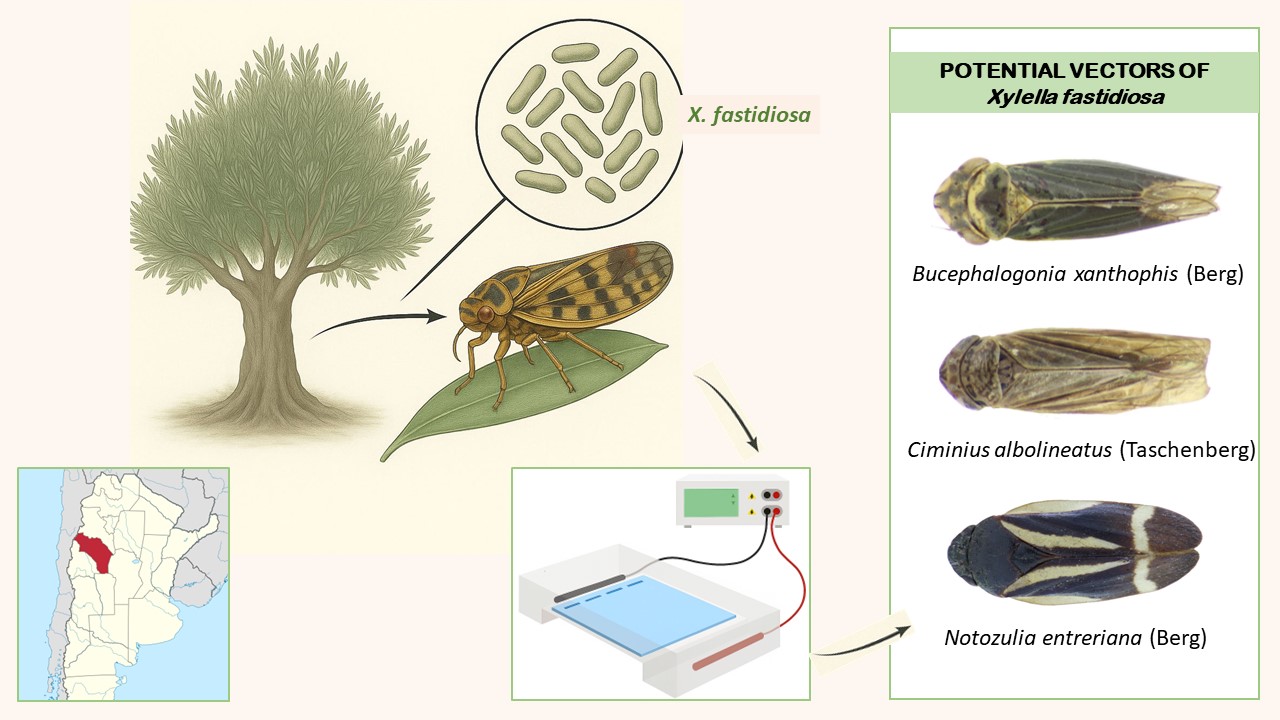
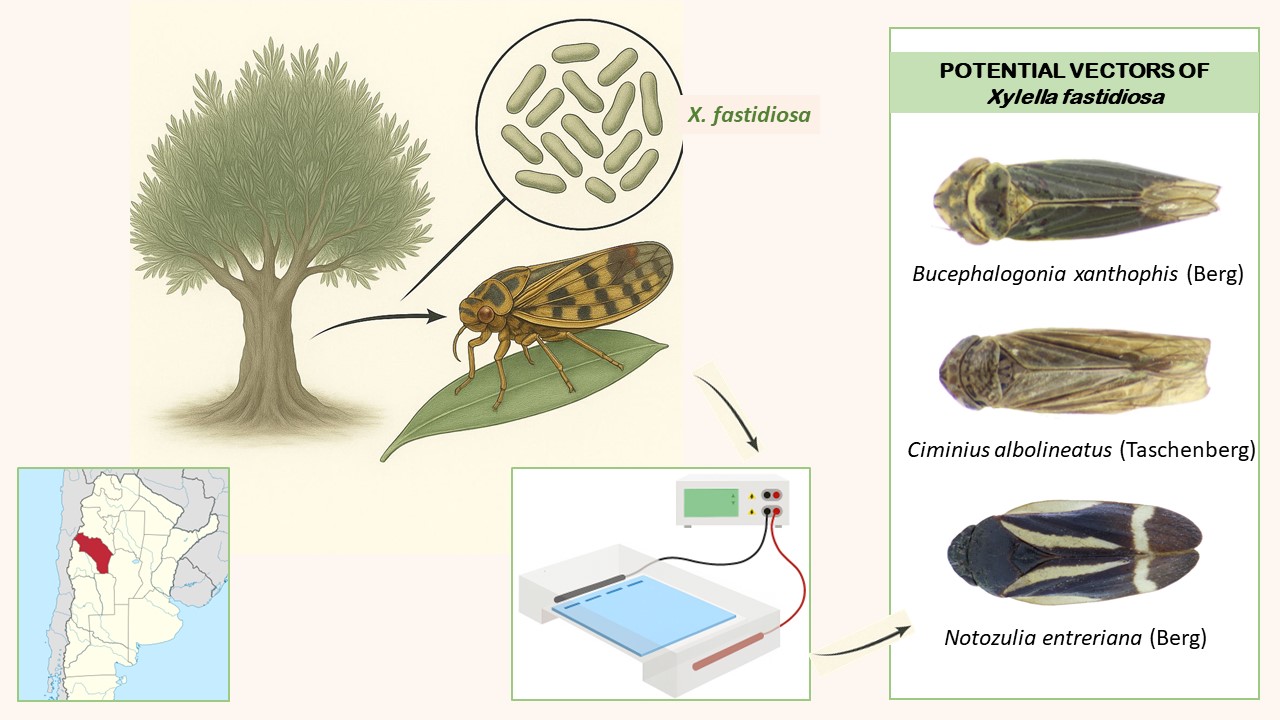
This study aimed to identify potential vectors of the bacterium Xylella fastidiosa in olive orchards in La Rioja Province, Argentina. Hoppers (Hemiptera: Auchenorrhyncha) were collected during the spring of 2019 from localities with a high incidence of this pathogen in olive trees and associated spontaneous vegetation. Of the 14 species identified, eight tested positive for X. fastidiosa subsp. pauca. The ability to transmit this xylem-inhabiting bacterium is directly linked to the feeding habits of its vectors. The xylem-feeding species Bucephalogonia xanthophis (Berg), Ciminius albolineatus (Taschenberg), and Notozulia entreriana (Berg) tested positive and are confirmed carriers of X. fastidiosa. Consequently, these species may be considered potential vectors in olive orchards in La Rioja and represent suitable candidates for further epidemiological studies aimed at confirming their role as effective vectors of the bacterium.
Highlights:
- Fourteen species of Auchenorrhyncha (Hemiptera) were recorded in olive orchards affected by Olive Quick Decline in La Rioja, Argentina.
- Standard PCR assays enabled the confirmation of Xylella fastidiosa pauca in eight species.
- The xylem-feeding species Bucephalogonia xanthophis, Ciminius albolineatus (Hemiptera: Cicadellidae), and Notozulia entreriana (Hemiptera: Cercopidae) tested positive for Xylella fastidiosa and are considered potential vectors of the bacterium in olive orchards in La Rioja, Argentina.
Descargas
Citas
Ben Moussa, I. E., Mazzoni, V., Valentini, F., Yaseen, T., Lorusso, D., Speranza, S. & D’Onghia, A. M. (2016). Seasonal fluctuations of sap-feeding insect species infected by Xylella fastidiosa in Apulian olive groves of southern Italy. Journal of Economic Entomology, 109(4), 1512-1518. DOI: 10.1093/jee/tow123
Bextine, B., Tuan, S. J., Shaikh, H., Blua, M., & Miller, T. A. (2004). Evaluation of methods for extracting Xylella fastidiosa DNA from the glassy-winged sharpshooter. Journal of Economic Entomology, 97(3), 757-763. DOI: 10.1093/jee/97.3.757
Biedermann, R., Achtziger, R., Nickel, H., & Stewart, A. J. (2005). Conservation of grassland leafhoppers: a brief review. Journal of Insect Conservation, 9, 229-243. DOI: 10.1007/s10841-005- 0531-z
Calahorra, M. A. (2023). Monitoreo de Chicharritas y Salivazos Asociados al Agroecosistema Olivícola, Potenciales Vectores de Xylella fastidiosa en Chilecito, La Rioja (Insecta: Hemiptera: Cicadellidae, Cercopidae). [Tesis de Maestría, Universidad Nacional de Chilecito, Argentina]. https://repositorio.inta.gob. ar/xmlui/handle/20.500.12123/216/browse?authority=27227180086&type=author
Carciofi, I., Maspi N. & Guevara Lynch, J. P. (2023). Cítricos dulces en Argentina. Antecedentes productivos, catalizadores tecnológicos y experiencias internacionales de la industria citrícola. Documento N°39. Ministerio de Economía. Secretaría de Industria y Desarrollo Productivo.
Carpio, A. J., Solana, M., Tortosa, F. S., & Castro, J. (2020). Effect of cover crops in olive groves on Cicadomorpha communities. Spanish Journal of Agricultural Research, 18(2). DOI: 10.5424/sjar/2020182-15991
Castro, C., Di Salvo, B., & Roper, M. C. (2021). Xylella fastidiosa: A reemerging plant pathogen that threatens crops globally. PLoS Pathogens, 17(9), e1009813. DOI: 10.1371/journal. ppat.1009813
Cavalieri, V., Dongiovanni, C., Tauro, D., Altamura, G., Di Carolo, M., Fumarola, G., Saponari, M., & Bosco, D. (2018). Transmission of the CODIRO strain of Xylella fastidiosa by different insect species. In Proceedings XI European Congress of Entomology. Naples, Italy.
Chuche, J., Backus, E. A., Thiéry, D., & Sauvion, N. (2017). First finding of a dual-meaning X wave for phloem and xylem fluid ingestion: characterization of Scaphoideus titanus (Hemiptera: Cicadellidae) EPG waveforms. Journal of Insect Physiology, 102, 50-61. DOI: 10.1016/j. jinsphys.2017.01.013
Cornara, D., Cavalieri, V., Dongiovanni, C., Altamura, G., Palmisano, F., Bosco, D. & Saponari, M. (2017). Transmission of Xylella fastidiosa by naturally infected Philaenus spumarius (Hemiptera, Aphrophoridae) to different host plants. Journal of Applied Entomology, 141(1-2), 80-87. DOI: 10.1111/jen.12365
Cornara, D., Morente, M., Markheiser, A., Bodino, N., Fereres, A., Redak, R. A. & Lopes, J. R. S. (2019). An overview on the worldwide vectors of Xylella fastidiosa. Entomologia Generalis, 39(3-4), 157-181. DOI: 10.1127/entomologia/2019/0811
De Coll, O. R., Remes-Lenicov, A. M. M., Agostini, J. P., & Paradell, S. (2000). Detection of Xylella fastidiosa in Weedsand Sharpshooters in Orange Groves affected with Citrus Variegated Chlorosis in Misiones, Argentina. International Organization of Citrus Virologists Conference Proceedings (1957-2010), 14(14), 216-222. https://escholarship.org/uc/item/0x65j6dn
Defea, B., Foieri, A., & Paradell, S. (2019). Vectores de Xylella Fastidiosa. En Esteva Matías (Ed.), Manual de protocolos de manejo de Plagas y patologías del olivo. 155-172.
Defea, B., Virla, E. G., Logarzo, G. A., Cavichioli, R. R., Tapia, S., Aguirre, M. R. & Paradell, S. L. (2022). Contributions to the knowledge of the Cicadellini Sharpshooters (Hemiptera: Cicadellidae) associated with citrus orchards in Argentina. Zootaxa, 5205(1), 55-72. DOI: 10.11646/ zootaxa.5205.1.4
Dellapé, G., Paradell, S., Semorile, L., & Delfederico, L. (2016). Potential vectors of Xylella fastidiosa: a study of leafhoppers and treehoppers in citrus agroecosystems affected by Citrus Variegated Chlorosis. Entomologia Experimentalis et Applicata, 161(2), 92-103. DOI: 10.1111/eea.12491
Esteva, M., Banno, N., Bataglia M. J., Bonafede, F., Brizuela, M. G., Calahorra, M. A., Defea, B. S. (2019). Manual de protocolos de manejo de plagas y patologías del olivo. Consejo Federal de Inversiones.
FOA (Federación Olivícola Argentina). (2024). Informe Olivícola 2018-2024. https://federacionolivicolaargentina. com.ar/informes-anuales/
Froza, J. (2022). Papel de espécies de cigarrinhas (Hemiptera: Auchenorrhyncha) na disseminação de Xylella fastidiosa em oliveira na Serra da Mantiqueira. [Thesis PhD. Piracicaba, Brazil].
Gibin, D., Gutierrez Linares, A., Fasanelli, E., Pasinato, L., & Delbianco, A. (2023). Update of the Xylella spp. host plant database-systematic literature search up to 30 June 2023. EFSA Journal, 21(12), e8477. https://doi.org/10.2903/j.efsa.2023.8477
Haelterman, R. M., Tolocka, P. A., Roca, M. E., Guzmán, F. A., Fernández, F. D., & Otero, M. L. (2015). First presumptive diagnosis of Xylella fastidiosa causing olive scorch in Argentina. Journal of Plant Pathology, 97(2), 393.
Janse, J. D., & Obradovic, A. (2010). Xylella fastidiosa: its biology, diagnosis, control and risks. Journal of Plant Pathology, 92(1), 35-148.
Jones, J. R., & Deitz, L. L. (2009). Phylogeny and systematics of the leafhopper subfamily Ledrinae (Hemiptera: Cicadellidae). Zootaxa, 2186(1), 1-120. DOI: 10.11646/zootaxa.2186.1.1
Leal, A. H., Creão-Duarte, A. J., & Mejdalani, G. (2016). Taxonomic review of Scopogonalia Young, 1977 (Insecta: Hemiptera: Cicadellidae: Cicadellini) with description of six new species. Journal of Natural History, 50(23-24), 1513-1542. DOI: 10.1080/00222933.2016.1166530
Leite, R. P., & Nunes, L. M. (2003). Avanços nas pesquisas sobre Xylella fastidiosa do café no Brasil. In Produção integrada de café (p. 87-101). Universidade Federal de Viçosa, Brazil.
Lopes, J., Landa, B., Fereres, A. (2014). A survey of potential insect vectors of the plant pathogenic bacterium Xylella fastidiosa in three regions of Spain. Spanish Journal of Agricultural Research, 12(3), 795-800.
Marucci, R. C., Lopes, J. R., & Cavichioli, R. R. (2008). Transmission efficiency of Xylella fastidiosa by sharpshooters (Hemiptera: Cicadellidae) in coffee and citrus. Journal of Economic Entomology, 101(4), 1114-1121. DOI: 10.1603/0022-0493(2008)101[1114:TEOXFB]2.0.CO;2
Ministerio de Desarrollo Productivo Argentina (2022). Olivicultura en Argentina. Aprendiendo de la experiencia internacional: políticas públicas para el desarrollo sostenible del sector. Doc.26.https://www.argentina.gob.ar/produccion/cep/consejo-cambio-estructural/documentos
Minsavage, G. V., Thompson, C. M., Hopkins, D. L., Leite, R. M. V. B. C. & Stall, R. E. (1994). Development of a polymerase chain reaction protocol for detection of Xylella fastidiosa in plant tissue. Phytopathology, 84(5), 456-461. DOI: 10.1094/Phyto-84-456
Nome, S. F., Haelterman, R. M., Docampo, D. M., Prataviera, A. G., & Feo, L. D. V. D. (1992). Almond leaf scorch in Argentina. Brazilian Phytopathology, 17, 57-60.
Paladini, A., Carvalho, G. S., & Valério, J. R. (2008). Ultrastructure and redescription of Notozulia entreriana (Berg) (Hemiptera: Cercopidae). Neotropical Entomology, 37, 552-557. DOI: 10.1590/S1519-566X2008000500008
Rapicavoli, J., Ingel, B., Blanco‐Ulate, B., Cantu, D., & Roper, C. (2018). Xylella fastidiosa: an examination of a re‐emerging plant pathogen. Molecular plant pathology, 19(4), 786-800. DOI: 10.1111/ mpp.12585
Redak, R. A., Purcell, A. H., Lopes, J. R., Blua, M. J., Mizell Iii, R. F., & Andersen, P. C. (2004). The biology of xylem fluid-feeding insect vectors of Xylella fastidiosa and their relation to disease epidemiology. Annual Reviews in Entomology, 49(1), 243-270. DOI: 10.1146/annurev. ento.49.061802.123403
Remes Lenicov, A. M., Paradell, S., De Coll, O., & Agostini, J. (1999). Cicadelinos asociados a citrus afectados por clorosis variegada (CVC) en la República Argentina (Insecta: Homoptera: Cicadellidae). Revista de la Sociedad Entomologica Argentina, 58(3-4), 211-225.
Saponari, M., Loconsole, G., Cornara, D., Yokomi, R. K., De Stradis, A., Boscia, D. & Porcelli, F. (2014). Infectivity and transmission of Xylella fastidiosa by Philaenus spumarius (Hemiptera: Aphrophoridae) in Apulia, Italy. Journal of Economic Entomology, 107(4), 1316-1319.
Severin, H. H. (1950). Spittle-insect vectors of Pierce’s disease virus. II. Life history and virus transmission. Hilgardia, 19(11), 357.
Tolocka, P. A., Giolitti, F., Guzmán, F. A., Mattio, M. F., Nome, C. F., Ortega, L. I. & Haelterman, R. M. (2021). Caracterización de Xylella fastidiosa a partir de materiales vegetales y cepas aisladas de olivo (Olea europaea L.) e implementación de un sistema de diagnóstico serológico en Argentina. Revista de investigaciones agropecuarias, 47(3), 380-389.
Young, D. A. (1968). Taxonomic Study of the Cicadellinae (Homoptera: Cicadellidae). Technichal Bulletin of Carolina Agricultural Experimental Station. North Carolina State University. (239, 281).
Young, D. A. (1977). Taxonomic study of the Cicadellinae (Homoptera: Cicadellidae). Part 2. New World Cicadellini and the genus Cicadella. Bulletin of Carolina Agricultural Experimental Station. North Carolina State University.
Zahniser, J. N., & Dietrich, C. (2013). A review of the tribes of Deltocephalinae (Hemiptera: Auchenorrhyncha: Cicadellidae). European Journal of Taxonomy, (45). DOI: 10.5852/ ejt.2013.45
Zanol, K. (2007). Catalogue of the neotropical Deltocephalinae (Hemiptera: Cicadellidae). Part II-Tribe. Acta Biol. Par., 36 (1-2): 1-46.
Descargas
Publicado
Cómo citar
Número
Sección
Licencia

Esta obra está bajo una licencia internacional Creative Commons Reconocimiento-NoComercial-CompartirIgual 3.0.
Aquellos autores/as que tengan publicaciones con esta revista, aceptan las Políticas Editoriales.
 RevFCAUNCuyo






.jpg)