Heat Stress During the Dry Period in Crossbred Dairy Cows and its Impact on Subsequent Productive and Reproductive Performance
DOI:
https://doi.org/10.48162/rev.39.228Palabras clave:
estrés por calor, pastoreo, cruzamientos, ITH, eficiencia reproductiva, producción lecheraResumen
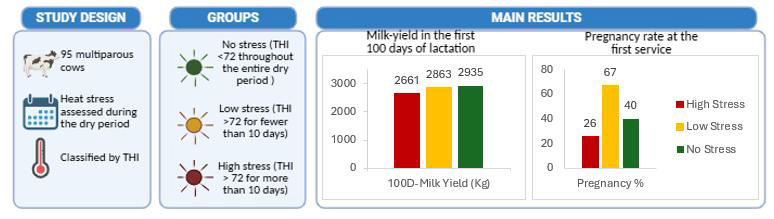
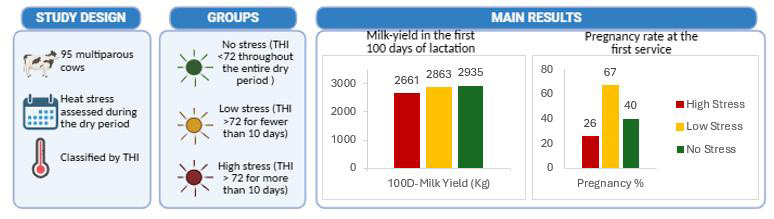
The dry period of a dairy cow is the time between the end of one lactation (when the cow is no longer milking) and the start of the next calving and lactation. The objective of this study was to evaluate the effect of heat stress during the dry period on milk production and reproductive performance during the first 100 days of the subsequent lactation in crossbred dairy cows managed in a pasture-based herd in Santa Fe, Argentina. Ninety-five multiparous cows were classified into three groups based on their exposure to heat stress: no stress, low stress, and high stress. Cows in the no stress group produced 274 kg more milk than those in the high stress group (P < 0.05) and showed higher conception rate at first service (P < 0.05). Heat stress during the dry period negatively affected early productive and reproductive performance, emphasizing the importance of mitigating heat stress in dry cows under pasture-based systems.
Highlights:
- Heat stress (HS) during the dry period on dairy pastured based cows reduces milk production during the first 100 days on milk.
- Cows without HS had a higher conception rate at first service than cows exposed to high heat stress
- 95 multiparous crossbred cows were classified as No stress, Low stress, or High stress according to the number of dry-period days with (Temperature-Humidity Index) THI >72.
- Milk yield during the first 100 days in milk (DIM) was estimated, using a third order orthogonal polynomial fitted individually for each cow.
Descargas
Citas
Avendaño-Reyes, J., Fuquay, J. W., Moore, R. B., Liu, Z., Clark, B. L. & Vierhout, C. (2010). Relationship between accumulated heat stress during the dry period, body condition score, and reproduction parameters of Holstein cows in tropical conditions. Tropical Animal Health and Production, 42(2), 265-273. https://doi.org/10.1007/s11250-009-9415-7
Cañete, V.; Lazzarini, B.; Alesso, A.; Baudracco, J.; Marini, P. R. (2025). Milk Production, Age at First Calving, and Calving-to-Conception Interval in Holstein, Brown Swiss, and Holstein x Brown Swiss Cows. Revista de la Facultad de Ciencias Agrarias. Universidad Nacional de Cuyo. 57(2): 148-154. DOI: https://doi.org/10.48162/rev.39.178
Collier, R. J. & Gebremedhin, K. G. (2015). Thermal biology of domestic animals. Annual Review of Animal Biosciences, 3, 513-532. https://doi.org/10.1146/annurev-animal-022114-110659
Collier R. J., Renquist, B. J., & Xiao, Y. (2017). A 100-Year Review: Stress physiology including heat stress. Journal of Dairy Science, 100(2), 10367-10380.
De Rensis, F. & Scaramuzzi, J. R. (2003). Heat stress and seasonal effects on reproduction in the dairy cow - a review. Theriogenology, 60, 1139-1151. https://doi.org/doi:10.1016/S0093-691X(03)00126-2
Fabris, T. F., Laporta, J., Corra, F. N., Torres, Y. M., Kirk, D. J., McLean, D. J., Chapman, J. D. & Dahl, G. E. (2017). Effect of nutritional immunomodulation and heat stress during the dry period on subsequent performance of cows. Journal of Dairy Science, 100(8), 6733-6742. https://doi.org/10.3168/jds.2016-12313
Fabris, T. F., Laporta, J., Skibiel, A. L., Corra, F. N., Senn, B. D., Wohlgemuth, S. E. & Dahl, G. E. (2019). Effect of heat stress during early, late, and entire dry period on dairy cattle. Journal of Dairy Science, 102(6), 5647-5656. https://doi.org/10.3168/jds.2018-15721
Ferreira, F. C., Gennari, R. S., Dahl, G. E. & De Vries, A. (2016). Economic feasibility of cooling dry cows across the United States. Journal of Dairy Science, 99(12), 9931-9941. https://doi.org/10.3168/jds.2016-11566
Hansen, P. J. (2004). Physiological and cellular adaptations of zebu cattle to thermal stress. Animal Reproduction Science, 82, 349-360. https://doi.org/10.1016/j.anireprosci.2004.04.011
IPCC. (2023). Current status and trends. In Climate Change 2023: Synthesis Report. Lee H. & Romero, J. (eds), pp. 42-66. https://doi.org/10.59327/IPCC/AR6-9789291691647
Jurkovich, V., Hejel, P. & Kovács, L. (2024). A Review of the Effects of Stress on Dairy Cattle Behaviour. Animals, 14(14), 2038. https://doi.org/10.3390/ani14142038
Lazzarini, B., Llonch, P. & Baudracco, J. (2024). Animal welfare on Argentinean dairy farms based on the Welfare Quality® protocol framework. Journal of Animal Behaviour and Biometeorology, 12(2): e20244010. https://doi.org/10.31893/jabb.2024010
Lembeye, F., López-Villalobos, N., Burke, J. L., Davis, S. R., Richardson, J., Sneddon, N. W. & Donaghy, D. J. (2016). Comparative performance in Holstein-Friesian, Jersey and crossbred cows milked once daily under a pasture-based system in New Zealand. New Zealand Journal of Agricultural Research, 59, 351-362. https://doi.org/10.1080/00288233.2016.1207669
Mader, T. L., Davis, M. S. & Brown-Brandl, T. (2006). Environmental factors influencing heat stress in feedlot cattle 1,2. Journal of Animal Science, 84, 712-719.
Morales-Piñeyrúa, J. T., Damián, J. P., Banchero, G. & Sant`Anna, A. C. (2022). The effects of heat stress on milk production and the grazing behavior of dairy Holstein cows milked by an automatic milking system. Journal of Animal Science, 100(9), 1-4. https://doi.org/10.1093/jas/skac225
Mylostyvyi, R. & Chernenko, O. (2019). Correlations between environmental factors and milk production of holstein cows. Data, 4(3). https://doi.org/10.3390/data4030103
Oliveira, C. P., Sousa, F. C. d., Silva, A. L. d.., Schultz, E. B., Valderrama-Londoño, R. I., Souza, A. R. (2025). Heat Stress in Dairy Cows: Impacts, Identification, and Mitigation Strategies - A Review. Animals, 15(2), 249. https://doi.org/10.3390/ani15020249
Penev, T., Dimov, D., Vasilev, N., Mitev, J., Miteva, Tch., Marinov, I. & Stojnov, M. (2021). Influence of heat stress on reproductive performance in dairy cows and opportunities to reduce its effects -A review. Agricultural Science and Technology, 13(1), 3-11. https://doi.org/10.15547/ast.2021.01.001
Phelan, P., Morgan, E. R., Rose, H., Grant, J. & O’Kielly, P. (2016). Predictions of future grazing season length for European dairy, beef and sheep farms based on regression with bioclimatic variables. Journal of Agricultural Science, 154(5), 765-781. https://doi.org/10.1017/S0021859615000830
Renaudeau, D., Collin, A., Yahav, S., De Basilio, V., Gourdine, J. L. and Collier, R. J. (2012). Adaptation to hot climate and strategies to alleviate heat stress in livestock production. Animal, 6, 707-728. https://doi.org/10.1017/S1751731111002448
Roman, L., Saravia, C., Astigarraga, L., Betancour, O. & La Manna, A. (2019). Shade access in combination with sprinkling and ventilation effects performance of Holstein cows in early and late lactation. Animal Production Science, 59(2), 347-358. https://doi.org/10.1071/AN16571
Roth, Z. (2020). Reproductive physiology and endocrinology responses of cows exposed to environmental heat stress - Experiences from the past and lessons for the present. Theriogenology, 155, 150-156. https://doi.org/10.1016/j.theriogenology.2020.05.040
Schüller, L. K, Burfeind, W. & Heuwieser, W. (2014). Impact of heat stress on conception rate of dairy cows in the moderate climate considering different temperature-humidity index thresholds, periods relative to breeding, and heat load indices. Theriogenology, 81, 1050-1057.
Tao, S., Bubolz, J. W., do Amaral, B. C., Thompson, I. M., Hayen, M. J., Johnson, S. E. & Dahl, G. E. (2011). Effect of heat stress during the dry period on mammary gland development. Journal of Dairy Science, 94(12), 5976-5986. https://doi.org/10.3168/jds.2011-4329
Tao, S., Orellana-Rivas, R. M., Marins, T. N., Chen, Y. C., Gao, J. & Bernard, J. K. (2020). Impact of heat stress on lactational performance of dairy cows. Theriogenology, 150, 437-444. https://doi.org/10.1016/j.theriogenology.2020.02.048
Thompson, I. M. & Dahl, G. E. (2012). Dry-period seasonal effects on the subsequent lactation. The Professional Animal Scientist, 28, 628-631.
Veissier, I., Van laer, E., Palme, R., Moons, C. P. H., Ampe, B., Sonck, B., Andanson, S. & Tuyttens, F. A. M. (2018). Heat stress in cows at pasture and benefit of shade in a temperate climate region. International Journal of Biometeorology, 62, 585-595. https://doi.org/10.1007/s00484-017-1468-0
Descargas
Publicado
Cómo citar
Número
Sección
Licencia

Esta obra está bajo una licencia internacional Creative Commons Reconocimiento-NoComercial-CompartirIgual 3.0.
Aquellos autores/as que tengan publicaciones con esta revista, aceptan las Políticas Editoriales.
 RevFCAUNCuyo