
Effect of Temperature, Water Potential and Salinity on Seed Germination of Four Native Perennial Grasses of the Monte (Argentina)
DOI:
https://doi.org/10.48162/rev.39.227Palabras clave:
temperatura, sequía, NaCl, Pappophorum caespitosum, Digitaria californica , Aristida mendocina, Leptochloa crinita, restauraciónResumen
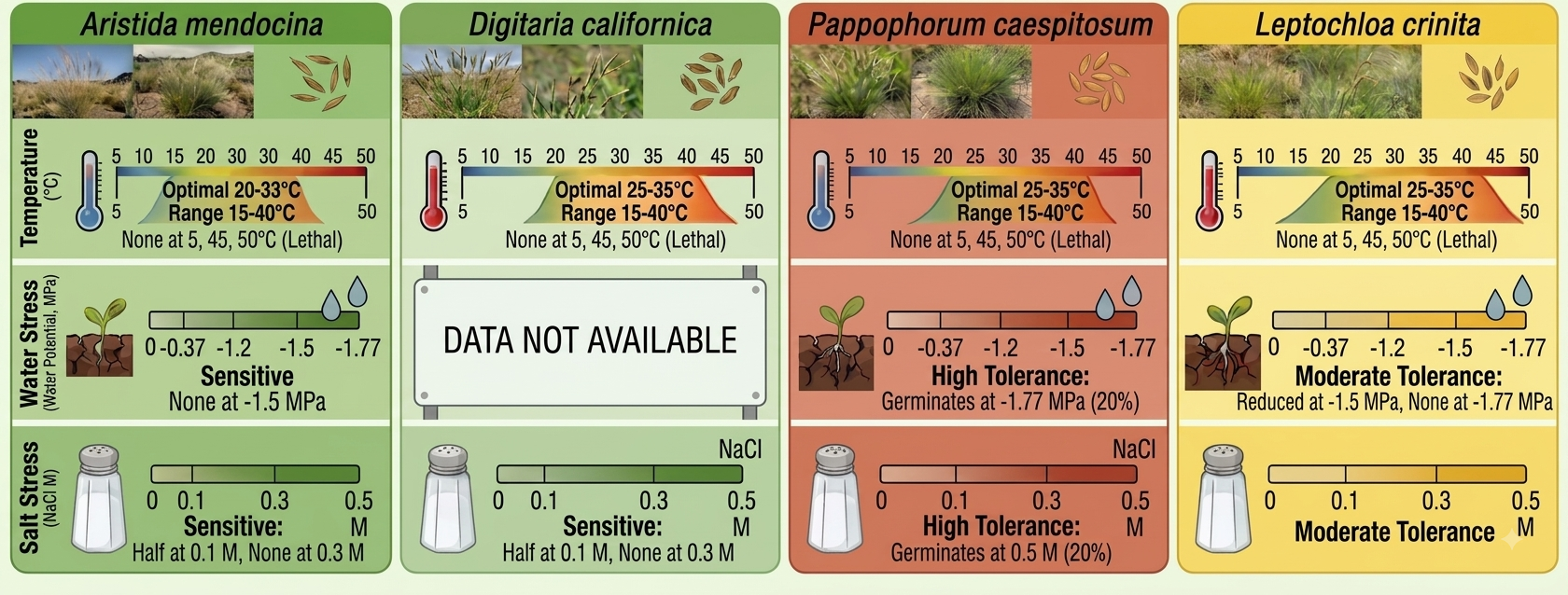
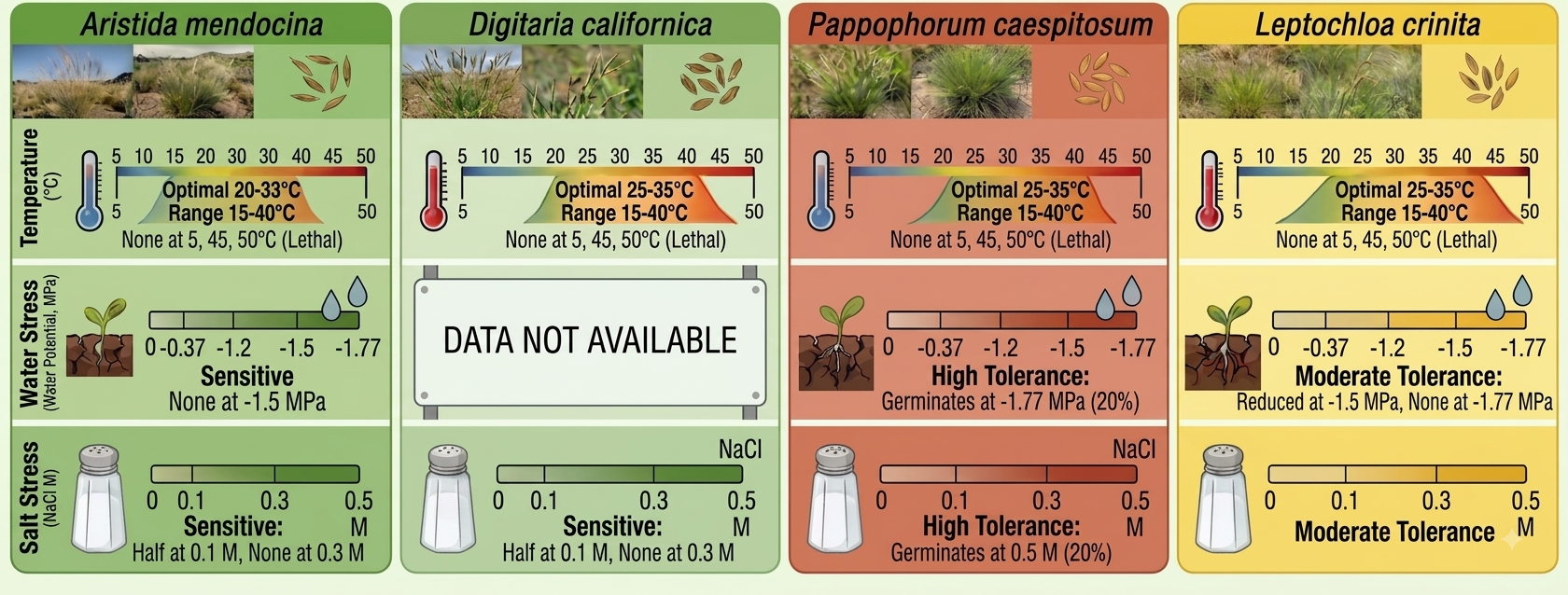
Seed germination is critical for successful restoration in degraded desert ecosystems. This study aimed to determine thermal requirements and tolerance limits to water and salt stress of four key forage species: Aristida mendocina, Digitaria californica, Pappophorum caespitosum, and Leptochloa crinita. Controlled laboratory experiments were conducted to evaluate constant temperature regimes (5, 15, 20, 25, 30, 35, 40, and 45°C), one alternating-temperatures regime (45-15°C), water potentials (0, -0.38, -0.58, -0.97, -1.30, -1.52, and -1.77 MPa) simulated with Polyethyleneglycol (PEG) solutions, and NaCl concentrations (0.1, 0.3, and 0.5 M). We recorded final germination percentage and germination rate (Maguire Index). The species exhibited different environmental plasticity. L. crinita and P. caespitosum showed the broadest thermal ranges, achieving optimal germination (>80%) between 25 and 35°C. P. caespitosum demonstrated the highest tolerance to salinity and water stress, being the only species capable of germinating in 0.5 M NaCl solutions (20%) and at -1.77 MPa (20%). In contrast, *A. mendocina* and *D. californica* were the most sensitive; the former restricted its optimum to 20-30°C, and both reduced their germination by half with just 0.1 M NaCl.
Highlights:
- All four C4 grasses germinate between 15 and 40 °C.
- Pappophorum caespitosum is highly tolerant to drought and salinity.
- Aristida mendocina and Digitaria californica have low tolerance to salinity.
- Leptochloa crinita showed intermediate tolerance to drought and salinity.
- Establishing tolerance thresholds enables genotype selection for ecological restoration.
Descargas
Citas
Baskin, C. C. & Baskin, J. M. (2014). Seeds: Ecology, biogeography, and evolution of dormancy and germination. Academic Press.
Bewley, J. D. & Black, M. (1994). Seeds: Physiology of development and germination. Springer Science and Business Media. 445 pp.
Cabido, M., González, C., Acosta, A. & Díaz, S. (1993). Vegetation changes along a precipitation gradient in Central Argentina. Vegetatio, 109(1), 5-14. https://doi.org/10.1007/BF00149541
Candia, R. J. & Guevara, J. C. (1973). Las comunidades vegetales del campo fiscal de La Llave y su valor forrajero. Deserta, 4.
Cavagnaro, J. B. (1988). Distribution of C3 and C4 grasses at different altitudes in a temperate arid region of Argentina. Oecologia, 76, 273-277.
Corvalán Videla, M. E., Aranibar, J. N. & Greco, S. (2021). Biological soil crusts from the Monte desert affect soil moisture and nutrients, and improve Leptochloa crinita grass development. Acta Oecologica, 110, 103712. https://doi.org/10.1016/j.actao.2021.103712
Dagata, S., Fernández, M. E. & Passera, C. B. (2021). Environmental factors affecting germination of Mimosa ephedroides (Fabaceae), an endemic shrub from Monte Desert, Argentina. Revista de la Facultad de Ciencias Agrarias. Universidad Nacional de Cuyo. 53(1), 139-149. https://doi.org/10.48162/rev.39.014
Di Giambatista, G., Garbero, M., Ruiz, M. & Pedranzani, A. G. H. (2010). Germinación de Trichloris crinita y Digitaria eriantha en condiciones de estrés abiótico. Pastos y Forrajes, 33(4),1-10.
Ferrari, F. N. & Parera, C. A. (2015). Germination of six native perennial grasses that can be used as potential soil cover crops in drip-irrigated vineyards in semiarid environs of Argentina. Journal of Arid Environments, 113, 1-5. https://doi.org/10.1016/j.jaridenv.2014.09.002
Flores, D. G., Suvires, G. & Dalmasso, A. (2015). Distribución de la vegetación nativa en ambientes geomorfológicos cuaternarios del Monte Árido Central de Argentina. Revista Mexicana de Biodiversidad, 86(1), 72-79.
Greco, S. A., Sartor, C. E. & Villagra, P. E. (2013). Minimum water input event for seedling emergence of three native perennial grasses of the Central Monte desert (Argentina) influenced by the effect of shade and the season of the year. Revista de la Facultad de Ciencias Agrarias. Universidad Nacional de Cuyo,45(2), 197-209.
Guden, B., Kiemde, O., Akşahin, M. Ç. & Uzun, B. (2024). Effects of salt stress on germination, seedling growth, and ion content of sweet sorghum. Mediterranean Agricultural Sciences, 37(2), 91-98.
Guevara, J. C., Cavagnaro, J. B., Estevez, O. R., Le Houerou, H. N. & Stasi, C. R. (1997). Productivity, management and development problems in the arid rangelands of the central Mendoza plains (Argentina). Journal of Arid Environments, 35, 575-600.
Guevara, J. C., Grunwaldt, E. G., Estevez, O. R., Bisigato, A. J., Blanco, L. J., Biurrun, F. N., Ferrando, C. A., Chirino, C. C., Morici, E., Fernández, B., Allegretti, L. I. & Passera C. B. (2009). Range and livestock production in the Monte Desert, Argentina. Journal of Arid Environments, 73(2): 228-237. https://doi.org/10.1016/j.jaridenv.2008.02.001
Gutterman, Y. (1993). Seed Germination in Desert Plants. By Y. Gutterman. Berlin and Heidelbeg: Springer-Verlag (1993), pp. 252, DM 198.00.
International Seed Testing Association. (2021). International Rules for Seed Testing. https://www.seedtest.org/en/publications/international-rules-seed-testing.html
Kigel, J. (1995). Seed germination in arid and semiarid regions. In: Seed development and Germination. Ed. by Kigel & Galili. Dekker, New Cork. 645-701.
Kildisheva, O. A., Erickson, T. E., Merritt, D. J. & Dixon, K. W. (2016). Setting the scene for dryland recovery: an overview and key findings from a workshop targeting seed-based restoration. Restoration Ecology. 24(2): 36-42.
Labraga J. C. and Villalba, R. (2009). Climate in the Monte Desert: Past trends, present conditions, and future projections. Journal of Arid Environments, 73(2): 154-163.
Lundholm, J. T. & Larson, D. W. (2004). Experimental separation of resource quantity from temporal variability: Seedling responses to water pulses. Oecologia, 141(2), 346-352. https://doi.org/10.1007/s00442-003-1454-6
Maguire, J. D. (1962). Speed of germination: aids in selection and evaluation for seedling emergence and vigor. Crop Science, 2: 176-177.
Mansouri, L. M. & Kheloufi, A. (2024). Salinity effects on germination of Portulaca oleracea L.: A multipurpose halophyte from arid rangelands. Journal of Applied Research on Medicinal and Aromatic Plants, 41, 100549.
Marchi, A., Guevara J. C., Borsetto, O., Estevez, O. R., Stassi, C. R., Candia, R. J., Silva, J. H., Orionte, E. L. (1991). La cría de bovinos en el centro de la llanura de Mendoza. Posibilidades y limitaciones. IADIZA-INTA. Boletín de Información Técnica N°1. Pp 2.
Marinoni, L., Zabala, J. M., Parra-Quijano, M., Fernández, R. J. & Pensiero, J. F. (2018). Genetic and environmental variation of seed weight in Trichloris species (Chloridoideae, Poaceae) and its association with seedling stress tolerance. Plant Ecology and Diversity, 11(2), 173-184. https://doi.org/10.1080/17550874.2018.1449262
Marinoni, L., Richard, G. A., Bustos, D., Taleisnik, E., Pensiero, J. F. & Zabala, J. M. (2020). Differential response of Trichloris crinita ecotypes from different habitats to drought and salt stress. Theoretical and Experimental Plant Physiology, 32, 213-229. https://doi.org/10.1007/s40626-020-00182-x
Marinoni, L., Zabala, J. M., Quiroga, R. E., Richard, G. A. & Pensiero, J. F. (2022). Seed Weight and Trade-Offs: An Experiment in False Rhodes Grasses under Different Aridity Conditions. Plants (Basel), 11(21): 2887. DOI: 10.3390/plants11212887
Marone, L., Horno, M. & Gonzalez del Solar, R. (2000). Post dispersal fate of seeds in the Monte desert of Argentina: patterns of germination in successive wet and dry years. Journal of Ecology, 88, 1-11.
Meglioli, C., Scaglia, J. A. & Parera, C. A. (2024). Factores que afectan la germinación de tres pastos de zonas áridas: Leptochloa crinita, Pappophorum caespitosum y Digitaria califórnica (Poaceae). Acta Botánica Mexicana, (131).
Meglioli, C.; Kuchen, B.; Ormeño, L.; Vazquez, F.; Parera, C. A. (2026). Statistical Optimization of Seed Coating in Arid-Zone Grass Species Used as Cover Crops in Woody Agroecosystems. Revista de la Facultad de Ciencias Agrarias. Universidad Nacional de Cuyo. 58(1): 1-14.DOI: https://doi.org/10.48162/rev.39.189
Mnif Fakhfakh, L., Abassi, S., & Chaieb, M. (2025). Effect of temperature, salinity and water potential on seed germination of annual grass Stipa capensis. Arid Land Research and Management, 39(1), 87-103.
Nikolić, N., Ghirardelli, A., Schiavon, M. & Masin, R. (2023). Effects of the salinity-temperature interaction on seed germination and early seedling development: a comparative study of crop and weed species. BMC Plant Biology, 23(1), 446.
Noy-Meir, I. (1973) Desert Ecosystems: Environment and Producers. Annual Review of Ecology and Systematics, 4, 25-51.
Okumuş, O. & Şekerci, A. D. (2024). Effects of different salt stress and temperature applications on germination in mung bean (Vigna radiata (L.) R. Wilczek) genotypes. Black Sea Journal of Agriculture, 7(3), 310-316.
Quiroga, R. E., Premoli, A. C. & Fernández, R. J. (2018). Climatic niche shift in the amphitropical disjunct grass Trichloris crinita. PLoS ONE. 13(6): e0199811. https://doi.org/10.1371/journal.pone.0199811
Roig, F. A. (1970a). Bosquejo fisonómico de la vegetación de la provincia de Mendoza. Boletín de la Sociedad Argentina de Botánica, 13 (Suppl.): 49-80.
Roig, F. A. (1970b). Flora y Vegetación de la Reserva Forestal de Ñacuñán. Deserta, 1:25-222.
Roig, F., Roig-Juñent, S. & Corbalán, V. (2009). Biogeography of the Monte desert. Journal of Arid Environments, 73(2), 164-172. https://doi.org/10.1016/j.jaridenv.2008.07.016
Sartor, C. E., Greco, S. A., Allegretti, L. I., Arancibia, C., Pucheta, E., Villagra, P. E. & Passera, C. B. (2024). Influence of Neltuma flexuosa and rainfall event on the germination of Leptochloa crinita and Pappophorum caespitosum in two different locations along a stress gradient in the central Monte desert. Ecological Research, 40(1), 65-75. https://doi.org/10.1111/1440-1703.12517
Schwinning, S. & Sala, O. E. (2004). Hierarchy of responses to resource pulses in arid and semi-arid ecosystems. Oecologia, 141(2), 211-220. https://doi.org/10.1007/s00442-004-1520-8
Singh, G. (2025). Seed Germination. In Seed Biology and Biotechnology. Editors: H. V. Bhoot, P. Karthikeyan, Dr. Geetika Singh, Pavithra Sivakumar and Akanksha Lakra. Haryana 136118 (India). P. 1-17.
Vega Riveros, C., Villagra P. & Greco S. (2020). Different root strategies of perennial native grasses under two contrasting water availability conditions: implications for their spatial distribution in desert dunes. Plant Ecology, 221:633-646
Villagra, P. E., Giordano, C., Alvarez, J. A., Cavagnaro, J. B., Guevara, A., Sartor, C. E., Passera, C. B. & Greco, S. (2011). Ser planta en el desierto: Estrategias de uso de agua y resistencia al estrés hídrico en el Monte Central de Argentina. Ecología Austral, 21(1), 29-42.
Zabala, J. M., Widenhorn, P. & Pensiero, J. F. (2011). Germination patterns of species of the genus Trichloris in arid and semiarid environments. Seed Science and Technology, 39, 338-353.
Descargas
Publicado
Cómo citar
Número
Sección
Licencia

Esta obra está bajo una licencia internacional Creative Commons Reconocimiento-NoComercial-CompartirIgual 3.0.
Aquellos autores/as que tengan publicaciones con esta revista, aceptan las Políticas Editoriales.
 RevFCAUNCuyo






.jpg)