Territory in Dispute: Socio-Environmental Conflicts in the Ecoregion of the Colombian Massif
DOI:
https://doi.org/10.48162/rev.40.092Keywords:
Macizo Colombiano, socio-ecological conflicts, peasant social movements, territory, extractivism, mining, political ecology, territorial identity, ColombiaAbstract
There are protests against mining, in support of clean water and in defence of the land. However, during Juan Manuel Santos’s presidency (2014–2018), Colombia’s government institutions did not acknowledge the socio-environmental conflicts in the Colombian Massif.
The Colombian Massif ecoregion is recognised as the country’s riverine heartland and is subject to a protection scheme due to its rich biodiversity. Nevertheless, the Colombian government also pursues a ‘mining and energy locomotive’ strategy, aiming to increase mineral extraction in the country and promoting extractivism in the Colombian Massif. At the same time, it recognised it as an ecoregion to protect its biodiversity. In this context, this research shows how peasant movements and government institutions negotiate access to and use of natural resources. It highlights the importance of the construction of territory and identity as a resource of power for peasant social movements. The article demonstrates how different constructions of territory shape socio-environmental conflicts between social movements and government institutions, and how these become resources of power.
Downloads
References
Alimonda, H., & Escobar, A. (Eds.). (2011). La naturaleza colonizada: Ecología política y minería en América Latina. CLACSO; Ediciones CICCUS.
Bárcenas, J. (2006). Propuesta de integración regional desde la perspectiva de ordenamiento territorial (Tesis de grado, Universidad de La Sabana). http://intellectum.unisabana.edu.co/bitstream/handle/10818/4789/130468.pdf?sequence=1&isAllowed=y
Bauriedl, S. (2016). Politische Ökologie: Nicht-deterministische, globale und materielle Dimensionen von Natur/Gesellschaft-Verhältnissen. Geographica Helvetica, 71, 341–351. https://doi.org/10.5194/gh-71-341-2016
Bebbington, A. (2009). The new extraction: Rewriting the political ecology of the Andes? NACLA Report on the Americas, 52(5), 12–40. http://www.seed.manchester.ac.uk/medialibrary/andes/publications/papers/Bebbington_NACLAReport.pdf
Breidenstein, G., Hirschauer, S., Kalthoff, H., & Nieswand, B. (2015). Ethnografie: Die Praxis der Feldforschung (2.ª ed.). UTB; UVK.
Breidenstein, G., Hirschauer, S., & Kalthoff, H. (2020). Ethnografie: Die Praxis der Feldforschung (3.ª ed.). UTB.
Cárdenas, M., & Rodríguez Becerra, M. (Eds.). (2004). Guerra, sociedad y medio ambiente. Foro Nacional Ambiental. http://library.fes.de/pdf-files/bueros/kolumbien/01993/01993inf.htm
Consejo Nacional de Política Económica y Social (CONPES). (2018). Documento CONPES 3915.
Corredor, C. (2014). Globalización, sistema mundo y territorialidades locales. Editorial Universidad del Cauca.
Departamento Nacional de Planeación (DNP). (2015). Plan nacional de desarrollo 2014–2018: Todos por un nuevo país (Vol. 1, 2.ª ed.).
Giddens, A. (1995). Die Konstitution der Gesellschaft: Grundzüge einer Theorie der Strukturierung (3.ª ed.). Campus.
Instituto de Hidrología, Meteorología y Estudios Ambientales (IDEAM). (1999). El macizo colombiano y su área de referencia. http://www.casadelcauca.org/doc/el_macizo_colombiano_y_su_area_de_influencia.pdf
Leff, E. (2003). La ecología política en América Latina: Un campo en construcción. Polis. Revista de la Universidad Bolivariana, 1(5). http://www.redalyc.org/articulo.oa?id=30500505
Miebach, B. (2014). Soziologische Handlungstheorie. Springer VS.
Ministerio de Minas y Energía. (2016). Política minera de Colombia: Bases para la minería del futuro. https://www.minminas.gov.co/documents/10180/698204/Pol%C3%ADtica+Minera+de+Colombia+final.pdf
Ministerio de Minas y Energía. (2017). Normatividad general para el control a la explotación ilícita de minerales. https://www.minminas.gov.co/documents/10192/23876760/120417_cartillla_norma_ctrl_explotacion_ilicita.pdf
Muñoz, C., Velarde, B., Velasco, D., Burbano, S., & Gómez, R. (2013). Prácticas de resistencia de las comunidades campesinas y organizaciones sociales en torno al agua en contextos de La Vega y Sucre, Macizo Colombiano (Tesis, Universidad de Manizales).
Reuber, P. (2012). Politische Geographie. UTB.
Rico, T., & Volmer, A.-K. (2023). Usos y definiciones del territorio en contextos de explotación minera: Miradas al Macizo Colombiano. Forum for Inter-American Research, 15(2), 10–29. http://interamerica.de/wp-content/uploads/2023/01/Rico_Volmer2.pdf
Svampa, M. (2019). Las fronteras del neoextractivismo en América Latina: Conflictos socioambientales, giro ecoterritorial y nuevas dependencias. Transcript; Bielefeld University Press.
Svampa, M. (2020). Die Grenzen der Rohstoffausbeutung. Transcript; Bielefeld University Press.
UNESCO. (2011). Biosphere reserve information: Colombia, Cinturón Andino. http://www.unesco.org/mabdb/br/brdir/directory/biores.asp?mode=all&code=COL+01
Volmer, A.-K. (2024). Sozio-ökologische Konflikte in Kolumbien: Politisch-ökologische Analyse einer Ökoregion. Nomos.
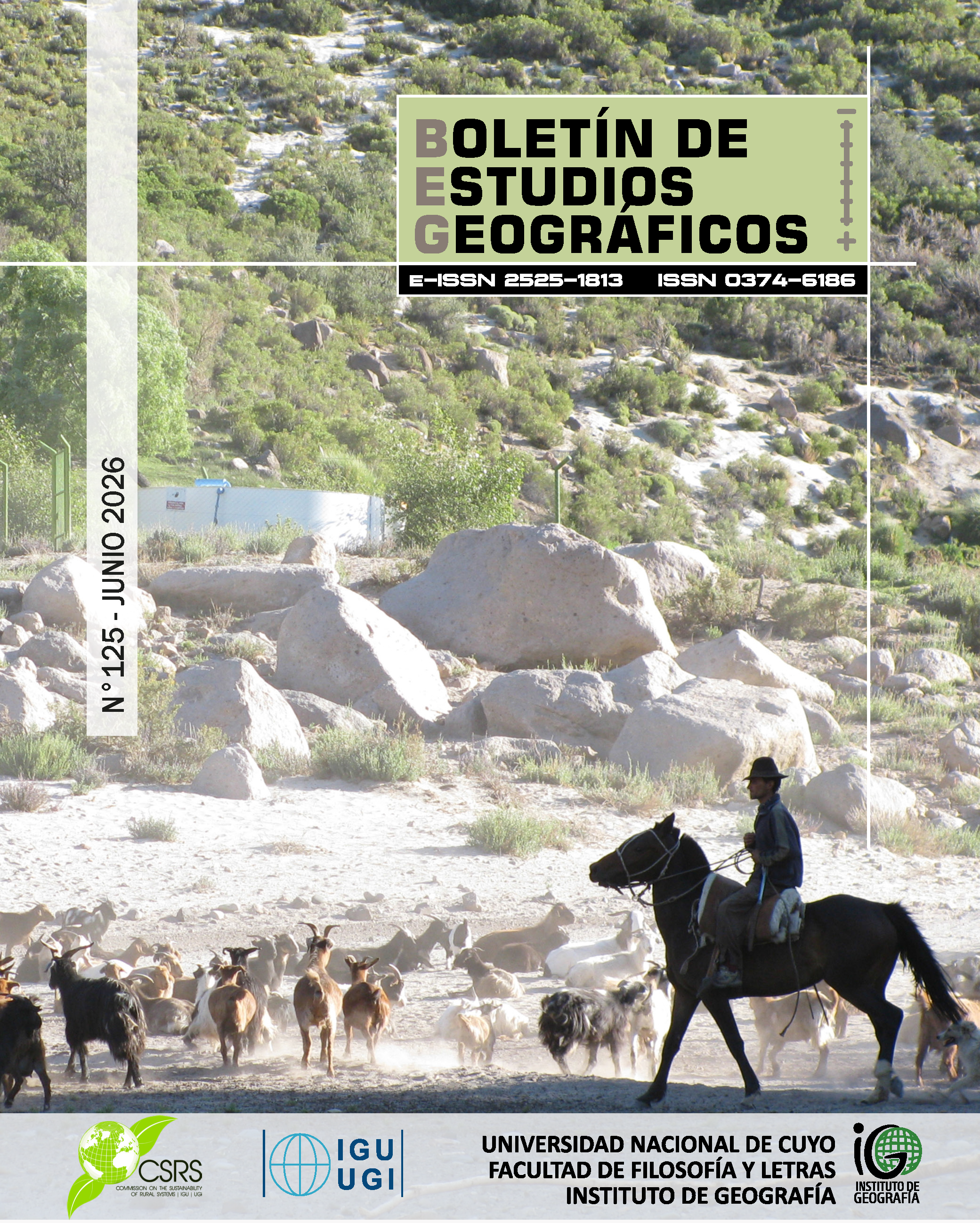
Downloads
Published
How to Cite
Issue
Section
License

This work is licensed under a Creative Commons Attribution-NonCommercial 4.0 International License.