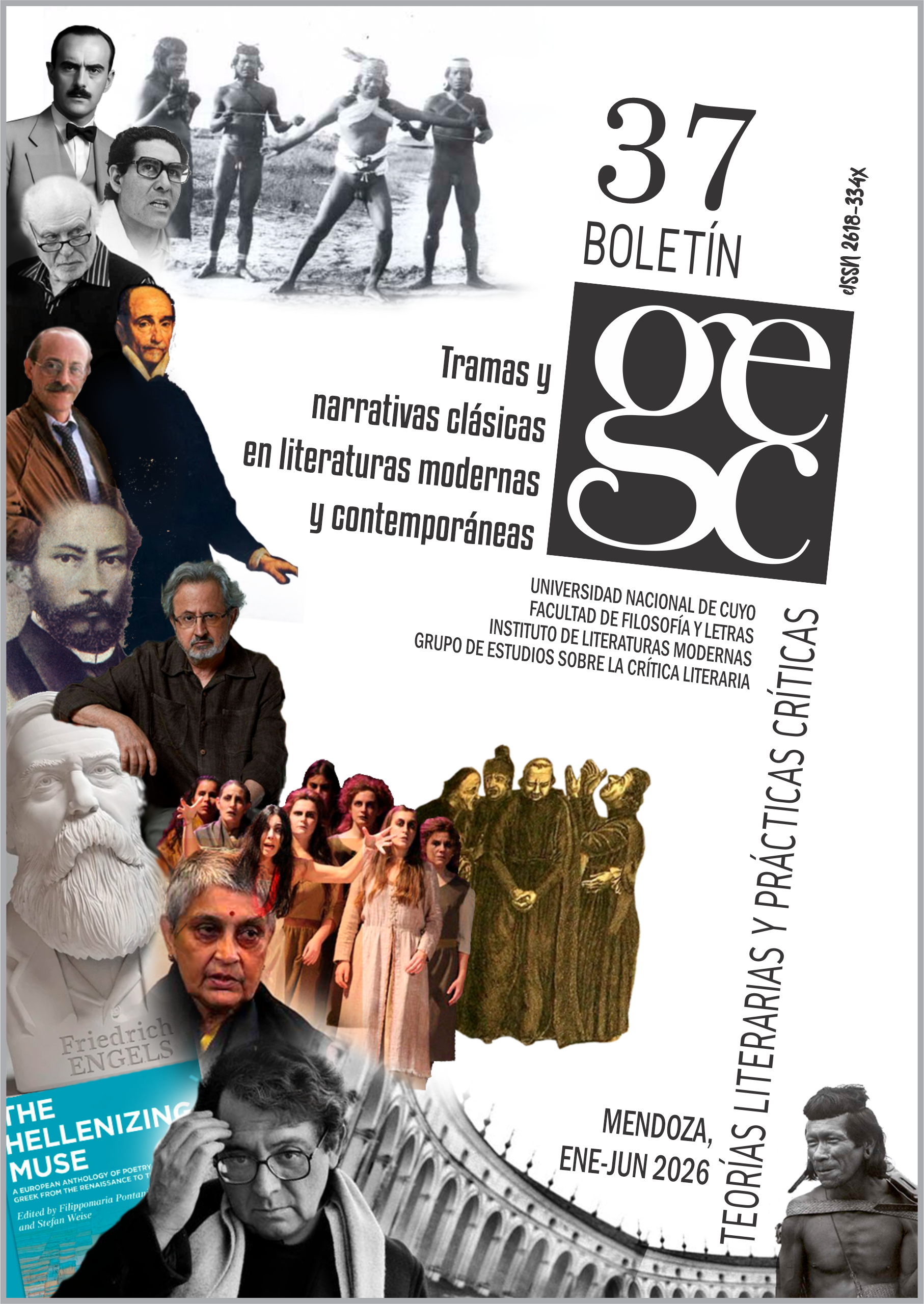
Classical Plots and Narratives in Modern and Contemporary Literatures
DOI:
https://doi.org/10.48162/rev.43.089Keywords:
classical reception, rewriting, classicsAbstract
This dossier examines the enduring presence of classical Greco-Roman literature not as the static preservation of untouchable texts, but as a dynamic practice of dialogue between the past and the present. Far from implying a lack of fidelity to the original, the appropriation, rewriting, reinterpretation and translation of classical plots constitute genuine forms of reimagination, in which ancient texts take on new meanings according to the historical, political and aesthetic contexts in which they are received. As an introduction to the Dossier Classical Plots and Narratives in Modern and Contemporary Literatures, this paper traces the theoretical milestones in the field of the ‘classical tradition’ and argues that every reading entails an active, rather than neutral, stance, which becomes decisive when it leads to rewriting. It also highlights the political malleability of classical plots and their capacity to operate outside the Western tradition, from peripheral geographies and languages. The six essays brought together here test this hypothesis against diverse corpora and confirm that Greco-Roman texts retain their power to generate new meanings.
Downloads
References
Atwood, M. (2005). The Penelopiad. Canongate.
Borges, J. L. (1989). Sobre los clásicos. En Obras completas (vol 2, p. 151). Emecé.
Calvino, I. (1991). Perché leggere i classici. Mondadori.
Curtius, E. R. (1955). Literatura europea y Edad Media latina. Fondo de Cultura Económica. (Original publicado en 1948).
García Jurado, F. (2007). ¿Por qué nació la juntura “Tradición Clásica”? Razones historiográficas para un concepto moderno. Cuadernos de Filología Clásica. Estudios Latinos, 27(2), 161-192. https://revistas.ucm.es/index.php/CFCL/article/view/CFCL0707120161A
García Jurado, F. (2024). Teoría de la tradición clásica. Conceptos, historia y métodos. Universidad Nacional Autónoma de México.
Hall, E. (2008). The Return of Ulysses: A Cultural History of Homer’s Odyssey. I. B. Tauris.
Hardwick, L. (2000). Translating Words, Translating Cultures. Duckworth.
Hardwick, L. y Stray, C. (Eds.) (2008). A Companion to Classical Receptions. Wiley-Blackwell.
Highet, G. (1954). La tradición clásica. Influencias griegas y romanas en la literatura occidental. Fondo de Cultura Económica. (Original publicado en 1949).
Homero (2017). The Odyssey. (Trad. E. Wilson). W. W. Norton.
Laguna Mariscal, G. (2004). ¿De dónde procede la denominación “Tradición Clásica”? Cuadernos de Filología Clásica. Estudios Latinos, 24(1), 83-93. https://revistas.ucm.es/index.php/CFCL/article/view/CFCL0404120083A
Martindale, C. y Thomas, R. F. (Eds.) (2006). Classics and the Uses of Reception. Blackwell.
Downloads
Published
Issue
Section
License
Copyright (c) 2026 Guillermo De Santis, Marcos Carmignani

This work is licensed under a Creative Commons Attribution-NonCommercial-NoDerivatives 4.0 International License.
Aquellos autores/as que tengan publicaciones en esta revista, aceptan los términos siguientes:
- Los autores/as conservarán sus derechos de autor y garantizarán a la revista el derecho de primera publicación de su obra, el cual estará simultáneamente sujeto a la Licencia de reconocimiento de Creative Commons que permite a terceros compartir la obra siempre que no se use para fines comerciales, siempre que se indique su autor y su primera publicación en esta revista, y siempre que se mencionen la existencia y las especificaciones de esta licencia de uso.
- Los autores/as podrán adoptar otros acuerdos de licencia no exclusiva de distribución de la versión de la obra publicada (p. ej.: depositarla en un archivo telemático institucional o publicarla en un volumen monográfico) siempre que se indique la publicación inicial en esta revista y se cumplan las otras condiciones mencionadas arriba.
- Se permite y recomienda a los autores/as difundir su obra a través de Internet (p. ej.: en archivos telemáticos institucionales o en su página web) antes y durante el proceso de envío, lo cual puede producir intercambios interesantes y aumentar las citas de la obra publicada. (Véase El efecto del acceso abierto).