
Effects of Anti-hail Net Transmittance and Installation System on Grapevine (Vitis vinifera L. cv. Malbec) Canopy Microclimate and Water Status
DOI:
https://doi.org/10.48162/rev.39.225Keywords:
Grembiule, radiation, plant water status, air temperature, VPDAbstract
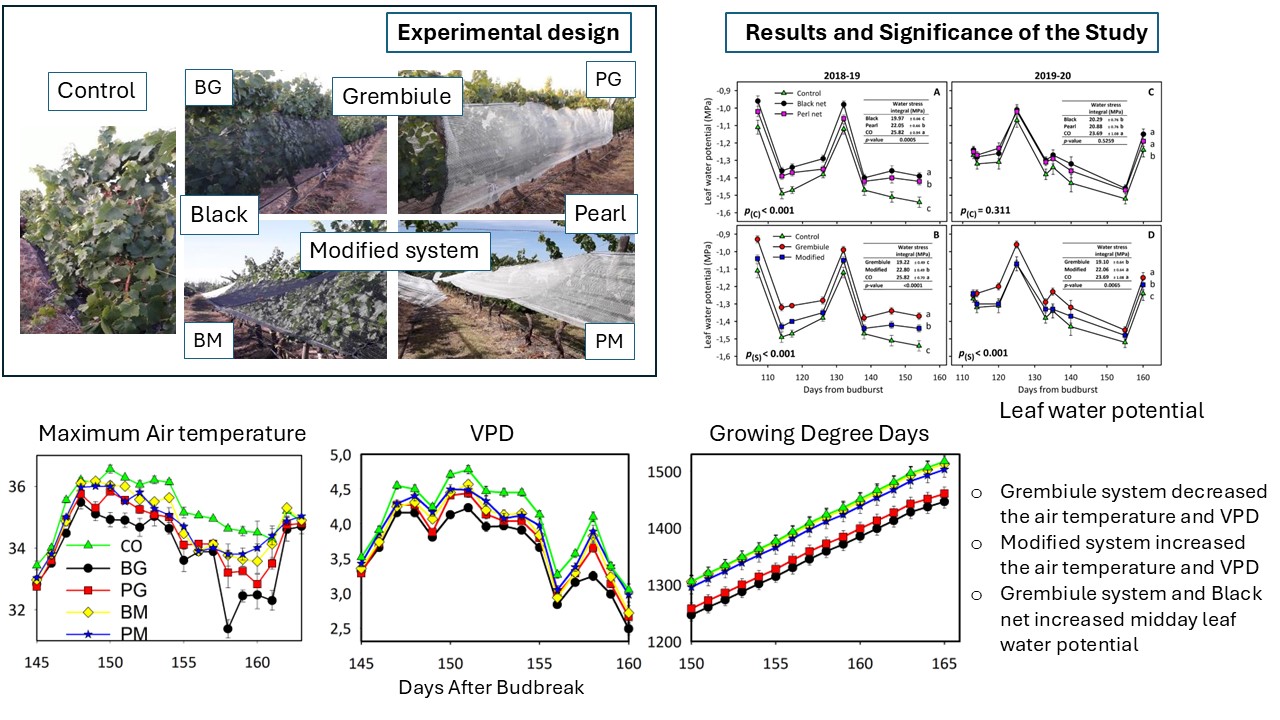
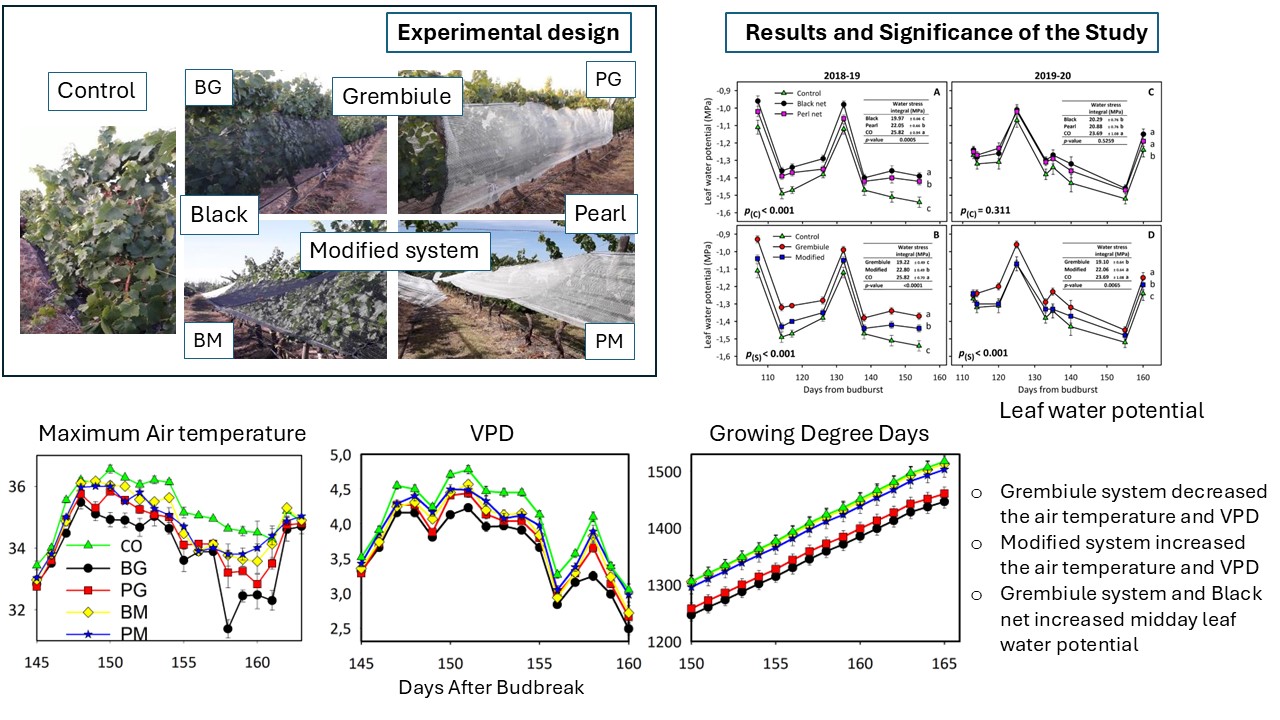
Hailstorms cause substantial economic loss in vineyards worldwide by reducing yield and deteriorating grape quality. Although anti-hail nets are extensively used to prevent hail damage, their effects on canopy microclimate, vine water status, vegetative growth, yield, and berry composition have been scarcely studied. Understanding these effects is increasingly important as climate change intensifies the frequency and severity of extreme weather events. We evaluated the effects of net color and installation system on canopy microclimate and midday leaf water potential (Ψmd) of Vitis vinifera L. cv. Malbec over two growing seasons. Treatments consisted of two net colors (Black and Pearl) combined with two systems (Grembiule and Modified), together with an uncovered control. Regardless of net color, the Grembiule system reduced canopy air temperature (Tair) and vapor pressure deficit (VPD), while the Modified system increased both variables. Ψmd was higher under the Grembiule than in the control, whereas the Modified system showed intermediate values. These results demonstrate that the effects of anti-hail nets produce contrasting results depending on net color and installation system. Careful selection of the installation system is therefore essential, particularly in warm, arid winegrowing regions frequently exposed to hailstorms and other environmental stresses.
Highlights:
- Radiation was reduced by all anti-hail nets, mainly under the Black net and the Modified system.
- The Grembiule system decreased the daily maximum air temperature and VPD at canopy levels.
- In contrast, the Modified system increased the air temperature when compared with Grembiule and Control plants.
- The Grembiule system increased midday leaf water potential.
- Our results could be used to improve the standard practices and installation systems by considering the impact of nets on canopy temperature, VPD, RH and water status.
Downloads
References
Aggarwal, R., Bhardwaj, S. (2022). Effect of anti-hail net installations on microclimate around apple plants in orchards of Himachal Pradesh. Journal of Agrometeorology, 24(1), 83-85. https://doi.org/10.54386/jam.v24i1.783
Arthurs, S. P., Stamps, R. H., Giglia, F. F. (2013). Environmental modification inside photoselective shadehouses. HortScience, 48, 975-979. https://doi.org/10.21273/HORTSCI.48.8.975
Avenant, J. H., Avenant, E. (2022). The effect of overhead netting on water utilization and soil wáter content of a table grape vineyard. Acta Horticulturae, 1335, 627-634. https://doi.org/10.17660/ActaHortic.2022.1335.79
Bastías, R. M. , Boini, A. (2022). Apple Production under Protective Netting Systems. In Apple Cultivation-Recent Advances. IntechOpen. pp. 91-102. http://dx.doi.org/10.5772/intechopen.109429
Blanke, M. M. (2008). Perspectives of fruit research and apple orchard management in Germany in a changing climate. Acta Horticulturae, 772, 441-446. https://doi.org/10.17660/ActaHortic.2008.772.75
Boini, A., Manfrini, L., Morandi, B., Corelli Grappadelli, L., Predieri, S., Daniele, G. M., López, G. (2021). High levels of shading as a sustainable application for mitigating drought, in modern apple production. Agronomy, 11(3), 422. https://doi.org/10.3390/agronomy11030422
Bosco, L. C., Bergamaschi, H., Cardoso, L. S., de Paula, V. A., Marodin, G. A. B., Brauner, P. C. (2018). Microclimate alterations caused by agricultural hail net coverage and effects on apple tree yield in subtropical climate of Southern Brazil. Bragantia, 77(1), 181-192. https://doi.org/10.1590/1678-4499.2016459
Cabral, D., Worlock, A., Gudiño, J., Fuentes, C. (1999). Protección de frutales y viñedos contra el granizo. Guía práctica para la construcción de estructuras. Ediciones INTA.
Cabré, M. F., Quénol, H., Nuñez, M. (2016). Regional climate change scenarios applied to viticultural zoning in Mendoza, Argentina. Int. J. Biometeoroly, 60, 1325-1340. https://doi.org/10.1007/s00484-015-1126-3
Campbell, G. S., Norman, J. N. (1998). An introduction to environmental biophysics. Springer Science & Business Media. 286 p. https://doi.org/10.1007/978-1-4612-1626-1
Caravia, L., Collins, C., Petrie, P. R., Tyerman, S. D. (2016). Application of shade treatments during Shiraz berry ripening to reduce the impact of high temperature. Aust. J. Grape Wine Res., 22, 422-437. https://doi.org/10.1111/ajgw.12248
Caretta A., Salcedo C., Ortiz Maldonado A. (2003). Damages by hail in grapes: its consequences in future harvest. Revista de la Facultad de Ciencias Agrarias. Universidad Nacional de Cuyo, 35(1), 83-88.
Carey, V. A., Archer, E., Barbeau, G., Saayman, D. (2008). Viticultural terroirs in Stellenbosch, South Africa. II. The interaction of Cabernet-Sauvignon and Sauvignon Blanc with environment. Oeno One, 42, 185-201. https://doi.org/10.20870/oeno-one.2008.42.4.808
Cartechini, A., Palliotti, A. (1995). Effect of shading on vine morphology and productivity and leaf gas exchange characteristics in grapevines in the field. Am. J. Enol. Vitic., 46, 227-234. https://doi.org/10.5344/ajev.1995.46.2.227
Coombe, B. G. (1995). Growth stages of the grapevine: adoption of a system for identifying grapevine growth stages. Aust. J. Grape Wine Res., 1(2), 104-110. https://doi.org/10.1111/j.1755-0238.1995.tb00086.x
Córdoba, M.; Vallone, R.; Paccioretti, P.; Corvalán, F.; Balzarini, M. (2025). Data-driven Method for the Delimitation of Viticultural Zones: Application in the Mendoza River Oasis, Argentina. Revista de la Facultad de Ciencias Agrarias. Universidad Nacional de Cuyo. 57(2): 57-68. DOI: https://doi.org/10.48162/rev.39.171
Crouchett-Rojas, R., Araya-Alman, M., Verdugo-Vásquez, N., Fourment, M., Gutiérrez-Gamboa, G. (2025). Shading Nets: A Current Viticultural Strategy to Mitigate the Negative Impacts of Global Warming on Grape and Wine Quality. Aust. J. Grape Wine Res., 9729885, 12. https://doi.org/10.1155/ajgw/9729885
DACC (Dirección de Agricultura y Contingencias Climáticas). (2023). Estadísticas 1993-2023. https://www.mendoza.gov.ar/contingencias/riesgo-agricola/
do Amarante, C. V. T., Stanger, M. C., Coldebella, M. C., Vilvert, J. C., dos Santos, A., Steffens, C. A. (2018). Fruit quality and yield of ‘Imperial Gala’ apple trees protected by anti-hail nets of different colorations in southern Brazil. Acta Horticulturae, 1205, 897-904. https://doi.org/10.17660/ActaHortic.2018.1205.115
Domanda, C., Blanco, I., Buccolieri, R., Rustioni, L. (2024). Anti-Hail Nets in Viticulture: Do They Affect White Grape Quality in the Mediterranean Region? Agriculture, 4(9), 1438. https://doi.org/10.3390/agriculture14091438
Flores, C. A.; Caretta, A. I.; Martineng, N. B. (2026). Climatic Normals in Chacras de Coria. Evolution of Air Temperature for the 1959-2020 Period. Revista de la Facultad de Ciencias Agrarias. Universidad Nacional de Cuyo. 58(1): 1-14. DOI: https://doi.org/10.48162/rev.39.210
Gandorfer, M., Hartwich, A., Bitsch, V. (2016). Hail risk management in fruit production: anti-hail net versus hail insurance in Germany. Acta Horticulturae, 1132, 141-146. https://doi.org/10.17660/ActaHortic.2016.1132.19
Gutiérrez-Gamboa, G., Zheng, W., de Toda, F. M. (2021). Current viticultural techniques to mitigate the effects of global warming on grape and wine quality: A comprehensive review. Food Res. Int., 139, 109946. https://doi.org/10.1016/j.foodres.2020.109946
Gutiérrez-Gamboa, G., Villalobos-Soublett, E., Garrido-Salinas, M., Verdugo-Vásquez, N. (2024). Monofilament Shading Nets Improved Water Use Efficiency on High-Temperature Days in Grapevines Subjected to Hyperarid Conditions. Horticulturae, 10(2), 176. https://doi.org/10.3390/horticulturae10020176
Iglesias, I., Alegre, S. (2006). The effect of anti-hail nets on fruit protection, radiation, temperature, quality and profitability of ‘Mondial Gala’ apples. Journal of Applied Horticulture, 8 (2), 91-100. https://doi.org/10.37855/jah.2006.v08i02.22
Instituto Nacional de Vitivinicultura (INV). (2025). Informe anual de superficie 2024. Ministerio de Economía de la Nación. Recuperado el 03 de octubre de 2025, de https://www.argentina.gob.ar/sites/default/files/2018/10/anuario_superficie_2024_0.pdf
Kalcsits, L., Musacchi, S., Layne, D. R., Schmidt, T., Mupambi, G., Serra, S., Espinoza, C. Z. (2017). Above and below-ground environmental changes associated with the use of photoselective protective netting to reduce sunburn in apple. Agricultural and Forest Meteorology, 237, 9-17. https://doi.org/10.1016/j.agrformet.2017.01.016
Kim, M. H., Lee, J., Lee, S. J. (2023). Hail: Mechanisms, Monitoring, Forecasting, Damages, Financial Compensation Systems, and Prevention. Atmosphere, 14(11), 1642. https://doi.org/10.3390/atmos14111642
Lakatos, L., Gonda, I., Soltész, M., Szabó, Z., Szél, J., Nyéki, J. (2011). Effects of excessive weather on the micro-climate of apple plantations under the hail protection nets. Int. J. Hortic. Sci, 17(4-5), 81-85. https://doi.org/10.31421/IJHS/17/4-5/975
Lopez, G., Boini, A., Manfrini, L., Torres-Ruiz, J. M., Pierpaoli, E., Zibordi, M., Losciale, P., Morandi, B., Corelli-Grappadelli, L. (2018). Effect of shading and water stress on light interception, physiology and yield of apple trees. Agricultural Water Management, 210, 140-148. https://doi.org/10.1016/j.agwat.2018.08.015
Martínez-Lüscher, J., Chen, C. C. L., Brillante, L., Kurtural, S. K. (2017). Partial Solar Radiation Exclusion with Color Shade Nets Reduces the Degradation of Organic Acids and Flavonoids of Grape Berry (Vitis Vinifera L.). J. Agric. Food Chem., 65, 10693-10702. https://doi.org/10.1021/acs.jafc.7b04163
Middleton, S., Mcwaters, A. (2002). Hail Netting of Apple Orchards-Australian Experience. The compact fruit tree, 35(2), 51-55.
Mira-García, A. B., Conejero, W., Vera, J., Ruiz-Sánchez, M. C. (2020). Leaf water relations in lime tres grown under shade netting and open-air. Plants, 9(4), 510. https://doi.org/10.3390/plants9040510
Mupambi, G., Anthony, B. M., Layne, D. R., Musacchi, S., Serra, S., Schmidt, T., Kalcsits, L. A., (2018a). The influence of protective netting on tree physiology and fruit quality of apple: A review. Sci. Hortic., 236, 60-72. https://doi.org/10.1016/j.scienta.2018.03.014
Mupambi, G., Musacchi, S., Serra, S., Kalcsits, L. A., Layne, D. R., Schmidt, T. (2018b). Protective netting improves leaf-level photosynthetic light use efficiency in ‘Honeycrisp’ apple under heat stress. HortScience, 53(10), 1416-1422. https://doi.org/10.21273/HORTSCI13096-18
Myers, B. J. (1988). Water stress integral: a link between short-term stress and long-term growth. Tree Physiology, 4(4), 315-323. https://doi.org/10.1093/treephys/4.4.315
Nahuel., C. G., Castro, P., Nahuel, E., Carbajal Ramos, I., Pérez Peña, J. (2024). Comportamiento de Vitis vinifera L. cv. Merlot bajo tres sistemas de instalación de malla antigranizo. Revista de Ingeniería y Ciencias Aplicadas (RevICAp), 4(2).
Pallotti, L., Dottori, E., Lattanzi, T., Lanari, V., Brillante, L., Silvestroni, O. (2025). Anti-Hail Shading Net and Kaolin Application: Protecting Grape Production to Ensure Grape Quality in Mediterranean Vineyards. Horticulturae, 11(2), 110. https://doi.org/10.3390/horticulturae11020110
Petoumenou, D. G., Biniari, K., Xyrafis, E., Mavronasios, D., Daskalakis, I., Palliotti, A. (2019). Effects of natural hail on the growth, physiological characteristics, yield, and quality of Vitis vinífera L. cv. Thompson Seedless under Mediterranean growing conditions. Agronomy, 9(4), 197. https://doi.org/10.3390/agronomy9040197
Raupach, T. H., Martius, O., Allen, J. T., Kunz, M., Lasher-Trapp, S., Mohr, S., Rasmussen, K. L., Trapp, R. J., Zhang, Q. (2021). The effects of climate change on hailstorms. Nat. Rev. Earth Environ., 2, 213-226. https://doi.org/10.1038/s43017-020-00133-9
Ruland, K., Montague, T., Helwi, P. (2023). Impact of hail-netting on Vitis vinifera L. canopy microclimate, leaf gas exchange, fruit quality, and yield in a semi-arid environment. Viticulture Data Journal, 555, e108805. https://doi.org/10.3897/vdj.555.e108805
Sodini, M., Pichierri, A., Tiozzo Fasiolo, D., Masutti, G., Gianesini, M., Scalera, L., Sivilotti, P. (2024). Canopy Volume Mitigates Hail Damage on Grapevine Berries: Insights from a Bayesian Probabilistic Analysis. SSRN, 4797493. http://dx.doi.org/10.2139/ssrn.4797493
Solomakhin, A., Blanke, M. (2010). The microclimate under coloured hailnets affects leaf and fruit temperature, leaf anatomy, vegetative and reproductive growth as well as fruit coloration in apple. Annals of Applied Biology, 156(1), 121-136. https://doi.org/10.1111/j.1744-7348.2009.00372.x
Tonietto, J., Carbonneau, A. (2004). A multicriteria climatic classification system for grape-growing regions worldwide. Agricultural and Forest Meteorology, 124(1-2), 81-97. https://doi.org/10.1016/j.agrformet.2003.06.001
Van den Bosch, M. E. (2022). Evaluación económica de las pérdidas por granizo en los oasis de la provincia de Mendoza e identificación de eventos extremos. Revista de Investigación en Modelos Financieros, 1, 63-77. https://ojs.econ.uba.ar/index.php/RIMF/article/view/2339
Villalobos-Soublett, E., Gutiérrez-Gamboa, G., Balbontín, C., Zurita-Silva, A., Ibacache, A., Verdugo-Vásquez, N. (2021). Effect of shading nets on yield, leaf biomass and petiole nutrients of a Muscat of Alexandria vineyard growing under hyper-arid conditions. Horticulturae, 7(11), 445. https://doi.org/10.3390/horticulturae7110445
Wachsmann, Y., Zur, N., Shahak, Y., Ratner, K., Giler, Y., Schlizerman, L., Sadka, A., Cohen, S., Garbinshikof, V., Giladi, B., Faintzak, M. (2014). Photoselective anti-hail netting for improved citrus productivity and quality. Acta Horticulturae, 1015, 169-176. https://doi.org/10.17660/ActaHortic.2014.1015.19
Zufferey V., Murisier F. (2000). Photosynthèse des feuilles de vigne (cv. Chasselas). I. Influence de la lumière et de la température. Revue suisse Vitic. Arboric. Hortic., 32(6): 341- 346.
Published
How to Cite
Issue
Section
License

This work is licensed under a Creative Commons Attribution-NonCommercial-ShareAlike 3.0 Unported License.
Authors who publish with this journal accept the Editorial Policies.
 RevFCAUNCuyo






.jpg)